
Life, 1909-09-02 · page 20 of 48
Life — September 2, 1909 — page 20: what you’re looking at
What you’re looking at
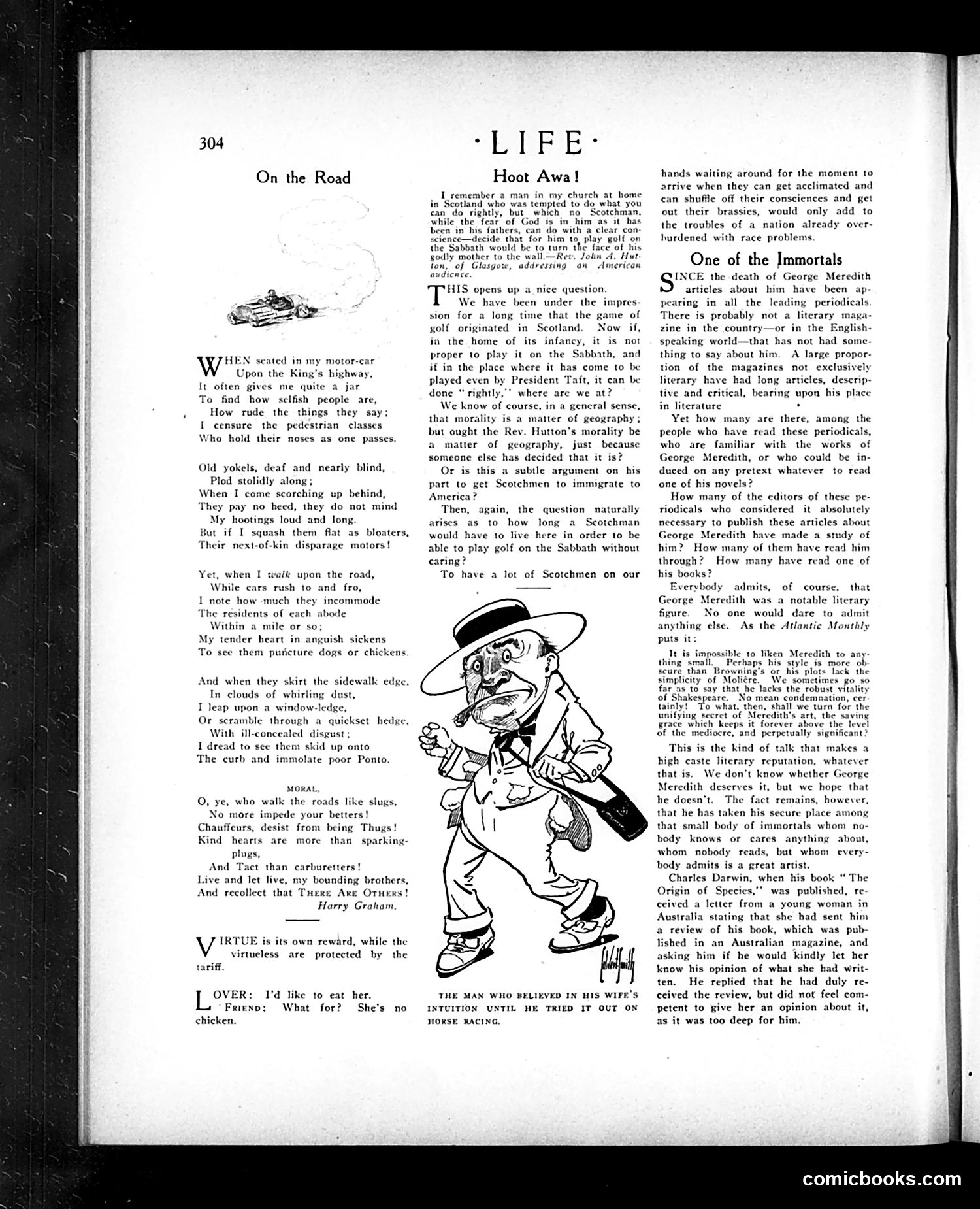
This page from *Life* magazine contains several distinct pieces of satire: **"On the Road"** (left): A poem by Harry Graham mocking the hypocrisy of early motorists. The speaker complains about pedestrians ignoring his car while driving recklessly, then complains about cars' dangers when he's on foot. The satire targets the selfish double standards of new automobile owners—they demand right-of-way but resent being inconvenienced themselves. **"Hoot Awa!"** (right, top): Commentary on Scottish Presbyterian morality, referencing a Scottish minister who forbids Sabbath golf. The piece sarcastically questions whether morality is merely geographical—if golf is sinful in Scotland but acceptable in America (where President Taft played), does moving change one's conscience? It mocks both rigid religious hypocrisy and the assumption that immigration erases moral conviction. **"One of the Immortals"** (right, bottom): Critiques literary journalism's obsession with dead author George Meredith. It notes that magazines publish extensive articles about him despite few readers actually reading his novels—satire on performative literary culture. The small cartoon depicts a caricatured figure, likely representing a ridiculous character type.
📄 Transcribed text from this page (OCR, searchable)
Machine-transcribed from the original scan — historical spelling and the odd misread are preserved.
On the Road HEN seated in my motor-car Upon the King’s highway, It often gives me quite a jar To find how selfish people are, How rude the things they say; I censure the pedestrian classes Who hold their noses as one passes. Old yokels, deaf and nearly blind, Plod stolidly along; When I come scorching up behind, They pay no heed, they do not mind My hootings loud and long. But if I squash them flat as bloater Their next-of-kin disparage motors! Yet, when I sealk upon the road, While cars rush to and fro, I note how much they incommode The residents of each abode Within a mile or so; My tender heart in anguish sickens To sce them puricture dogs or chickens And when they skirt the sidewalk edge, In clouds of whirling dust, I leap upon a window-ledge, Or scramble through a quickset hedge, With ill-concealed disgust ; I dread to see them skid up onto The curb and immolate poor Ponto MORAL, O, ye, who walk the No more impede your betters! Chauffeurs, desist from being Thugs Kind than sparking- roads like slugs, hearts are plugs, And Tact than carburetters Live and let live, my bounding brothers, And recollect that There Are Otnens! Harry Graham. more IRTUE is its own reward, while the virtueless are protected by the tariff OVER: Frienp: chicken. I'd like to eat her. What for? She's no “EREIE Hoot Awa! L.remember @ man in my church at home in Scotland who was tempted to do. what you can do rightly, but_ which no. Scotchman, while the fear of God is in him as it has been in his fathers, can do with a clear con: science—decide that for him to play golf on the Sabbath would be to turn the face of his godly mother to the wall.—Rev. John A. Hut ‘addressing an American HIS opens up a nice question. We have been under the impres sion for a long time that the game of golf originated in Scotland. Now if, ia the home of its infancy, it is not proper to play it on the Sabbath, and if in the place where it has come to be played even by President Taft, it can be done “ rightly,"” where are we at? We know of course, in a general sense, that morality is a matter of geography ; but ought the Rev. Hutton's morality be a matter of geography, just because someone else has decided that it is? Or is this a subtle argument on his part to get Scotchmen to immigrate to America? Then, again, the question naturally arises as to how long a Scotchman would have to live here in order to be able to play golf on the Sabbath without caring? To have a lot of Scotchmen on our THE MAN WHO BELIEVED IN HIS WIFE INTUITION UNTIL HE TRIED IT OUT ON HORSE RACING. hands waiting around for the moment to arrive when they can get acclimated and can shuffle off their consciences and get out their brassies, would only add to the troubles of a nation already over- burdened with race problems. One of the Immortals INCE the death of George Meredith articles about him have been ap pearing in all the leading periodicals. There is probably not a literary maga- zine in the country—or in the Englis speaking world—that has not had som thing to say about him. A large propor- tion of the magazines not exclusively literary have had long articles, descrip- tive and critical, bearing upon his place in literature ° Yet how many are there, among the people who have read these periodicals who are familiar with the works of George Meredith, or who could be in- duced on any pretext whatever to read one of his novels? How many of the editors of these pe- riodicals who considered it absolutely necessary to publish these articles about George Meredith have made a study of him? How many of them have read him through? How many have read one of his books? Everybody of course, tha George Meredith was a notable literary figure. No one would dare to admit anything else. As the Atlantic Monthly puts it: It is impossible to liken Meredith to any- thiog small” Pecheps bis style is wore ob scure than Browning's or his plots lack the simplicity of Moliére. We sometimes go so far_as to say that he lacks the robust vitality of Shakespeare. No mean condemnation, ce: tainly: ‘o what, then, shall we turn for th unifying secret of Meredith's art, the sav grace which keeps it forever above the level Of the mediocre, and perpetually significant? This is the kind of talk that makes a high caste literary reputation, whatever that We don't know whether George Meredith deserves it, but we hope that he doesn’t, The fact remains, however, that he has taken his secure place among that small body of immortals whom no- body knows or cares anything about, whom nobody reads, but whom every- body admits is a great artist. Charles Darwin, when his book “ The Origin of Species,” was published, re- ceived a letter from a young woman in Australia stating that she had sent him a review of his book, which was pub- lished in an Australian magazine, and asking him if he would kindly let her know his opinion of what she had writ- ten. He replied that he had duly re- ceived the review, but did not feel com- petent to give her an opinion about it, as it was too deep for him. admits, comicbooks.com