
Life, 1909-09-02 · page 12 of 48
Life — September 2, 1909 — page 12: what you’re looking at
What you’re looking at
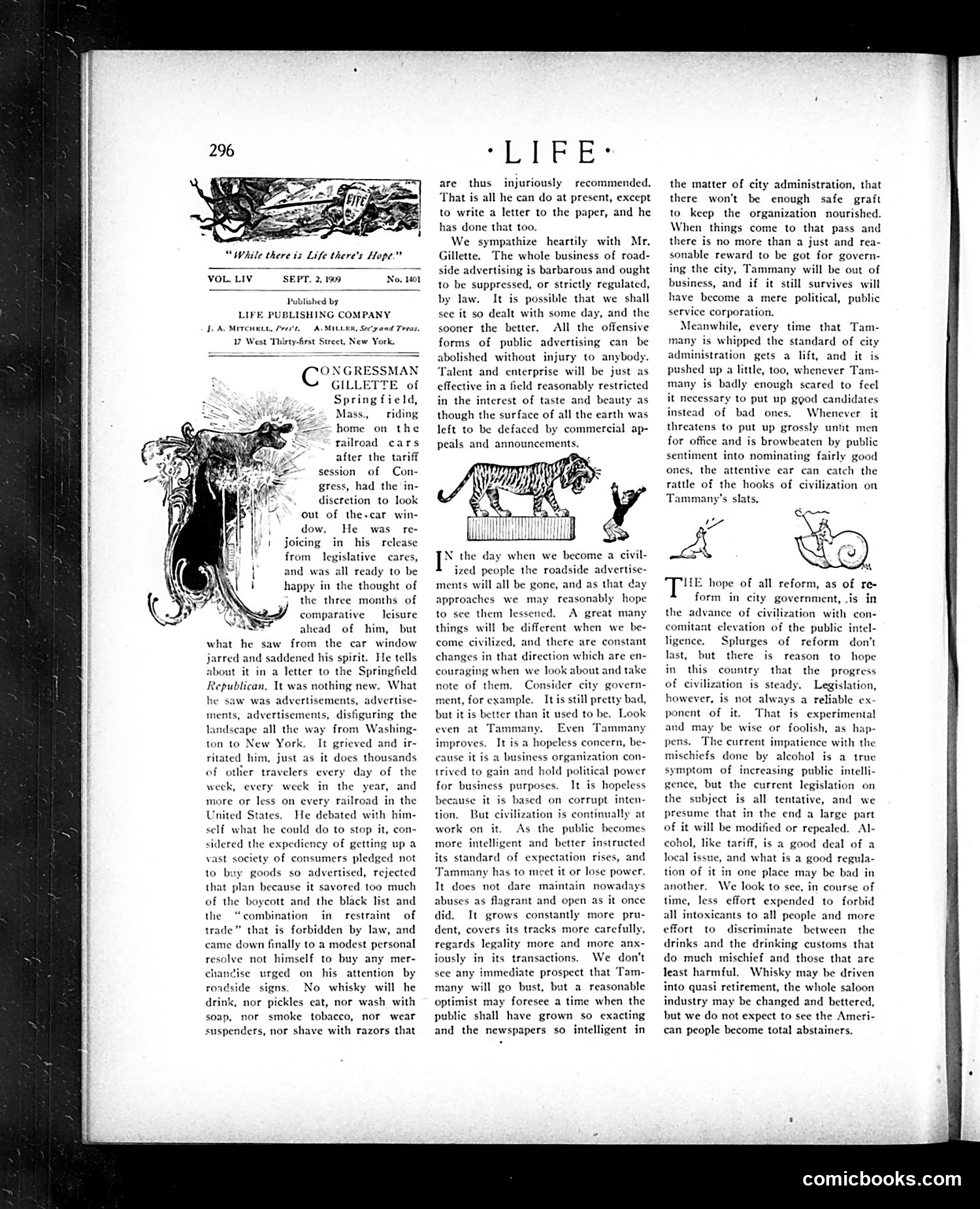
**The Main Cartoon** ("While there is Life there's Hope") depicts **Congressman Gillette of Springfield, Massachusetts**, shown as a figure emerging from or associated with a large bird or eagle. The text indicates Gillette had just been released from legislature and was celebrating his leisure time ahead. **The Point**: The cartoon satirizes Gillette's relief at escaping from congressional duties. The accompanying article criticizes his advertisement practices—specifically that he'd promoted roadside advertisements extensively during his tenure. The satire suggests he's pleased to leave behind the responsibilities of office, while the text argues such commercial displays should be regulated or suppressed. The cartoon exemplifies early 20th-century critique of both politicians and aggressive commercial advertising culture.
📄 Transcribed text from this page (OCR, searchable)
Machine-transcribed from the original scan — historical spelling and the odd misread are preserved.
“While there iz Life there's Hope.” VOL. LIV SEPT. 2,199 No, M01 Published by LIFE PUBLISHING COMPANY JA. Mrvenet Ac MILLER, Sec’y ond Treas, 7 West Th Prevt, y-first Street, New York, (CONSRESSMAN GILLETTE of Spring field, Mass, riding home on the railroad cars after the tariff session of Con- gress, had the in- discretion to look out of the-car win- dow. He was re- joicing in his release from legislative cares, and was all ready to be happy in the thought of the three months of comparative — leisure ahead of him, but what he saw from the car window jarred and saddened his spirit. He tells about it in a letter to the Springfield Republican, It was nothing new. What he saw was advertisements, advertise- ments, advertisements, disfiguring the landscape all the way from Washing- ton to New York. It grieved and ir- ritated him, just as it does thousands of other travelers every day of the week, every week in the year, and more or less on every railroad in the United States. He debated with him- self what he could do to stop it, con- sidered the expediency of getting up a vast society of consumers pledged not to buy goods so advertised, rejected that plan because it savored too much of the boycott and the black list and the “combination in restraint of trade” that is forbidden by law, and came down finally to a modest personal resolve not himself to buy any mer- handise urged on his attention by roadside signs. No whisky will he drink, nor pickles eat, nor wash with soap, nor smoke tobacco, nor wear suspenders, nor shave with razors that “ERE * are thus injuriously recommended. That is all he can do at present, except to write a letter to the paper, and he has done that too, We sympathize heartily with Mr. Gillette. The whole business of road- side advertising is barbarous and ought to be suppressed, or strictly regulated, by law. It is possible that we shall see it so dealt with some day, and the sooner the better. All the offensive forms of public advertising can be abolished without injury to anybody. Talent and enterprise will be just as effective in a field reasonably restricted in the interest of taste and beauty as though the surface of all the earth was left to be defaced by commercial ap- peals and announcements. N the day when we become a civil- ized people the roadside advertis ments will all be gone, and as that day approaches we may reasonably hope to see them lessened. A great many things will be different when we be- come civilized, and there are constant changes in that direction which are en- ing when we look about and take note of them. Consider city govern- ment, for example. It is still pretty bad, but it is better than it used to be. Look even at Tammany. Even Tammar improves. It is a hopeless concern, bi cause it is a business organization con- trived to gain and hold political power for business purposes. It is hopeless because it is based on corrupt inten- tion, But civilization is continually at work on it. As the public becomes more intelligent and better instructed its standard of expectation rises, and Tammany has to meet it or lose power. It does not dare maintain nowadays abuses as flagrant and open as it once did. It grows constantly more pru- dent, covers its tracks more carefully, regards legality more and more anx- jously in its transactions. We don't see any immediate prospect that Tam- many will go bust, but a reasonable optimist may foresee a time when the public shall have grown so exacting and the newspapers so intelligent in the matter of city administration, that there won't be enough safe graft to keep the organization nourished. When things come to that pass and there is no more than a just and rea- sonable reward to be got for govern- ing the city, Tammany will be out of business, and if it still survives will have become a mere political, public service corporation. Meanwhile, every time that Tam- many is whipped the standard of city administration gets a lift, and it is pushed up a little, too, whenever Tam- many is badly enough scared to feel it necessary to put up good candidates instead of bad ones. Whenever it threatens to put up grossly unfit men for office and is browbeaten by public sentiment into nominating fairly good ones, the attentive ear can catch the rattle of the hooks of civilization on Tammany’s slats, IIE hope of all reform, as of re- form in city government, .is in the advance of civilization with con- comitant elevation of the public intel- ligence. Splurges of reform don't last, but there is reason to hope in this country that the progress of civilization is steady, Legislation, however, is not always a reliable ex- ponent of it. That is experimental and may be wise or foolish, as hap- pens, The current impatience with the mischiefs done by alcohol is a true symptom of increasing public intelli gence, but the current legislation the subject is all tentative, and we presume that in the end a large part of it will be modified or repealed. Al- cohol, like tariff, is a good deal of local issue, and what is a good regula tion of it in one place may be bad in another. We look to see, in course of time, less effort expended to forbid all intoxicants to all people and more effort to discriminate between the drinks and the drinking customs that do much mischief and those that are least harmful, Whisky may be driven into quasi retirement, the whole saloon industry may be changed and bettered, but we do not expect to see the Ameri- can people become total abstainers. comicbooks.com