
A complete issue · 48 pages · 1908
Life — May 7, 1908
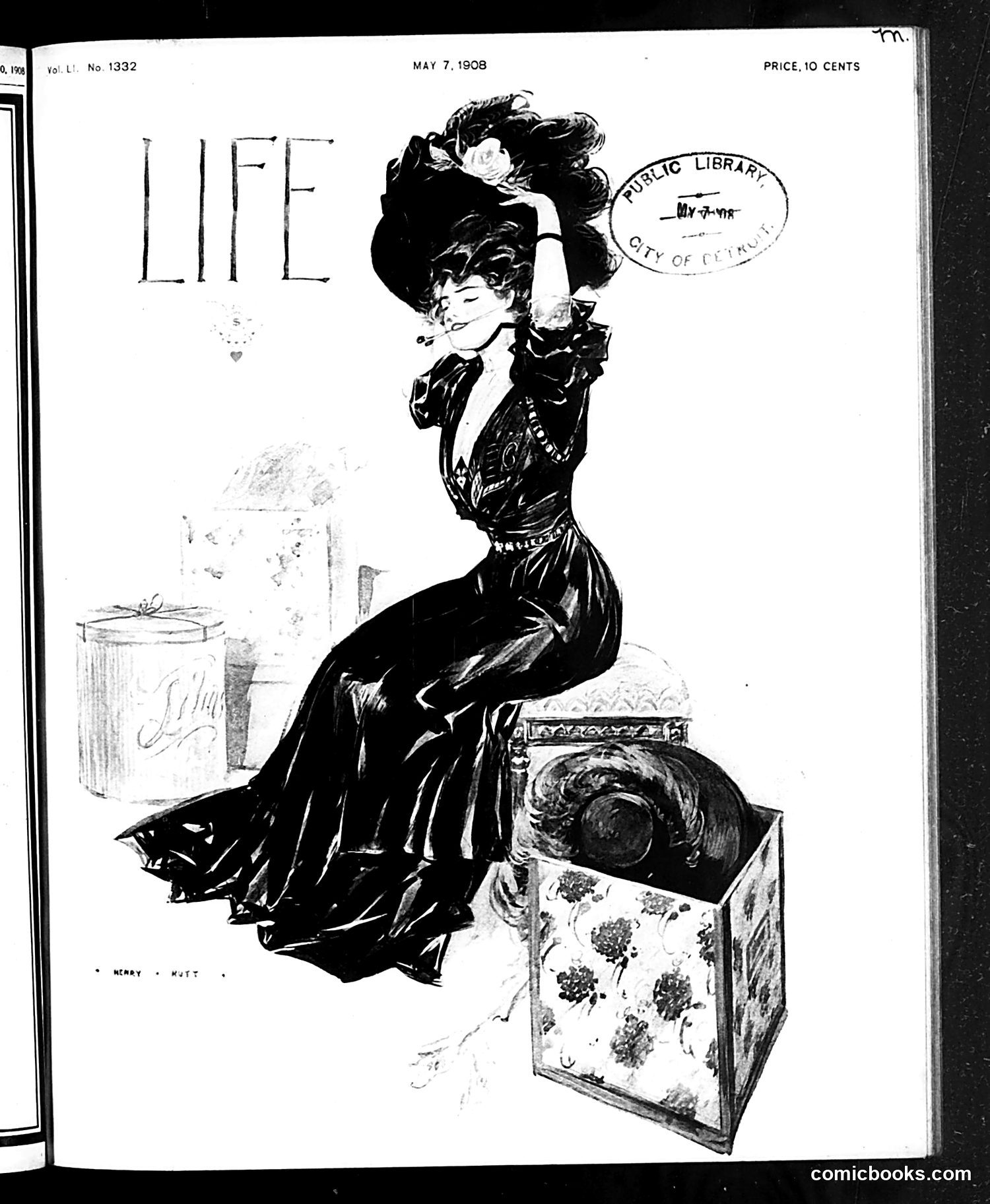
This cover illustration by Henry Mayer depicts an elegantly dressed Gibson Girl-type woman in early 1900s fashion—elaborate upswept hair, corseted waist, and flowing dark skirt—posing dramatically atop a decorative hat box. The satire likely comments on women's fashion obsession and the impracticality of the era's extreme styling. The woman's exaggerated pose, lifting her arm dramatically, mocks the vanity and theatrical affectation associated with high society. The hat box beneath her suggests that fashion accessories—particularly the enormous hats women wore—dominated their lives and priorities. This reflects the period's common satirical critique of upper-class women's preoccupation with appearance over substance, a recurring theme in Life magazine's social commentary.
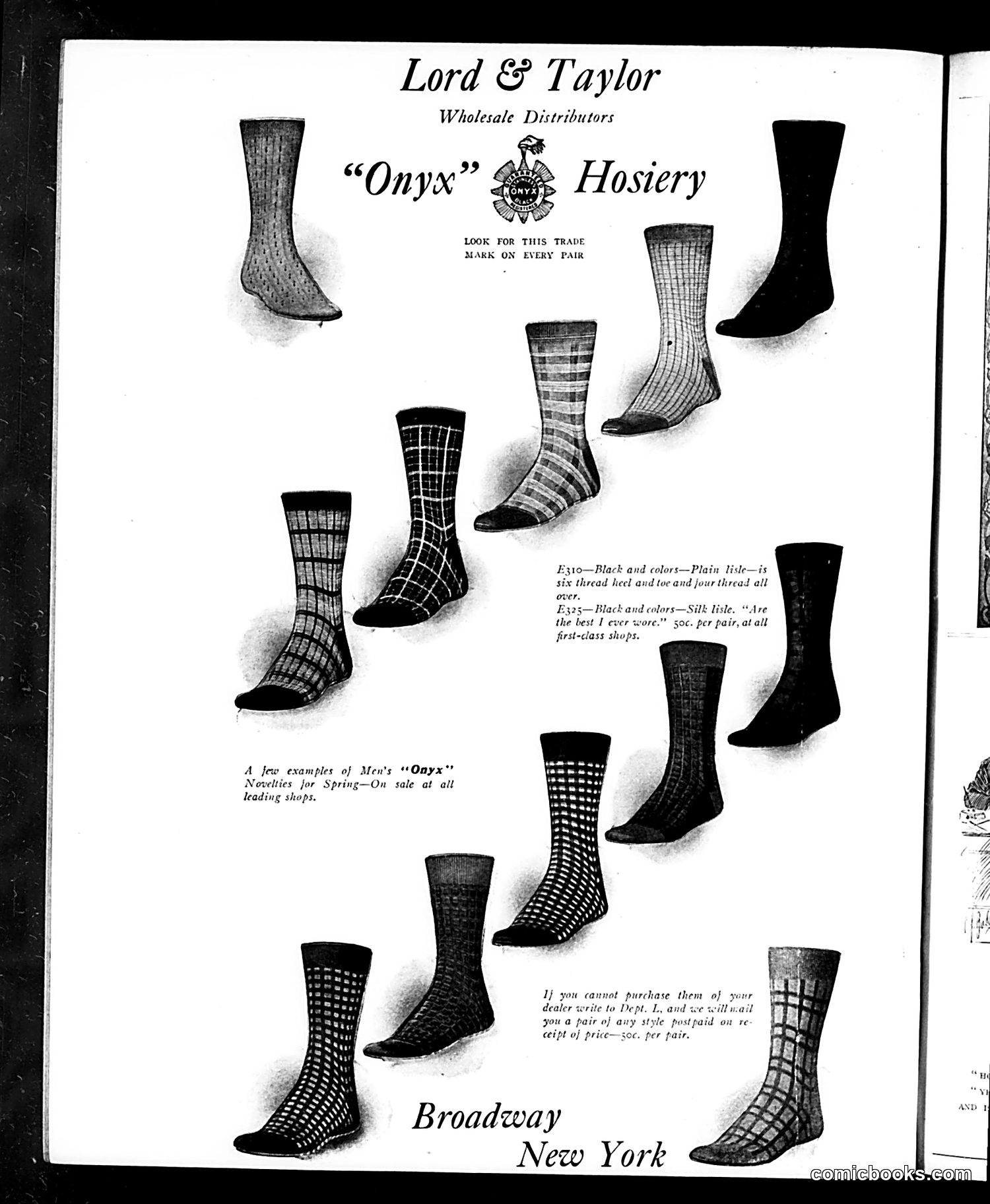
This page is **advertising, not editorial content or satire**. It's a product advertisement for "Onyx" brand hosiery, distributed by Lord & Taylor wholesale distributors. The page displays approximately a dozen men's socks in various patterns—plaids, checks, stripes, and solids—arranged on a white background. The advertisement emphasizes that these are "novelties for Spring" available at leading shops, with pricing information (50¢ per pair for plain styles, prices varying for silk varieties). There is no political cartoon, satire, or social commentary present. This is straightforward early-20th-century product marketing aimed at retailers and consumers, promoting fashionable sock designs of the era.
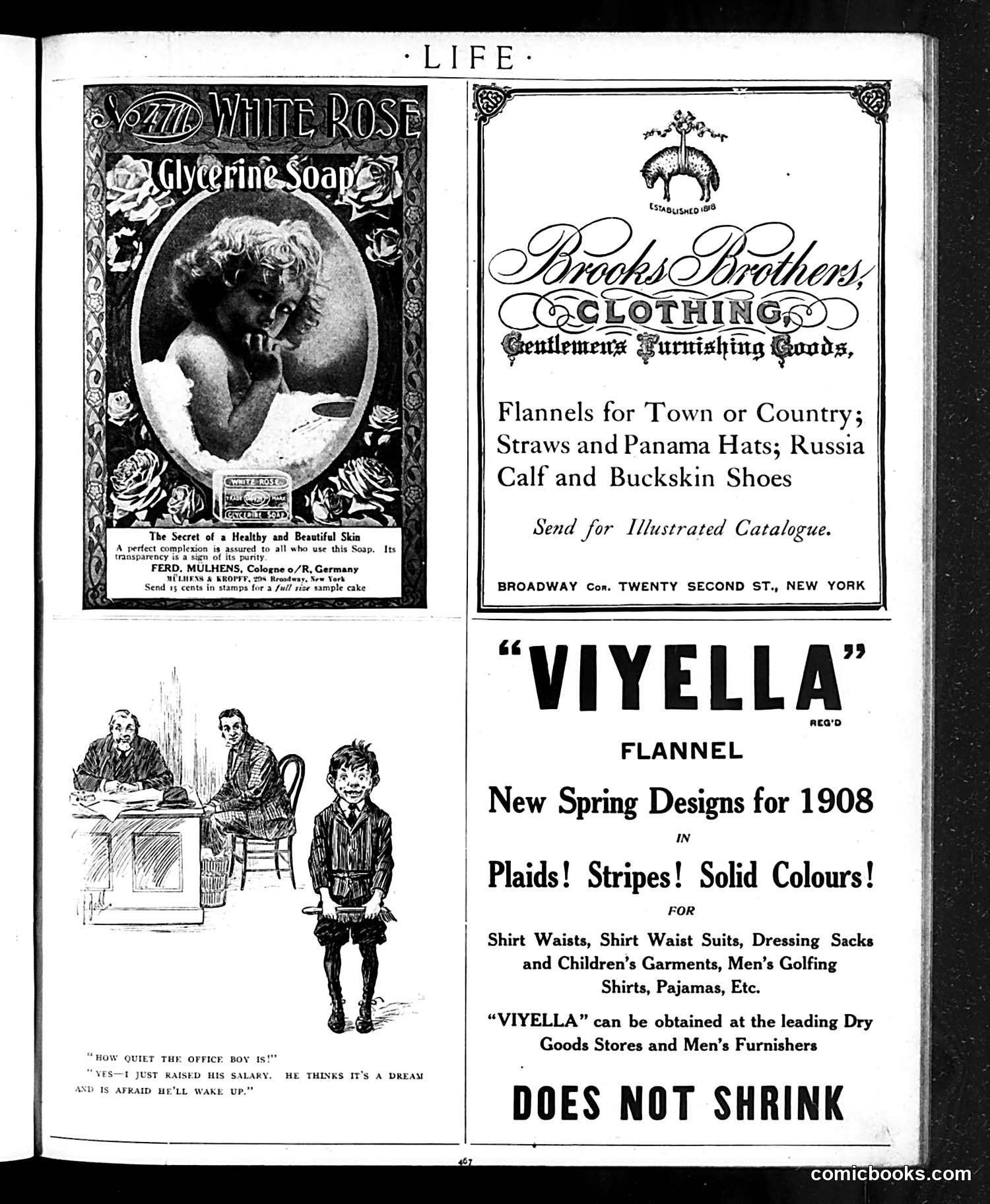
This page is **primarily advertising** with one small cartoon. The cartoon (lower left) shows an office scene with the caption: "HOW QUIET THE OFFICE BOY IS!" / "YES—I JUST RAISED HIS SALARY. HE THINKS IT'S A DREAM AND IS AFRAID HE'LL WAKE UP." **The joke**: Satirizes a boss's miserly nature—he's so stingy that when he gives a modest raise, the office boy is shocked into stunned silence, fearing it's too good to be true. The humor relies on the period expectation that employers paid minimal wages and workers were perpetually anxious about their precarious economic position. The surrounding ads (White Rose soap, Brooks Brothers clothing, Viyella flannel) represent typical early-1900s consumer goods marketed in *Life* magazine.
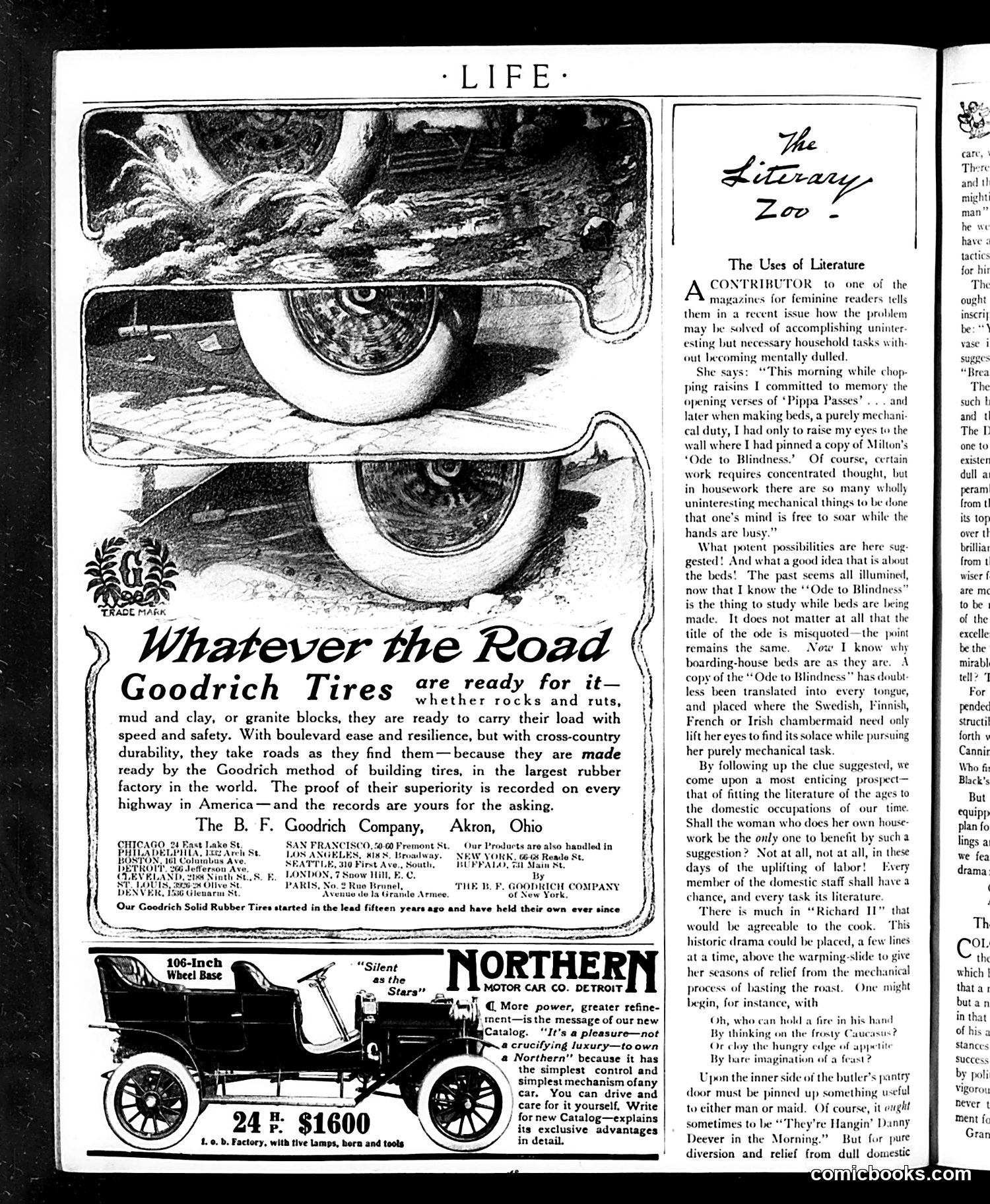
This page is primarily **advertising rather than satirical content**. The dominant visual element is a Goodrich Tires advertisement featuring cross-sectioned tire images, with accompanying product copy emphasizing durability for various road conditions. Below that is a Northern Motor Car Company advertisement for a vehicle priced at $1600. The right column contains "The Literary Zoo," a regular column discussing literature's practical value in household management. A female contributor describes using poetry (specifically Wordsworth's "Ode to Blindness") to mentally escape tedious domestic tasks like making beds and cooking. **There is no political cartoon or satire evident here.** The page reflects early 20th-century attitudes about women's domestic roles and the marketing strategies of that era—primarily automobile and tire manufacturers targeting consumers.
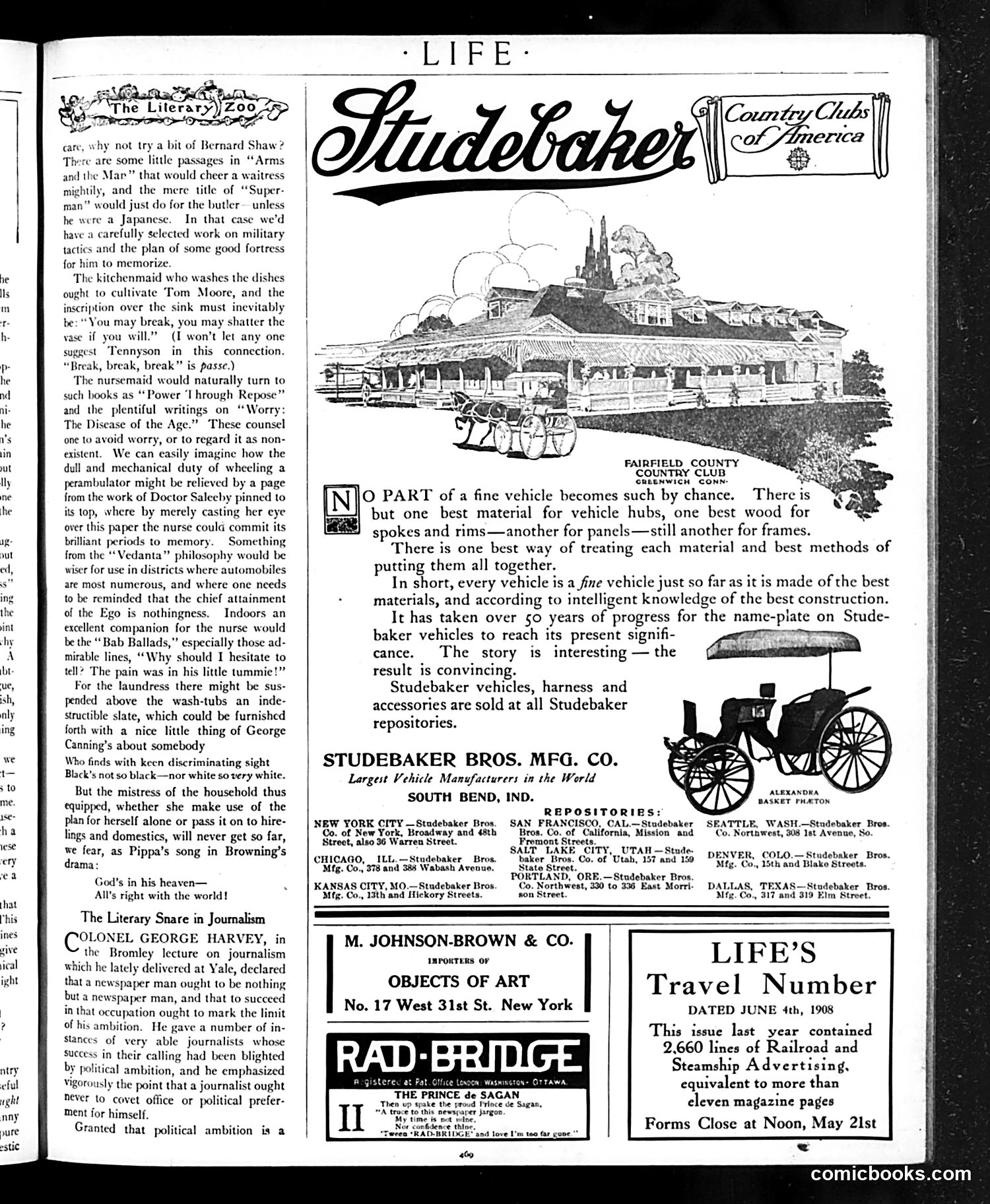
This page is primarily **advertising and editorial content**, not political satire. The dominant feature is a large advertisement for **Studebaker Bros. vehicles**, showcasing their horse-drawn carriages and early automobiles. The ad emphasizes Studebaker's 50 years of manufacturing expertise and lists their numerous distribution points across America. Below are smaller advertisements for art objects and a "Rad-Bridge" product. The left column contains editorial text discussing household management and journalism ethics, unrelated to any cartoon or satire. There is **no political cartoon visible** on this page. The Studebaker illustration is commercial imagery, not satirical commentary. This appears to be a typical issue of *Life* magazine mixing advertising with general-interest editorial content.
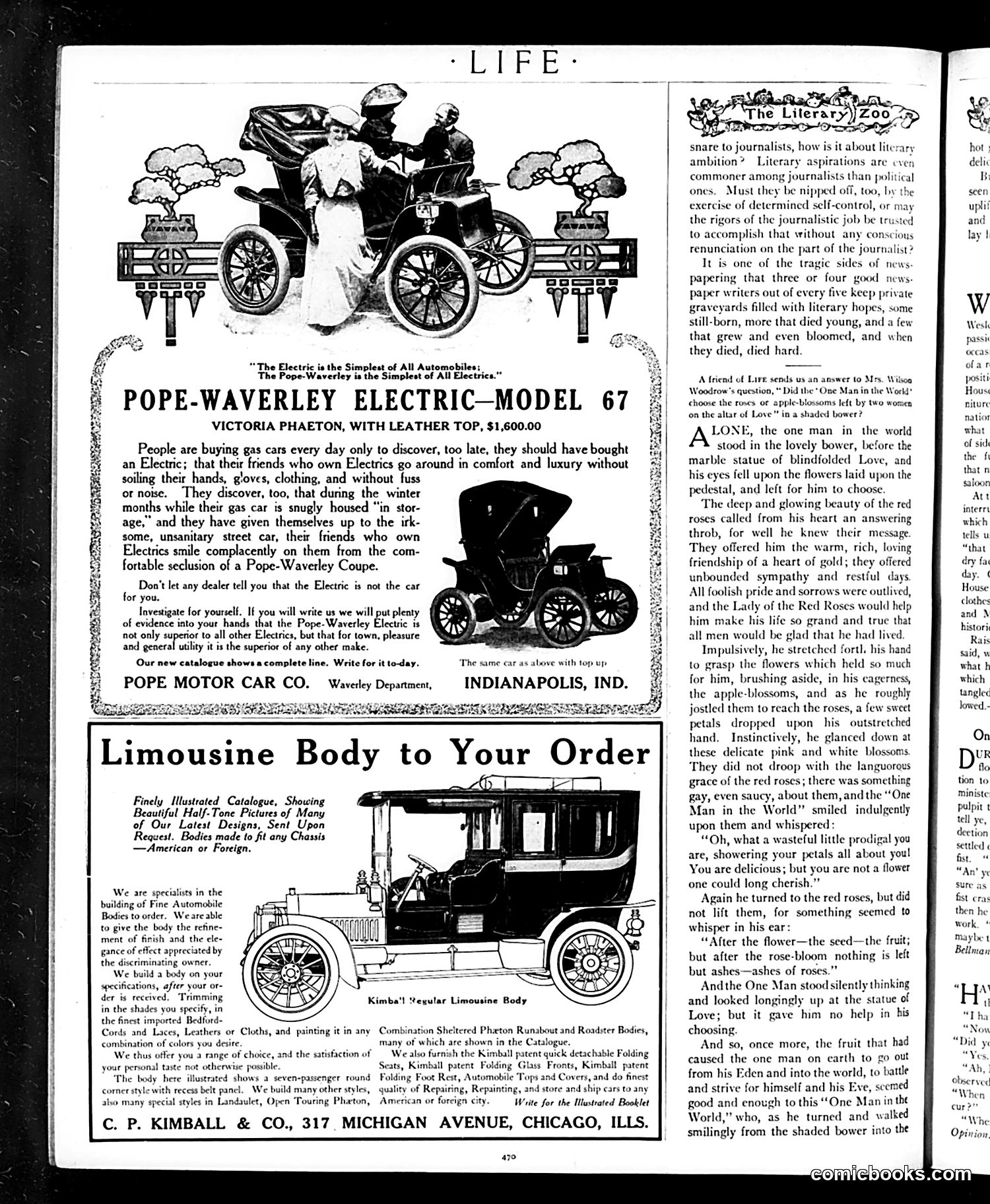
This page is primarily **advertising, not satire or political commentary**. The two main advertisements are for automobiles: 1. **Pope-Waverley Electric Model 67** - an electric car marketed as superior to gasoline vehicles. The ad emphasizes cleanliness and comfort, appealing to buyers (particularly women, shown in the illustration) who want luxury without the dirt of gas engines. 2. **C.P. Kimball & Co.'s Limousine Body** - offering custom automobile bodies built to order in Chicago. The right column contains **"The Literary Zoo,"** a separate feature about journalists and literary ambition, unrelated to the advertisements. This reflects early 1900s automotive marketing, when electric cars were still competitive with gasoline models and custom automobile bodies were a significant luxury market.
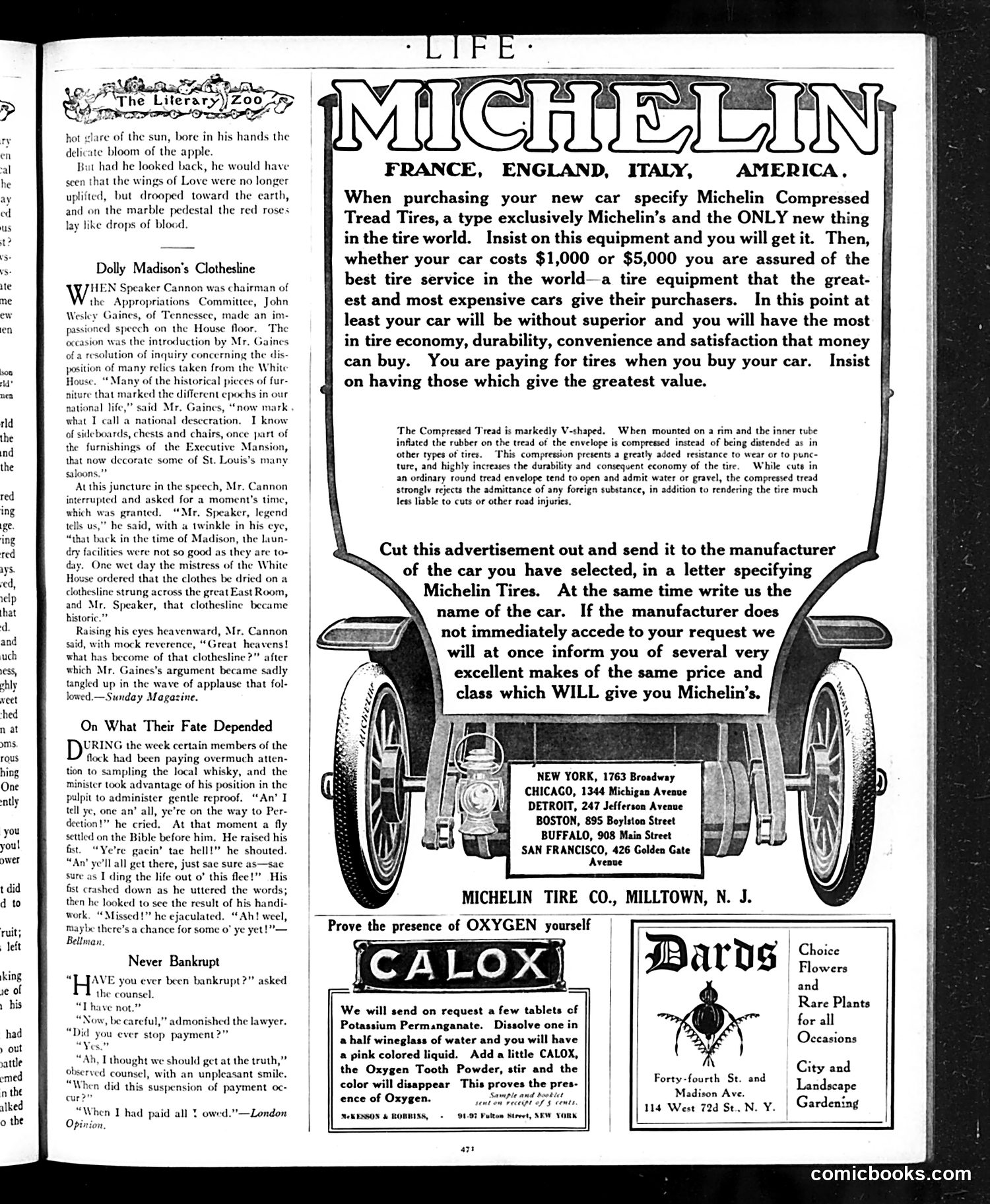
This page is primarily **advertising content**, not satire or political commentary. The dominant feature is a full-page advertisement for **Michelin Tires**, prominently displayed with an illustration of a car's wheels and tire tread. The ad encourages buyers to specify Michelin tires when purchasing vehicles and provides detailed information about Michelin's "Compressed Tread" technology, claiming superior durability and economy. It includes instructions to cut out and mail the advertisement to car manufacturers. Below the main ad are smaller advertisements for **Calox** (an oxygen-based tooth product) and **Dards Flowers and Rare Plants**. The left side contains unrelated editorial content: short fiction pieces including "Dolly Madison's Clothesline" and "Never Bankrupt." This is a typical early 20th-century magazine page mixing editorial and advertising content with minimal satire.
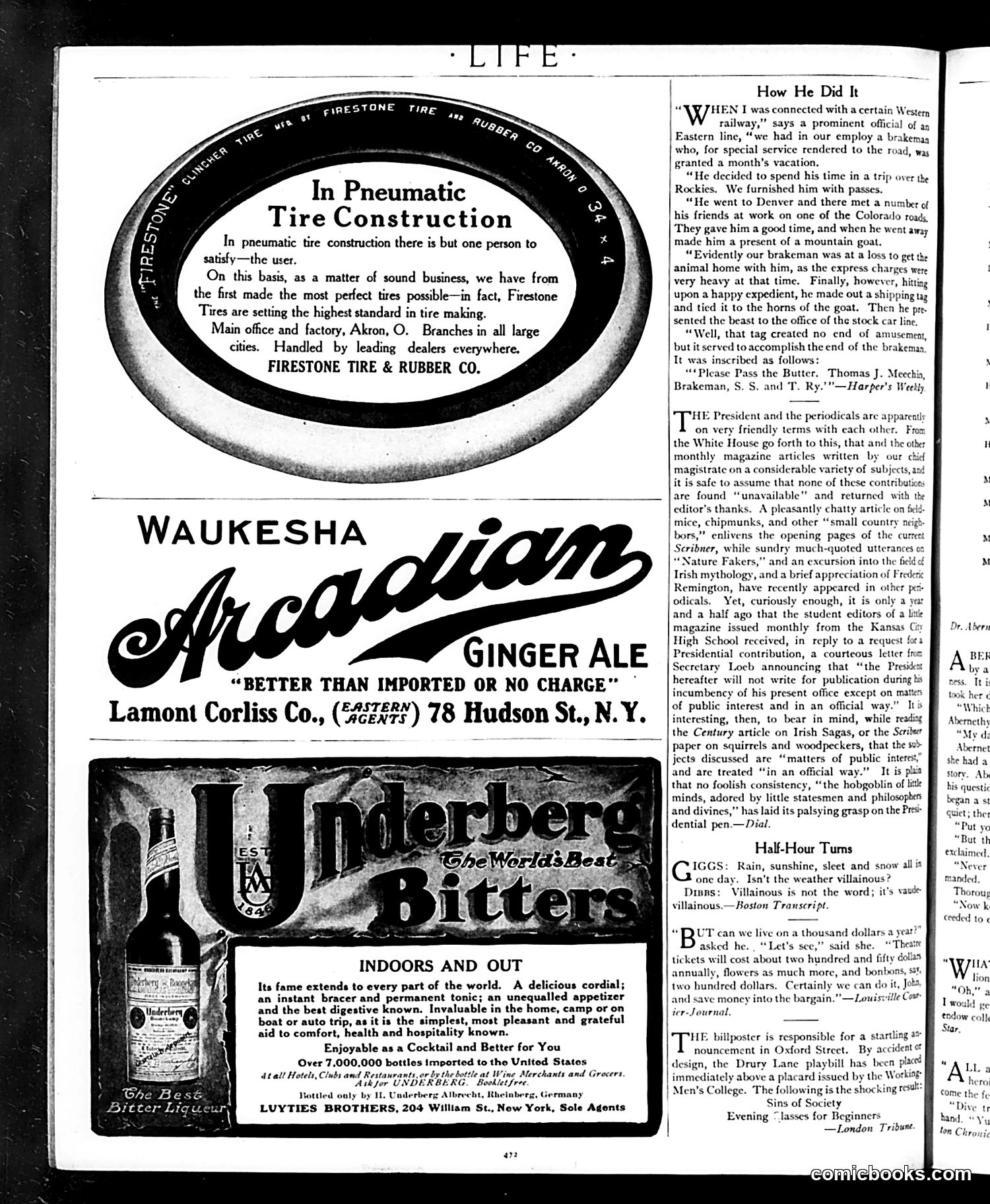
This page is primarily **advertising**, not political satire. It features three vintage product ads from what appears to be an early 20th-century issue of Life magazine: 1. **Firestone Tires** - An oval tire advertisement emphasizing pneumatic tire construction and quality standards 2. **Waukesha Arcadian Ginger Ale** - A beverage ad claiming superiority to imported products 3. **Underberg Bitters** - A digestive liqueur marketed for indoor and outdoor consumption The right column contains brief editorial content including anecdotes and commentary, but contains no political cartoons or satirical imagery. This is a standard magazine page mixing commercial advertisements with light editorial material typical of the era.
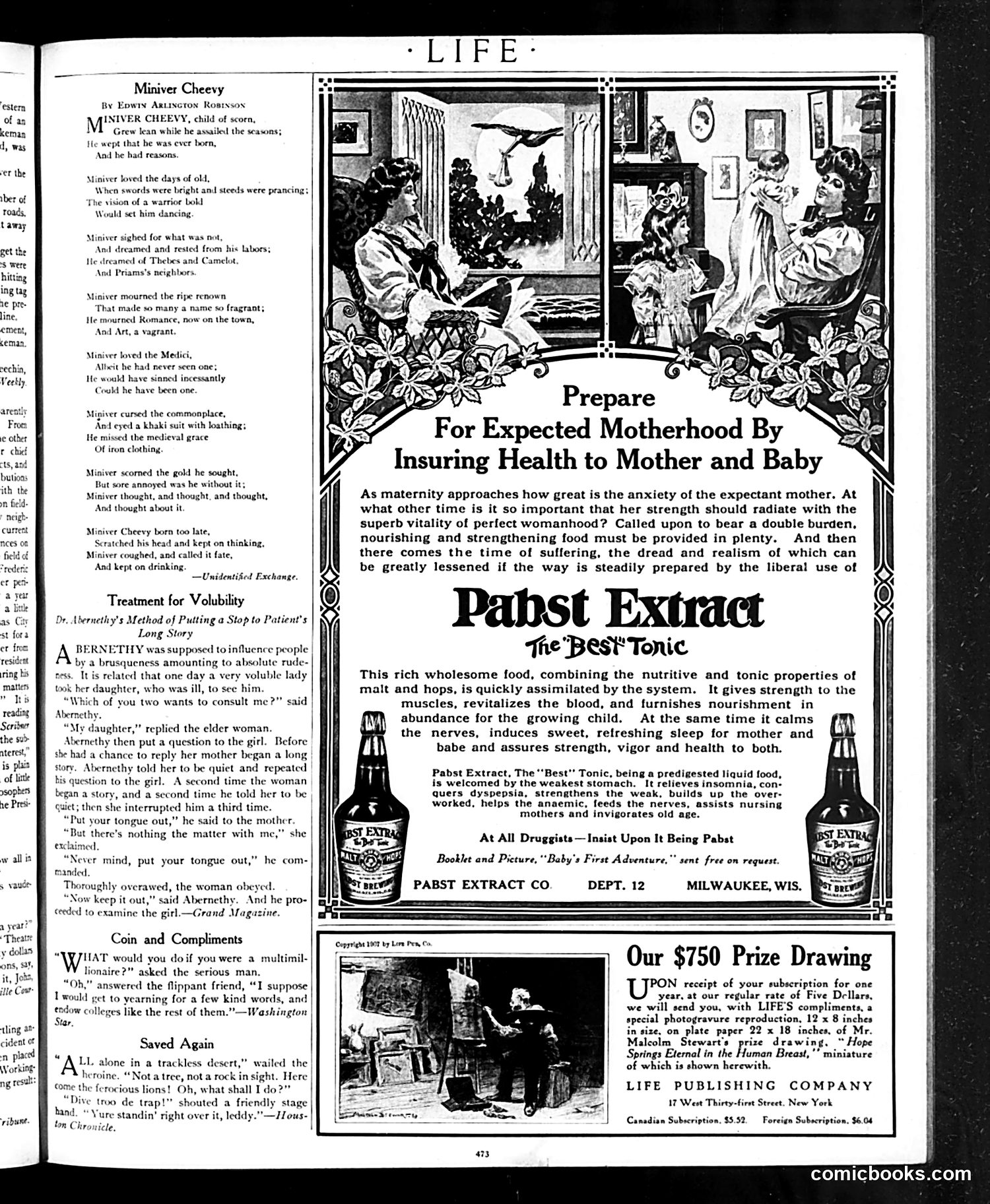
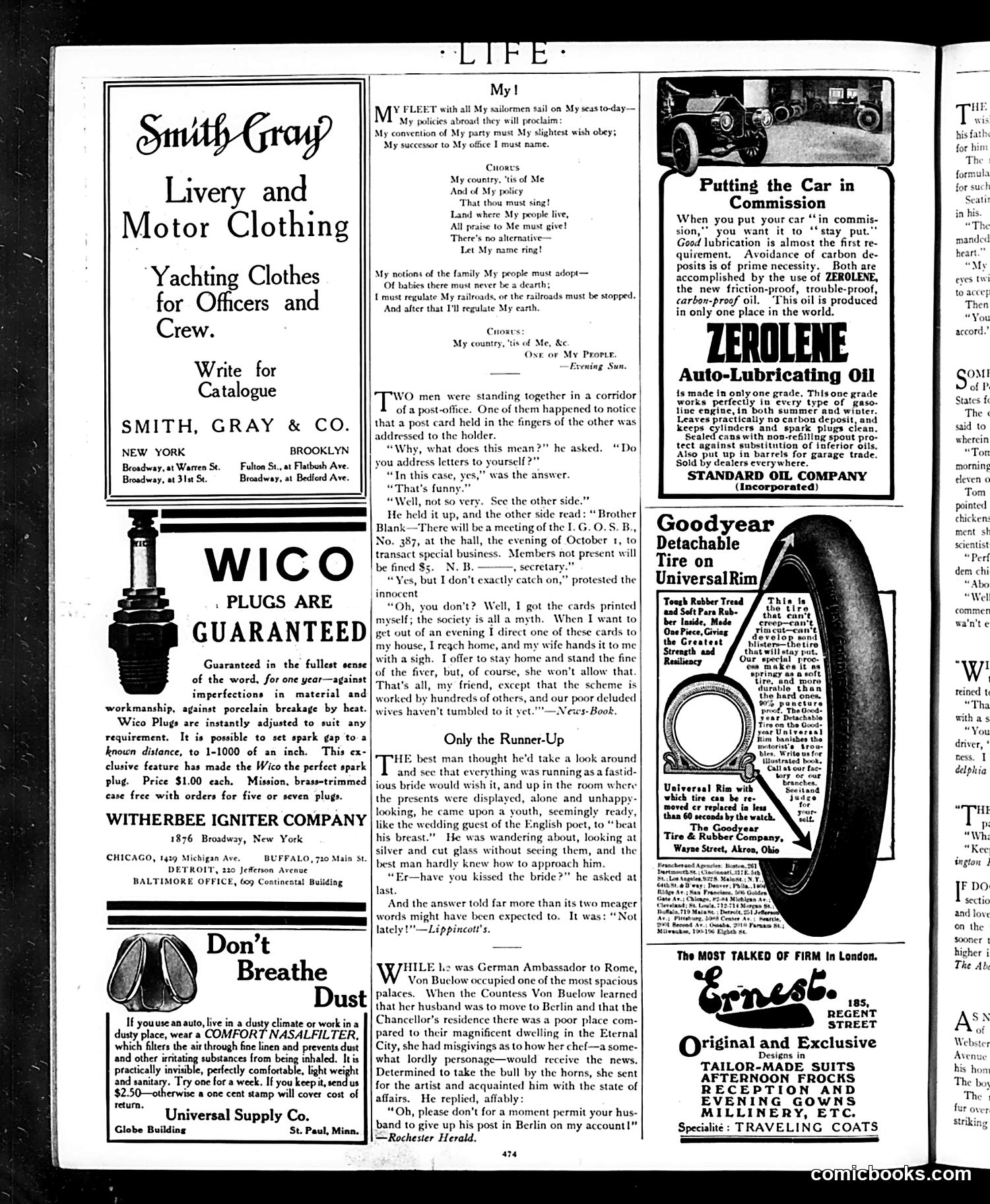
This page is primarily **advertising**, not political satire. It contains commercial promotions for: - Smith, Gray & Co. (clothing) - WICO spark plugs - Zerolene auto oil - Goodyear tires - Witherbee Igniter Company - Universal Supply Co. (dust filters) - Ernest (tailored suits and gowns) The humorous content includes brief anecdotes about misunderstandings—one concerning printed cards at a social event, another about a German Ambassador's wife in Rome seeking Berlin residence permits. These are mild, society-focused jokes typical of Life's satirical humor. The overall page reflects early automotive-era advertising and upper-class social humor, with no discernible political commentary.
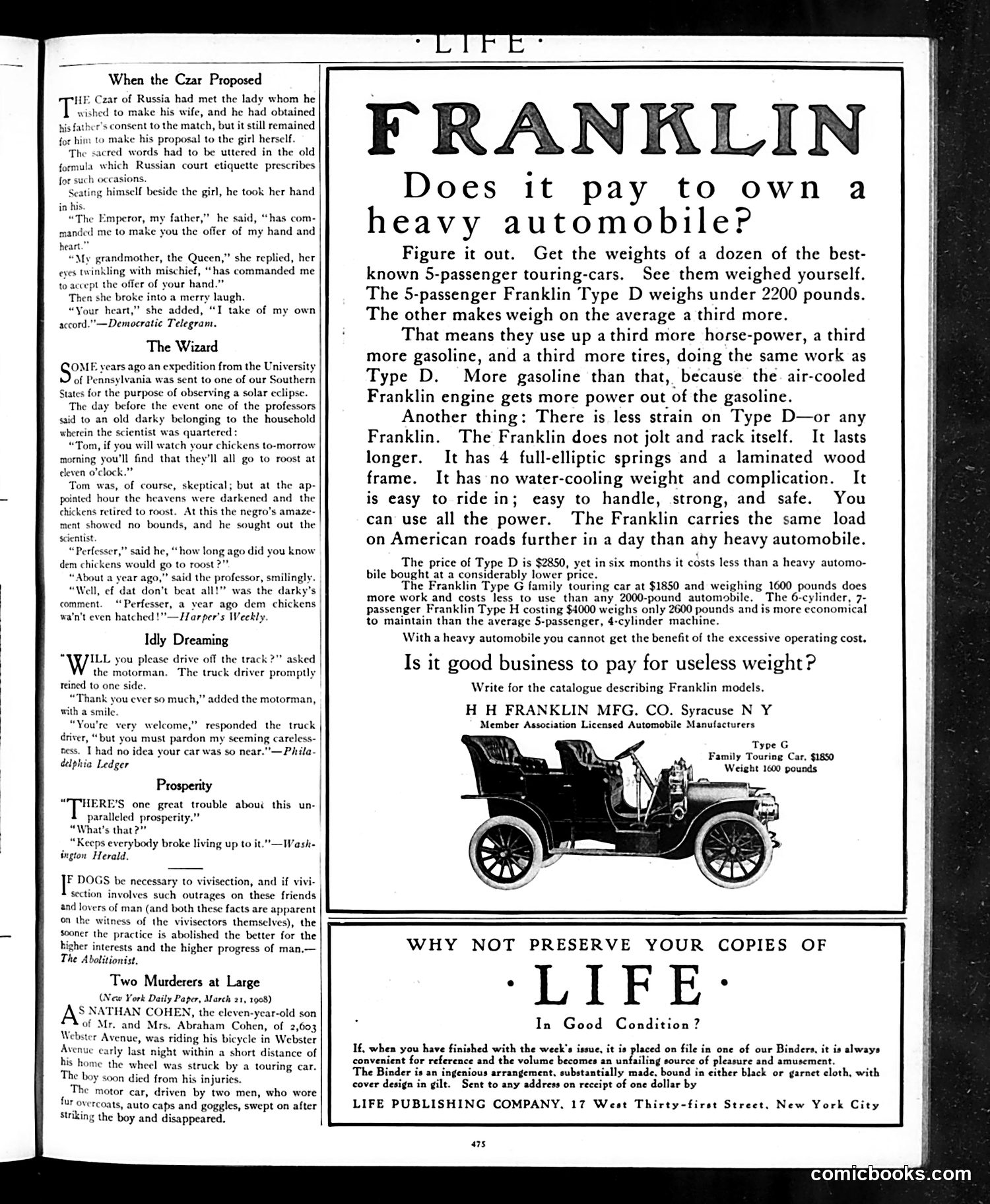
This page from *Life* magazine contains several satirical short stories and one large advertisement for Franklin automobiles—not political cartoons. The stories mock contemporary social situations: a Czar's marriage proposal (mocking Russian aristocratic formality), a University of Pennsylvania eclipse expedition with a skeptical observer doubting whether chickens actually roost at night, a motorman's interaction with a truck driver, and a note about vivisection debates. The Franklin auto ad argues that lighter weight means better fuel economy and less strain on the engine—positioning the car as practical and economical against heavier competitors. The page reflects early 20th-century concerns: class pretension, scientific skepticism, labor relations, and animal welfare advocacy. The humor relies on observational wit rather than visual caricature.
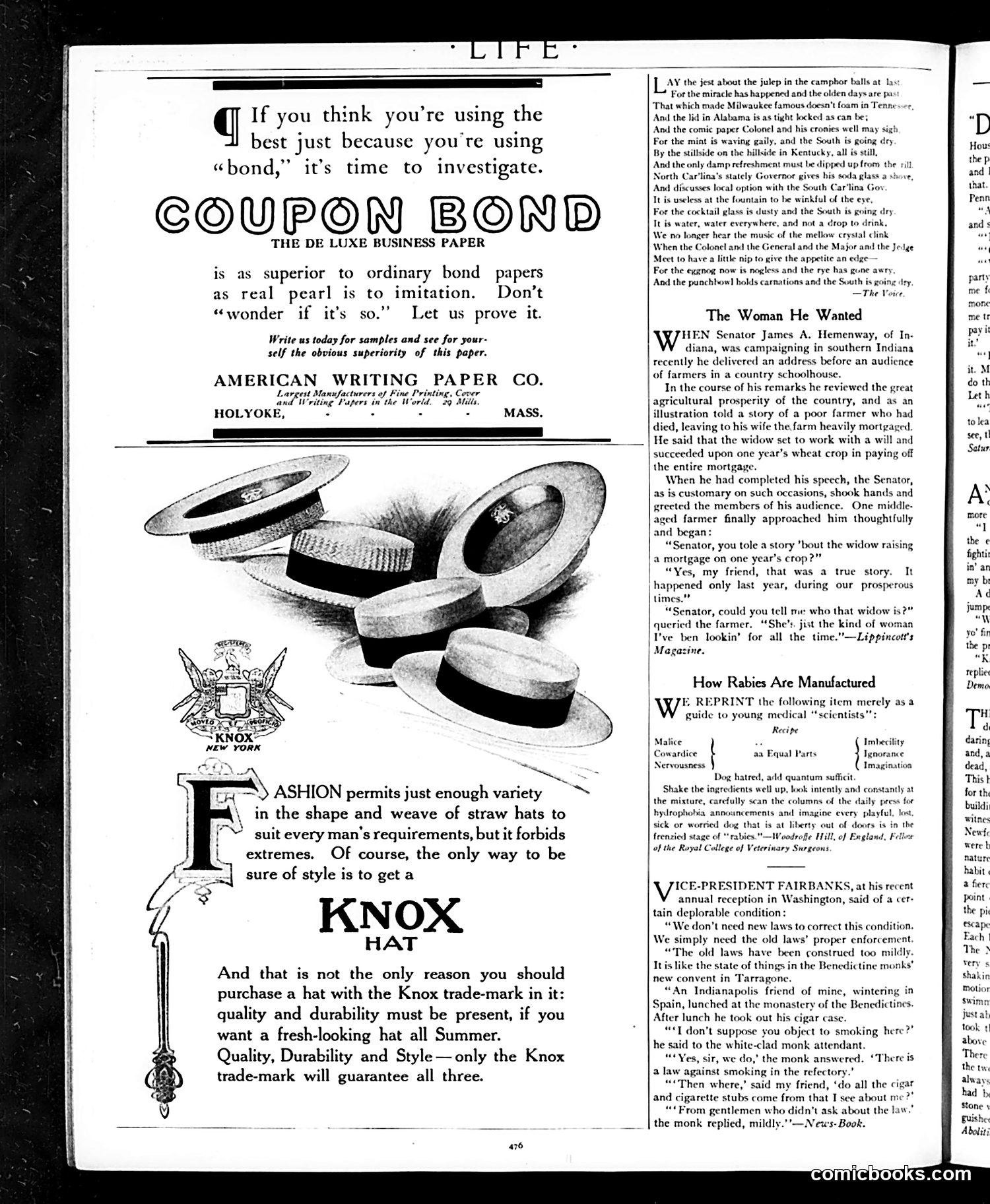
This page is primarily **advertising content** rather than political satire. It features two main advertisements: 1. **Coupon Bond** (top): An ad for American Writing Paper Co. claiming their bond paper is superior to competitors, using the metaphor "real pearl is to imitation." 2. **Knox Hat** (center): A fashion advertisement playing on straw hat variety, claiming Knox brand hats offer superior "quality, durability and style" for summer wear. The ad includes decorative illustrations of hats and a small Knox trade-mark emblem. The right column contains unrelated editorial content: a poem about Southern life and articles on farming anecdotes and rabies manufacturing. There is **no political cartoon or satirical commentary** on this page—it's a standard commercial advertising spread typical of Life magazine's mixed content format.
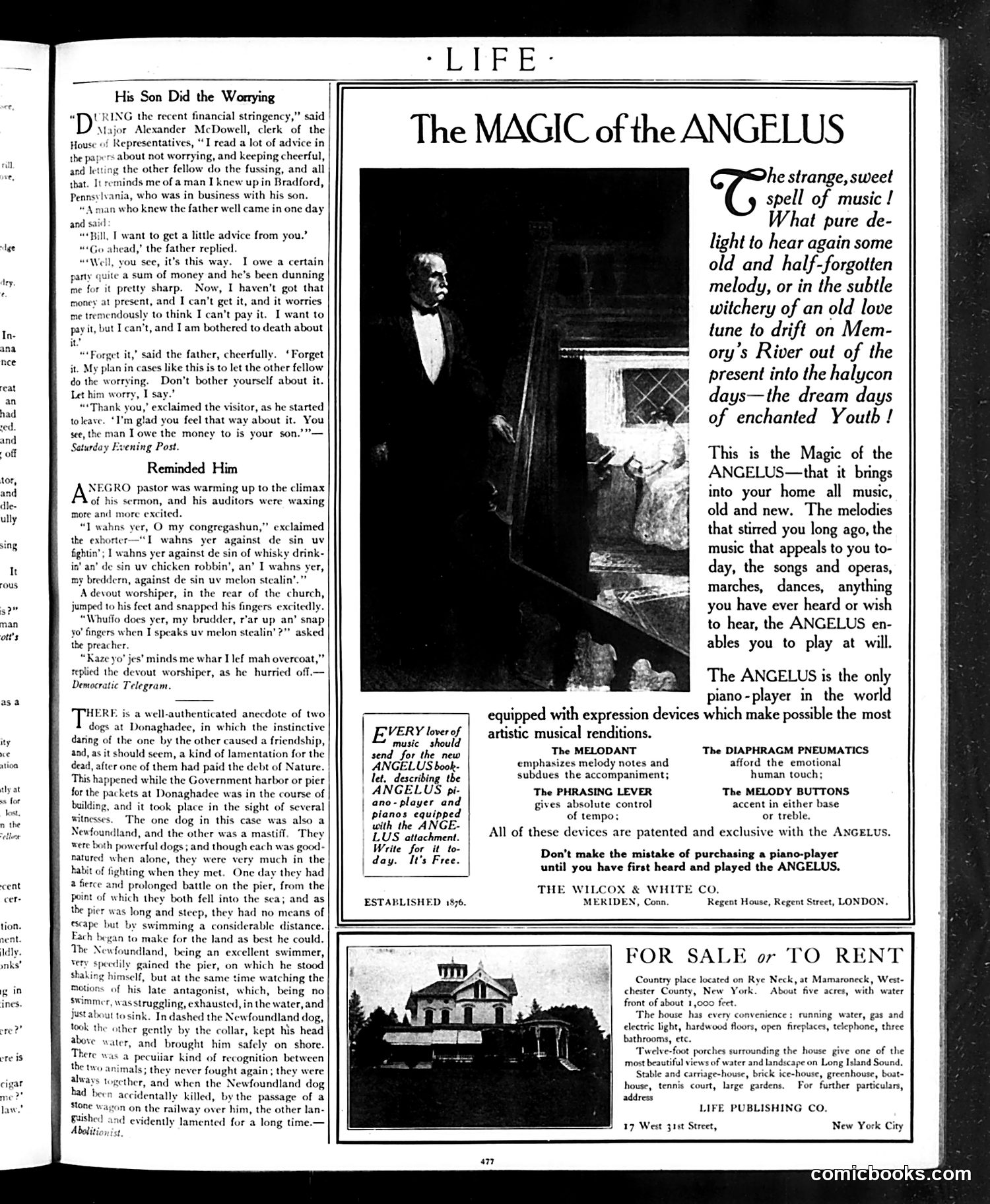
This page contains two distinct sections. On the left are two short humorous anecdotes ("His Son Did the Worrying" and "Reminded Him"), typical of *Life* magazine's satirical humor pieces from this era. These appear to be gentle social commentary rather than sharp political satire. The right side is dominated by a full-page advertisement for the Angelus piano player—a mechanical device that allows non-musicians to play pre-programmed music rolls. The ad uses romantic, nostalgic language about evoking "old and half-forgotten melodies" and "enchanted Youth." The bottom of the page contains unrelated classified advertisements for property rental and sales. This is primarily an advertising-heavy page rather than a satirical one, representing early 20th-century *Life* magazine's business model.
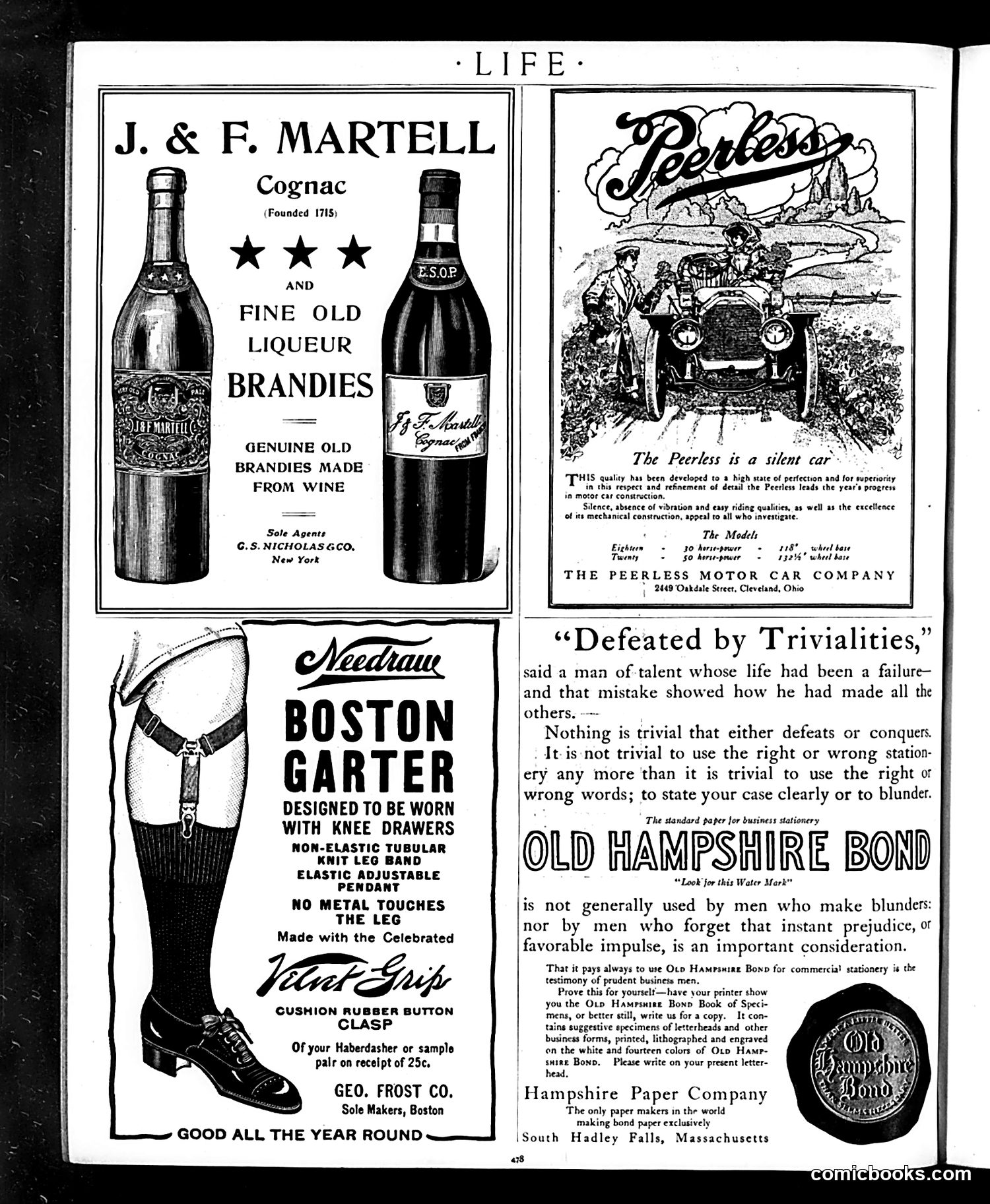
This is primarily a **advertisements page** with no political cartoons or satire. It contains four distinct ads from circa 1910s-1920s: 1. **J. & F. Martell Cognac** — promoting French brandy through a New York distributor 2. **Peerless Motor Car** — advertising an automobile emphasizing quietness and engineering quality 3. **Needham Boston Garter** — men's garter with rubber button clasp, sold by mail 4. **Old Hampshire Bond Paper** — business stationery with an accompanying essay about how using quality paper reflects professionalism and competence The Hampshire Bond ad includes editorial content ("Defeated by Trivialities") arguing that attention to detail—including paper choice—signals business competence and prevents costly mistakes from poor first impressions. These ads reflect early 20th-century consumer culture targeting middle and upper-class men: luxury imports, automobiles, personal grooming items, and business supplies. There is **no satire or political commentary** on this page.
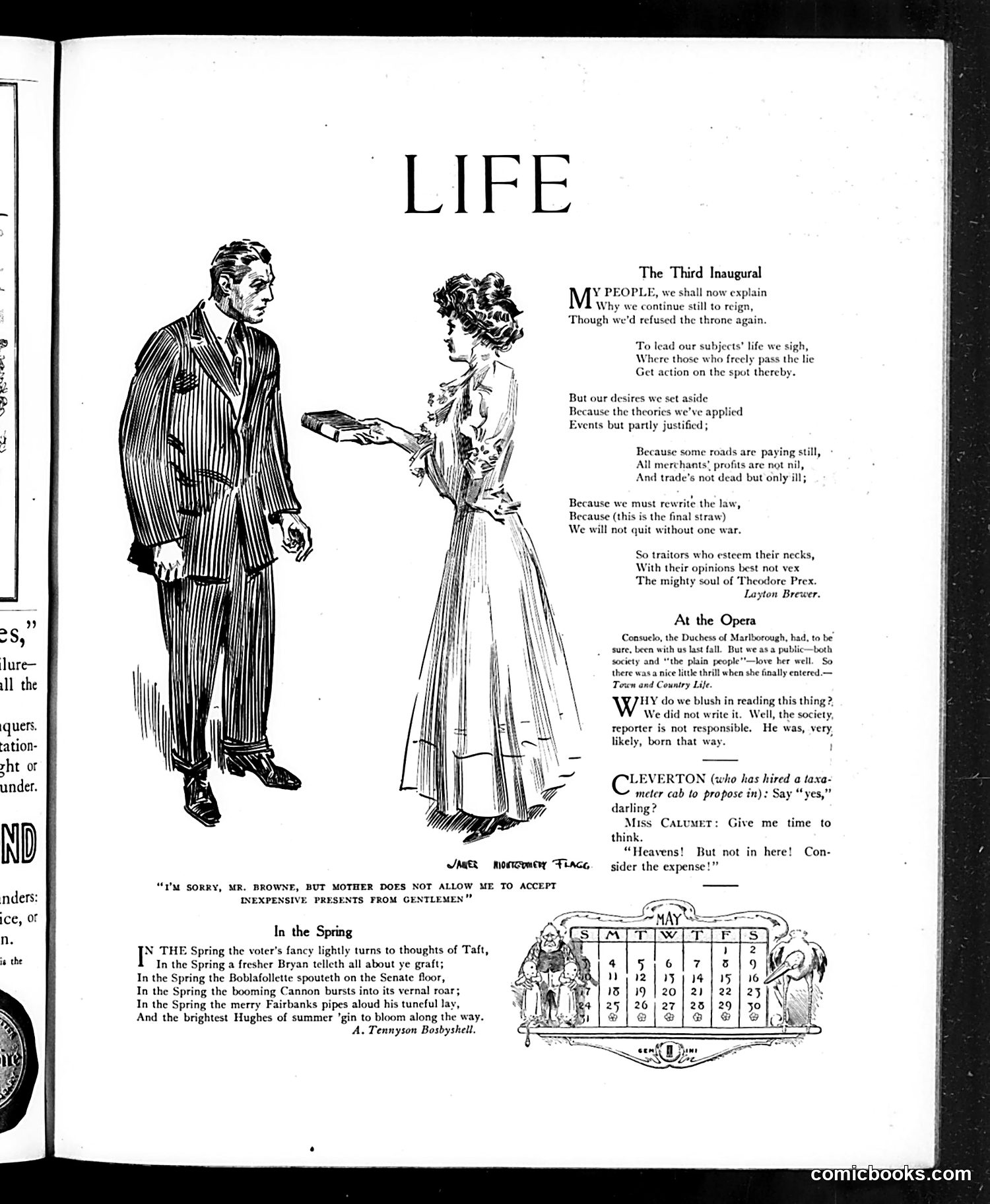
This page satirizes President Theodore Roosevelt's third term ambitions. "The Third Inaugural" poem mocks Roosevelt's justifications for continuing to rule despite earlier pledges to step down. The cartoon depicts a man in a pinstriped suit (Roosevelt) receiving an expensive gift from a woman—referencing Roosevelt's wealth and aristocratic associations while critiquing his contradictions between populist rhetoric and elite behavior. The "At the Opera" section ridicules society journalism's fawning coverage of wealthy figures like Consuelo Vanderbilt (the Duchess of Marlborough), exposing the gap between "plain people" and high society. The final section parodies Tennyson, listing presidential candidates (Taft, Bryan, La Follette, Cannon, Fairbanks, Hughes) as spring flowers—treating politics as seasonal theatrical posturing rather than serious governance. Overall, the page critiques Roosevelt's political legacy, class hypocrisy, and the era's celebrity-obsessed media.
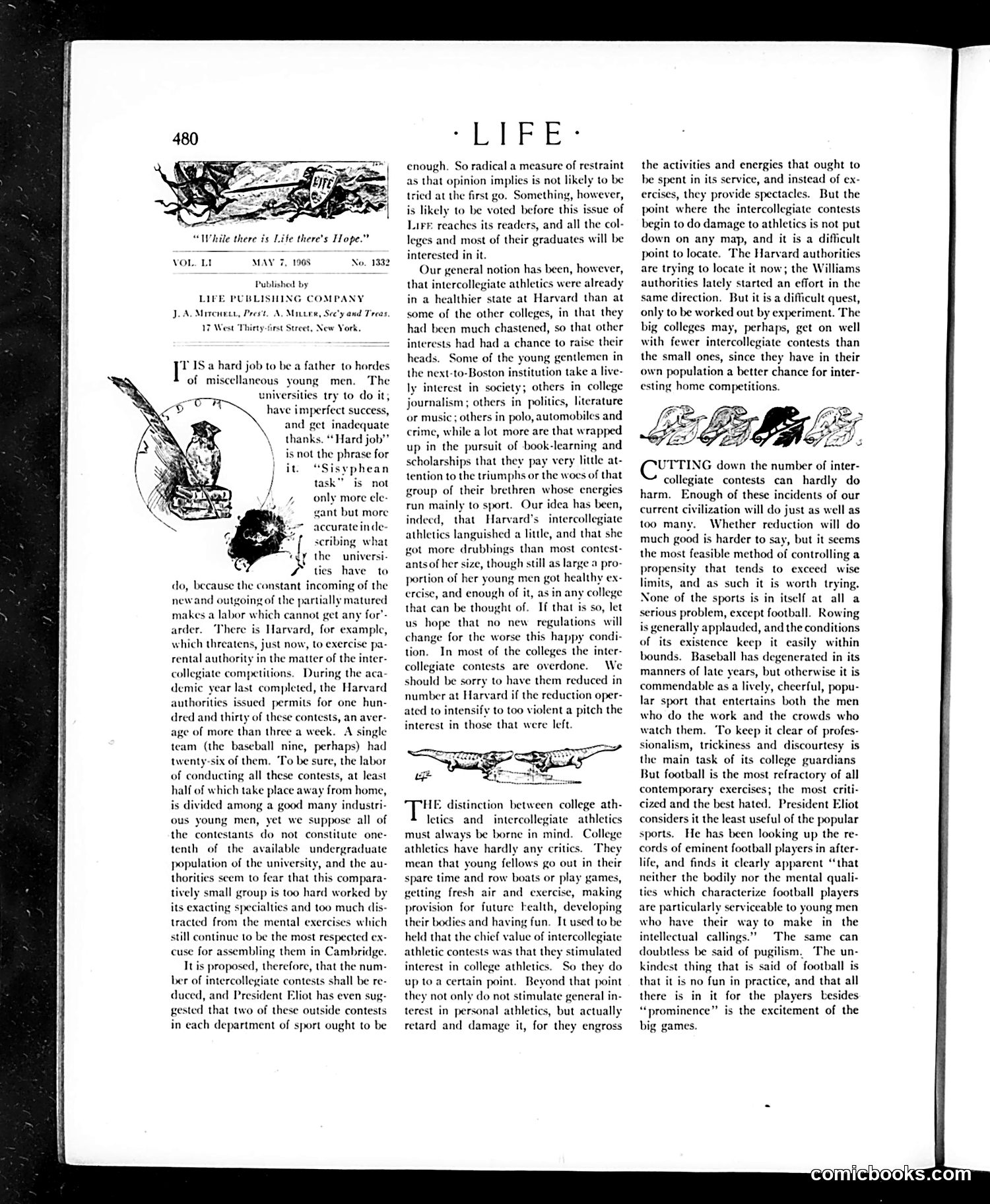
This page discusses Harvard University's proposal to restrict intercollegiate athletic competitions. The article notes that Harvard authorities issued permits for 130 contests in the previous year—an excessive burden on student-athletes who competed in events like baseball, with one team participating in twenty-six contests. The editorial compares universities' task of managing student life to Sisyphus's endless labor. President Eliot apparently suggested limiting outside contests to two per sport department—a radical measure the author doubts will be adopted immediately. The satire is gentle: Life supports *some* restraint on athletics at Harvard, arguing the institution already maintains better balance than other colleges, where intercollegiate sports are "overdone." The concern is that excessive competition distracts from academics while preventing broader intellectual engagement among undergraduates. The cartoons (illustrating the text) appear decorative rather than specifically satirical.
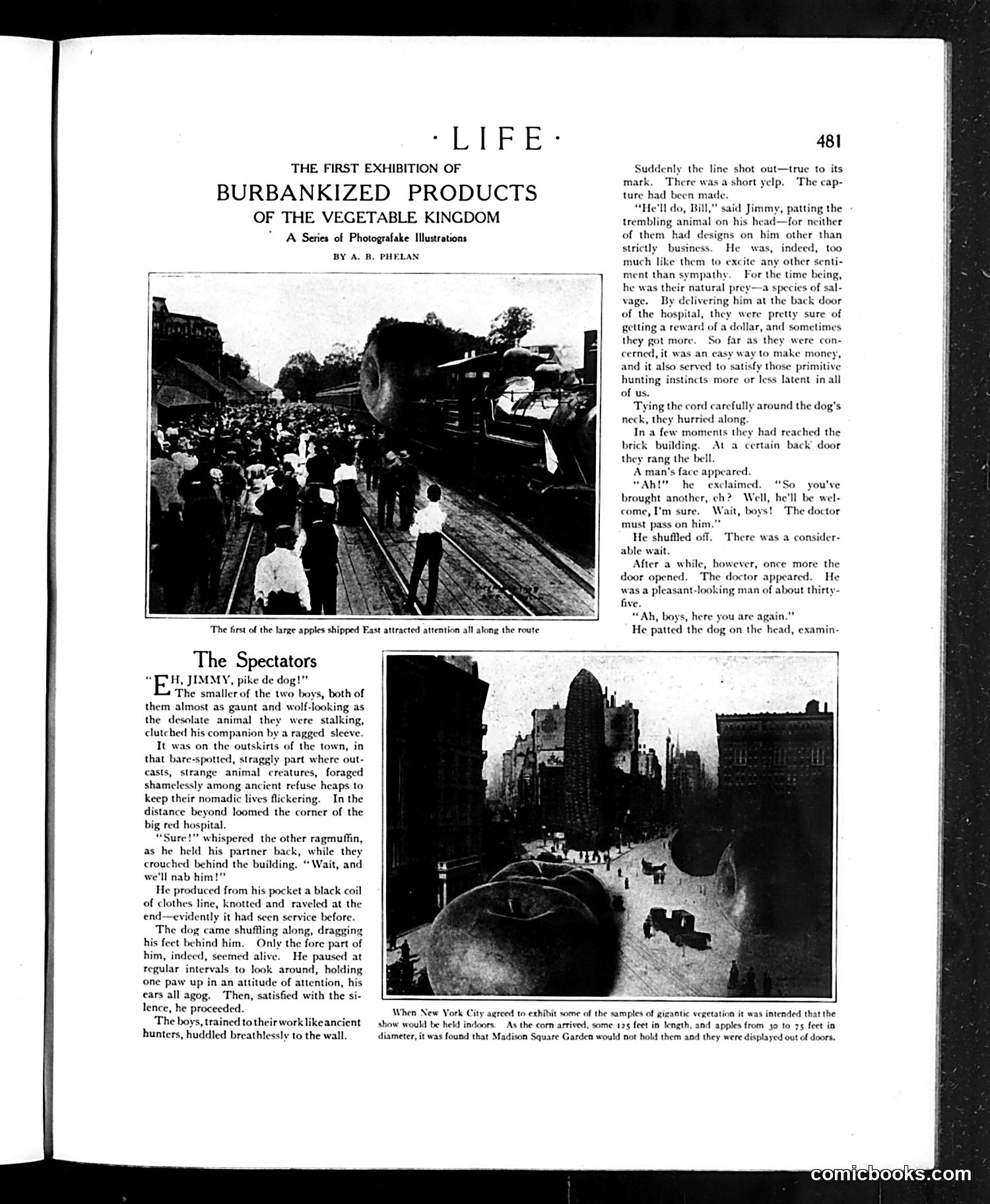
This page satirizes Luther Burbank, the famous plant breeder who developed new vegetable and fruit varieties through selective cultivation. The title mocks his work by proposing an exhibition of his "products." The top photograph shows a train car surrounded by crowds—likely depicting the actual exhibition of Burbank's giant vegetables that New York City attempted to display. The caption notes the corn reached 125 feet and apples 30-75 feet, so large that Madison Square Garden couldn't contain them, requiring outdoor display. The accompanying narrative about street boys capturing a stray dog for hospital reward appears unrelated to the Burbank theme—likely a separate story in the magazine. The dog appears malnourished ("gaunt and wolf-looking"), reflecting turn-of-the-century social conditions where poor urban children lived among refuse heaps. The satire's point: Burbank's "improved" vegetables became so monstrously oversized they couldn't fit indoors—a humorous exaggeration of scientific ambition producing impractical results.
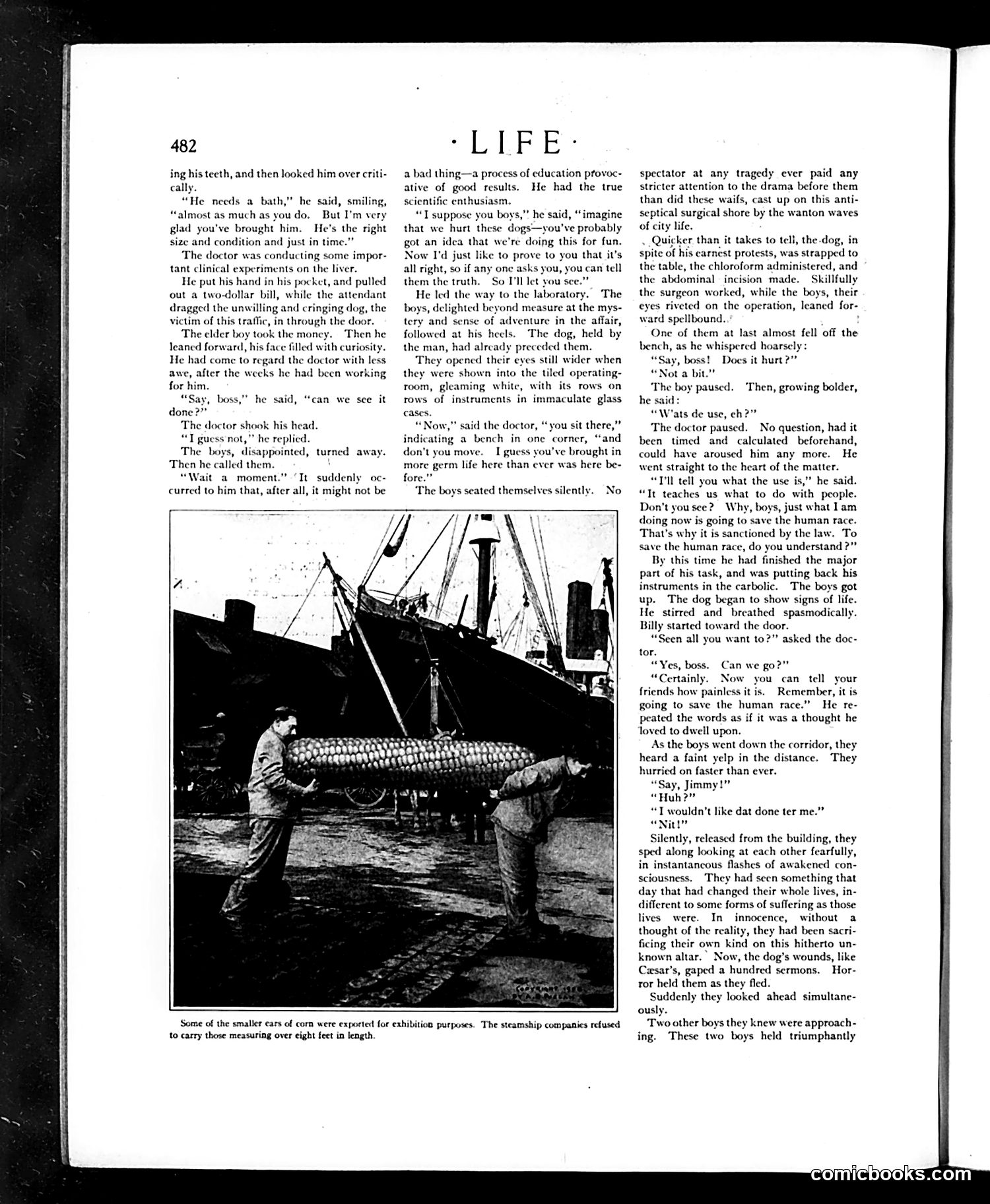
This page presents a narrative story—not a political cartoon—about a doctor performing vivisection (animal experimentation) on a dog for medical research purposes. **The scenario:** Two boys from the streets bring a stray dog to a doctor conducting "clinical experiments on the liver." The doctor pays them and then, seeking to educate them, invites them to observe the surgery. **The satire's point:** The story critiques the justification of animal experimentation through appeals to scientific progress and human benefit. The doctor's repeated insistence that vivisection "will save the human race" and is "sanctioned by the law" appears designed to show how authority figures rationalize potentially troubling practices to vulnerable audiences (poor street boys). **The image** shows the large ear of corn mentioned in the caption—an exhibition specimen too large for steamships to transport, a humorous aside unrelated to the main narrative. The piece likely reflects early-20th-century tensions between advancing medical science and growing animal welfare concerns.
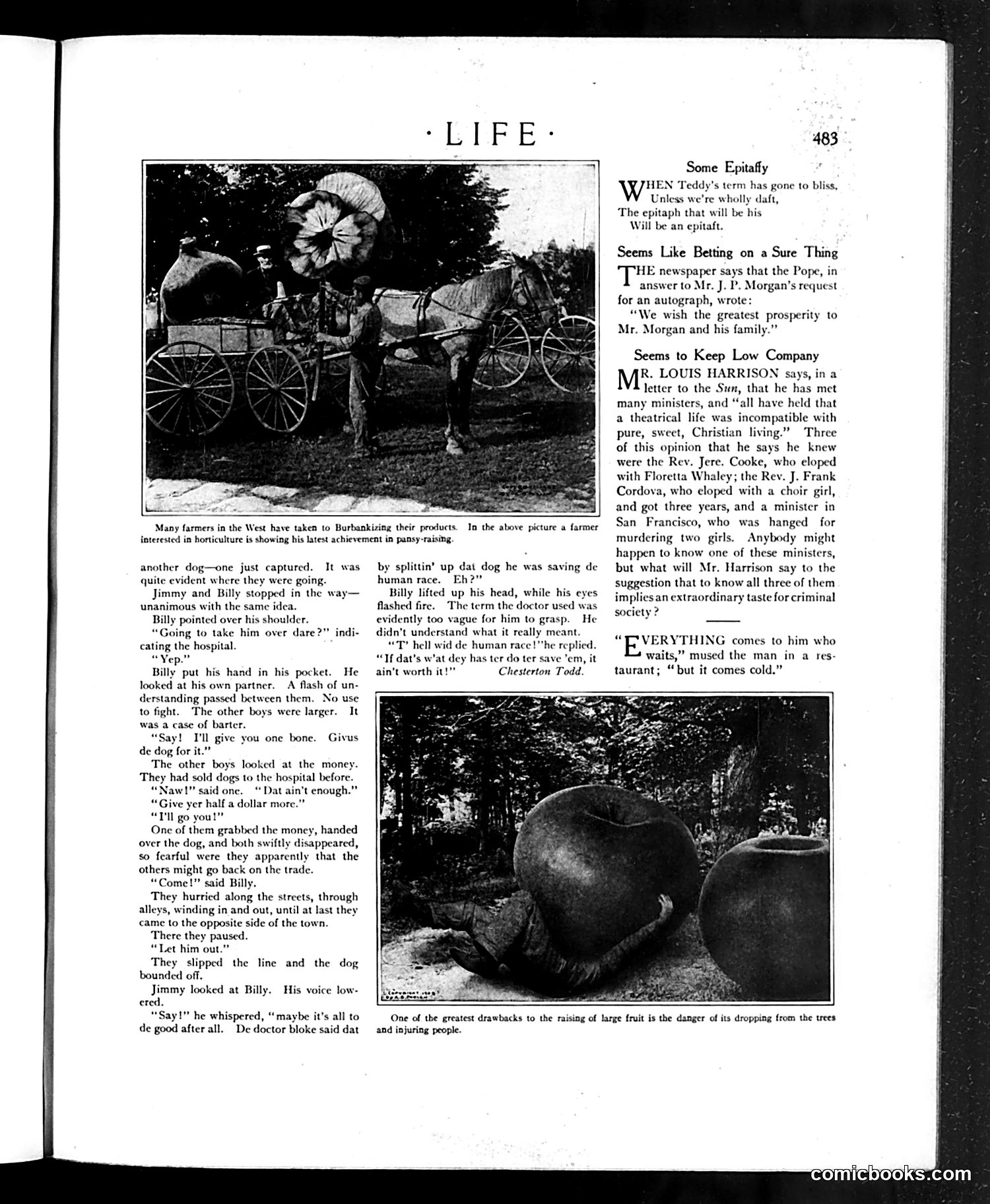
This page contains three satirical items from *Life* magazine: ## Main Story: "Burbankizing" The narrative mocks Luther Burbank, the famous plant breeder, by showing boys catching stray dogs to sell to a hospital (likely for vivisection in medical research). The joke: they're "improving" the dog supply like Burbank improved crops. The story's ending critiques this callousness—one boy rejects the rationalization that experimenting on dogs "saves the human race," declaring the human race not worth saving if that's the cost. ## "Some Epitaffy" A brief joke about President Theodore Roosevelt ("Teddy"), predicting his epitaph will be an "epitaph"—a pun on words. ## "Low Company" Satirizes claims that theatrical life is immoral by listing respectable ministers caught in scandals: elopements and murder. The satire: ministers lecturing actors about morality while committing crimes themselves. All reflect *Life*'s muckraking tradition of exposing hypocrisy in institutions and public figures.
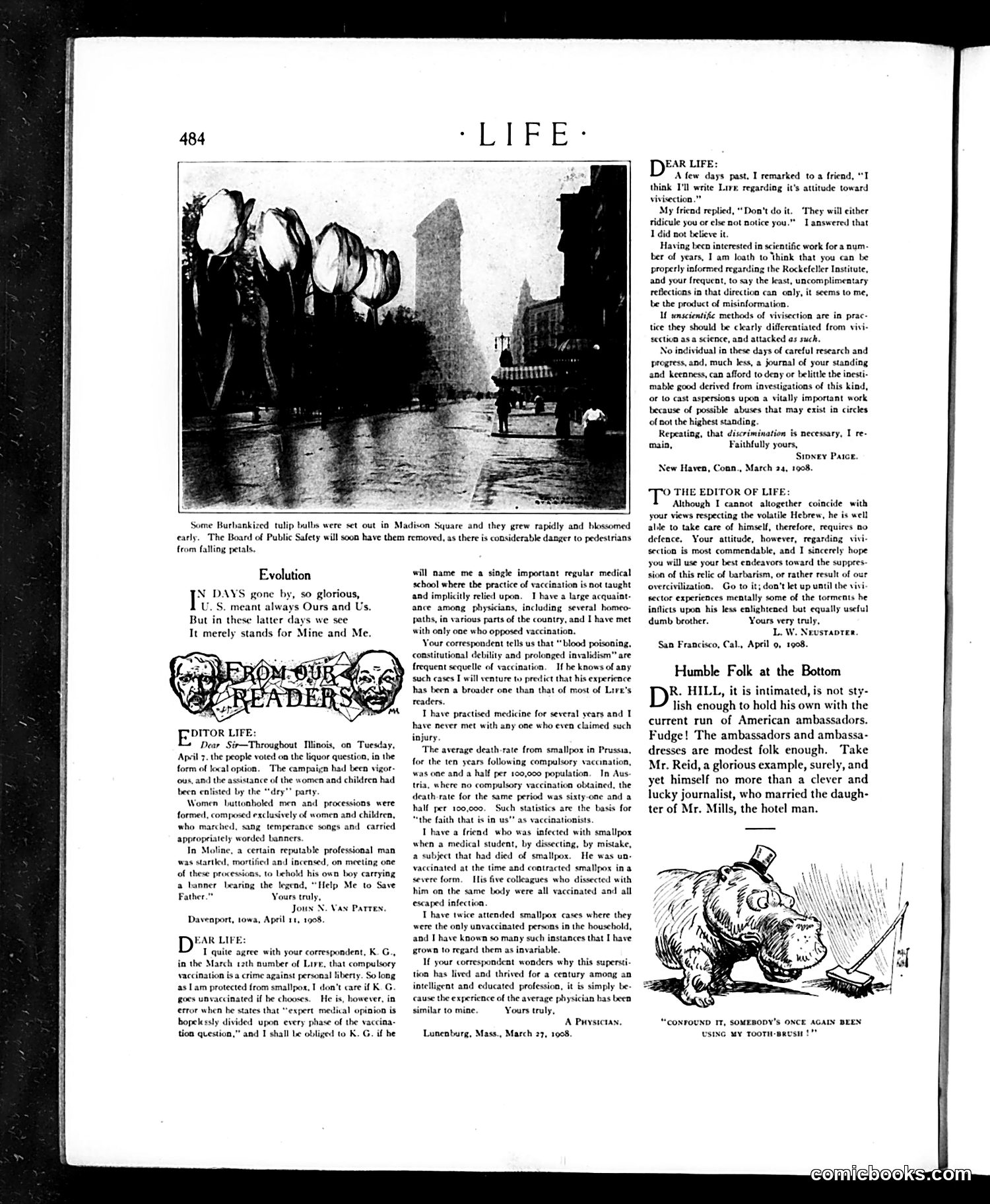
**Main Cartoon (Top Left):** Shows oversized tulip flowers in Madison Square with a caption noting they grew rapidly after being "Burbanked" (selectively bred by horticulturist Luther Burbank). The joke satirizes how successful selective breeding made them so large that fallen petals become a pedestrian safety hazard—absurdist humor about unintended consequences of agricultural innovation. **"Evolution" Cartoon (Center):** A crude illustration depicts the shift from collective pronouns ("Ours and Us") to selfish ones ("Mine and Me"), suggesting growing American individualism and materialism—a social critique common in early 1900s satirical magazines. **Letters Section:** Contains three reader debates about contemporary issues: compulsory vaccination (with strong pro-vaccination medical arguments), women's temperance activism, and vivisection (animal testing). These represent genuine public controversies of 1908, not satire—the magazine functioned as a forum for social debate alongside humor. The page reflects Life's dual role: satirizing modern excess while engaging serious reform debates of the Progressive Era.
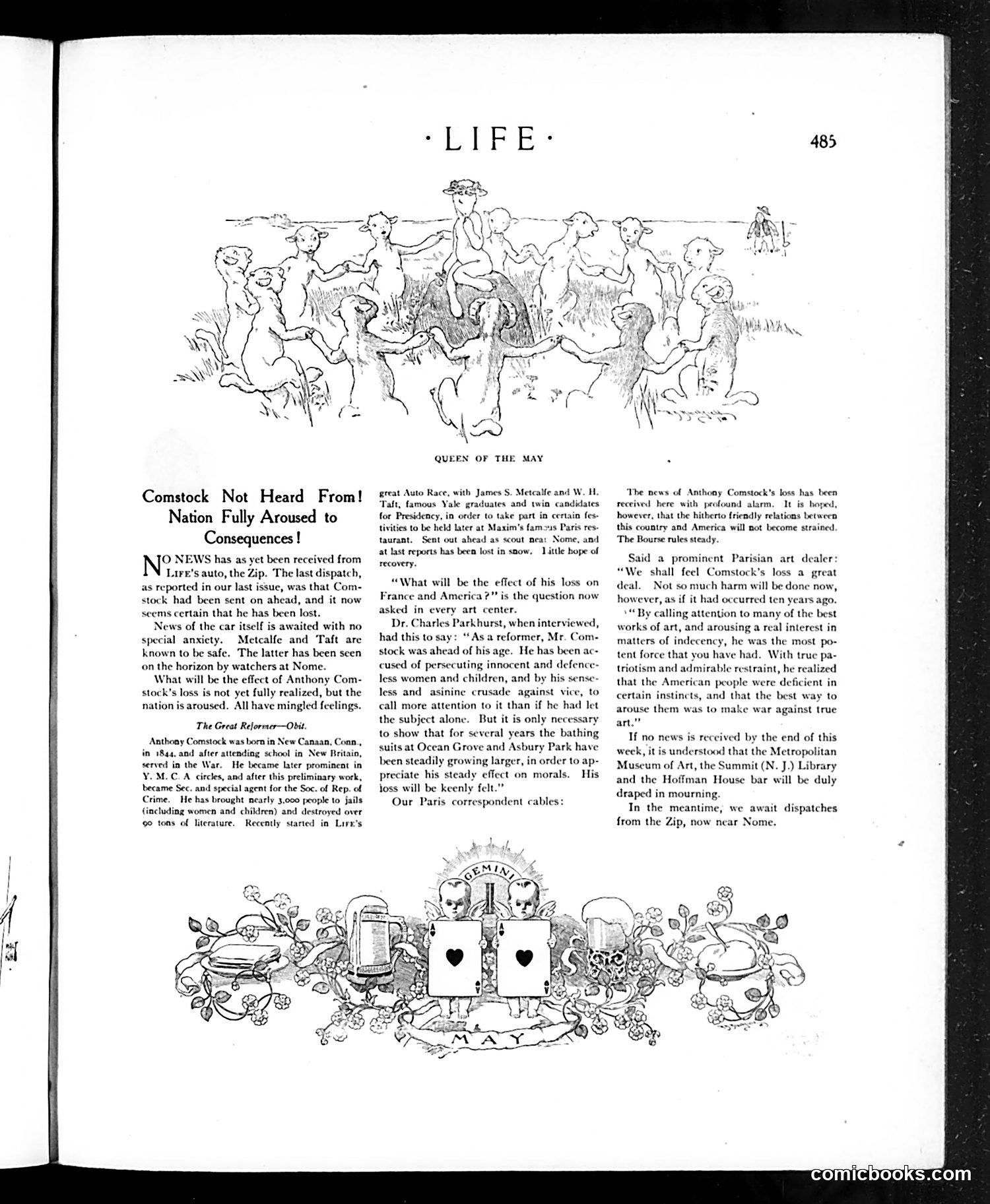
This is satirical commentary on Anthony Comstock, the real historical figure famous for moral censorship and obscenity prosecutions. The "news" that he's been lost in the Arctic during an auto race is fictional framing for what is essentially his mock obituary. The satire works on multiple levels: **The Setup**: Comstock is portrayed as disappearing during "Life's" auto race to Paris, creating darkly comedic "what will America do without him?" speculation. **The Targets**: - Comstock's actual record: nearly 3,000 jailed, 90 tons of literature destroyed - His persecution of "innocent" people, especially women - His prudish censorship (bathing suits at Ocean Grove) - The irony that his crusades against vice actually drew *more* attention to it **The Joke**: Paris mourns potentially losing their "best" promoter of American art interest (through his attempts to suppress it). American institutions like the Metropolitan Museum would drape in mourning—sarcastically suggesting Comstock's absence would harm culture and morality. The overall message: good riddance to a puritanical censor whose destruction of literature and harassment caused more harm than good.
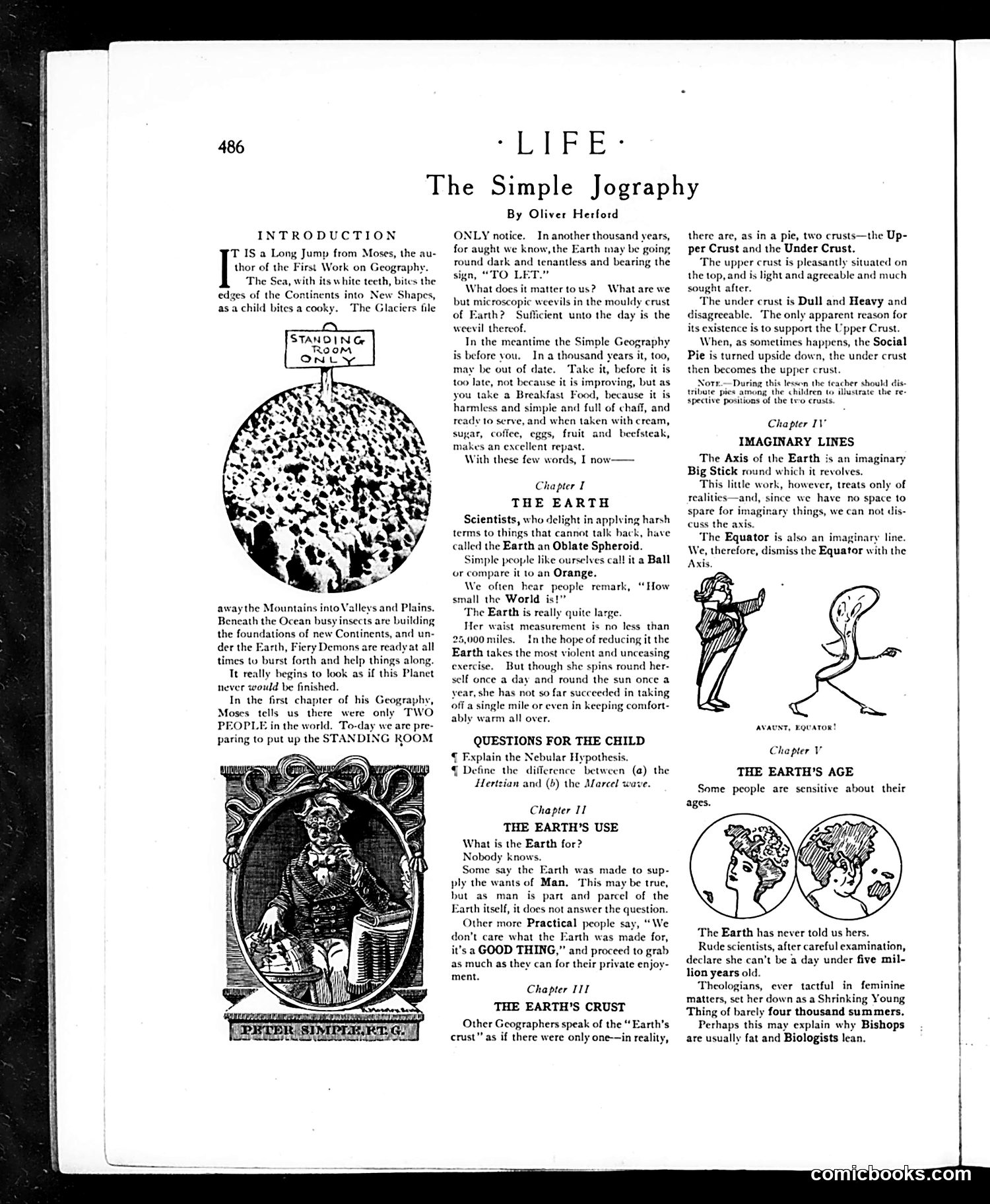
This is a satirical geography primer by humorist Oliver Herford, using absurdist humor to mock both scientific pretension and human folly. **The satire targets:** 1. **Pseudointellectual jargon**: Scientists use harsh terms like "Oblate Spheroid" for what ordinary people simply call a "ball"—mocking unnecessary complexity. 2. **Human insignificance**: Herford compares humans to "microscopic weevils in the mouldy crust of Earth," undercutting our self-importance. 3. **Social class/inequality**: The "Social Pie" metaphor with "Upper Crust" and "Under Crust" satirizes class division—the upper crust is pleasant and sought after; the lower exists only to support it. 4. **Materialism**: Practical people grab Earth's resources without understanding its purpose, caring only that it's "a GOOD THING." 5. **Feminine vanity**: Earth is personified as a woman obsessively exercising to reduce her 25,000-mile waist measurement. The cartoonish figures (appearing to depict the Equator personified) reinforce the playful mockery of taking geography—or ourselves—too seriously.
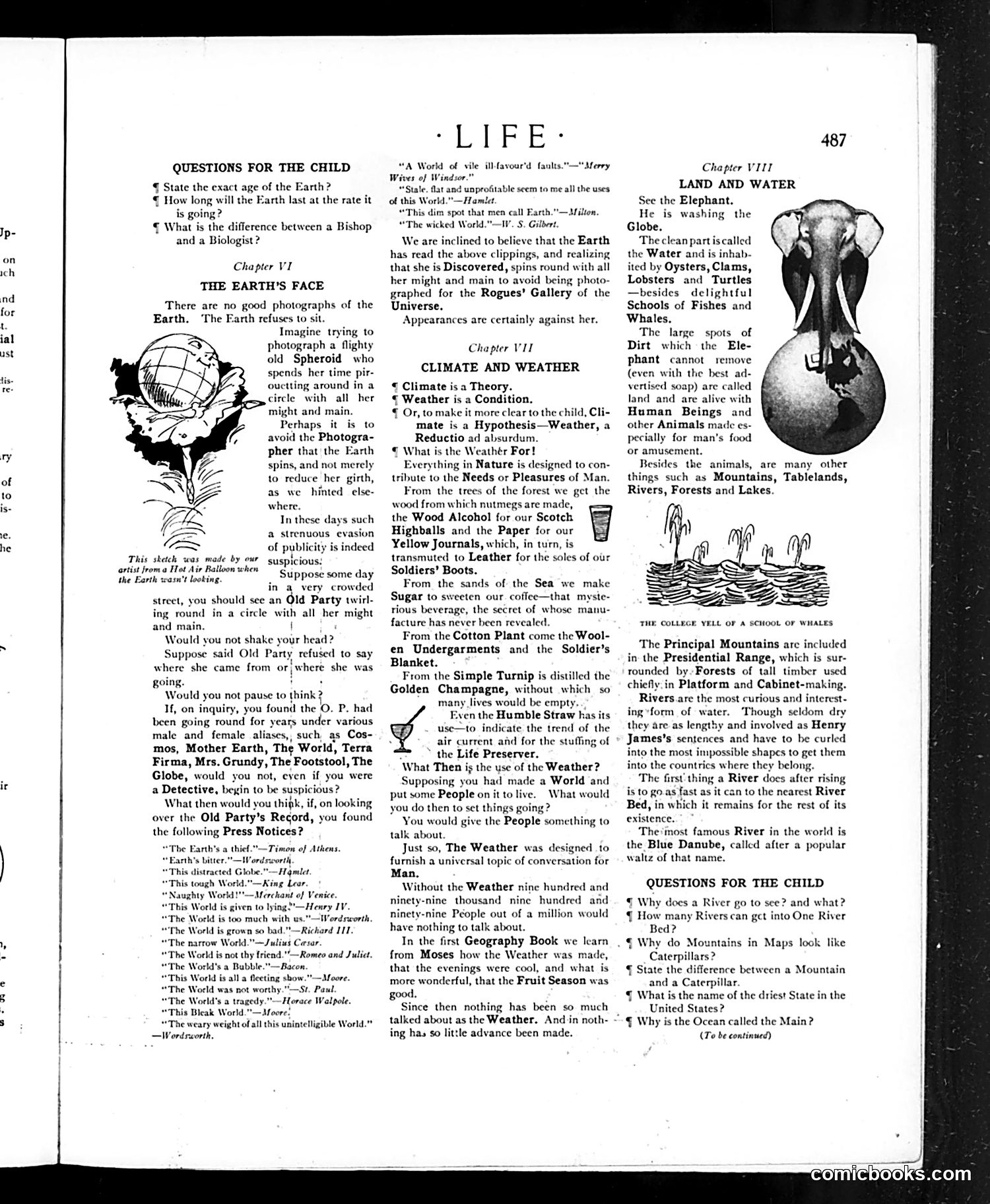
This page from Life magazine is primarily **educational satire** aimed at children, mocking pretentious educational literature of the era. **The Content:** Chapter VI ridicules attempts to photograph Earth by comparing the planet to a suspicious "Old Party" (elderly woman) who spins in circles to avoid photographers. The satire compiles Shakespeare and literary quotes portraying the world negatively—implying Earth has "read the clippings" and realizes she's "discovered," hence her constant spinning. **The Joke:** The humor targets both Earth's apparent "bad reputation" in literature and the absurdity of trying to photograph a spinning planet. It's meta-commentary on how pessimistic Western literature portrays the world. Chapter VII continues the mockery, proposing that everything in nature exists solely for human use (scotch, leather boots, champagne), reducing nature to mere resource extraction. This satirizes utilitarian philosophy and industrial-age thinking. **Modern Relevance:** The page shows Life magazine's approach: educational content disguised as humor, poking fun at Victorian earnestness and materialistic worldviews.
This page from *Life* magazine features a theatrical or operatic scene. The left image shows a woman in an elaborate ball gown with detailed fabric draping, photographed against a dark background. She appears to be performing or posing dramatically. The right side contains another darker image, with partial text visible at bottom reading "THE STORY THAT NEVER GI[VES]" (text cut off). Without clearer context or a visible date, I cannot identify the specific theatrical production, performer, or satirical point being made. The dramatic lighting and formal costume suggest this may be reviewing or commenting on a stage performance, possibly opera or classical theater. However, the specific social or political commentary intended remains unclear from this isolated page fragment.
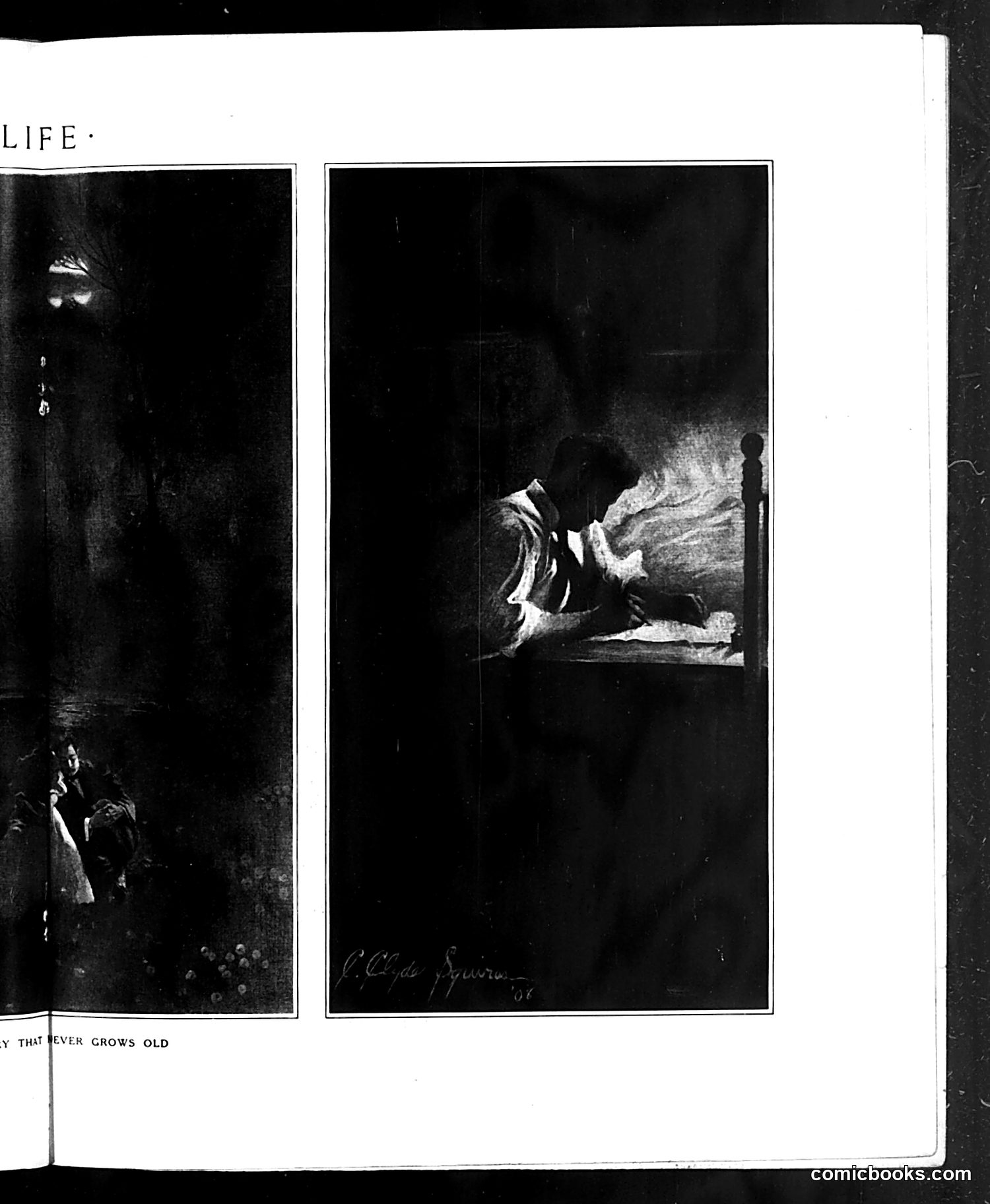
This page from *Life* magazine shows two black and white photographs arranged vertically. The left image appears to show a figure in darkness with only face details visible. The right image depicts someone working or laboring over what seems to be a surface or task. The visible text fragment "Y THAT FEVER GROWS OLD" is unclear in context without the full caption. The page header reads "LIFE," confirming this is from the satirical magazine. However, without complete text, publication date, or clearer image quality, I cannot confidently identify the specific political or social references, the individuals depicted, or the intended satire. The dramatic lighting and composition suggest commentary on contemporary labor or social conditions, but specifics remain uncertain.
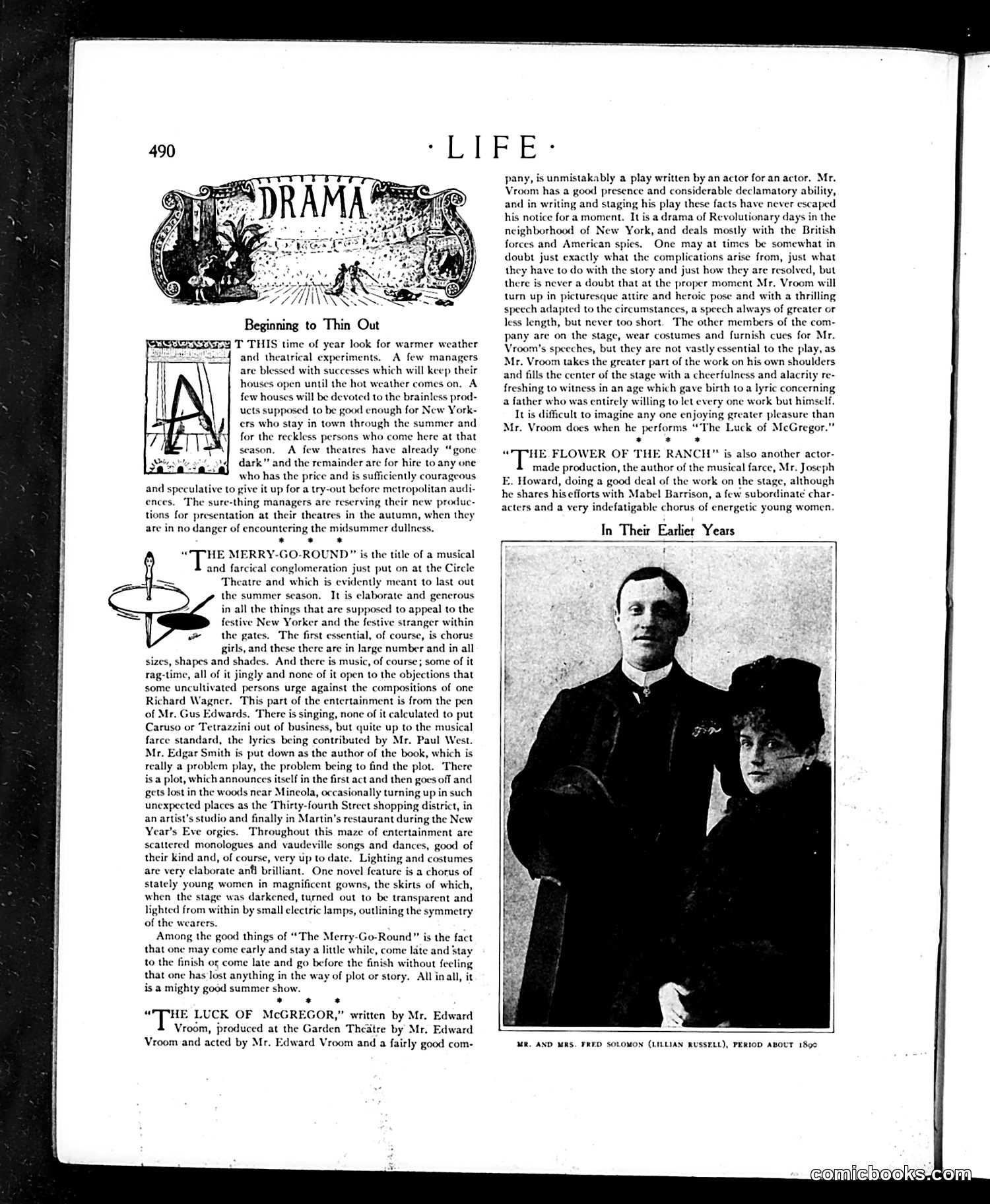
This page contains theater reviews from an early 20th-century issue of *Life* magazine. The text discusses three Broadway productions: **"The Merry-Go-Round"** — A musical farce at the Circle Theatre designed as lightweight summer entertainment, featuring chorus girls, ragtime music, and an intentionally nonexistent plot that "gets lost in the woods." The reviewer jokes it doesn't matter when you arrive or leave since there's no coherent story. **"The Luck of McGregor"** — A Revolutionary War-era drama written by and starring actor Edward Vroom, described sarcastically as a vanity project where Vroom's "good presence and considerable declamatory ability" are never allowed to escape notice. The accompanying photograph shows **Fred Solomon and Lillian Russell** (labeled "Mr. and Mrs. Fred Solomon") from around 1820, illustrating theatrical history. The satire targets summer theater's low standards and actors' self-indulgent productions.
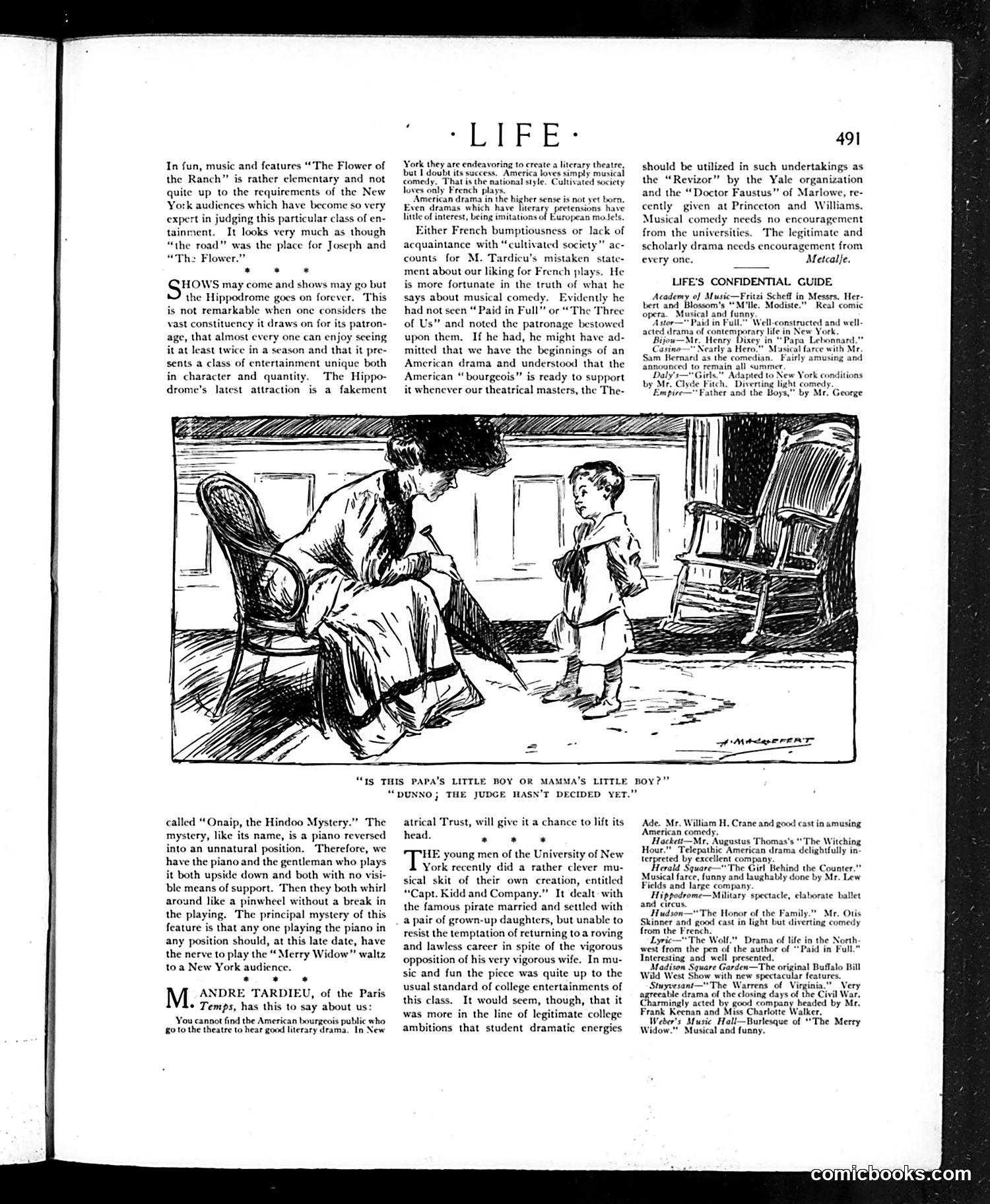
This page contains theater criticism and commentary typical of Life's satirical approach to American culture circa early 1900s. **The cartoon** depicts a woman with a tennis racket confronting a small boy, captioned "Is this Papa's little boy or Mamma's little boy? 'Dunno; the judge hasn't decided yet." This references custody disputes—apparently a contemporary social issue worthy of mockery. **The text critiques**: 1. **"The Flower of the Ranch"** — dismissed as "elementary," suggesting New York audiences demand higher theatrical standards than touring productions. 2. **The Hippodrome's "Onaip, the Hindoo Mystery"** — sarcastically exposed as a gimmick (a reversed piano and pianist playing upside-down), with particular scorn for performing the dated "Merry Widow" waltz. 3. **André Tardieu's dismissal of American drama** — the writer rebuts the French critic's claim that Americans prefer only musical comedy, arguing American drama is developing legitimately. 4. **University theater** — praising Yale's "Revizor" and Princeton's "Doctor Faustus" over musical comedy as worthier dramatic pursuits. The overall tone mocks pretension while advocating for theatrical sophistication.
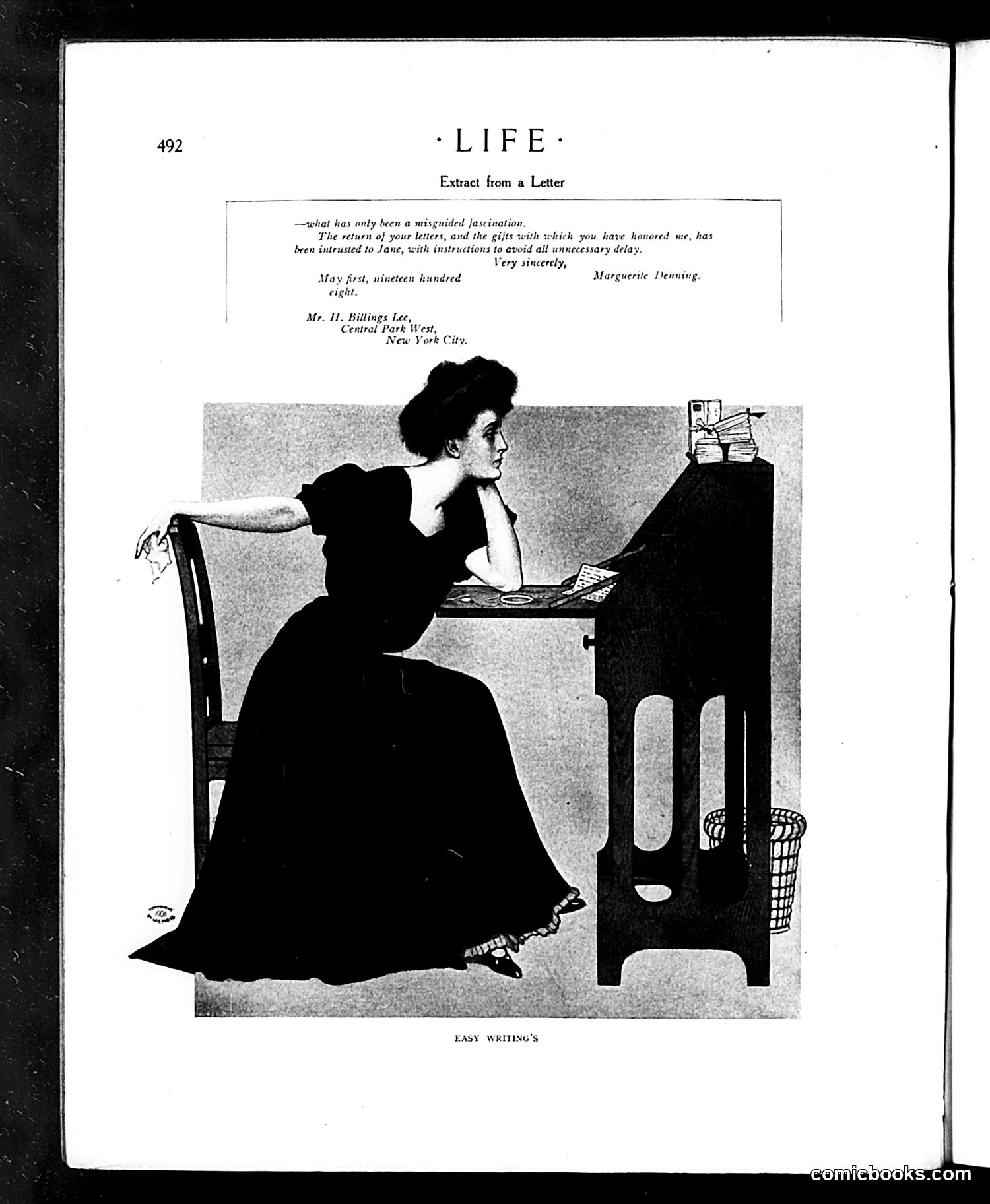
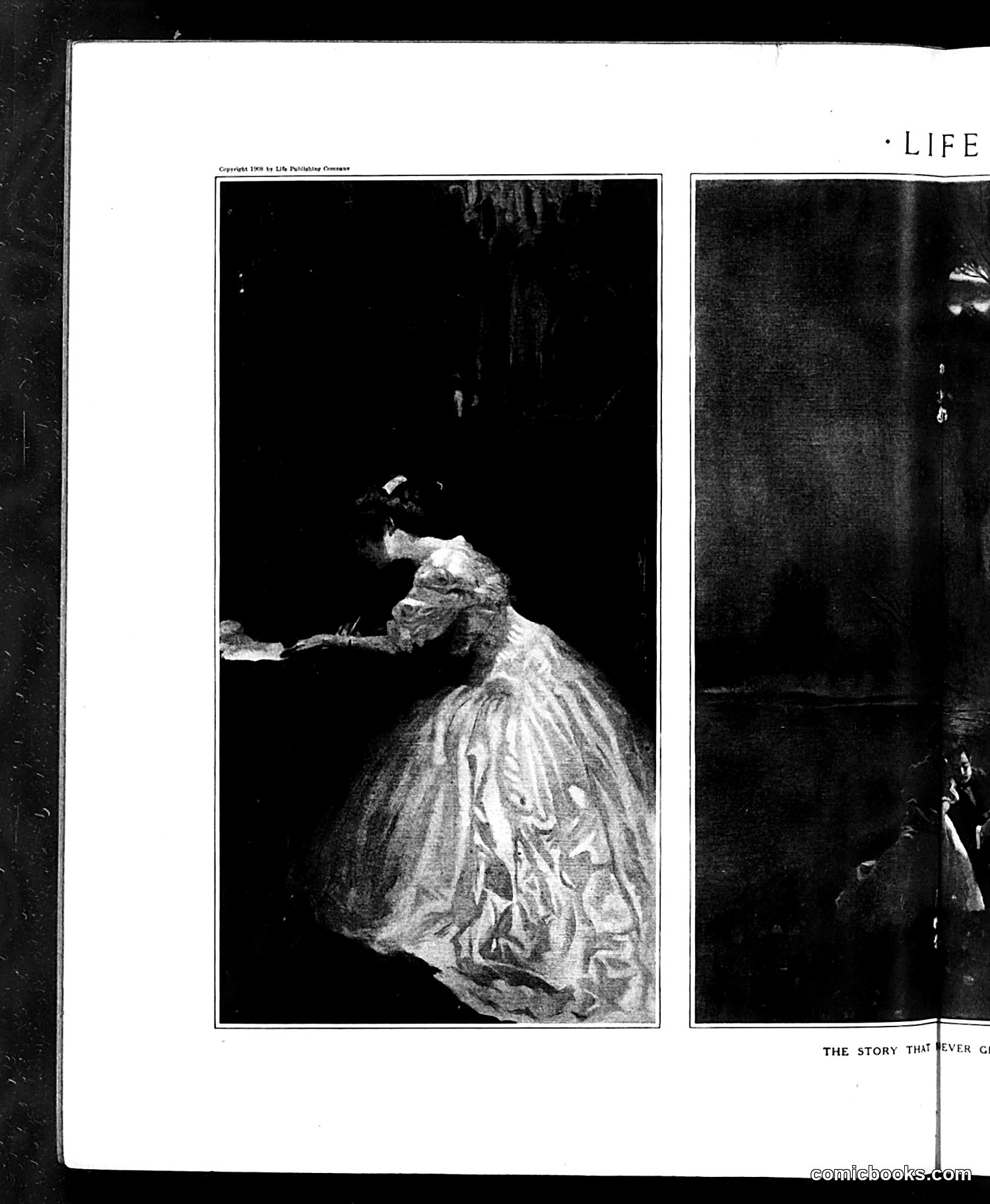
This appears to be a satirical advertisement or editorial feature titled "Easy Writing's" (possibly "Easy Writings"). The image shows a woman at a desk writing a letter—specifically, what appears to be a "Dear John" or rejection letter. The accompanying text excerpt reveals she's returning a suitor's letters and gifts, instructing someone named Jane to deliver them quickly while maintaining polite distance ("Very sincerely"). The satire targets romantic correspondence of the era. The joke is likely that despite the emotional difficulty of rejecting someone, the woman's letter remains impeccably formal and controlled—exemplifying "easy writing" through practiced social etiquette rather than genuine feeling. The stark silhouette illustration emphasizes the coldness of the transaction, contrasting the intimate nature of love letters with their businesslike dismissal. This reflects early-20th-century social conventions around courtship and the performance required in written communication.
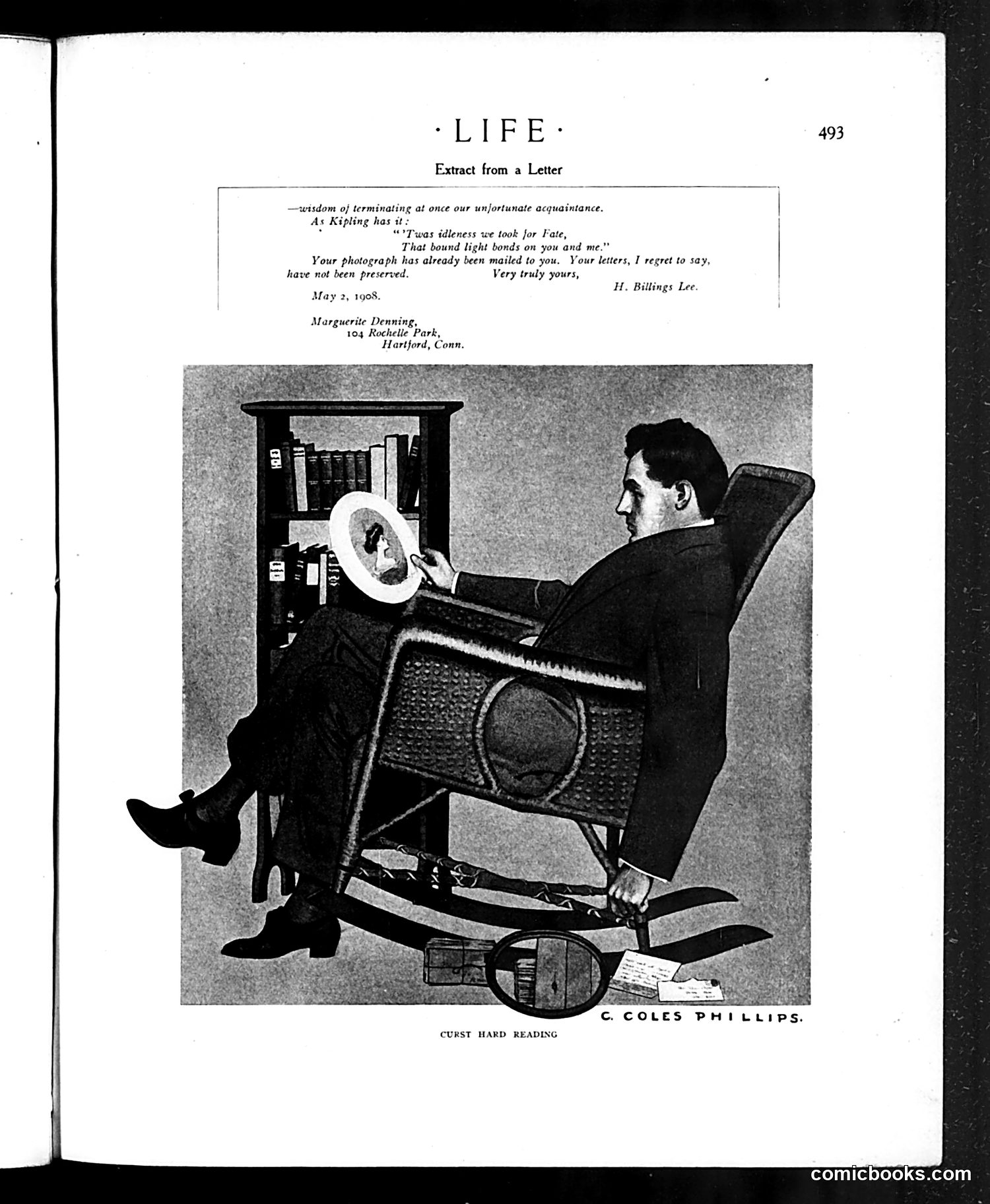
This page features an illustration by Coles Phillips titled "Curst Hard Reading," depicting a man straining to read from what appears to be an early electrical device or machine—likely representing new technology of the era. The accompanying letter is a breakup note from H. Billings Lee to Marguerite Denning, written in formal, somewhat cruel language. It quotes Kipling to suggest their relationship was based on illusion rather than genuine connection, mentions destroying her letters, and coldly terminates their acquaintance. **The satire**: The juxtaposition of the "hard reading" illustration with this curt dismissal likely satirizes the difficulty of interpreting romantic intentions or love letters—the technological struggle mirrors the emotional/intellectual struggle of deciphering a lover's true feelings. The man's contorted effort to read reflects the confusion of receiving such a coldly formal rejection disguised in literary language.
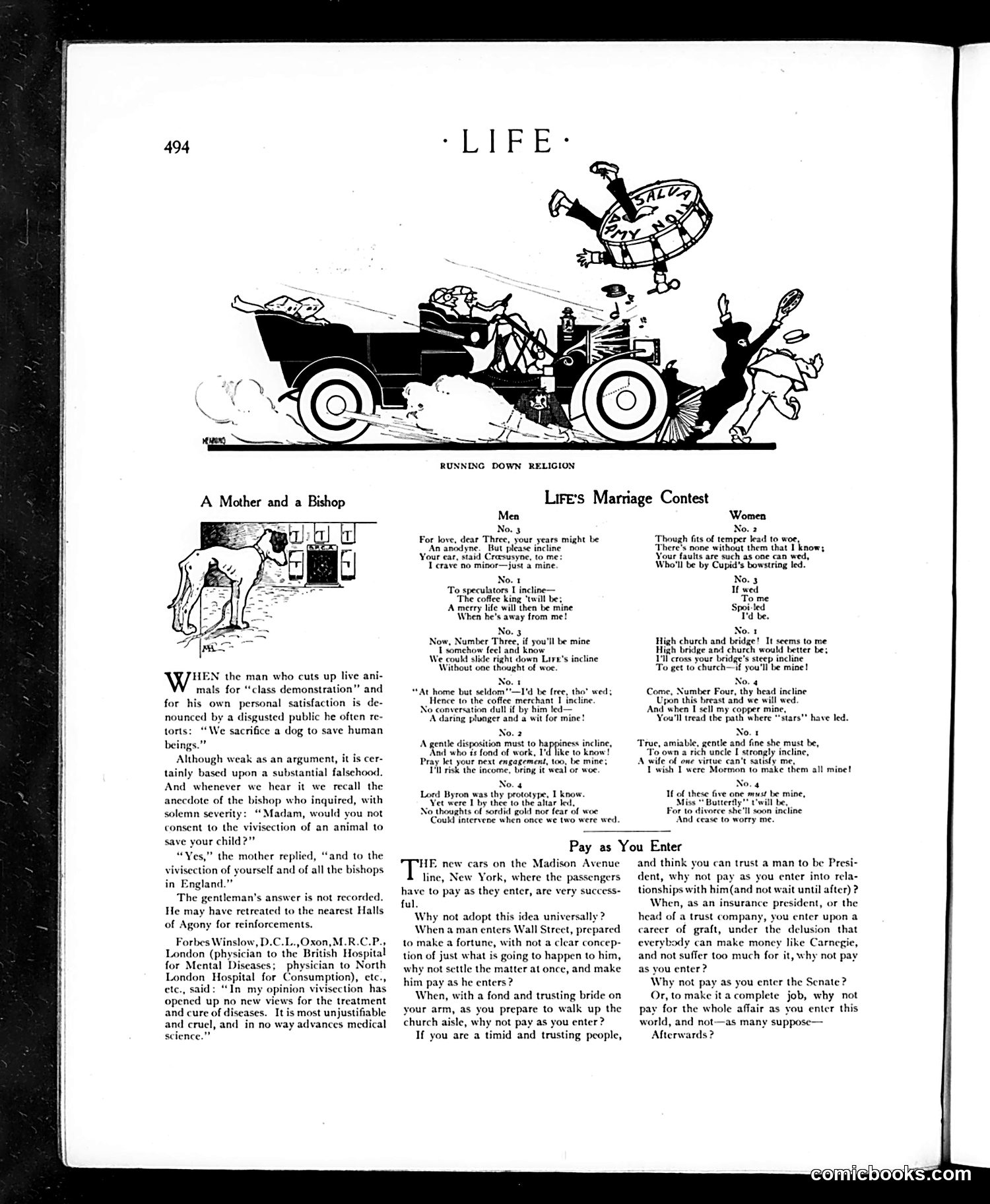
This page contains three distinct satirical pieces: **"A Mother and a Bishop"** (left): A serious editorial opposing vivisection (animal testing). It mocks the common justification that animal experimentation saves human lives by recounting an anecdote where a mother, asked if she'd permit vivisection to save her child, responds she'd consent to vivisecting the bishops too. The piece argues vivisection is cruel and scientifically pointless, citing a real British physician's opposition. **"Life's Marriage Contest"** (center): A humorous matching game where five men and five women each state their marital preferences in verse. The satire targets materialistic marriage motivations—men want wealthy wives or mistresses; women seek rich husbands, absent partners, or those with "copper mines." It mocks the era's transactional view of marriage. **"Pay as You Enter"** (right): Social commentary proposing that since passengers on new Madison Avenue transit cars pay upon entry, why not apply this principle to other life commitments—entering Wall Street, marriage, trusting a president, or joining corporations? It satirizes people entering major commitments naively without understanding costs.
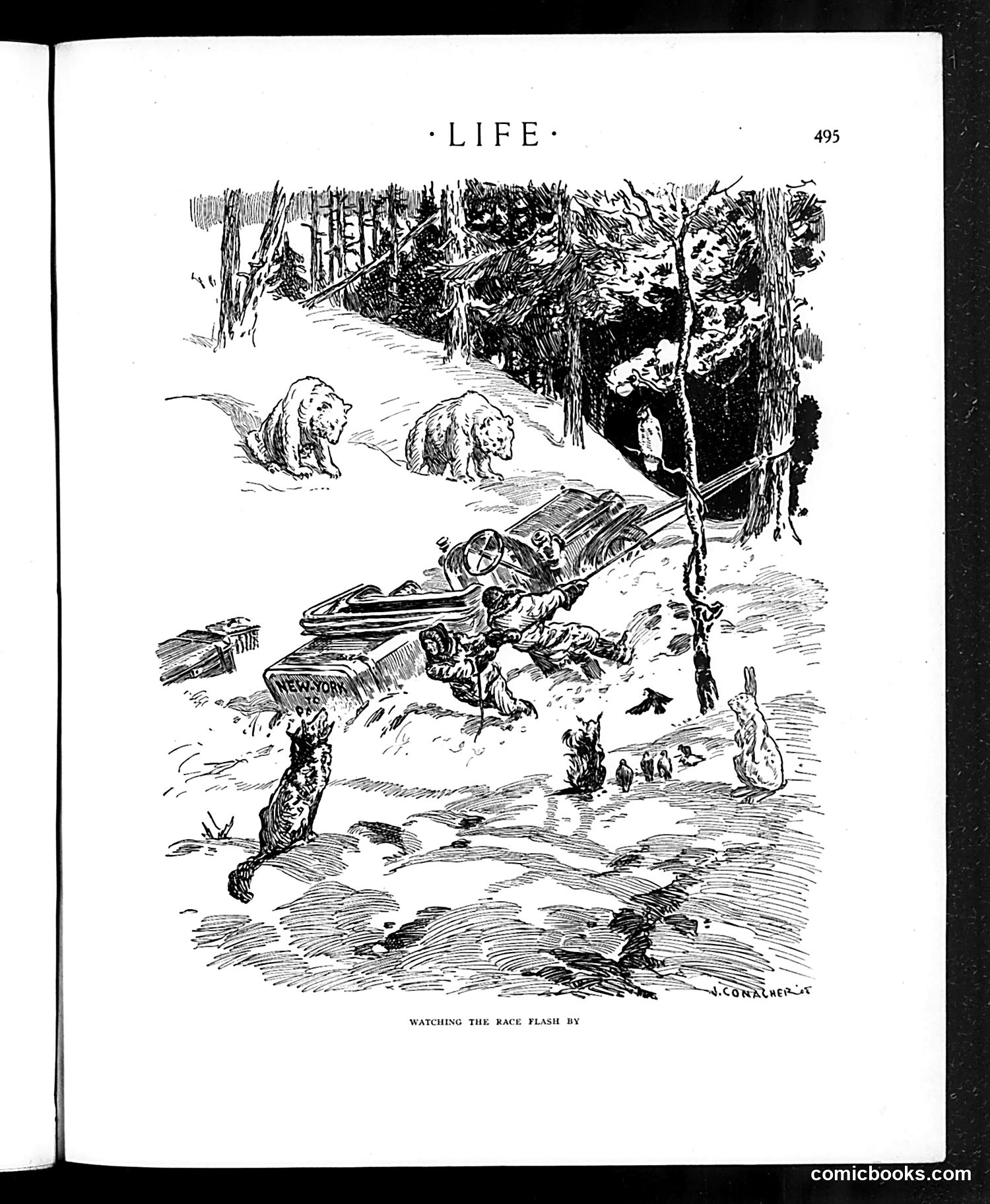
This satirical cartoon depicts bears observing a speeding automobile marked "NEW YORK" crash through a forest. The humor relies on contrast: woodland animals (bears) are portrayed as spectators to modern civilization's rapid, chaotic progress. The wrecked car and scattered debris suggest the destructive force of industrialization invading nature. The title plays on the double meaning of "race"—both a competition and the rushing motion itself. This likely satirizes early 20th-century American attitudes toward progress and speed, mocking how quickly modernity was transforming the landscape while nature's inhabitants could only watch helplessly. The cartoon critiques industrial expansion and automobile culture as reckless forces overwhelming the natural world.
This story depicts two lawyers, Peter Sande and Gideon Slater, discussing the estate of their deceased client Eugene Midford. Sande controls $100,000 in unregistered bonds left to Midford's widow, and proposes giving her only a small allowance rather than her full inheritance. The satire lies in Sande's self-serving rationalization: he claims restricting her access protects her from the corrupting influence of wealth and prevents her becoming "a prey to adventurers." His rhetoric about her "frivolous" nature and need for paternal control masks straightforward theft—he wants to keep most of the money himself while posing as her moral guardian. The cartoon's title, "With and Without," likely refers to the contrast between appearing virtuous (with morality) while actually being corrupt (without it). This critiques how early-20th-century legal authorities exploited fiduciary power and paternalistic assumptions about women to commit fraud while maintaining respectability.
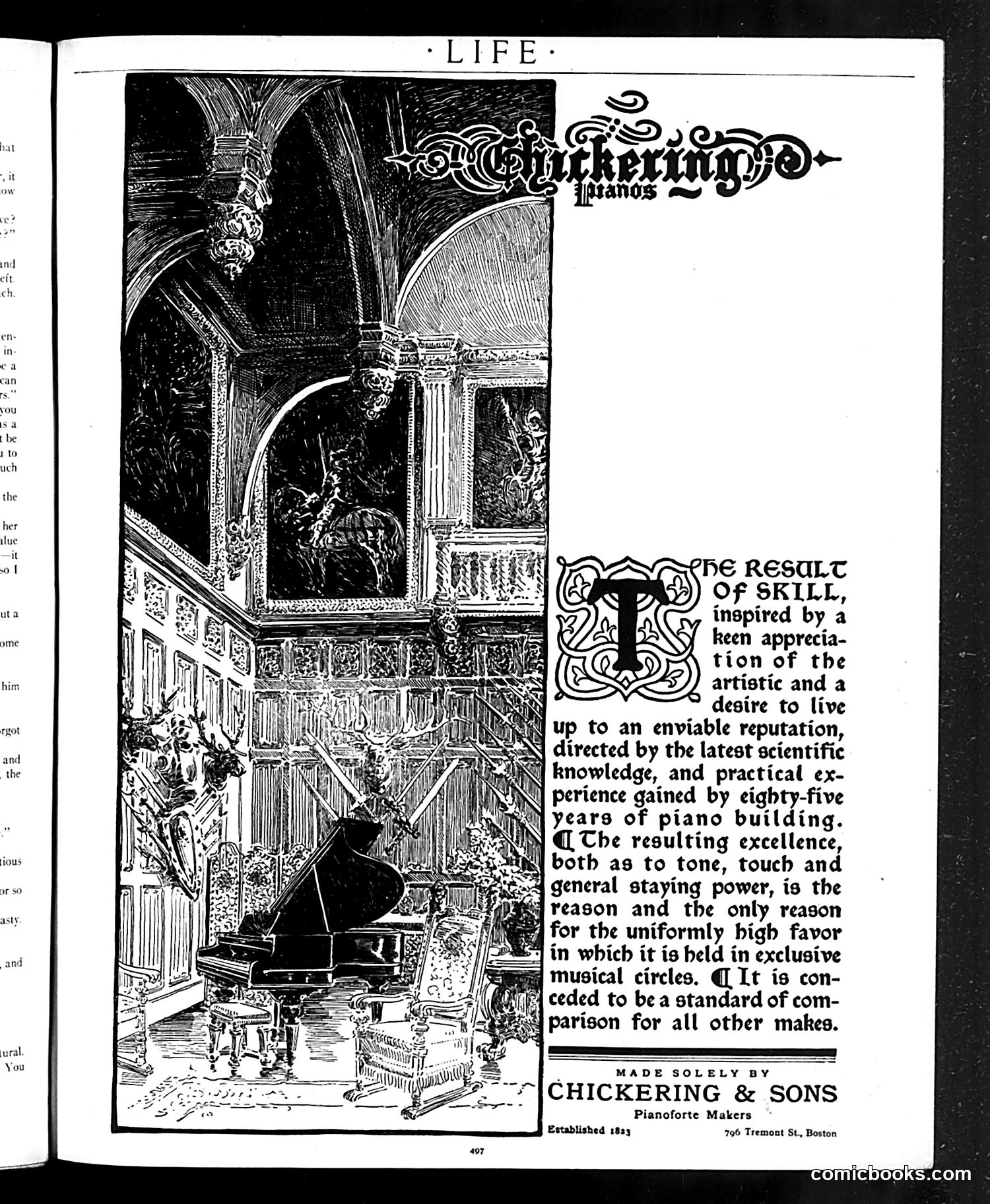
This page is **primarily an advertisement**, not political satire. It advertises Chickering & Sons pianos, a Boston-based manufacturer established in 1823. The ornate illustration depicts an elegant interior—likely a wealthy home's music room—with a grand piano as the focal point. The image conveys luxury and refinement, appealing to the "exclusive musical circles" mentioned in the text. The ad's rhetoric emphasizes quality through heritage (85 years of experience), scientific knowledge, and superior craftsmanship. It positions Chickering pianos as the standard against which all competitors are measured—a claim common in early 20th-century luxury advertising. The decorative typography and elaborate artistic framing reflect the aesthetics of the *Life* magazine era, when high-end advertisements mimicked fine art to associate products with cultural sophistication. This is **marketing through aspiration**: readers are invited to imagine themselves in these refined surroundings by purchasing the advertised product.
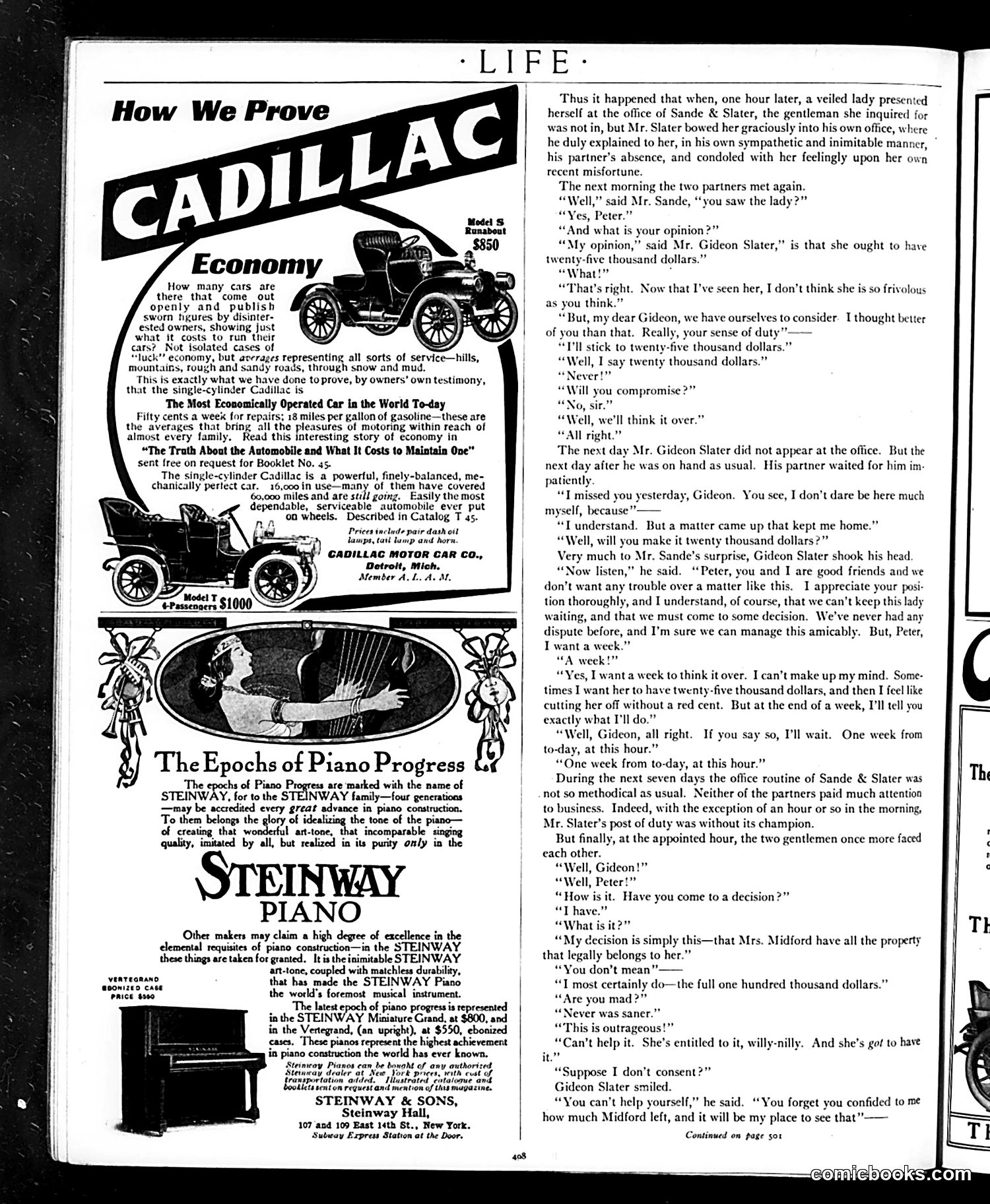
This page contains **primarily advertisements** rather than political satire. The **Cadillac ad** promotes the single-cylinder Cadillac as economical—claiming 18 miles per gallon and 50 cents weekly operating costs. This targets middle-class families, positioning affordable motoring as accessible to "almost every family." The emphasis on published owner testimony reflects early automotive marketing's concern with establishing reliability credibility. The **Steinway Piano ad** uses the phrase "Epochs of Piano Progress," crediting the Steinway family with advancing piano construction and achieving superior "art-tone" quality. This is luxury marketing emphasizing heritage and craftsmanship. The **story text** (right column) appears to be serialized fiction about business partners Sande and Slater debating compensation for a veiled lady's misfortune—likely continuing from a previous installment. It's domestic drama, not satire. Overall, this is a **commercial magazine page** featuring upscale consumer goods advertising alongside light entertainment fiction, typical of Life's early 20th-century format.
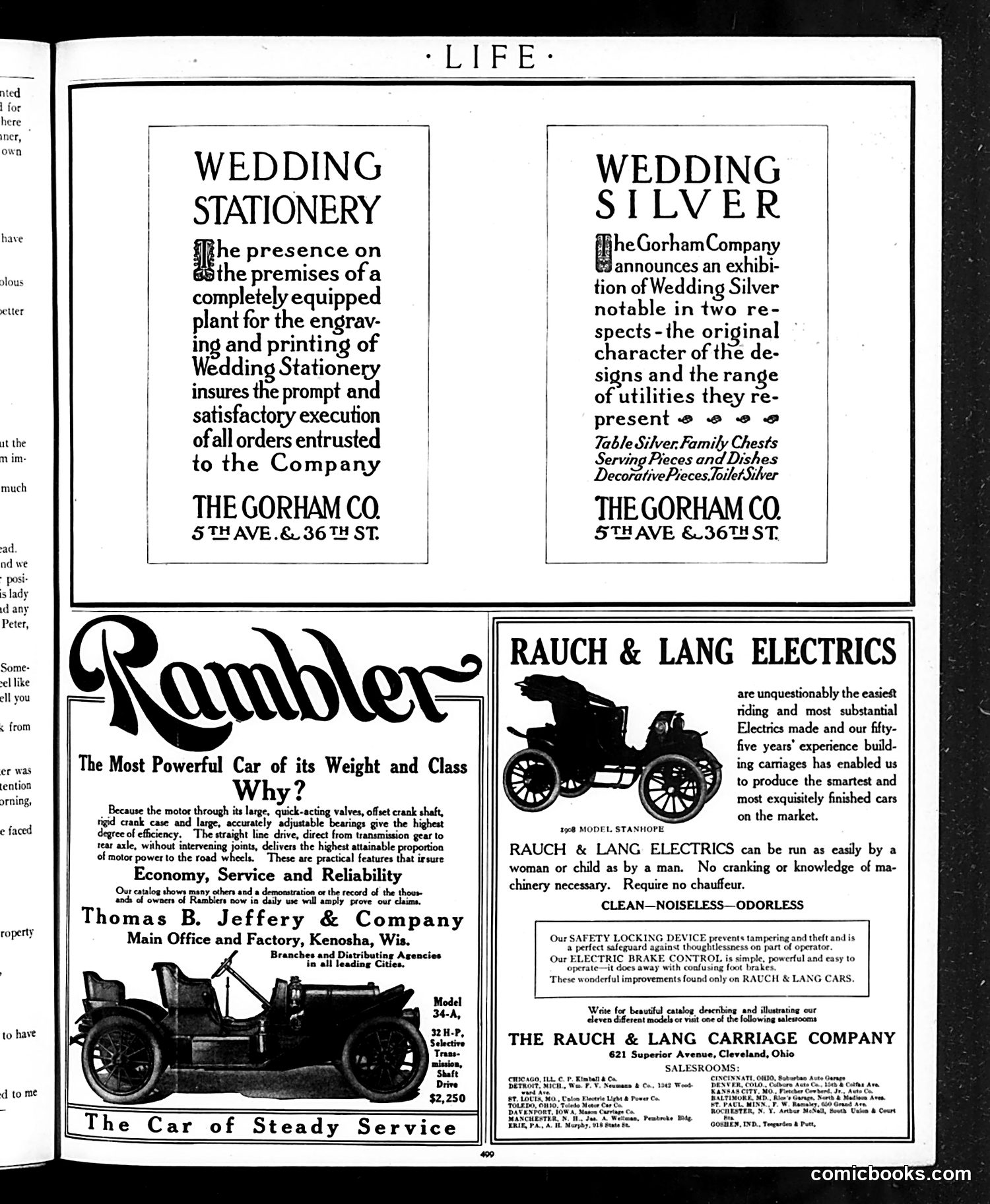
This is primarily a **advertisements page**, not a satirical cartoon. It contains four early automobile and luxury goods ads from around 1908-1910. The top two ads promote **The Gorham Company's** wedding stationery and silver services—standard luxury goods advertising emphasizing quality and reliability. The bottom half features two competing **electric automobile** advertisements: 1. **Rambler** (Thomas B. Jeffery & Company) advertises a gasoline-powered car emphasizing engineering power and "steady service." 2. **Rauch & Lang Electrics** markets electric vehicles specifically to women and children, emphasizing ease of operation ("no cranking," "no knowledge of machinery necessary"), cleanliness, and quiet operation—positioning electrics as safer, simpler alternatives to temperamental gasoline cars. This reflects the historical reality that **electric vehicles appealed to affluent women** in the early 1900s before gasoline engines dominated. The ads reveal gendered marketing and competing automotive technologies before the internal combustion engine became standard.
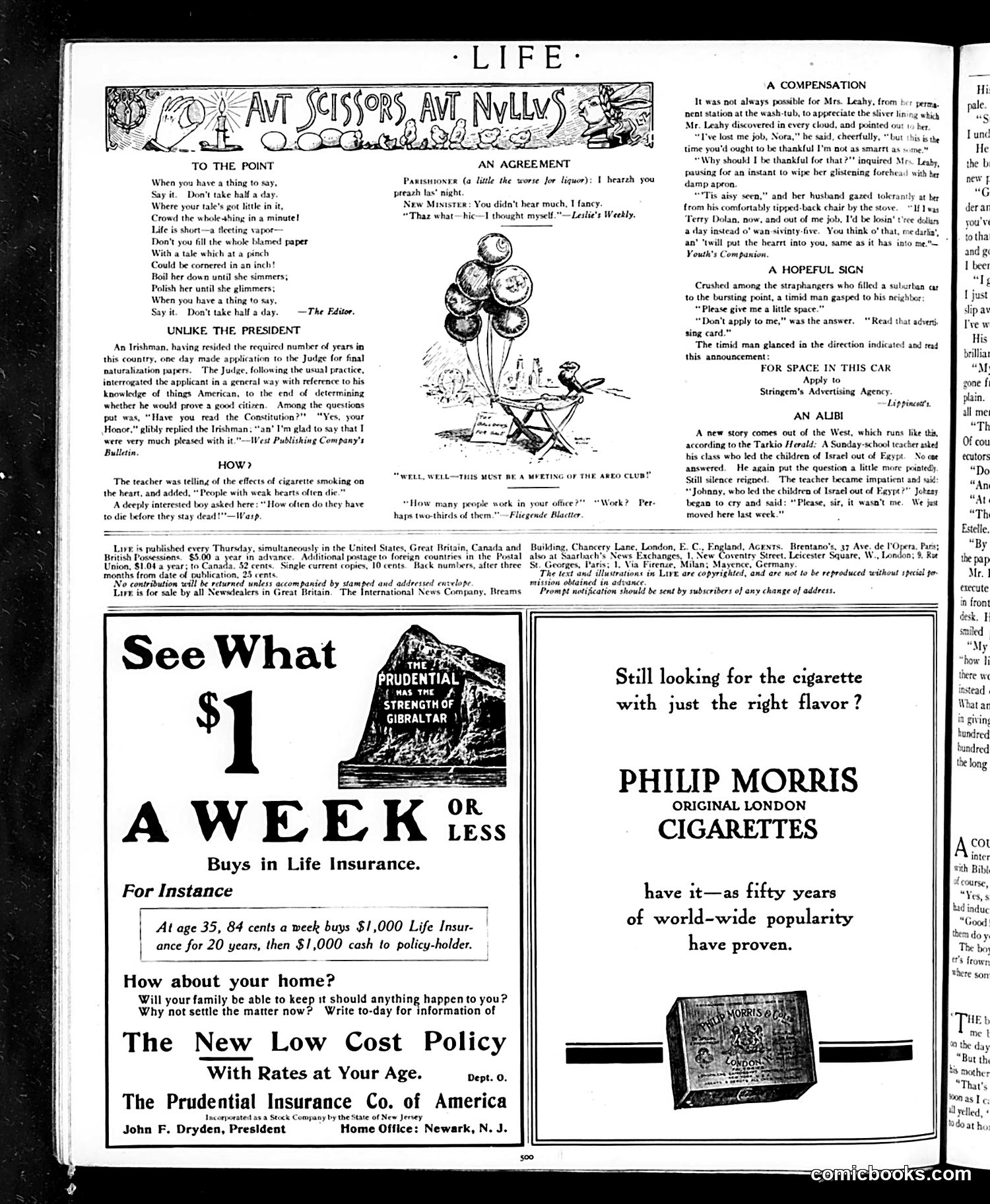
This page contains several brief humorous pieces typical of early 20th-century American satirical journalism: **"To the Point"** and **"Unlike the President"** are editorial poems/anecdotes mocking verbosity and praising conciseness—likely referencing contemporary political long-windedness. **"How?"** is a child's logic joke about the absurdity of repeated dying. **"An Agreement"** appears to be a cartoon about a drunk man and a minister at an "Aero Club" meeting, their conversation illustrating mutual misunderstanding or hypocrisy. **"A Compensation"** depicts Irish immigrant humor: a jobless Mr. Leahy philosophically notes his unemployment is less costly than a wealthier man's would be—playing on ethnic stereotypes about Irish laborers and stoic poverty. **"A Hopeful Sign"** satirizes commercial advertising's invasiveness—even subway space is being sold for ads. The page is primarily **advertising** (Prudential Insurance, Philip Morris cigarettes) interspersed with short humor pieces rather than sustained political commentary. The tone is gentle satire of class, ethnicity, and commercialism rather than hard-hitting social criticism.
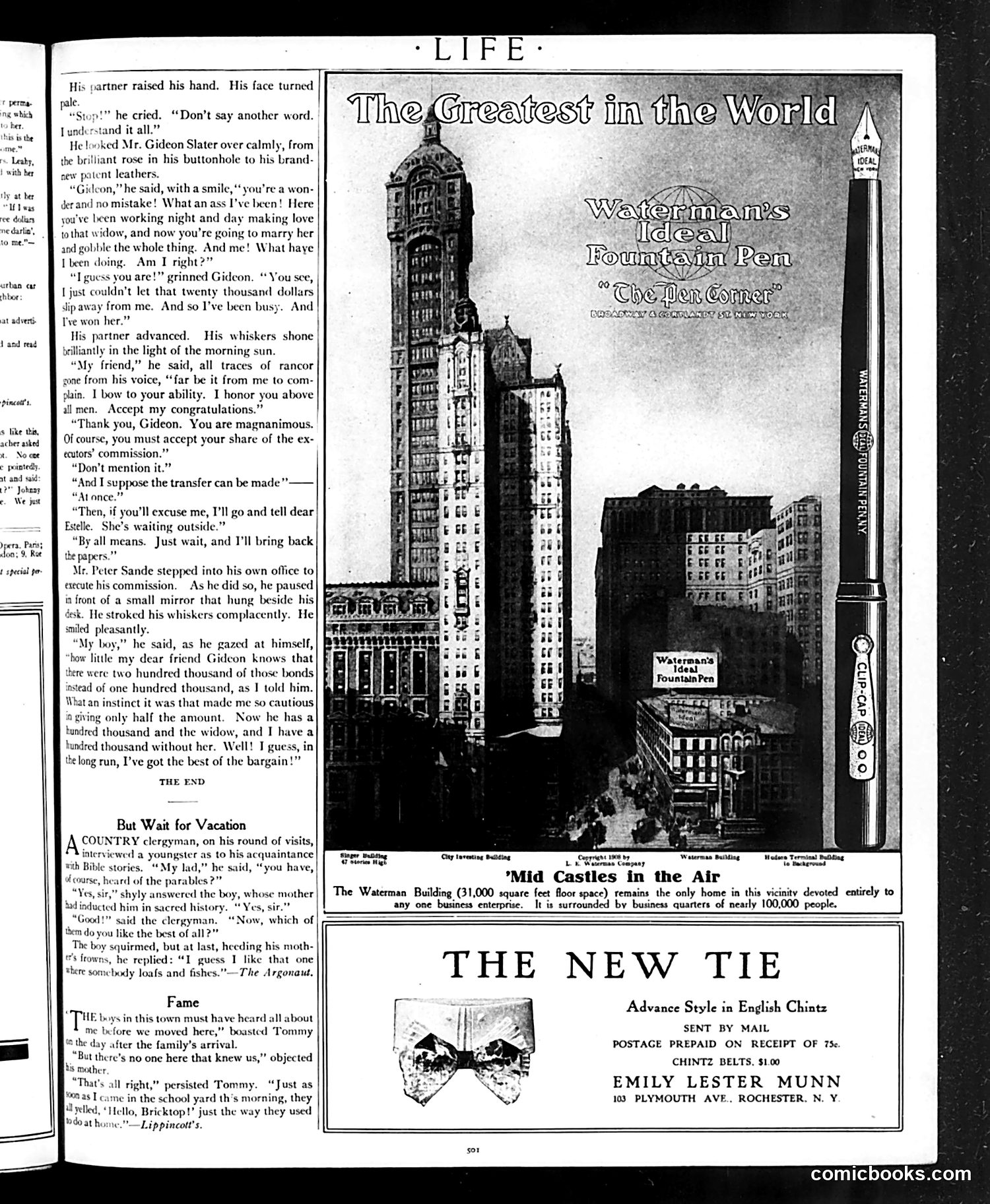
This page contains a short story satirizing greed and deception. Two business partners scheme over a wealthy widow's inheritance of $200,000. One partner, Gideon Slater, courts and marries her while the other, Peter Sande, pretends to congratulate him—but reveals in private that he's actually won the larger prize: he told Gideon there were only $100,000 in bonds when there were actually $200,000, keeping half for himself while Gideon gets the widow and her apparent fortune. The satire mocks male avarice and scheming: both men's actions are morally corrupt, though Sande's betrayal is more cynical. The story's irony—that deception ultimately profits the more ruthless deceiver—reflects turn-of-the-century anxieties about dishonest business practices. The page also includes unrelated humorous anecdotes and advertisements (Waterman fountain pens, Emily Lester Munn's mail-order chintz belts).
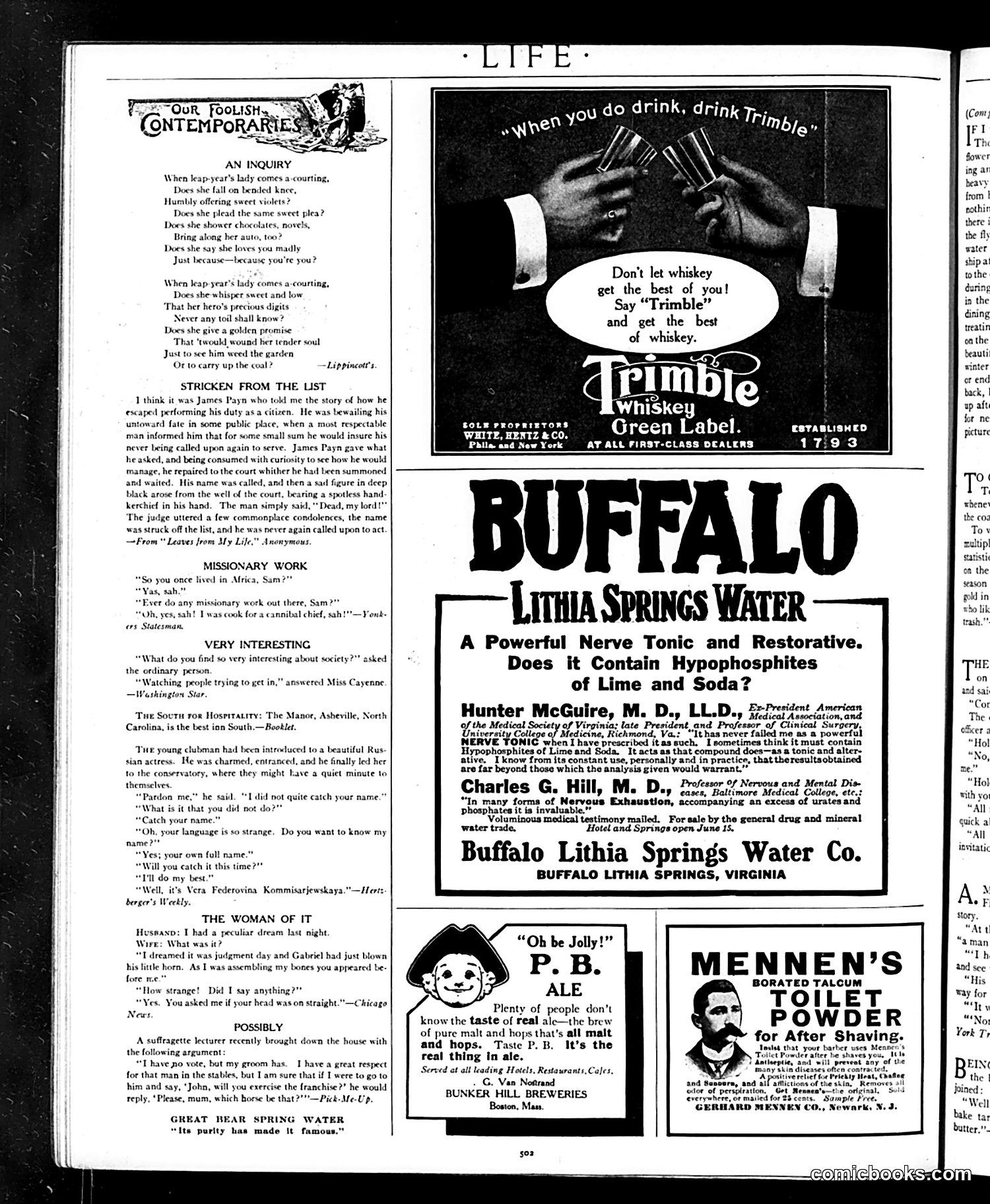
This page from *Life* magazine combines satirical commentary with period advertisements. The main content includes several humorous short pieces poking fun at contemporary social conventions: **"An Inquiry"** satirizes leap-year traditions where women were expected to initiate courtship, questioning whether women would offer the same romantic gestures men typically did. **"The Woman of It"** jokes about marital dynamics, with a husband describing a dream where his wife's first concern upon resurrection is whether his head is on straight—mocking women's supposed obsession with male appearance. The advertisements reveal period attitudes: **Trimble Whiskey** uses gendered language ("don't let whiskey get the best of you"), while **Buffalo Lithia Springs Water** promotes itself as a nerve tonic with medical endorsements—common for patent medicines of this era that made unsubstantiated health claims. **Mennen's Talcum Powder** advertises for "After Shaving," reflecting early 20th-century grooming products. Overall, the page reflects contemporary gender stereotypes and the era's acceptance of dubious medical claims in advertising.
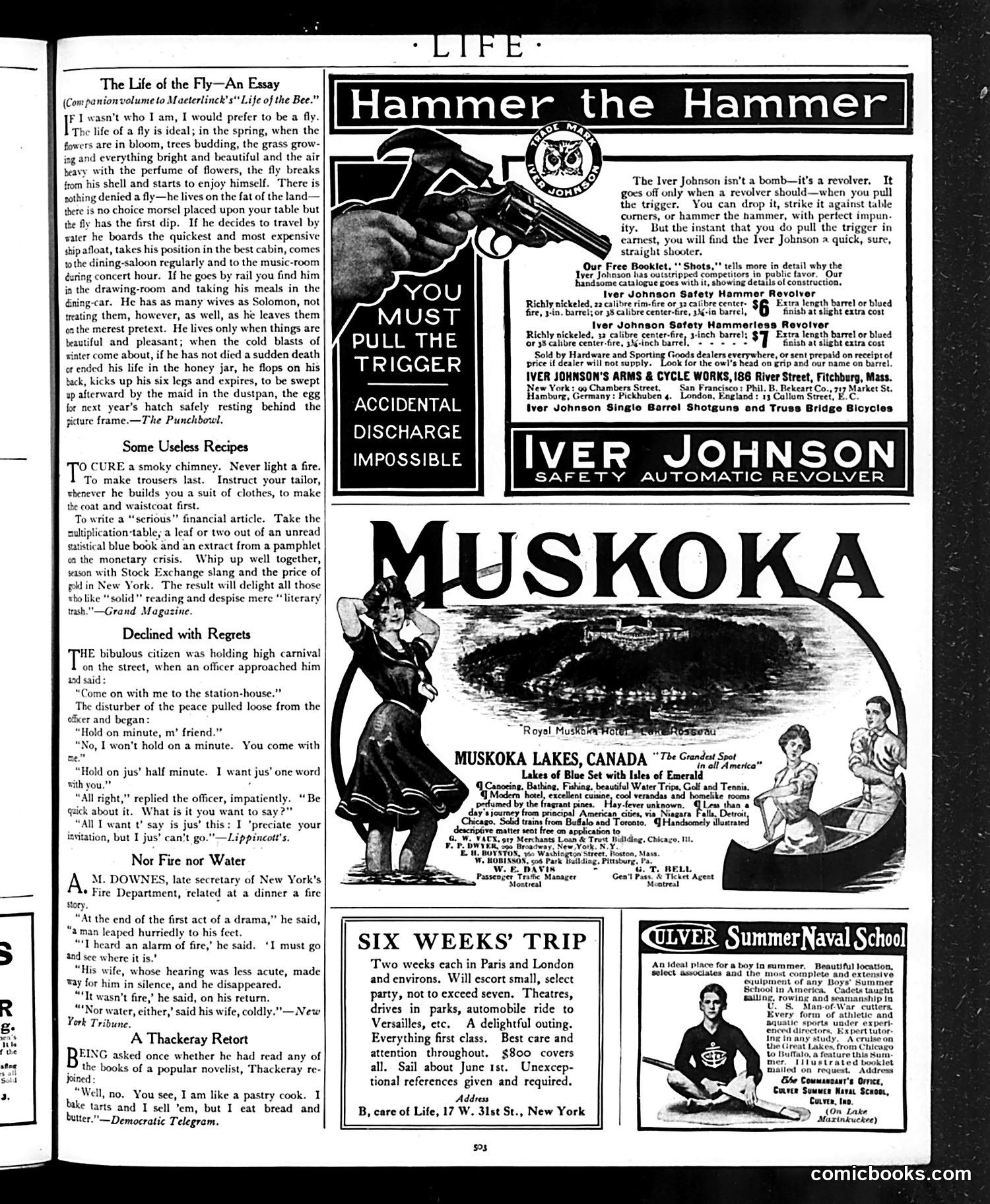
This page is primarily **advertising and light humor** rather than political satire. The dominant feature is a large **Iver Johnson Safety Automatic Revolver advertisement**, emphasizing that the gun won't fire accidentally—only when deliberately triggered. This reflects early 20th-century product safety marketing. The page includes several humorous essays and anecdotes: - "The Life of the Fly" satirizes human pretension by describing an imagined fly's luxurious existence - "Some Useless Recipes" offers tongue-in-cheek advice (e.g., "to cure a smoky chimney, never light a fire") - "Declined with Regrets" and "Nor Fire nor Water" are brief comedic stories about misunderstandings - A Thackeray anecdote mocks writers The remaining advertisements promote **Muskoka Lakes, Canada** as a tourist destination and a **Culver Summer Naval School** for boys. There are no identifiable political figures or pointed social commentary—this is entertainment and commerce typical of Life's early satirical-magazine format.
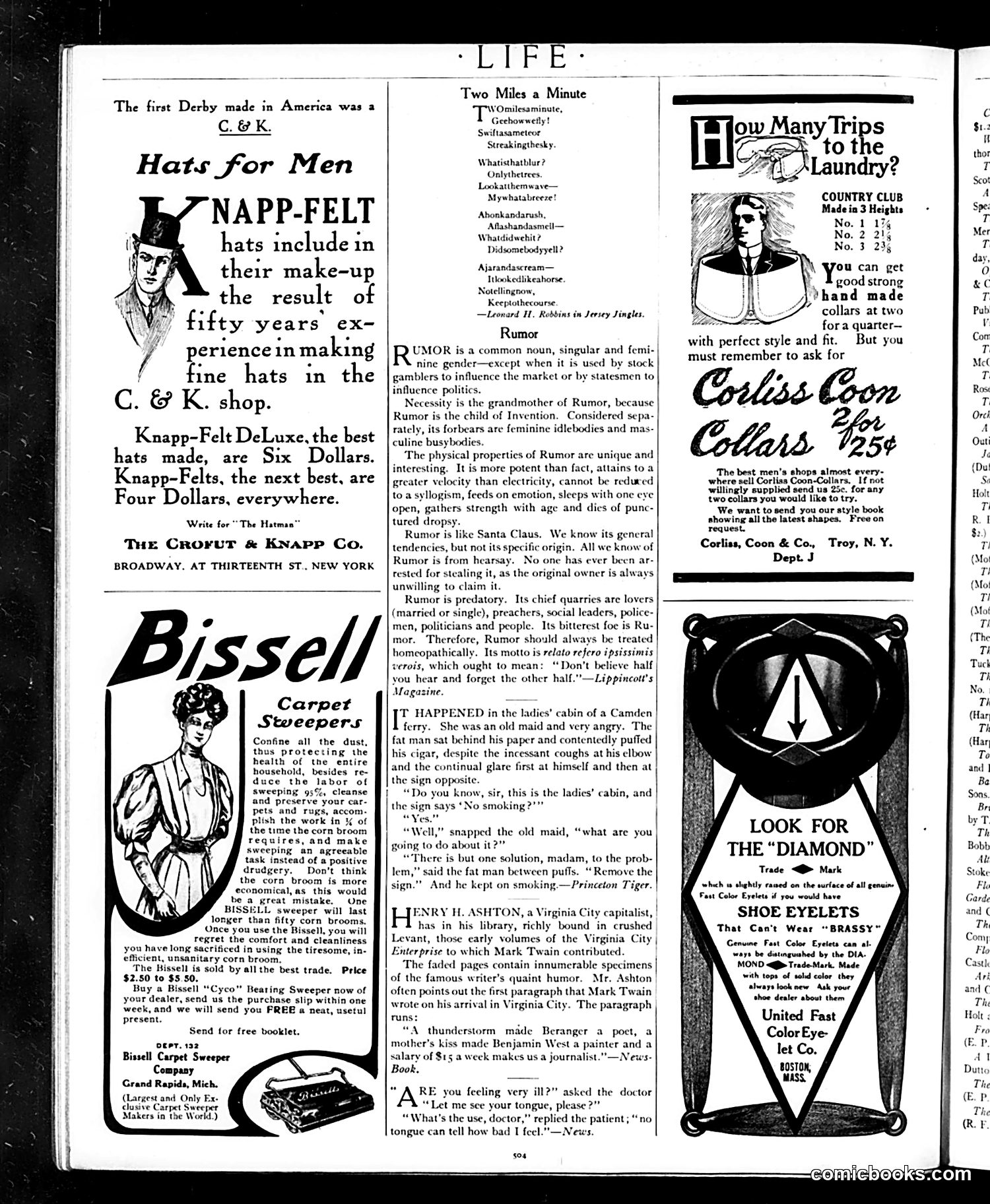
This is primarily a **advertisements and humor page** from Life magazine, with minimal political content. The page features: 1. **Hat and household product ads** (Knapp-Felt hats, Bissell carpet sweepers, Corliss Coon Collars, shoe eyelets)—typical early 20th-century marketing emphasizing domestic efficiency and male fashion. 2. **"Two Miles a Minute"**—a lighthearted poem about speeding automobiles, reflecting the era's fascination with new automotive technology and its thrilling (and reckless) speed. 3. **"Rumor"**—a satirical essay personifying Rumor as female, noting it spreads fastest among "lovers, preachers, social leaders, policemen, politicians and people." This gently mocks how gossip and misinformation spread in society. 4. **Anecdotes** about a cigar-smoking man in a ladies' cabin and Mark Twain materials—humor pieces rather than satire. The page reflects everyday American consumer culture and genteel humor of the period, not political commentary.
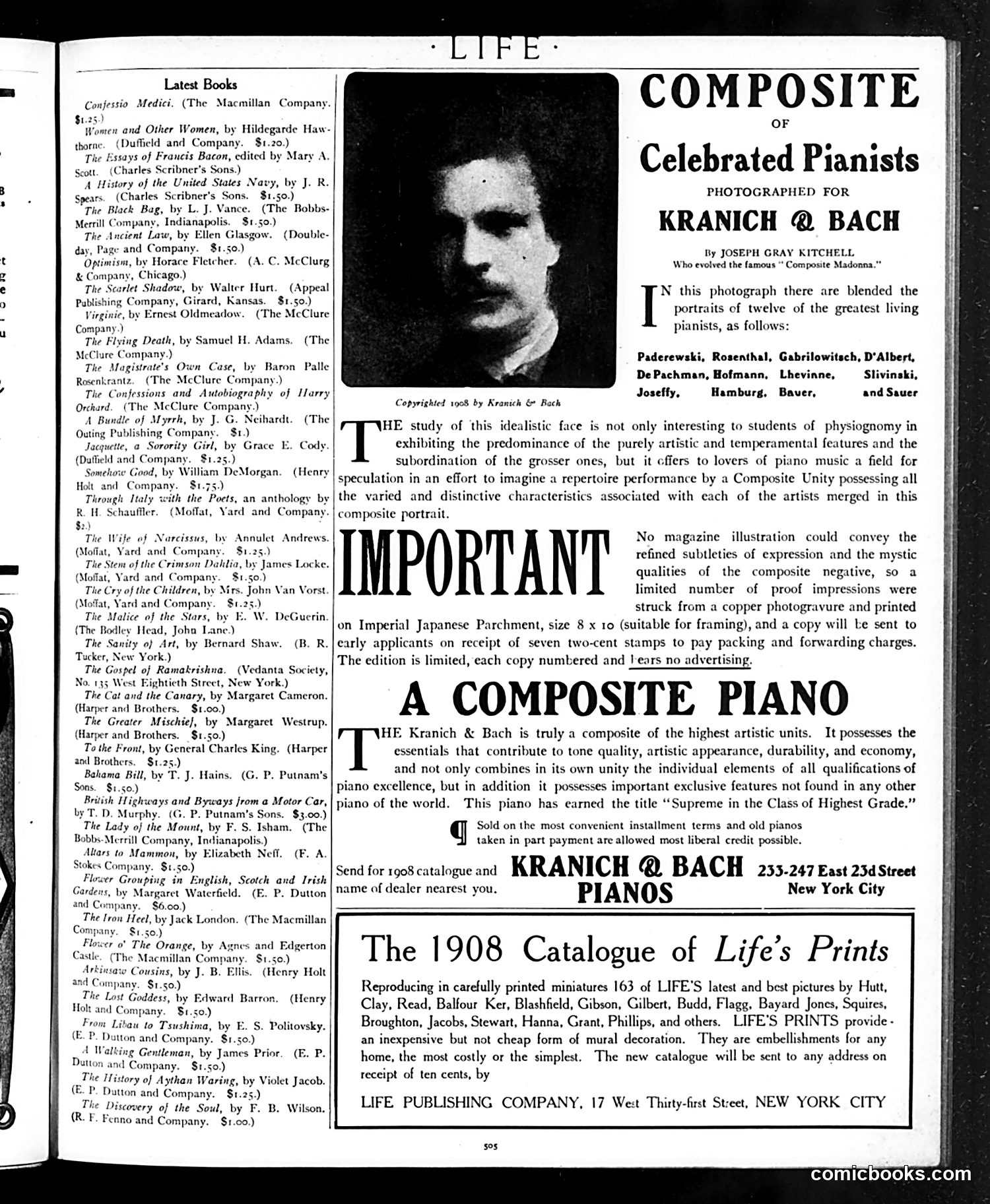
This page is primarily **advertising**, not political satire. The left column lists new books from 1908. The dominant content is a **commercial advertisement** for Kranich & Bach pianos featuring a composite photograph. The composite image blends portraits of twelve celebrated pianists (Paderewski, Rosenthal, Gabrilowitsch, and others) into a single "idealistic face." This marketing technique, credited to photographer Joseph Gray Kitchell, aimed to create an aspirational image representing piano excellence. The ad claims the resulting piano combines "all qualifications of piano excellence" in "one unity." The accompanying text argues the composite portrait fascinates physiognomy students and piano enthusiasts alike—inviting readers to imagine how a performer possessing all these pianists' traits might sound. This reflects early 1900s advertising innovation using composite photography to sell luxury goods.
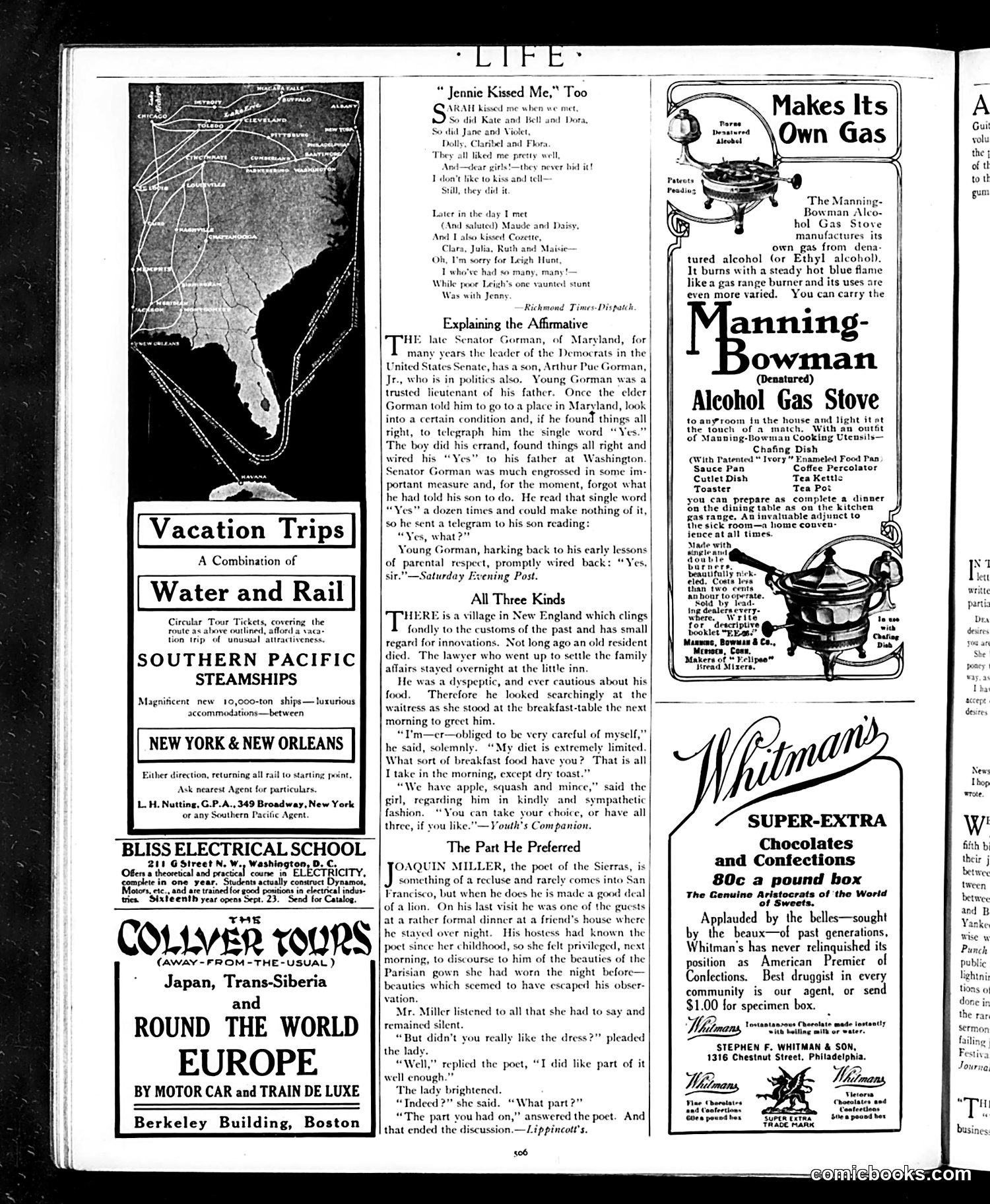
This page is primarily **advertisements and short humor pieces** rather than political satire. The ads promote travel (Southern Pacific steamships, Collver Tours), education (Bliss Electrical School), and consumer products (Manning-Bowman gas stove, Whitman's chocolates). The humor pieces are light social comedy: 1. **"Jennie Kissed Me, Too"** — A poem joking about a man who receives kisses from multiple women, playing on Leigh Hunt's famous poem. 2. **"Explaining the Affirmative"** — An anecdote about Senator Gorman's son who responds "Yes, sir" to his father's confused telegram, illustrating obedience and miscommunication. 3. **"All Three Kinds"** — A New England innkeeper's humorous misunderstanding when offering a dyspeptic lawyer "apple, squash and mince" as breakfast food (vegetables, not grain cereals). 4. **"The Part He Preferred"** — Poet Joaquin Miller politely deflects a hostess's questions about her dress, implying he preferred something else about the evening. These are gentle, domestic humor pieces typical of *Life* magazine's satirical approach to everyday social situations.
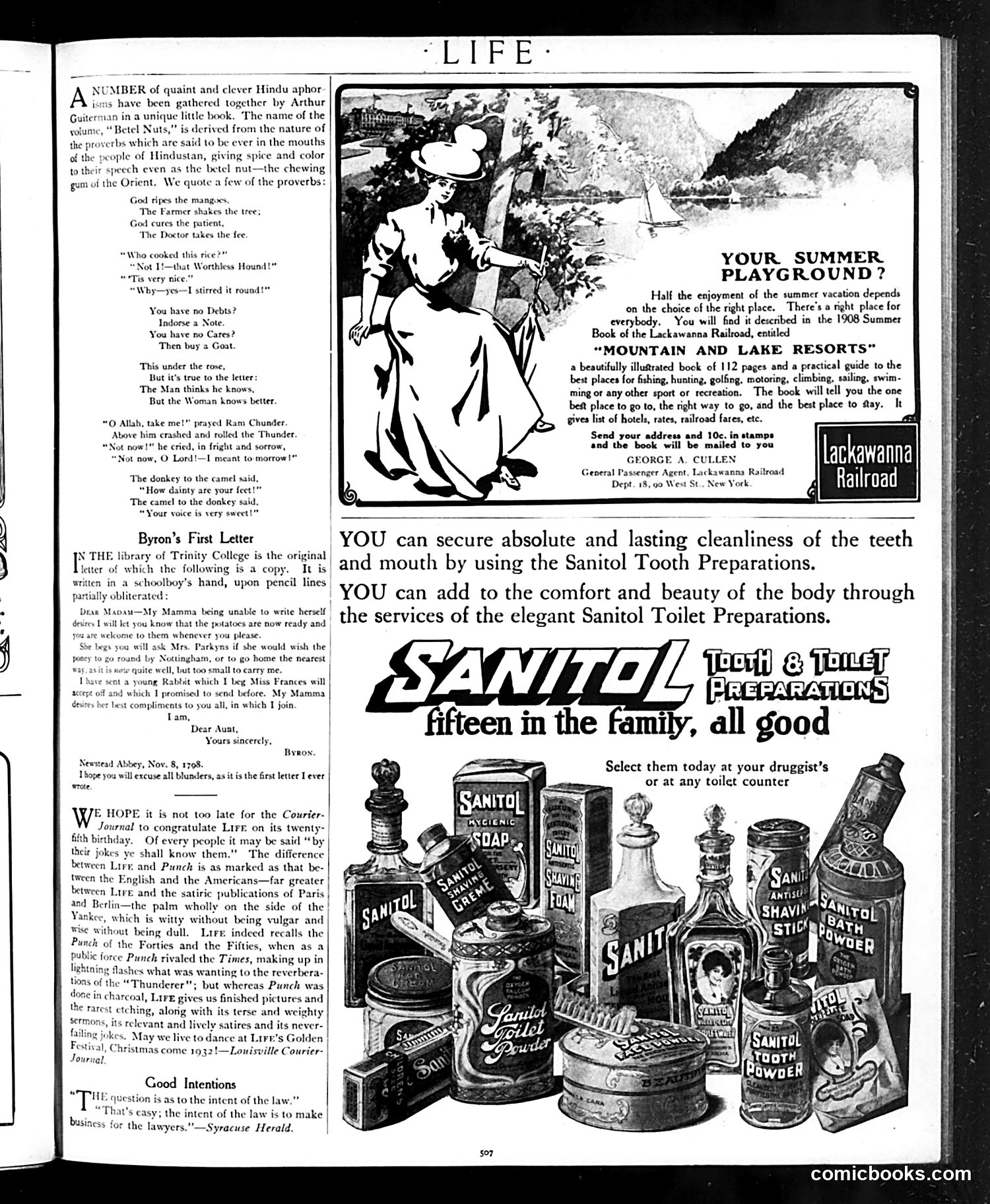
This page is primarily **advertising and literary content** rather than political satire. The main items are: 1. **"Betel Nuts"** — A collection of Hindu proverbs gathered by Arthur Guiterman, presented with gentle humor. These are folk sayings about human nature (e.g., "God cures the patient, / The Doctor takes the fee"), offering mild social commentary through traditional wisdom rather than sharp satire. 2. **Byron's First Letter** — A reproduction of a childhood letter from the poet Lord Byron, presented as a historical curiosity with editorial commentary praising *Life* magazine's wit compared to British *Punch*. 3. **Advertisements** — Large ads for the Lackawanna Railroad's summer resort guide and Sanitol toilet/tooth preparations. The page reflects *Life*'s 25th-anniversary self-congratulation and general early-1900s magazine content mixing literature, humor, and advertising without explicit political targeting.
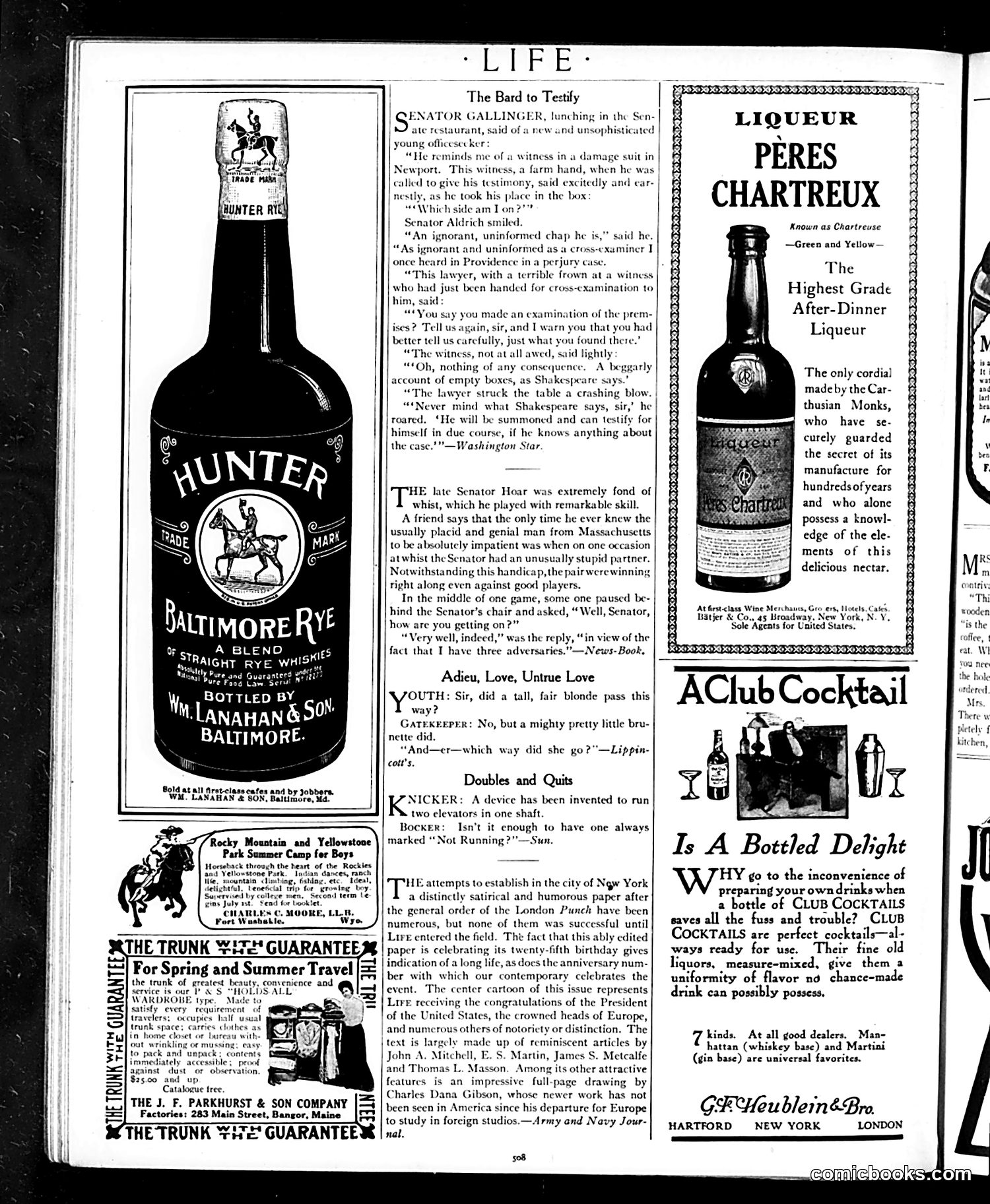
This page is primarily **advertising with humorous anecdotes** rather than editorial cartoons. The satire appears in the text sections: **"The Bard to Teetify"** mocks incompetent witnesses in courtroom testimony—a farm hand unable to remember which side he's on, and a lawyer dealing with an uninformed witness. The humor derives from rural/working-class inability to navigate formal legal procedures. **The Senator Hoar anecdote** satirizes a whist player so frustrated by his partner's incompetence that he claims to have "three adversaries" (the two opponents plus his own useless partner). It's genteel humor at the expense of the socially inept. **"Adieu, Love, Untrue Love"** is a brief dialogue joke about mistaken identity—a man asking about a blonde woman, told only a brunette passed. **"Doubles and Quits"** puns on broken elevators marked "Not Running." The bulk of the page consists of advertisements for Hunter Rye whiskey, summer camps, luggage, and liqueur—typical of Life's revenue model. There's also an editorial note celebrating Life's 25th anniversary with congratulations from world leaders (referenced but not pictured here).
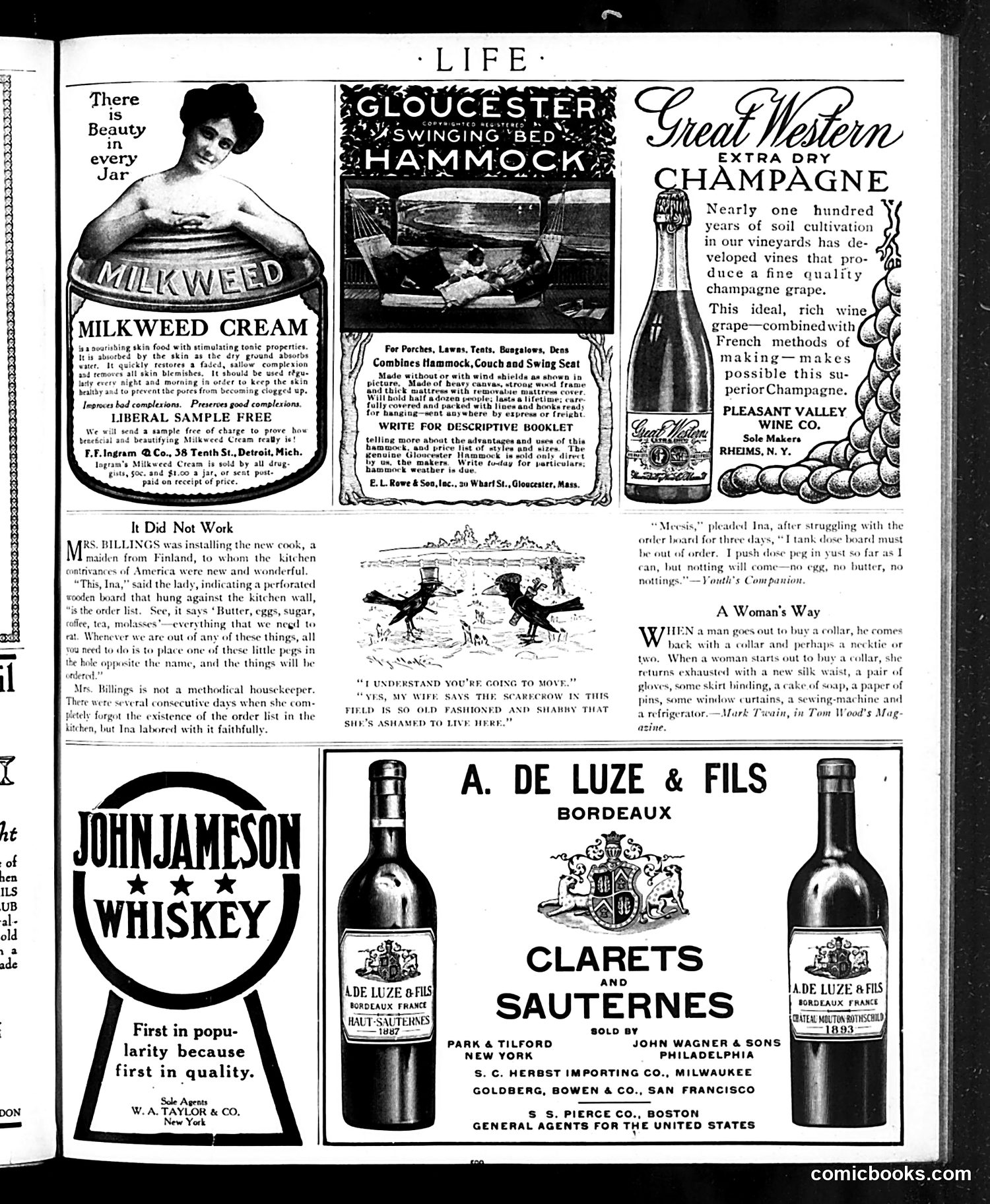
This page is primarily **advertisements and light humor pieces**, not political satire. The content includes: **Advertisements:** Milkweed Cream (skincare), Gloucester Hammock (furniture), Pleasant Valley Wine, John Jameson Whiskey, and A. De Luze & Fils (French wines). **Humor Pieces:** - "It Did Not Work" features a Finnish immigrant cook named Ina who misunderstands an order board system in her American employer's kitchen—a gentle joke about language/cultural barriers common in early 20th-century American humor. - "A Woman's Way" satirizes women's shopping habits, suggesting women sent to buy one item return with multiple unrelated purchases. **The cartoon** (two figures arguing in snow) illustrates a quarrel about a scarecrow being old-fashioned. The page reflects period concerns: immigration, domestic service, consumer culture, and gender stereotypes. There is **no significant political commentary**—this appears to be a typical early-1900s Life magazine blend of advertising, mild social humor, and consumer goods promotion.
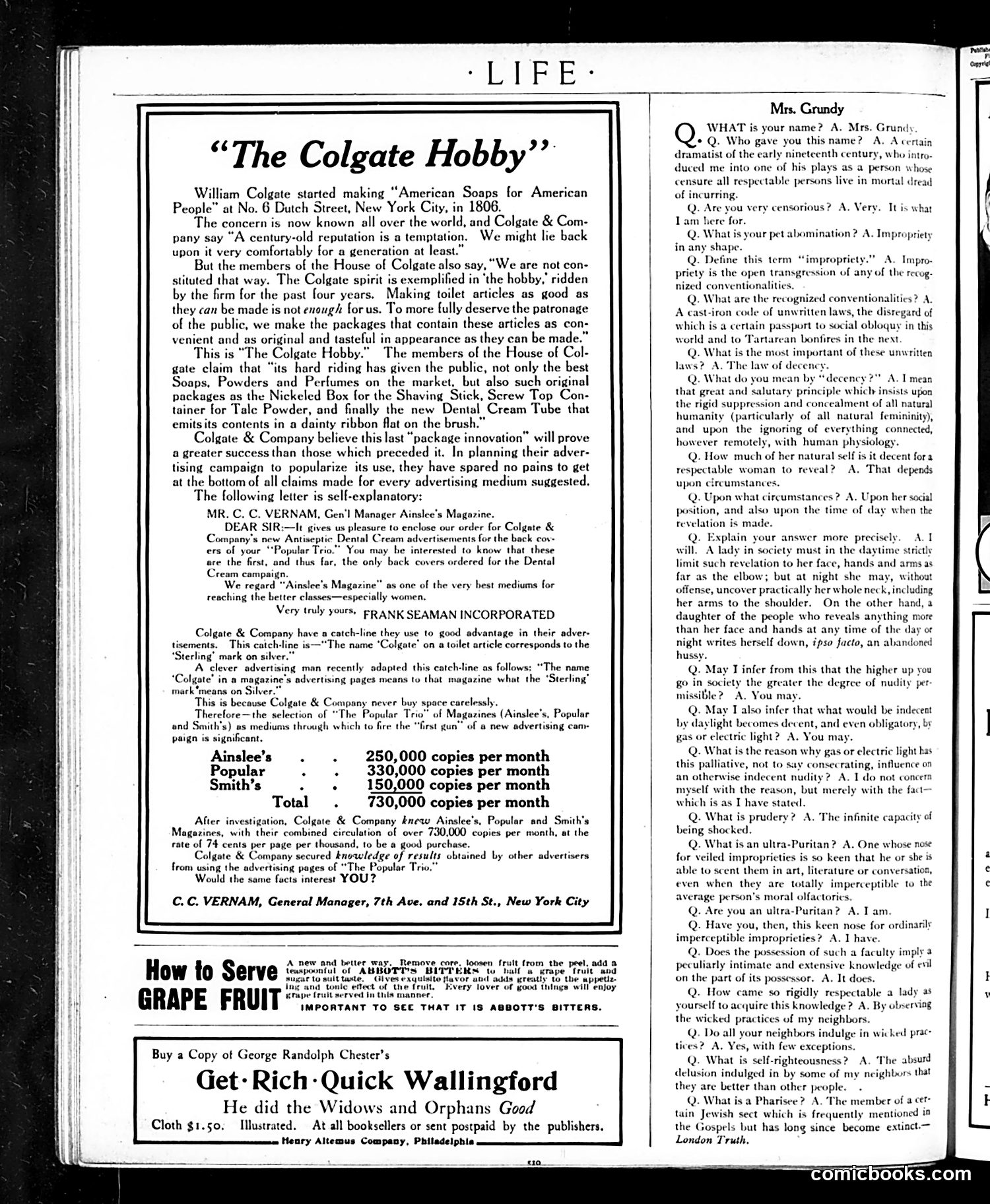
This is primarily a **corporate advertisement**, not satire or political commentary. It promotes Colgate & Company's business philosophy through a detailed case study. **The "Hobby"** refers to the company's commitment to continuous product and packaging innovation—not a recreational pursuit. The text emphasizes that Colgate refuses to rest on its 100-year reputation, instead obsessively improving soap quality and container design (highlighting innovations like the "Dental Cream Tube" that dispenses product as a "dainty ribbon"). **The Marketing Claim**: Colgate compares its brand value to the "Sterling" mark on silver, suggesting reliability and quality assurance. **The Data Section** documents Colgate's strategic magazine placement—selecting *Ainslee's*, *Popular*, and *Smith's* magazines (combined 730,000 monthly circulation) to reach middle and upper-class readers, "especially women." The accompanying sidebar features an interview with "Mrs. Grundy" (a generic character representing conventional morality and social propriety), likely used elsewhere in Life for satirical commentary, but here it appears unrelated to the Colgate material. This represents **early 20th-century corporate branding**: emphasizing innovation, targeting specific demographics through magazine advertising, and using numerical data to justify marketing decisions.
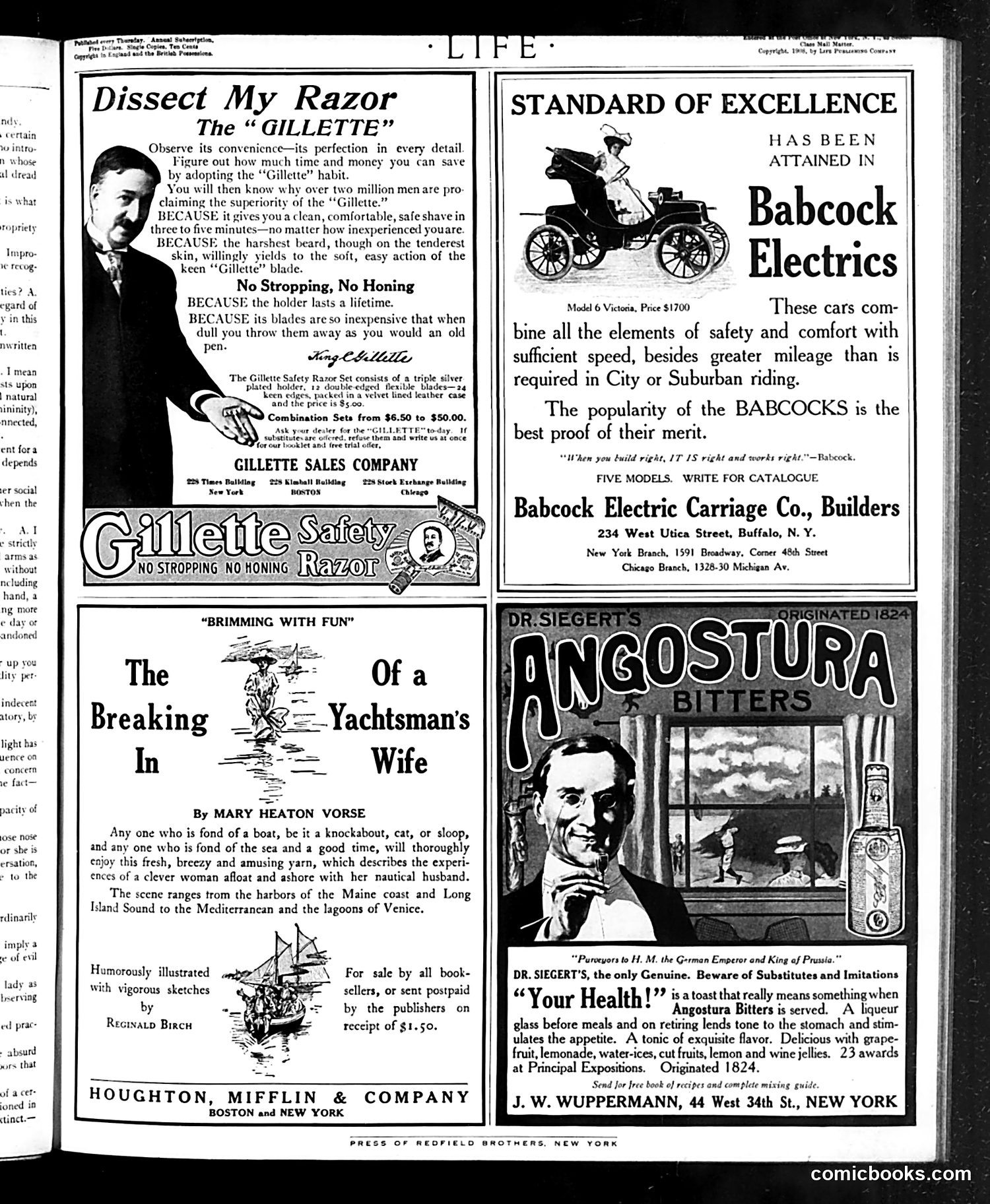
This page is primarily **advertising**, not political satire. It contains four product advertisements typical of early 1900s Life magazine: 1. **Gillette Safety Razor** - Promotes the convenience and affordability of disposable blades versus traditional stropping razors. The "dissect" framing is a sales hook emphasizing product superiority. 2. **Babcock Electric Carriage** - Advertises an early electric automobile, emphasizing safety, comfort, and range for urban/suburban use. 3. **"The Breaking-In of a Yachtsman's Wife"** - A serialized story by Mary Heaton Verse about a woman's sailing adventures, offered by publisher Houghton Mifflin. 4. **Angostura Bitters** - A medicinal liqueur marketed as a digestive tonic, claiming 23 awards and imperial endorsement. The page reflects early 20th-century consumer culture and technological novelties (safety razors, electric cars) presented as modern innovations deserving adoption by affluent readers.
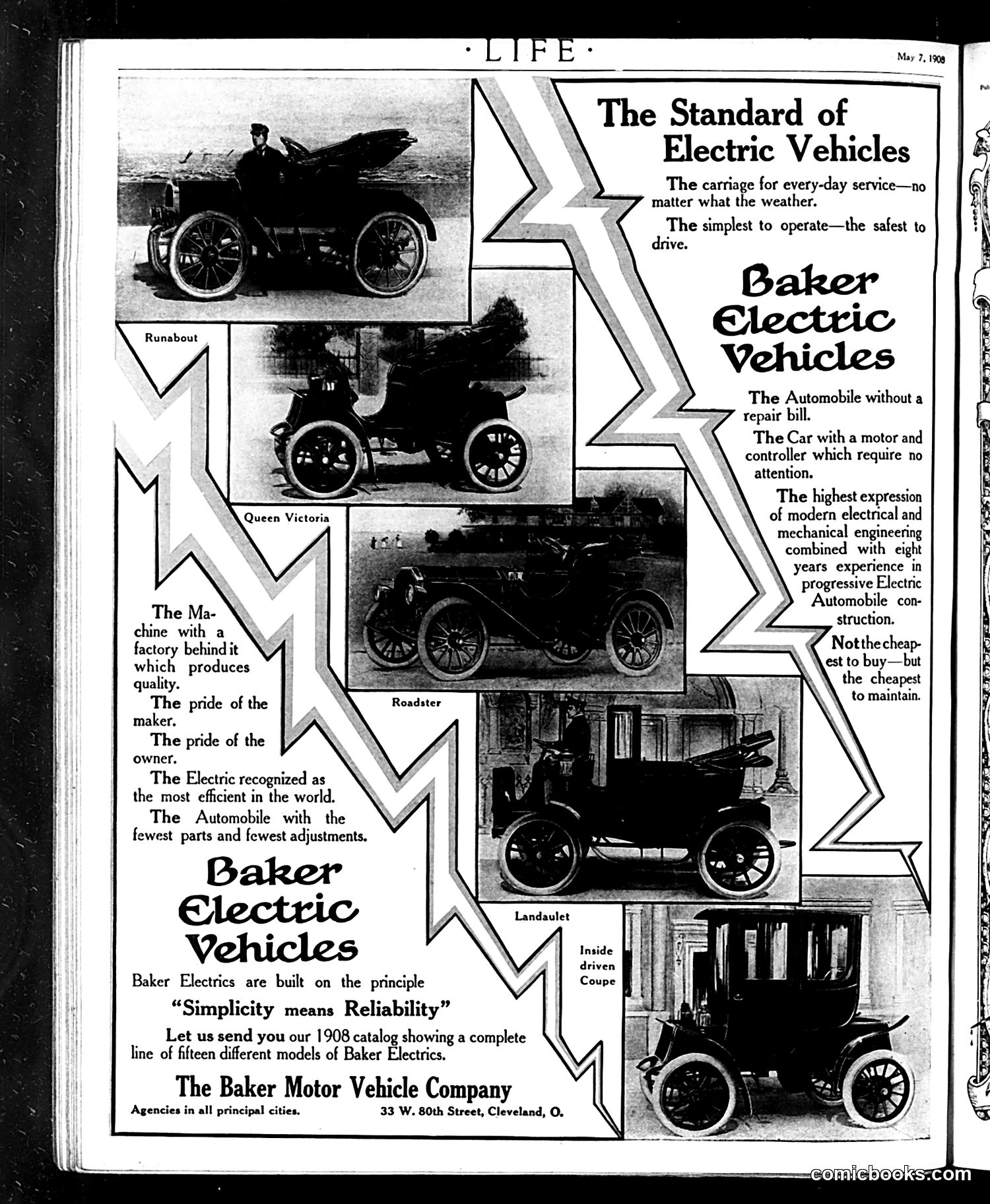
This is primarily a **product advertisement**, not satire. The Baker Motor Vehicle Company promotes electric automobiles to early-20th-century readers. The page showcases five vehicle models (Runabout, Queen Victoria, Roadster, Landaulet, Inside-driven Coupe) with photographs demonstrating their elegance and practicality. The text emphasizes electric vehicles' advantages: no repair bills, simple operation, safety, and reliability—appealing to affluent buyers, particularly women, who found them easier to operate than gasoline cars requiring hand-cranking. The repeated slogan **"Simplicity means Reliability"** reinforces the marketing message. References to "eight years experience in progressive Electric Automobile construction" and being "recognized as the most efficient in the world" assert the company's legitimacy. This advertisement reflects a historical moment when electric vehicles competed seriously with gasoline engines before gas cars ultimately dominated the market.