
Life, 1908-05-07 · page 46 of 48
Life — May 7, 1908 — page 46: what you’re looking at
What you’re looking at
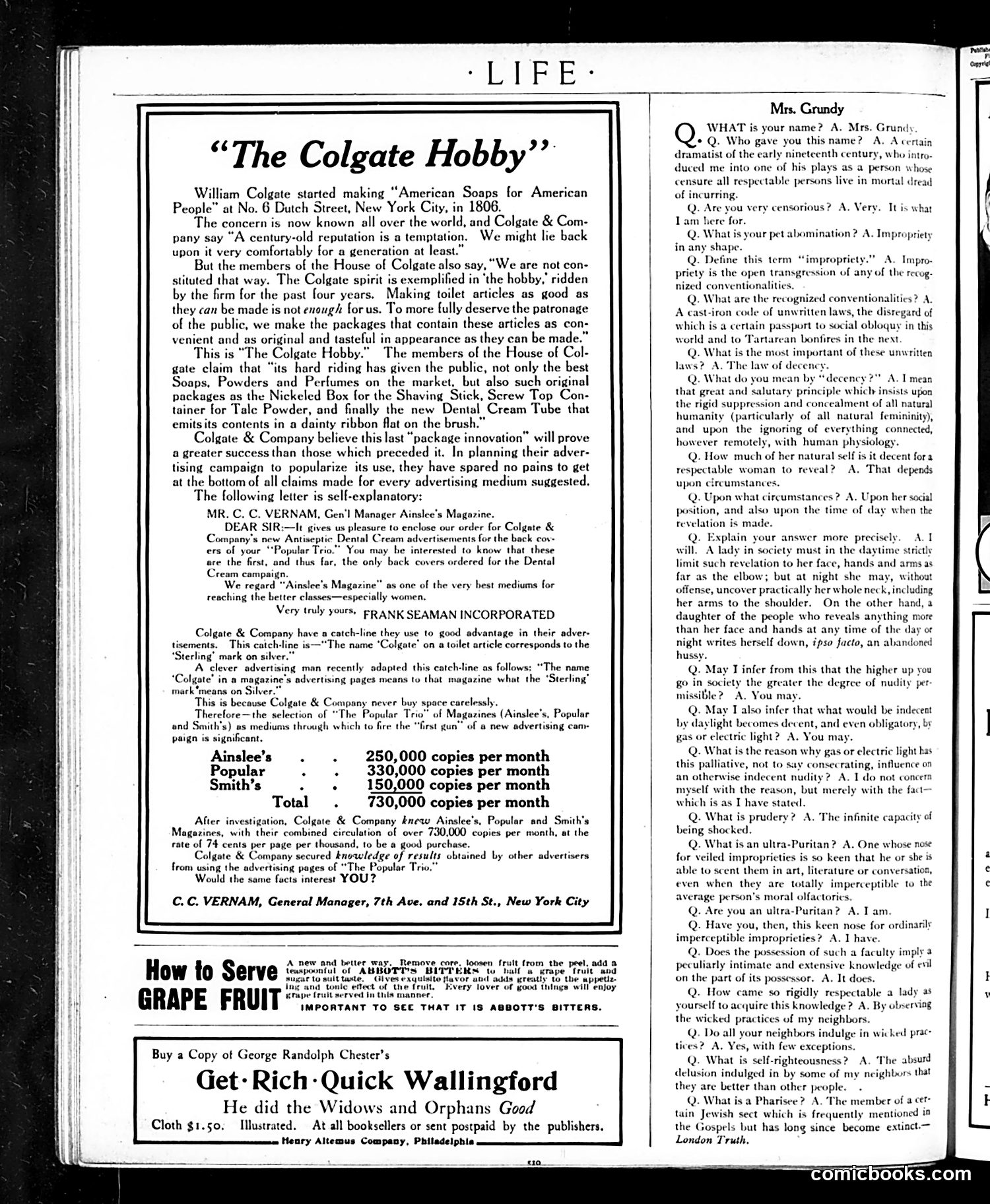
This is primarily a **corporate advertisement**, not satire or political commentary. It promotes Colgate & Company's business philosophy through a detailed case study. **The "Hobby"** refers to the company's commitment to continuous product and packaging innovation—not a recreational pursuit. The text emphasizes that Colgate refuses to rest on its 100-year reputation, instead obsessively improving soap quality and container design (highlighting innovations like the "Dental Cream Tube" that dispenses product as a "dainty ribbon"). **The Marketing Claim**: Colgate compares its brand value to the "Sterling" mark on silver, suggesting reliability and quality assurance. **The Data Section** documents Colgate's strategic magazine placement—selecting *Ainslee's*, *Popular*, and *Smith's* magazines (combined 730,000 monthly circulation) to reach middle and upper-class readers, "especially women." The accompanying sidebar features an interview with "Mrs. Grundy" (a generic character representing conventional morality and social propriety), likely used elsewhere in Life for satirical commentary, but here it appears unrelated to the Colgate material. This represents **early 20th-century corporate branding**: emphasizing innovation, targeting specific demographics through magazine advertising, and using numerical data to justify marketing decisions.
📄 Transcribed text from this page (OCR, searchable)
Machine-transcribed from the original scan — historical spelling and the odd misread are preserved.
“The Colgate Hobby’’ William Colgate started making “American Soaps for American People” at No. 6 Dutch Street, New York City, in 1806. The concern is now known all over the world, and Colgate & Com- pany say “A century-old reputation is a temptation. We might lie back upon it very comfortably for a generation at least.’ But the members of the House of Colgate also say, “We are not con- stituted that way. The Colgate spirit is exemplified in ‘the hobby,’ ridden by the firm for the past four years. Making toilet articles as good as they can be made is not enough for us. To more fully deserve the patronage of the public, we make the packages that contain these articles as con. venient and as original and tasteful in appearance as they can be mad is “The Colgate Hobby.” The members of the House of Col- gate claim that “its hard riding has given the public, not only the best Soaps, Powders and Perfumes on the market, but also such original packages as the Nickeled Box for the Shaving Stick, Screw Top Con- tainer for Tale Powder, and finally the new Dental Cream Tube that emitsits contents in a dainty ribbon flat on the bi Colgate & Company believe this last" “package i innovation” will prove In planning their adver- $ y spared no pains to get at the bottom of all claims made for every advertising medium suggested. The following letter is self-explanatory: MR. C. C. VERNAM, Gen'l Manager Ainslee’s Magazine. DEAR SIR:—It gives us pleasure to enclose our order for Colgate & Company's new Antiseptic Dental Cream advertisements for the back cov- “Popular Trio.” You may be interested to know that these ig thus far, the only back covers ordered for the Dental We regard "Ainalee's Magazine” as one of the very hest mediums for reaching the better classes—especially women. Very truly yours. PRANK SEAMAN INCORPORATED Colgate & Company have a cateh-line they use to good advantage in their adver- tisements. This eaich-line is—"The name ‘Colgate’ on a toilet article corresponds to the ‘Sterling’ mark on silver.”” clever advertising man recently adapted this eatch-line ax follows: “The name ‘Colgate’ in a magazine's advertising pages means to that magazine what the ‘Sterling’ mark’means on Silver.” This is because Colgate & Company never buy Therefore—the selection of “The Popular Tr and Smith's) as mediums through which to fire th paign is significant, Ainslee’s es 250,000 copies per month Popular ‘ . 330,000 copies per month Smith’s . . 150,000 copies per month Total . 730,000 copies per month Alter investigation, Colgate & Company knew Ainslee's, Popular and Smith's Magazines, with their combined circulation of over 730,000 copies per month, at the rate of 74 cents per page per thousand, to be a good purchase. Colgate & Company secured knowledge of results obtained by other advertisers from using the advertising pages of “The Popular Triv.”” Would the same facts interest YOU? C. C. VERNAM, General Manager, 7th Ave. and 15th St., New York City ‘A new and better way. Remove core, loosen frult from the prel. add a ieapoontul of ABBOTTS BITTERS to hull w grape fruit and How to Serv (aie te BERT fe dan eater th one GRAPE FRUIT wrap rved inthis manner. Buy a Copy of George Randolph Chester’s Get: Rich: Quick Wallingford He did the Widows and Orphans Good Cloth $1.50, Illustrated. At all booksellers or sent postpaid by the publishers. Menry Altemus Company, Philadelphia Mrs. Grundy WHAT is your name? A. Mrs. Grundy Q Q. Who gave you this name? A. A cert dramatist of the early nineteenth century, who intro- duced me into one of his plays as a person whose censure all respectable persons live in mortal dread of incurring. Q. Are you very censorious? A. Very. Tt is what Lam here for. Q. What is your pet abomination? A. Impropriety in any shape. Q. Define this term “impropri A. Impro- priety is the open transgression of any of the recog. nized conventionalities, Q. What are the recognized conventionalities? A. A cast-iron code of unwritten laws, the disregard of which is a certain passport to social obloquy in this world and to Tartarean Donfires in the next Q. What is the most important of these unwritten laws? A. ‘The law of decency. Q. What do you mean by “decency ?" A. T mean that great and salutary principle which insists upon the rigid suppression and concealment of all natural humanity (particularly of all natural femininity), and upon the ignoring of everything connected, however remotely, with human physiology. Q. How much of her natural self is it decent fora respectable woman to reveal? A. That depends upon circumstances. Q. Upon what circumstances? A. Upon her social position, and also upon the time of day when the revelation is made. Q. Explain your answer more precisely. A. 1 will, A lady in society must in the daytime strictly limit such revelation to her face, hands and arms as far as the elbow; but at night she may, without offense, uncover practically her whole neck, including her arms to the shoulder. On the other hand, a daughter of the people who reveals anything more than her face and hands at any time of the day or night writes herself down, ipso facto, an abandoned hussy. Q. May I infer from this that the higher up you go in society the greater the degree of nudity per missible? A, You may Q. May I also infer that what would be indecent by daylight becomes decent, and even obligatory, by gas or electric light? A. You may. Q. What is the reason why gas or electric light has this p not to say consecrating, influence on an otherwise indecent nus A. I do not concern myself with the reason, but merely with the fact- which is as I have stated. Q. What is prudery? A. The infinite capacity of being shocked. Q. What is an ultra-Puritan? A. One whose nos for veiled impropricties is so keen that he or she is able to scent them in art, literature or conversation, even when they are totally imperceptible to the average person's moral olfactories. Q. Are you an ultra-Puritan? A. Tam. Q. Have you, then, this keen nose for ordinarily imperceptible improprieties? A. I have. Q. Does the possession of such a faculty imply peculiarly intimate and extensive knowledge of evil on the part of its possessor. A. It does. Q. How came so rigidly respectable a lady 48 yourself to acquire this knowledge? A. By observing the wicked practices of my neighbors. Q. Do all your neighbors indulge in wicked pre tives? A. Yes, with few exceptions. Q. What is self-righteousness? A. ‘The absurd delusion indulged in by some of my neighbors that they are better than other people. Q. What is a Pharisee ? A. The member of a cet- tain Jewish sect which is frequently mentioned in the Gospels but has long since become extinct London Truth.