
Life, 1908-05-07 · page 26 of 48
Life — May 7, 1908 — page 26: what you’re looking at
What you’re looking at
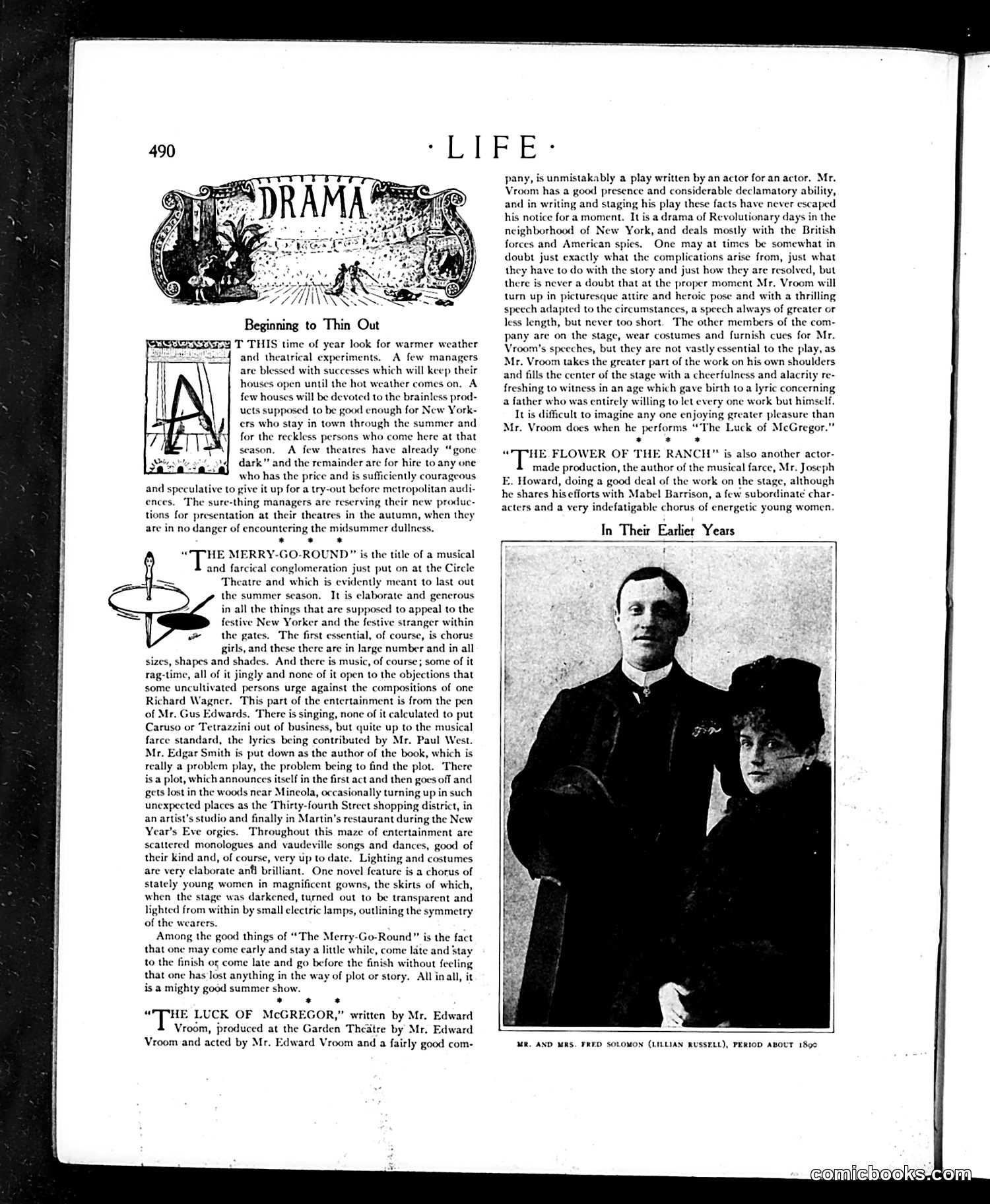
This page contains theater reviews from an early 20th-century issue of *Life* magazine. The text discusses three Broadway productions: **"The Merry-Go-Round"** — A musical farce at the Circle Theatre designed as lightweight summer entertainment, featuring chorus girls, ragtime music, and an intentionally nonexistent plot that "gets lost in the woods." The reviewer jokes it doesn't matter when you arrive or leave since there's no coherent story. **"The Luck of McGregor"** — A Revolutionary War-era drama written by and starring actor Edward Vroom, described sarcastically as a vanity project where Vroom's "good presence and considerable declamatory ability" are never allowed to escape notice. The accompanying photograph shows **Fred Solomon and Lillian Russell** (labeled "Mr. and Mrs. Fred Solomon") from around 1820, illustrating theatrical history. The satire targets summer theater's low standards and actors' self-indulgent productions.
📄 Transcribed text from this page (OCR, searchable)
Machine-transcribed from the original scan — historical spelling and the odd misread are preserved.
and theatrical experiments. A few managers are blessed with successes which will keep their houses open until the hot weather comes on, A few houses will be devoted to the brainless prod- ucts supposed to be good enough for New York- ers who stay in town through the summer and for the reckless persons who come here at that season, A few theatres have already “gone dark” and the remainder are for hire to any one who has the price and is sufficiently courageous and speculative to give it up for a try-out before metropolitan audi- ences. ‘The sure-thing managers are reserving their new produc- tions for presentation at their theatres in the autumn, when they are in no danger of encountering the midsummer dullness. . + 8 “CHE MERRY-GO-ROUND” is the title of a musical and farcical conglomeration just put on at the Circle ‘Theatre and which is evidently meant to last out the summer season, It is elaborate and gencrous in all the things that are supposed to appeal to the festive New Yorker and the festive stranger within the gates. The first essential, of course, is chorus girls, and these there are in large number and in all sizes, shapes and shades. And there is music, of course; some of it rag-time, all of it jingly and none of it open to the objections that some uncultivated persons urge against the compositions of one Richard Wagner. This part of the entertainment is from the pen of Mr. Gus Edwards. ‘There is singing, none of it calculated to put Caruso or Tetrazzini out of business, but quite up to the musical farce standard, the lyrics being contributed by Mr. Paul West Mr. Edgar Smith is put down as the author of the book, which really a problem play, the problem being to find the plot. ‘There isa plot, which announces itself in the first act and then goes off and gets lost in the woods near Mincola, occasionally turning up in such unexpected places as the Thirty-fourth Strect shopping district, in an artist's studio and finally in Martin’s restaurant during the New Year's Eve orgies. Throughout this maze of entertainment are scattered monologues and vaudeville songs and dances, good of their kind and, of course, very tip to date. Lighting and costumes are very claborate anfi brilliant. One novel feature is a chorus of stately young women in magnificent gowns, the skirts of which, when the stage was darkened, turned out to be transparent and lighted from within by small electric lamps, outlining the symmetry of the wearers. Among the good things of “The Merry-Go-Round” is the fact that one may come early and stay a little while, come late and stay to the finish or come late and go before the finish without feeling that one has lost anything in the way of plot or story. All inall, it is a mighty good summer show. * 8 8 “THE LUCK OF McGREGOR,” written by Mr. Edward Vroom, produced at the Garden Theatre by Mr, Edward Vroom and acted by Mr. Edward Vroom and a fairly good com- pany, is unmistakably a play written by an actor for an actor. Mr. Vroom has a good presence and considerable declamatory ability, and in writing and staging his play these facts have never escaped his notice for a moment. It is a drama of Revolutionary days in the neighborhood of New York, and deals mostly with the British forces and American spies, One may at times be somewhat in doubt just exactly what the complications arise from, just what they have to do with the story and just how they are resolved, but there is never a doubt that at the proper moment Mr. Vroom will turn up in picturesque attire and heroic pose and with a thrilling speech adapted to the circumstances, a speech always of greater oF less length, but never too short. The other members of the com- pany are on the stage, wear costumes and furnish cues for Mr. Vroom’s speeches, but they are not vastly essential to the play, as Mr. Vroom takes the greater part of the work on his own shoulders and fills the center of the stage with a cheerfulness and alacrity re- freshing to witness in an age which gave birth to a lyric concerning a father who was entirely willing to let every one work but himself. It is difficult to imagine any one enjoying greater pleasure than Mr. Vroom does when he performs “The Luck of McGregor.” . * * “THE FLOWER OF THE RANCH" is also another actor- made production, the author of the musical farce, Mr. Joseph E. Howard, doing a good deal of the work on the stage, although he shares hisefforts with Mabel Barrison, a few subordinate char- acters and a very indefatigable chorus of energetic young women In Their Earlier Years MR. AND MRS. FRED SOLOMON (LILLIAN RUSSELL), PERIOD ABOUT 189°