
Life, 1908-05-07 · page 16 of 48
Life — May 7, 1908 — page 16: what you’re looking at
What you’re looking at
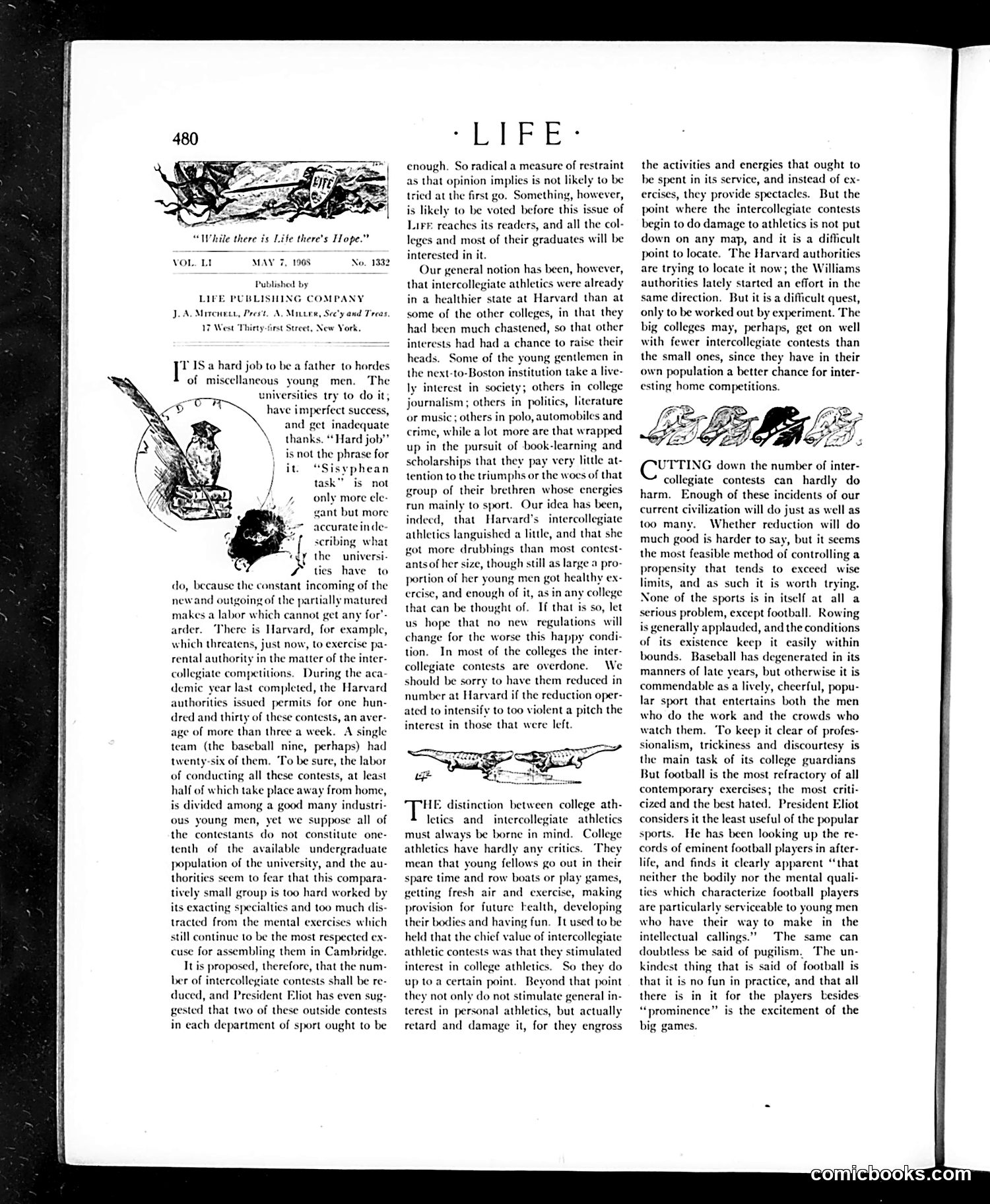
This page discusses Harvard University's proposal to restrict intercollegiate athletic competitions. The article notes that Harvard authorities issued permits for 130 contests in the previous year—an excessive burden on student-athletes who competed in events like baseball, with one team participating in twenty-six contests. The editorial compares universities' task of managing student life to Sisyphus's endless labor. President Eliot apparently suggested limiting outside contests to two per sport department—a radical measure the author doubts will be adopted immediately. The satire is gentle: Life supports *some* restraint on athletics at Harvard, arguing the institution already maintains better balance than other colleges, where intercollegiate sports are "overdone." The concern is that excessive competition distracts from academics while preventing broader intellectual engagement among undergraduates. The cartoons (illustrating the text) appear decorative rather than specifically satirical.
📄 Transcribed text from this page (OCR, searchable)
Machine-transcribed from the original scan — historical spelling and the odd misread are preserved.
“While there is Life there's Hope.” No. 1332 VOL. Lt MAY 7, 1908 Published by LIFE PUBLISHING COMPANY JA. Mirren, Pres 17 Wes A, Mivere, See'y and Treas Thiety-tirst Street, New York. ‘T IS a hard job to be a father to hord of miscellaneous young men. The universities try to do it; have imperfect success, and get inadequate \_ thanks. “Hard job” is not the phrase for it. “Sisyphean task” is not only more ele: gant but more accurate inde- scribing what the universi- ties have to do, because the constant incoming of the new and outgoing of the partially matured makes a labor which cannot get any for’- arder. There is Harvard, for example, which threatens, just now, to exercise pa- rental authority in the matter of the inter- collegiate competitions. During the aca demic year last completed, the Harvard authorities issued permits for one hun- dred and thirty of these contests, an aver age of more than three a week. A single tcam (the baseball nine, perhaps) had twenty-six of them. ‘To be sure, the labor of conducting all these contests, at least half of which take place away from home, is divided among a good many industri- ous young men, yet we suppose all of the contestants do not constitute one- tenth of the available undergraduate population of the university, and the au- thorities seem to fear that this compara- tively small group is too hard worked by its exacting specialties and too much dis- tracted from the mental exercises which still continue to be the most respected ex- cuse for assembling them in Cambridgi It is proposed, therefore, that the num- ber of intercollegiate contests shall be re- duced, and President Eliot has even sug: gested that two of these outside contests in cach department of sport ought to be *LIFE: enough. So radical a measure of restraint as that opinion implies is not likely to be tried at the first go. Something, however, is likely to be voted before this issue of Lire: reaches its readers, and all the col- leges and most of their graduates will be interested in it. Our general notion has been, however, that intercollegiate athletics were already in a healthier state at Harvard than at some of the other colleges, in that they had been much chastened, so that other interests had had a chance to raise their heads. Some of the young gentlemen in the next-to-Boston institution take a live- ly interest in society; others in college journalism; others in politics, literature or music; others in polo, automobiles and crime, while a lot more are that wrapped up in the pursuit of book-learning and scholarships that they pay very little at- tention to the triumphs or the woes of that group of their brethren whose energies run mainly to sport. Our idea has been, indeed, that Harvard's intercollegiate athletics languished a little, and that she got more drubbings than most contest- antsof her size, though still as large a pro- portion of her young men got healthy ex- ercise, and enough of it, as in any college that can be thought of. If that is so, let us hope that no new regulations will change for the worse this happy condi- tion. In most of the colleges the inter- collegiate contests are overdone. We should be sorry to have them reduced in number at Harvard if the reduction oper- ated to intensify to too violent a pitch the interest in those that were left. HE distinction between college ath- ics and_ intercollegiate athletics They athletics have hardly any critic: mean that young fellows go out in their spare time and row boats or play games, getting fresh air and exercise, making provision for future health, developing their bodies and having fun. Ttused to be held that the chief value of intercollegiate athletic contests was that they stimulated interest in college athletics. So they do up toa certain point. Beyond that point they not only do not stimulate general in- terest in personal athletics, but actually retard and damage it, for they engross the activities and energies that ought to be spent in its service, and instead of ex- ercises, they provide spectacles. But the point where the intercollegiate contests begin to do damage to athletics is not put down on any map, and it is a difficult point to locate. The Harvard authorities are trying to locate it now; the Williams authorities lately started an effort in the same direction. But it is a difficult quest, only to be worked out by experiment. The big colleges may, perhaps, get on well with fewer intercollegiate contests than the small ones, since they have in their own population a better chance for inter- esting home competitions CUTTING down the number of inter- collegiate contests can hardly do harm. Enough of these incidents of our current civilization will do just as well as too many. Whether reduction will do much good is harder to say, but it seems the most feasible method of controlling a propensity that tends to exceed wise limits, and as such it is worth trying. None of the sports is in itself at all a serious problem, except football. Rowing is generally applauded, and the conditions of its existence keep it easily within bounds. Baseball has degenerated in its manners of late years, but otherwise it is commendable as a lively, cheerful, popu- lar sport that entertains both the men who do the work and the crowds who watch them. ‘To keep it clear of profes- sionalism, trickiness and discourtesy is the main task of its college guardians But football is the most refractory of all contemporary exercises; the most criti- cized and the best hated. President Eliot considers it the least useful of the popular sports. He has been looking up the re- cords of eminent football players in after- life, and finds it clearly apparent “that neither the bodily nor the mental quali- ties which characterize football players are particularly serviceable to young men who have their way to make in the intellectual callings.” The same can doubtless be said of pugilism, ‘The un- kindest thing that is said of football that it is no fun in practice, and that all there is in it for the players besides “prominence” is the excitement of the big games.