
Life, 1908-05-07 · page 32 of 48
Life — May 7, 1908 — page 32: what you’re looking at
What you’re looking at
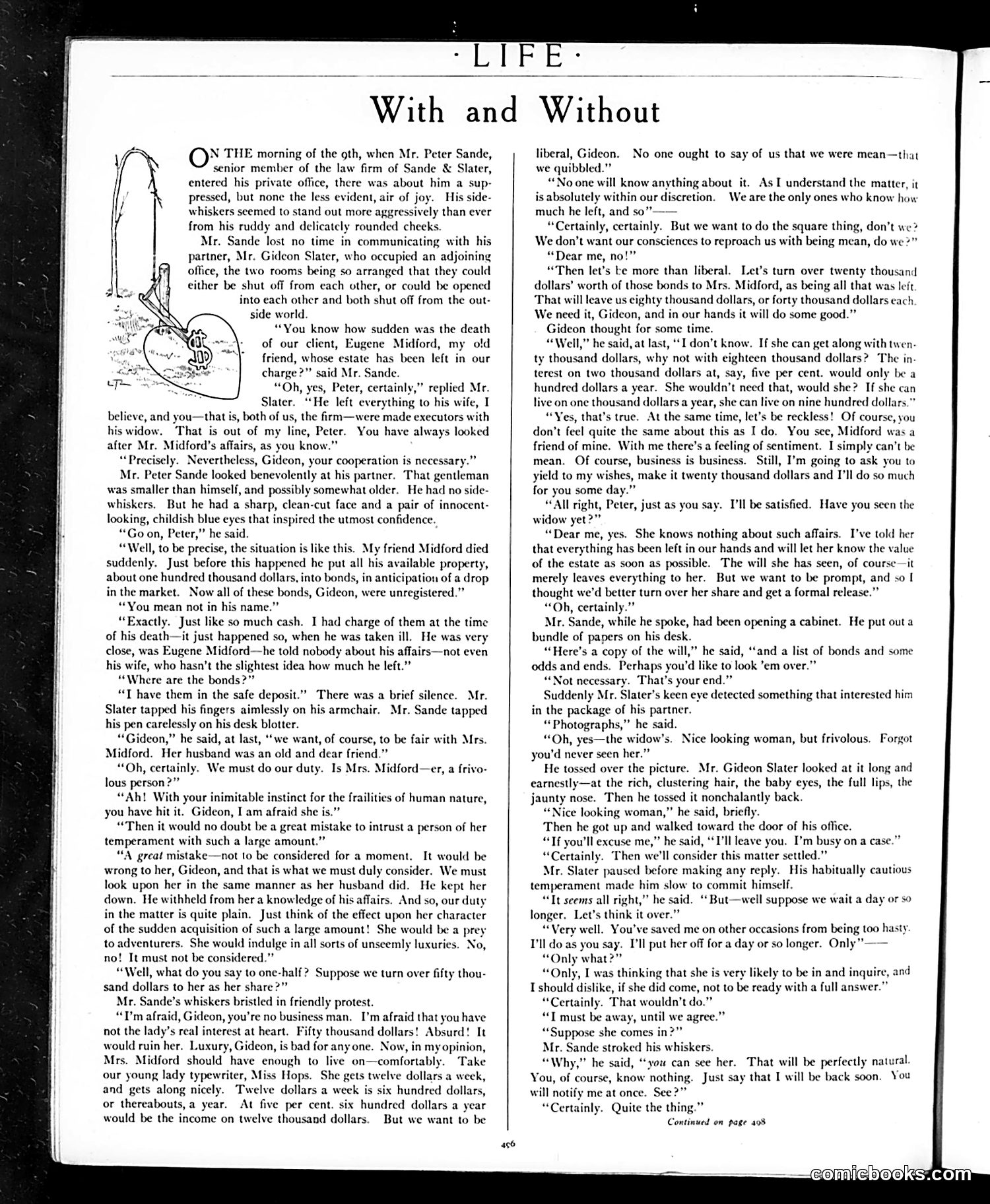
This story depicts two lawyers, Peter Sande and Gideon Slater, discussing the estate of their deceased client Eugene Midford. Sande controls $100,000 in unregistered bonds left to Midford's widow, and proposes giving her only a small allowance rather than her full inheritance. The satire lies in Sande's self-serving rationalization: he claims restricting her access protects her from the corrupting influence of wealth and prevents her becoming "a prey to adventurers." His rhetoric about her "frivolous" nature and need for paternal control masks straightforward theft—he wants to keep most of the money himself while posing as her moral guardian. The cartoon's title, "With and Without," likely refers to the contrast between appearing virtuous (with morality) while actually being corrupt (without it). This critiques how early-20th-century legal authorities exploited fiduciary power and paternalistic assumptions about women to commit fraud while maintaining respectability.
📄 Transcribed text from this page (OCR, searchable)
Machine-transcribed from the original scan — historical spelling and the odd misread are preserved.
oe! Le) Le) ia N THE morning of the oth, when Mr. Peter Sande, senior member of the law firm of Sande & Slater, entered his private office, there was about him a sup- pressed, but none the less evident, air of joy. His side- whiskers seemed to stand out more aggressively than ever from his ruddy and delicately rounded cheeks. r. Sande lost no time in communicating with his partner, Mr. Gidcon Slater, who occupied an adjoining office, the two rooms being so arranged that they could either be shut off from each other, or could be opened into each other and both shut off from the out- side world. “You know how sudden was the death of our client, Eugene Midford, my old friend, whose estate has been left in our S ‘ charge?” said Mr. Sande. SS “Oh, yes, Peter, certainly,” replied Mr. 7 Slater. ‘He left everything to his wife, I believe, and you—that is, both of us, the firm—were made executors with his widow. That is out of my line, Peter. You have always looked after Mr. Midford’s affairs, as you know.” “Precisely. Nevertheless, Gideon, your cooperation is necessary.” Mr. Peter Sande looked benevolently at his partner. That gentleman was smaller than himself, and possibly somewhat older. He had no side- whiskers. But he had a sharp, clean-cut face and a pair of innocent- looking, childish blue eyes that inspired the utmost confidence. “Go on, Peter,” he said. “Well, to be precise, the situation is like this. My friend Midford died suddenly. Just before this happened he put all his available property, about one hundred thousand dollars, into bonds, in anticipation of a drop in the market. Now all of these bonds, Gideon, were unregistered.” You mean not in his name.” xactly. Just like so much cash. I had charge of them at the time of his death—it just happened so, when he was taken ill. He was very close, was Eugene Midford—he told nobody about his affairs—not even his wife, who hasn’t the slightest idea how much he left.” “Where are the bonds?” “T have them in the safe deposit.” There was a brief silence. Mr. Slater tapped his fingers aimlessly on his armchair. Mr. Sande tapped his pen carelessly on his desk blotter. “Gideon,” he said, at last, “‘we want, of course, to be fair with Mrs. Midford. Her husband was an old and dear friend.” “Oh, certainly. We must do our duty. Is Mrs. Midford—er, a frivo- lous person?” “Ah! With your inimitable instinct for the frailities of human nature, you have hit it. Gideon, I am afraid she i “Then it would no doubt be a great mi: temperament with such a large amount.” “A great mistake—not to be considered for a moment. It would be wrong to her, Gideon, and that is what we must duly consider. We must look upon her in the same manner as her husband did, He kept her down. He withheld from her a knowledge of his affairs. And so, our duty in the matter is quite plain. Just think of the effect upon her character of the sudden acquisition of such a large amount! She would be a prey to adventurers. She would indulge in all sorts of unseemly luxuries. No, no! It must not be considered.” “Well, what do you say to one-half? Suppose we turn over fifty thou- sand dollars to her as her shar Mr. Sande’s whiskers bristled in friendly protest. “T’'m afraid, Gideon, you're no business man. I’m afraid that you have not the lady’s real interest at heart. Fifty thousand dollars! Absurd! It would ruin her. Luxury, Gideon, is bad for any one. Now, in my opinion, Mrs. Midford should have enough to live on—comfortably. Take our young lady typewriter, Miss Hops. She gets twelve dollars a wee and gets along nicely. Twelve dollars a w is six hundred dollars, or thereabouts, a year. At five per cent. six hundred dollars a year But we want to be ake to intrust a person of her would be the income on twelve thousand dollars. With and Without liberal, Gideon. No one ought to say of us that we were mean—that we quibbled.” “No one will know anything about it. As I understand the matter, it is absolutely within our discretion. We are the only ones who know how much he left, and so”—— “Certainly, certainly. But we want to do the square thing, don’t we? We don’t want our consciences to reproach us with being mean, do we?” “Dear me, no!” “Then let’s ke more than liberal. Let’s turn over twenty thousand dollars’ worth of those bonds to Mrs. Midford, as being all that was left That will leave us eighty thousand dollars, or forty thousand dollars cach. We need it, Gideon, and in our hands it will do some good.” Gideon thought for some time. “Well,” he said, at last, “I don’t know. If she can get along with twen- ty thousand dollars, why not with eighteen thousand dollars? The in- terest on two thousand dollars at, say, five per cent. would only be a hundred dollars a year. She wouldn’t need that, would she? If she can live on one thousand dollars a year, she can live on nine hundred dollars.” “Yes, that’s true. At the same time, let’s be reckless! Of course, you don’t feel quite the same about this as Ido. You see, Midford was a friend of mine. With me there’s a feeling of sentiment. I simply can’t be mean. Of course, business is business. Still, I’m going to ask you to yield to my wishes, make it twenty thousand dollars and I'll do so much for you some day. Il right, Peter, just as you say. I'll be satisfied. Have you seen the widow yet?” “Dear me, yes. She knows nothing about such affairs. I’ve told her that everything has been left in our hands and will let her know the value of the estate as soon as possible. The will she has seen, of course—it merely leaves everything to her. But we want to be prompt, and so [ thought we'd better turn over her share and get a formal release.” “Oh, certainly.” Mr. Sande, while he spoke, had been opening a cabinet. He put out a bundle of papers on his desk. “‘Here’s a copy of the will,” he said, ‘‘and a list of bonds and some odds and ends. Perhaps you'd like to look ’em over.” Not necessary. That's your end.” Suddenly Mr. Slater’s keen eye detected something that interested him in the package of his partner. “Photographs,” he said. “Oh, yes—the widow's you'd never seen her.” He tossed over the picture. Mr. Gideon Slater looked at it long and earnestly—at the rich, clustering hair, the baby eyes, the full lips, the jaunty nose. ‘Then he tossed it nonchalantly back. ice looking woman,” he said, briefly. Then he got up and walked toward the door of his office. “Tf you'll excuse me,” he said, “I'll leave you. I’m busy ona case.” “Certainly. Then we'll consider this matter settled.” Mr. Slater paused before making any reply. His habitually cautious temperament made him slow to commit himself. “Tt seems all right,” he said. ‘‘ But—well suppose we wait a day or so longer. Let’s think it over.”” “Very well. You’ve saved me on other occasions from being too hasty. I'll do as you say. I'll put her off for a day or so longer. Only”’- “Only what “Only, I was thinking that she is very likely to be in and inquire, I should dislike, if she did come, not to be ready with a full answer. “Certainly. That wouldn't do.” “I must be away, until we agree.” “Suppose she comes in? Mr. Sande stroked his whiskers. “Why,” he said, “you can see her. That will be perfectly natural You, of course, know nothing. Just say that I will be back soon. You will notify me at once. See?” “Certainly. Quite the thing. Continued on page 408 Nice looking woman, but frivolous. Forgot