
Life, 1908-05-07 · page 19 of 48
Life — May 7, 1908 — page 19: what you’re looking at
What you’re looking at
This page contains three satirical items from *Life* magazine: ## Main Story: "Burbankizing" The narrative mocks Luther Burbank, the famous plant breeder, by showing boys catching stray dogs to sell to a hospital (likely for vivisection in medical research). The joke: they're "improving" the dog supply like Burbank improved crops. The story's ending critiques this callousness—one boy rejects the rationalization that experimenting on dogs "saves the human race," declaring the human race not worth saving if that's the cost. ## "Some Epitaffy" A brief joke about President Theodore Roosevelt ("Teddy"), predicting his epitaph will be an "epitaph"—a pun on words. ## "Low Company" Satirizes claims that theatrical life is immoral by listing respectable ministers caught in scandals: elopements and murder. The satire: ministers lecturing actors about morality while committing crimes themselves. All reflect *Life*'s muckraking tradition of exposing hypocrisy in institutions and public figures.
📄 Transcribed text from this page (OCR, searchable)
Machine-transcribed from the original scan — historical spelling and the odd misread are preserved.
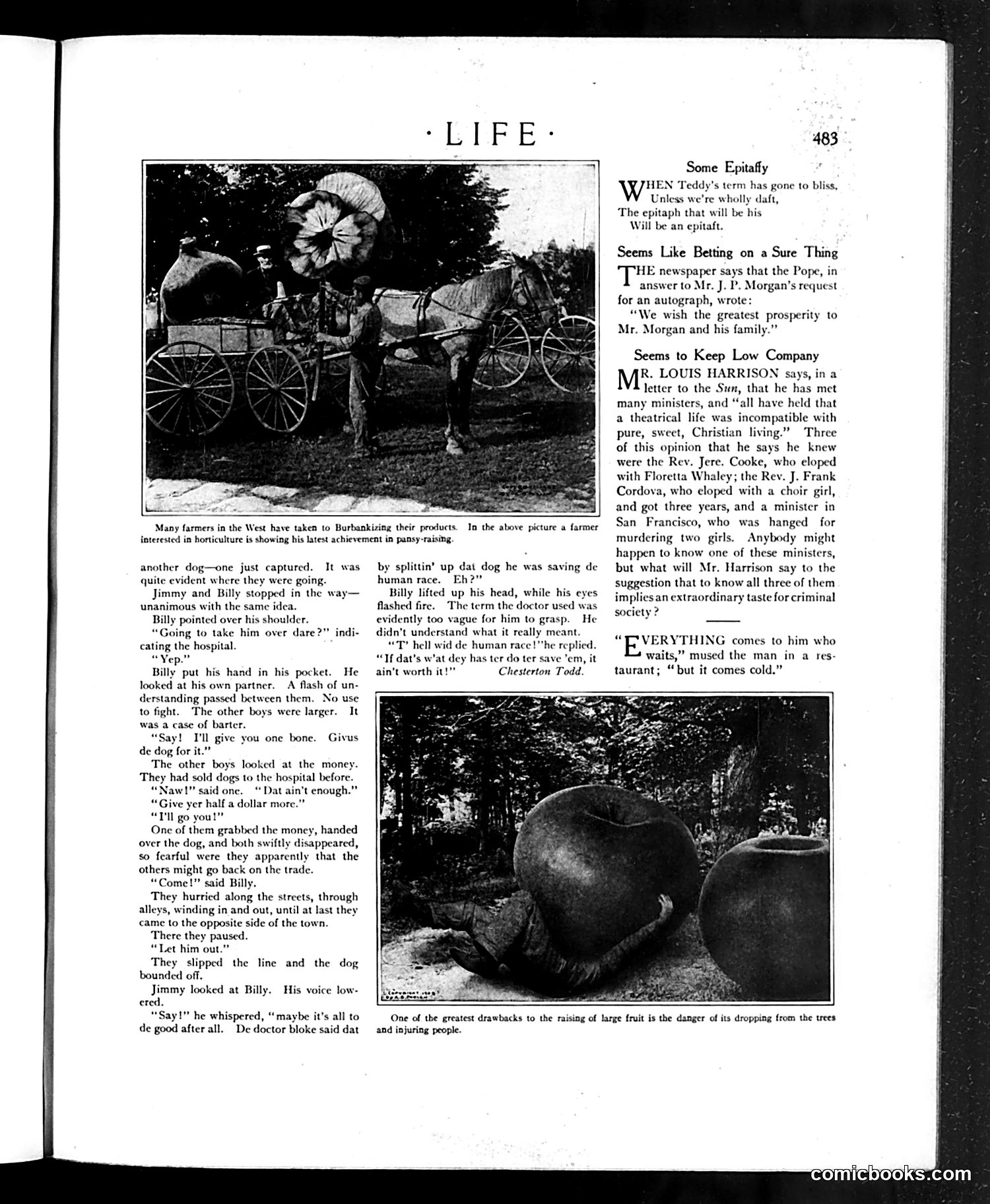
Many farmers in the West have taken to Burbankizing their products. In the above picture a farmer interested in horticulture is showing his latest achievement in pansy-raising, another dog—one just captured. It was quite evident where they were going. Jimmy and Billy stopped in the way— ‘unanimous with the same idea. Billy pointed over his shoulder. “Going to take him over dare?” indi- cating the hospital. “Yep.” Billy put his hand in his pocket. He looked at his own partner. A flash of un- derstanding passed between them. No use to fight. The other boys were larger. It was a case of barter. “Say! I'll give you one bone. us de dog for it.” The other boys looked at the money. They had sold dogs to the hospital before. “Naw!” said one.“ Dat ain't enough.” “Give yer half a dollar more.” “Tl go youl” One of them grabbed the money, handed over the dog, and both swiftly disappeared, so fearful were they apparently that the others might go back on the trade. “Come!” said Billy They hurried along the streets, through alleys, winding in and out, until at last they came to the opposite side of the town. ‘There they paused. “Let him out.” They slipped the line and the dog bounded off. Jimmy looked at Billy. ered. “Say! he whispered, “maybe it’s all to de good after all. De doctor bloke said dat His voice low- by splittin’ up dat dog he was saving de human race. Eh?” Billy lifted up his head, while his eyes flashed fire. The term the doctor used was evidently too vague for him to grasp. He didn't understand what it really meant. “T" hell wid de human race !""he replied. “If dat’s w'at dey has ter do ter save 'em, it ain't worth it! Chesterton Todd. 483 Some Epitaffy HEN Teddy's term has gone to bliss, Unless we’re wholly daft, ‘The epitaph that will be his Will be an epitaft. Seems Like Betting on a Sure Thing TH newspaper says that the Pope, in answer to Mr. J. P. Morgan's request for an autograph, wrote: “We wish the greatest prosperity to Mr. Morgan and his family.” Seems to Keep Low Company R. LOUIS HARRISON says, in a letter to the Sun, that he has met many ministers, and “all have held that a theatrical life was incompatible with Christian living.” Three opinion that he says he knew were the Rev. Jere. Cooke, who eloped with Floretta Whaley; the Rev. J. Frank Cordova, who eloped with a choir girl, and got three years, and a minister in San Francisco, who was hanged for murdering two girls. Anybody might happen to know one of these ministers, but what will Mr. Harrison say to the suggestion that to know all three of them implies an extraordinary taste for criminal society ? “TVERYTHING comes to him who waits,” mused the man in a res- taurant; “but it comes cold.” ‘One of the greatest drawbacks to the raising of large fruit is the danger of its dropping from the trees and injuring people.