
Life, 1908-05-07 · page 18 of 48
Life — May 7, 1908 — page 18: what you’re looking at
What you’re looking at
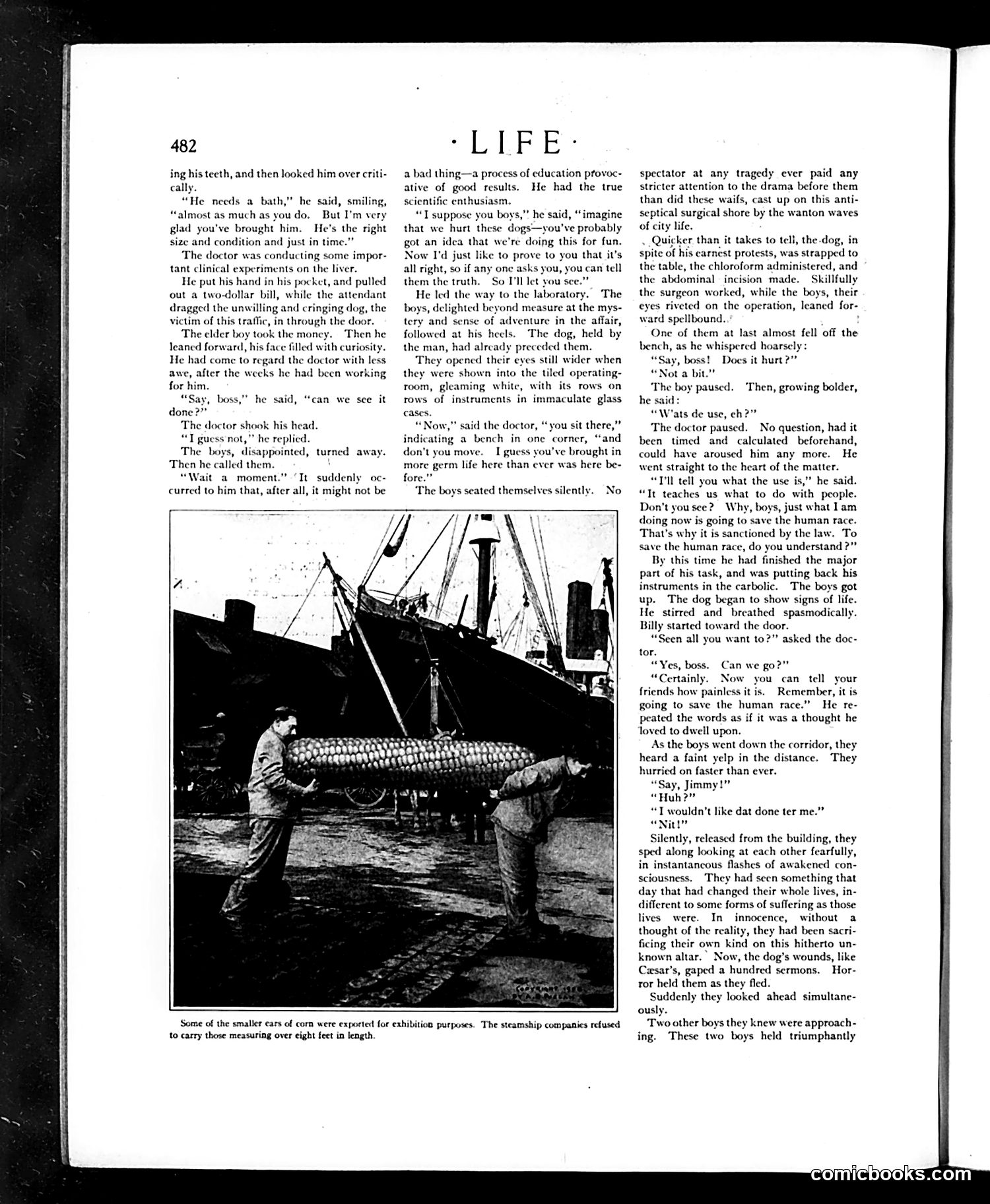
This page presents a narrative story—not a political cartoon—about a doctor performing vivisection (animal experimentation) on a dog for medical research purposes. **The scenario:** Two boys from the streets bring a stray dog to a doctor conducting "clinical experiments on the liver." The doctor pays them and then, seeking to educate them, invites them to observe the surgery. **The satire's point:** The story critiques the justification of animal experimentation through appeals to scientific progress and human benefit. The doctor's repeated insistence that vivisection "will save the human race" and is "sanctioned by the law" appears designed to show how authority figures rationalize potentially troubling practices to vulnerable audiences (poor street boys). **The image** shows the large ear of corn mentioned in the caption—an exhibition specimen too large for steamships to transport, a humorous aside unrelated to the main narrative. The piece likely reflects early-20th-century tensions between advancing medical science and growing animal welfare concerns.
📄 Transcribed text from this page (OCR, searchable)
Machine-transcribed from the original scan — historical spelling and the odd misread are preserved.
482 ing his teeth, and then looked him over criti- cally. “He needs a bath," he said, smiling, “almost as much as you do. But I'm very glad you've brought him. He's the right size and condition and just in time.” ‘The doctor was conducting some impor- tant clinical experiments on the liver. He put his hand in his pocket, and pulled out a two-dollar bill, while the attendant dragged the unwilling and cringing dog, the victim of this traffic, in through the door. The elder boy took the money. ‘Then he leaned forward, his face filled with curiosity. He had come to regard the doctor with less awe, after the weeks he had been working for him. doni ‘The doctor shook his head. “T guess not,” he replied. The boys, disappointed, turned away. Then he called them. “Wait a moment.” ‘It suddenly oc- curred to him that, after all, it might not be he said, “can we sce it *LUPE* a bad thing—a process of education pfovoc- ative of good results. He had the true scientific enthusiasm. “T suppose you boys,” he said, “imagine that we hurt these dogs—you've probably got an idea that we're doing this for fun. Now I'd just like to prove to you that it’s all right, so if any one asks you, you can tell them the truth. So I'll let you see.’ He led the way to the laboratory. The boys, delighted beyond measure at the mys- tery and sense of adventure in the affair, followed at his heels. The dog, held by the man, had already preceded them. They opened their eyes still wider when they were shown into the tiled operating- room, gleaming white, with its rows on rows of instruments in immaculate glass cases. “Now,” said the doctor, “you sit there,” indicating a bench in one corner, “and don't you move. I guess you've brought in more germ life here than ever was here be- fore.” ‘The boys seated themselves silently. No Some of the smaller cars of corn were exported for exhibition purposes. The steamship companics refused to carry those measuring over eight feet in length. spectator at any tragedy ever paid any stricter attention to the drama before them than did these waifs, cast up on this anti septical surgical shore by the wanton waves of city life. . Quicker than it takes to tell, the-dog, in spite of his earnest protests, was strapped to the table, the chloroform administered, and the abdominal incision made. Skillful the surgeon worked, while the boys, their eyes riveted on the operation, leaned for- ward spellbound. One of them at last almost fell off the bench, as he whispered hoarsely : “Say, boss! Does it hurt?” “Not a bit.” ‘The boy paused. ‘Then, growing bolder, he sai “Wriats de use, eh ?”” The doctor paused. No question, had it been timed and calculated beforehand, could have aroused him any more. He went straight to the heart of the matter. “T'll tell you what the use is,”” he said. “Tt teaches us what to do with people. Don't you see? Why, boys, just what Iam doing now is going to save the human race. ‘That's why it is sanctioned by the law. To save the human race, do you understand ?”” By this time he had finished the major part of his task, and was putting back his instruments in the carbolic. The boys got up. The dog began to show signs of life. He stirred and breathed spasmodically. Billy started toward the door. “Seen all you want to?” asked the doc- tor. Yes, boss. Can we go?” “Certainly, Now you can tell your friends how painless it is. Remember, it is going to save the human race.” He re- peated the words as if it was a thought he loved to dwell upon. As the boys went down the corridor, they heard a faint yelp in the distance. They hurried on faster than ever. “Say, Jimmy “Huh?” “T wouldn't like dat done ter me. Silently, released from the building, they sped along looking at each other fearfully, in instantancous flashes of awakened con- sciousness. They had seen something that day that had changed their whole lives, in- different to some forms of suffering as those lives were. In innocence, without a thought of the reality, they had been sacri- ficing their own kind on this hitherto un- known altar.’ Now, the dog’s wounds, like Carsar’s, gaped a hundred sermons. Hor- ror held them as they fled. Suddenly they looked ahead simultane ous ‘Two other boys they knew were approach- ing. ‘These two boys held triumphantly