
Life, 1908-05-07 · page 27 of 48
Life — May 7, 1908 — page 27: what you’re looking at
What you’re looking at
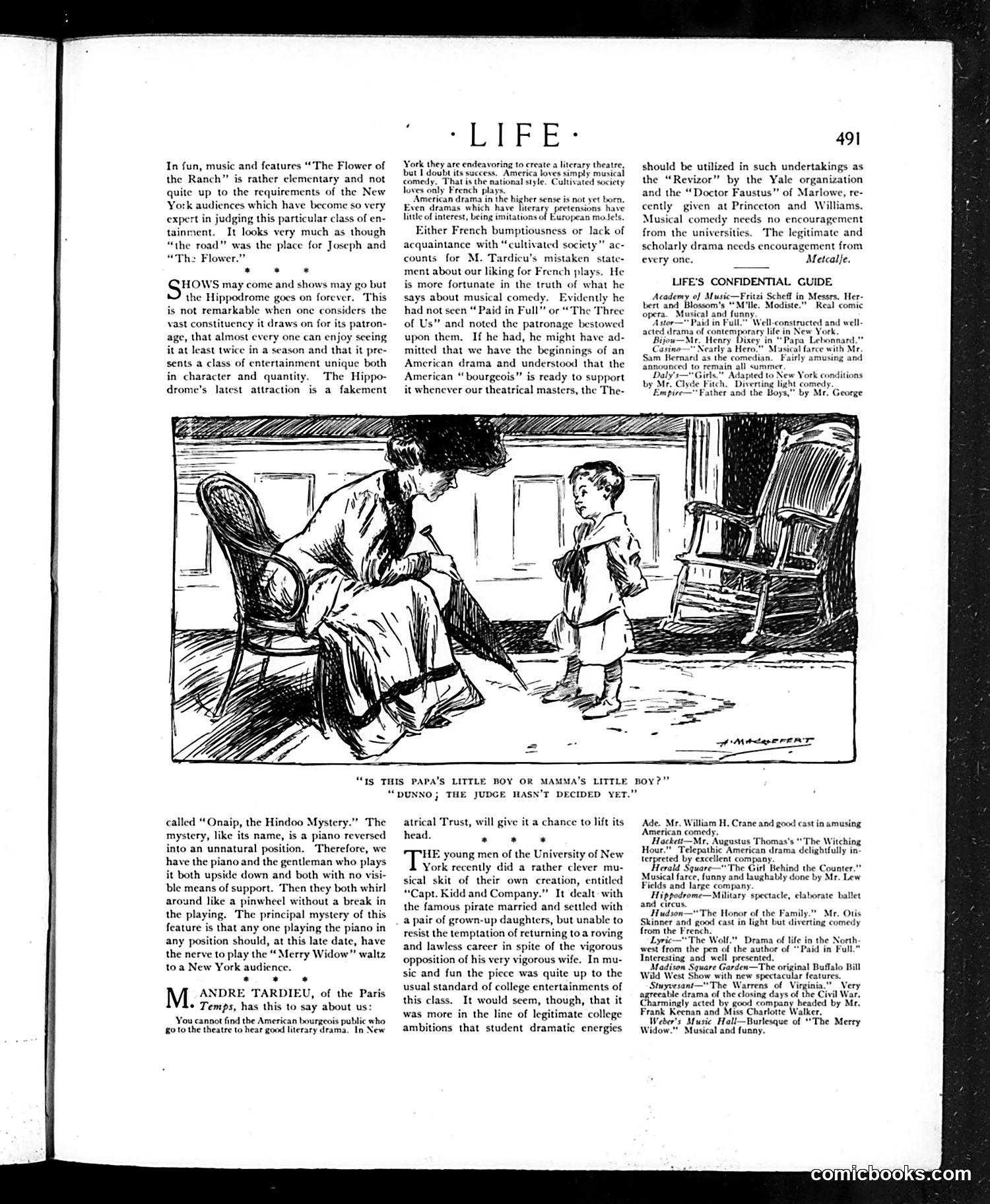
This page contains theater criticism and commentary typical of Life's satirical approach to American culture circa early 1900s. **The cartoon** depicts a woman with a tennis racket confronting a small boy, captioned "Is this Papa's little boy or Mamma's little boy? 'Dunno; the judge hasn't decided yet." This references custody disputes—apparently a contemporary social issue worthy of mockery. **The text critiques**: 1. **"The Flower of the Ranch"** — dismissed as "elementary," suggesting New York audiences demand higher theatrical standards than touring productions. 2. **The Hippodrome's "Onaip, the Hindoo Mystery"** — sarcastically exposed as a gimmick (a reversed piano and pianist playing upside-down), with particular scorn for performing the dated "Merry Widow" waltz. 3. **André Tardieu's dismissal of American drama** — the writer rebuts the French critic's claim that Americans prefer only musical comedy, arguing American drama is developing legitimately. 4. **University theater** — praising Yale's "Revizor" and Princeton's "Doctor Faustus" over musical comedy as worthier dramatic pursuits. The overall tone mocks pretension while advocating for theatrical sophistication.
📄 Transcribed text from this page (OCR, searchable)
Machine-transcribed from the original scan — historical spelling and the odd misread are preserved.
In fun, music and features “The Flower of the Ranch” is rather elementary and not quite up to the requirements of the New York audiences which have become so very expert in judging this particular class of en- tainment. It looks very much as though “the road” was the place for Joseph and “Th: Flower.” se 6 HOWS may come and shows may go but the Hippodrome goes on forever. This is not remarkable when one considers the vast constituency it draws on for its patron- age, that almost every one can enjoy seeing it at least twice in a Season and that it pre- sents a class of entertainment unique both in character and quantity. The Hippo- drome’s latest attraction’ is a fakement “Is 71 called “Onaip, the Hindoo Mystery.” The mystery, like its name, is a piano reversed into an unnatural position. ‘Therefore, we have the piano and the gentleman who plays it both upside down and both with no visi- ble means of support. ‘Then they both whirl around like a pinwheel without a break in the playing. The principal mystery of this feature is that any one playing the piano in any position should, at this late date, have the nerve to play the “ Merry Widow” waltz to a New York audience. es 8 ANDRE TARDIEU, of the Paris * Temps, has this to say about us: You cannot find the American bourgeois public who 0 to the theatre to hear good literary drama. In New ~LIFE- York they are endeavoring to create a literary theatre, but I doubt its success. America loves simply musical comedy, That is the national style. Cultivated society loves only French plays. _ American drama in the higher sense is not yet born. Even dramas which have literary pretensions have litte of interest, being imitations of Huropean mio.le!s. Either French bumptiousness or lack of acquaintance with “cultivated society” ac- counts for M. Tardicu’s mistaken state- ment about our liking for French plays. He is more fortunate in the truth of what he says about musical comedy. Evidently he had not seen “Paid in Full” of “The Three of Us” and noted the patronage bestowed upon them, If he had, he might have ad- mitted that we have the beginnings of an American drama and understood that the American “bourgeois” is ready to support it whenever our theatrical masters, the The- WL lve HIS PAPA’S LITTLE BOY “pu! THE JUDGE HASN'T DECIDED YE atrical Trust, will give it a chance to lift its head, « « » HE young men of the University of New York recently did a rather clever mu- sical skit of their own creation, entitled “Capt. Kidd and Company.” It dealt with the famous pirate married and settled with a pair of grown-up daughters, but unable to resist the temptation of returning toa roving and lawless career in spite of the vigorous opposition of his very vigorous wife. In mu- sic and fun the piece was quite up to the usual standard of college entertainments of this class. It would seem, though, that it was more in the line of legitimate college ambitions that student dramatic energies 491 should be utilized in such undertakings as the “Revizor” by the Yale organization and the “Doctor Faustus” of Marlowe, re- cently given at Princeton and Williams. Musical comedy needs no encouragement from the universities. The legitimate and scholarly drama needs encouragement from every one. Metcalje. LIFE’S CONFIDENTIAL GUIDE Academy of Music—Fritzi Schefl i bert and Blossom’s “M'lle. Modiste. opera. Musical and funny A stor—" Paid in Full.” Well-constructed and well- acted drama of contemporary life in New York. Bijou Henry Dixey. in “Papa Lebonn: Casino—" Nearly a Hero." Musical farce w Sam Bernard as the comedian. Fairly am announced to remain all summer Daly's—"Girls.” Adapted to New York conditions by Mr. Clyde Fitch, Diverting light comedy Empire—" Father and the Boys,” by Mr. George Messrs, Her- Real comic AM tae rE RT OR MAMMA’S LITTLE BOY?” Ade. Mr. William H. Crane and good cast in amusing American comedy. Hockett—Mr, Augustus Thomas's Hour.” Telepathic American drama delightf terpreted by excellent company Herald Square—"The Girl Behind the Counter.” Musical farce, funny and laughably done by Mr. Lew Fields and large company Hippodrome—Military spectacle, elat and circus Hudson—"The Honor of the Family.” Mr. Otis Skinner and good cast in light but diverting comedy from the French. Lyric—"The Wolf." Drama of life in the North. west from the pen of the author of “Paid in Full.” Toteresting and well presented. Madizon Square Garden—The original Buffalo Bill Wild West Show with new spectacular features. Stupvesant—"The Warrens of Virginia.” | Very agreeable drama of the closing days of the Civil War. Charmingly acted by good company headed by Mr. Frank Keenan and Miss Charlotte Walker. Weber's Music Hall—Burlesque of “The Merry Widow." Musical and funny. orate ballet