
A complete issue · 56 pages · 1907
Life — June 6, 1907
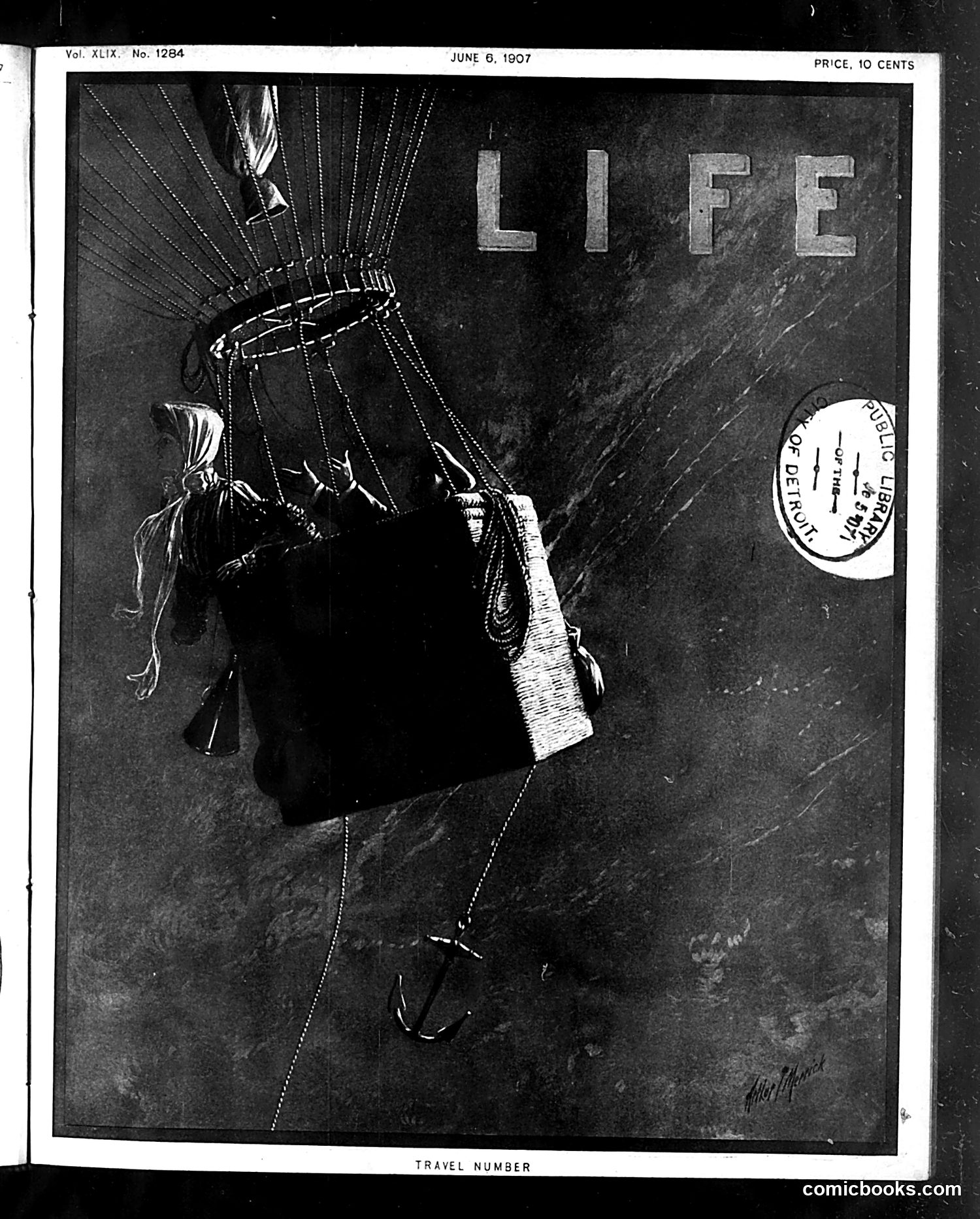
This is a Life magazine cover featuring a dramatic illustration of a hot air balloon or airship suspended by multiple ropes against a dark sky. The large word "LIFE" appears at the top. The image shows what appears to be a basket or gondola beneath the aircraft with various ropes and rigging extending upward to the balloon envelope. Given the 1907 date, this likely references early aviation developments and the public fascination with airships and balloons during that era. The artistic style and composition suggest this is satirizing contemporary aviation experiments or public anxiety about aerial technology. However, without additional text or context visible on this page, the specific satirical target or joke remains unclear. The "TRAVEL NUMBER" notation suggests this issue focused on transportation themes.
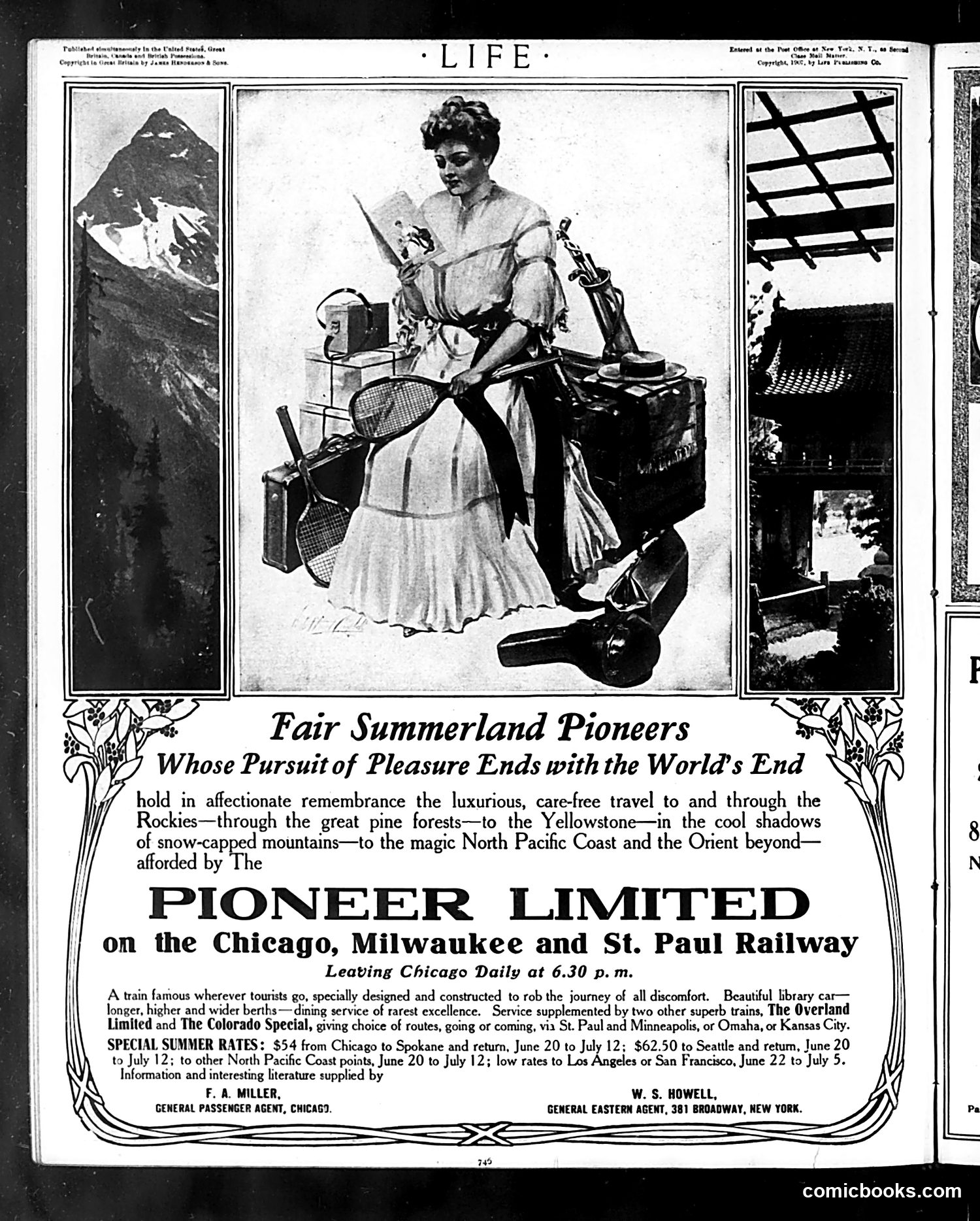
This page is primarily a **railroad advertisement**, not political satire. It promotes the Pioneer Limited train on the Chicago, Milwaukee and St. Paul Railway, departing Chicago daily at 6:30 p.m. The central illustration depicts a fashionable woman surrounded by luxury travel accessories—tennis rackets, golf clubs, and luggage—representing the leisurely pursuits available to affluent travelers. The headline "Fair Summerland Pioneers / Whose Pursuit of Pleasure Ends with the World's End" uses ironic language: "world's end" refers not to apocalypse but to remote destinations like the Rockies, Yellowstone, and the Pacific Northwest. The ad emphasizes the train's comfort (library car, dining service) and lists special summer rates for various routes, targeting wealthy tourists seeking transcontinental pleasure travel.
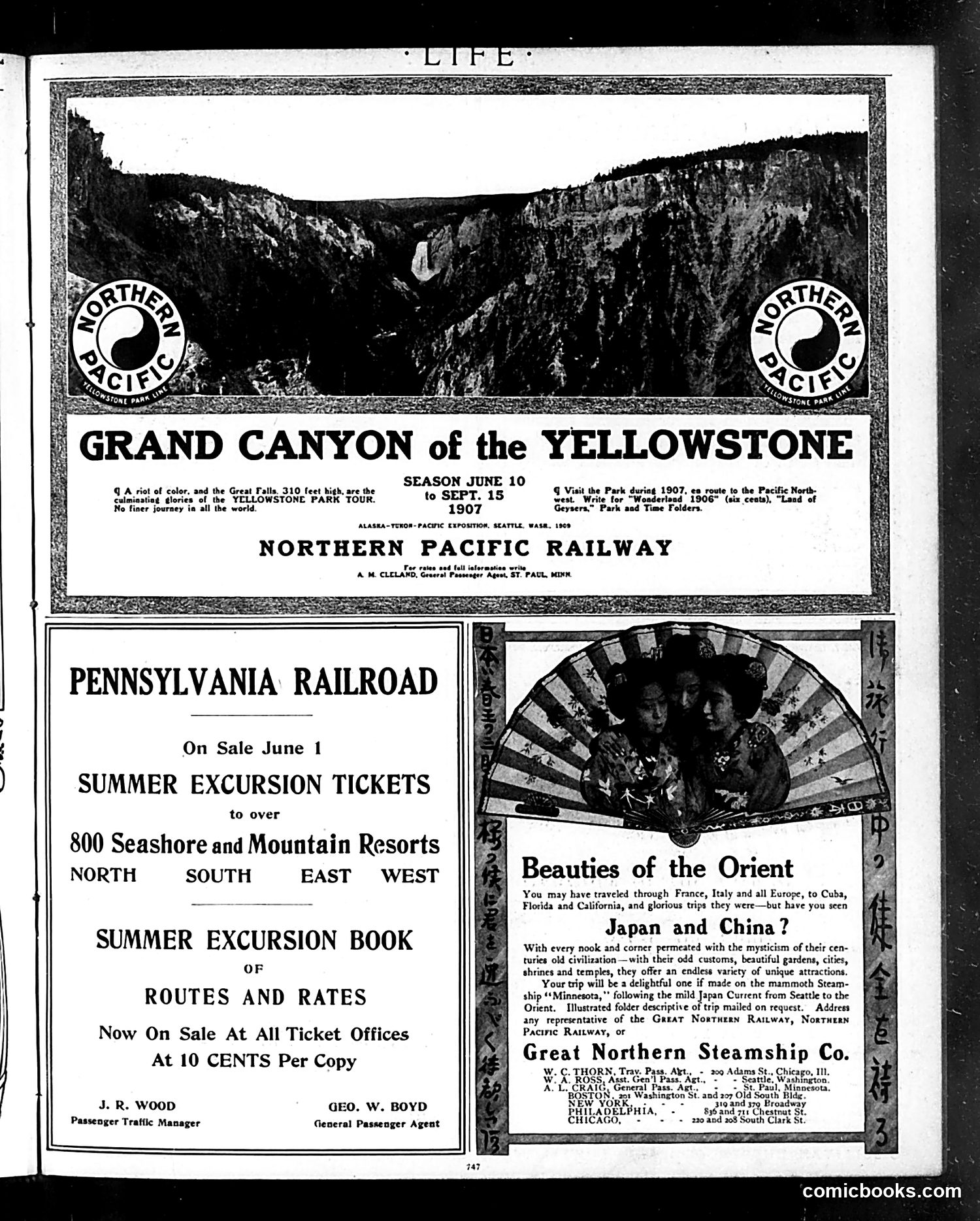
This page is primarily **advertising content**, not political satire. It contains two major travel advertisements: 1. **Top**: Northern Pacific Railway promotes the "Grand Canyon of the Yellowstone" for the 1907 summer season (June 10-September 15). 2. **Bottom left**: Pennsylvania Railroad advertises summer excursion tickets to 800 seashore and mountain resorts, with a 10-cent guidebook. 3. **Bottom right**: Great Northern Steamship Company advertises trips to Japan and China, featuring an image of an Asian woman with a decorative fan—reflecting early 20th-century orientalist marketing that exoticized Asian travel destinations for American tourists. The page reflects 1907 American leisure culture and the railroad industry's dominance in tourism promotion.
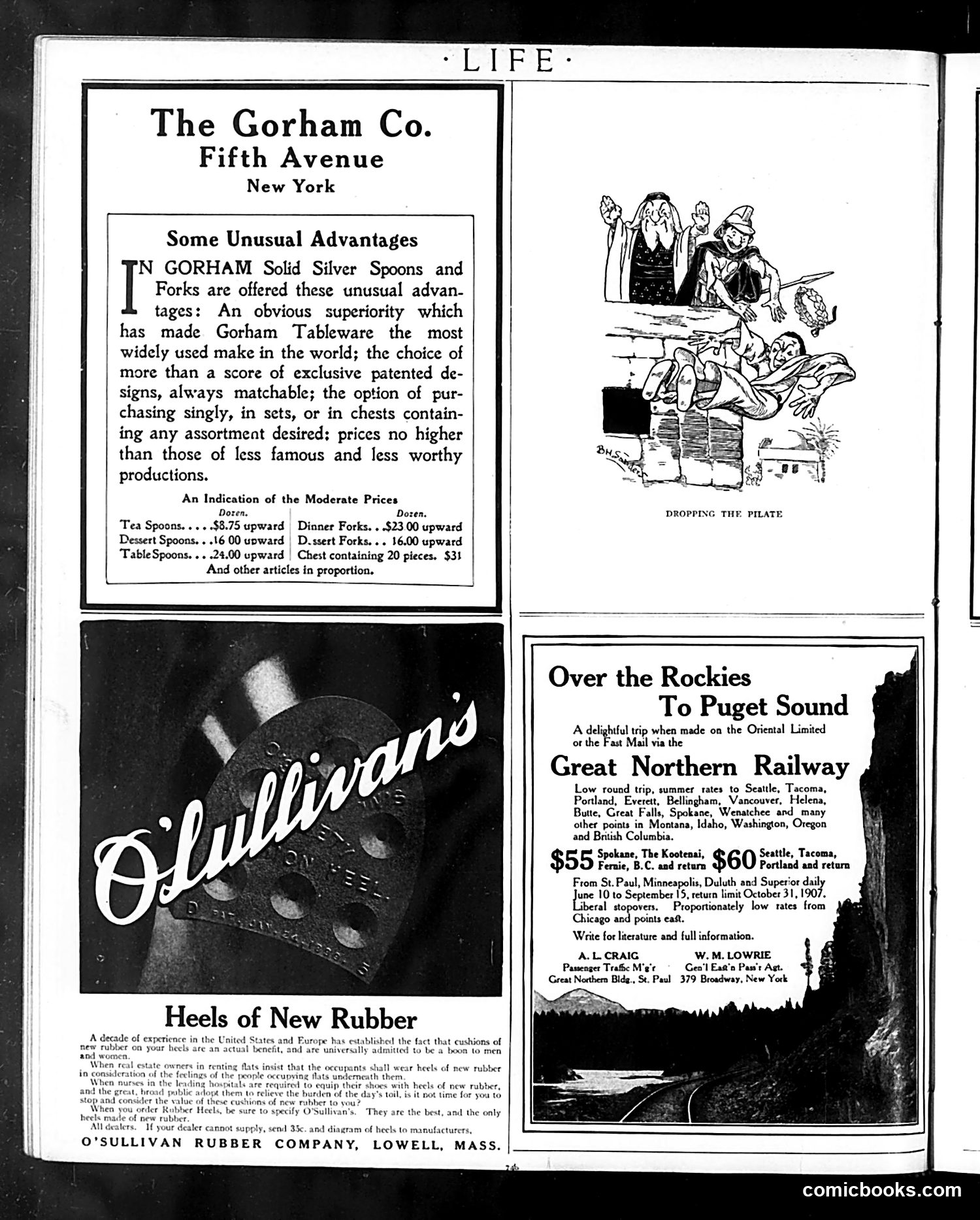
This single cartoon depicts a humorous domestic scene where a maid or servant has dropped a plate, causing it to shatter. The illustration shows the moment of impact with dishes and food scattered about, while well-dressed observers (likely the household employers) react with alarm from the background. The satire targets the universal domestic anxiety of servants breaking valuable tableware—a genuine concern for households of this era, when fine dinnerware represented significant expense. The exaggerated reactions and chaotic composition amplify the comedy of this everyday mishap. The cartoon accompanies advertisements for luxury goods (Gorham silverware, O'Sullivan rubber heels), creating ironic contrast: while the page promotes expensive household items, the cartoon humorously depicts their destruction through ordinary household accidents.
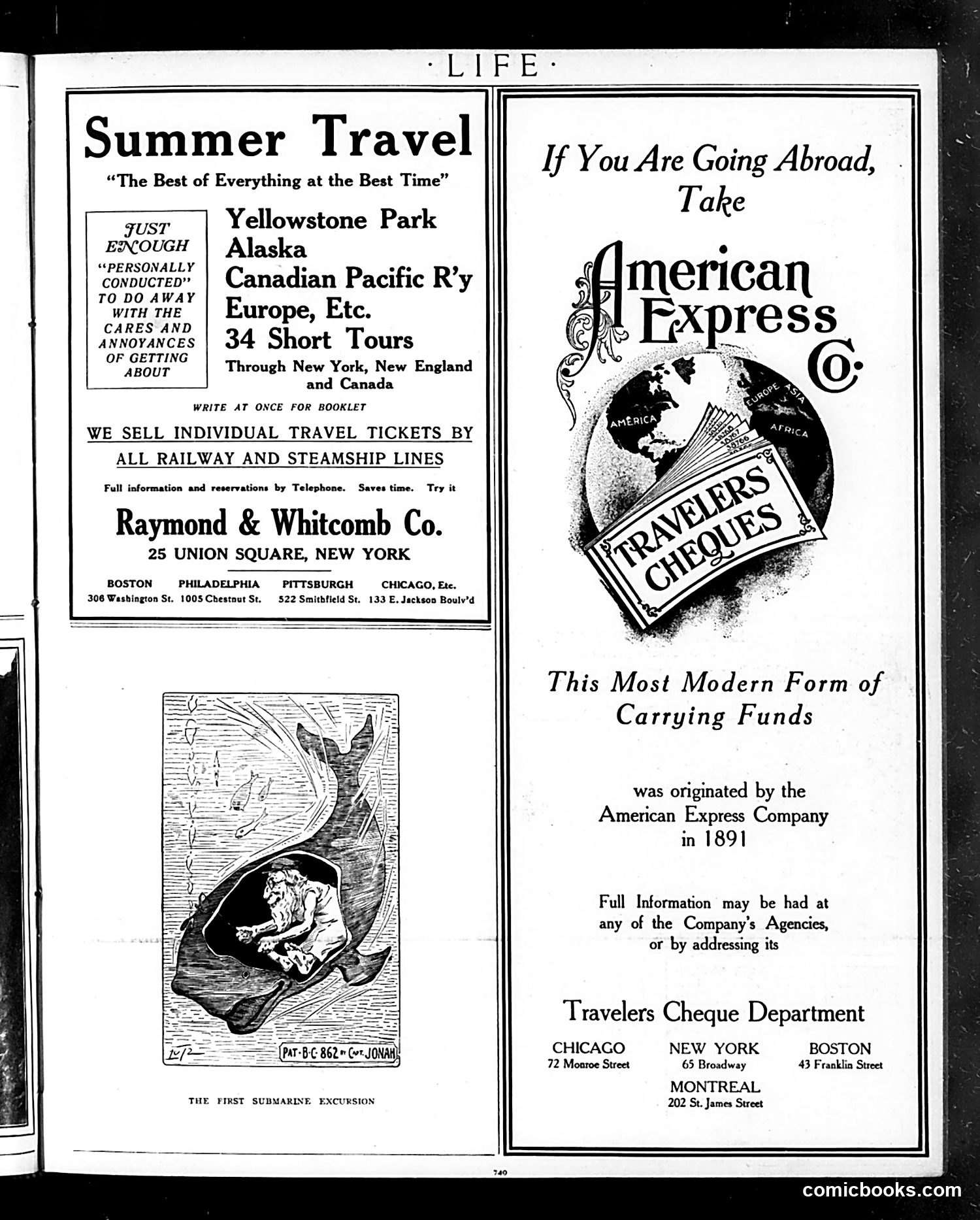
This page contains two advertisements rather than satirical editorial content. The **left advertisement** promotes summer travel through Raymond & Whitcomb Co., offering tours to Yellowstone Park, Alaska, Canada, and Europe via various rail and steamship lines. Below is an illustration labeled "THE FIRST SUBMARINE EXCURSION" depicting a figure in what appears to be an early submarine vessel. This references the novelty of submarine tourism—submarines were emerging technologies in the early 1900s, making recreational submarine trips a remarkable luxury experience to advertise. The **right advertisement** promotes American Express Co.'s Travelers Cheques, established in 1891. It emphasizes this as a "modern form of carrying funds" for international travelers, with contact information for multiple cities. Both ads target wealthy travelers planning summer vacations abroad—the page's primary audience and advertisers.
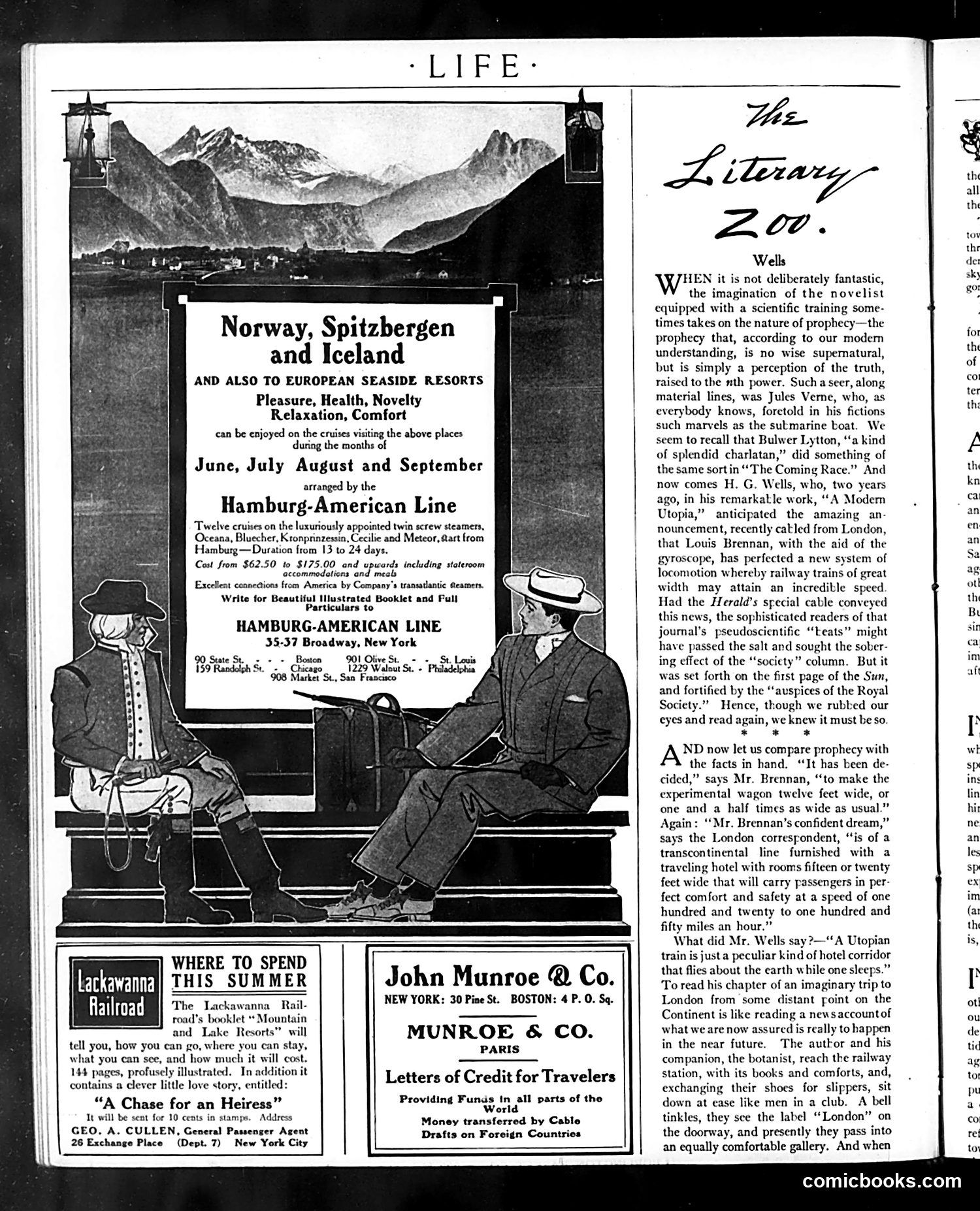
This page is primarily **advertising** (Hamburg-American Line cruises, Lackawanna Railroad, travel services), with the main editorial content being a brief essay titled "The Literary Zoo" by Wells. The essay discusses H.G. Wells's recent work "A Modern Utopia," comparing his scientific predictions to Jules Verne's earlier fiction. The author notes that Wells's imaginative vision of future transportation—a transcontinental train traveling 120+ mph in a hotel corridor—seems fantastical but may prove prophetic. The piece treats Wells as a serious speculative thinker whose "prophecies" warrant comparison with actual technological progress, positioning imaginative literature as a legitimate form of forward-thinking analysis rather than mere fantasy.
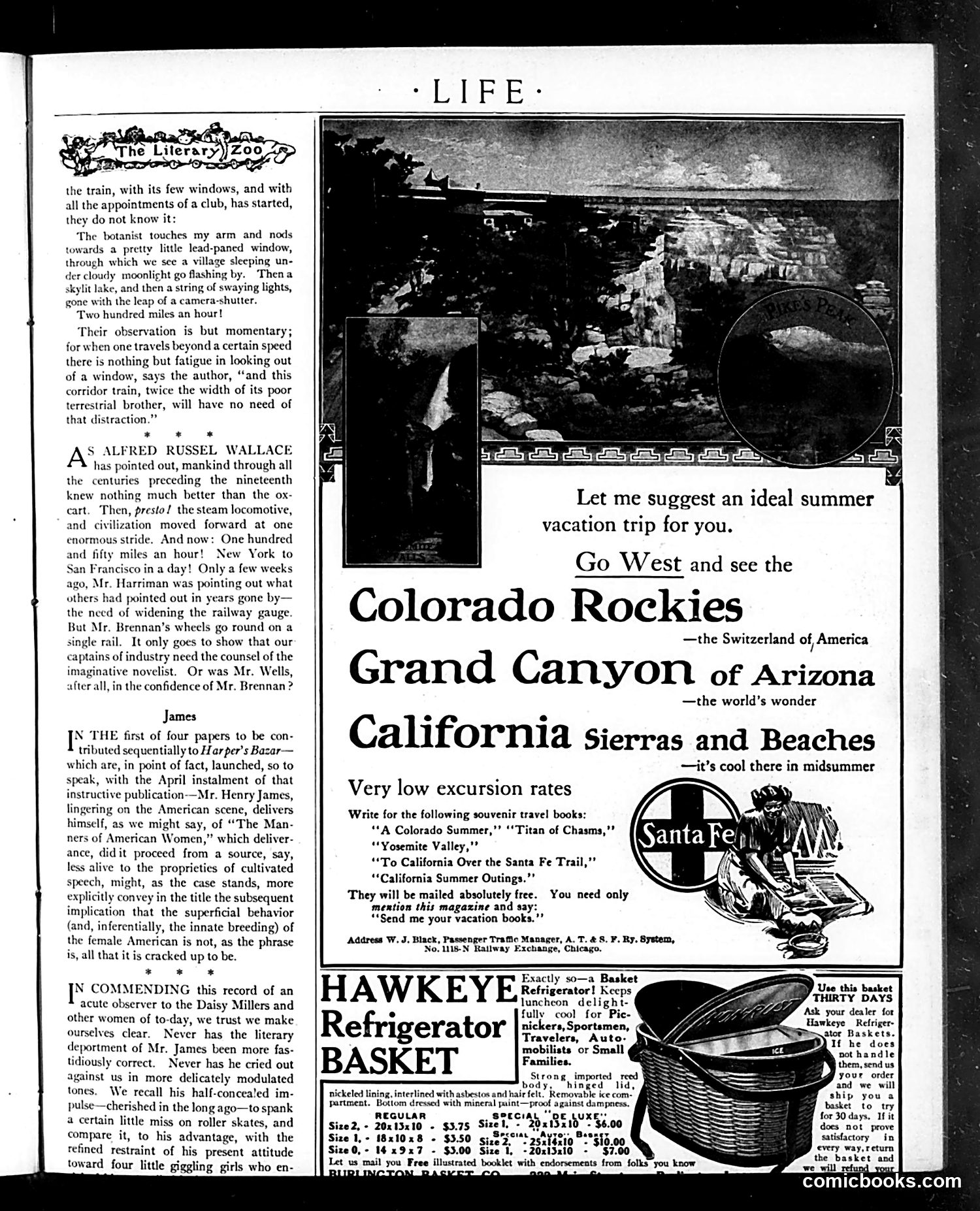
This page is primarily **advertising and editorial content** rather than political satire. The left column contains book reviews, including discussion of works about American women and society. The dominant right side features a large **Santa Fe Railway advertisement** promoting western vacation destinations: the Colorado Rockies, Grand Canyon, and California beaches, with excursion rates and souvenir travel books offered. Below that are advertisements for a **Hawkeye Refrigerator Basket** (for keeping lunches cool during travel) and other products. There is **no political cartoon or satirical content** visible. This appears to be a standard magazine page mixing literary commentary with travel and consumer product advertising, typical of early 20th-century Life magazine format.
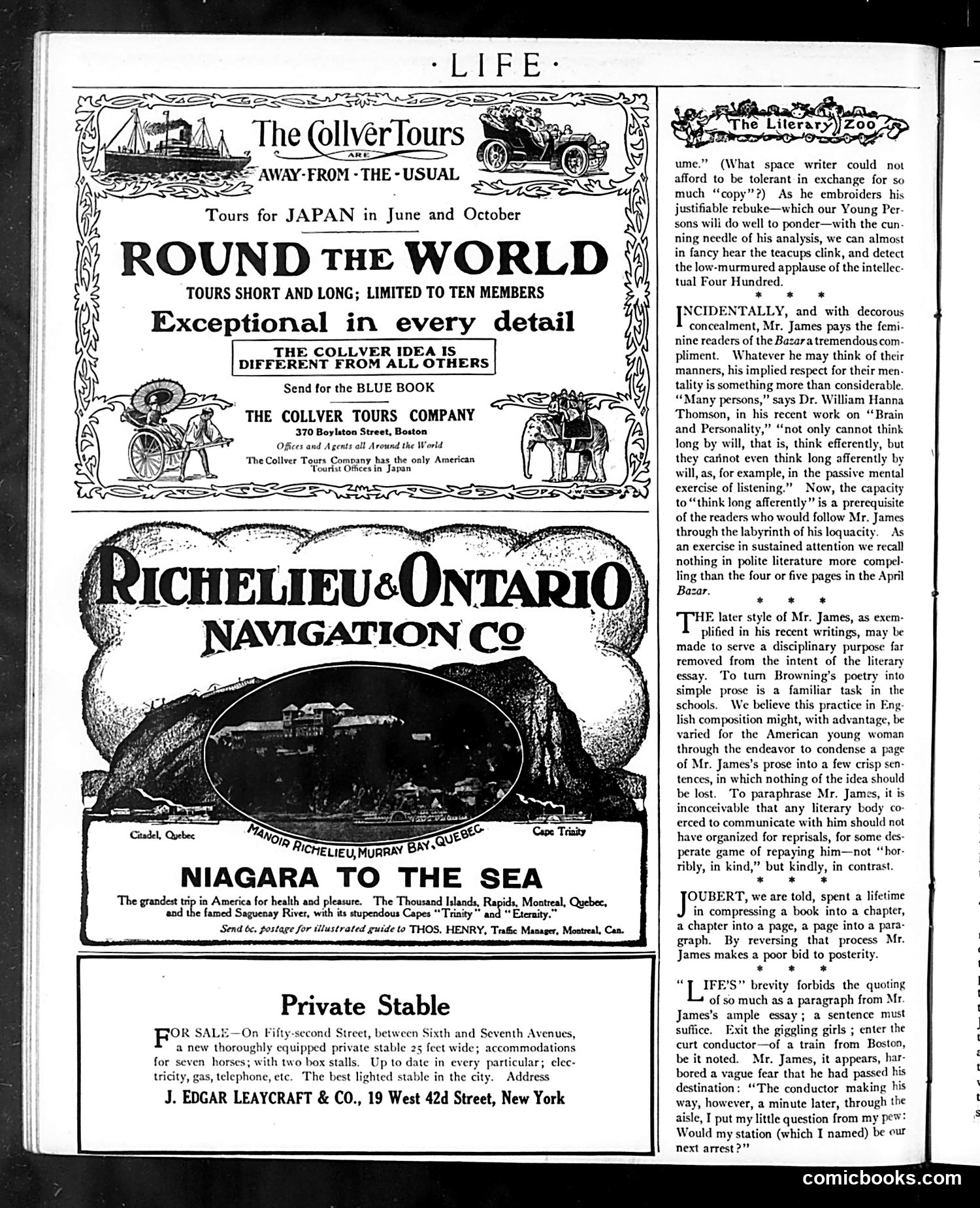
This page is **primarily advertisements**, not satirical cartoons. The main ads are: 1. **The Collver Tours** — promoting world travel packages, emphasizing their uniqueness ("Away-From-The-Usual"), with tours to Japan scheduled for June and October. 2. **Richelieu & Ontario Navigation Co.** — advertising a scenic boat trip from Niagara to the Sea, calling it "the grandest trip in America for health and pleasure." 3. **Private Stable** — offering a newly-equipped horse stable on the Upper East Side of New York City. The right column contains **book reviews** discussing literary essays and poetry, including commentary on writers' styles and their educational value. There is **no political satire or recognizable caricature** on this page — it's a standard commercial and editorial spread typical of early 20th-century magazine content.
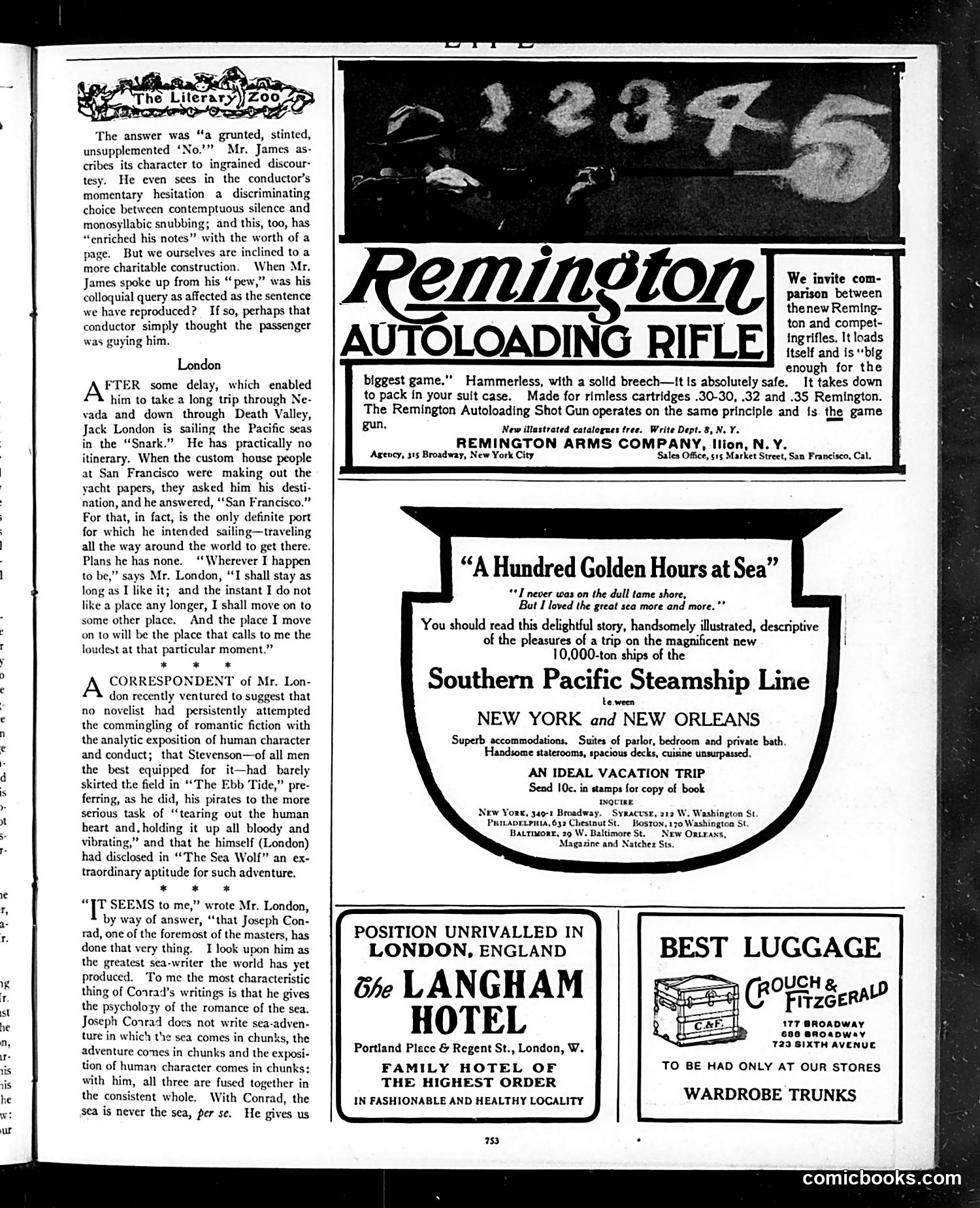
This page is primarily **advertising** rather than editorial content. The top portion contains text discussing literary criticism of a work by "Mr. James" regarding a conductor's character and speech patterns, but the dominant content consists of product advertisements. The visible ads include: - **Remington Autoloading Rifle** (top right) - emphasizing safety and portability - **Southern Pacific Steamship Line** - promoting "A Hundred Golden Hours at Sea" vacation travel to New Orleans - **The Langham Hotel** in London - **Crouch & Fitzgerald** luggage and wardrobe trunks These ads reflect early 20th-century consumer goods and leisure travel marketed to affluent readers. There are no political cartoons or satirical illustrations visible on this page.
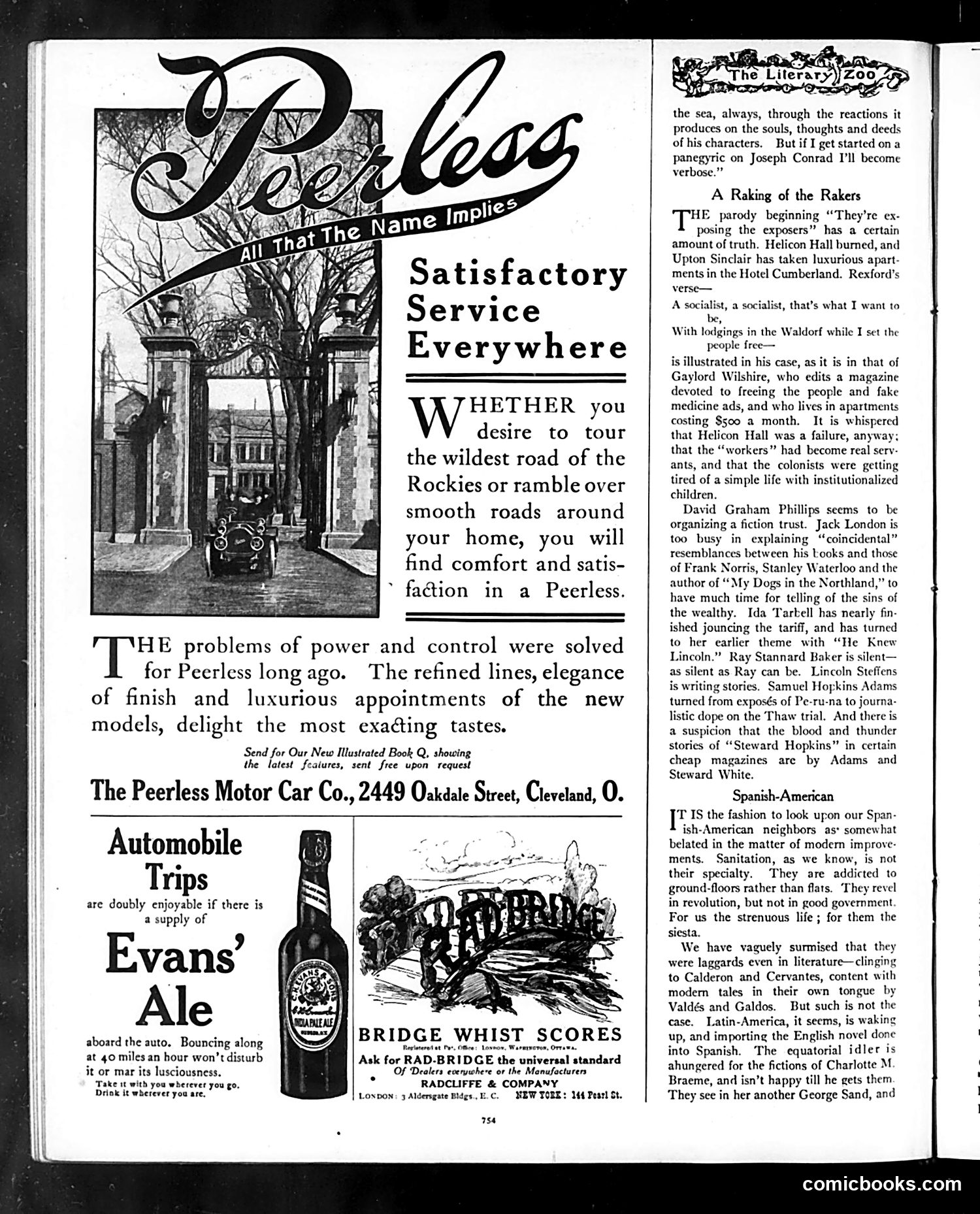
This page is primarily **advertising and literary commentary**, not political satire. The top half features ads for the **Peerless Motor Car Company** (Cleveland, Ohio) and **Evans' Ale**, emphasizing luxury automobiles and refreshment for road trips—common early 20th-century consumer messaging. Below is a **Bridge Whist Scores** card game advertisement by Radcliffe & Company (London/New York). The right column contains literary criticism discussing contemporary fiction—mentioning authors like Joseph Conrad, Jack London, and Ray Stannard Baker. The critic discusses socialist themes in literature and Spanish-American subject matter in novels, suggesting debates about modern literature's political and social relevance. The page reflects **1910s-era concerns**: automobiles as status symbols, card games as leisure activity, and literature's engagement with socialism and imperialism.
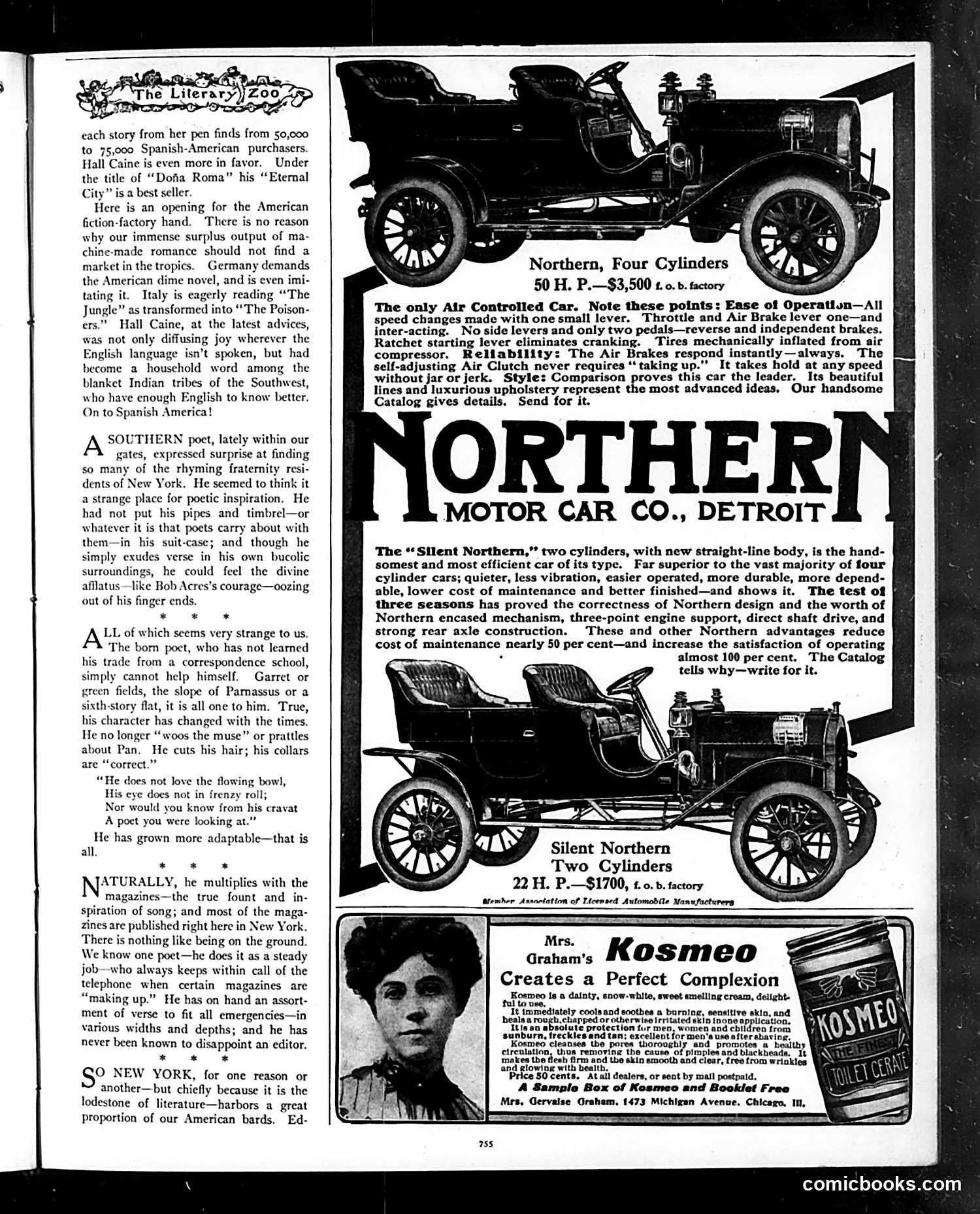
This page is **primarily advertising**, not political satire. The dominant content features: 1. **Northern Motor Car Company ads** (two models shown) - marketing automobiles with technical specifications and pricing ($3,500 for the four-cylinder model) 2. **Mrs. Graham's Kosmeo advertisement** - a beauty product promising complexion improvement, featuring a woman's portrait and testimonial from "Mrs. Gertrude Graham" of Chicago The left column contains literary content from "The Literary Zoo" discussing Spanish-American literature and American poets, but this is editorial material, not satire. There are **no political cartoons** on this page. The imagery is straightforward product advertising typical of early 20th-century magazine layouts. The "satire" in Life magazine during this era typically appeared elsewhere in the publication.
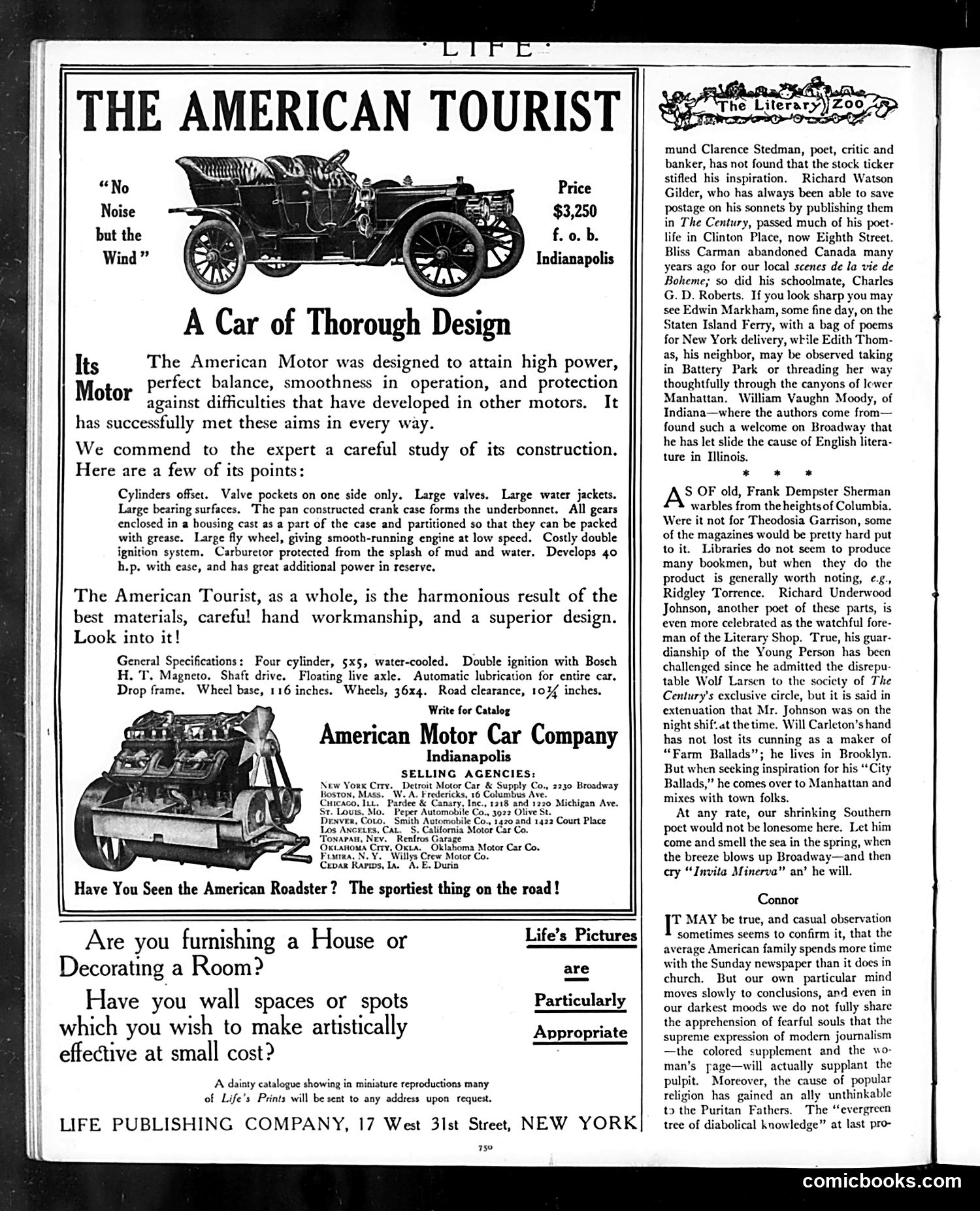
This page is **primarily advertising** for the American Tourist automobile, a car manufactured in Indianapolis by the American Motor Car Company. The ad emphasizes the vehicle's superior engineering—four-cylinder engine, double ignition, floating live axle, and other technical features designed for smooth operation. The slogan "No Noise but the Wind" markets the car's quiet, refined performance as a luxury feature. The price ($3,250 f.o.b. Indianapolis) and detailed specifications suggest this targeted affluent buyers. The right column contains **literary content** discussing various American writers and poets, unrelated to the automotive advertisement. There is no political satire or cartoon on this page—it functions as a straightforward commercial advertisement within Life magazine's pages.
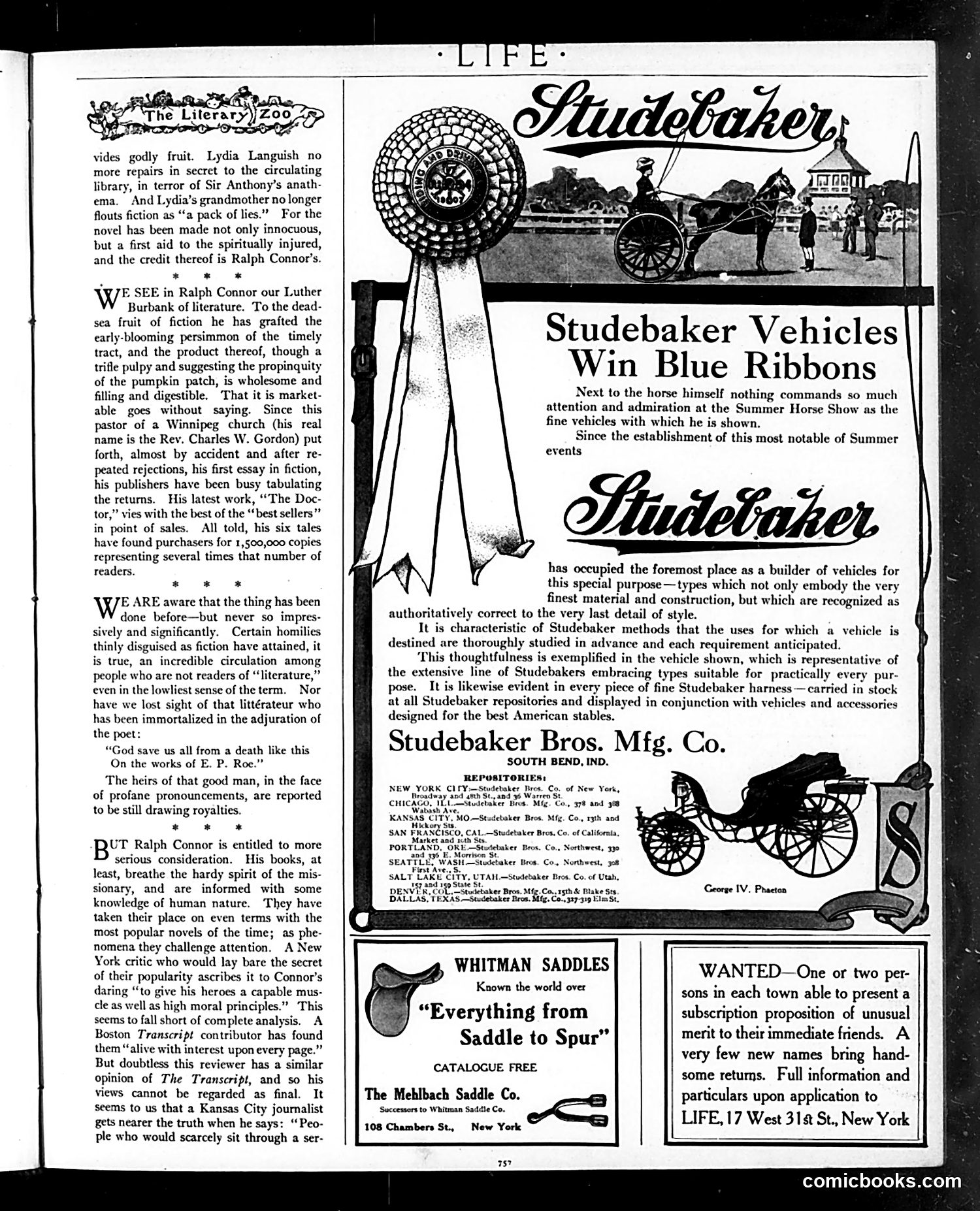
This page is primarily **advertising and literary commentary**, not political satire. The left column discusses **Ralph Connor**, a Canadian author, praising his novels for their moral fiber and popularity (reportedly 1.5 million copies sold). The text compares Connor favorably to E.P. Roe as a spiritually-minded writer who appeals to general readers. The right side features **full-page advertisements** for Studebaker vehicles and their distributors, and smaller ads for Whitman saddles and a Life magazine subscription pitch. There are **no political cartoons** on this page. The visual content consists of decorative illustrations supporting the advertisements—a Studebaker horse-drawn carriage and saddle imagery—rather than satirical commentary. This represents typical Life magazine content: mixing literary criticism with commercial advertising in the early 20th century.
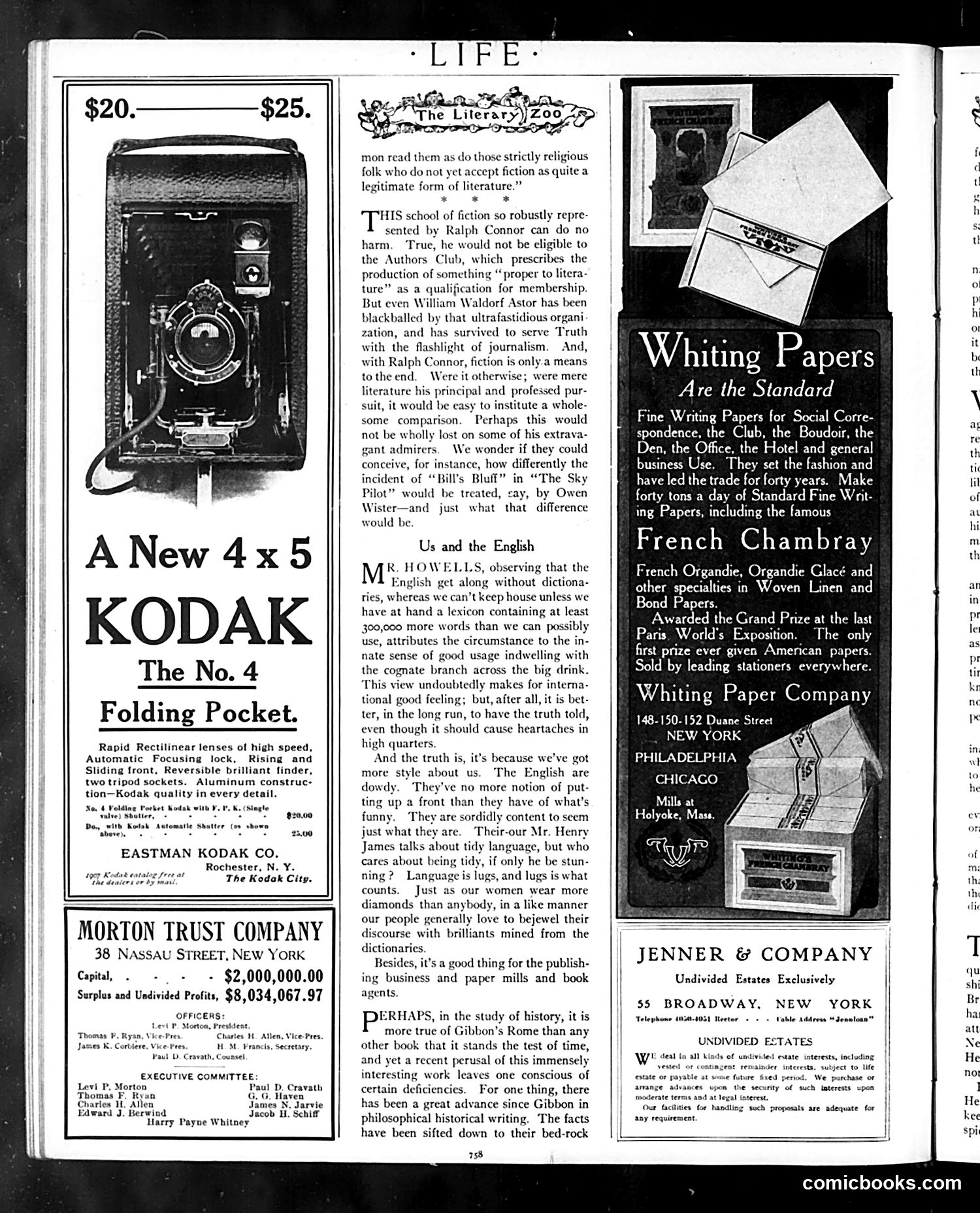
This page is primarily **advertising and editorial content**, not a political cartoon. "The Literary Zoo" is a satirical column discussing American literary taste and cultural attitudes. The main editorial critiques three subjects: 1. **Ralph Connor's fiction** — The writer defends Connor's moralistic novels against the snobbish Authors Club, which demands "proper" literature. The satire: even William Waldorf Astor (a wealthy industrialist) was rejected by this pretentious organization. 2. **American vs. English language use** — The piece sarcastically claims Americans need 300,000-word dictionaries while English people don't, attributing this to American "style." The joke: Americans are actually just showier and more ostentatious ("bejewel their discourse"), wanting to display vocabulary like women wear diamonds. This benefits publishers—cynically noted as the real point. 3. **Gibbon's historical writing** — Brief observation that despite being timeless, newer philosophical approaches have surpassed it. The satire targets American pretentiousness, consumerism, and cultural insecurity relative to England—themes typical of *Life* magazine's urbane, elite readership.
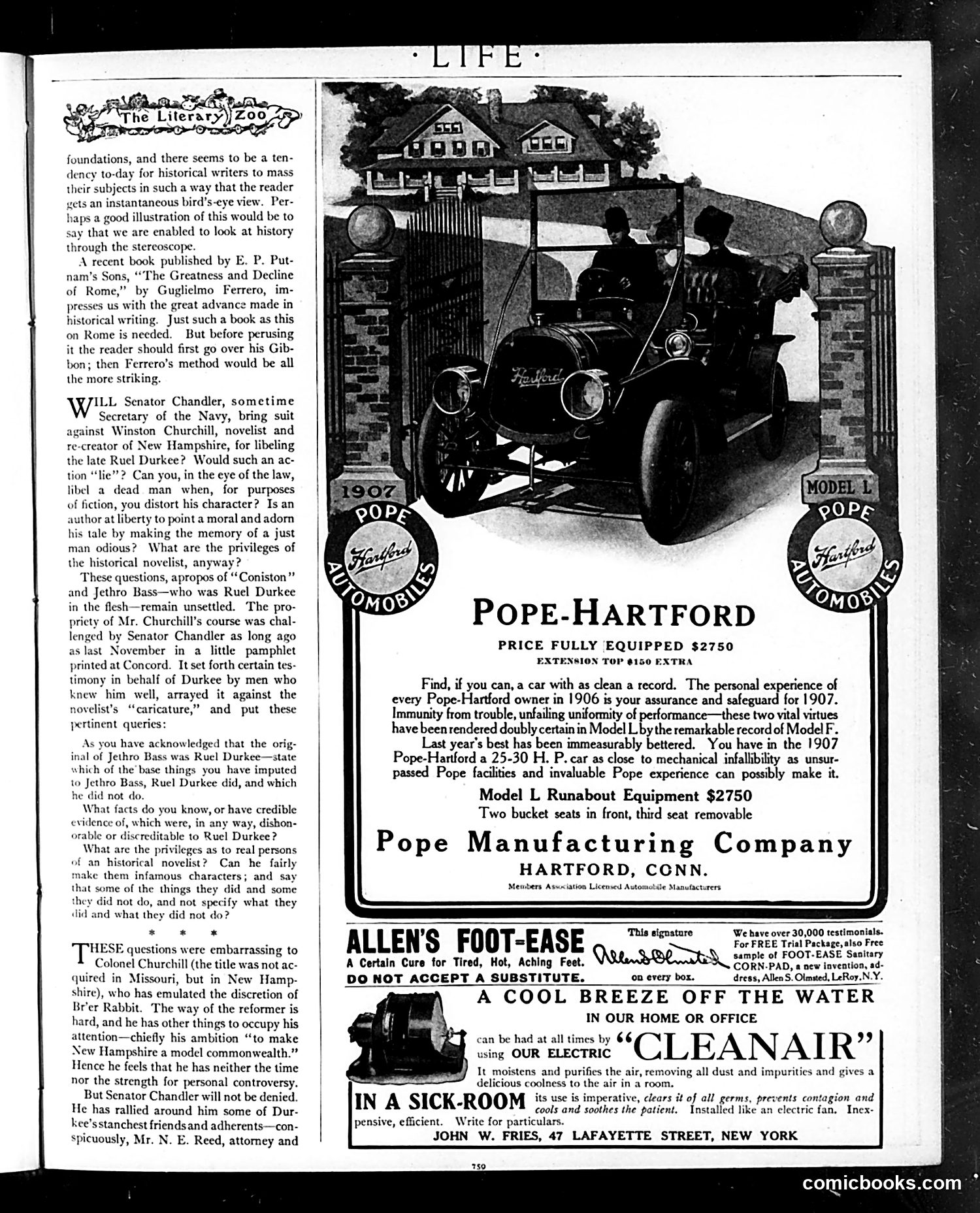
The main text discusses a literary controversy: Senator Chandler challenged novelist Winston Churchill (the American writer, not the British politician) for portraying the late New Hampshire politician Ruel Durkee as the corrupt "Jethro Bass" in Churchill's novel *Coniston*. The satire questions the ethical and legal privileges of historical novelists—can they defame real people through fiction? Should authors distort a just man's memory for narrative effect? Chandler demanded Churchill specify which allegations against the character were factually true of the actual Durkee. Churchill avoided responding, claiming he lacked time for controversy while pursuing his goal of making "New Hampshire a model commonwealth." The page is mostly advertising (Pope-Hartford automobiles, Allen's Foot-Ease, and Cleanair air purifiers), which was typical of *Life* magazine's business model.
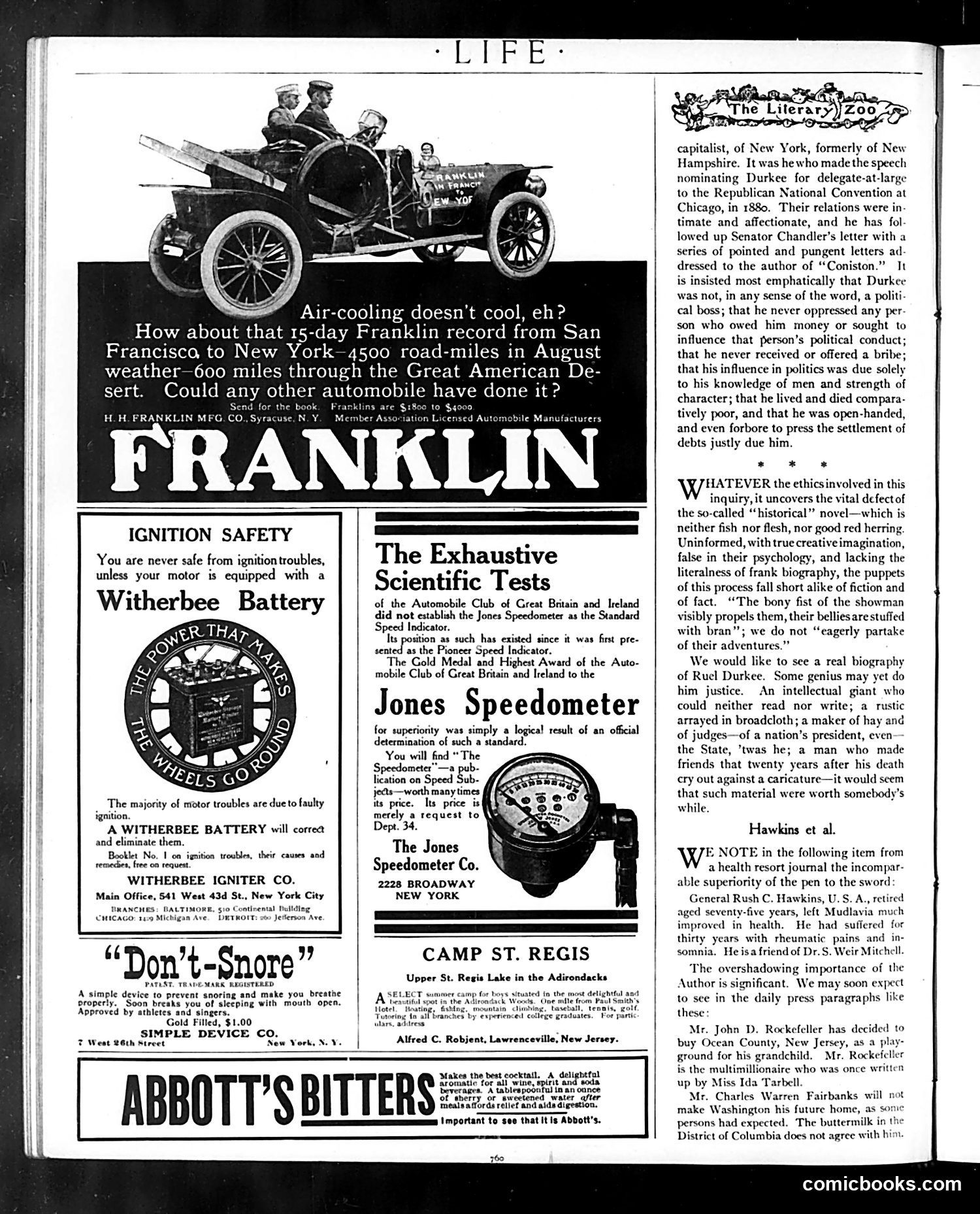
This is primarily an **advertising page** from Life magazine, not a political cartoon page. The main content consists of automobile and product advertisements (Franklin cars, Witherbee Battery, Jones Speedometer, Abbott's Bitters, etc.). The significant editorial content appears on the right side: a literary critique discussing a novel called "Coniston" and a character named Ruel Durkee. The text defends Durkee against portrayals in this "historical novel," arguing he was not a political boss but an honest man of character. It criticizes historical fiction generally for being neither authentic biography nor good creative writing—dismissing such works as manipulative spectacle ("the bony fist of the showman visibly propels them"). The page reflects early 1900s concerns about how literature depicts real political figures and the tension between factual accuracy and artistic freedom. Without additional context, the specific political figures and novel referenced remain unclear from the image alone.
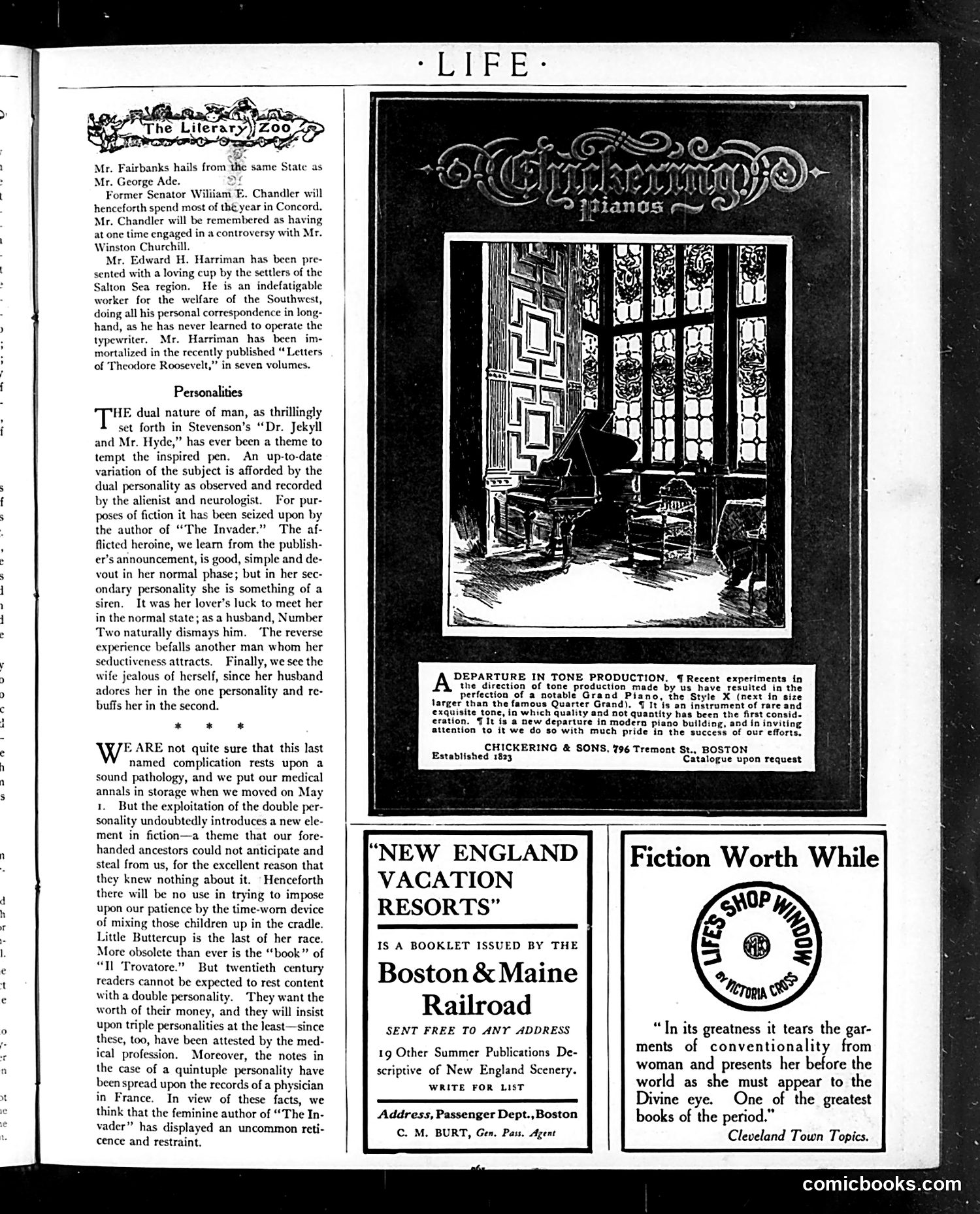
This page mixes social commentary with advertisements. The main content discusses literary trends and notable figures: **Text Content:** The "Personalities" section satirizes a contemporary novel called "The Invader," which features a female protagonist with dual personalities—good and devout in one state, seductive and siren-like in another. Life's critics mock this plot device as derivative of *Dr. Jekyll and Mr. Hyde*, then humorously predict readers will demand *triple* or *quintuple* personalities in future fiction, since medical cases documenting such conditions exist. They suggest the author showed unusual restraint by not exploiting this angle further. **References to Public Figures:** Brief mentions of Fairbanks, Senator Chandler, and E.H. Harriman appear to be typical gossip items about prominent Americans' movements and activities. **Advertisements:** Piano manufacturing (Chickering & Sons), railroad tourism (Boston & Maine), and a book recommendation fill the lower section—typical period magazine fare. The satire targets both the literary trend of psychological novels and readers' apparent appetite for increasingly sensational variations on established themes.
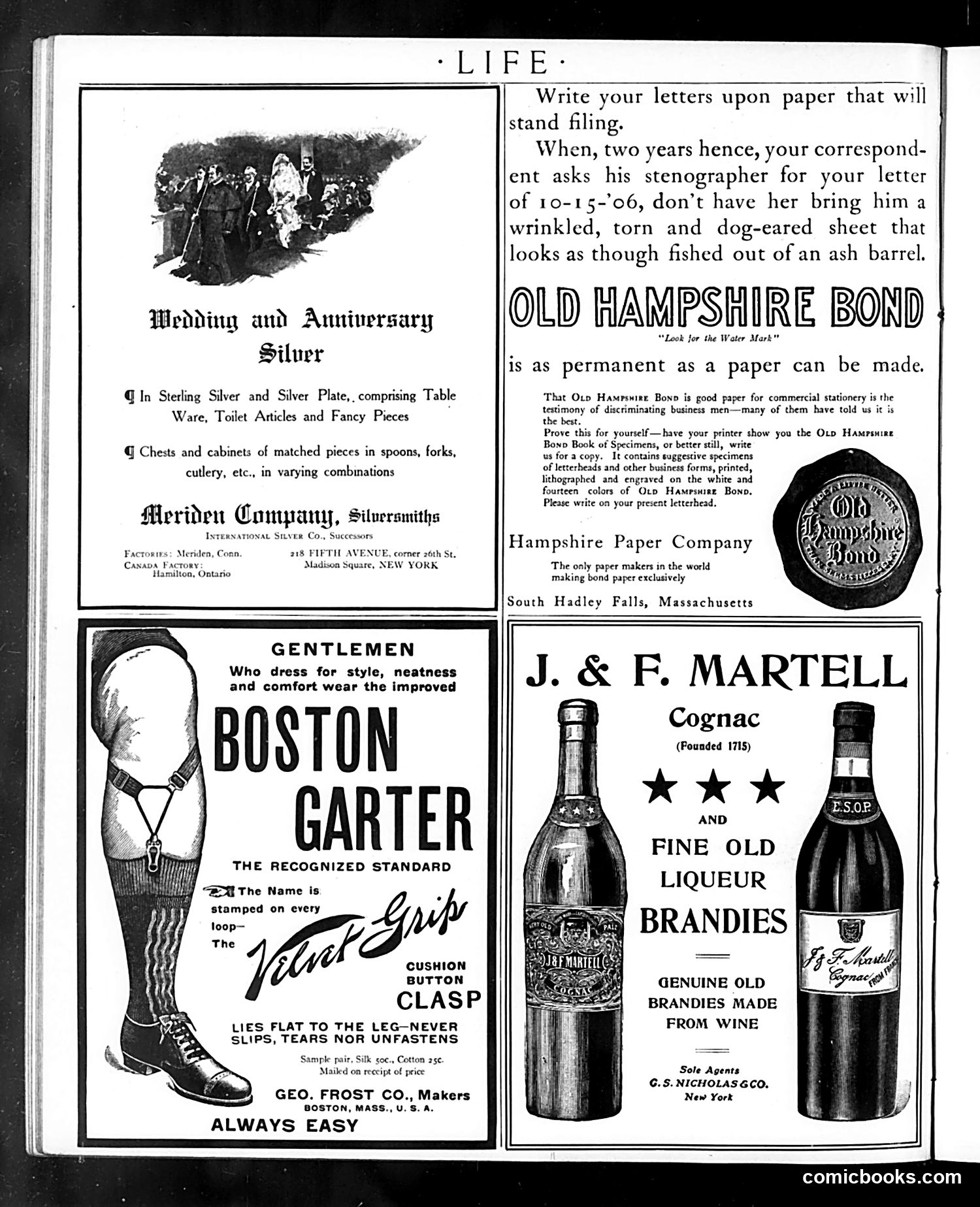
This page is primarily **advertising**, not satire or political commentary. It contains four distinct product advertisements from the early 1900s: 1. **Meriden Company Silver** — promotes sterling silver and silver plate tableware and decorative pieces 2. **Old Hampshire Bond Paper** — pitches high-quality paper for business correspondence, emphasizing permanence and professional appearance over two years' time 3. **Boston Garter** — advertises men's garters with cushioned buttons that "lie flat to the leg" and don't slip or tear, positioned as "the recognized standard" 4. **J. & F. Martell Cognac and Brandies** — promotes French liqueurs founded in 1715, marketed as "genuine old brandies made from wine" The page reflects early 1900s consumer culture, targeting middle/upper-class gentlemen concerned with proper dress, professional correspondence, and imported luxury goods. There is **no political cartoon or satire present** — this is straightforward commercial content typical of Life's revenue model during this era.
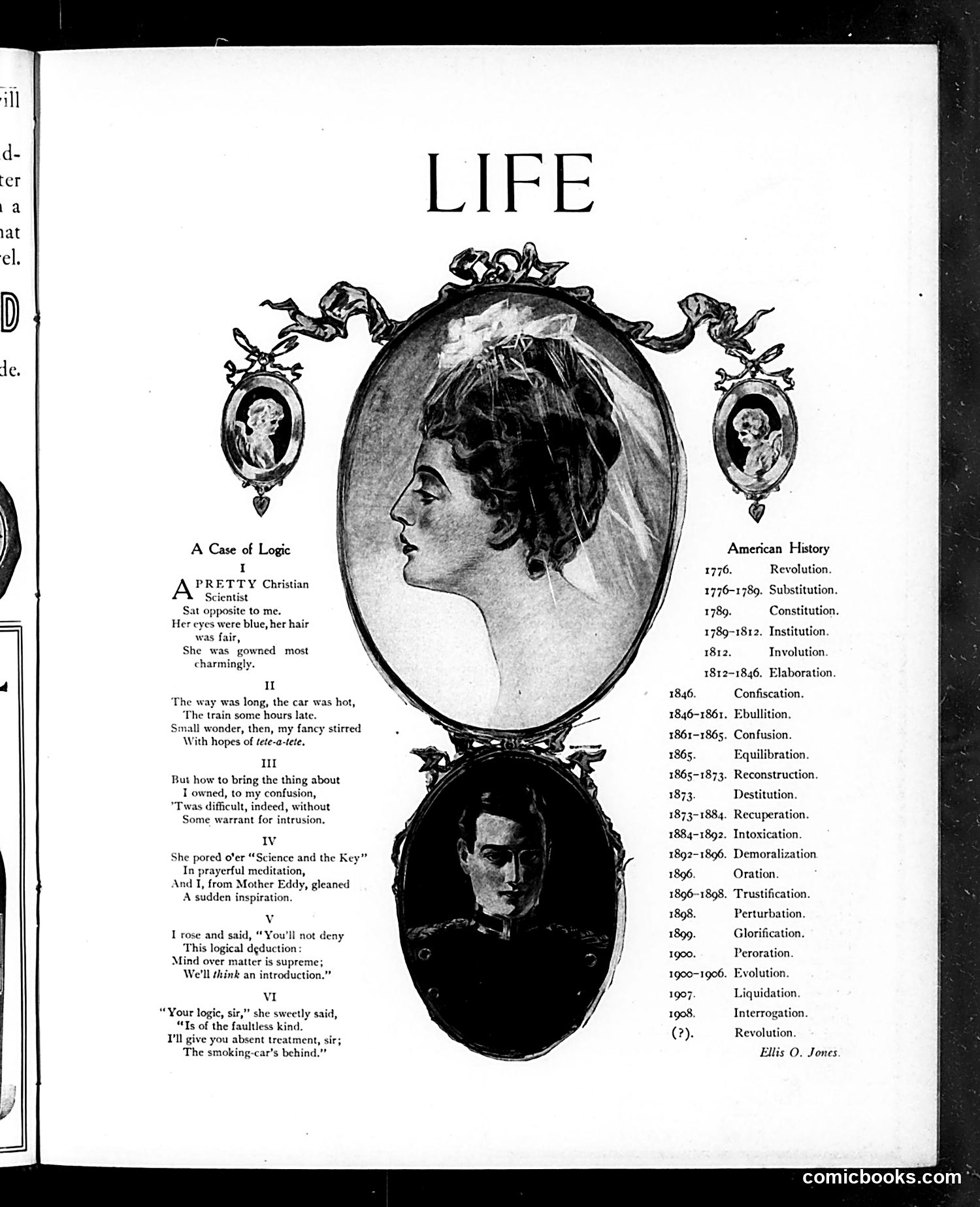
This satirical poem mocks New Thought religious movements popular in the early 1900s—specifically Christian Science (founded by Mary Baker Eddy) and similar metaphysical philosophies claiming "mind over matter" supremacy. **The Setup:** A man encounters an attractive woman on a train and uses pseudo-spiritual logic to engineer an introduction, citing that "mind over matter is supreme; We'll think an introduction." **The Joke:** The woman deflates his pretentious reasoning by suggesting "absent treatment"—a Christian Science practice of mental healing through distance—and dismissively directs him to the smoking car. She outsmarts his faux-philosophical pickup attempt using the very doctrine he invoked. **The Satire:** The poem ridicules both New Thought movements (treating them as convenient justifications for nonsense) and the man's transparent attempt to weaponize spiritual language for romantic advantage. The accompanying American History timeline appears unrelated or is a separate page element.
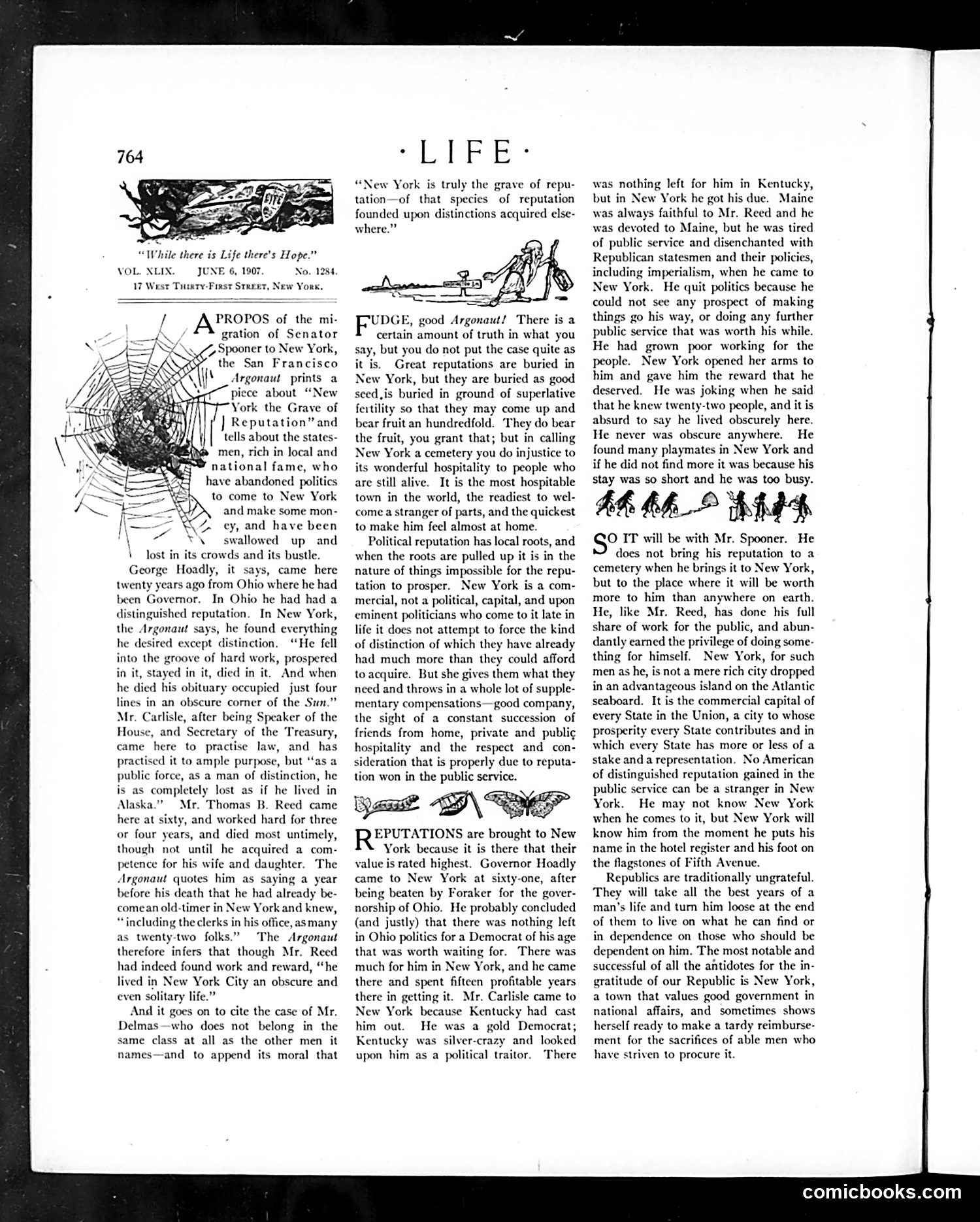
This page defends New York against criticism from the San Francisco *Argonaut* newspaper. The *Argonaut* had argued that New York is "the grave of reputation"—that prominent politicians who relocate there lose their public distinction, citing former Ohio Governor George Hoadly, ex-Speaker of the House John Carlisle, and ex-Congressman Thomas B. Reed as examples. Life's editor rebuts this, arguing New York doesn't destroy reputations but rather "buries" them like seeds in fertile soil, yielding hundredfold fruit. The key point: these men were *local* politicians whose regional power couldn't transfer to a commercial (not political) capital. New York offers superior compensations—business opportunity, intellectual company, and respect for public service—even if traditional political influence fades. The cartoon (left) appears to show a politician's confused or disillusioned face, visually reinforcing the tension between political ambition and New York's commercial reality.
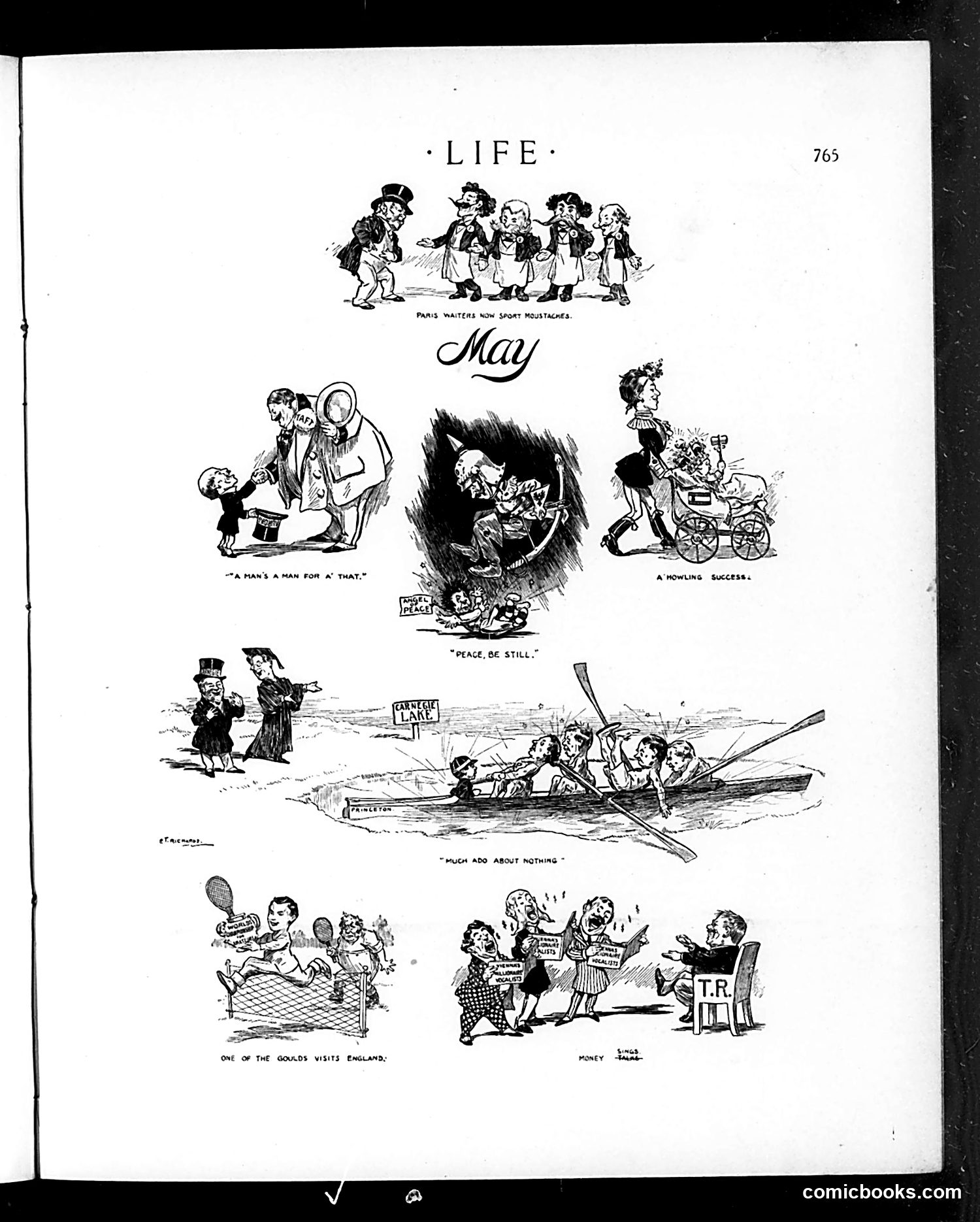
This page contains six satirical cartoons for May, each with a caption. The central image, "Peace, Be Still," appears to show someone calming turbulent waters—likely a reference to political or social unrest. "A Man's a Man for a' That" depicts an adult with a child, possibly satirizing class pretensions. "A Howling Success" shows someone with a baby carriage, likely mocking parental ambitions or social climbing. "Much Ado About Nothing" features figures in a boat, suggesting satirical commentary on trivial matters being treated seriously. "One of the Goulds Visits England" and "Money" appear to reference the wealthy Gould family, likely satirizing American wealth and its reception abroad—a common Life magazine theme during the Gilded Age. The cartoons collectively mock social pretension, class dynamics, and wealth.
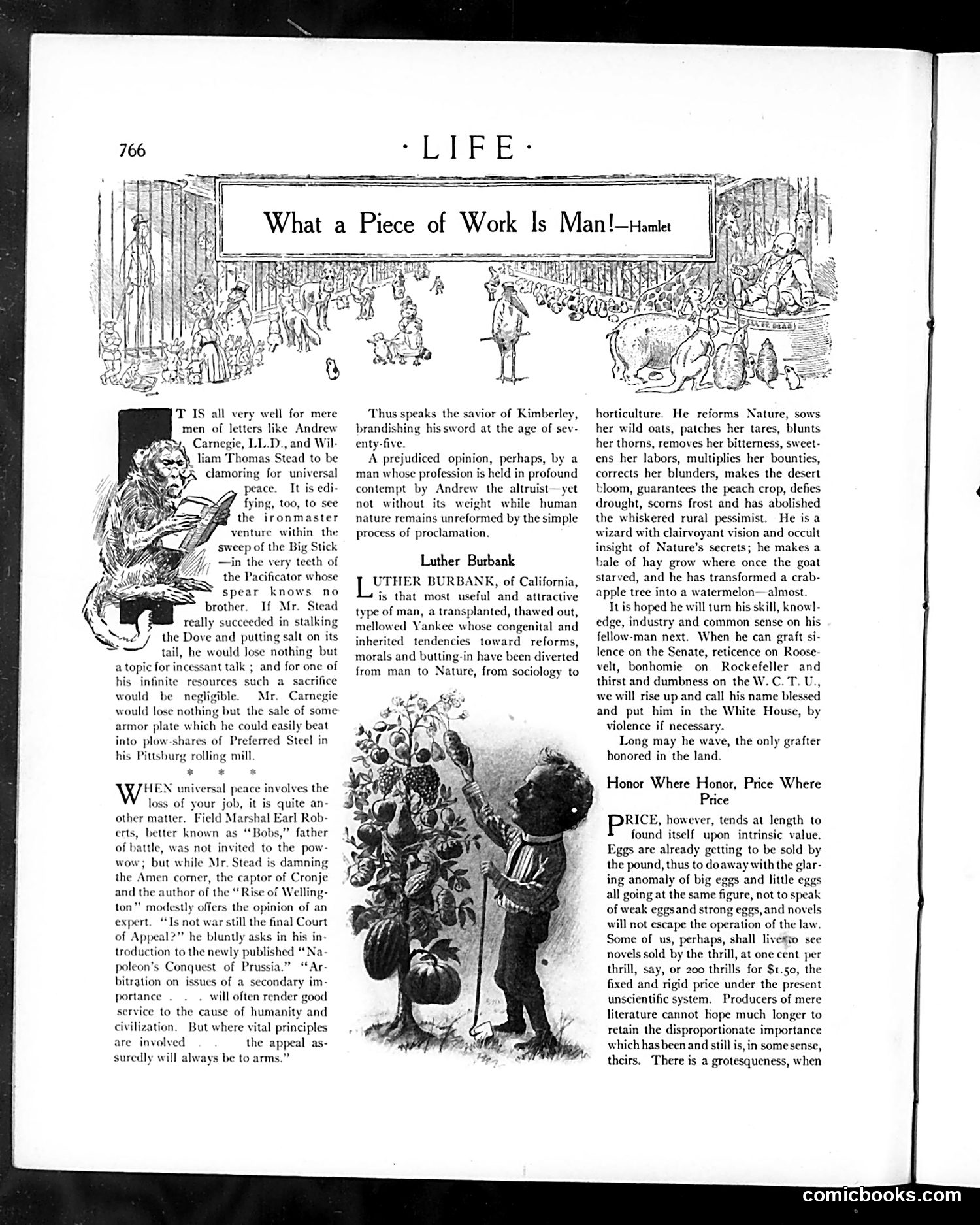
This page satirizes prominent figures of the early 1900s debating peace versus practical necessity. The text contrasts **Andrew Carnegie and William Stead** (pacifist philanthropists) with **Field Marshal Earl Roberts** ("Bobs"), the British military hero. Roberts dismissively counters their universal peace advocacy by asking if war isn't "the final Court of Appeal"—the satire being that advocates like Carnegie, who profited from armor-plate sales, could afford idealism while soldiers and working people bore war's actual costs. The piece then praises **Luther Burbank**, the plant scientist, for redirecting reform impulses from fixing society to improving crops. The satire humorously suggests if Burbank could "graft silence on the Senate, reticence on Roosevelt, [and] bonhomie on Rockefeller," he'd deserve the presidency. Finally, it jokes about pricing novels by "thrill" rather than volume—mocking commercialization of literature. The overall theme: examining human nature and whether idealism or self-interest drives behavior.
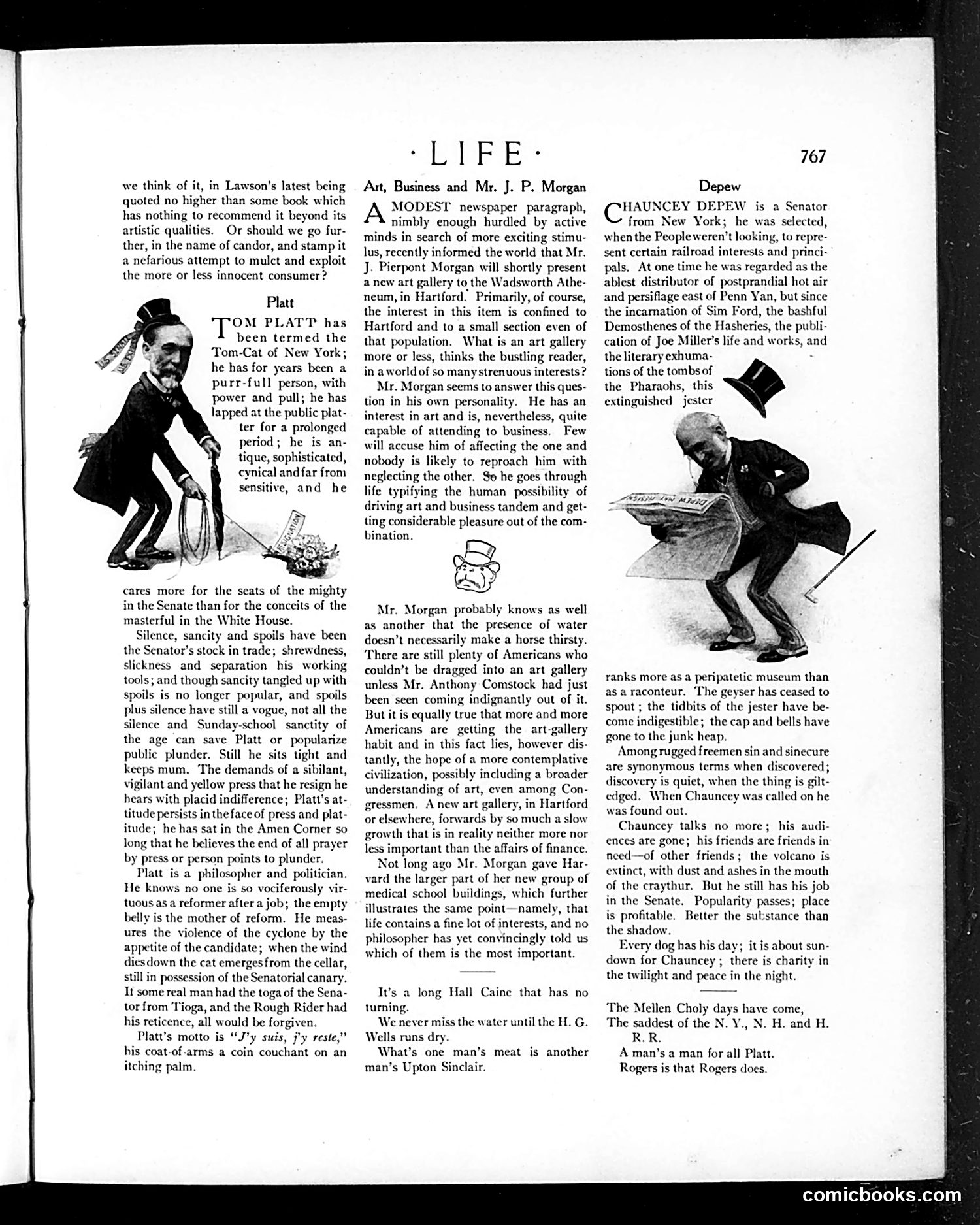
**Tom Platt Cartoon (left):** The illustration depicts Senator **Tom Platt of New York**, caricatured as a "Tom-Cat"—a nickname the text explicitly uses. The cartoon shows him as a sophisticated, cynical political operator who has "lapped at the public platter" for years through corruption ("spoils") and silence. The satire criticizes Platt for prioritizing Senate power over the presidency, remaining unmoved by press demands for resignation, and profiting from public office. His French motto "J'y suis, j'y reste" (I am here, I stay here) and "coat-of-arms" (a coin on an itching palm) emphasize his shameless self-interest and refusal to reform. **J.P. Morgan Article (right):** The text discusses banker **J.P. Morgan's** planned art gallery donation to Hartford's Wadsworth Atheneum. The piece praises Morgan's rare ability to balance art patronage with business interests, suggesting his example might elevate American cultural appreciation beyond current narrow-mindedness—perhaps referencing **Anthony Comstock**, the notorious censor.
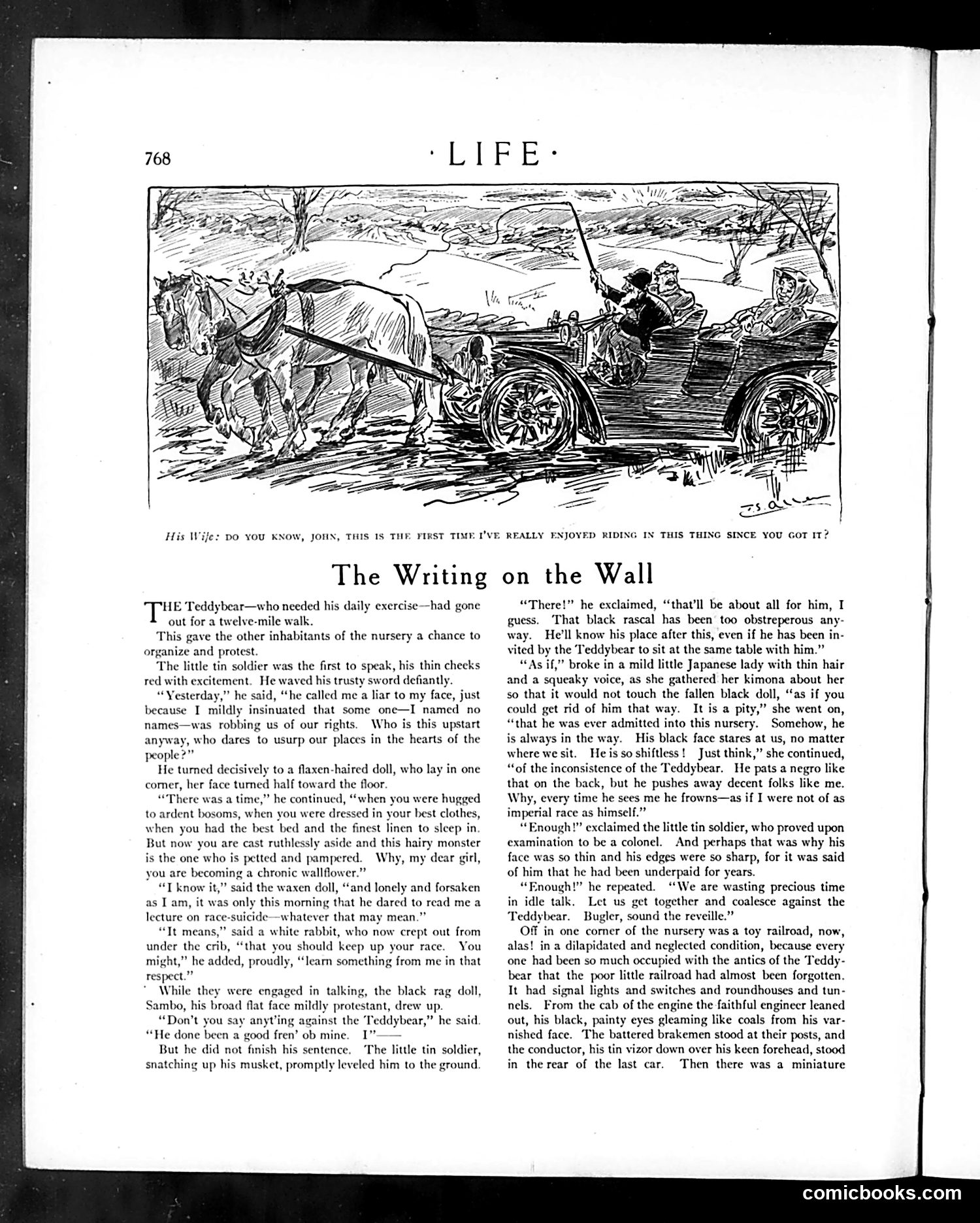
This story uses a nursery full of toys as allegory for social conflict, likely reflecting early 20th-century American anxieties about immigration and social hierarchy. The **Teddybear** represents a popular, well-liked figure (possibly Theodore Roosevelt or a general "common man") whose friendliness toward all toys—particularly the Black rag doll—offends the toy establishment. The **tin soldier** leads a revolt of "traditional" toys (a white rabbit emphasizing racial purity, a Japanese doll) against the Teddybear's egalitarianism. They're scandalized that he treats the Black doll as an equal and sits with him. The **Black rag doll** (Sambo) is sympathetic to the Teddybear, calling him a "good friend." He's attacked and knocked down by the soldier for this loyalty. The satire critiques the prejudiced establishment's intolerance of the Teddybear's progressive inclusivity—portraying the protesters as petty, exclusive, and threatened by equality. The abandoned toy railroad suggests their complaint is self-centered nostalgia rather than principle.
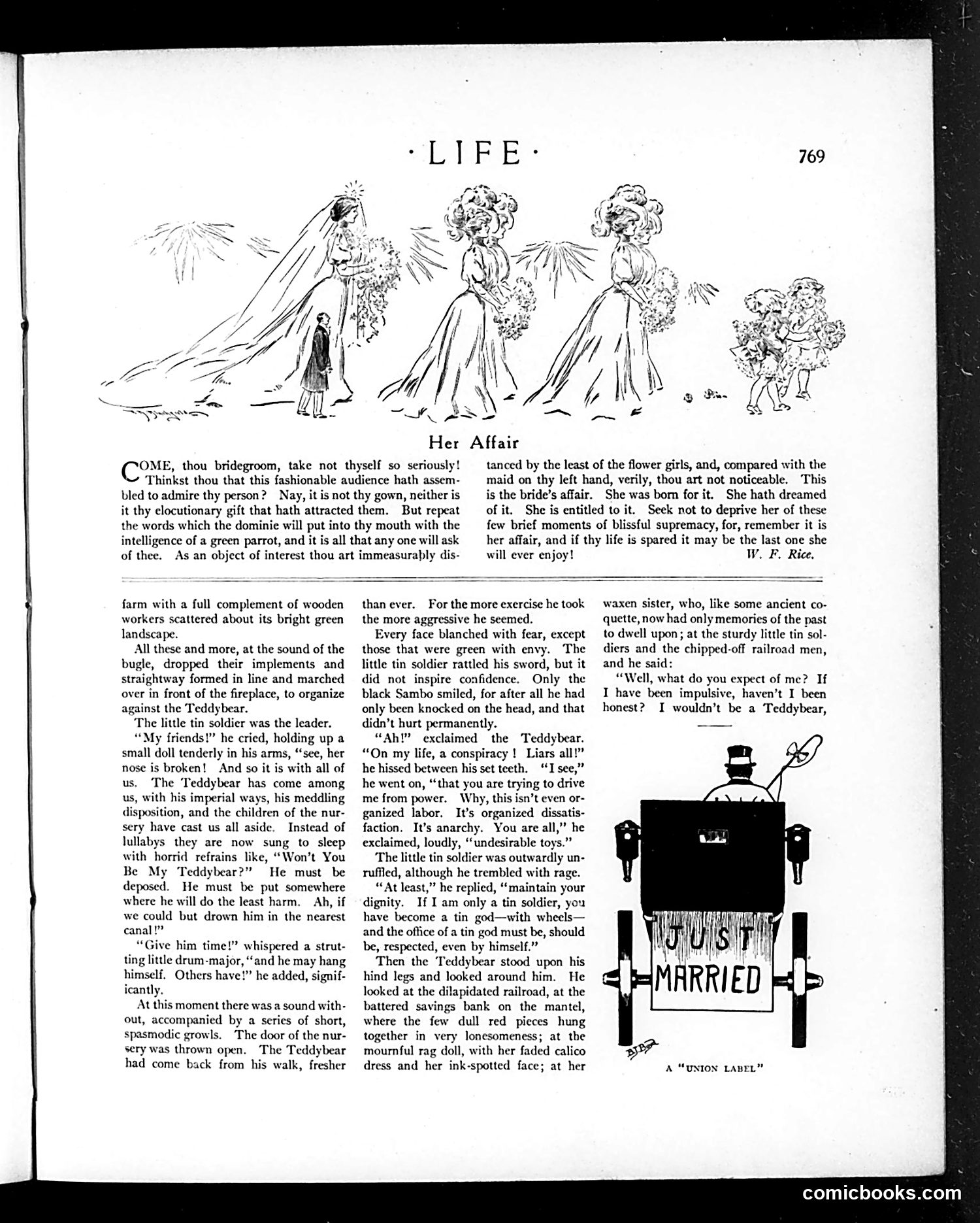
This page contains two distinct pieces. The top section, "Her Affair" by W.F. Rice, is a humorous essay advising bridegrooms not to take themselves seriously at weddings—the bride is the center of attention, and that's as it should be. The longer narrative below is a satirical allegory using nursery toys as political figures. A tin soldier leads other toys in conspiracy against an aggressive, newly-arrived Teddybear who has displaced them from favor. The Teddybear defends itself as honest and energetic, dismissing the rebellion as "organized dissatisfaction" and "anarchy," while declaring itself a "tin god" deserving respect. The satire appears to reference labor unrest and class conflict—note the tin soldier's reference to "organized labor" and the Teddybear's dismissal of the uprising as "undesirable." The toys represent different social classes or political factions competing for power and children's (public) favor. The exact historical moment remains unclear without a date, though the mention of Teddybears and "Union Label" suggests early 20th-century American politics.
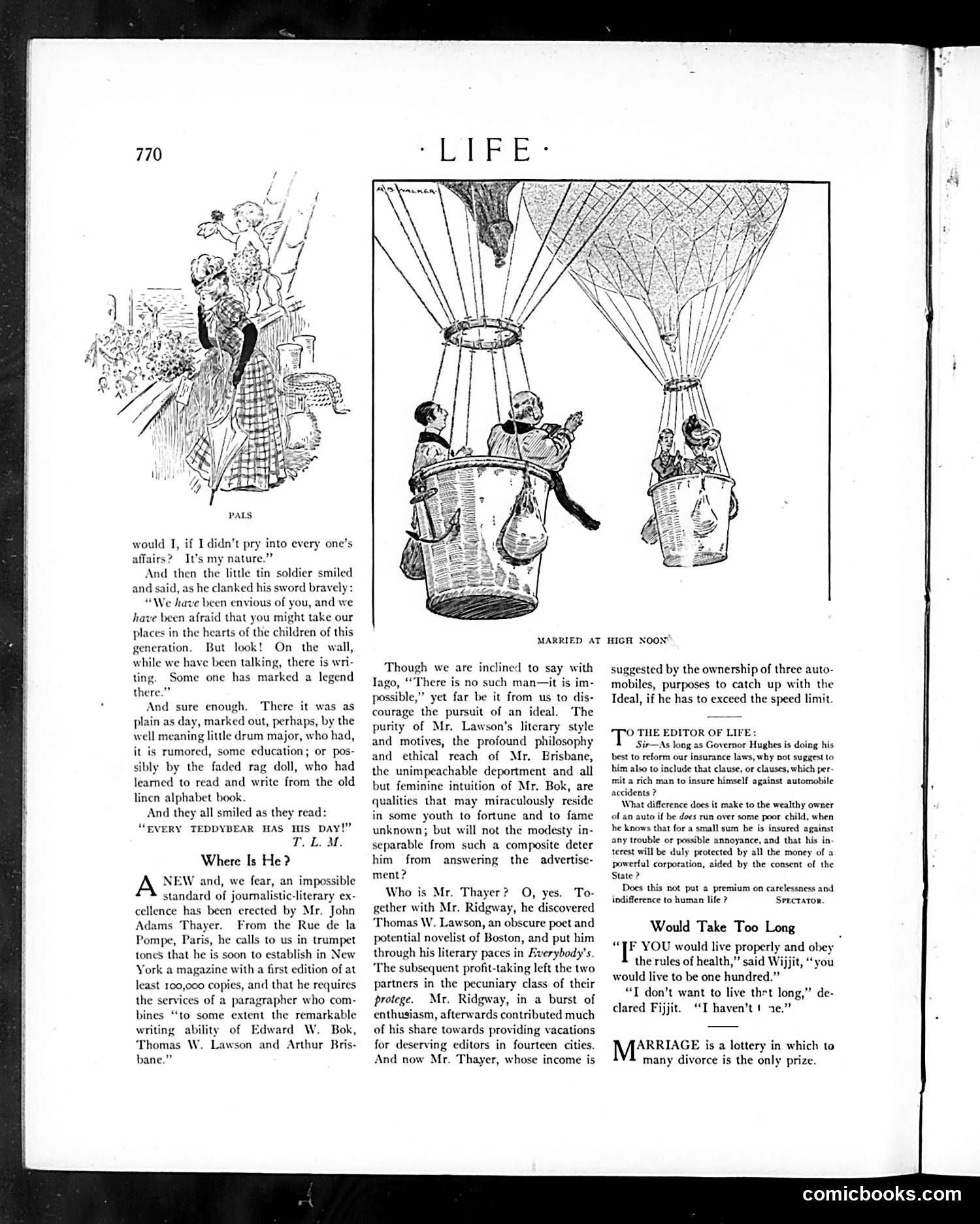
This page from *Life* magazine contains several distinct pieces of social satire: **"Pals" (left illustration):** A sentimental story about toy soldiers and a teddy bear reconciling their jealousy, concluding with the moral "Every Teddy Bear Has His Day"—likely satirizing sentimental children's literature and the era's obsession with teddy bears as toys. **"Where Is He?" (main article):** Mocks John Adams Thayer's announced plan to launch a prestigious New York magazine requiring a writer combining the talents of Edward W. Bok, Thomas W. Lawson, and Arthur Brisbane—three famous contemporary editors/writers. The satire suggests such a perfect person cannot exist. The piece also references Thayer's partnership with Ridgway in promoting Lawson through *Everybody's* magazine. **"Married at High Noon" (illustration):** Shows hot-air balloons, likely satirizing extravagance or frivolous pursuits. **Letters section:** Critiques wealthy automobile owners who can afford insurance against hitting pedestrians, treating accidents as insurable risks rather than moral wrongs. The overall tone mocks pretension, wealth inequality, and journalistic ambition.
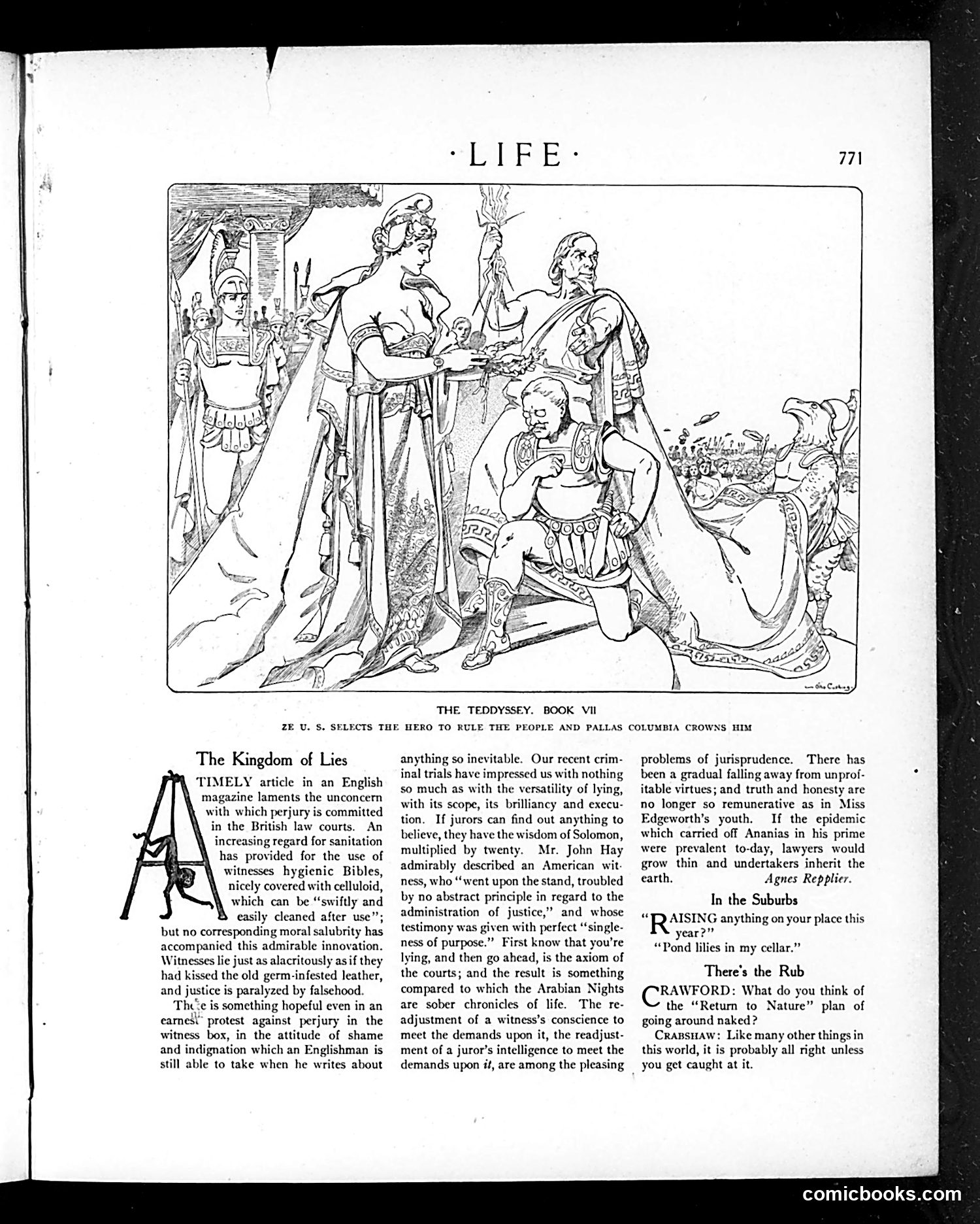
The main illustration depicts "The Teddyssey, Book VII," a satirical series referencing Theodore Roosevelt. It shows a classical scene where Columbia (America personified) crowns a hero selected "to rule the people"—a jab at executive power and democratic process. The text below critiques perjury and dishonesty in courts on both sides of the Atlantic. The article, attributed to Agnes Repplier, argues that witnesses and jurors routinely lie with impunity, making a mockery of justice. It references John Hay's description of American witnesses who testify without moral principle, and sardonically suggests that if divine punishment for perjury (like Ananias's fate in scripture) still occurred, lawyers would starve. The smaller jokes mock suburban pretension and social hypocrisy regarding the "Return to Nature" movement—suggesting people advocate it only when socially convenient, not actually. The satire targets American legal corruption, judicial incompetence, and the gap between stated values and actual behavior.
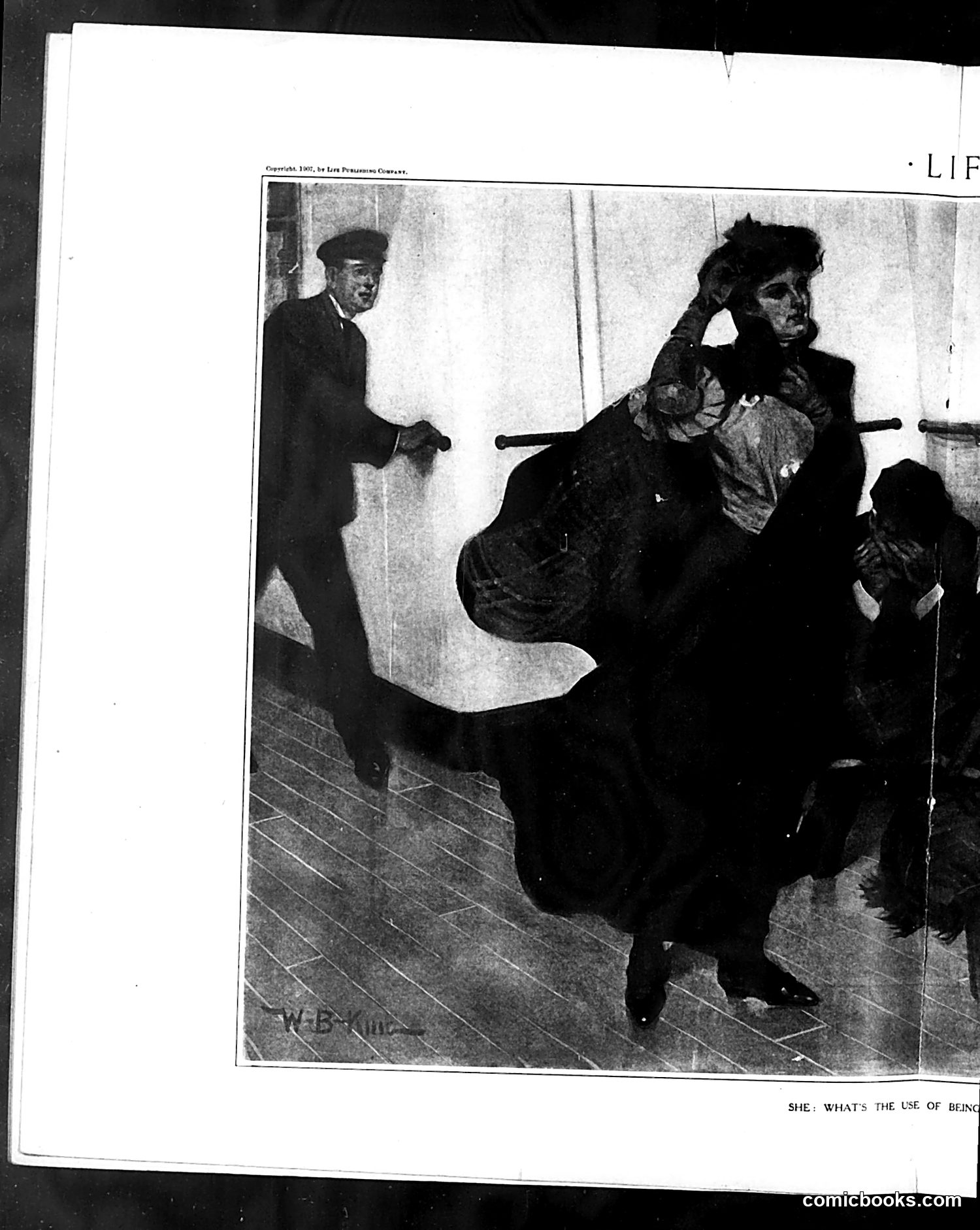
This appears to be a satirical scene from Life magazine depicting a social or political situation. The image shows three figures: a man in a cap and coat on the left observing two people on the right—a woman in dark clothing being supported or restrained by another figure. The woman appears distressed or in an exaggerated pose of helplessness. The caption reads: "SHE: WHAT'S THE USE OF BEING..." (text cuts off) Without the complete caption or publication date visible, the precise meaning is unclear. However, this appears to be social satire, likely mocking either gender relations, class dynamics, or a specific contemporary scandal. The exaggerated poses and composition suggest commentary on theatrical victimhood or performative behavior. More context would be needed to identify the specific figures or events referenced.
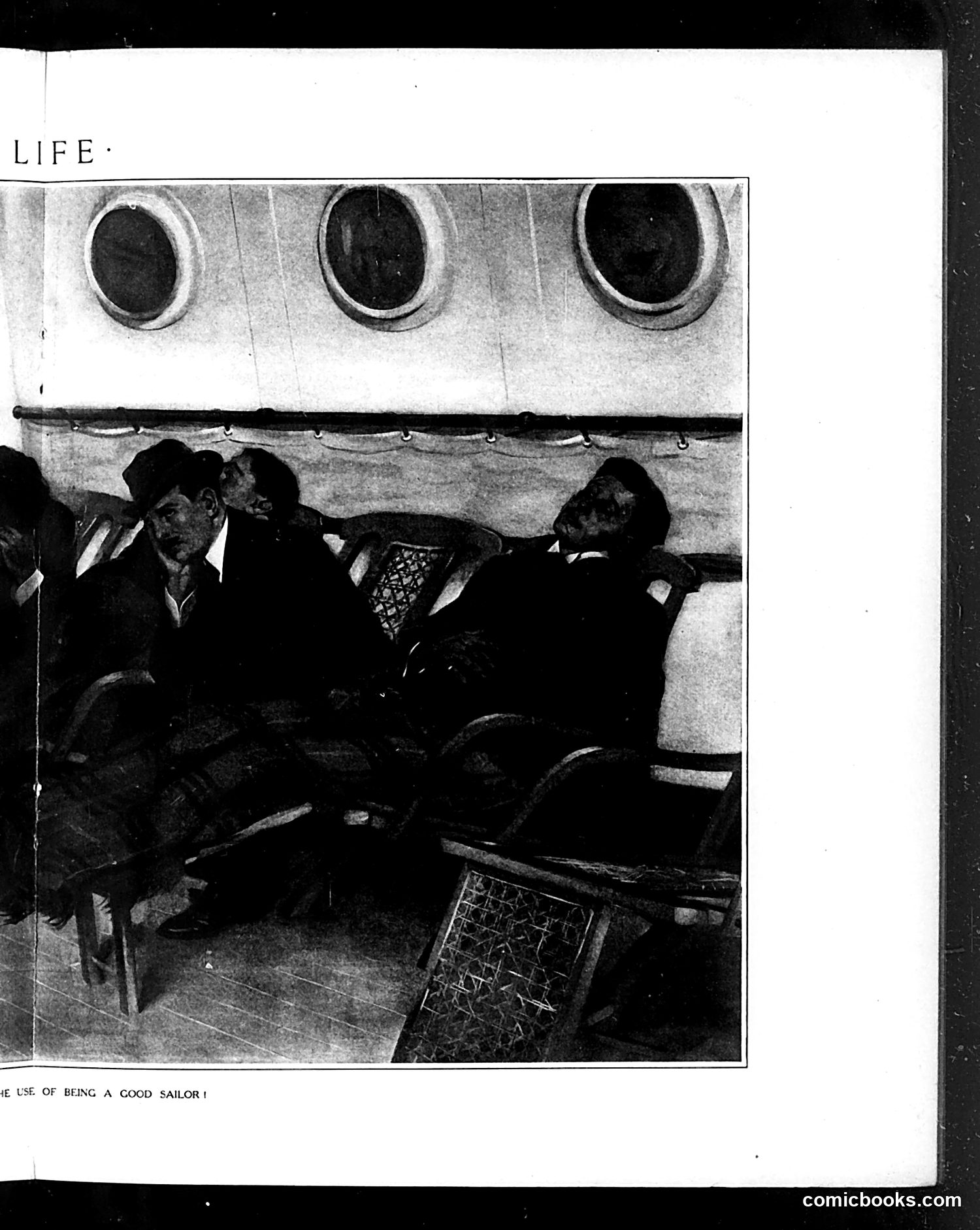
This is a Life magazine page featuring a photograph of passengers aboard what appears to be a ship's interior, visible through three circular portholes. Several men in suits and formal wear are seated in cramped quarters below deck. The caption reads "THE USE OF BEING A GOOD SAILOR!" — though the incomplete OCR makes the full joke unclear. The satire likely comments on maritime travel conditions or passenger comfort during the era when this was published. The cramped, dark seating arrangement visible through the portholes suggests the humor derives from contrasting the romanticized notion of seafaring with the actual unglamorous reality of ship travel for ordinary passengers. Without additional context or complete caption text, the specific satirical target remains uncertain.
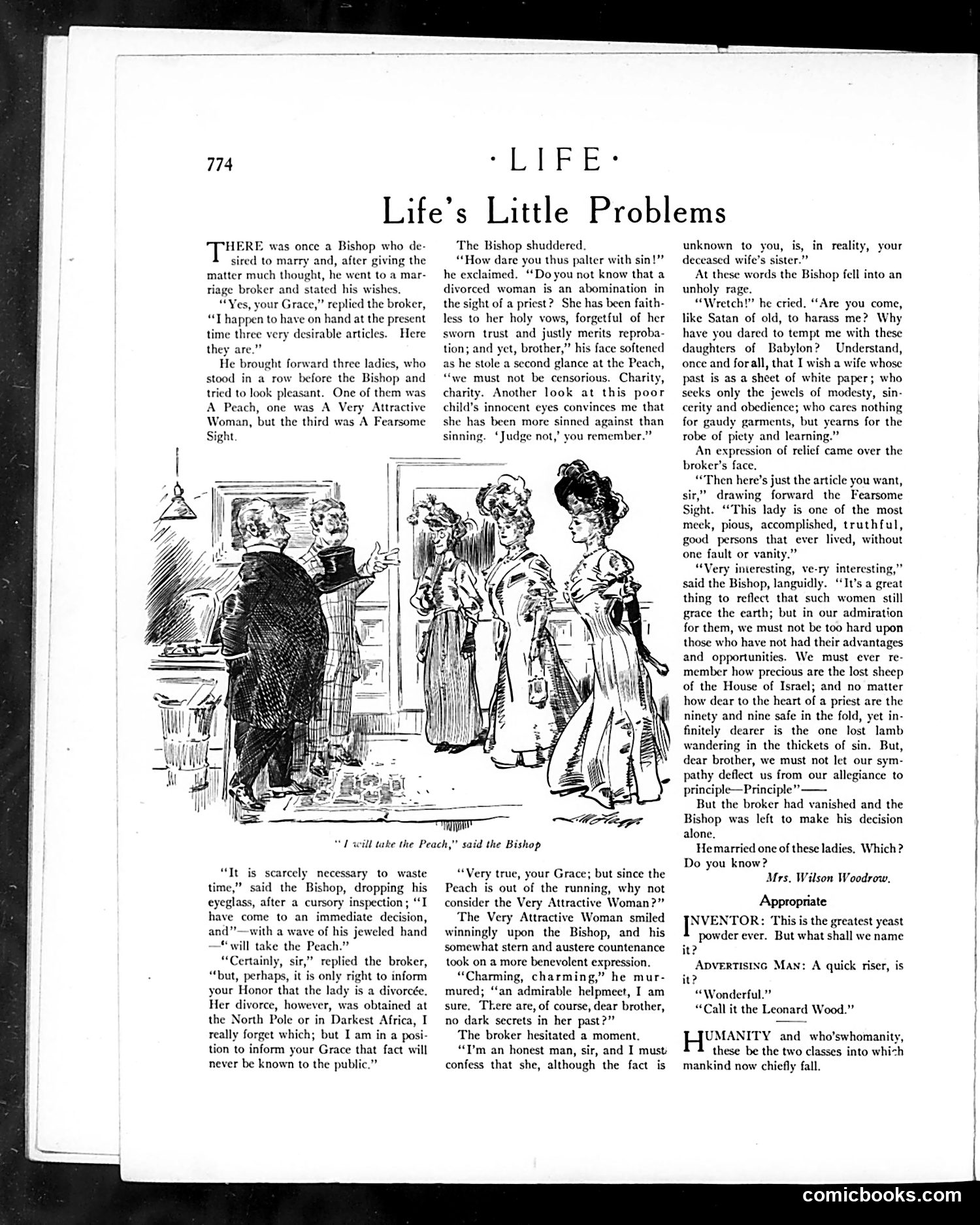
This story mocks a Bishop's moral inconsistency. He visits a marriage broker seeking a wife and encounters three women: an attractive divorcée, an attractive woman (secretly his deceased wife's sister—forbidden by Victorian church law), and an unattractive but virtuous woman. The satire exposes the Bishop's true priorities: he initially desires the "Peach" (attractive divorcée) despite church doctrine condemning divorce, then the "Very Attractive Woman" until learning she's his deceased wife's sister—a canonical impediment that actually outrages him. Only when offered the "Fearsome Sight" does he suddenly embrace pious principles about "lost lambs" and charity. The joke is obvious: the Bishop's stated religious values are revealed as mere pretense, deployed selectively to justify whatever he wants. Physical attraction dictates his choices until church law directly blocks him—then he performs virtue. The broker's vanishing ending suggests the Bishop's transparent hypocrisy isn't fooling anyone.
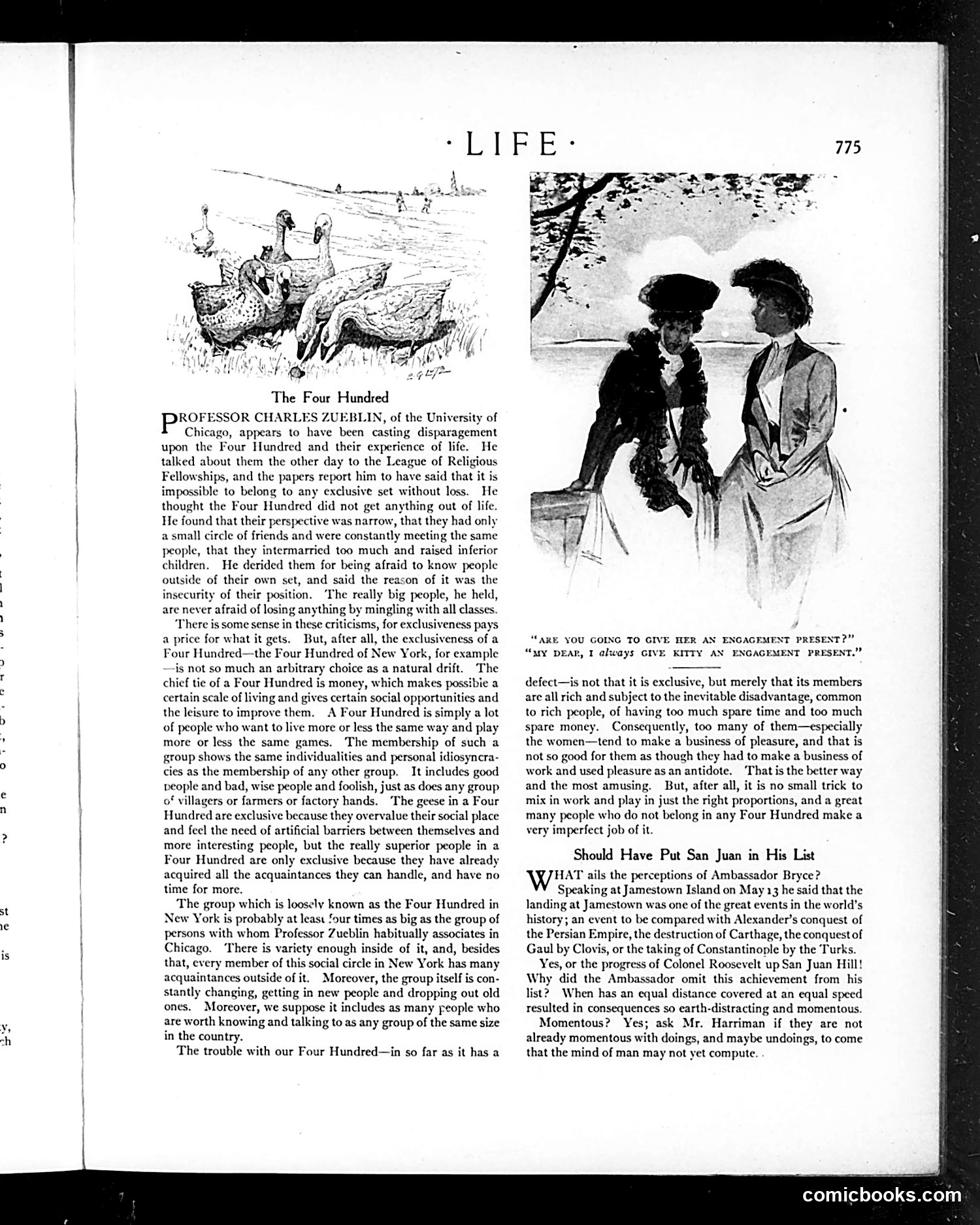
The page defends New York's "Four Hundred"—the city's wealthy elite social circle—against criticism from Professor Charles Zueblin of the University of Chicago, who claimed exclusive social groups were narrow and damaging. The **sketch at top left** depicts members of this exclusive class at leisure, establishing the subject visually. The **photograph on the right** shows two fashionably dressed women in conversation, illustrating the social world under discussion. The caption's joke concerns engagement presents for "Kitty"—the speaker always gives such gifts, suggesting this is a routine expectation within their wealthy social set, highlighting both their material abundance and the ritualized nature of their social obligations. Life's editorial position: the Four Hundred's exclusivity stems naturally from wealth and shared lifestyle, not snobbery. The real weakness is that excess leisure time encourages frivolous behavior, particularly among women. The piece also includes an unrelated section criticizing Ambassador Bryce for omitting San Juan from his historical achievements list.
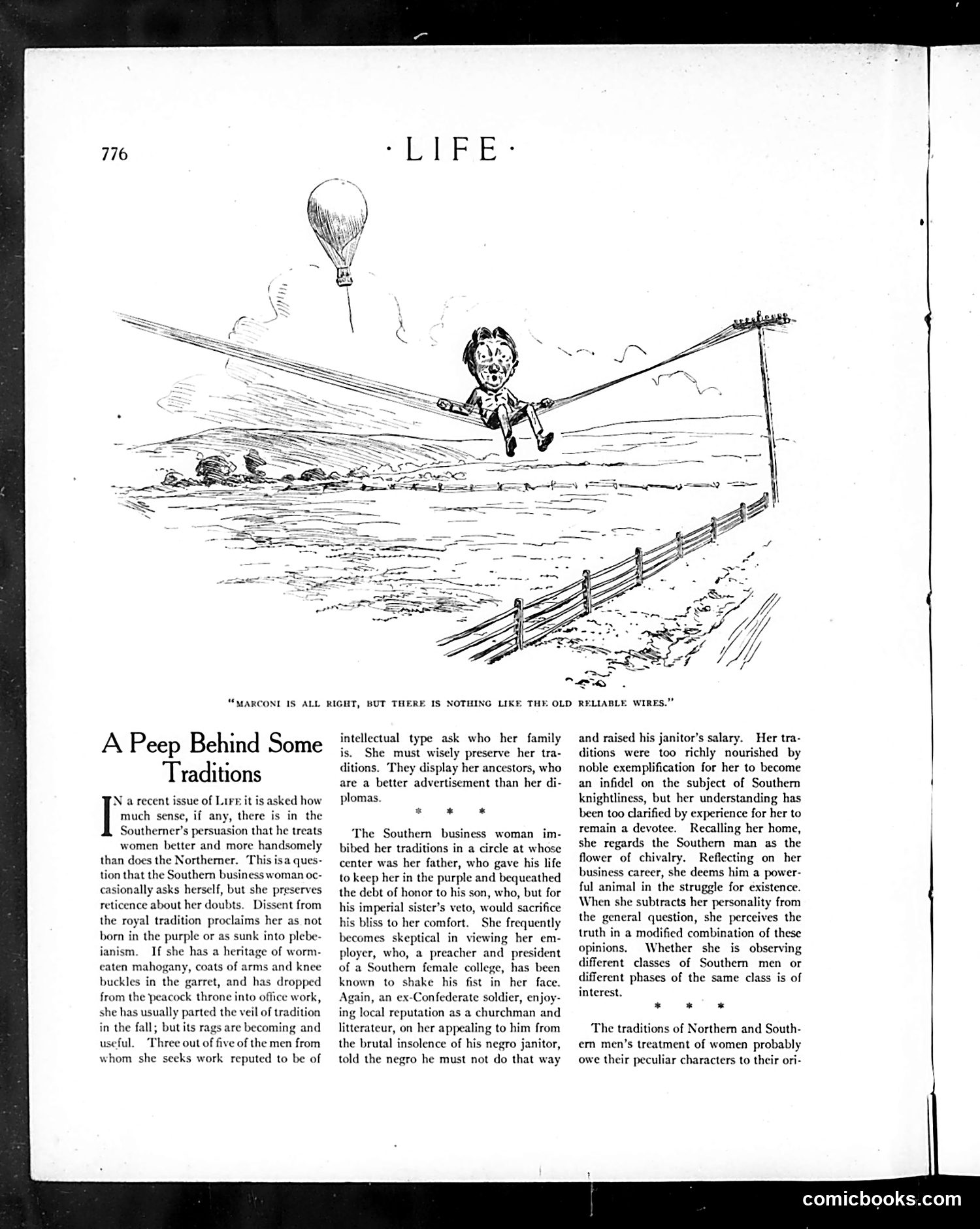
This Life magazine page satirizes Southern gentility myths versus reality. The cartoon depicts a man using old telegraph wires while a hot air balloon (representing Marconi's wireless technology) floats nearby—a visual joke: "Marconi is all right, but there is nothing like the old reliable wires," mocking stubborn adherence to outdated traditions. The article critiques Southern women who maintain "traditions" of chivalry and aristocratic heritage (ancestors, mahogany furniture, family status) despite experiencing professional disrespect. The satire exposes the gap between the "Southern gentleman" myth—men as "flowers of chivalry"—and their actual behavior: employers shaking their fists at women, janitors treated brutally until complained about. The piece argues Southern women preserve these traditions not from genuine belief but because questioning them marks them as "not born in the purple"—socially inferior. The joke: they've learned through hard experience that Southern men are merely "powerful animals in the struggle for existence," yet publicly maintain the romantic myth.
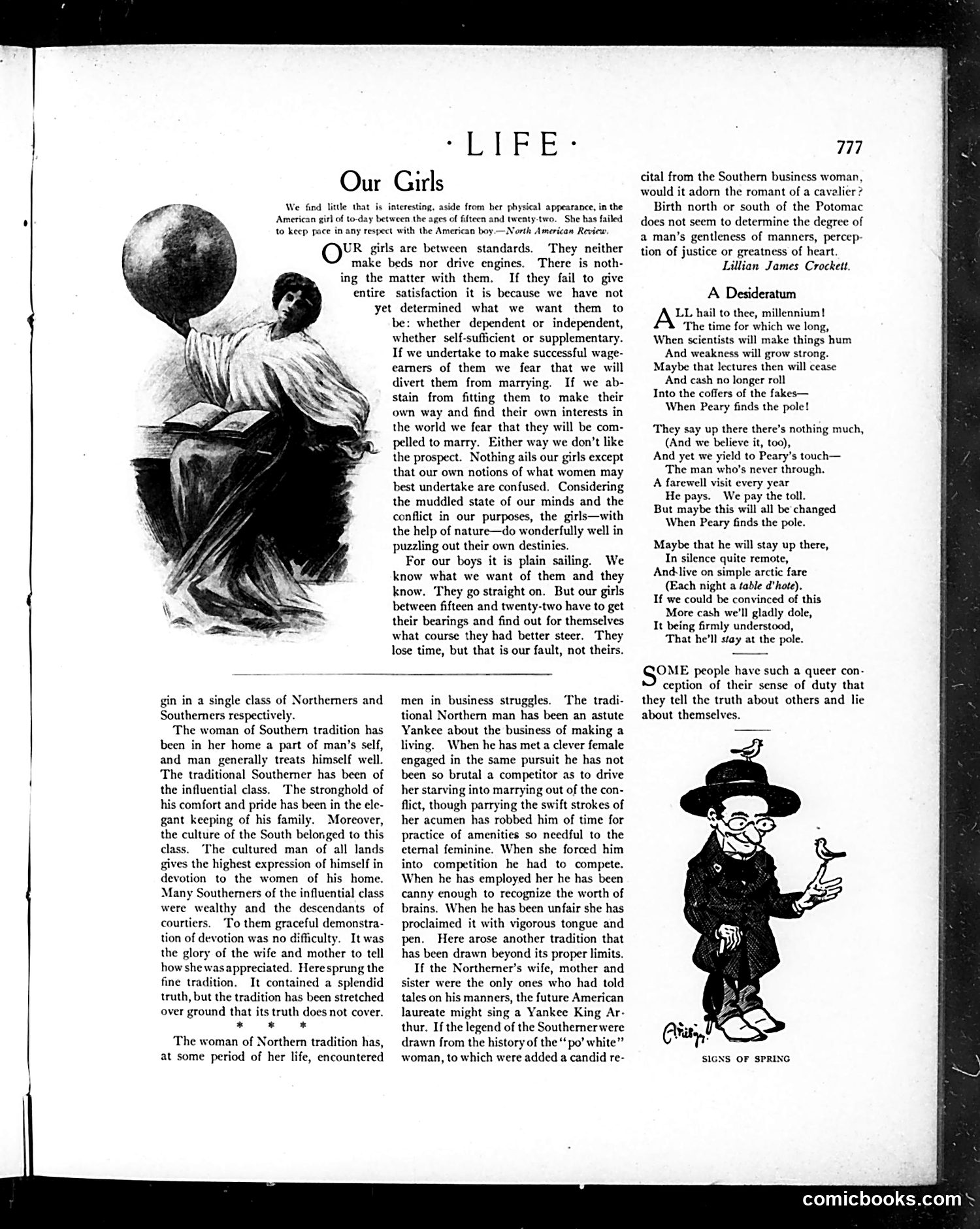
This page presents an editorial essay titled "Our Girls," critiquing American women aged 15-22. The author argues that while American boys have clear societal expectations, girls face confusing, contradictory demands: society won't let them become independent wage-earners (fearing they'll abandon marriage), yet won't prepare them for self-sufficiency (fearing forced marriages). The piece blames society's confusion, not the girls themselves, for their "muddled" circumstances. The essay then contrasts Northern and Southern female traditions: Southern women were sheltered, cherished domestically; Northern women competed in business and spoke bluntly about injustice. The author suggests neither tradition fully applies universally. The accompanying illustration shows a classical female figure holding a globe, symbolizing the scope and weight of women's uncertain position. The page includes an unrelated poem, "A Desideratum," about Arctic exploration, and a small cartoon labeled "Signs of Spring" showing a figure with birds.
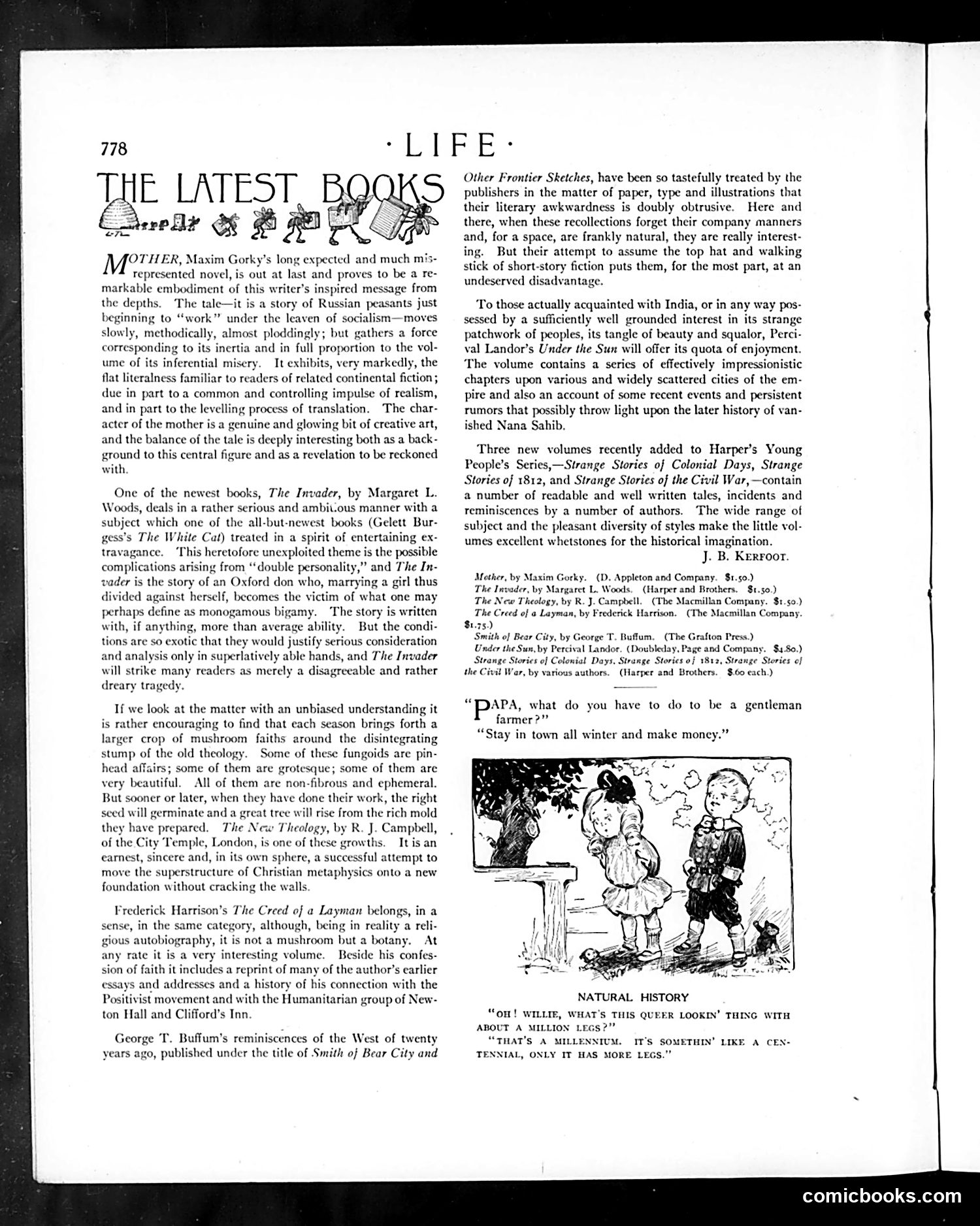
This is a **book review page**, not primarily a political cartoon. The single cartoon shown illustrates a joke about natural history rather than satire. The main content reviews new literary works, notably Maxim Gorky's *Mother*—a novel about Russian peasants under socialism. The reviewer praises its artistic merit while noting its heavy, realistic style. Other books discussed include works exploring "double personality" and various religious philosophy texts (*The New Theology*, *The Creed of a Layman*). The small cartoon captioned "NATURAL HISTORY" depicts two children observing an insect, with dialogue about it having "a million legs" and one child correcting that "it's somethin's like a centennial—only it has more legs." This is simply a children's humor joke playing on the similarity between "centennial" (100 years) and "centipede" (many legs)—likely meant as a palate-cleanser among dense literary criticism. The page reflects early 1900s intellectual culture's engagement with socialist literature and modernist religious philosophy.
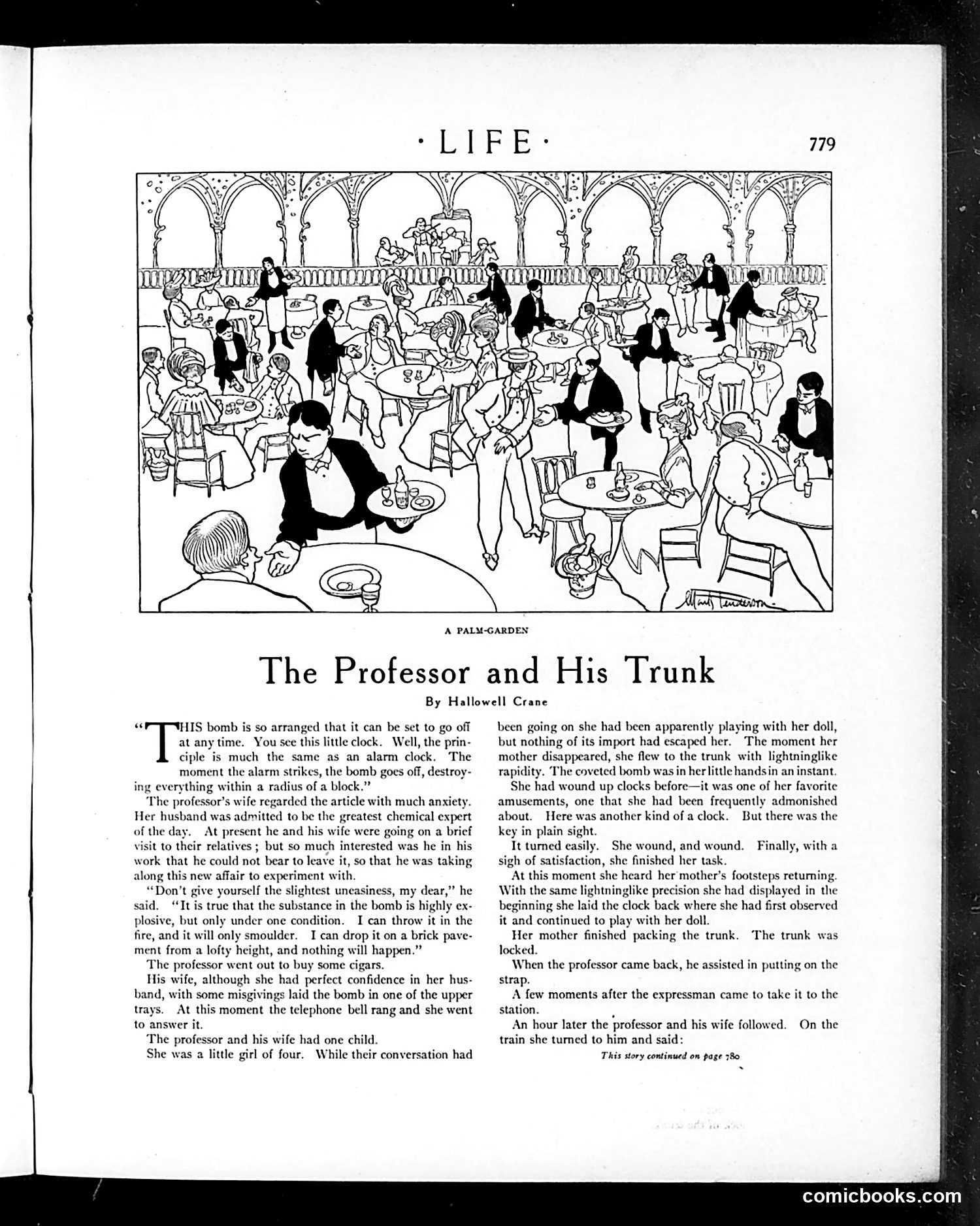
This is a satirical short story (not a political cartoon) about a dangerous invention. A chemistry professor transports an experimental bomb in his trunk—disguised as a clock mechanism—while traveling to visit relatives. The joke centers on dramatic irony: the professor confidently assures his anxious wife the bomb is safe because it only detonates under specific conditions. However, the professor's young daughter, while he's out buying cigars, discovers the "clock" in the trunk and winds it repeatedly—exactly as she'd been taught to wind actual clocks. The story builds tension as readers anticipate disaster. The satire mocks absent-minded academics who pursue dangerous experiments without properly considering domestic reality, and the gap between theoretical safety and practical household hazards. The wife's "misgivings" prove prescient as the child's innocent actions create genuine peril, though the page cuts off before revealing consequences.
This page presents a serialized short story about a professor who accidentally packed a **bomb (disguised as a "clock")** in a train trunk. The narrative follows the dramatic discovery that his young daughter Adele wound up the device while the parents were distracted—setting the timer to detonate at approximately 10:15 p.m. The story exemplifies early 20th-century **melodramatic fiction**: a suspenseful tale of ordinary people facing extraordinary peril through mundane mistakes. The humor (and satire) lies in the contrast between the professors' anxious precision about luggage and their casual terror about transporting explosives. This reflects period anxieties about anarchist bombs and railway dangers that were genuine contemporary concerns. The page contains no political cartoons—it's purely literary content typical of Life's mix of humor and serialized fiction.
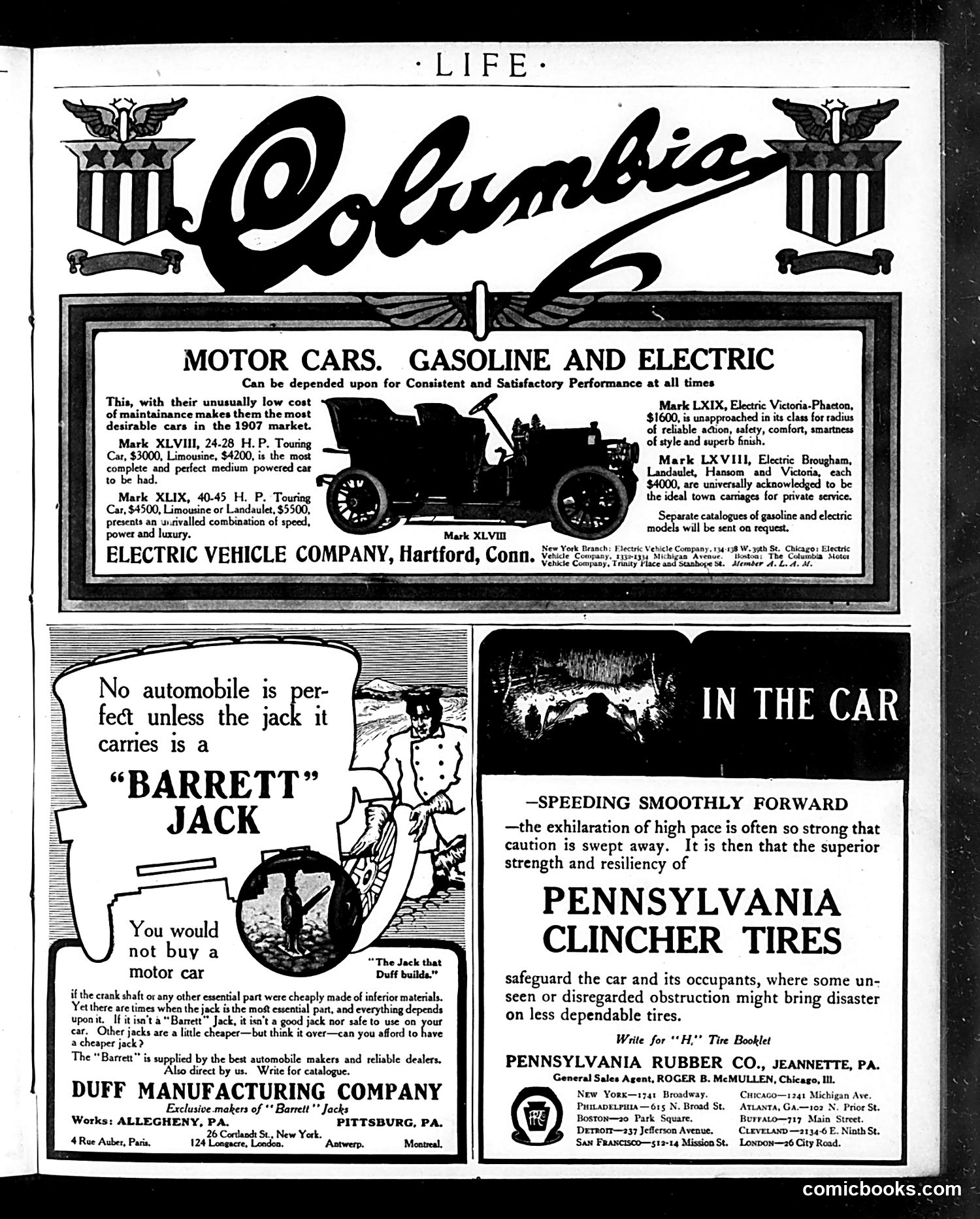
This page is primarily **advertising**, not satirical content. It showcases early automotive technology during a pivotal moment when both gasoline and electric cars competed for market dominance. The Columbia Electric Vehicle Company advertises luxury models ($1,600-$5,500), emphasizing reliability and low maintenance—key selling points for electric cars, which were cleaner and quieter than gasoline vehicles. The "Barrett" Jack advertisement uses humor to argue that quality matters in every component: a cheap jack on an expensive car is foolish. This reflects period consumer consciousness about mechanical reliability. The Pennsylvania Clincher Tires ad warns drivers that high-speed driving (then thrilling and dangerous) requires dependable tires. This underscores how early automobiles were unpredictable, hazardous machines where equipment failure could cause disaster. Together, these ads reveal 1907 automotive concerns: cost, maintenance, safety, and the legitimacy of electric vehicles as practical alternatives to gasoline cars—a competition electricity ultimately lost.
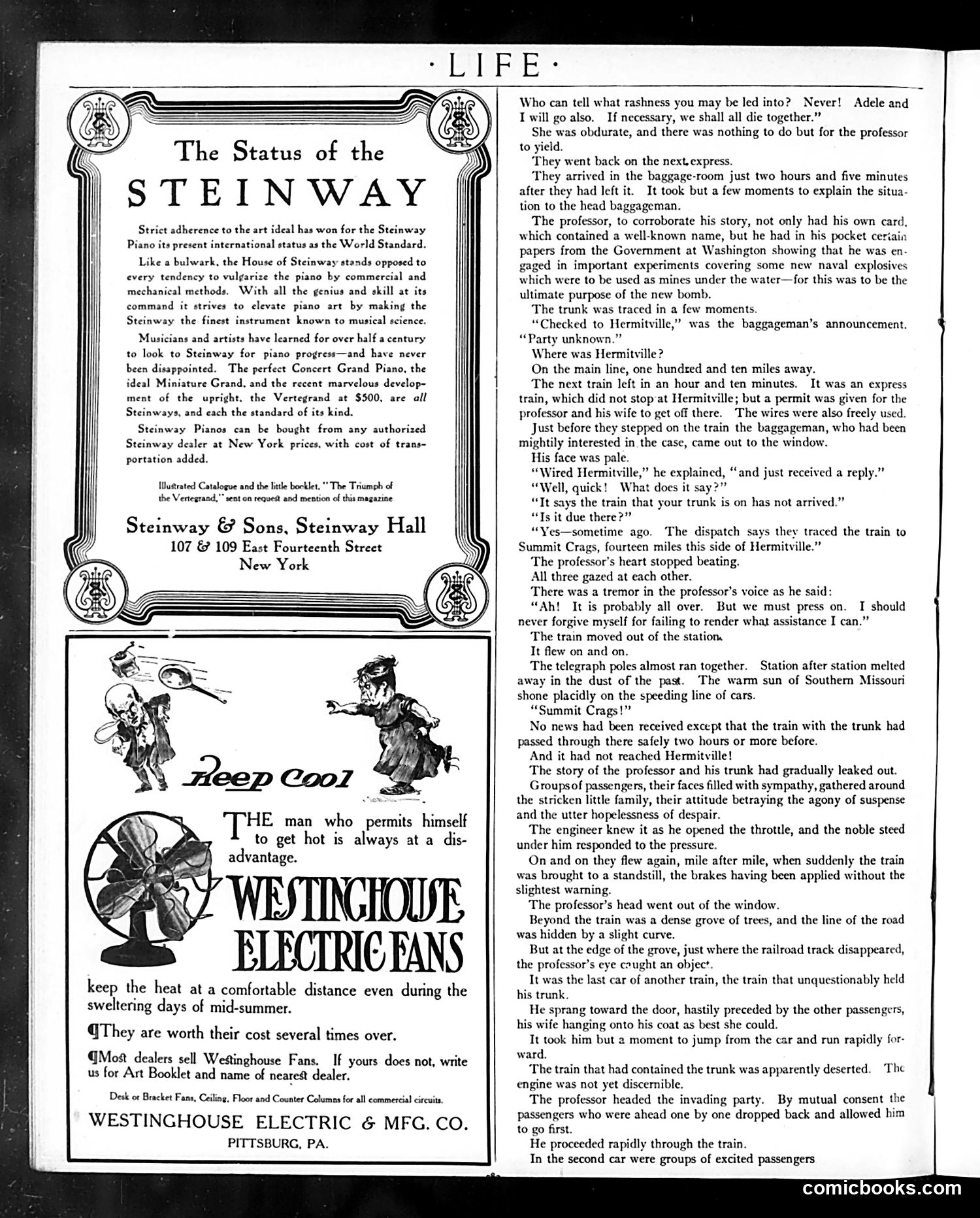
This page from *Life* magazine contains two advertisements (Steinway pianos and Westinghouse electric fans) flanking a serialized story about a professor pursuing a lost trunk containing naval explosives. The story itself—not a cartoon—appears to be a suspense narrative: a professor traveling with his wife Adele discovers their baggage has been misdirected to "Hermitville." The trunk contains secret government documents and experimental materials for naval mines. The dramatic tension builds as they learn the train carrying their trunk disappeared near "Summit Crags," fourteen miles before its destination, with no further information available. The satire here is subtle: the story plays on contemporary anxieties about new technology, government secrets, and explosive weapons development during an era of international tension (likely early 20th century). The juxtaposition with advertisements for refined pianos and cooling fans creates ironic contrast—civilized domestic comfort versus dangerous military innovation. This appears designed for serialized reader engagement rather than standalone humor.
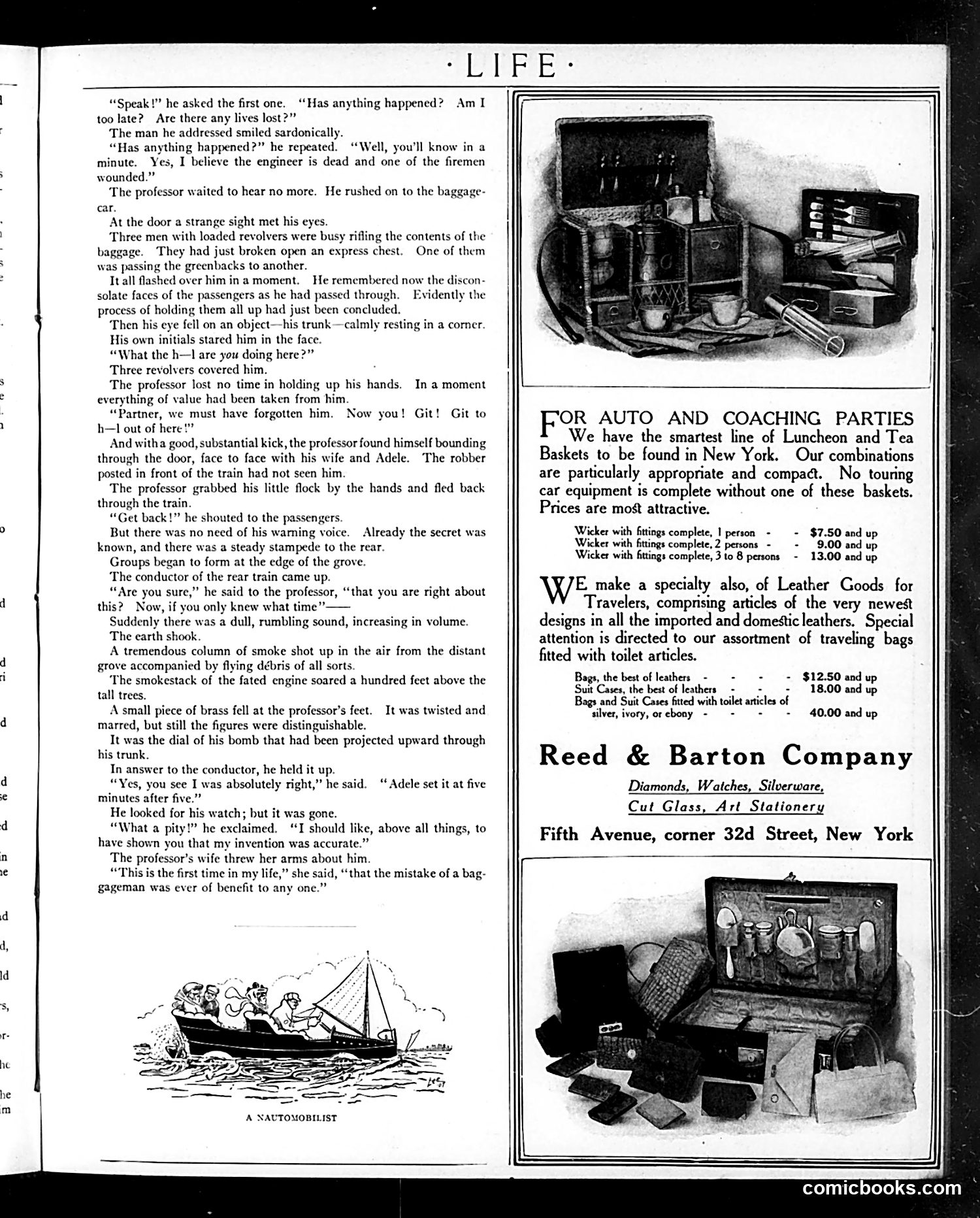
This is a serialized fiction story about a professor whose train is robbed during a journey. The narrative depicts classic turn-of-the-century drama: bandits rifle the baggage car while passengers are held up, the professor loses his valuables, and he's kicked from the train. The twist provides dark humor: the professor had constructed a bomb (set for five minutes) in his trunk as some kind of invention demonstration. While robbers stole his watch and money, they unknowingly triggered the device, destroying the locomotive and themselves—proving his invention's accuracy, albeit at tragic cost. The story's title, "A Nautomobilist," suggests the professor is a tinkerer/inventor obsessed with new technology. The satirical joke appears to be mocking both the era's faith in mechanical innovation and the irony of accidental consequences—his invention "succeeds" only through criminal interference and destruction. The page is primarily text with minimal illustration, padding around advertisements for travel baskets and leather goods.
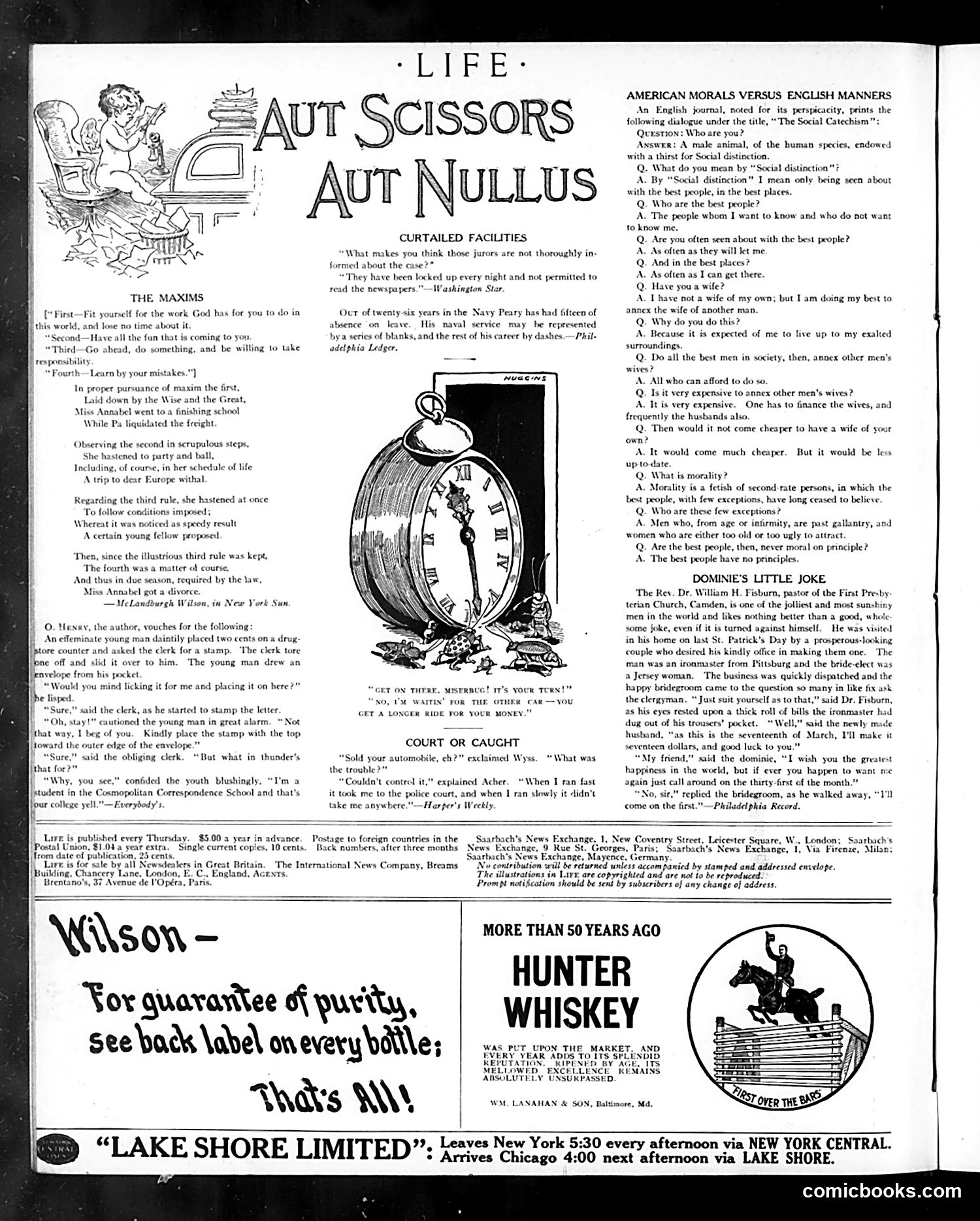
This page contains satirical commentary on American social customs and morality from the early 20th century. **"The Maxims"** depicts a wealthy young woman (Miss Annabel) following society's unwritten rules: enjoying herself, pursuing social status, accepting a marriage proposal, and divorcing—all presented as logical consequences of following proper upper-class conduct. The satire critiques how wealthy society normalizes serial marriage and divorce. **"The Social Catechism"** is a dialogue mocking American pretension by defining "social distinction" as associating with people who don't want to know you, and frankly acknowledging that wealthy men regularly seduce other men's wives as expected behavior. This attacks American hypocrisy regarding morality—the title contrasts American "morals" with English "manners," suggesting Americans claim virtue while practicing vice. **Other brief jokes** mock jury selection practices, naval record-keeping gaps, and automobile ownership. The page overall critiques wealthy American society's superficiality, materialism, and moral inconsistency during the Progressive Era.
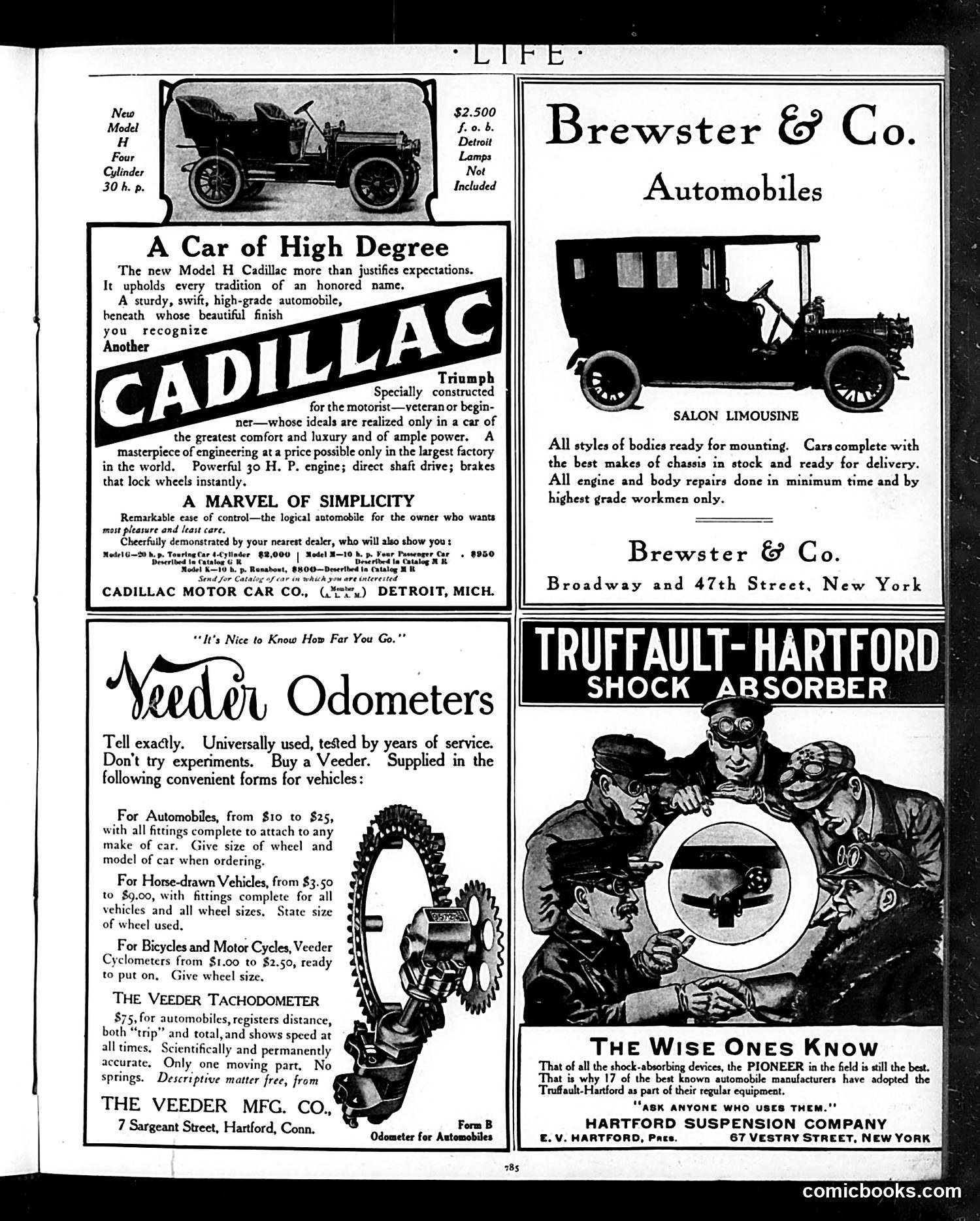
This is primarily a **commercial advertising page**, not satirical content. It contains four automobile-related advertisements from the early 1900s: 1. **Cadillac Model H**: Emphasizes luxury, engineering quality, and affordability for a high-end car ($2,500). The pitch highlights "simplicity" and reliability—marketing to wealthy buyers wanting prestige without complexity. 2. **Brewster & Co.**: Offers custom automobile bodies and repair services in New York, targeting the luxury market. 3. **Veeder Odometers**: Sells distance-measuring devices for various vehicles (automobiles, carriages, bicycles), with prices ranging from $1 to $75. 4. **Truffault-Hartford Shock Absorber**: Features illustrated mechanics endorsing their suspension technology, claiming superiority over competitors and adoption by major manufacturers. The page reflects the **emerging automobile industry** (circa 1910s), where competing manufacturers promoted mechanical innovations and reliability to a wealthy clientele. There is **no political satire**—this is straightforward commercial promotion typical of Life magazine's revenue model.
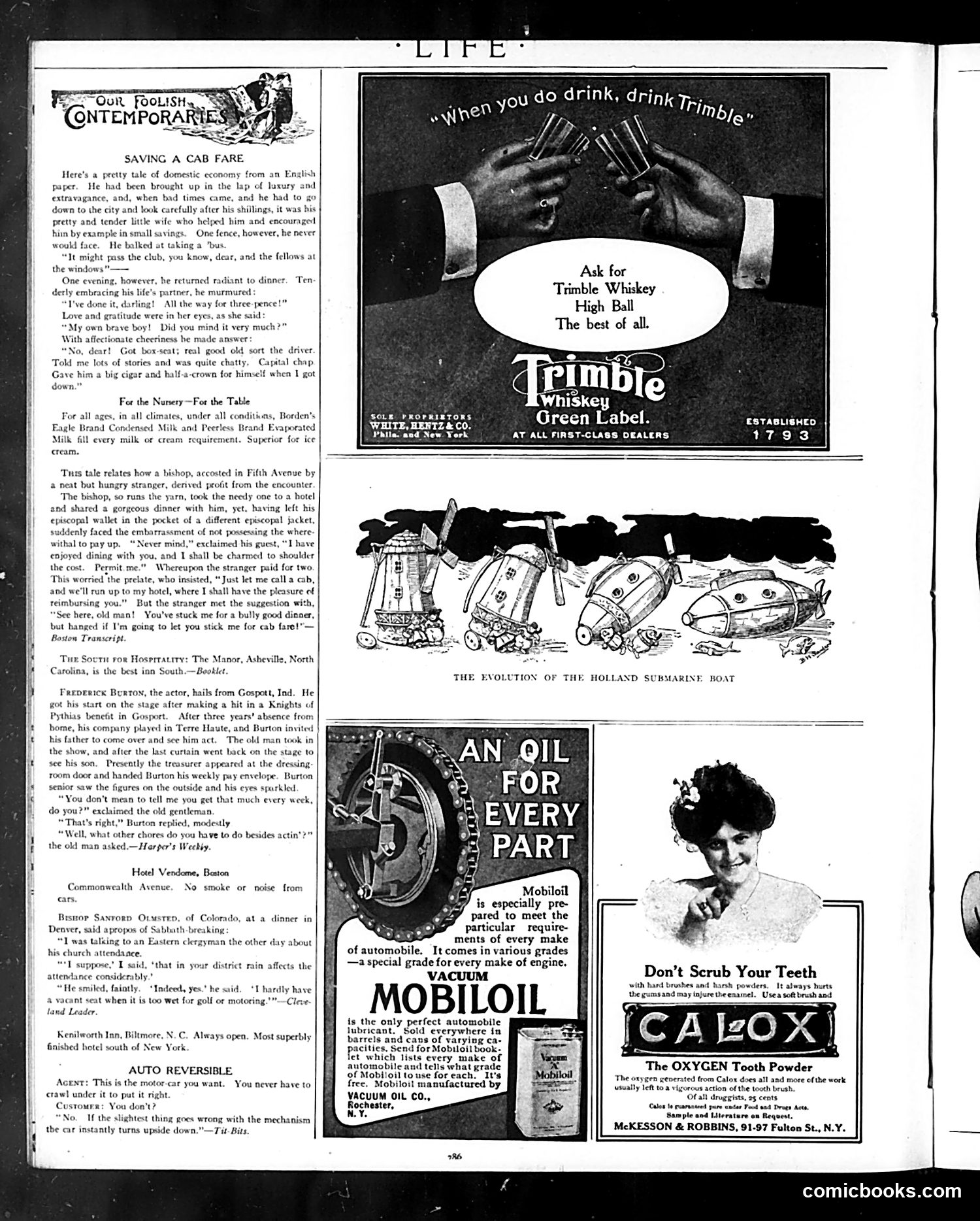
This humorous story mocks misplaced pride masquerading as thrift. An Englishman, fallen from wealth into financial hardship, learns economizing from his wife—except for one thing: he refuses to take a bus because someone from his club might see him through the windows, which would be socially embarrassing. The irony: to save threepence (a bus fare), he finally takes one. But upon arriving, he spends far more than he saved by tipping the driver a cigar and half-a-crown—undermining his entire economy effort through vanity. The satire targets the British upper-class obsession with appearances and social standing. He'll sacrifice genuine financial prudence to avoid *perceived* loss of status, only to squander money anyway on gratitude and status-signaling. The "brave" wife celebrates his bus-riding as a moral victory, missing that he's actually learned nothing about real economy.
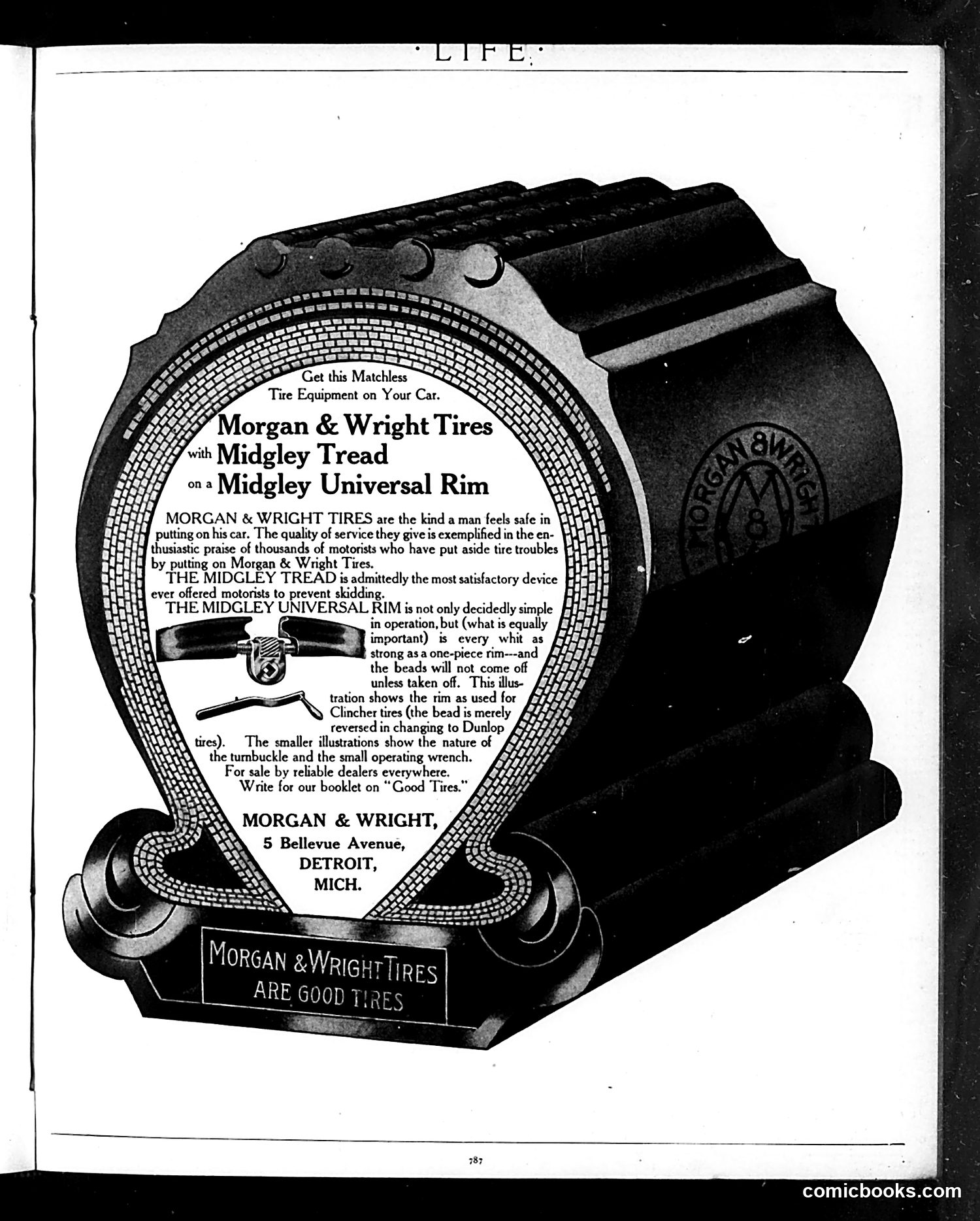
This is **not a cartoon or satire**—it's a straightforward advertisement for automobile tires from the early 20th century. The page shows a three-dimensional product display featuring a giant tire cross-section with the Midgley Tread and Universal Rim. The ad emphasizes practical features targeting early motorists: the Midgley Tread prevents skidding, and the Universal Rim is strong and reliable. Small diagrams illustrate the tumbuckle and operating wrench used for tire installation. Morgan & Wright, headquartered in Detroit, marketed their product as dependable and widely available through dealers. The tagline "Morgan & Wright Tires Are Good Tires" appears as both text and a base plate on the display. This represents Life magazine's commercial content—automotive advertisements were common in early 20th-century publications seeking advertiser revenue. No satire or social commentary is present.
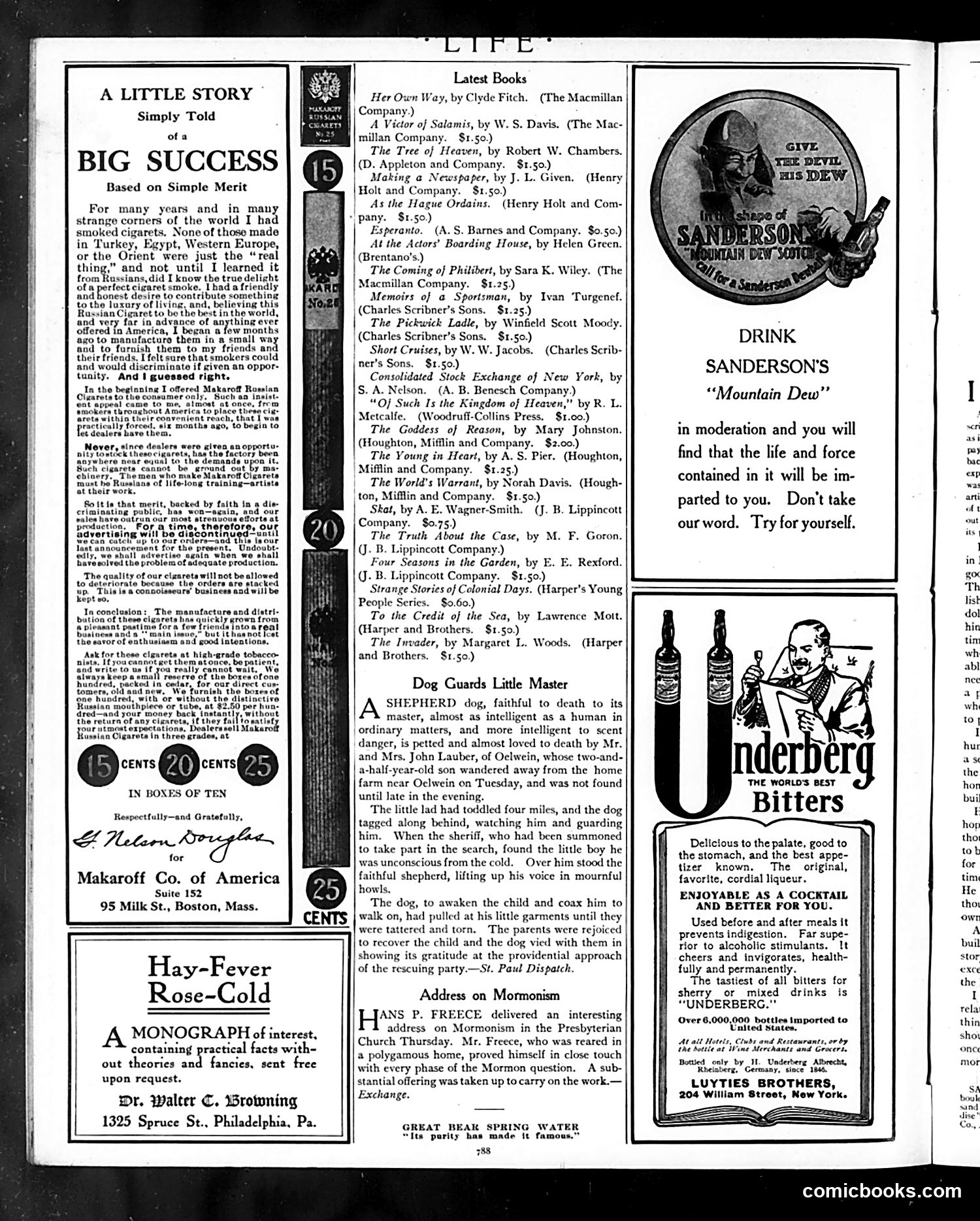
This page blends editorial content with advertising—typical for early 1900s *Life* magazine. **Main Content:** A lengthy advertisement disguised as a success story promotes Makaroff Russian Cigarettes. The unnamed narrator claims to have discovered superior Russian cigarette-making techniques and now manufactures them in America. The "satire" appears gentle: the advertiser presents his venture as driven by pure merit and honest desire to improve American smokers' lives, a self-congratulatory tone *Life* likely found amusing enough to publish (for a fee). **Advertisements:** The page includes ads for Underberg Bitters (claiming digestive and health benefits) and Dr. Browning's hay fever remedy—typical patent medicine claims of the era. **No Political Cartoon:** Despite your framing question, this page contains no political cartoon. It's primarily advertisements and book listings, which explains why identifying specific satirical targets proves impossible.
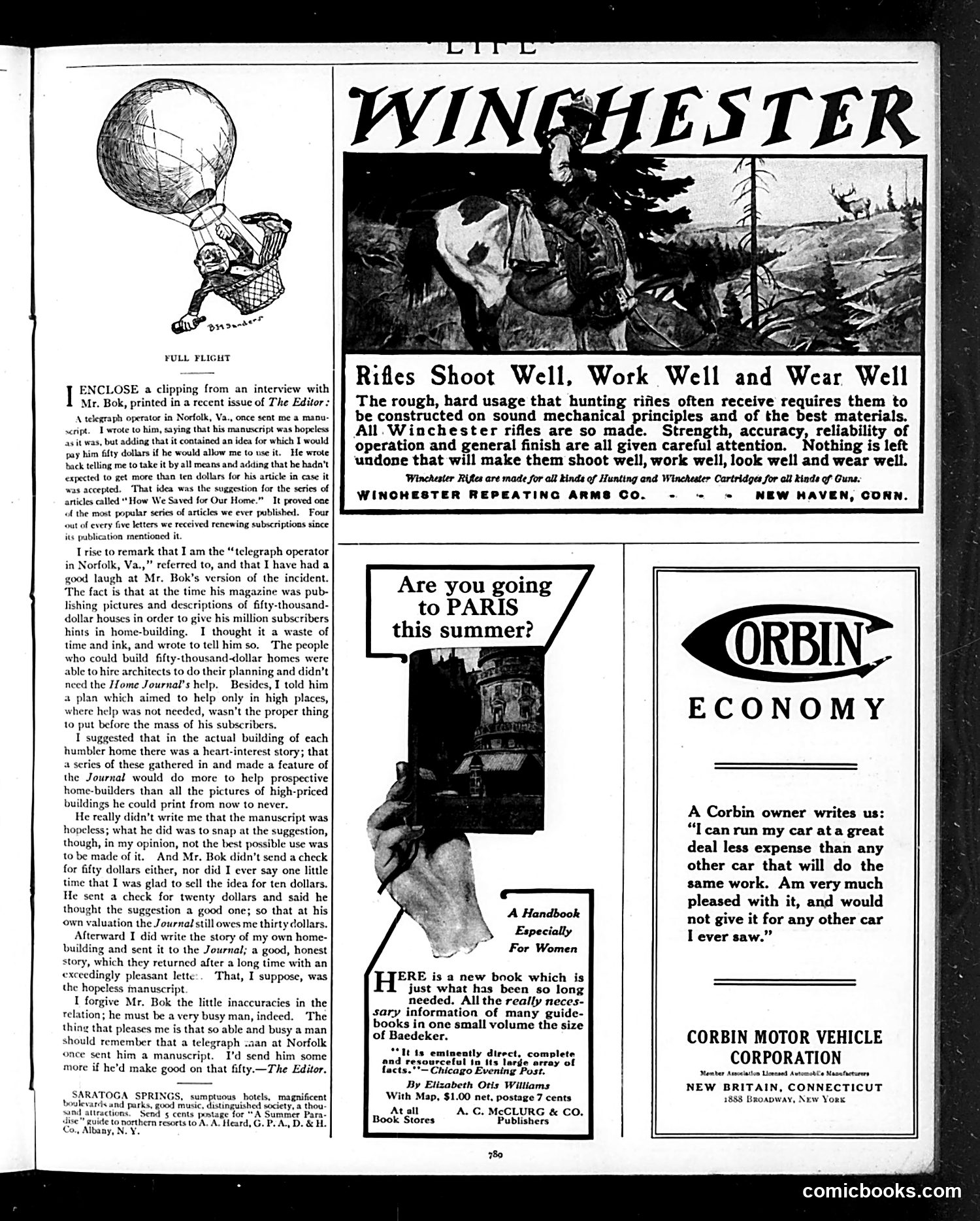
This page contains **primarily editorial and advertising content** rather than political cartoons. **The main feature** is a letter-exchange about Edward Bok (editor of *The Ladies' Home Journal*). A telegraph operator from Norfolk, Virginia corrects Bok's account of their interaction. Bok claimed he discovered the operator's idea for home-building articles and paid $50; the operator counters that Bok actually paid only $20, misrepresented the circumstances, and later rejected the operator's own submitted story. The satirical point: **Bok embellished a self-serving anecdote to appear generous and insightful**, when the reality was less flattering. **The advertisements** (Winchester rifles, Corbin automobiles, Paris travel, a Baedeker guide) represent typical early-20th-century magazine revenue. The "Full Flight" hot-air balloon illustration appears decorative rather than satirical. The page demonstrates how *Life* mixed reader letters critiquing public figures with commercial content—a format allowing critique of powerful editors like Bok while maintaining advertising revenue.
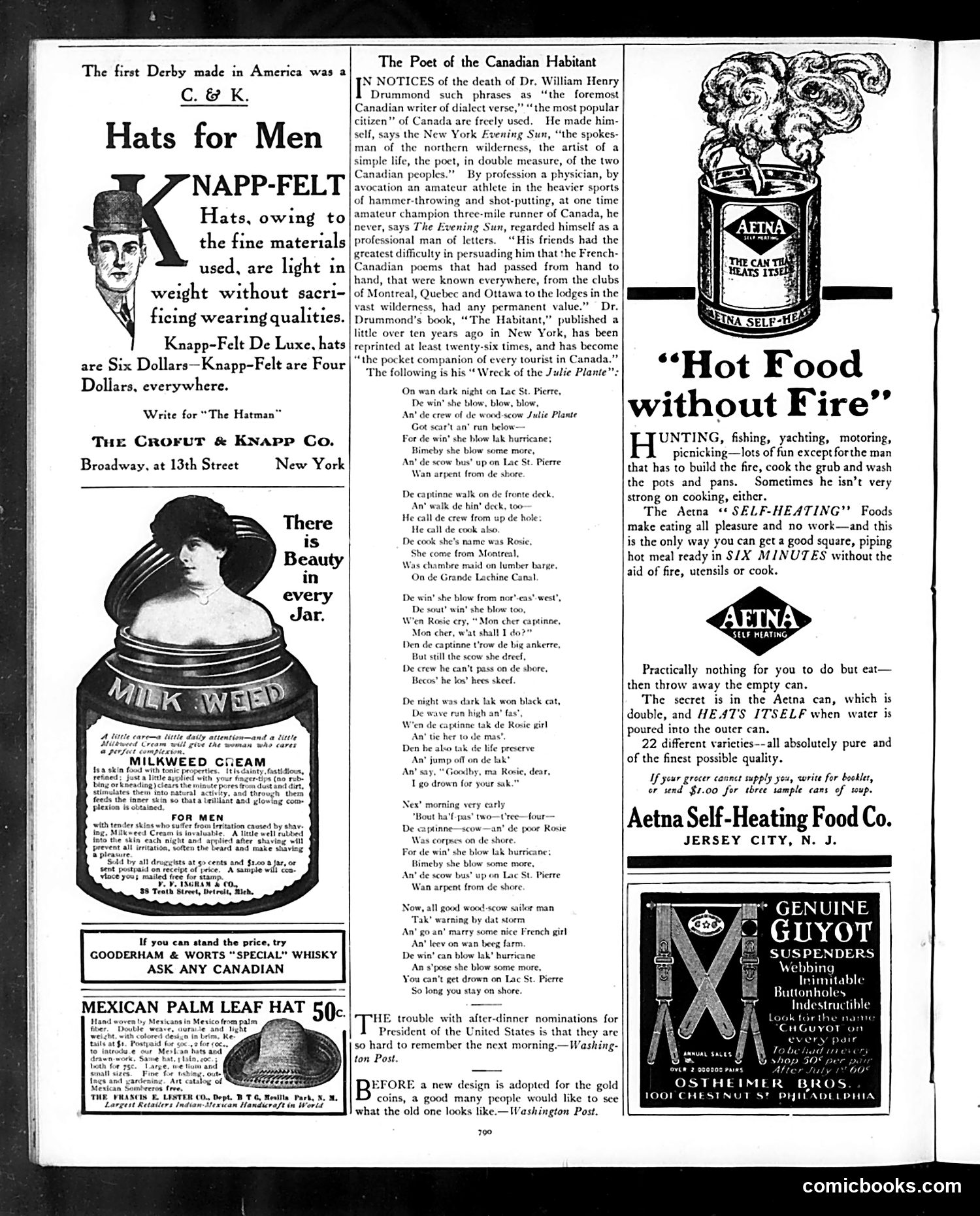
This page is primarily **advertising with editorial content**, not political satire. The main elements are: **Advertisements**: Hat companies (Knapp-Felt, Mexican Palm Leaf), Milkweed Cream, Gooderham & Worts whisky, Aetna Self-Heating Foods, and Guyot Suspenders dominate the layout. **Editorial Content**: A substantial tribute to **Dr. William Henry Drummond**, a Canadian poet who recently died. The piece celebrates him as "the foremost Canadian writer of dialect verse" and "the most popular citizen" of Canada. It includes his famous poem "The Wreck of the Julie Plante"—a narrative ballad written in French-Canadian dialect about a shipwreck on Lake St. Pierre. The poem exemplifies Drummond's specialty: capturing the speech and lives of French-Canadian working people. **Brief Humor Fillers**: Two short editorial quips about presidential nominations and coin design appear at bottom—typical Life magazine filler content. The page reflects early 20th-century American literary culture's interest in regional Canadian voices and dialect poetry.
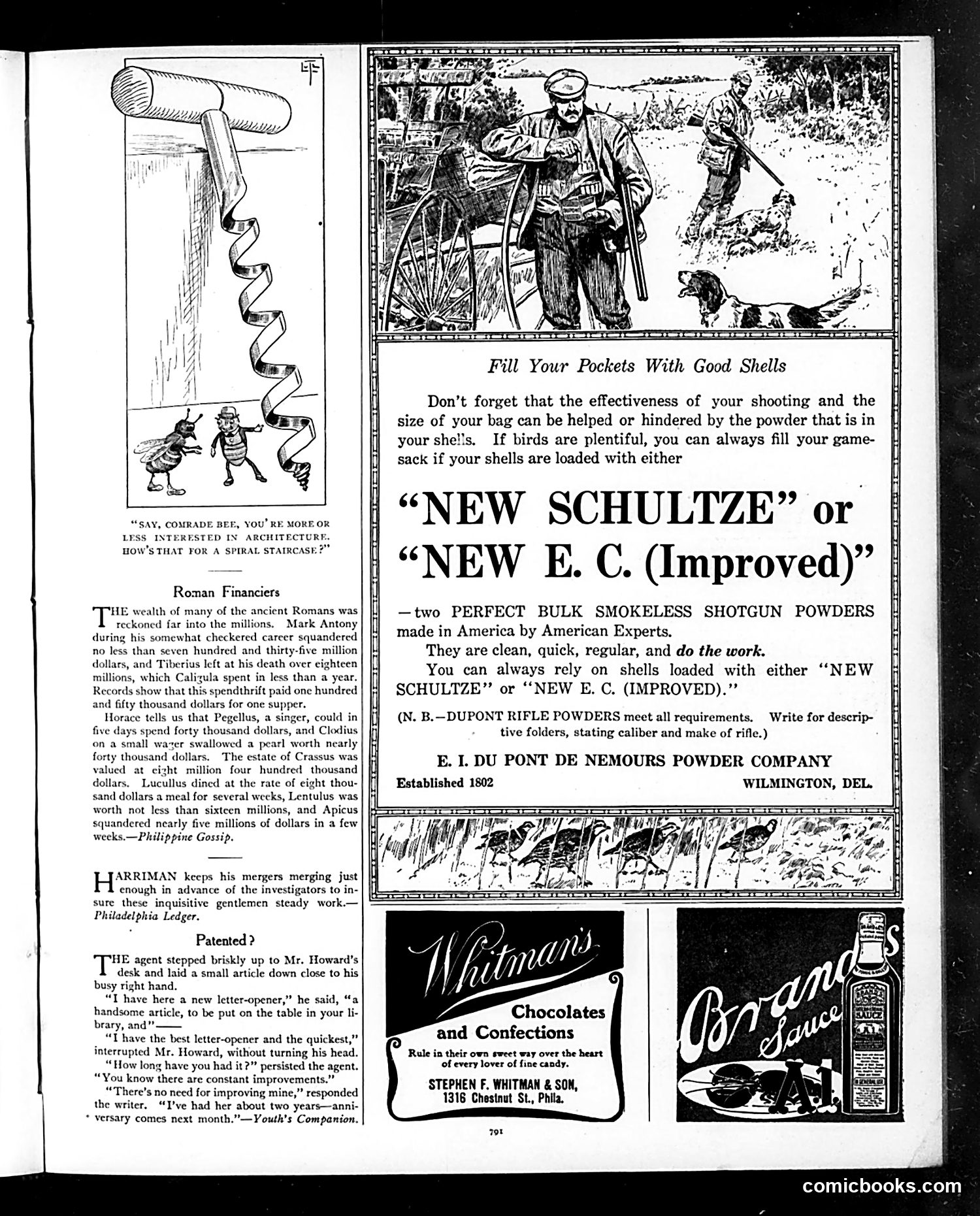
This page contains three distinct satirical pieces: **"Roman Financiers"** (left): A brief humorous essay listing extravagant spending by wealthy ancient Romans—Mark Antony, Caligula, Crassus, and others—to mock excessive wealth and conspicuous consumption. The opening cartoon shows two tiny figures marveling at a spiral staircase, with the caption implying the wealthy care more about architectural showiness than practical living. **"Patented?"** (bottom left): A short joke about a salesman pitching a "new" letter-opener to a man who refuses, claiming his current one works perfectly and is two years old. The satire targets both aggressive sales tactics and consumer resistance to unnecessary "improvements." The rest comprises **advertisements**: Du Pont gunpowder for hunting, Whitman's chocolates, and Borden's sauce—typical early-20th-century magazine filler. The page blends light satire on wealth, consumer culture, and marketing with practical commercial messaging, reflecting Life's mixed editorial-advertising format.
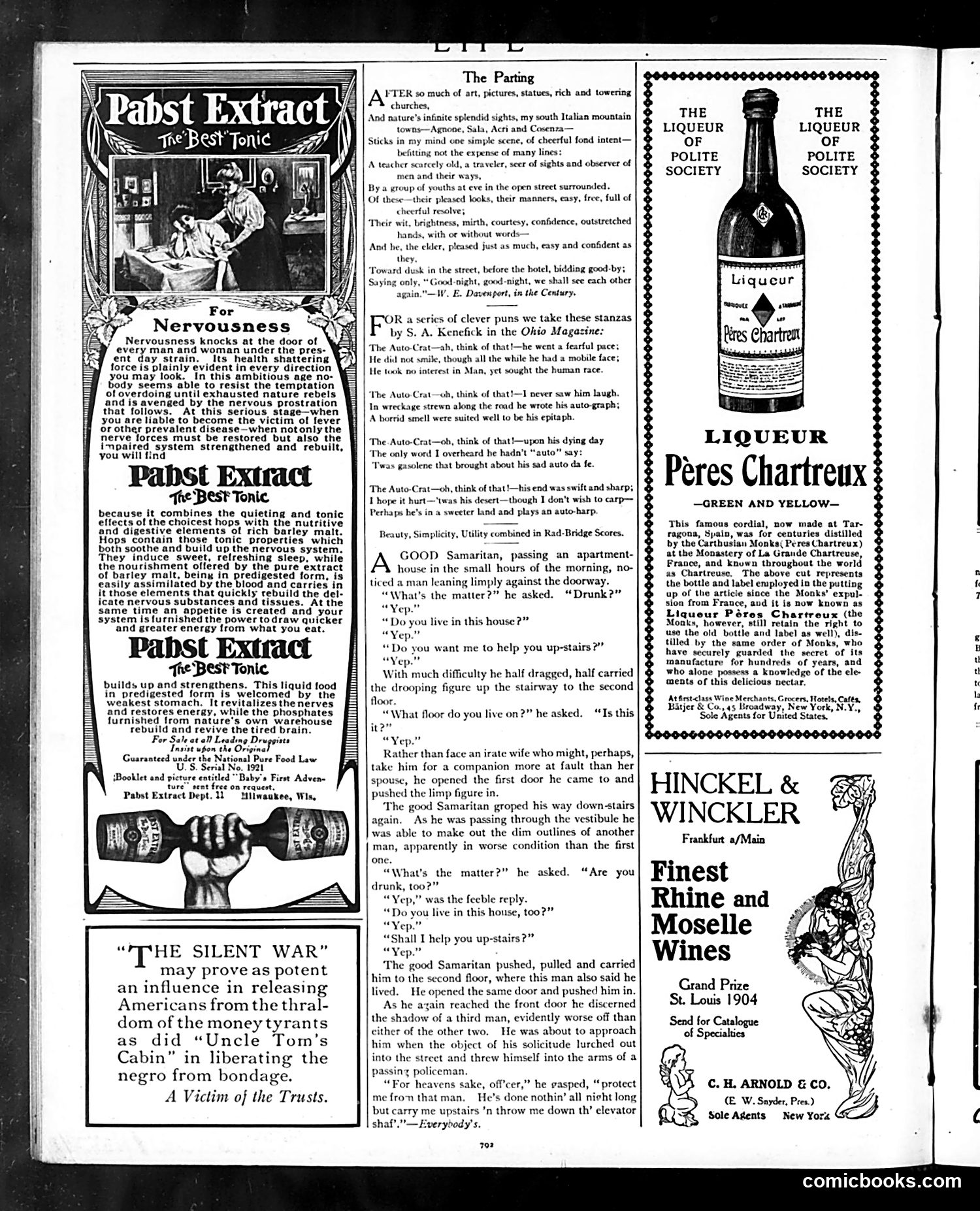
This page is primarily **advertising and literary content** rather than political satire. The main elements are: 1. **Pabst Extract advertisements** (left side): Promote a tonic supposedly curing "nervousness"—a common Victorian/Edwardian ailment supposedly caused by modern strain and overwork. The ads claim the product rebuilds nerves and energy. 2. **"The Silent War" reference** (bottom left): A brief mention suggesting a book/work about trusts and corporate monopolies ("money tyrants"), comparing its potential impact to *Uncle Tom's Cabin*. This reflects early 1900s Progressive Era concerns about corporate power. 3. **Literary content** (center and right): Poetry and humorous puns about automobiles ("Auto-Crat"), reflecting the novelty and cultural impact of early cars. 4. **Liqueur advertisements** (right): Promotional material for alcoholic beverages. The page reflects early-20th-century anxieties about modernity, corporate trusts, and "nerve exhaustion"—treating these serious social concerns through both advertising and literature.
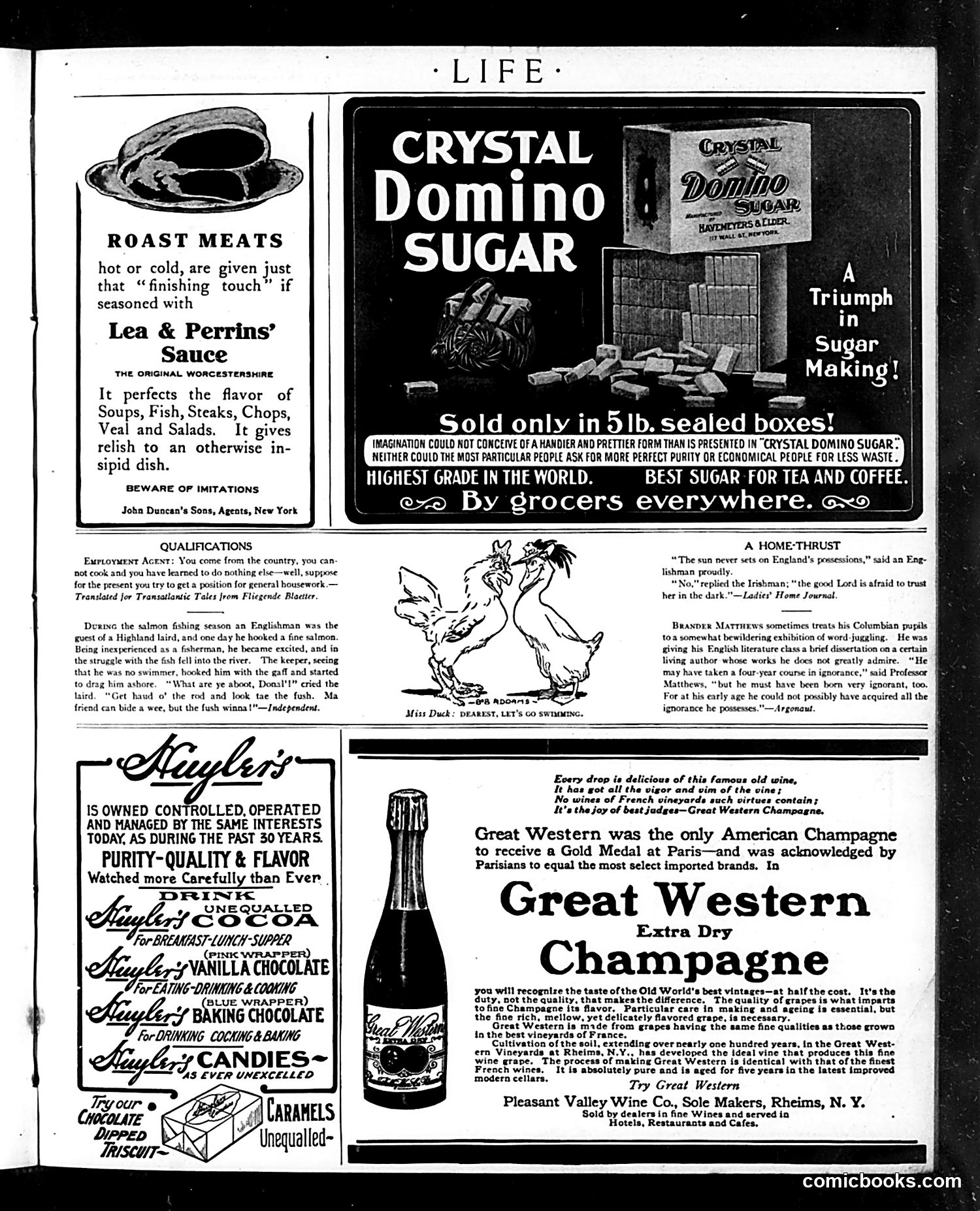
This page is primarily **advertising** with interspersed brief humor pieces and anecdotes rather than political cartoons. The advertisements include Lea & Perrins sauce, Crystal Domino Sugar, Stayler's chocolate products, and Great Western Champagne—typical early 20th-century brand promotions. The editorial content consists of short jokes and stories: - A piece on "Qualifications" mocking incompetent household servants - A Scottish fishing anecdote about an Englishman falling in water - An Irish joke about England's empire ("the sun never sets")—playing on the famous imperial phrase by suggesting God won't trust England in darkness - A Professor Matthews quip about student ignorance - A caption about ducks swimming These are mild, conventional humor pieces with no apparent political satire. The page reflects period attitudes toward servants, national stereotypes (English/Irish), and academic pomposity, but contains no identifiable caricatures of specific political figures or events.
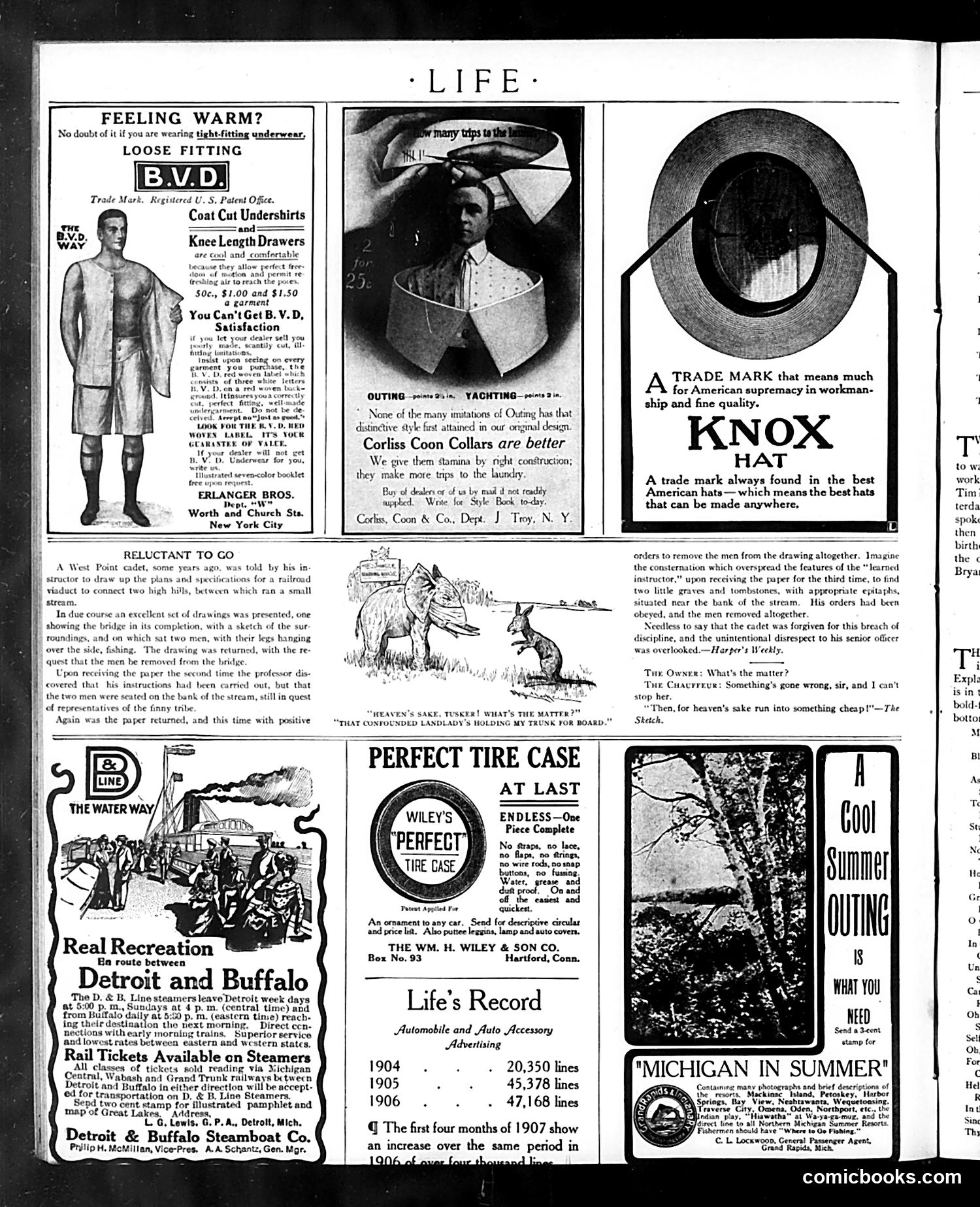
This is primarily an **advertising page** from Life magazine, circa 1904-1907 (based on the "Life's Record" statistics showing 1906 data). The only substantive cartoon/humor content is "RELUCTANT TO GO," a military-academy anecdote about a West Point cadet repeatedly ignoring an instructor's order to remove two fishing soldiers from a bridge drawing. On the third submission, the cadet depicts them as graves with tombstones—technically obeying orders while mocking the instructor's nitpicking. The humor depends on American appreciation for clever insubordination and the absurdity of pedantic authority. The caption's wry tone suggests the cadet is forgiven. The remainder consists of advertisements for underwear (B.V.D.), collars, hats (Knox), tires, and steamship travel—typical period marketing emphasizing comfort, durability, and quality. These reflect early-1900s consumer culture and social expectations around gentlemen's dress.
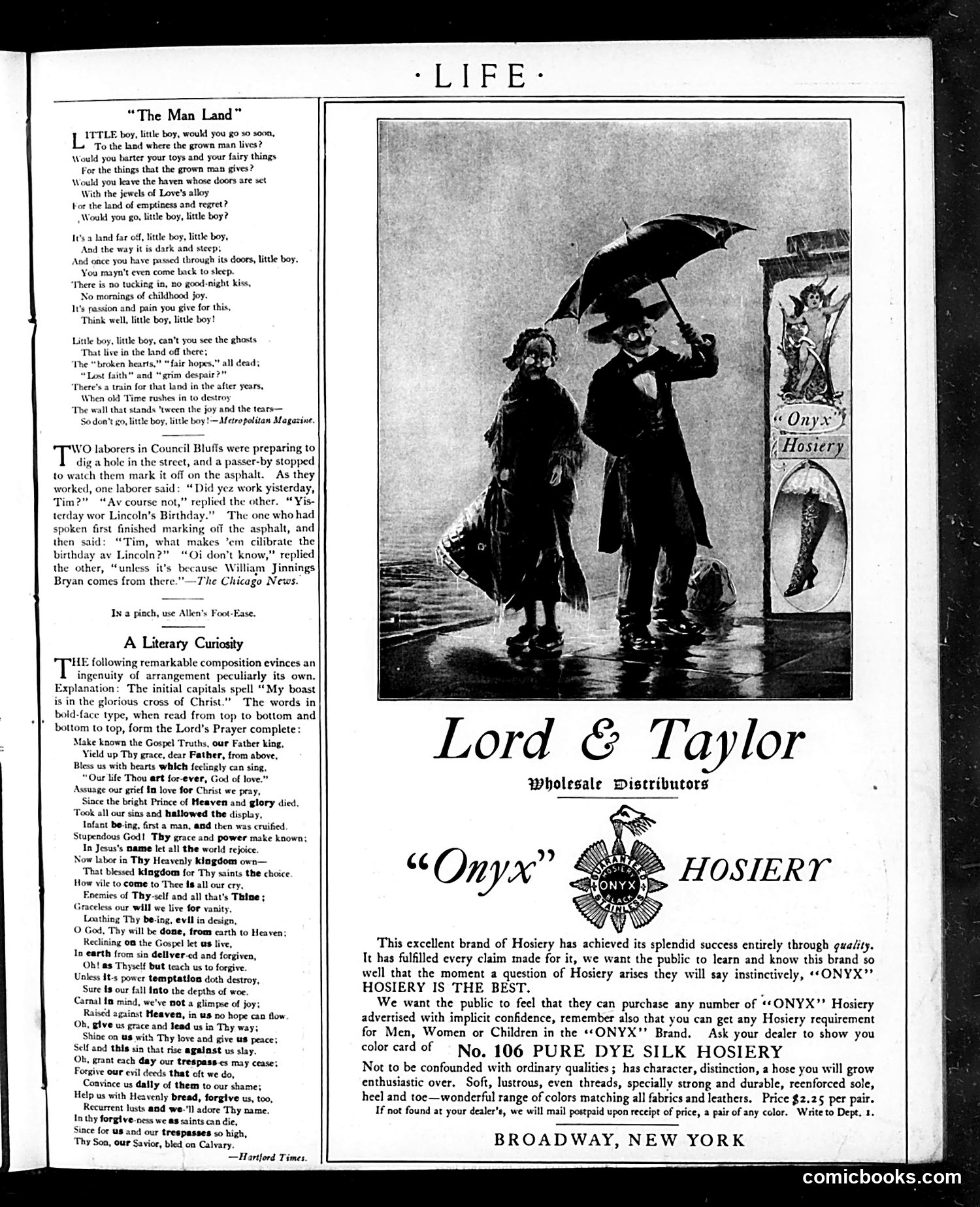
This Life magazine page contains three distinct items: **"The Man Land"** is a cautionary poem warning boys against premature adulthood. It uses romantic language to depict growing up as abandoning childhood's joy for adult responsibilities—"passion and pain" replacing innocence. The poem references ghostly consequences: broken hearts, lost faith, despair. **The Council Bluffs anecdote** is a brief humorous exchange between two laborers debating why Lincoln's birthday is celebrated. One suggests it's because William Jennings Bryan (a three-time presidential candidate from Nebraska) comes from there—implying Lincoln's significance has been overshadowed or confused with contemporary politics. **"A Literary Curiosity"** showcases a religious poem with hidden structure: its capital letters spell "My boast is in the glorious cross of Christ," while bold words read as the Lord's Prayer both top-to-bottom and bottom-to-top. The page concludes with a Lord & Taylor advertisement for "Onyx" brand hosiery.
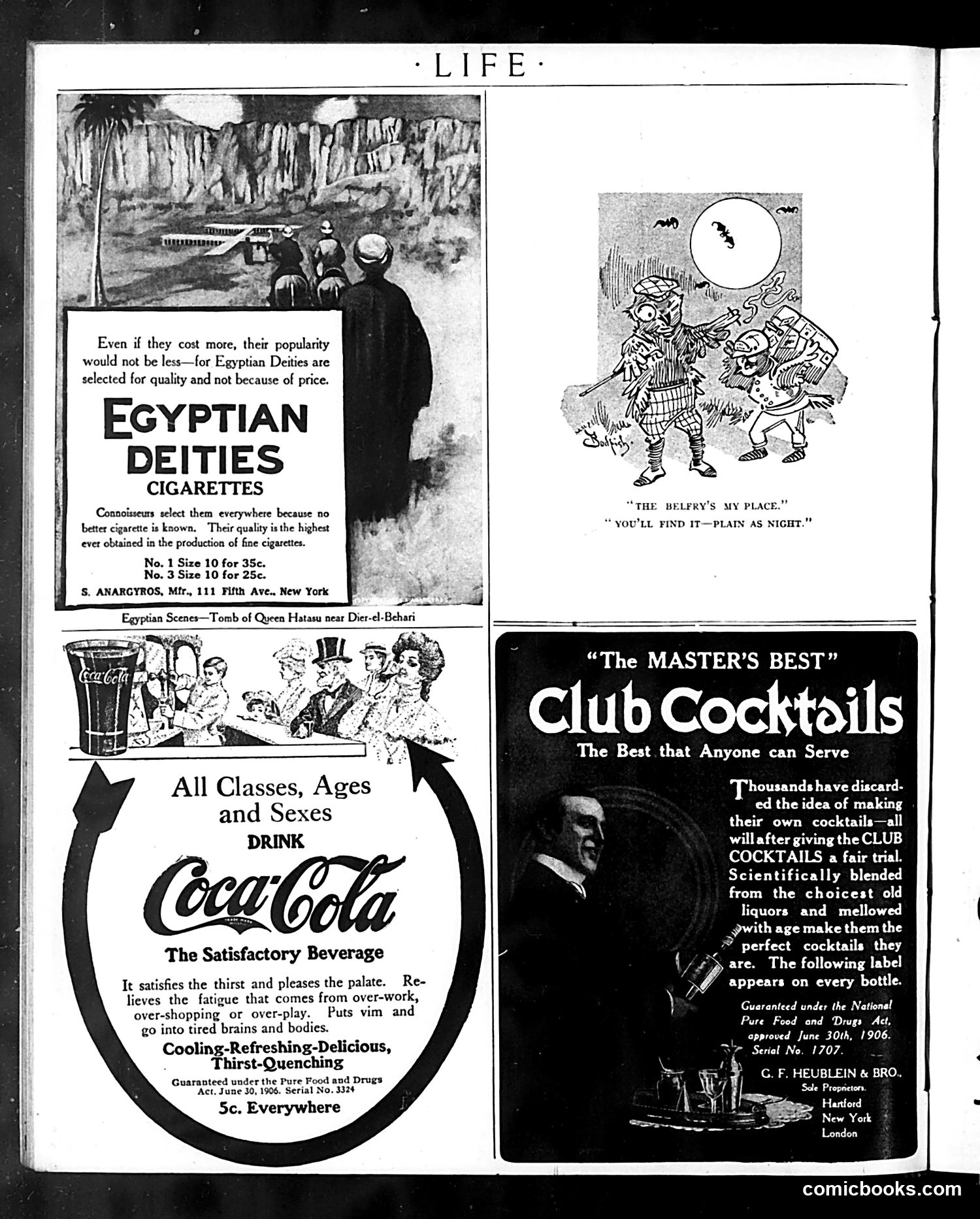
This page is primarily **advertising content** rather than editorial satire. It contains four product advertisements: 1. **Egyptian Deities Cigarettes** — emphasizing quality over price, with an Egyptian-themed image 2. **Coca-Cola** — marketed broadly to "All Classes, Ages and Sexes" as a restorative beverage for fatigue 3. **Club Cocktails** — pre-mixed drinks for home service, positioned as superior to homemade cocktails 4. A small cartoon captioned "The Belfry's My Place" — appears to show bat-like figures, likely a humorous non-sequitur unrelated to the ads The ads reflect **early 1900s marketing** (note the 1906 Pure Food and Drugs Act guarantees). Notably, Coca-Cola and alcohol products are advertised alongside cigarettes without restriction—products later heavily regulated or banned. The tone assumes these are legitimate, respectable consumer goods for general audiences. There is **no political satire** visible here; this is a commercial page representative of the era's advertising practices.
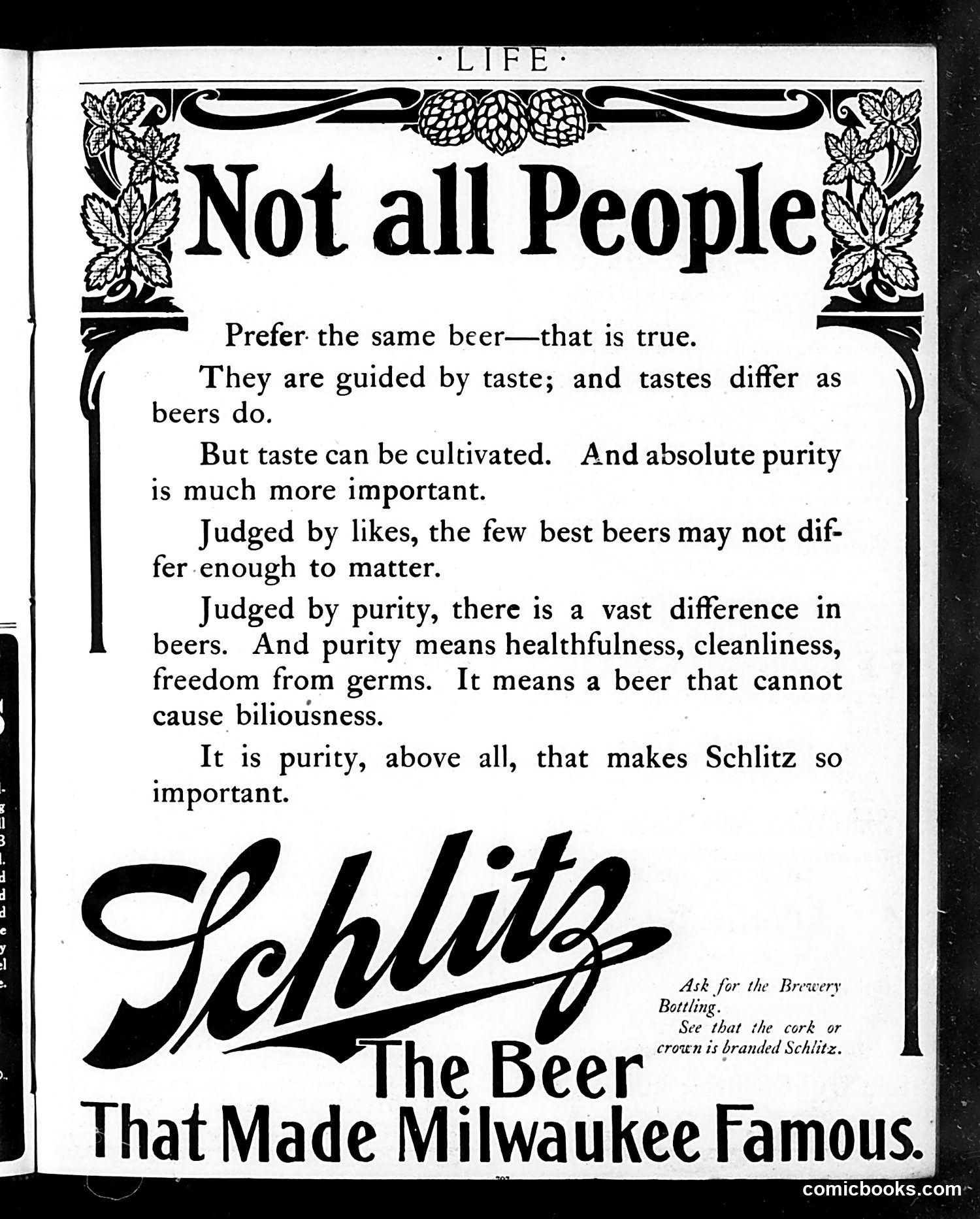
This is a **Schlitz beer advertisement**, not a satirical cartoon. The page appeared in *Life* magazine during the early 20th century. The ad argues that while people have different taste preferences in beer, **purity is more important than flavor preference**. It claims Schlitz's key advantage is absolute purity—freedom from germs and the inability to cause biliousness (digestive upset). This appeals to health-conscious consumers of the era. The ad emphasizes checking bottles for "Brewery Bottling" branding on corks or crowns to ensure authenticity. The tagline "The Beer That Made Milwaukee Famous" references Schlitz's actual prominence in Milwaukee's brewing industry. This reflects early-1900s advertising's focus on scientific purity claims as a competitive selling point.
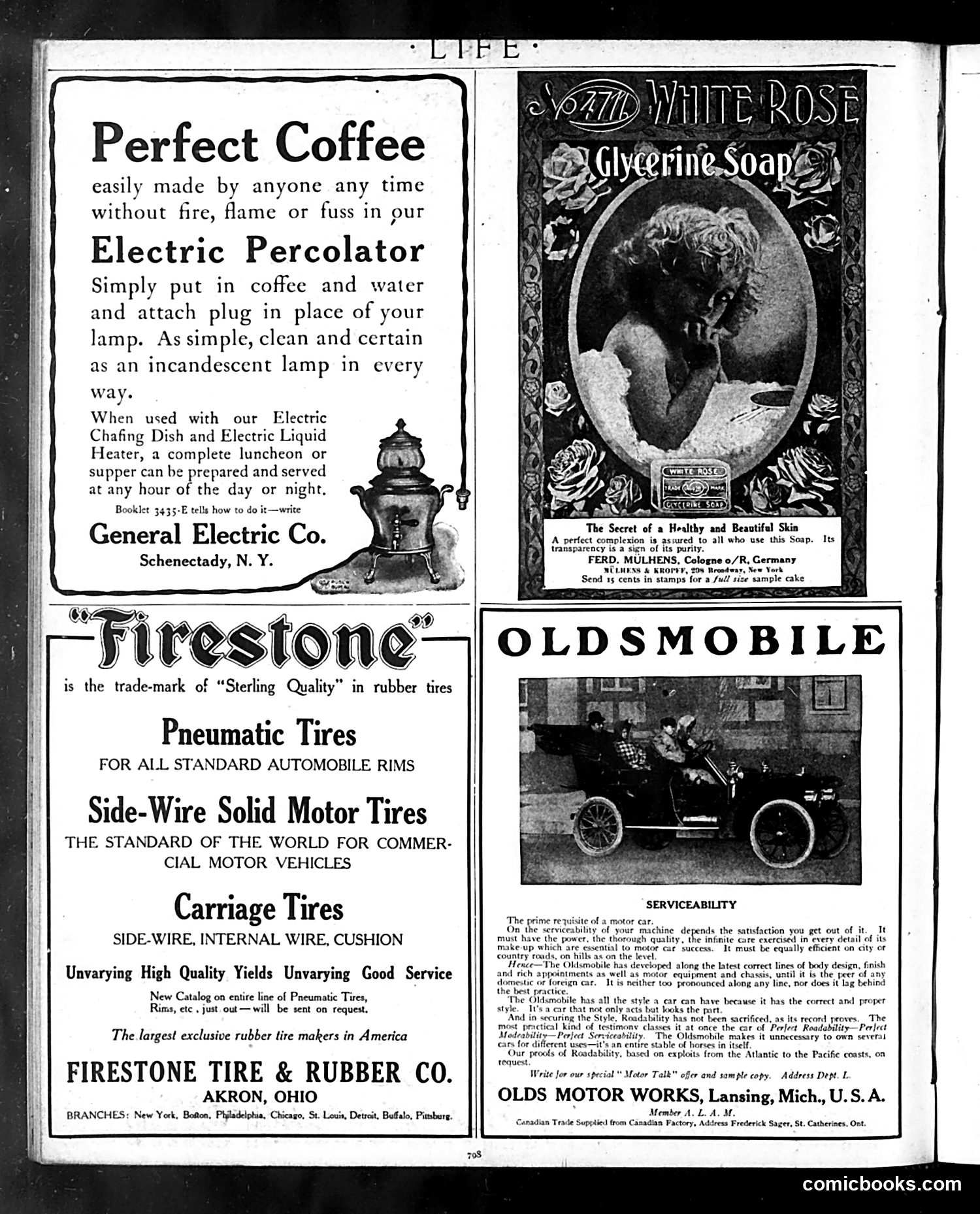
This is **not a cartoon page** but rather a **Life magazine advertisement section**, typical of early 1900s publications. The page contains four product advertisements: 1. **General Electric's Electric Percolator** — promoting modern electric kitchen convenience, positioning coffee-making as effortless and safe compared to fire-based methods. 2. **Glycerine Soap** — featuring a classical allegorical figure (appears to be representing purity or beauty), emphasizing transparency as proof of quality. 3. **Firestone Tires** — advertising pneumatic and solid motor tires for automobiles and carriages, emphasizing durability and service. 4. **Oldsmobile** — showcasing an early automobile with text emphasizing "serviceability" and versatility across different road conditions. The collective message reflects early 20th-century consumer culture: modern electricity, hygiene products, and automobiles as desirable innovations improving daily life. No satire is present—this is straightforward commercial promotion.
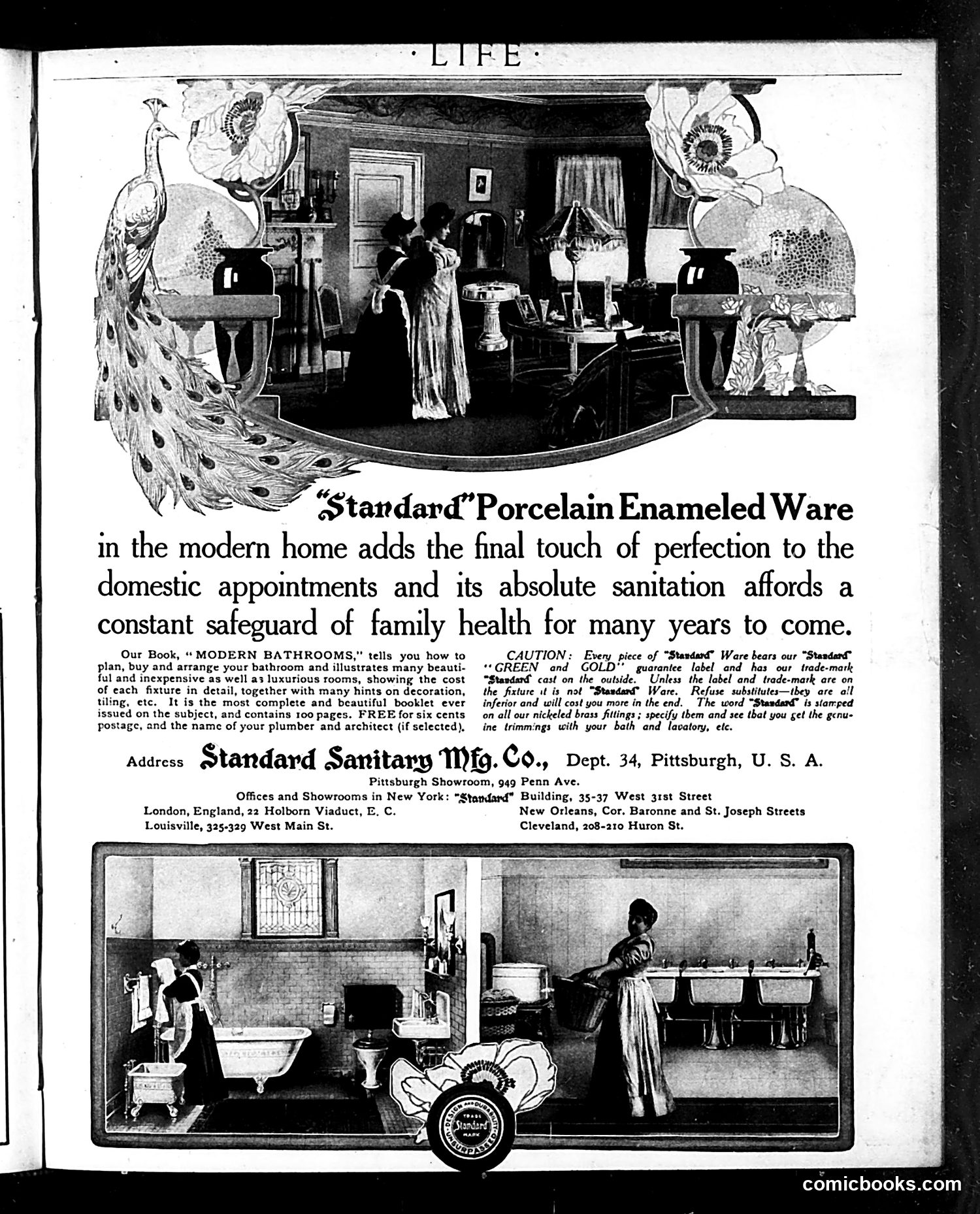
This is **not a political cartoon or satire**—it's a straightforward product advertisement for Standard Sanitary Manufacturing Company's porcelain bathroom fixtures. The page features decorative peacocks framing an idealized bathroom scene, promoting "Standard" porcelain enamel ware as essential to the modern home. The advertisement emphasizes sanitation and health protection, reflecting early-20th-century anxieties about hygiene. The company offers a free 100-page booklet on bathroom design and warns consumers against counterfeit products bearing fake "Standard" labels, a common concern before modern trademark protections. The lower panel shows two bathroom scenes—a woman at a sink and another at multiple fixtures—depicting aspirational domestic life. This represents how Life magazine, while known for satire, also carried conventional advertising reflecting period values about modern domestic comfort and cleanliness.
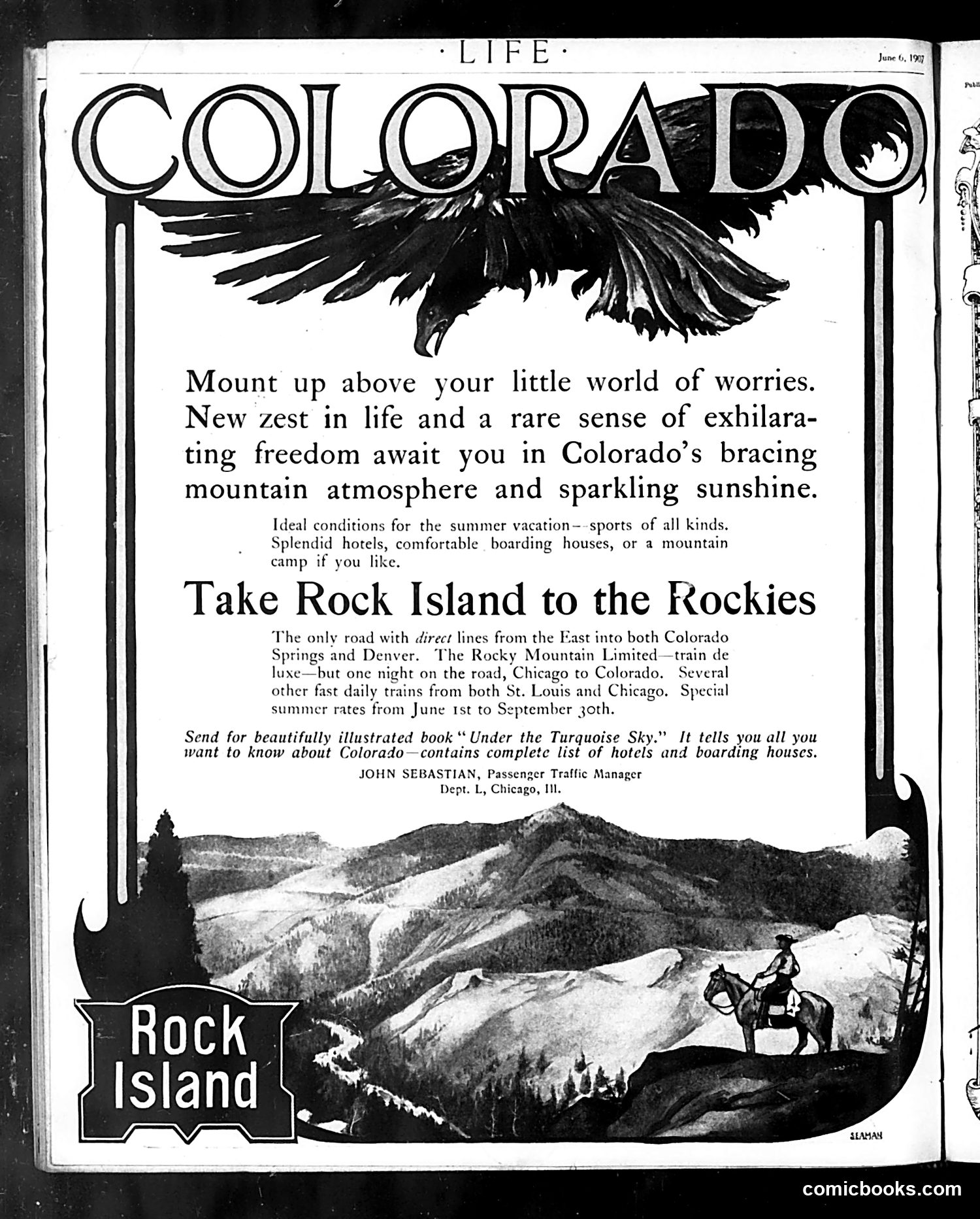
This is **not a political cartoon or satire**—it's a straightforward travel advertisement for the Rock Island Railroad Line, promoting Colorado tourism. The page features: - **The eagle** at top: a patriotic symbol commonly used in American advertising, suggesting national pride and freedom - **The mountain landscape** and silhouetted rider: romanticized imagery of the American West to attract vacation travelers - **The messaging**: Escapism language ("Mount up above your little world of worries") marketing Colorado's mountains as a summer destination - **The business pitch**: Rock Island Railroad promoting direct rail service from Chicago to Colorado Springs and Denver, with special summer rates (June-September) The advertisement targets affluent leisure travelers seeking mountain experiences. The "Rock Island" logo and railroad branding dominate the lower section. This represents early 20th-century American tourism marketing capitalizing on the West's mystique and accessibility via expanded rail networks.