
Life, 1907-06-06 · page 32 of 56
Life — June 6, 1907 — page 32: what you’re looking at
What you’re looking at
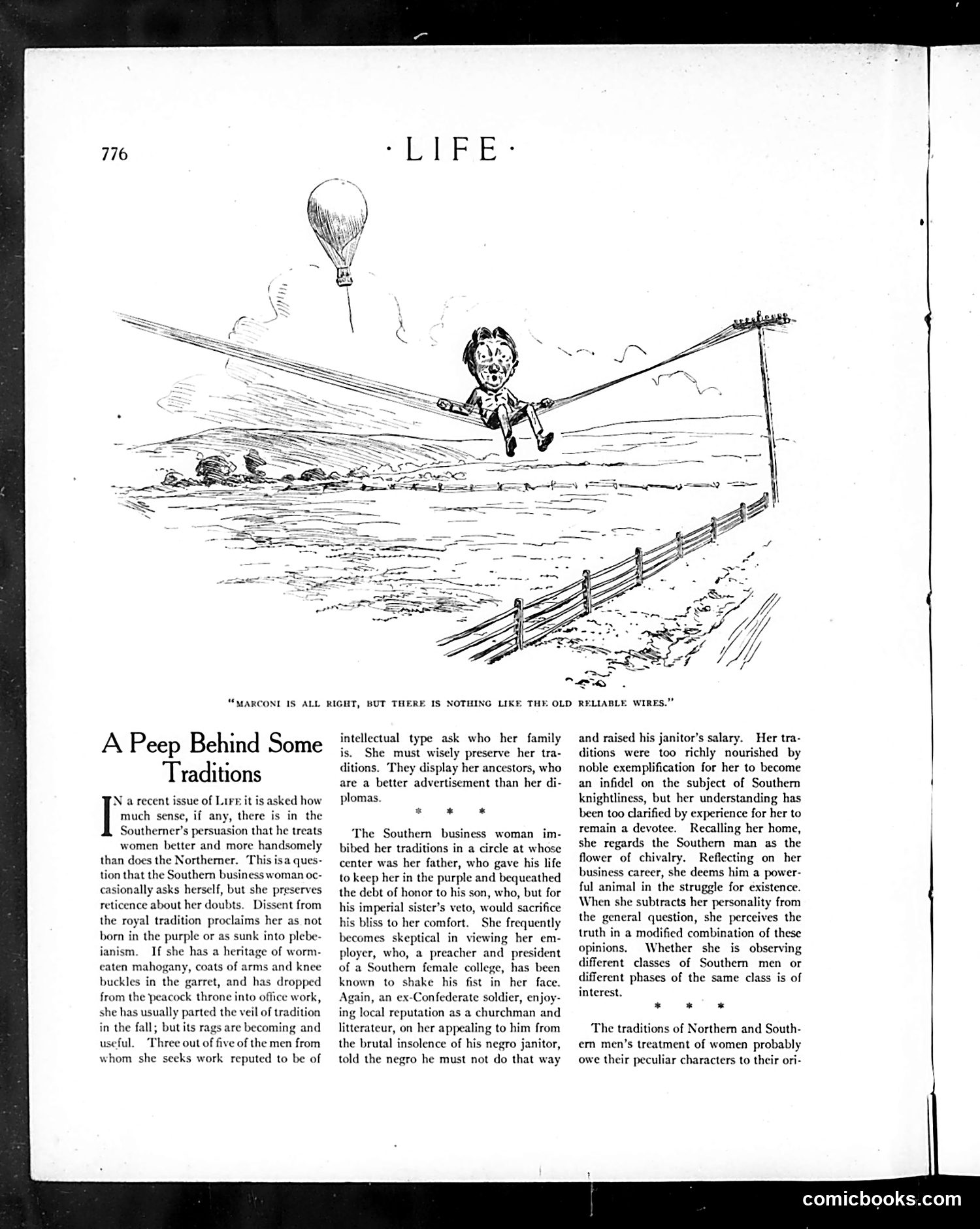
This Life magazine page satirizes Southern gentility myths versus reality. The cartoon depicts a man using old telegraph wires while a hot air balloon (representing Marconi's wireless technology) floats nearby—a visual joke: "Marconi is all right, but there is nothing like the old reliable wires," mocking stubborn adherence to outdated traditions. The article critiques Southern women who maintain "traditions" of chivalry and aristocratic heritage (ancestors, mahogany furniture, family status) despite experiencing professional disrespect. The satire exposes the gap between the "Southern gentleman" myth—men as "flowers of chivalry"—and their actual behavior: employers shaking their fists at women, janitors treated brutally until complained about. The piece argues Southern women preserve these traditions not from genuine belief but because questioning them marks them as "not born in the purple"—socially inferior. The joke: they've learned through hard experience that Southern men are merely "powerful animals in the struggle for existence," yet publicly maintain the romantic myth.
📄 Transcribed text from this page (OCR, searchable)
Machine-transcribed from the original scan — historical spelling and the odd misread are preserved.
“MARCONI IS ALL RIGHT, BUT THERE IS NOTHING LIKE THE OLD RELIABLE WIRES.” A Peep Behind Some Traditions N a recent issue of Lire it is asked how | much sense, if any, there is in the Southerner’s persuasion that he treats women better and more handsomely than does the Northerner. This isa ques- tion that the Southern business woman oc- casionally asks herself, but she preserves reticence about her doubts. Dissent from the royal tradition proclaims her as not born in the purple or as sunk into plebe- ianism. If she has a heritage of worm- eaten mahogany, coats of arms and knee buckles in the garret, and has dropped from the peacock throne into office work, she has usually parted the veil of tradition in the fall; butits rags are becoming and useful. Three out of five of the men from whom she seeks work reputed to be of intellectual type ask who her family is. She must wisely preserve her tra- ditions. They display her ancestors, who are a better advertisement than her di- plomas * * « The Southern business woman im- bibed her traditions in a circle at whose center was her father, who gave his life to keep her in the purple and bequeathed the debt of honor to his son, who, but for his imperial sister’s veto, would sacrifice his bliss to her comfort. She frequently becomes skeptical in viewing her em- ployer, who, a preacher and president of a Southern female college, has been known to shake his fist in her face. Again, an ex-Confederate soldier, enjoy- ing local reputation as a churchman and litterateur, on her appealing to him from the brutal insolence of his negro janitor, told the negro he must not do that way and raised his janitor’s salary. Her tra- ditions were too richly nourished by noble exemplification for her to become an infidel on the subject of Southem knightliness, but her understanding has been too clarified by experience for her to remain a devotee. Recalling her home, she regards the Southem man as the flower of chivalry. Reflecting on her business career, she deems him a power- ful animal in the struggle for existence. When she subtracts her personality from the general question, she perceives the truth in a modified combination of these opinions, Whether she is observing different classes of Southern men or different phases of the same class is of interest. * oe * The traditions of Northern and South- em men’s treatment of women probably owe their peculiar characters to their ori- comicbooks.com