
Life, 1907-06-06 · page 27 of 56
Life — June 6, 1907 — page 27: what you’re looking at
What you’re looking at
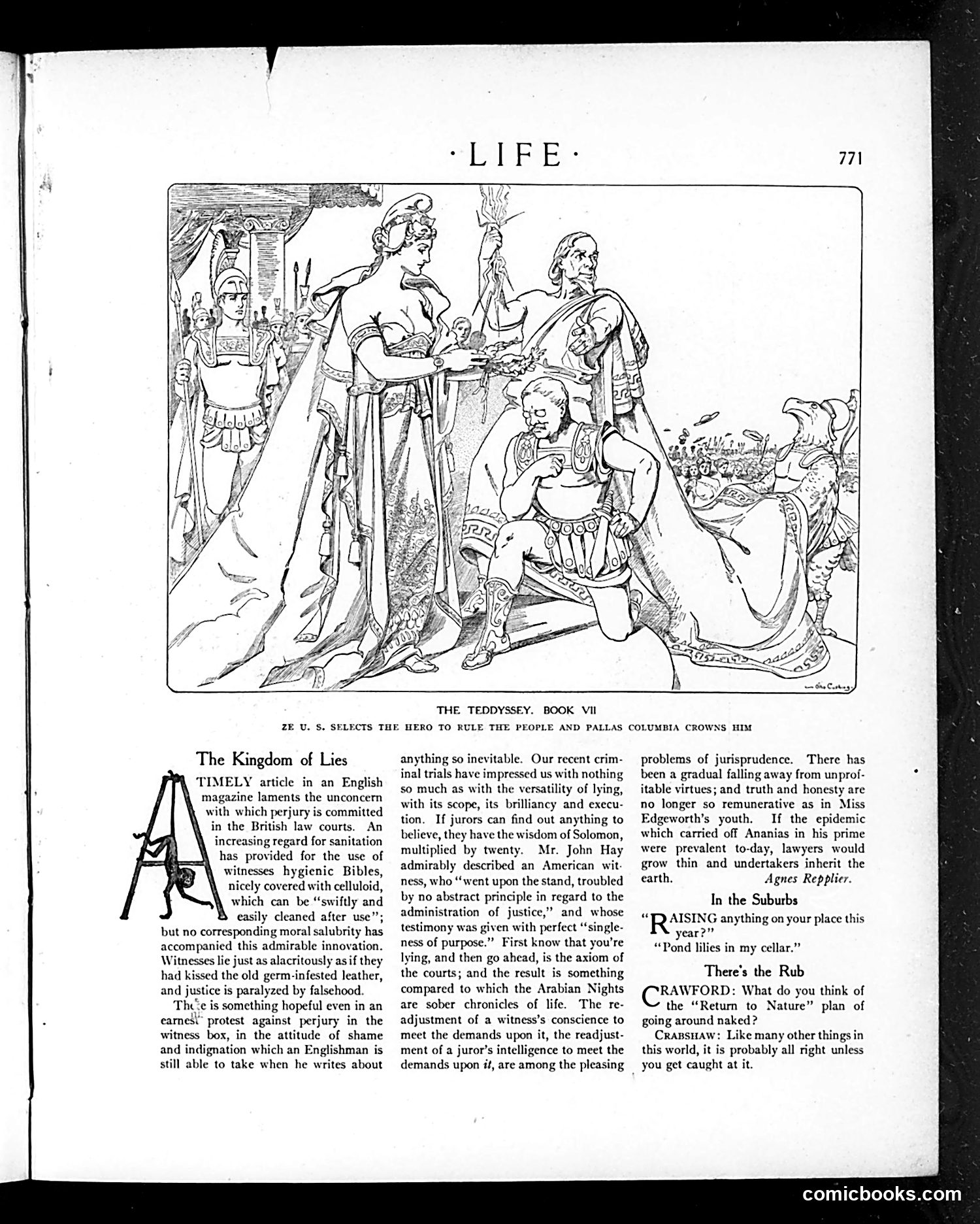
The main illustration depicts "The Teddyssey, Book VII," a satirical series referencing Theodore Roosevelt. It shows a classical scene where Columbia (America personified) crowns a hero selected "to rule the people"—a jab at executive power and democratic process. The text below critiques perjury and dishonesty in courts on both sides of the Atlantic. The article, attributed to Agnes Repplier, argues that witnesses and jurors routinely lie with impunity, making a mockery of justice. It references John Hay's description of American witnesses who testify without moral principle, and sardonically suggests that if divine punishment for perjury (like Ananias's fate in scripture) still occurred, lawyers would starve. The smaller jokes mock suburban pretension and social hypocrisy regarding the "Return to Nature" movement—suggesting people advocate it only when socially convenient, not actually. The satire targets American legal corruption, judicial incompetence, and the gap between stated values and actual behavior.
📄 Transcribed text from this page (OCR, searchable)
Machine-transcribed from the original scan — historical spelling and the odd misread are preserved.
THE TEDDYSSEY. BOOK VII ZE U. S. SELECTS THE HERO TO RULE THE PEOPLE AND PALLAS COLUMBIA CROWNS HIM The Kingdom of Lies TIMELY article in an English magazine laments the unconcern with which perjury is committed in the British law courts. An increasing regard for sanitation has provided for the use of witnesses hygienic Bibles, nicely covered with celluloid, which can be “swiftly and easily cleaned after use”; but no corresponding moral salubrity has accompanied this admirable innovation. Witnesses lie just as alacritously as if they d the old germ-infested leather, is paralyzed by falsehood. The<e is something hopeful even in an camest” protest against perjury in the witness box, in the attitude of shame and indignation which an Englishman is still able to take when he writes about anything so inevitable. Our recent crim- inal trials have impressed us with nothing so much as with the versatility of lying, with its scope, its brilliancy and execu- tion. If jurors can find out anything to believe, they have the wisdom of Solomon, multiplied by twenty. Mr. John Hay admirably described an American wit- ness, who “went upon the stand, troubled by no abstract principle in regard to the administration of justice,” and whose testimony was given with perfect “‘single- ness of purpose.” First know that you're lying, and then go ahead, is the axiom of the courts; and the result is something compared to which the Arabian Nights are sober chronicles of life. The re- adjustment of a witness’s conscience to meet the demands upon it, the readjust- ment of a juror’s intelligence to meet the demands upon it, are among the pleasing problems of jurisprudence. There has been a gradual falling away from unproj- itable virtues; and truth and honesty are no longer so remunerative as in Miss Edgeworth’s youth. If the epidemic which carried off Ananias in his prime were prevalent to-day, law: would grow thin and undertakers inherit the earth, Agnes Repplier. In the Suburbs GRAsns anything on your place this year?” “Pond lilies in my cellar.” There's the Rub GBAWEORD: What do you think of the “Return to Nature” plan of going around naked? Crassuaw: Like many other things in this world, it is probably all right unless you get caught at it. comicbooks.com