
Life, 1907-06-06 · page 10 of 56
Life — June 6, 1907 — page 10: what you’re looking at
What you’re looking at
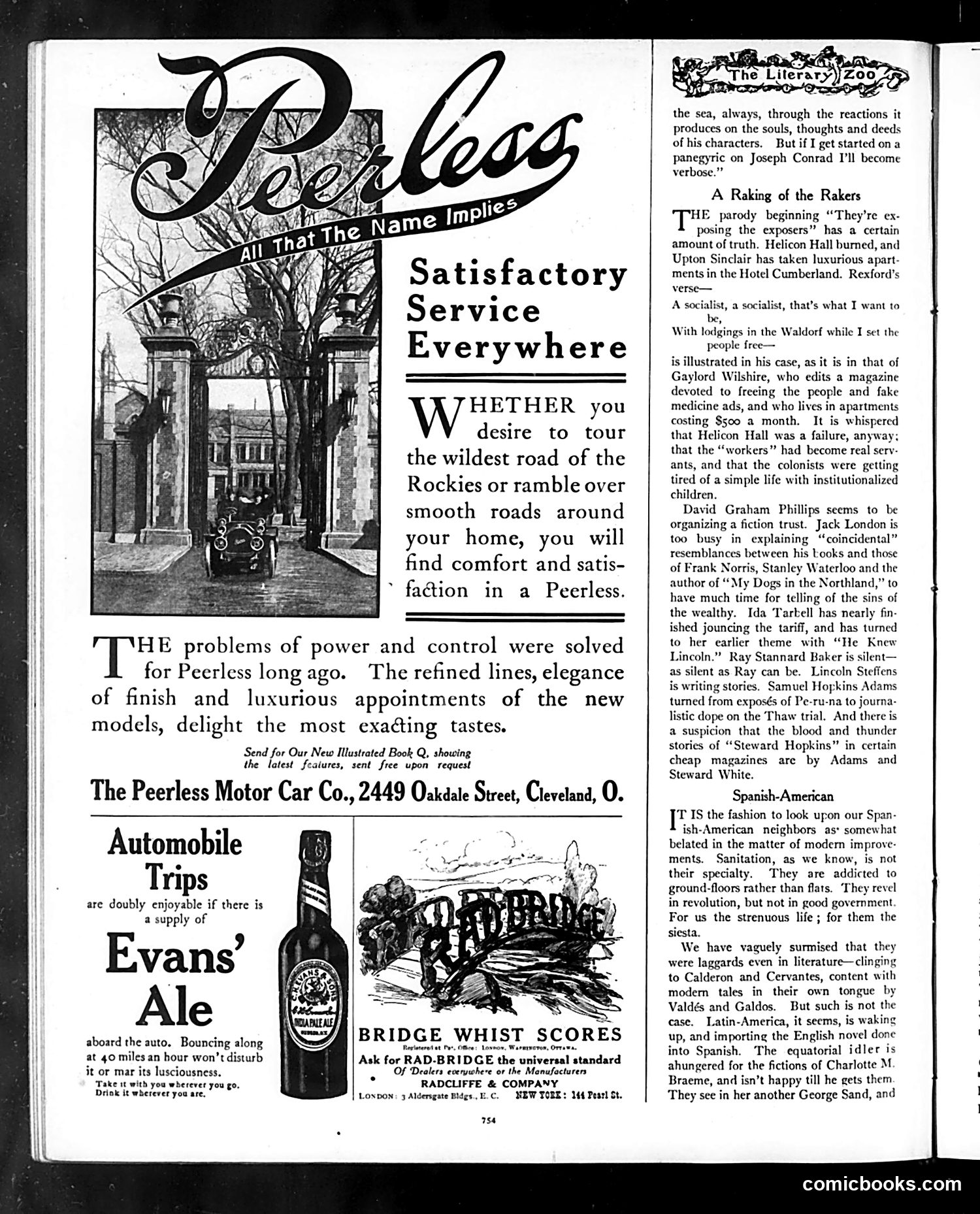
This page is primarily **advertising and literary commentary**, not political satire. The top half features ads for the **Peerless Motor Car Company** (Cleveland, Ohio) and **Evans' Ale**, emphasizing luxury automobiles and refreshment for road trips—common early 20th-century consumer messaging. Below is a **Bridge Whist Scores** card game advertisement by Radcliffe & Company (London/New York). The right column contains literary criticism discussing contemporary fiction—mentioning authors like Joseph Conrad, Jack London, and Ray Stannard Baker. The critic discusses socialist themes in literature and Spanish-American subject matter in novels, suggesting debates about modern literature's political and social relevance. The page reflects **1910s-era concerns**: automobiles as status symbols, card games as leisure activity, and literature's engagement with socialism and imperialism.
📄 Transcribed text from this page (OCR, searchable)
Machine-transcribed from the original scan — historical spelling and the odd misread are preserved.
Satisfactory Service Everywhere HETHER you desire to tour the wildest road of the Rockies or ramble over smooth roads around your home, you will find comfort and satis- fadion in a Peerless. HE problems of power and control were solved for Peerless long ago. The refined lines, elegance of finish and luxurious appointments of the new models, delight the most exaéting tastes. Send for Our New Illustrated Book Q, showing the latest features, sent free upon request The Peerless Motor Car Co., 2449 Oakdale Street, Creveland, 0. Automobile Trips are doubly enjoyable if there is a supply of Evans’ Ale a BRIDGE WHIST SCORES aboard the auto. Bouncing along ff Redcrtet fe Ot lta irmsstn Or at 40 milesan hour won’tdisturb Ask for RAD-BRIDGE the universal standard it or mar its lusciousness. 2 . OD everywhere or the Manufacturers ‘Take it with you wherever you go. RADCLIFFE & COMPANY Drink it wherever you are, Loxpon: 3 Aldersgate Bldgs. E.C. NEW TORE: 144 Pearl St. 784 SS tg Se ee irae easy the sea, always, through the reactions it produces on the souls, thoughts and deeds of his characters. But if I get started on a panegyric on Joseph Conrad I'll become verbose.” A Raking of the Rakers TH parody beginning ‘They're ex- posing the exposers” has a certain amount of truth. Helicon Hall burned, and Upton Sinclair has taken luxurious apart- ments in the Hotel Cumberland. Rexford’s verse— A socialist, a socialist, that’s what I want to be, With lodgings in the Waldorf while I set the people free— is illustrated in his case, as it is in that of Gaylord Wilshire, who edits a magazine devoted to freeing the people and fake medicine ads, and who lives in apartments costing $500 a month. It is whispered that Helicon Hall was a failure, anyway; that the “workers” had become real serv- ants, and that the colonists were getting tired of a simple life with institutionalized children. David Graham Phillips seems to be organizing a fiction trust. Jack London is too busy in explaining “coincidental” resemblances between his tooks and those of Frank Norris, Stanley Waterloo and the author of “My Dogs in the Northland,” to have much time for telling of the sins of the wealthy. Ida Tarkell has nearly fin- ished jouncing the tariff, and has turned to her earlier theme with “He Knew Lincoln.” Ray Stannard Baker is silent— as silent as Ray can be. Lincoln Steffens is writing stories. Samuel Hopkins Adams turned from exposés of Pe-ru-na to journa- listic dope on the Thaw trial. And there is a suspicion that the blood and thunder stories of “Steward Hopkins” in certain cheap magazines are by Adams and Steward White. Spanish-American cr. IS the fashion to look upon our Span- ish-American neighbors as* somewhat belated in the matter of modem improve- ments. Sanitation, as we know, is not their specialty. They are addicted to ground-floors rather than flats. They revel in revolution, but not in good government For us the strenuous life ; for them the siesta. We have vaguely surmised that they were laggards even in literature—clinging to Calderon and Cervantes, content with modem tales in their own tongue by Valdés and Galdos. But such is not the case. Latin-America, it seems, is waking up, and importing the English novel done into Spanish. The equatorial idler is ahungered for the fictions of Charlotte M Braeme, and isn’t happy till he gets them They see in her another George Sand, and comicbooks.com