
Life, 1907-06-06 · page 26 of 56
Life — June 6, 1907 — page 26: what you’re looking at
What you’re looking at
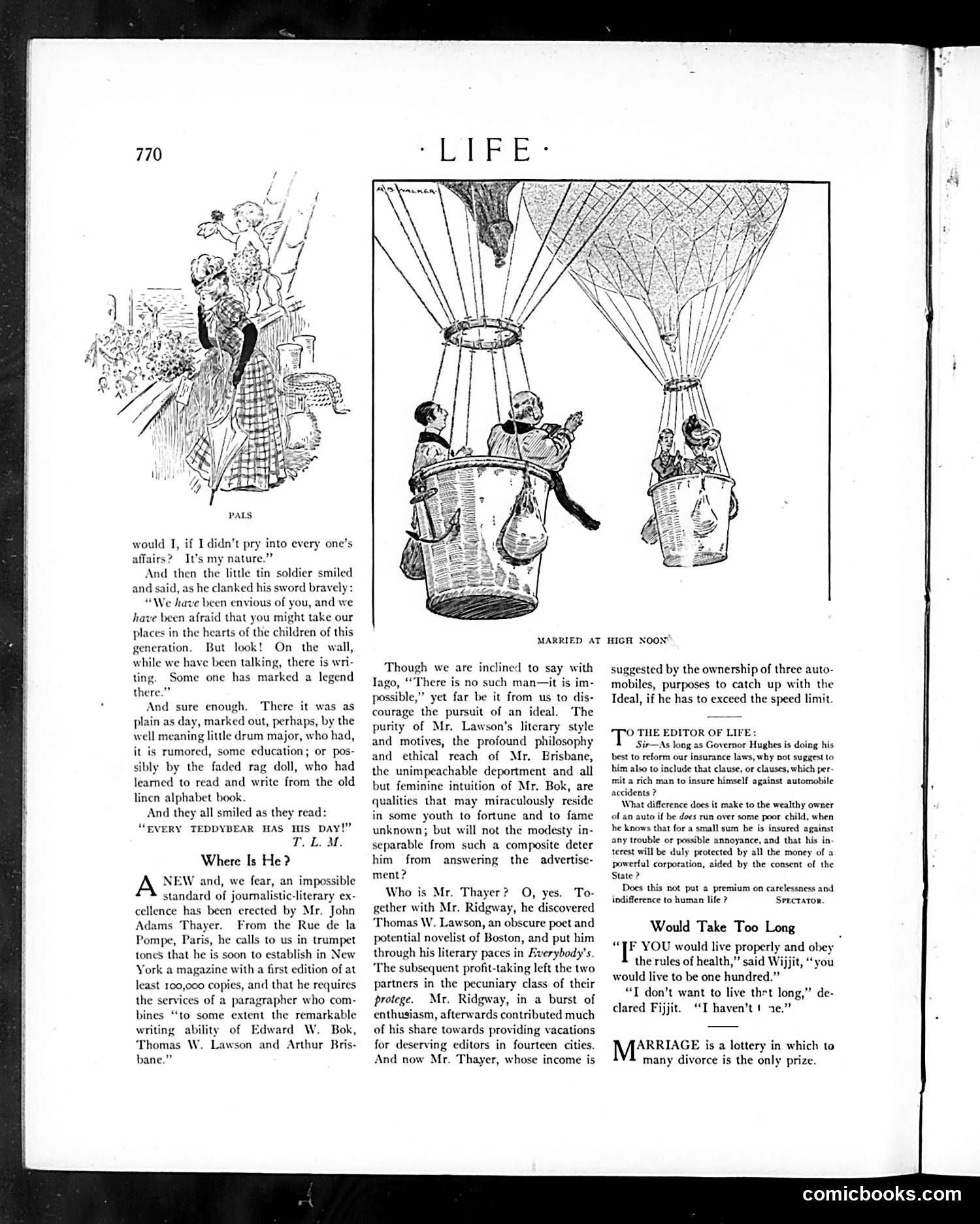
This page from *Life* magazine contains several distinct pieces of social satire: **"Pals" (left illustration):** A sentimental story about toy soldiers and a teddy bear reconciling their jealousy, concluding with the moral "Every Teddy Bear Has His Day"—likely satirizing sentimental children's literature and the era's obsession with teddy bears as toys. **"Where Is He?" (main article):** Mocks John Adams Thayer's announced plan to launch a prestigious New York magazine requiring a writer combining the talents of Edward W. Bok, Thomas W. Lawson, and Arthur Brisbane—three famous contemporary editors/writers. The satire suggests such a perfect person cannot exist. The piece also references Thayer's partnership with Ridgway in promoting Lawson through *Everybody's* magazine. **"Married at High Noon" (illustration):** Shows hot-air balloons, likely satirizing extravagance or frivolous pursuits. **Letters section:** Critiques wealthy automobile owners who can afford insurance against hitting pedestrians, treating accidents as insurable risks rather than moral wrongs. The overall tone mocks pretension, wealth inequality, and journalistic ambition.
📄 Transcribed text from this page (OCR, searchable)
Machine-transcribed from the original scan — historical spelling and the odd misread are preserved.
PALS would I, if I didn’t pry into every one’s affairs? It’s my nature.” And then the little tin soldier smiled and said, as he clanked his sword bravely : “We have been envious of you, and we have been afraid that you might take our places in the hearts of the children of this generation. But look! On the wall, while we have been talking, there is wri- ting. Some one has marked a legend there.” And sure enough. There it was as plain as day, marked out, perhaps, by the well meaning little drum major, who had, it is rumored, some education; or pos- sibly by the faded rag doll, who had learned to read and write from the old linen alphabet book. And they all smiled as they read: “EVERY TEDDYBEAR HAS HIS Day!” T.L. M. Where Is He ? NEW and, we fear, an impossible ndard of journalistic-literary ex- cellence has been erected by Mr. John Adams Thayer. From the Rue de la Pompe, Paris, he calls to us in trumpet tones that he is soon to establish in New York a magazine with a first edition of at least 100,000 copies, and that he requires the services of a paragrapher who com- bines ‘to some extent the remarkable writing ability of Edward W. Bok, Thomas W. Lawson and Arthur Bris- bane.” MARRIED AT HIGH NOON Though we are inclined to say with Tago, ‘There is no such man—it is im- possible,” yet far be it from us to dis- courage the pursuit of an ideal. The purity of Mr. Lawson's literary style and motives, the profound philosophy and ethical reach of Mr. Brisbane, the unimpeachable deportment and all but feminine intuition of Mr. Bok, are qualities that may miraculously reside in some youth to fortune and to fame unknown; but will not the modesty in- separable from such a composite deter him from answering the advertise- ment? Who is Mr. Thayer? O, yes. To- gether with Mr. Ridgway, he discovered ‘Thomas W. Lawson, an obscure poet and potential novelist of Boston, and put him through his literary paces in Everybody's. ‘The subsequent profit-taking left the two partners in the pecuniary class of their protege. Mr. Ridgway, in a burst of enthusiasm, afterwards contributed much of his share towards providing vacations for deserving editors in fourteen cities. And now Mr. Thayer, whose income is suggested by the ownership of three auto- mobiles, purposes to catch up with the Ideal, if he has to exceed the speed limit ‘O THE EDITOR OF LIFE: Sir—As long as Governor Hughes is doing his best to reform our insurance laws, why not suggest to him also to include that clause, or clauses, which per mit a rich man to insure himself against automobile accidents ? What difference docs it make to the wealthy owner ‘of an auto if he does run over some poor child, when he knows that for a small sum be is insured against any trouble or possible annoyance, and that his in terest will be duly protected by all the money of a powerful corporation, aided by the consent of the State ? Does this not put a premium on carelessness and indifference to human life ? SPECTATOR. Would Take Too Long “TF YOU would live properly and obey the rules of health,” said Wijjit, “you would live to be one hundred.” “T don’t want to live thet long,” de- clared Fijjit. “I haven’t 1 ¢.” MERRIE is a lottery in which to many divorce is the only prize. comicbooks.com