
Life, 1907-06-06 · page 24 of 56
Life — June 6, 1907 — page 24: what you’re looking at
What you’re looking at
This story uses a nursery full of toys as allegory for social conflict, likely reflecting early 20th-century American anxieties about immigration and social hierarchy. The **Teddybear** represents a popular, well-liked figure (possibly Theodore Roosevelt or a general "common man") whose friendliness toward all toys—particularly the Black rag doll—offends the toy establishment. The **tin soldier** leads a revolt of "traditional" toys (a white rabbit emphasizing racial purity, a Japanese doll) against the Teddybear's egalitarianism. They're scandalized that he treats the Black doll as an equal and sits with him. The **Black rag doll** (Sambo) is sympathetic to the Teddybear, calling him a "good friend." He's attacked and knocked down by the soldier for this loyalty. The satire critiques the prejudiced establishment's intolerance of the Teddybear's progressive inclusivity—portraying the protesters as petty, exclusive, and threatened by equality. The abandoned toy railroad suggests their complaint is self-centered nostalgia rather than principle.
📄 Transcribed text from this page (OCR, searchable)
Machine-transcribed from the original scan — historical spelling and the odd misread are preserved.
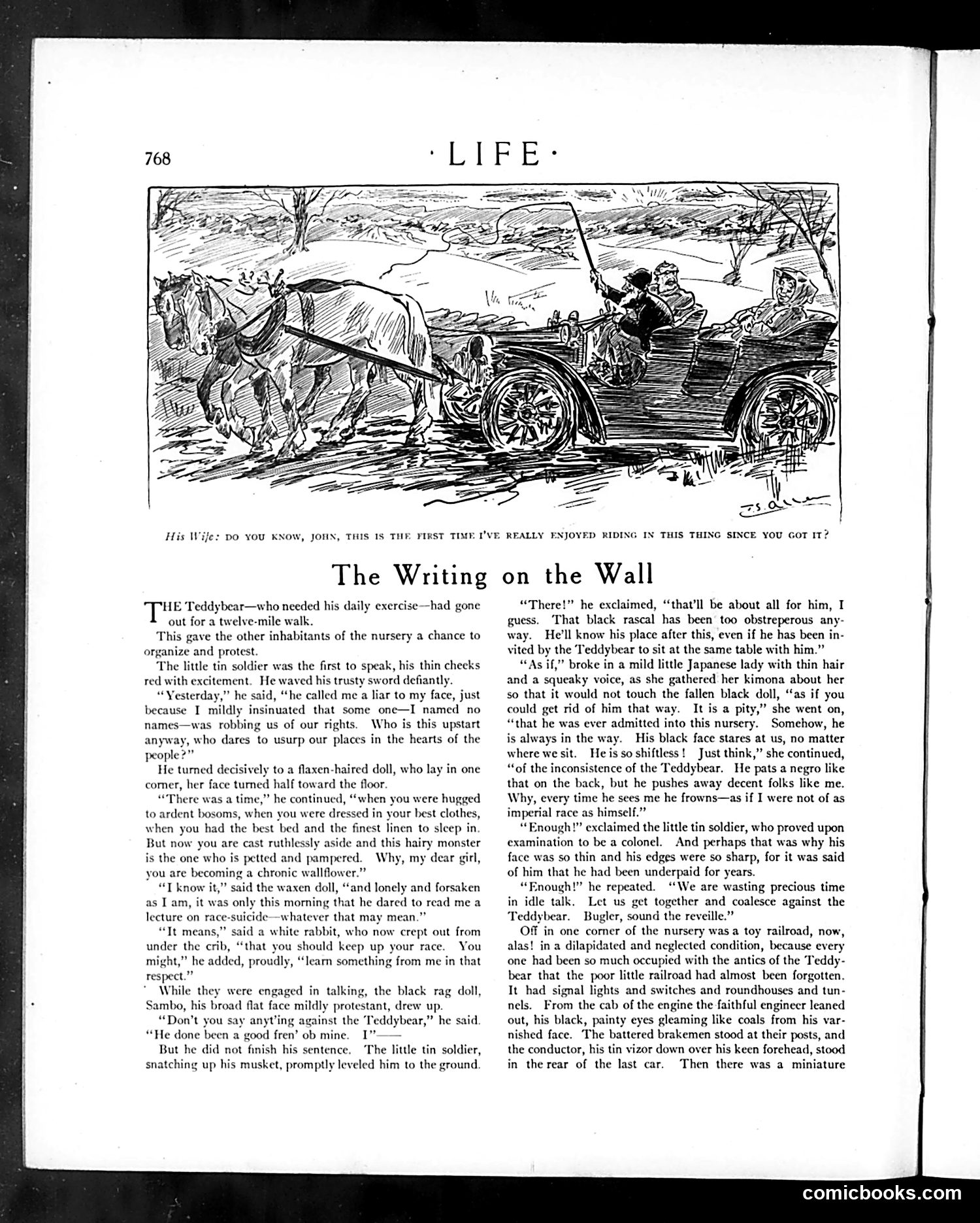
His Wife: po you KNow, JOHN, THIS 15 THE FIRST TIME I'VE REALLY ENJOYED RIDING IN THIS THING SINCE YOU GoT IT? The Writing on the Wall TH ‘Teddybear—who needed his daily exercise—had gone out for a twelve-mile walk. This gave the other inhabitants of the nursery a chance to organize and protest. The little tin soldier was the first to speak, his thin checks red with excitement. He waved his trusty sword defiantly. “Yesterday,” he said, “he called me a liar to my face, just because I mildly insinuated that some one—I named no names—was robbing us of our rights. Who is this upstart anyway, who dares to usurp our places in the hearts of the people?” He turned decisively to a flaxen-haired doll, who lay in one comer, her face turned half toward the floor. “There was a time,” he continued, “when you were hugged to ardent bosoms, when you were dressed in your best clothes, when you had the best bed and the finest linen to sleep in But now you are cast ruthlessly aside and this hairy monster is the one who is petted and pampered. Why, my dear girl, you are becoming a chronic wallflower.” “T know it,” said the waxen doll, “and lonely and forsaken as I am, it was only this morning that he dared to read me a lecture on ra ide—whatever that may mean.” “It means,” said a white rabbit, who now crept out from under the crib, “that you should keep up your race. You might,” he added, proudly, “learn something from me in that respect.” While they were engaged in talking, the black rag doll, Sambo, his broad flat face mildly protestant, drew up. “Don’t you say anyt’ing against the ‘Teddybear,” he said “He done been a good fren’ ob mine. 1”—— But he did not finish his sentence. The little tin soldier, snatching up his musket, promptly leveled him to the ground “There!” he exclaimed, ‘that'll be about all for him, I guess. That black rascal has been too obstreperous any- way. He'll know his place after this, even if he has been in- vited by the Teddybear to sit at the same table with him.” “As if,” broke in a mild little Japanese lady with thin hair and a squeaky voice, as she gathered her kimona about her so that it would not touch the fallen black doll, “as if you could get rid of him that way. It is a pity,” she went on, “that he was ever admitted into this nursery. Somehow, he is always in the way. His black face stares at us, no matter where we sit. He is so shiftless! Just think,” she continued, “of the inconsistence of the Teddybear. He pats a negro like that on the back, but he pushes away decent folks like me. Why, every time he sees me he frowns—as if I were not of as i jal race as himself.” “Enough!” exclaimed the little tin soldier, who proved upon examination to be a colonel. And perhaps that was why his face was so thin and his edges were so sharp, for it was said of him that he had been underpaid for years. “Enough!” he repeated. “We are wasting precious time in idle talk. Let us get together and coalesce against the Teddybear. Bugler, sound the reveille.” Off in one corner of the nursery was a toy railroad, now, alas! in a dilapidated and neglected condition, because every one had been so much occupied with the antics of the Teddy- bear that the poor little railroad had almost been forgotten. It had signal lights and switches and roundhouses and tun- nels. From the cab of the engine the faithful engineer leaned out, his black, painty eyes gleaming like coals from his var- nished face. The battered brakemen stood at their posts, and the conductor, his tin vizor down over his keen forehead, stood in the rear of the last car. Then there was a miniature comicbooks.com