
Life, 1907-06-06 · page 20 of 56
Life — June 6, 1907 — page 20: what you’re looking at
What you’re looking at
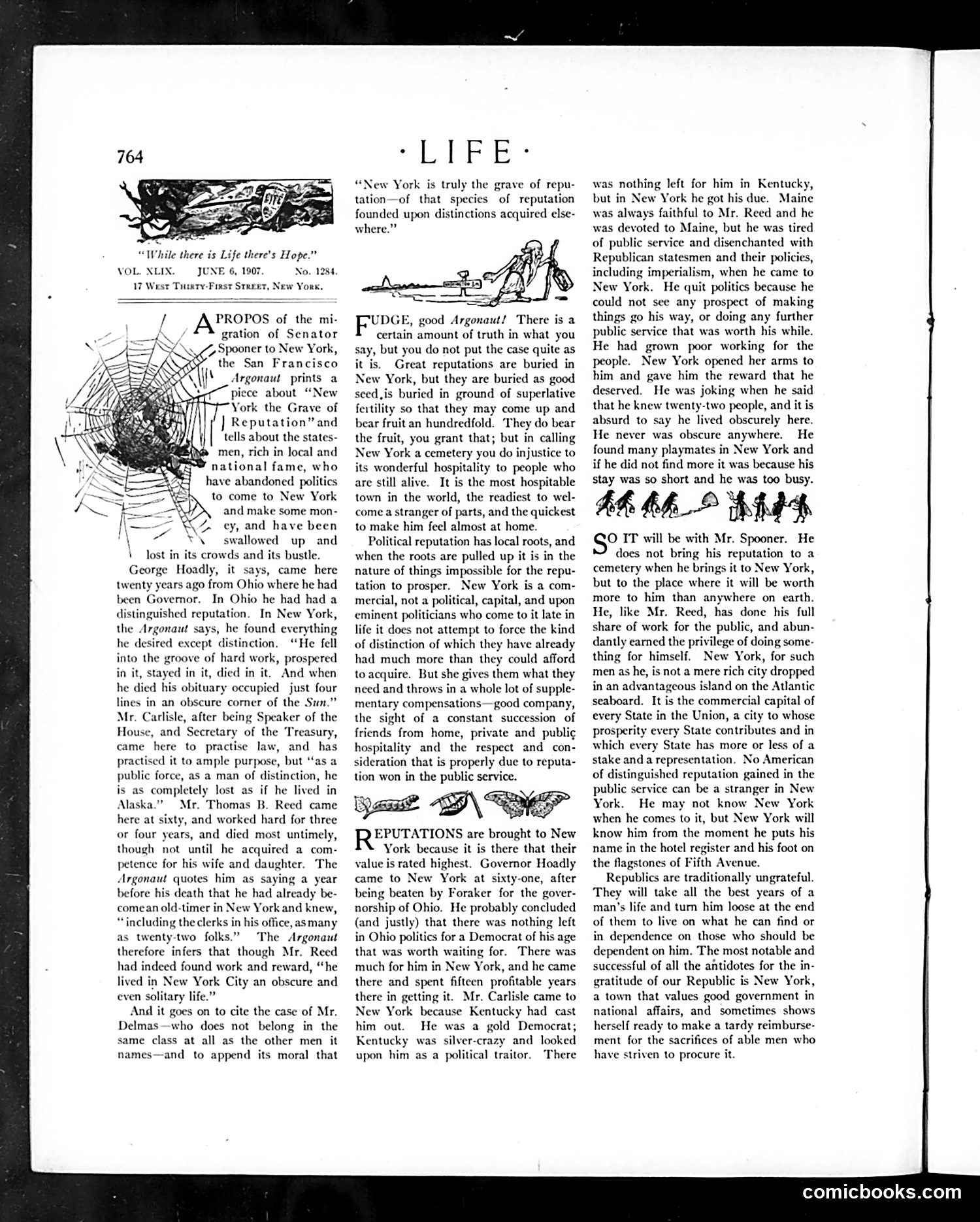
This page defends New York against criticism from the San Francisco *Argonaut* newspaper. The *Argonaut* had argued that New York is "the grave of reputation"—that prominent politicians who relocate there lose their public distinction, citing former Ohio Governor George Hoadly, ex-Speaker of the House John Carlisle, and ex-Congressman Thomas B. Reed as examples. Life's editor rebuts this, arguing New York doesn't destroy reputations but rather "buries" them like seeds in fertile soil, yielding hundredfold fruit. The key point: these men were *local* politicians whose regional power couldn't transfer to a commercial (not political) capital. New York offers superior compensations—business opportunity, intellectual company, and respect for public service—even if traditional political influence fades. The cartoon (left) appears to show a politician's confused or disillusioned face, visually reinforcing the tension between political ambition and New York's commercial reality.
📄 Transcribed text from this page (OCR, searchable)
Machine-transcribed from the original scan — historical spelling and the odd misread are preserved.
“While there is Life there’s Hope.” VOL. XLIX. JUNE 6, 1907. No. 1284. 17 West Trunty-First Sree PROPOS of the mi- gration of Senator 4, Spooner to New York, San Francisco Argonaut prints a piece about “New York the Grave of ] Reputation” and tells about the states- men, rich in local and national fame, who have abandoned politics to come to New York and make some mon- KZ ey, and have been SX swallowed up and lost in its crowds and its bustle. George Hoadly, it says, came here twenty years ago from Ohio where he had been Governor. In Ohio he had had a distinguished reputation. In New York, the Argonaut says, he found everything he desired except distinction. “He fell into the groove of hard work, prospered in it, stayed in it, died in it. And when he died his obituary occupied just four lines in an obscure corner of the S17.” Mr. Carlisle, after being Speaker of the House, and Secretary of the Treasury, came here to practise law, and has practised it to ample purpose, but “as a public force, as a man of distinction, he is as completely lost as if he lived in Alaska.” Mr. Thomas B. Reed came here at sixty, and worked hard for three or four years, and died most untimely, though not until he acquired a com- petence for his wife and daughter. The Argonaut quotes him as saying a year before his death that he had already be- comean old-timer in New York and knew, “including the clerks in his office, asmany as twenty-two folks.” The Argonaut therefore infers that though Mr. Reed had indeed found work and reward, “he lived in New York City an obscure and even solitary life.” And it goes on to cite the case of Mr. Delmas—who does not belong in the same class at all as the other men it names—and to append its moral that Z ‘LEP E * “New York is truly the grave of repu- tation—of that species of reputation founded upon distinctions acquired else- where.” good Argonaut! There is a certain amount of truth in what you ay, but you do not put the case quite as is. Great reputations are buried in New York, but they are buried as good sced,is buried in ground of superlative fertility so that they may come up and bear fruit an hundredfold. They do bear the fruit, you grant that; but in calling w York a cemetery you do injustice to its wonderful hospitality to people who are still alive. It is the most hospitable town in the world, the readiest to wel- come a stranger of parts, and the quickest to make him feel almost at home. Political reputation has local roots, and when the roots are pulled up it is in the nature of things impossible for the repu- tation to prosper. New York is a com- mercial, not a political, capital, and upon eminent politicians who come to it late in life it does not attempt to force the kind of distinction of which they have already had much more than they could afford to acquire. But she gives them what they need and throws in a whole lot of supple- mentary compensations—good company, the sight of a constant succession of friends from home, private and publig hospitality and the respect and con- sideration that is properly due to reputa- tion won in the public service. R PUTATIONS are brought to New York because it is there that their value is rated highest. Governor Hoadly came to New York at sixty-one, after being beaten by Foraker for the gover- norship of Ohio. He probably concluded (and justly) that there was nothing left in Ohio politics for a Democrat of his age that was worth waiting for. There was much for him in New York, and he came there and spent fifteen profitable years there in getting it. Mr. Carlisle came to New York because Kentucky had cast him out. He was a gold Democrat; Kentucky was silver-crazy and looked upon him as a political traitor. There was nothing left for him in Kentucky, but in New York he got his due. Maine was always faithful to Mr. Reed and he was devoted to Maine, but he was tired of public service and disenchanted with Republican statesmen and their policies, including imperialism, when he came to New York. He quit politics because he could not see any prospect of making things go his way, or doing any further public service that was worth his while. He had grown poor working for the people. New York opened her arms to him and gave him the reward that he deserved. He was joking when he said that he knew twenty-two people, and it is absurd to say he lived obscurely here. He never was obscure anywhere. He found many playmates in New York and if he did not find more it was because his stay was so short and he was too busy. AG Mh © Phas Ss° IT will be with Mr. Spooner. He does not bring his reputation to a cemetery when he brings it to New York, but to the place where it will be worth more to him than anywhere on earth. He, like Mr. Reed, has done his full share of work for the public, and abun- dantly earned the privilege of doing some- thing for himself. New York, for such men as he, is not a mere rich city dropped in an advantageous island on the Atlantic seaboard. It is the commercial capital of every State in the Union, a city to whose prosperity every State contributes and in which every State has more or less of a stake and a representation. No American of distinguished reputation gained in the public service can be a stranger in New York. He may not know New York when he comes to it, but New York will know him from the moment he puts his name in the hotel register and his foot on the flagstones of Fifth Avenue. Republics are traditionally ungrateful. They will take all the best years of a man’s life and turn him loose at the end of them to live on what he can find or in dependence on those who should be dependent on him. The most notable and successful of all the antidotes for the in- gratitude of our Republic is New York, a town that values good government in national affairs, and sometimes shows herself ready to make a tardy reimburse- ment for the sacrifices of able men who have striven to procure it. comicbooks.com