
Life, 1907-06-06 · page 40 of 56
Life — June 6, 1907 — page 40: what you’re looking at
What you’re looking at
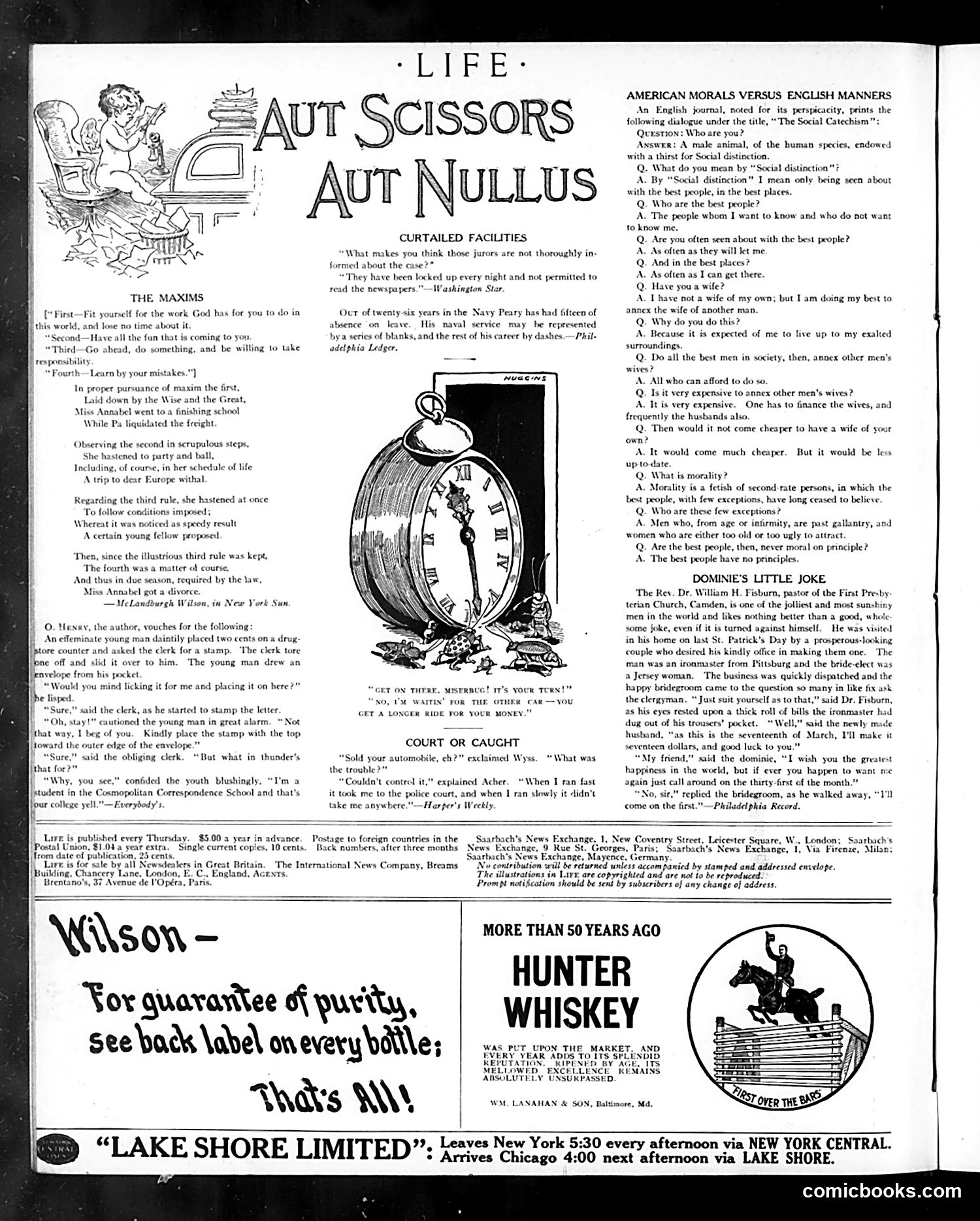
This page contains satirical commentary on American social customs and morality from the early 20th century. **"The Maxims"** depicts a wealthy young woman (Miss Annabel) following society's unwritten rules: enjoying herself, pursuing social status, accepting a marriage proposal, and divorcing—all presented as logical consequences of following proper upper-class conduct. The satire critiques how wealthy society normalizes serial marriage and divorce. **"The Social Catechism"** is a dialogue mocking American pretension by defining "social distinction" as associating with people who don't want to know you, and frankly acknowledging that wealthy men regularly seduce other men's wives as expected behavior. This attacks American hypocrisy regarding morality—the title contrasts American "morals" with English "manners," suggesting Americans claim virtue while practicing vice. **Other brief jokes** mock jury selection practices, naval record-keeping gaps, and automobile ownership. The page overall critiques wealthy American society's superficiality, materialism, and moral inconsistency during the Progressive Era.
📄 Transcribed text from this page (OCR, searchable)
Machine-transcribed from the original scan — historical spelling and the odd misread are preserved.
THE MAXIMS ("First this world, and lose “Third—Go ahead, do someth' responsibility 1) Fourth—Lea » time about it the fun that is coming to you. ng. and be willing to t akes."] In proper pursuance of maxim the first, Laid down by the Wise a Miss Annabel went to a finishing school While Pa liquidated the feeight n by your mi Observing the second in scrupulous steps, She hastened to party and ball, Including, of course, in her schedule of life A trip to dear Europe withal Regarding the third rule, she hastened To follow conditions imposed ; Whereat it was noticed as speedy result A certain young fellow proposed ‘Then, since the illustrious third rule was kept, The fourth was a matter of course, And thus in dve season, required by the lave, Miss Annabel got a divorce. Mel. Ho. tenes, Boe cee store counter and asked the clerk for a stamp. one off and slid it over to him. ‘The young man envelope fro MH “Would you n Phe lisped )) Sure," said the clerk, as he started to stamp the letter. “Oh, stay!” cautioned the young man in great alarm that way, I beg of you. Kindly place the stamp wi toward the outer edge of the envelope.” said the obliging clerk. hor, vouches for the following his pocket fthat f | “Why, you see,” confided the youth blushingly, “I'm a |student in the Cosmopolitan Correspondence School and that’s pur college yell." —Everybody’s. Fit yourself for the work God has for you to do in ake id licking it for me and placing it on here? “But what in thunder's pal tes| Le ea UT SCISSORS Aut NULLUS CURTAILED FACILITIES "What makes you t formed about the case They have been locked up every night and not permitted to read the newspapers."—Washington Star. jak those jurors are not thoroughly in- Ov of twenty-six years in the Navy Peary has had fifteen of absence “on he represented bya series of blanks, and the rest of his career by dashes. —Phil- adelphia Ledger. Keave. His naval service may woaens burgh Wilson, in New York Sun te young man daintily placed two cents on a drug- ‘The cletk tore ET ON THERE. MISERBUG! IT'S YOUR T “NO, 1M WAITIN' FOR THE OTHER CAR —YOU GET A LONGER RIDE TOR YOUR MONEY.” “Not h the top COURT OR CAUGHT old your automobile, ch?” exclaimed Wyss the trouble?” “Couldn't contrel it,” explained Acher, “When I ran fast it took me to the police court, and when I ran slowly it didn’t take me anywhere."—Herper's Weekly. “What was AMERICAN MORALS VERSUS ENGLISH MANNERS An English journal, noted for its perspicacity, prints the following dialogue under the title, “The Social Catechism”: Question: Who are you? Axswer: A male animal, of the human species, endowed with a thirst for Social distinction. Q. What do you mean by "Social distinction"? A. By “Social distinction” I mean only being seen about with the best people, in the best places. Q. Who are the best people? A. The people whom I want to know and who do not want to know me. Q. Are you often seen about with the best people? A. As often as they will let me Q. And in the best places? A. As often as I can get there. Q. Have you a wife? A. [have not a wife of my own; but Iam doing my best to annex the wife of another man. Q. Why do you do this? A. Because it is expected of me to live up to my exaked surroundings. Q. Do all the best men in society, then, annex other men's wives? A. All who can afford to do so. Q. Is it very expensive to annex other men's wives? A. It is very expensive. One has to finance the wives, and frequently the husbands also. Q. Then would it not come cheaper to have a wife of your own? A. It would come much cheaper up to-date, Q. What is morality? A. Morality is a fetish of second-rate persons, in which the best people, with few exceptions, have long ceased to believe Q. Who are these few exceptions? A. Men who, from age or infirmity, are past gallantry, and women who are either too old of too ugly to attract Q. Are the best people, then, never moral on principle? A. The best people have no principles. DOMINIE’S LITTLE JOKE ‘The Rev. Dr, William H. Fisburn, pastor of the First Presby terian Church, Camden, is one of the jolliest and most sunshiny men in the world and likes nothing better than a good, whole some joke, even if it is turned against himself, He was visited in his home on last St. Patrick's Day by a prosperous-looking couple who desired his kindly office in making them one. The man was an iroamaster from Pittsburg and the bride-elect was a Jersey woman. The business was quickly dispatched and the happy bridegroom came to the question so many in like fix ask the clergyman. “Just suit yourself as to that,” said Dr, Fisburn, as his eyes rested upon a thick roll of bills the ironmaster had dug out of his trousers’ pocket. “Well,” said the newly n husband, “as this is the seventeenth of March, I'll make it seventeen dollars, and good luck to you.” “My friend.” said the dominie, “I wish you the greatest happiness in the world, but if ever you happen to want me again just call around on the thirty-first of the month.” No, si," replicd the bridegroom, as he walked away, come on the first." Philadel phia Record. But it would be less Livz. is published every Thursday. ostal Union, extra. Single curr rom date of pi 5 cents Lire. is for sale by all Newsdealers in G Building, Chancery Lane, London, F Brentano's, 37 Avenue de !Opér | sat Brit ! C., England, Acexts. } Paris $5.00 a year in advance. copies, 10 cents. ‘The International News Company, Breams Postage to foreign countries in the Back numbers, after three months News h's News Exchange, 1, New Coventry Stecet, Leicester Square, W.. Londc hange, 9 Rue St. Georges, Paris; Saarbach's News Exchange, 1, Via Firenze, Saarbach's News Exchange, Mayence, Germany, No contribution will be returned unless accompanied by stamped and addressed envelope. The illustrations in Lave, are copyrighted and are not to be reproduced. Prompt notification should be sent by subscribers o] any change of address. AAson— Vor guarartee of purity, see back \abel onevery baile; Wat's WS REPUTATION, MORE THAN 50 YEARS AGO HUNTER WHISKEY WAS PUT UPON THE MARKET. AND. EVERY YEAR ADDS TO ITS SP NDID KIPENED BY AGE, ITS MELLOWED EXCELLENCE ADSOLUTELY UNSURPASSED. REMAINS, WM. LANAHAN & SON, Baltimore, Md, “LAKE SHORE LIMITED” . Leaves New York 5:30 every afternoon via NEW YORK CENTRAL. ¢ Arrives Chicago 4:00 next afternoon via LAKE SHORE. comicbooks.com