
Life, 1907-06-06 · page 34 of 56
Life — June 6, 1907 — page 34: what you’re looking at
What you’re looking at
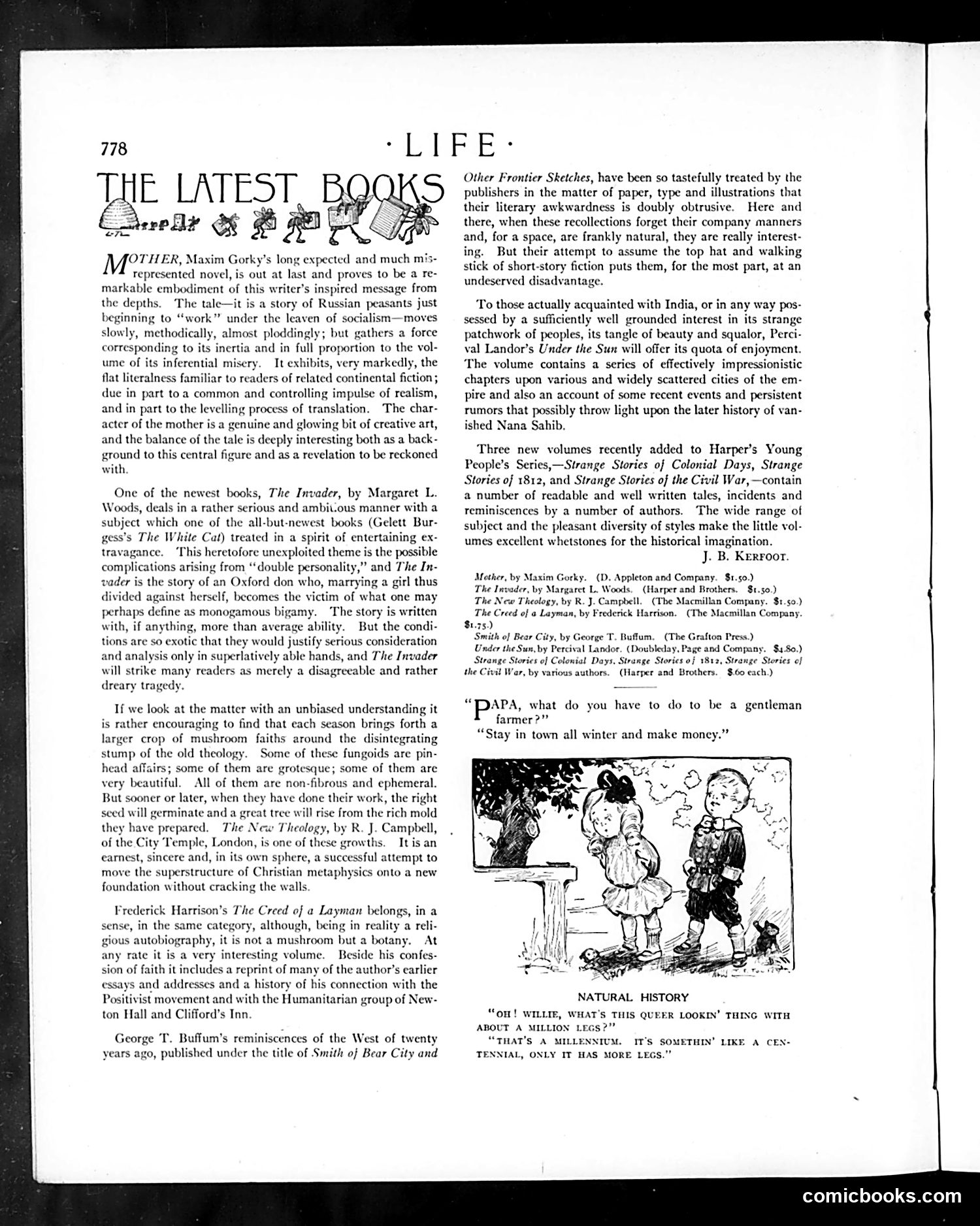
This is a **book review page**, not primarily a political cartoon. The single cartoon shown illustrates a joke about natural history rather than satire. The main content reviews new literary works, notably Maxim Gorky's *Mother*—a novel about Russian peasants under socialism. The reviewer praises its artistic merit while noting its heavy, realistic style. Other books discussed include works exploring "double personality" and various religious philosophy texts (*The New Theology*, *The Creed of a Layman*). The small cartoon captioned "NATURAL HISTORY" depicts two children observing an insect, with dialogue about it having "a million legs" and one child correcting that "it's somethin's like a centennial—only it has more legs." This is simply a children's humor joke playing on the similarity between "centennial" (100 years) and "centipede" (many legs)—likely meant as a palate-cleanser among dense literary criticism. The page reflects early 1900s intellectual culture's engagement with socialist literature and modernist religious philosophy.
📄 Transcribed text from this page (OCR, searchable)
Machine-transcribed from the original scan — historical spelling and the odd misread are preserved.
‘Libs - OTHER, Maxim Gorky’s long expected and much m: represented novel, is out at last and proves to be a re- markable embodiment of this writer’s inspired message from the depths. The tale—it is a story of Russian peasants just beginning to “work” under the leaven of socialism—moves slowly, methodically, almost ploddingly; but gathers a force corresponding to its inertia and in full proportion to the vol- ume of its inferential misery. It exhibits, very markedly, the flat literalness familiar to readers of related continental fiction ; due in part toa common and controlling impulse of realism, and in part to the levelling process of translation. The char- acter of the mother is a genuine and glowing bit of creative art, and the balance of the tale is deeply interesting both as a back- ground to this central figure and as a revelation to be reckoned with, One of the newest books, The Invader, by Margaret L. Woods, deals in a rather serious and ambit.ous manner with a subject which one of the all-but-newest books (Gelett Bur- gess’s The White Cat) treated in a spirit of entertaining ex- travagance. ‘This heretofore unexploited theme is the possible complications arising from ‘double personality,” and The In- vader is the story of an Oxford don who, marrying a girl thus divided against herself, becomes the victim of what one may perhaps define as monogamous bigamy. ‘The story is written with, if anything, more than average ability. But the condi- tions are so exotic that they would justify serious consideration and analysis only in superiatively able hands, and The Invader will strike many readers as merely a disagreeable and rather dreary tragedy. If we look at the matter with an unbiased understanding it is rather encouraging to find that each season brings forth a larger crop of mushroom faiths around the disintegrating stump of the old theology. Some of these fungoids are pin- head affairs; some of them are grotesque; some of them are very beautiful. All of them are non-fibrous and ephemeral. But sooner or later, when they have done their work, the right sced will germinate and a great tree will rise from the rich mold they have prepared, The New Theology, by R. J. Campbell, of the City Temple, London, is one of these growths. It is an earnest, sincere and, in its own sphere, a successful attempt to move the superstructure of Christian metaphysics onto a new foundation without cracking the walls. Frederick Harrison’s The Creed of a Layman belongs, in a sense, in the same category, although, being in reality a reli- gious autobiography, it is not a mushroom but a botany. At any rate it is a very interesting volume. Beside his confes- sion of faith it includes a reprint of many of the author’s earlier essays and addresses and a history of his connection with the Positivist movement and with the Humanitarian group of New- ton Hall and Clifford's Inn. George T. Buffum’s reminiscences of the West of twenty rs ago, published under the title of Smith of Bear City and Other Frontier Sketches, have been so tastefully treated by the publishers in the matter of paper, type and illustrations that their literary awkwardness is doubly obtrusive. Here and there, when these recollections forget their company manners and, for a space, are frankly natural, they are really interest- i But their attempt to assume the top hat and walking stick of short-story fiction puts them, for the most part, at an undeserved disadvantage. ‘To those actually acquainted with India, or in any way pos- sessed by a sufficiently well grounded interest in its strange patchwork of peoples, its tangle of beauty and squalor, Perci- val Landor’s Under the Sun will offcr its quota of enjoyment. The volume contains a series of effectively impressionistic chapters upon various and widely scattered cities of the em- pire and also an account of some recent events and persistent rumors that possibly throw light upon the later history of van- ished Nana Sahib, Three new volumes recently added to Harper’s Young People’s Series,—Strange Stories of Colonial Days, Strange Stories of 1812, and Strange Stories of the Civil War, —contain a number of readable and well written tales, incidents and reminiscences by a number of authors. The wide range of subject and the pleasant diversity of styles make the little vol- umes excellent whetstones for the historical imagination. J. B. Kerroor. Mether, by Maxim Gorky. (D. Appleton and Company. $1.50.) The Invader, by Margaret L. Woods. (Harper and Brothers. $1.50.) The New Theology, by R. J. Campbell. (The Macmillan Company. $1.50.) The Creed of a Layman, by Frederick Harrison. (The Macmillan Company $1.75.) Smith of Bear City, by George T. Buflum. (The Grafton Press.) Under the Sun, by Percival Landor. (Doubleday, Page and Company. Strange Stories of Colonial Days, Strange Stories 0 1812, Strange St the Civil War, by various authors. (Harper and Brothers. $.60 each.) APA, what do you have to do to be a gentleman farmer?” “Stay in town all winter and make money.” NATURAL HISTORY “OH! WILLIE, WHAT'S THIS QUEER LOOKIN’ THING WITH ABOUT A MILLION LEGS THAT'S A MILLENNIUM. I TENNIAL, ONLY IT HAS MORE SOMETHIN’ LIKE A CEN- comicbooks.com