
Life, 1907-06-06 · page 31 of 56
Life — June 6, 1907 — page 31: what you’re looking at
What you’re looking at
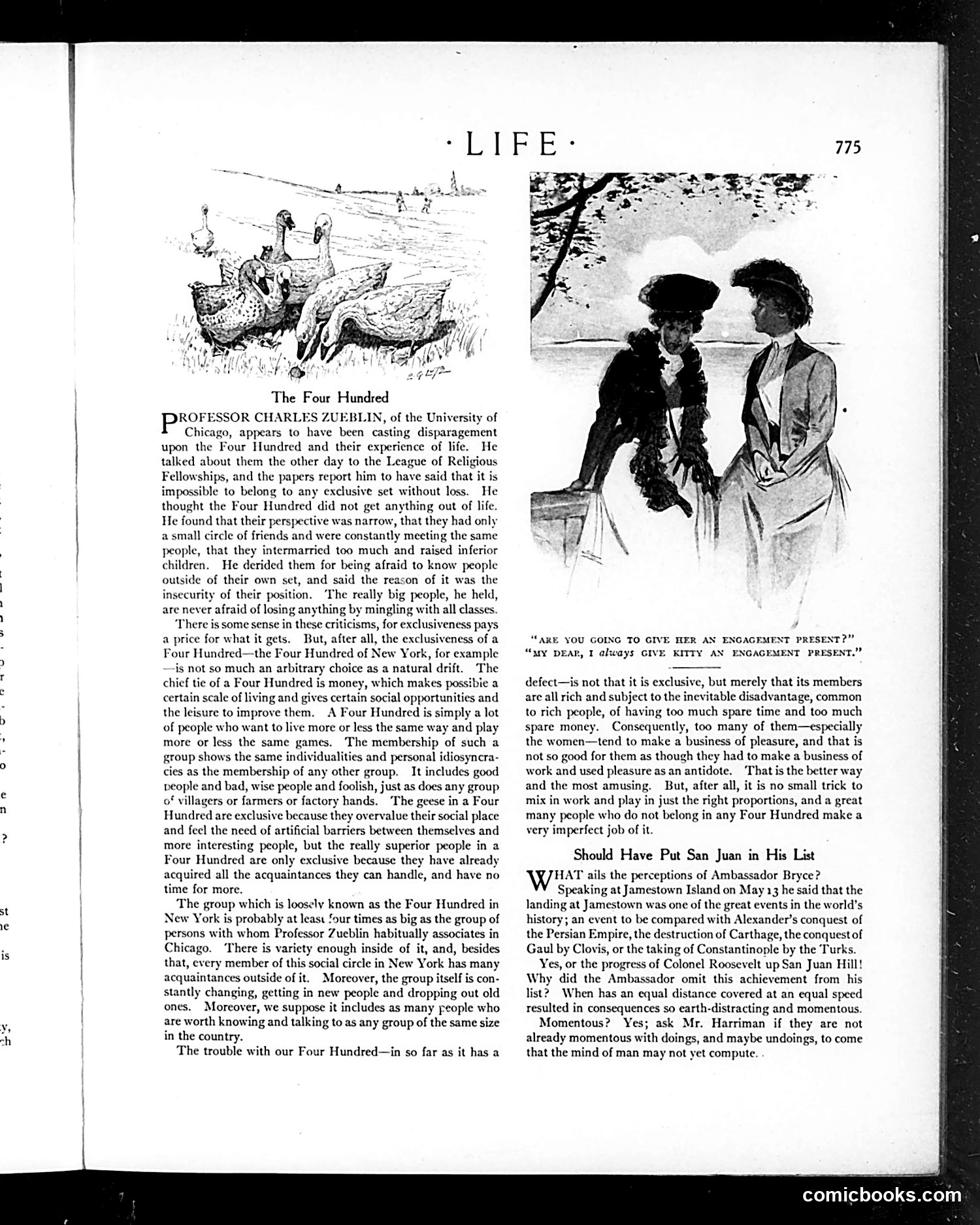
The page defends New York's "Four Hundred"—the city's wealthy elite social circle—against criticism from Professor Charles Zueblin of the University of Chicago, who claimed exclusive social groups were narrow and damaging. The **sketch at top left** depicts members of this exclusive class at leisure, establishing the subject visually. The **photograph on the right** shows two fashionably dressed women in conversation, illustrating the social world under discussion. The caption's joke concerns engagement presents for "Kitty"—the speaker always gives such gifts, suggesting this is a routine expectation within their wealthy social set, highlighting both their material abundance and the ritualized nature of their social obligations. Life's editorial position: the Four Hundred's exclusivity stems naturally from wealth and shared lifestyle, not snobbery. The real weakness is that excess leisure time encourages frivolous behavior, particularly among women. The piece also includes an unrelated section criticizing Ambassador Bryce for omitting San Juan from his historical achievements list.
📄 Transcribed text from this page (OCR, searchable)
Machine-transcribed from the original scan — historical spelling and the odd misread are preserved.
st e ch The Four Hundred ROFESSOR CHARL] JEBLIN, of the University of Chicago, appears to have been casting disparagement upon the Four Hundred and their experience of life. He talked about them the other day to the League of Religious Fellowships, and the papers report him to have said that it is impossible to belong to any exclusive set without loss. He thought the Four Hundred did not get anything out of life. He found that their perspective was narrow, that they had only a small circle of friends and were constantly meeting the same people, that they intermarried too much and raised inferior children, He derided them for being afraid to know people outside of their own set, and said the reason of it was the insecurity of their position. ‘The really big people, he held, are never afraid of losing anythi mingling with all classes. ‘There is some sense in these cri a price for what it gets. But, after all, the exclusiveness of a Four Hundred—the Four Hundred of New York, for example is not so much an arbitrary choice as a natural drift. The chief tie of a Four Hundred is money, which makes possibie a certain scale of living and gives certain social opportunities and the leisure to improve them. A Four Hundred is simply a lot of people who want to live more or less the same way and play more or less the same games. The membership of such a group shows the same individualities and personal idiosyncra- cies as the membership of any other group. It includes good people and bad, wise people and foolish, just as does any group of villagers or farmers or factory hands. The geese in a Four Hundred are exclusive because they overvalue their social place and feel the need of artificial barriers between themselves and more interesting people, but the really superior people in a Four Hundred are only exclusive because they have already acquired all the acquaintances they can handle, and have no time for more. The group which is loosely known as the Four Hundred in New York is probably at least four times as big as the group of persons with whom Professor Zucblin habitually associates in Chicago. ‘There is variety enough inside of it, and, besides that, every member of this social circle in New York has many acquaintances outside of it. Moreover, the group itself is con- stantly changing, getting in new people and dropping out old ones. Moreover, we suppose it includes as many people who are worth knowing and talking to as any group of the same size in the country. The trouble with our Four Hundred—in so far as it has a “ARE YOU GOING TO GIVE HER AN “a0y DEAR, I always GIVE KITTY AN NGAGEMENT PRESENT NGAGEMENT PRESENT.” defect—is not that it is exclusive, but merely that its members. are all rich and subject to the inevitable disadvantage, common to rich people, of having too much spare time and too much spare money. Consequently, too many of them—especially the women—tend to make a business of pleasure, and that is not so good for them as though they had to make a business of work and used pleasure as an antidote. ‘That is the better way and the most amusing. But, after all, it is no small trick to mix in work and play in just the right proportions, and a great many people who do not belong in any Four Hundred make a very imperfect job of it. Should Have Put San Juan in His List HAT ails the perceptions of Ambassador Bryce? Speaking at Jamestown Island on May 13 he said that the landing at Jamestown was one of the great events in the world’s history; an event to be compared with Alexander’s conquest of the Persian Empire, the destruction of Carthage, the conquest of Gaul by Clovis, or the taking of Constantinople by the Turks. Yes, or the progress of Colonel Roosevelt up San Juan Hill! Why did the Ambassador omit this achievement from his list? When has an equal distance covered at an equal speed resulted in consequences so earth-distracting and momentous Momentous? Yes; ask Mr. Harriman if they are not already momentous with doings, and maybe undoings, to come that the mind of man may not yet compute. comicbooks.com