
Life, 1907-06-06 · page 33 of 56
Life — June 6, 1907 — page 33: what you’re looking at
What you’re looking at
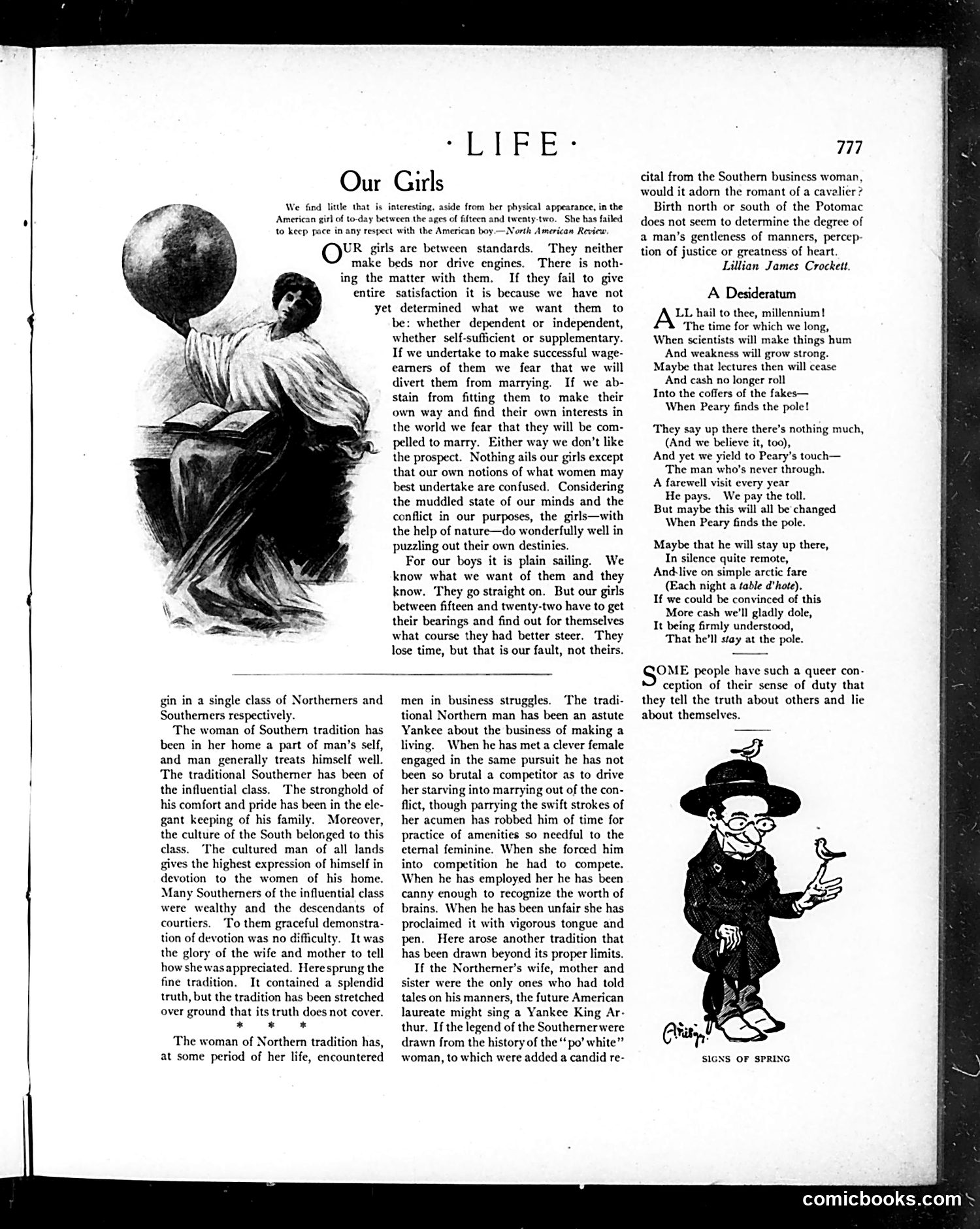
This page presents an editorial essay titled "Our Girls," critiquing American women aged 15-22. The author argues that while American boys have clear societal expectations, girls face confusing, contradictory demands: society won't let them become independent wage-earners (fearing they'll abandon marriage), yet won't prepare them for self-sufficiency (fearing forced marriages). The piece blames society's confusion, not the girls themselves, for their "muddled" circumstances. The essay then contrasts Northern and Southern female traditions: Southern women were sheltered, cherished domestically; Northern women competed in business and spoke bluntly about injustice. The author suggests neither tradition fully applies universally. The accompanying illustration shows a classical female figure holding a globe, symbolizing the scope and weight of women's uncertain position. The page includes an unrelated poem, "A Desideratum," about Arctic exploration, and a small cartoon labeled "Signs of Spring" showing a figure with birds.
📄 Transcribed text from this page (OCR, searchable)
Machine-transcribed from the original scan — historical spelling and the odd misread are preserved.
Our -LIFE-: Girls We find little that is interesting, aside from her physical appearance, in the American girl of to-day between the ages of fifteen and twenty-two. She has failed to keep pace in any respect with the American boy. —North American Revie UR girls are between standards. make beds nor drive engines. There is noth- ing the matter with them. entire satisfaction it is because we have not yet determined what we want them to ‘They neither If they fail to give be: whether dependent or independent, whether self-sufficient or supplementary. If we undertake to make successful wage- earners of them we fear that we will divert them from marrying. If we ab- stain from fitting them to make their own way and find their own interests in the world we fear that they will be com- pelled to marry. Either way we don’t like the prospect. Nothing ails our girls except that our own notions of what women may best undertake are confused, Considering the muddled state of our minds and the conflict in our purposes, the girls—with the help of nature—do wonderfully well in puzzling out their own destinies. For our boys it is plain sailing. We know what we want of them and they know. They go straight on. But our girls between fifteen and twenty-two have to get their bearings and find out for themselves what course they had better steer. They lose time, but that is our fault, not theirs. gin in a single class of Northemers and Southemers respectively. The woman of Southem tradition has been in her home a part of man’s self, and man generally treats himself well. The traditional Southerner has been of the influential class. The stronghold of his comfort and pride has been in the ele- gant keeping of his family. Moreover, the culture of the South belonged to this class. The cultured man of all lands gives the highest expression of himself in devotion to the women of his home. Many Southerners of the influential class were wealthy and the descendants of courtiers. ‘To them graceful demonstra- tion of devotion was no difficulty. It was the glory of the wife and mother to tell how shewasappreciated. Heresprung the fine tradition. It contained a splendid truth, but the tradition has been stretched over ground that its truth does not cover. * me * The woman of Northern tradition has, at some period of her life, encountered men in business struggles. The tradi- tional Northern man has been an astute Yankee about the business of making a living. When he has met a clever female engaged in the same pursuit he has not been so brutal a competitor as to drive her starving into marrying out of the con- flict, though parrying the swift strokes of her acumen has robbed him of time for practice of amenities so needful to the eternal feminine. When she forced him into competition he had to compete. When he has employed her he has been canny enough to recognize the worth of brains. When he has been unfair she has proclaimed it with vigorous tongue and pen. Here arose another tradition that has been drawn beyond its proper limits. If the Northemer’s wife, mother and sister were the only ones who had told tales on his manners, the future American laureate might sing a Yankee King Ar- thur. If the legend of the Southernerwere drawn from the history of the “ po’ white” woman, to which were added a candid re- 777 cital from the Southern business woman, would it adorn the romant of a cavalier? Birth north or south of the Potomac does not seem to determine the degree of a man’s gentleness of manners, percep- tion of justice or greatness of heart. Lillian James Crockett. A Desideratum LL hail to thee, millennium! ‘The time for which we long, When scientists will make things hum And weakness will grow strong. Maybe that lectures then will cease And cash no longer roll Into the coffers of the fakes— When Peary finds the pole! They say up there there’s nothing much, (And we believe it, too), And yet we yield to Peary’s touch— The man who's never through. A farewell visit every year He pays. We pay the toll. But maybe this will all be changed When Peary finds the pole. Maybe that he will stay up there, In silence quite remote, Andlive on simple arctic fare (Each night a table d’hote). If we could be convinced of this More cash we'll gladly dole, It being firmly understood, That he'll stay at the pole. OME people have such a queer con- ception of their sense of duty that they tell the truth about others and lie about themselves. SIGNS OF SPRING comicbooks.com