
Life, 1907-06-06 · page 22 of 56
Life — June 6, 1907 — page 22: what you’re looking at
What you’re looking at
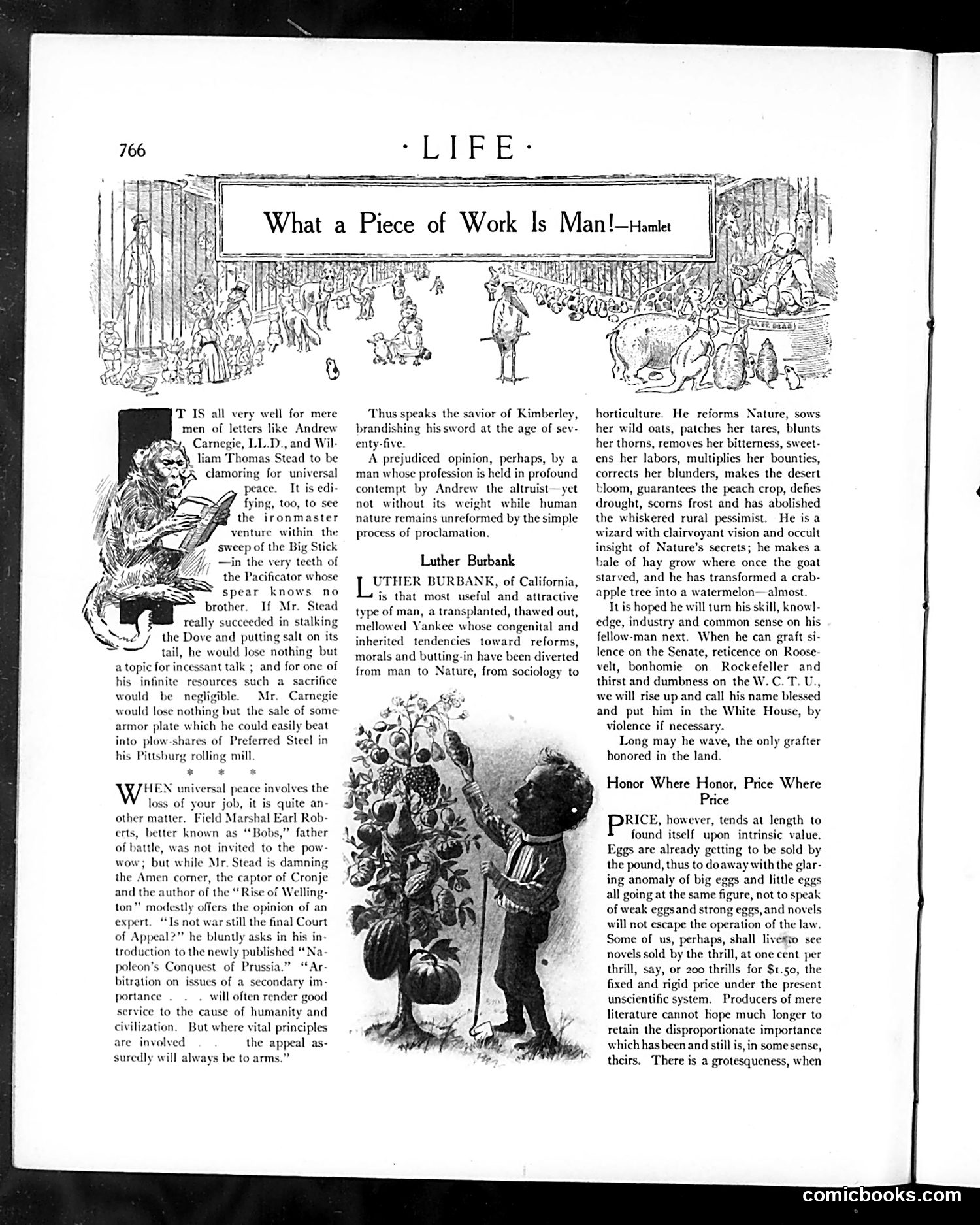
This page satirizes prominent figures of the early 1900s debating peace versus practical necessity. The text contrasts **Andrew Carnegie and William Stead** (pacifist philanthropists) with **Field Marshal Earl Roberts** ("Bobs"), the British military hero. Roberts dismissively counters their universal peace advocacy by asking if war isn't "the final Court of Appeal"—the satire being that advocates like Carnegie, who profited from armor-plate sales, could afford idealism while soldiers and working people bore war's actual costs. The piece then praises **Luther Burbank**, the plant scientist, for redirecting reform impulses from fixing society to improving crops. The satire humorously suggests if Burbank could "graft silence on the Senate, reticence on Roosevelt, [and] bonhomie on Rockefeller," he'd deserve the presidency. Finally, it jokes about pricing novels by "thrill" rather than volume—mocking commercialization of literature. The overall theme: examining human nature and whether idealism or self-interest drives behavior.
📄 Transcribed text from this page (OCR, searchable)
Machine-transcribed from the original scan — historical spelling and the odd misread are preserved.
T IS all very well for mere men of letters like Andrew aS Camegie, LL.D., and Wil- XSe@h_ liam Thomas Stead to be BOA clamoring for universal 7 peace. It is edi- fying, too, to see the ironmaster venture within the sweep of the Big Stick f,, —in the very teeth of the Pacificator whose spear knows no brother. If Mr. Stead really succeeded in stalking ey) the Dove and putting salt on its tail, he would Jose nothing but atopic for incessant talk ; and for one of his infinite resources such a sacrifice would be negligible. Mr. Carnegie would lose nothing but the sale of some armor plate which he could easily beat into plow-shares of Preferred Steel in his Pittsburg rolling mill. * *& # HEN universal peace involves the loss of your job, it is quite an- other matter. Id Marshal Earl Rob- certs, better known “Bobs,” father of battle, was not invited to the pow- wow; but while Mr. Stead is damning the Amen corner, the captor of Cronje and the author of the “Rise of Welling- ton” modestly offers the opinion of an expert. “Is not war still the final Court of Appeal?” he bluntly asks in his in- troduction to the newly published “Na- poleon’s Conquest of Prussia.” ‘Ar- bitration on issues of a secondary im- portance . . . will often render good service to the cause of humanity and civilization. But where vital principles are involved the appeal as- suredly will always be to arms.” Rex i ve CRs ‘Thus speaks the savior of Kimberley, brandishing his sword at the age of sev- enty-five. A prejudiced opinion, perhaps, by a man whose profession is held in profound contempt by Andrew the altruist— yet not without its weight while human nature remains unreformed by the simple process of proclamation. Luther Burbank UTHER BURBANK, of California, is that most useful and attractive type of man, a transplanted, thawed out, mellowed Yankee whose congenital and inherited tendencies toward reforms, morals and butting-in have been diverted from man to Nature, from sociology to horticulture. He reforms Nature, sows her wild oats, patches her tares, blunts her thorns, removes her bitterness, sweet- ens her labors, multiplies her bounties, corrects her blunders, makes the desert bloom, guarantees the peach crop, defies drought, scorns frost and has abolished the whiskered rural pessimist. He is a wizard with clairvoyant vision and occult insight of Nature’s secrets; he makes a bale of hay grow where once the goat starved, and he has transformed a crab- apple tree into a watermelon— almost. Itis hoped he will turn his skill, knowl- edge, industry and common sense on his fellow-man next. When he can graft si- lence on the Senate, reticence on Roose: velt, bonhomie on Rockefeller and thirst and dumbness on the W.C. T. U., we will rise up and call his name blessed and put him in the White House, by violence if necessary. Long may he wave, the only grafter honored in the land. Honor Where Honor, Price Where Price RICE, however, tends at length to found itself upon intrinsic value. Eggs are already getting to be sold by the pound, thus to doaway with the glar- ing anomaly of big eggs and little eggs all going at the same figure, not to speak of weak eggsand strong eggs, and novels will not escape the operation of the law, Some of us, perhaps, shall livesto see novels sold by the thrill, at one cent per thrill, say, or 200 thrills for $1.50, the fixed and rigid price under the present unscientific system. Producers of mere literature cannot hope much longer to retain the disproportionate importance which hasbeen and still is, in some sense, theirs. There is a grotesqueness, when comicbooks.com