
Life, 1907-06-06 · page 25 of 56
Life — June 6, 1907 — page 25: what you’re looking at
What you’re looking at
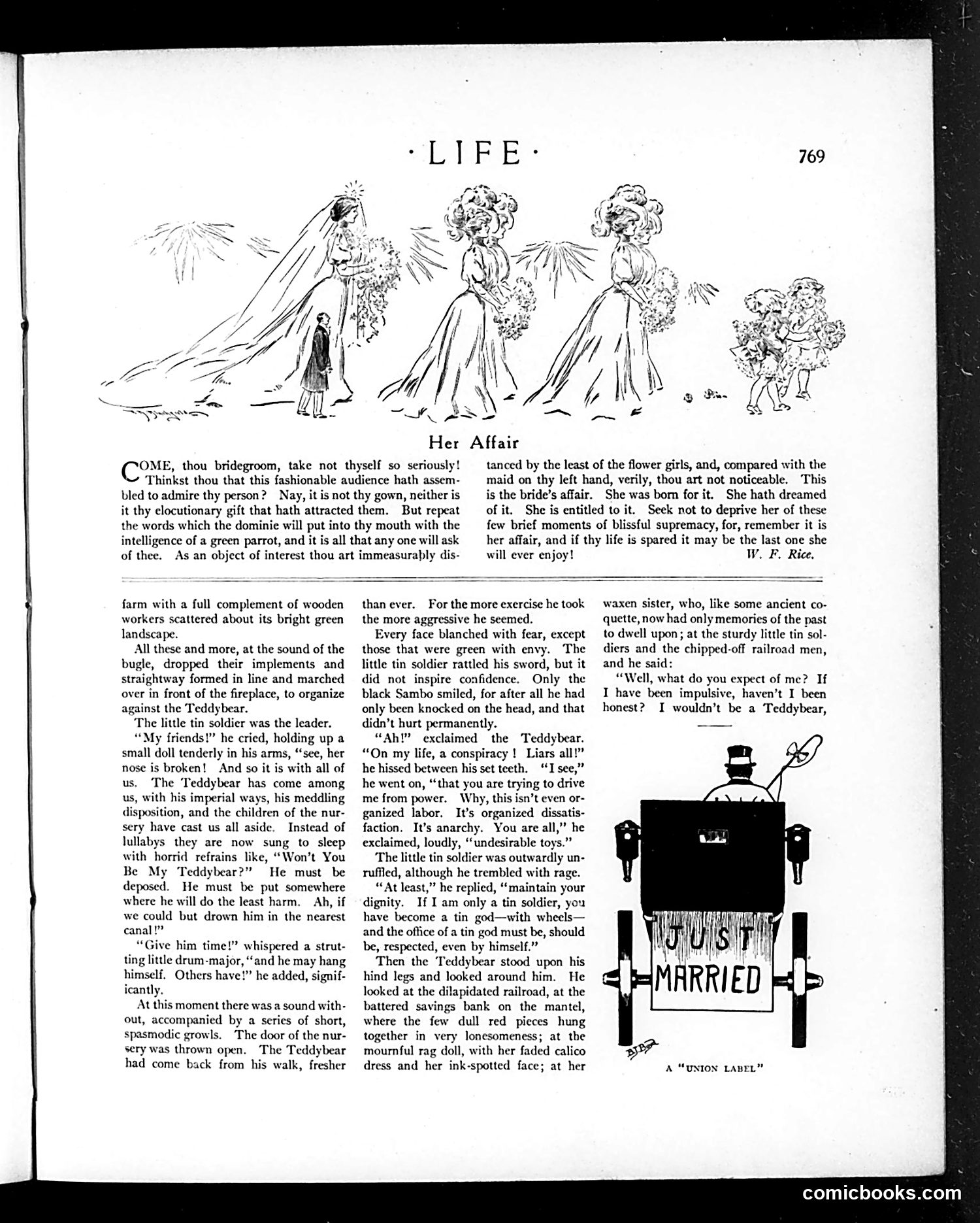
This page contains two distinct pieces. The top section, "Her Affair" by W.F. Rice, is a humorous essay advising bridegrooms not to take themselves seriously at weddings—the bride is the center of attention, and that's as it should be. The longer narrative below is a satirical allegory using nursery toys as political figures. A tin soldier leads other toys in conspiracy against an aggressive, newly-arrived Teddybear who has displaced them from favor. The Teddybear defends itself as honest and energetic, dismissing the rebellion as "organized dissatisfaction" and "anarchy," while declaring itself a "tin god" deserving respect. The satire appears to reference labor unrest and class conflict—note the tin soldier's reference to "organized labor" and the Teddybear's dismissal of the uprising as "undesirable." The toys represent different social classes or political factions competing for power and children's (public) favor. The exact historical moment remains unclear without a date, though the mention of Teddybears and "Union Label" suggests early 20th-century American politics.
📄 Transcribed text from this page (OCR, searchable)
Machine-transcribed from the original scan — historical spelling and the odd misread are preserved.
SSRs Her Affair OME, thou bridegroom, take not thyself so seriously! Thinkst thou that this fashionable audience hath assem- bled to admire thy person? Nay, it is not thy gown, neither is it thy elocutionary gift that hath attracted them. But repeat the words which the dominie will put into thy mouth with the intelligence of a green parrot, and it is all that any one will ask tanced by the least of the flower girls, and, compared with the maid on thy left hand, verily, thou art not noticeable. This is the bride’s affair. She was bor for it. She hath dreamed of it. She is entitled to it. Seek not to deprive her of these few brief moments of blissful supremacy, for, remember it is her affair, and if thy life is spared it may be the last one she of thee. farm with a full complement of wooden workers scattered about its bright green landscape. All these and more, at the sound of the bugle, dropped their implements and straightway formed in line and marched over in front of the fireplace, to organize against the Teddybear. The little tin soldier was the leader. “My friends!” he cried, holding up a small doll tenderly in his arms, “see, her nose is broken! And so it is with all of us, The Teddybear has come among us, with his imperial ways, his meddling disposition, and the children of the nur- sery have cast us all aside. Instead of lullabys they are now sung to sleep with horrid refrains like, “Won’t You Be My Teddybear?” He must be deposed. He must be put somewhere where he will do the least harm. Ah, if we could but drown him in the nearest canal!” “Give him time!” whispered a strut- ting little drum-major, ‘and he may hang himself. Others have!” he added, signif- icantly. At this moment there was a sound with- out, accompanied by a series of short, spasmodic growls. The door of the nur- sery was thrown open. The Teddybear had come back from his walk, fresher As an object of interest thou art immeasurably dis- will ever enjoy! W. F. Rice. than ever. For the more exercise he took the more aggressive he seemed. Every face blanched with fear, except those that were green with envy. The little tin soldier rattled his sword, but it did not inspire confidence. Only the black Sambo smiled, for after all he had only been knocked on the head, and that didn’t hurt permanently. “Ah!” exclaimed the Teddybear. “On my life, a conspiracy ! Liars all!” he hissed between his set teeth. ‘I see,” he went on, “that you are trying to drive me from power. Why, this isn’t even or- ganized labor. It’s organized dissatis- faction. It’s anarchy. You are all,” he exclaimed, loudly, “‘undesirable toys.” The little tin soldier was outwardly un- ruffled, although he trembled with rage. “At least,” he replied, “maintain your If I am only a tin soldier, you come a tin god—with wheels— and the office of a tin god must be, should be, respected, even by himself.” Then the ‘Teddybear stood upon his hind legs and looked around him. He looked at the dilapidated railroad, at the battered savings bank on the mantel, where the few dull red pieces hung together in very lonesomeness; at the mournful rag doll, with her faded calico dress and her ink-spotted face; at her waxen sister, who, like some ancient co- quette, now had only memories of the past to dwell upon; at the sturdy little tin sol- diers and the chipped-off railroad men, and he said: “Well, what do you expect of me? If I have been impulsive, haven’t I been honest? I wouldn’t be a Teddybear, A “UNION LABEL” comicbooks.com