A complete issue · 36 pages · 1922
Judge — March 25, 1922
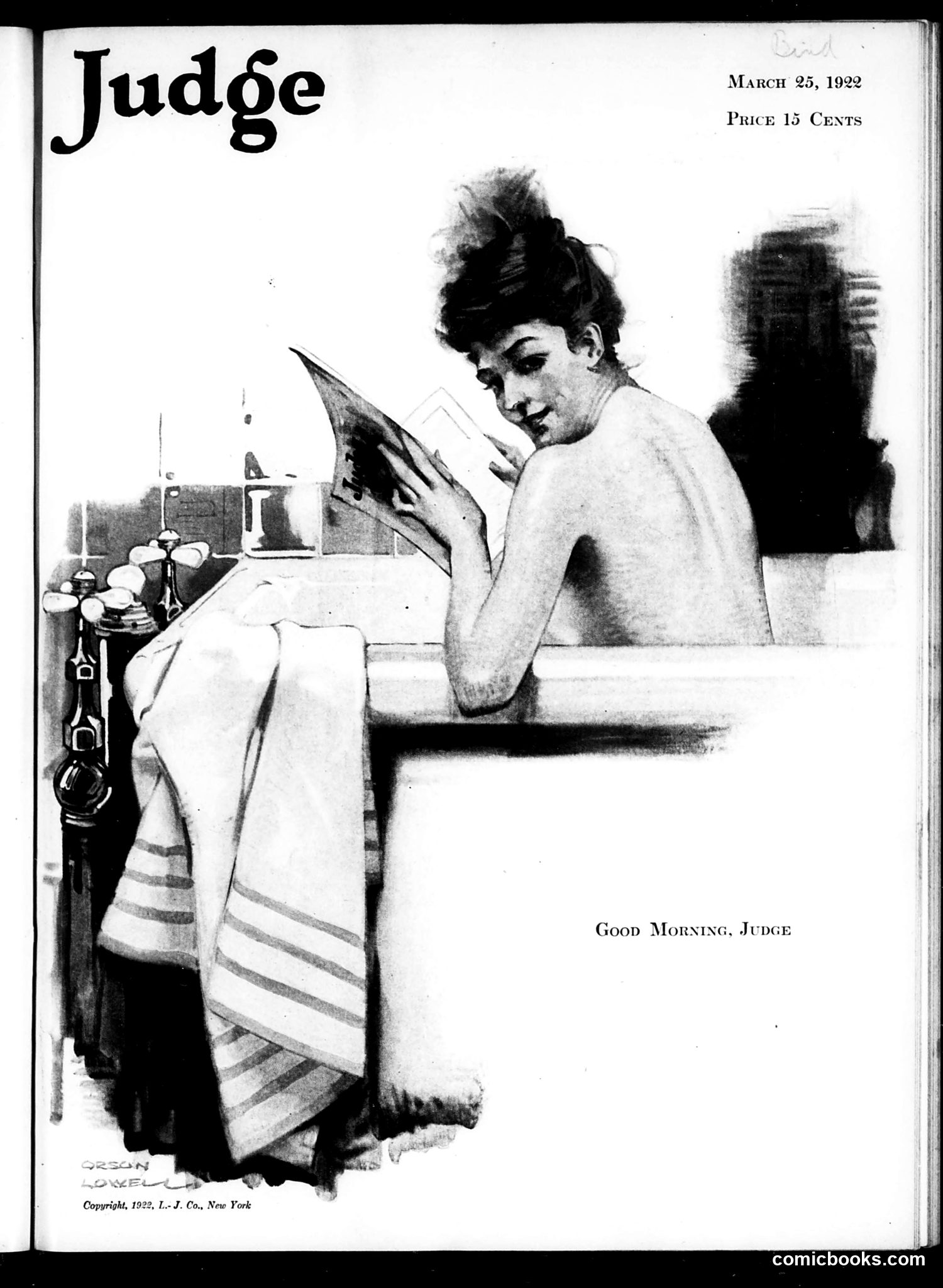
This cover illustration titled "Good Morning, Judge" depicts a woman in a bathrobe reading the Judge magazine itself. The image is a straightforward piece of self-promotional humor—the magazine is literally shown as morning reading material for an attractive woman starting her day. The illustration appears to be generic lifestyle content rather than political satire. It's an advertisement for the magazine's appeal to readers, suggesting that Judge provides entertaining morning reading. The artist's signature indicates this is professional commercial artwork typical of the magazine's cover design during this era. No specific political figures or current events appear referenced on this particular page.
This page is **advertising copy** for *Leslie's Weekly*, a rival publication to *Judge*. The title uses a colloquial phrase meaning "the real truth" or "the hidden advantage." The advertisement presents reader testimonials from across the United States praising *Leslie's Weekly* for its varied content—Investment and Automobile Departments, illustrated articles, picture pages, and editorials. Readers describe it as "refreshing," "informative," "instructive," "diverting," and "interesting." The piece concludes that *Leslie's* success stems from readers genuinely liking and enjoying the publication—positioning readership as voluntary enthusiasm rather than habit. The closing "Join the army NOW!" adopts military language common to 1910s-era magazine promotions. This is essentially competitor advertising rather than satirical editorial content.
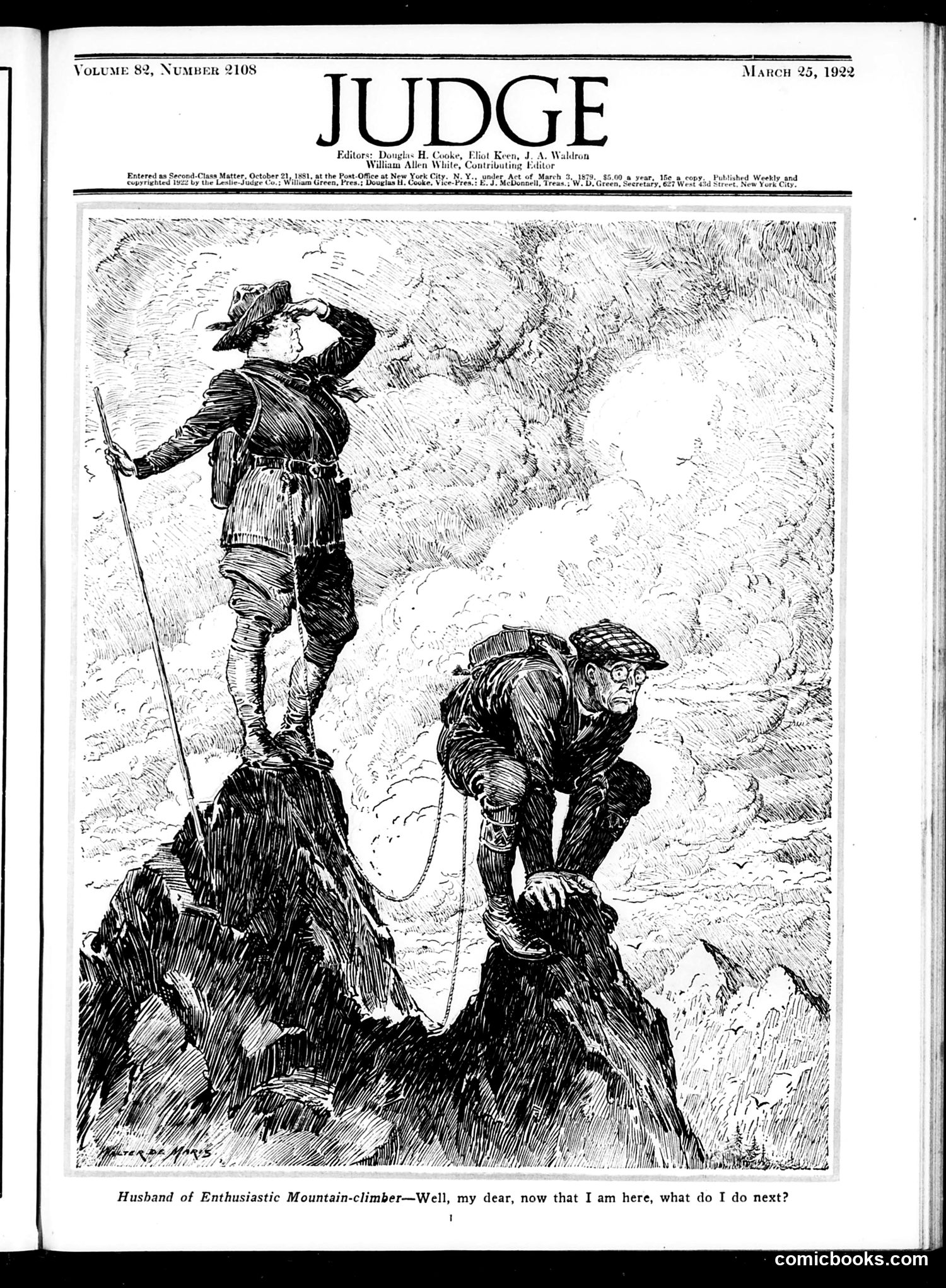
This 1922 *Judge* cartoon satirizes the challenges of marriage to an adventure-obsessed woman. The illustration shows a husband standing atop a rocky mountain peak, shielding his eyes to scout ahead, while his wife (depicted as more athletic/masculine-looking) crouches below, secured by a rope. The caption—"Well, my dear, now that I am here, what do I do next?"—humorously suggests the husband has been dragged along on a mountain-climbing expedition despite lacking enthusiasm or expertise. The satire targets changing gender roles of the 1920s, when women's increased independence and athletic pursuits sometimes clashed with traditional spousal expectations. The joke implies the wife's passion has inadvertently stranded them both in an awkward, dangerous situation.
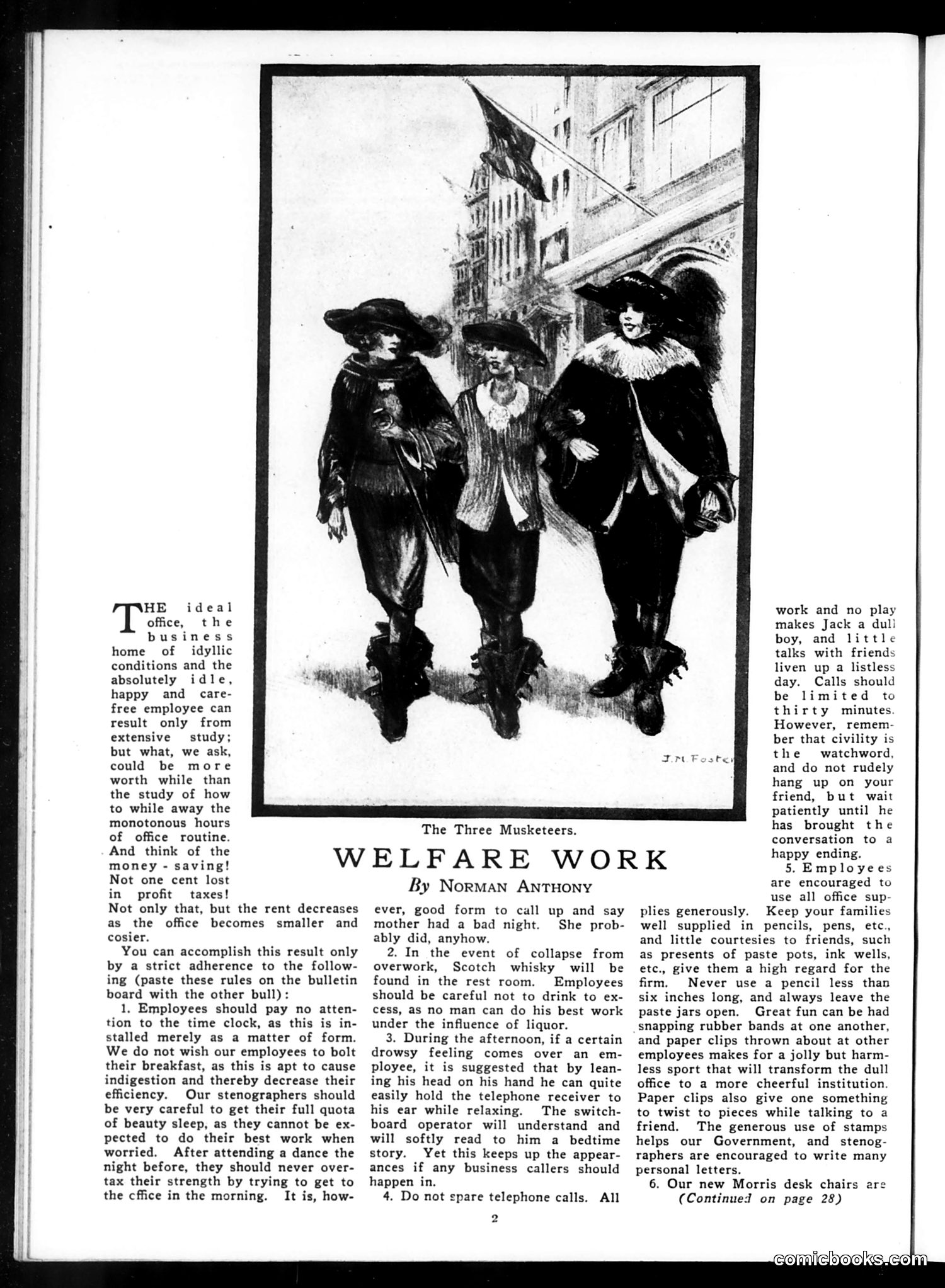
This page contains an illustration titled "The Three Musketeers" by Jim Foster, accompanying an article on "Welfare Work" by Norman Anthony. The cartoon depicts three well-dressed men in period costume walking together on a city street. The accompanying text offers satirical advice on office management and employee welfare, presenting tongue-in-cheek "rules" for treating workers—such as limiting telephone calls to thirty minutes and providing office supplies generously. The satire suggests that while companies promoted "welfare work" as progressive management, the actual implementation often amounted to modest gestures masking continued workplace constraints. The "Three Musketeers" reference appears ironic, contrasting the camaraderie of that literary ideal with the actual employer-employee relationship.
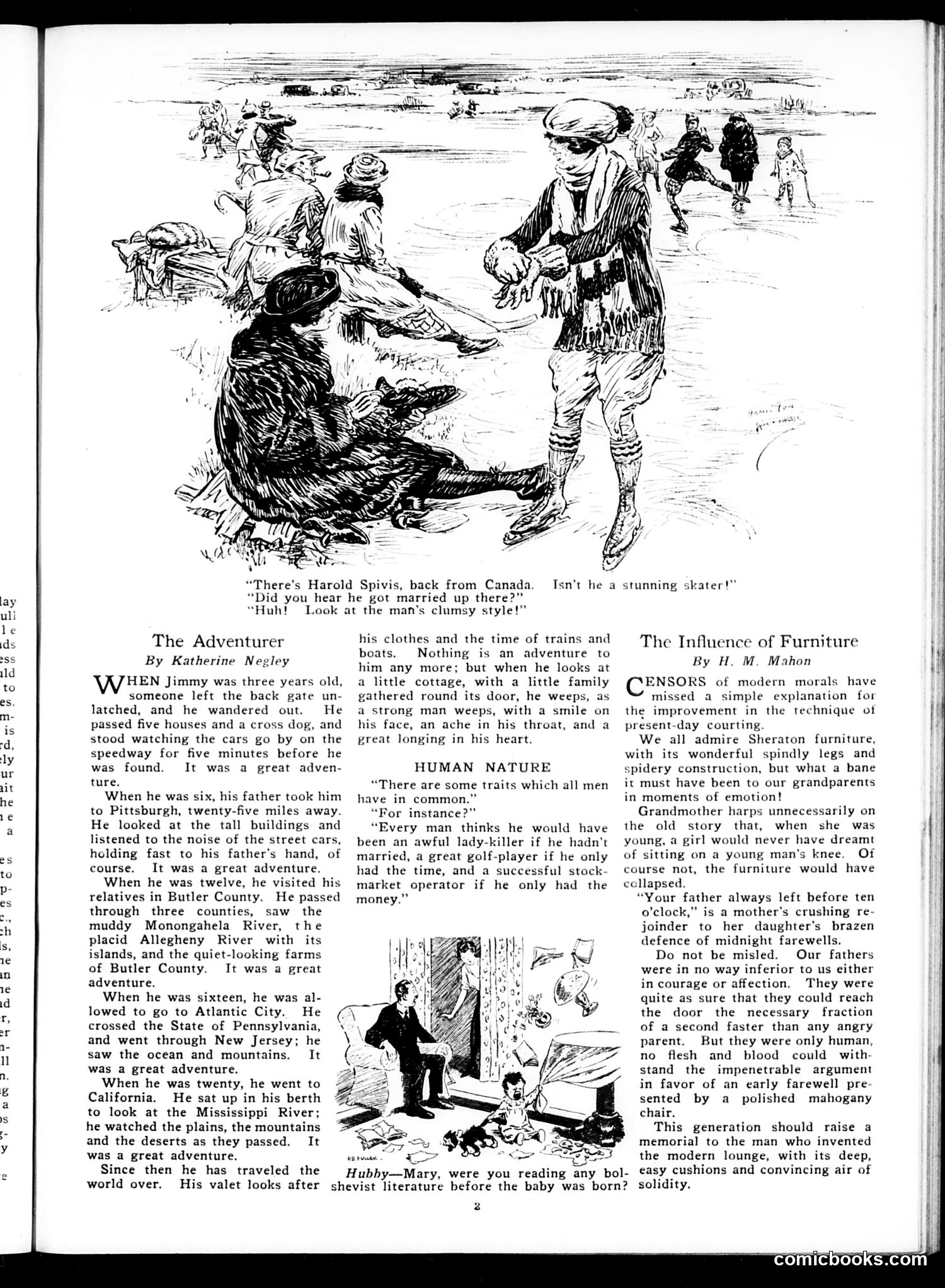
The top cartoon depicts an ice-skating scene with the caption about "Harold Snivis back from Canada" and comments on his marriage and skating ability. The humor appears to reference a specific contemporary figure (Harold Snivis—identity unclear to modern readers) who married in Canada and is being mocked for clumsy skating despite his travels. The page primarily contains three articles: "The Adventurer" by Katherine Metley (a whimsical story about youthful wanderlust), "Human Nature" (discussing universal male traits), and "The Influence of Furniture in a Salon" (critiquing modern furniture design and lamenting Victorian craftsmanship). The lower illustration shows a domestic scene with a child and furniture. The content suggests this is a lifestyle/humor magazine page mixing social commentary with gentle domestic satire, typical of Judge's early 20th-century editorial approach.
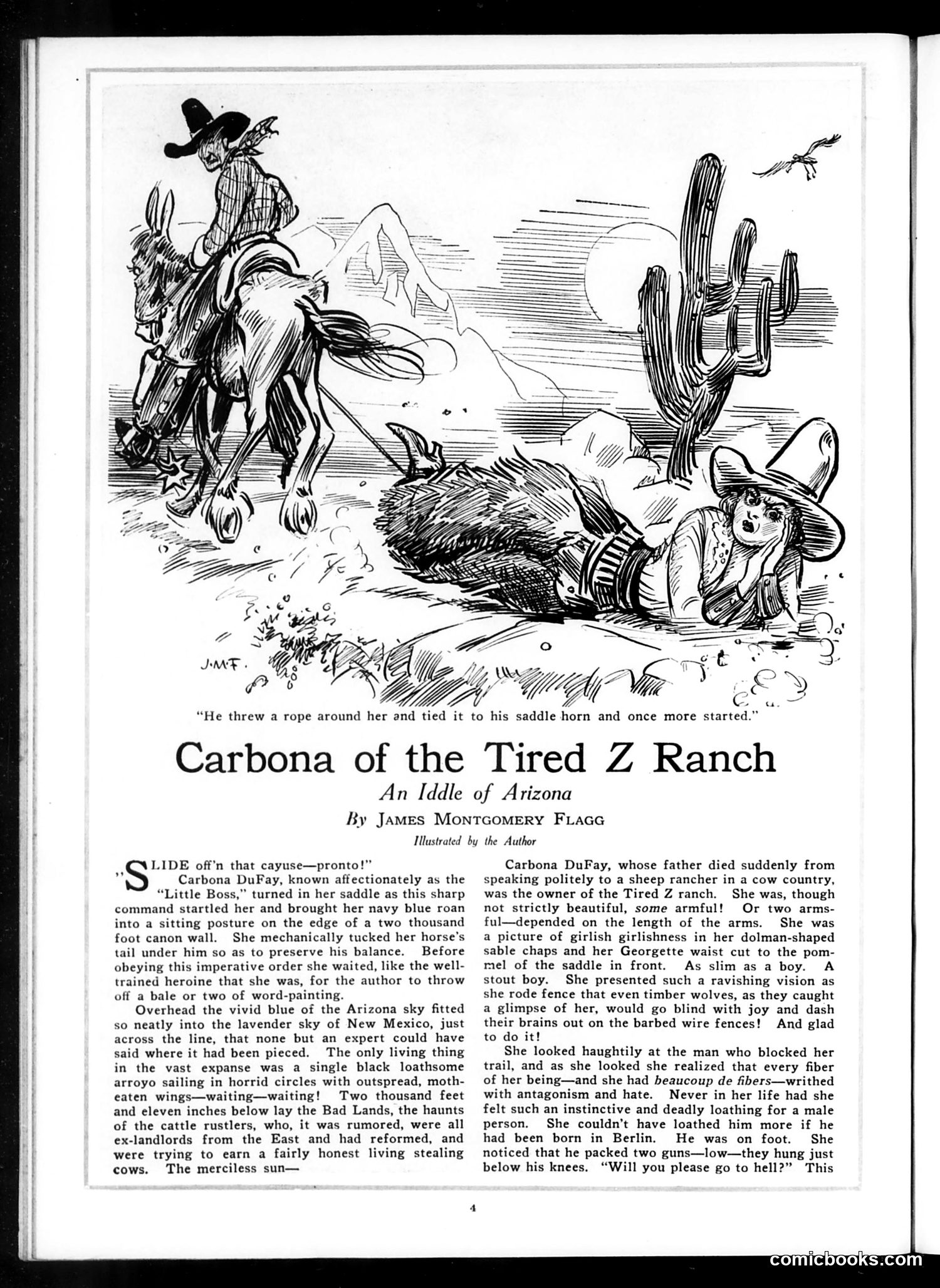
This page is **not a political cartoon or satire**. It's the opening of a Western fiction story titled "Carbona of the Tired Z Ranch: An Iddle of Arizona" by James Montgomery Flagg, illustrated by the author. The narrative illustration depicts a cowboy on horseback discovering a woman (Carbona) lying on the desert ground near a saguaro cactus. The accompanying text introduces Carbona as an orphaned, independent young woman living at the Tired Z ranch in Arizona, and describes a man blocking her trail—setting up a conflict or dramatic encounter. This is straightforward adventure fiction rather than political commentary or social satire.
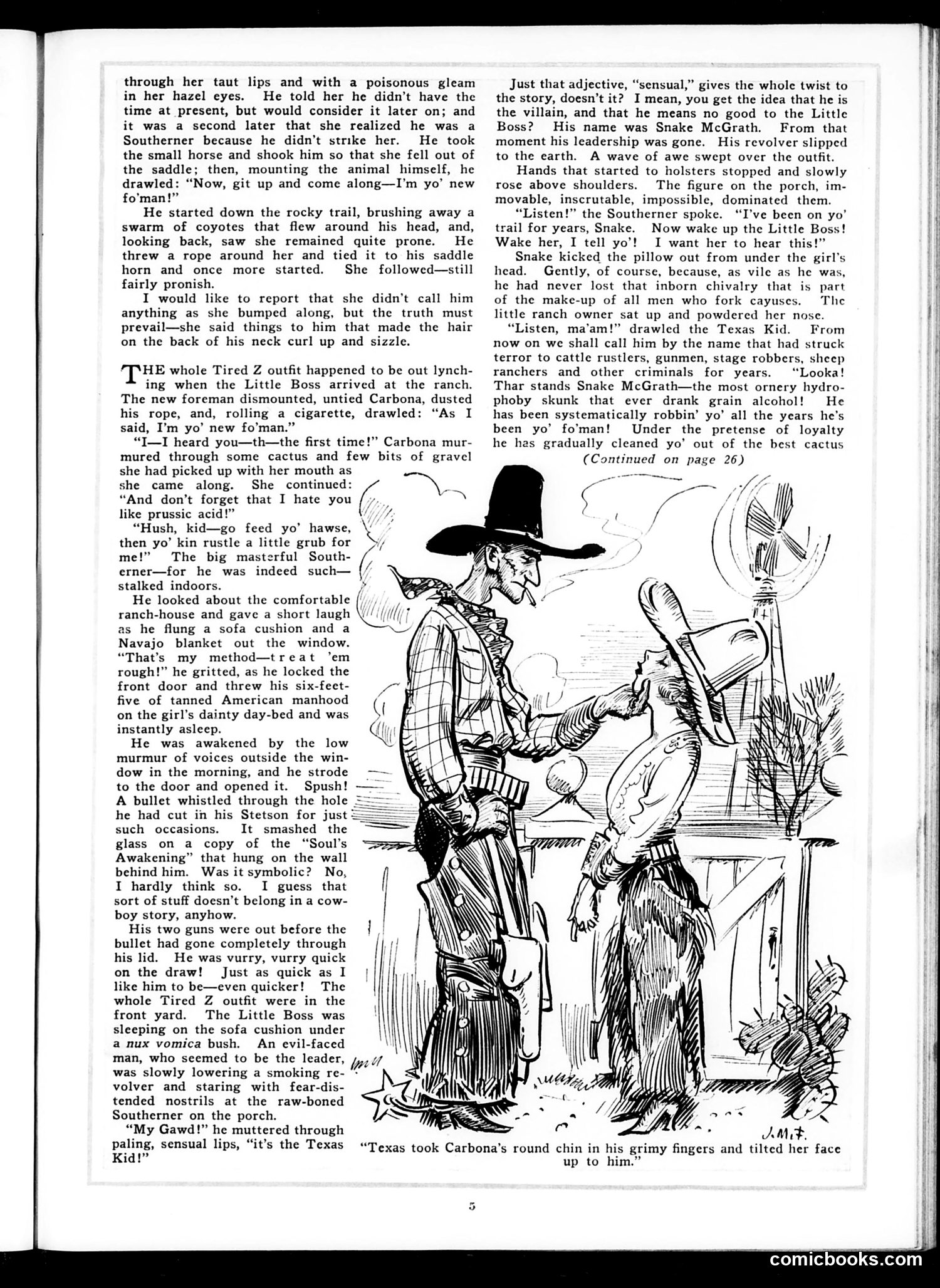
This page satirizes **Western pulp fiction conventions** through exaggerated parody. The story features stereotypical characters: a rough, domineering "Texas Kid" Southerner who rescues the "Little Boss" (a woman) from villainous rustlers led by the evil "Snake McGrath." The satire targets the genre's overwrought melodrama and clichés—the "sensual lips" of villains, the impossibly heroic gunslinger, contrived plot devices (the bullet through his hat), and purple prose ("inscrutable, impossible, dominated them"). The narrator explicitly mocks narrative conventions, as when noting the symbolic bullet hole "doesn't belong in a cowboy story, anyhow." The illustration shows the Southerner confronting the rustlers after the dramatic reveal of his identity terrifies them. Judge's mockery suggests contemporary readers found such Western stories laughably predictable and overwrought.
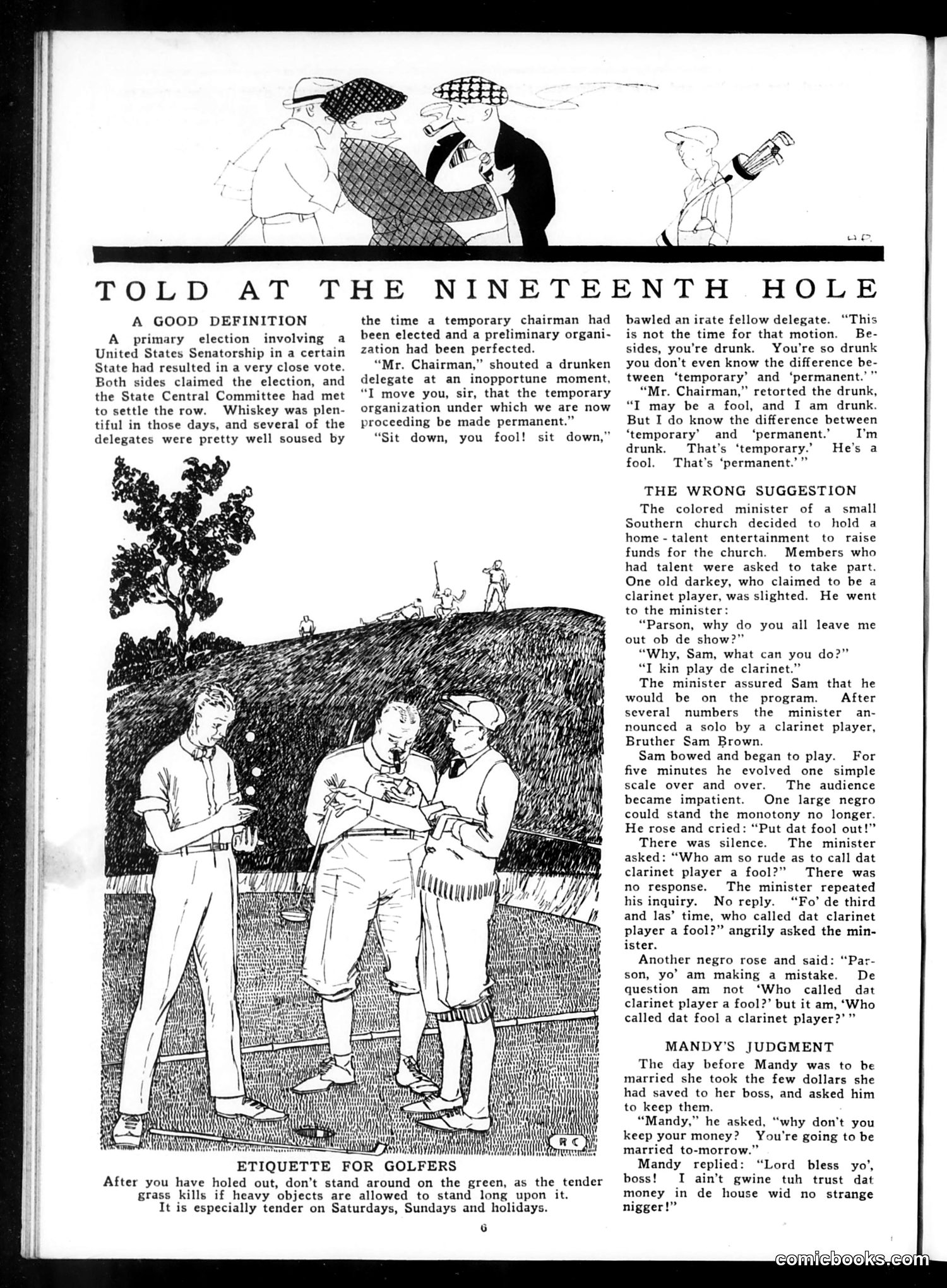
This page from *Judge* magazine contains three separate humorous anecdotes positioned as casual stories told among golfers (hence "nineteenth hole"—the bar at golf clubs). **"A Good Definition"** satirizes political corruption during the primary election era. A drunken delegate at a state party meeting confuses "temporary" and "permanent" organization, prompting his colleague to mock him—only for the drunk to cleverly retort that his intoxication is merely "temporary," while his rival's foolishness is "permanent." The joke mocks both alcohol-fueled politics and the self-deception of political operatives. **"The Wrong Suggestion"** and **"Mandy's Judgment"** employ racist caricatures and dialect stereotyping common to early 20th-century American humor magazines. These feature Black characters in servile or dependent positions, using exaggerated language for comedic effect. The page reflects *Judge's* era: political satire mixed with entertainment humor that relied heavily on ethnic and racial stereotyping accepted (though controversial even then) in mainstream publications.
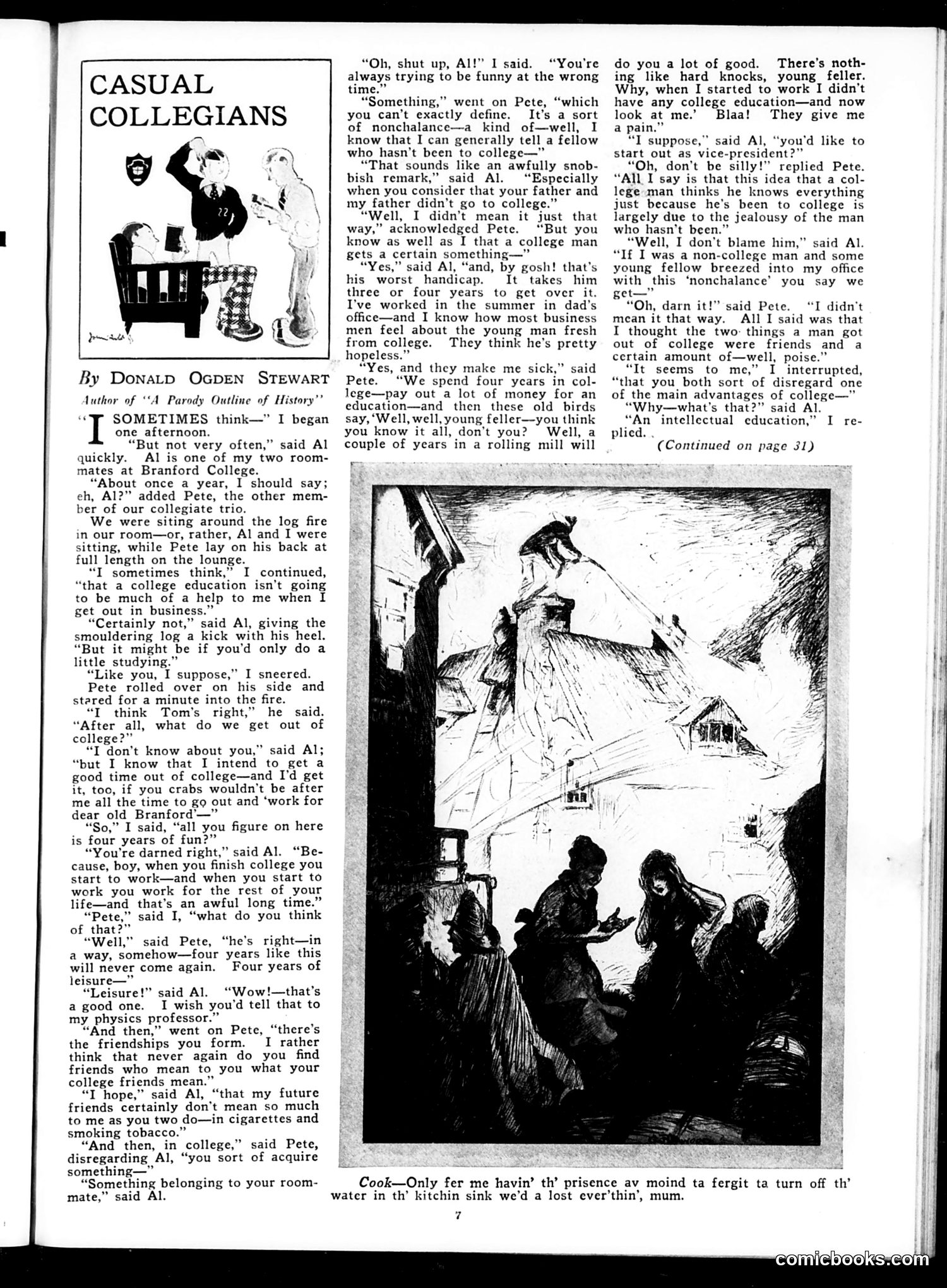
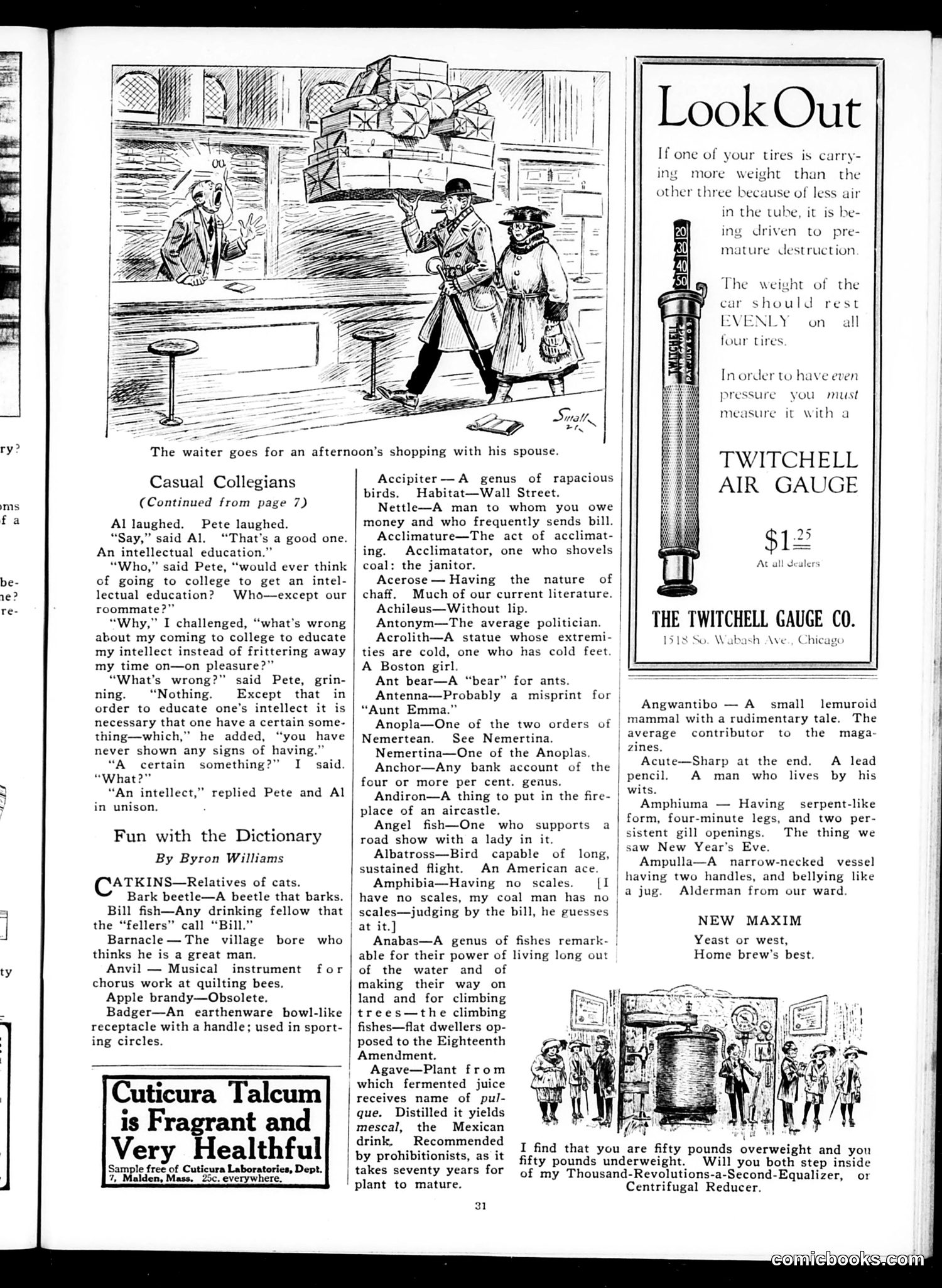
This is a humorous short story satirizing college students and their self-important attitudes. Three roommates at Branford College debate what college actually offers. The story mocks several period attitudes: **The targets of satire:** - College students' pretension about acquiring undefined "nonchalance" and superiority - Business owners who dismiss college graduates as arrogant know-it-alls - The contradiction between college's promise and its actual utility - Students viewing college primarily as leisure rather than education **The joke's premise:** The characters ironically acknowledge that college supposedly grants intangible sophistication, yet employers resent this attitude. Al cynically views college as four years of fun before lifelong work; Pete romanticizes college friendships while also recognizing the snobbery involved. The illustration shows figures in period dress, likely depicting the casual dorm scene described. The satire reflects 1920s anxiety about higher education's actual value and the generational clash between college-educated youth and skeptical business elders.
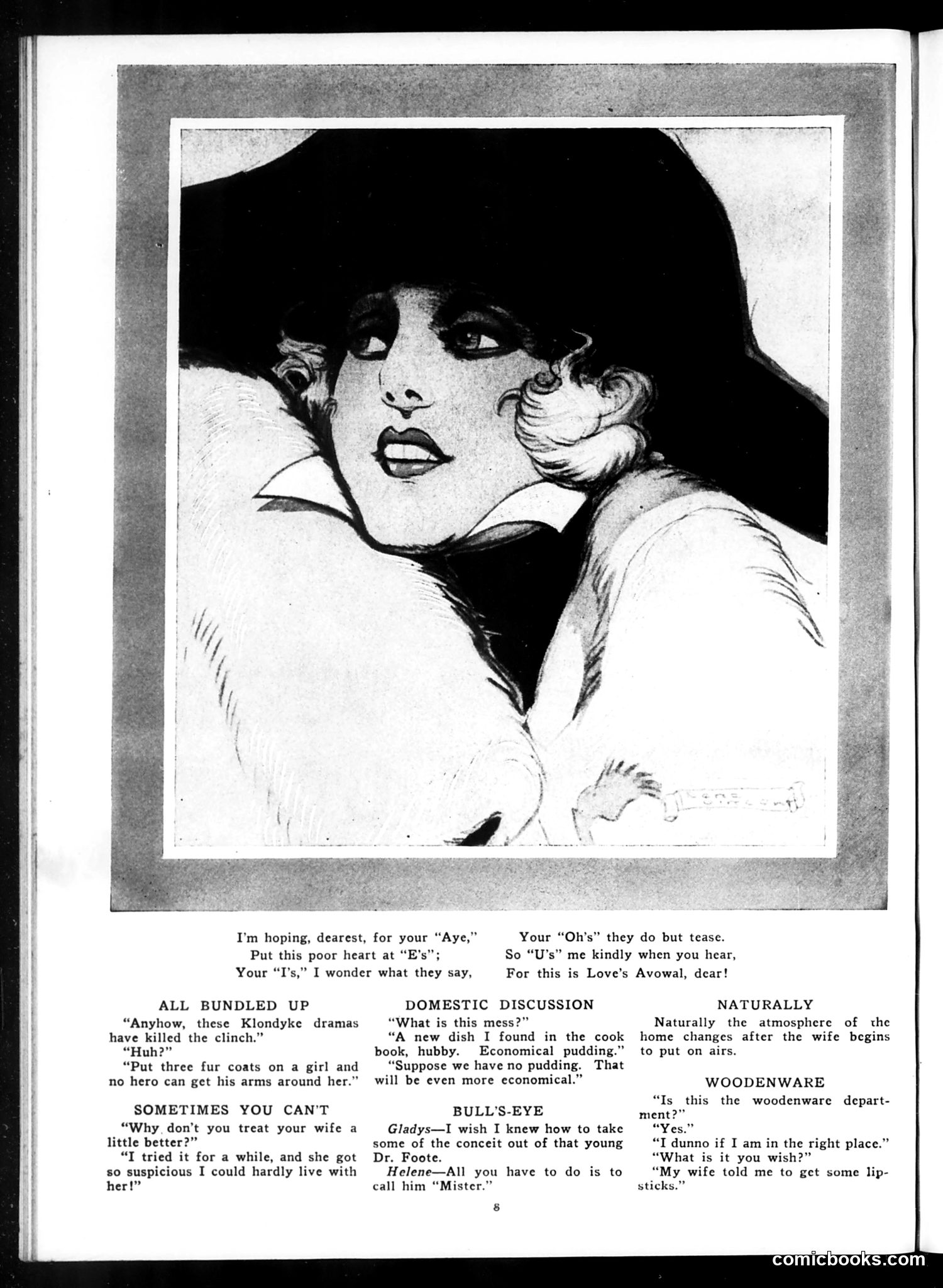
This page from *Judge* contains multiple brief satirical vignettes on marriage and domestic life, typical of early 20th-century humor magazines. **"All Bundled Up"** mocks the Klondike gold rush craze by joking that excessive winter clothing defeats romantic advances—a topical reference to the 1890s Klondike stampede. **"Sometimes You Can't"** presents a marital paradox: a husband's attempt at kindness backfires when his wife grows suspicious, satirizing the impossibility of pleasing a spouse. **"Domestic Discussion"** ridicules both wives' cookbook experiments and husbands' miserly penny-pinching, a standard marital complaint. **"Bull's-Eye"** uses the pun of calling a conceited doctor "Mister" (rather than "Doctor") as a deflating insult. **"Woodenware"** concludes with a wordplay joke conflating "woodenware" with "wooden ware" (stupid merchandise), implying wives are foolish shoppers. The page's dominant image appears to be decorative or thematic rather than illustrating specific content. Overall, the humor targets both spouses' perceived failings in traditional marriage.
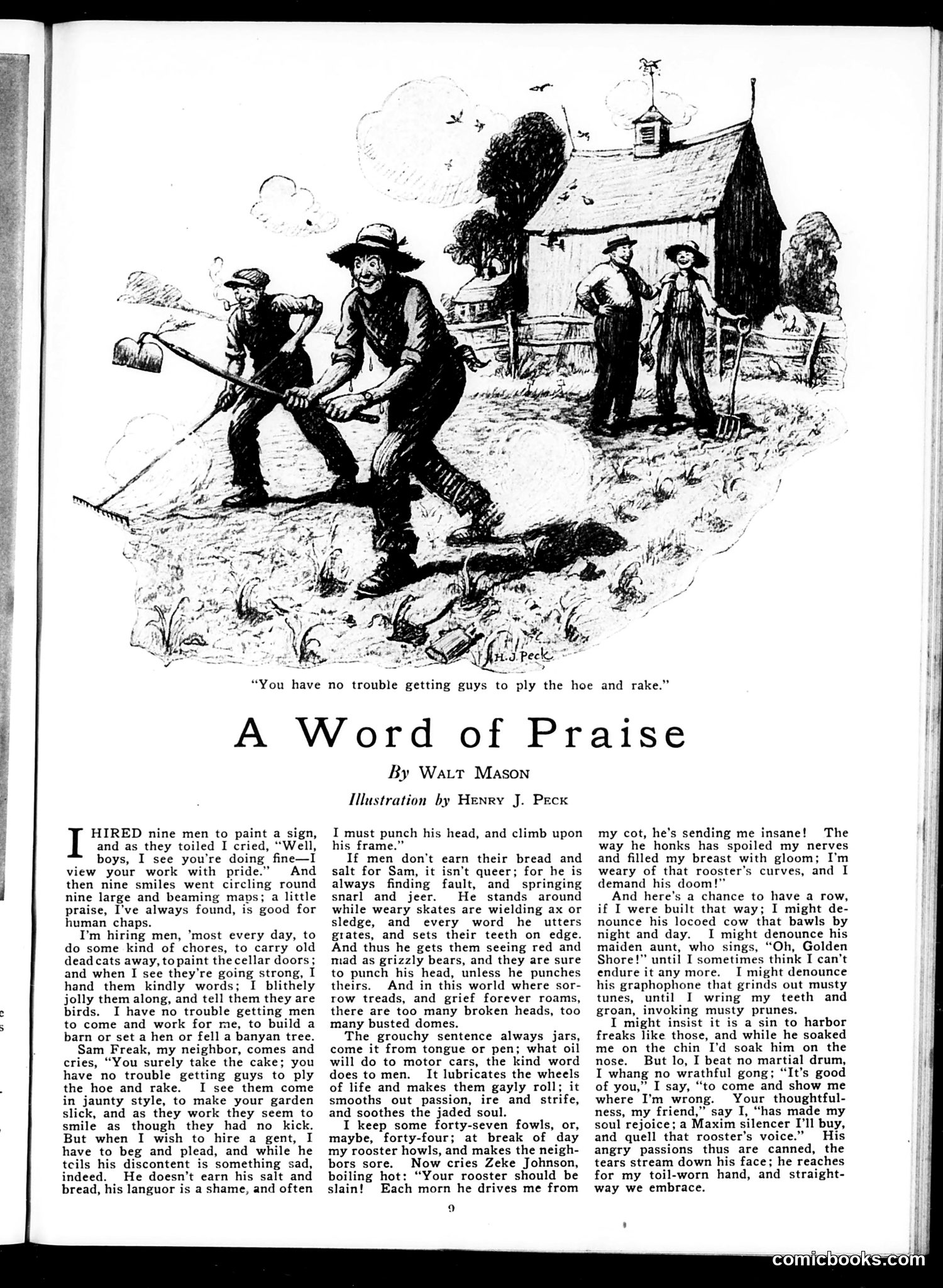
This is a morality tale about workplace management and human nature, not political satire. The narrator contrasts two approaches to hiring workers: The narrator praises his employees generously, calling them "birds" and complimenting their work. They arrive "in jaunty style" and work happily. His neighbor Sam, by contrast, constantly criticizes and finds fault with workers, causing them to become angry and defensive—leading to fistfights. Mason's point: **kindness and encouragement motivate better work than criticism and complaints.** He illustrates this with a final anecdote about his annoying rooster. Rather than insulting his neighbor Zeke's livestock and property, the narrator praises Zeke's thoughtfulness, which dissolves tensions and transforms potential conflict into friendship. The message is straightforward labor advice for a modern audience: positive reinforcement works better than negativity. There's no hidden political reference—just practical wisdom about human psychology wrapped in homey, vernacular verse.
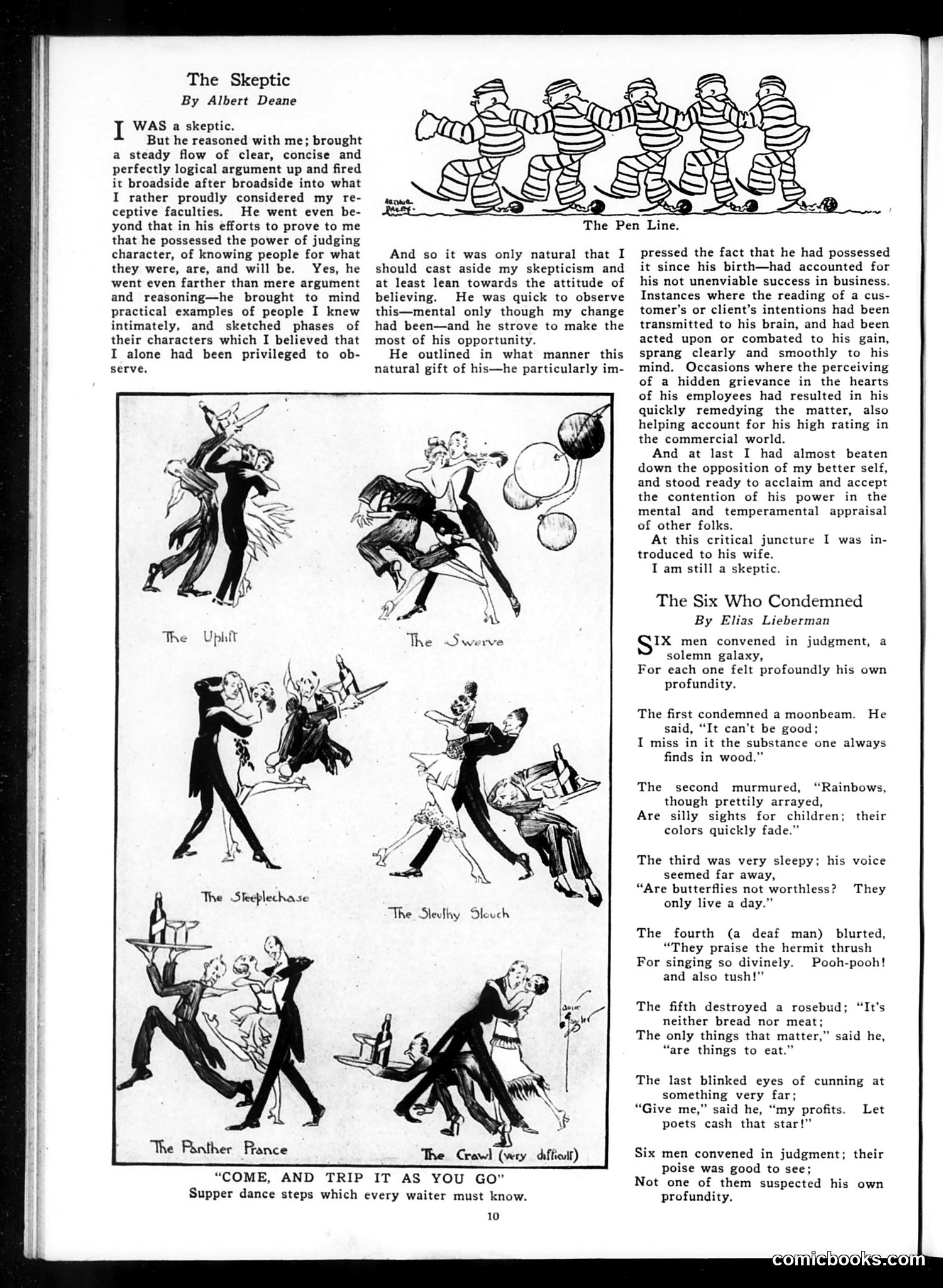
**"The Skeptic"** satirizes gullible belief in character-reading expertise. A persuasive man claims an innate gift for judging people, using business success as proof. The narrator almost capitulates—until meeting the man's wife, whose existence contradicts his claimed perceptiveness. The joke: someone truly skilled at reading character would surely understand his own spouse, yet apparently doesn't. **"The Six Who Condemned"** mocks pompous, self-righteous judgment. Six men condemn natural beauties (moonbeams, rainbows, butterflies, birdsong, rosebuds, stars) as worthless—revealing not the objects' flaws but their own narrow materialism, pretension, and spiritual poverty. The irony: each feels profound while demonstrating complete obliviousness to his own shallowness. Both pieces target human vanity and the danger of confident self-deception.
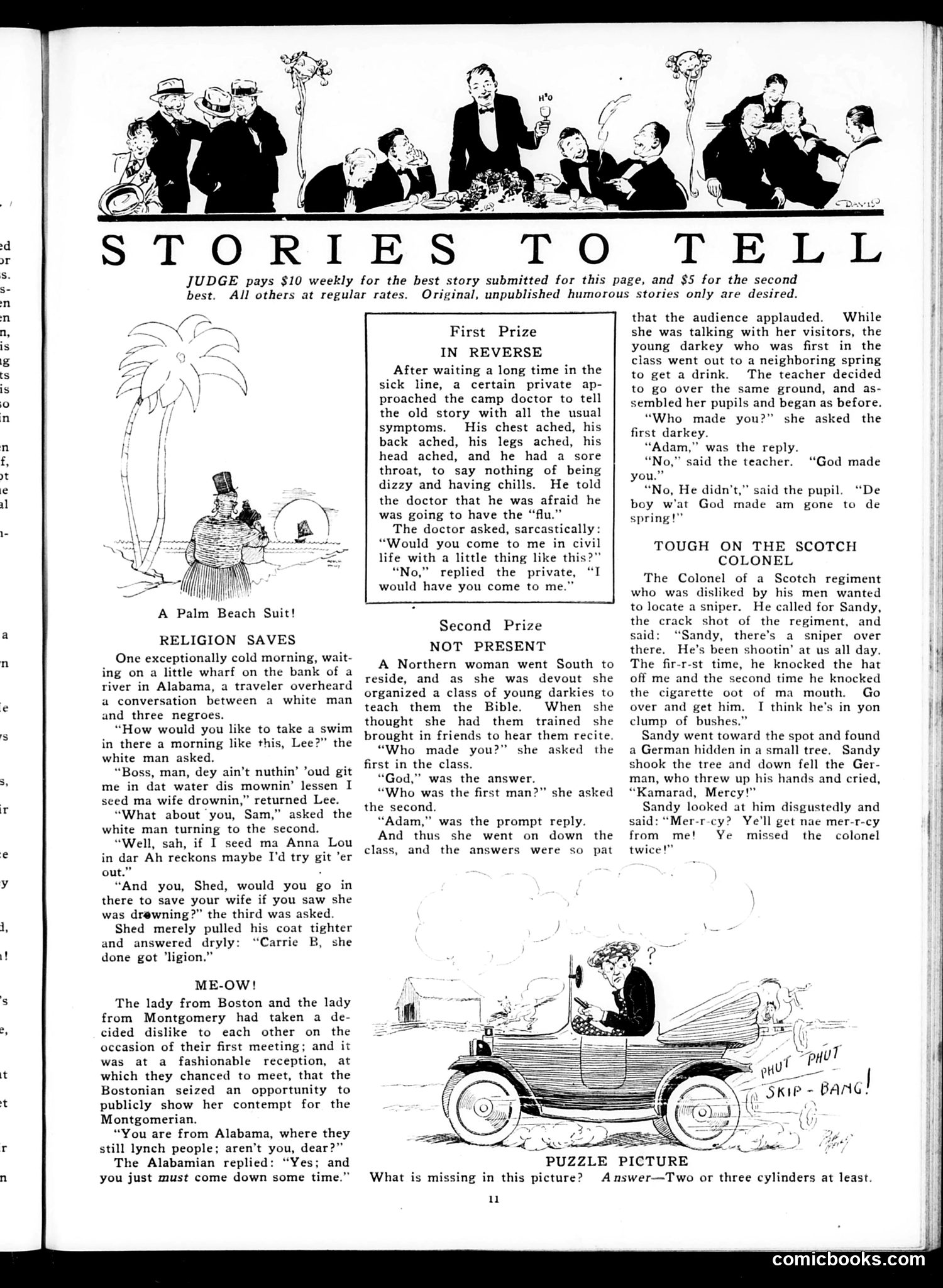
This page from *Judge* magazine features humorous short stories submitted by readers, with prizes offered for the best submissions. The stories rely on period racial and ethnic stereotypes common to early 20th-century American humor: 1. **"Religion Saves"** uses dialect humor about enslaved or formerly enslaved Black men in Alabama, playing on the stereotype that religious devotion would make one's wife behave obediently. 2. **"Me-ow!"** presents a catty exchange between Northern and Southern white women, with the Alabamian's threat of lynching framed as a witty comeback—reflecting how casually violence against Black Americans was treated as comedic fodder. 3. **"In Reverse"** mocks a Northern woman teaching Black children Bible lessons, suggesting they give rote answers; the joke relies on dialect humor and stereotypes about Black children. 4. **"Tough on the Scotch Colonel"** uses Scottish dialect for humor about a WWI soldier seeking revenge. These stories reflect *Judge*'s satirical tradition but reveal attitudes toward race, region, and ethnicity that modern readers would find offensive.
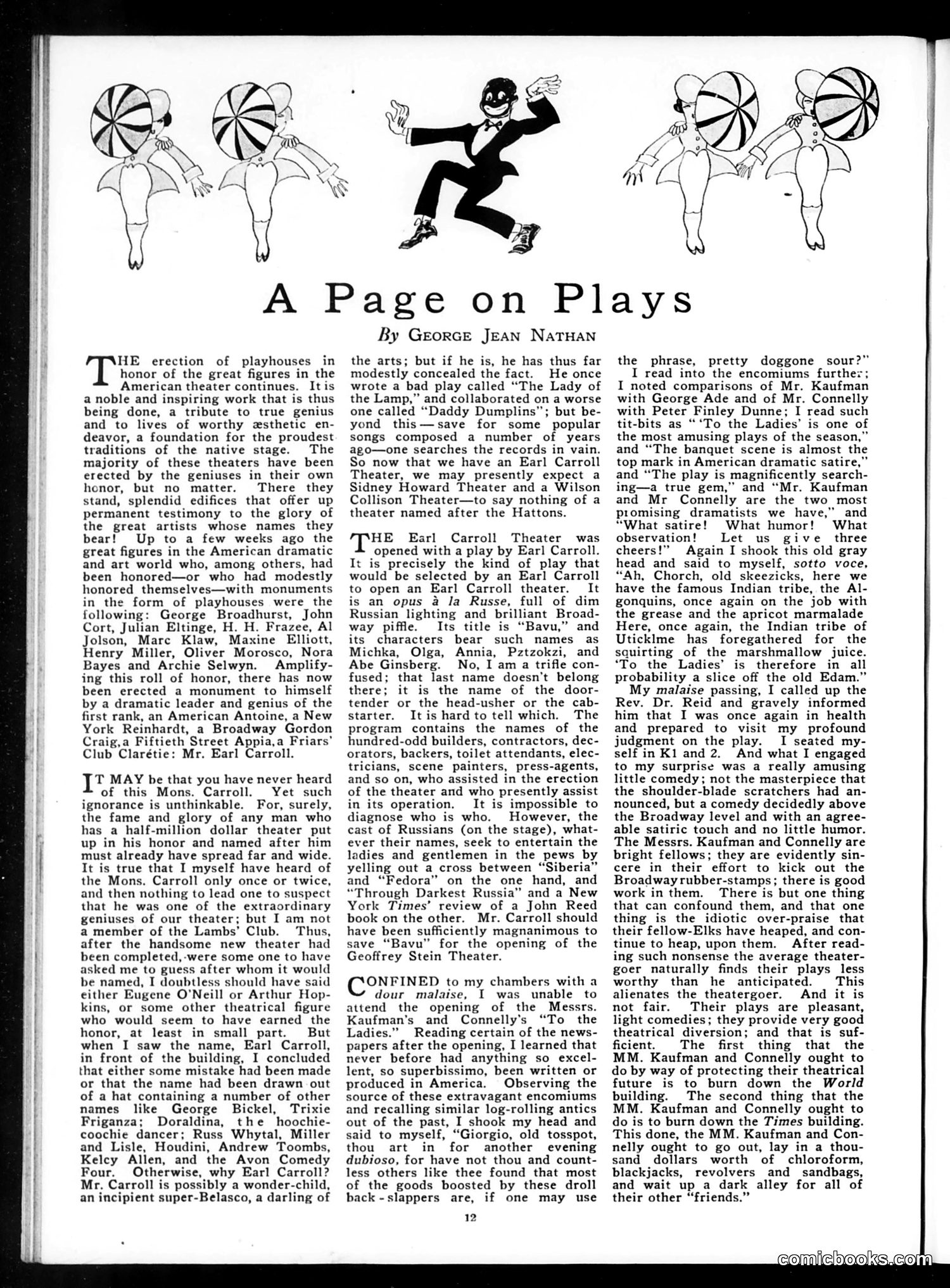
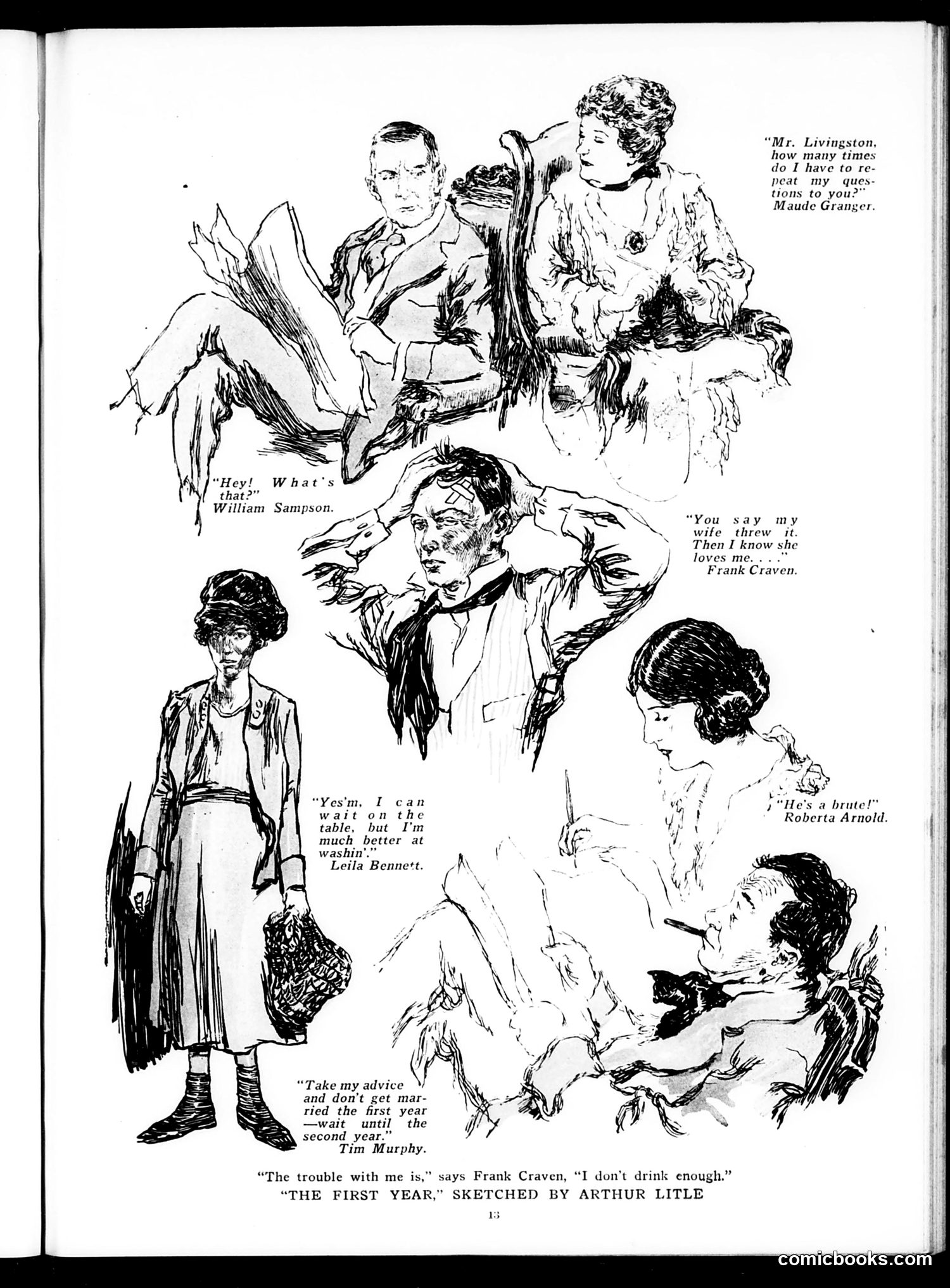
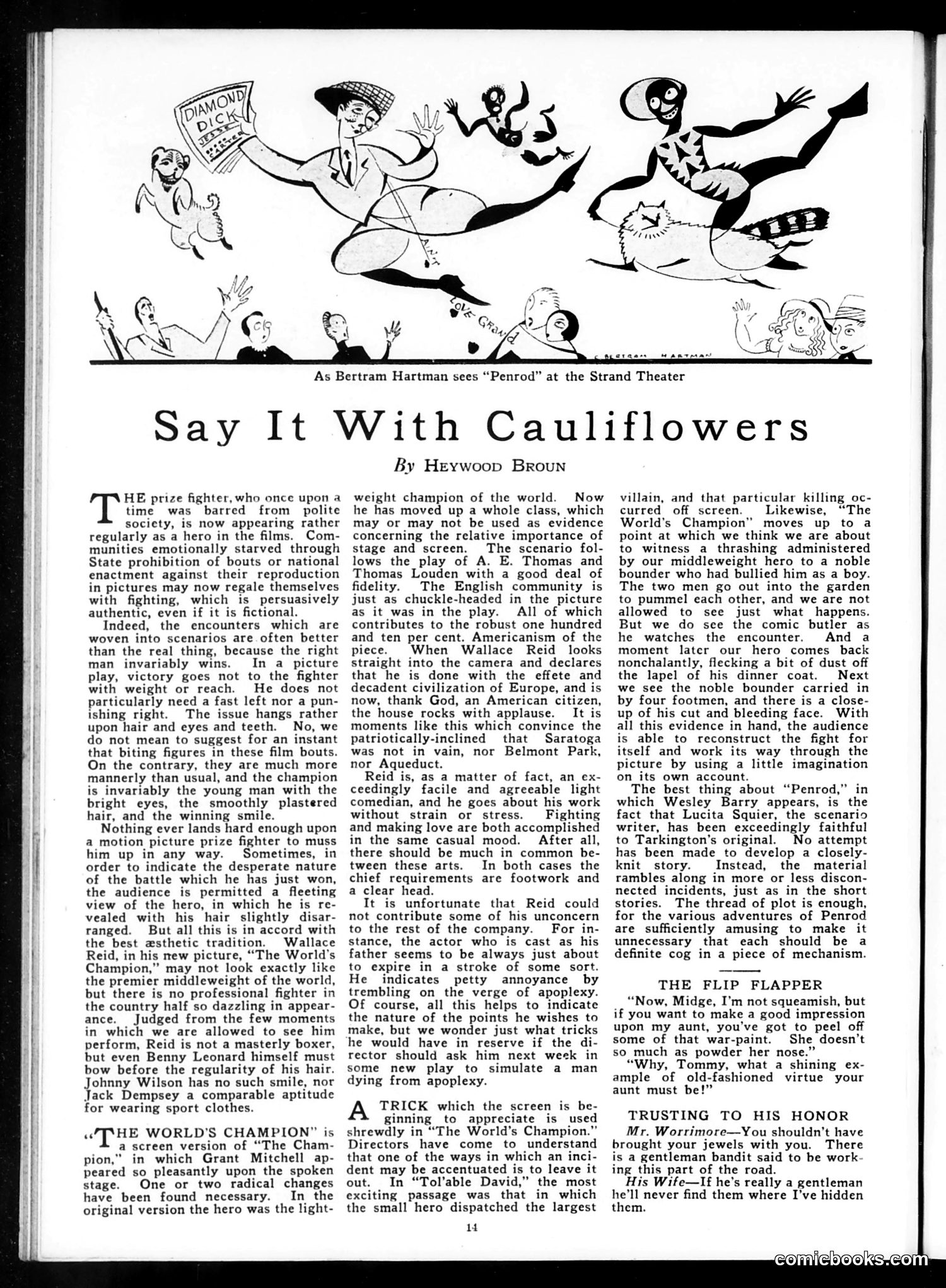
The cartoon at top shows "Bertram Hartman" (a Judge cartoonist) reacting wildly to the film "Penrod" at the Strand Theater—the exaggerated response mocking overwrought theatrical reactions to movies. The accompanying article by Heywood Broun critiques boxing films, particularly Wallace Reid's "The World's Champion." Broun satirizes how Hollywood fight scenes prioritize male beauty and glamour over authenticity: fighters never get truly mussed up, victory goes to the handsome hero with the best hair and smile rather than the stronger boxer, and there's no real damage or struggle shown. Broun further mocks the film's patriotic messaging—Reid's character renounces "effete" European civilization for American vigor, triggering audience applause. The piece suggests this appeals to audiences starved for entertainment after Prohibition banned boxing exhibitions, but the sanitized, vain heroes bear no resemblance to real fighters like Benny Leonard or Jack Dempsey. The satire targets both Hollywood's vanity and audiences' appetite for reassuring myths over reality.
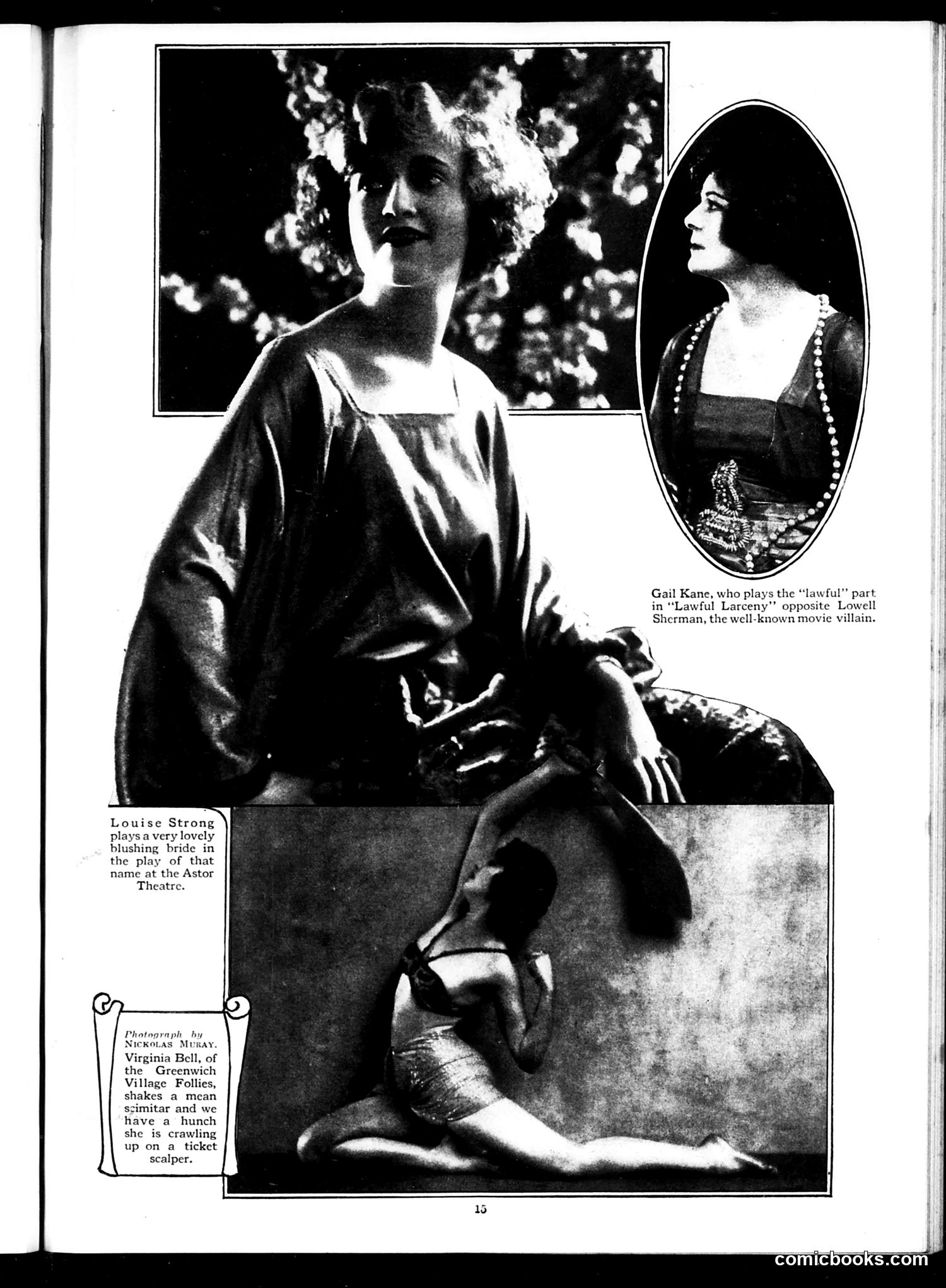
This page showcases Broadway actresses of the era with brief, gossipy commentary typical of Judge's satirical theater coverage. **Louise Strong** is praised for playing a "blushing bride" at the Astor Theatre. **Virginia Bell** of the Greenwich Village Follies is noted for her skill with a scimitar, with a joking suggestion she's "crawling up" to a ticket scalper—implying she's currying favor with someone who controls ticket access. **Gail Kane** is highlighted for playing the "lawful" role opposite "well-known movie villain" Lowell Sherman in *Lawful Larceny*. The humor assumes readers follow Broadway productions closely. The "ticket scalper" reference mocks the parasitic middlemen who profited from theater ticket resales—a persistent complaint of the era.
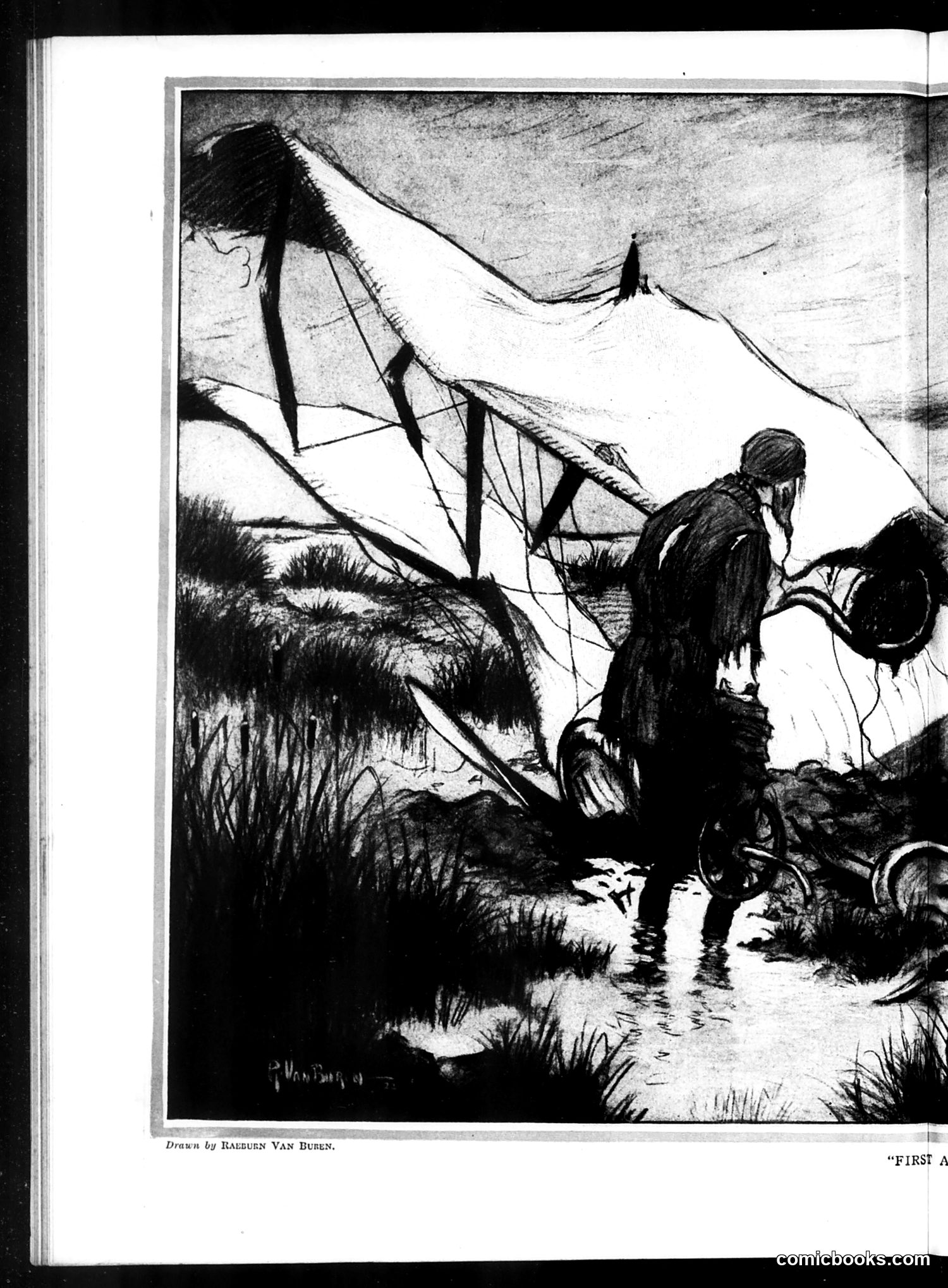
This is a black and white illustration credited to Raburn Van Buren showing a figure in period clothing standing in shallow water near reeds and grasses, examining what appears to be a large fishing net or sail structure. The figure is holding a rod or pole and appears to be engaged in fishing or water-related activity. Without additional visible text explaining the cartoon's caption or context, I cannot definitively identify the specific political or social satire intended. The artistic style and publication in *Judge* magazine suggests it's meant as commentary, but the exact subject—whether it's satirizing politics, social behavior, or economic conditions—remains unclear from the image alone. More context from the page's title or surrounding text would be needed to explain the specific reference.
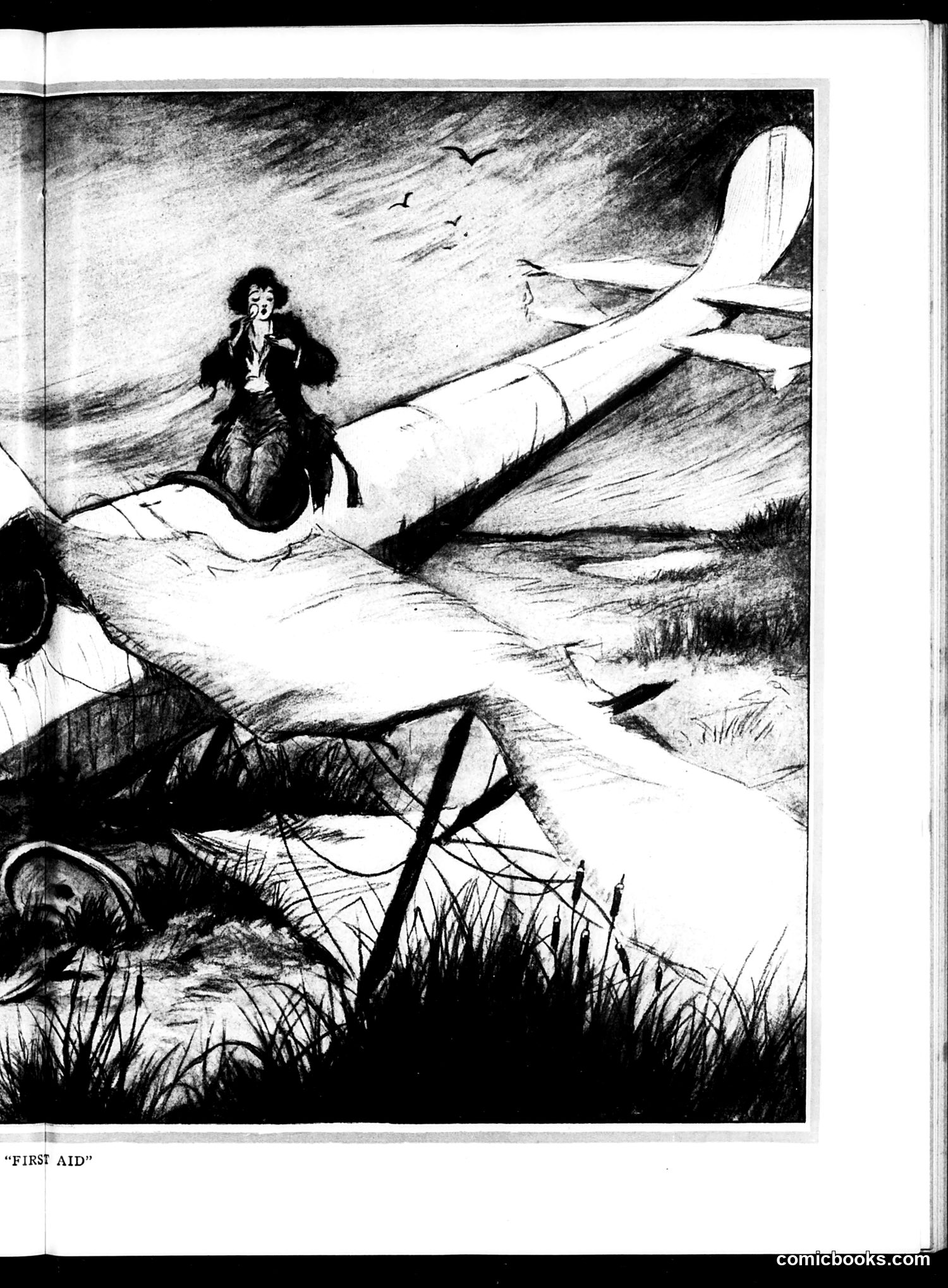
This political cartoon, titled "First Aid," depicts a figure in formal attire kneeling beside what appears to be a crashed or damaged airplane in a desolate landscape. The figure appears distressed or crying. The satire likely comments on emergency response to a crisis—possibly an aviation accident or disaster. The title "First Aid" suggests inadequate or ineffective immediate assistance, implying that whatever help is being offered is insufficient for the scale of the problem represented by the wrecked aircraft. Without additional context about the specific date of publication, it's unclear which particular aviation incident or political situation this references, though early aviation disasters were common subjects of Judge magazine's satirical commentary on government incompetence or safety failures.
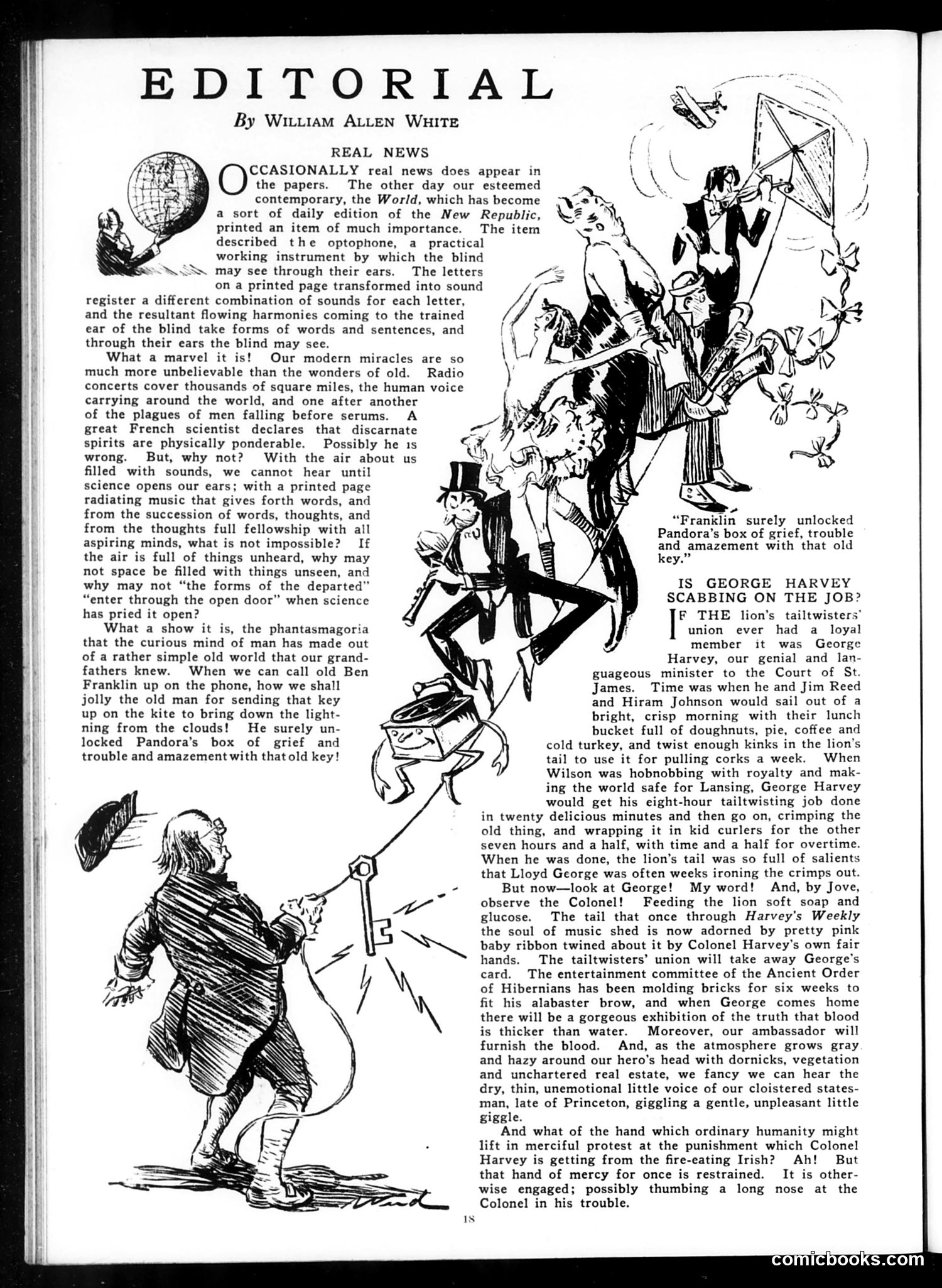
This editorial by William Allen White satirizes **George Harvey**, U.S. Ambassador to Britain ("minister to the Court of St. James"), for abandoning his former critical stance toward British power. The "lion's tailtwisters' union" is a metaphor for critics who aggressively challenged British interests. Harvey was once a fierce member of this group—alongside Jim Reed and Hiram Johnson—who attacked British policy in his publication *Harvey's Weekly*. He could "twist" the lion's tail (criticize Britain) in just twenty minutes, then spend the remaining workday elaborating his critiques. Now, as ambassador, Harvey has become conciliatory toward Britain, "feeding the lion soft soap and glucose" and adorning its tail with "pretty pink baby ribbon." The union will revoke his membership card. White suggests Harvey's shift from critic to diplomat—essentially becoming a British apologist—represents betrayal of his former principles. The cartoon illustrates this contradiction visually through chaotic imagery of Harvey's transformed role.
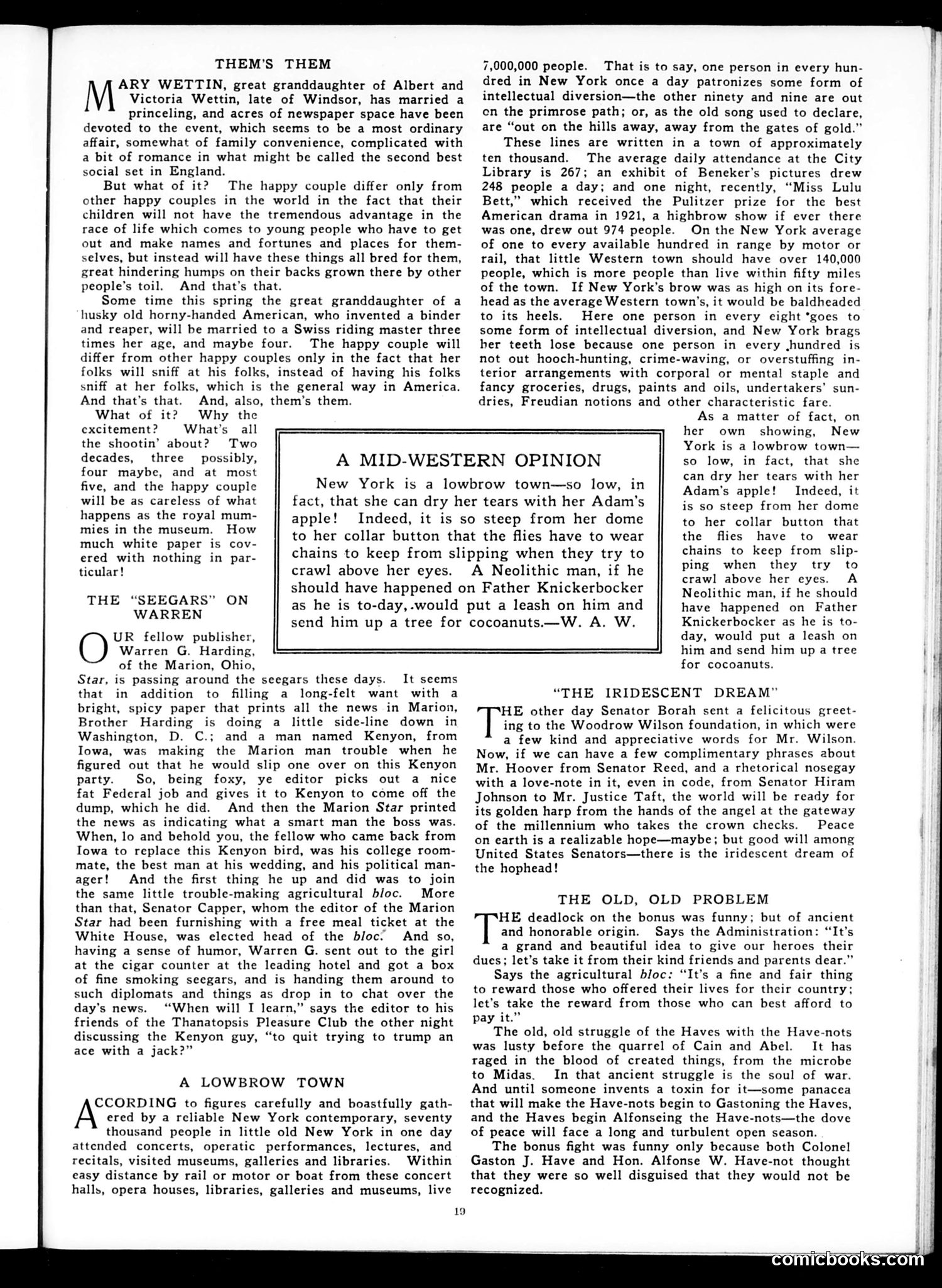
This page contains satirical commentary on three separate topics: **"Them's Them"**: Mocks excessive newspaper coverage of Mary Wettin's (likely a royal or aristocratic figure) marriage. The satire argues that inherited privilege, while celebrated, actually handicaps children compared to self-made Americans. The contrast—a wealthy American heiress marrying a poor Swiss riding master—illustrates that class distinctions are ultimately meaningless. **"The 'Seegars' on Warren"**: Attacks Warren G. Harding (Marion, Ohio newspaper publisher and future U.S. President) for hypocritical self-promotion. He publicized a federal job appointment as evidence of his political savvy, but the appointee was replaced by the original candidate's college roommate—undermining Harding's claimed influence. The "seegars" (cigars) reference Harding's embarrassed attempts to smooth over the political blunder. **"A Lowbrow Town"**: Sarcastically critiques New York's cultural pretensions, claiming despite 70,000 daily attendees at high-culture venues, the city remains fundamentally lowbrow—too preoccupied with material concerns to truly appreciate intellectual pursuits.
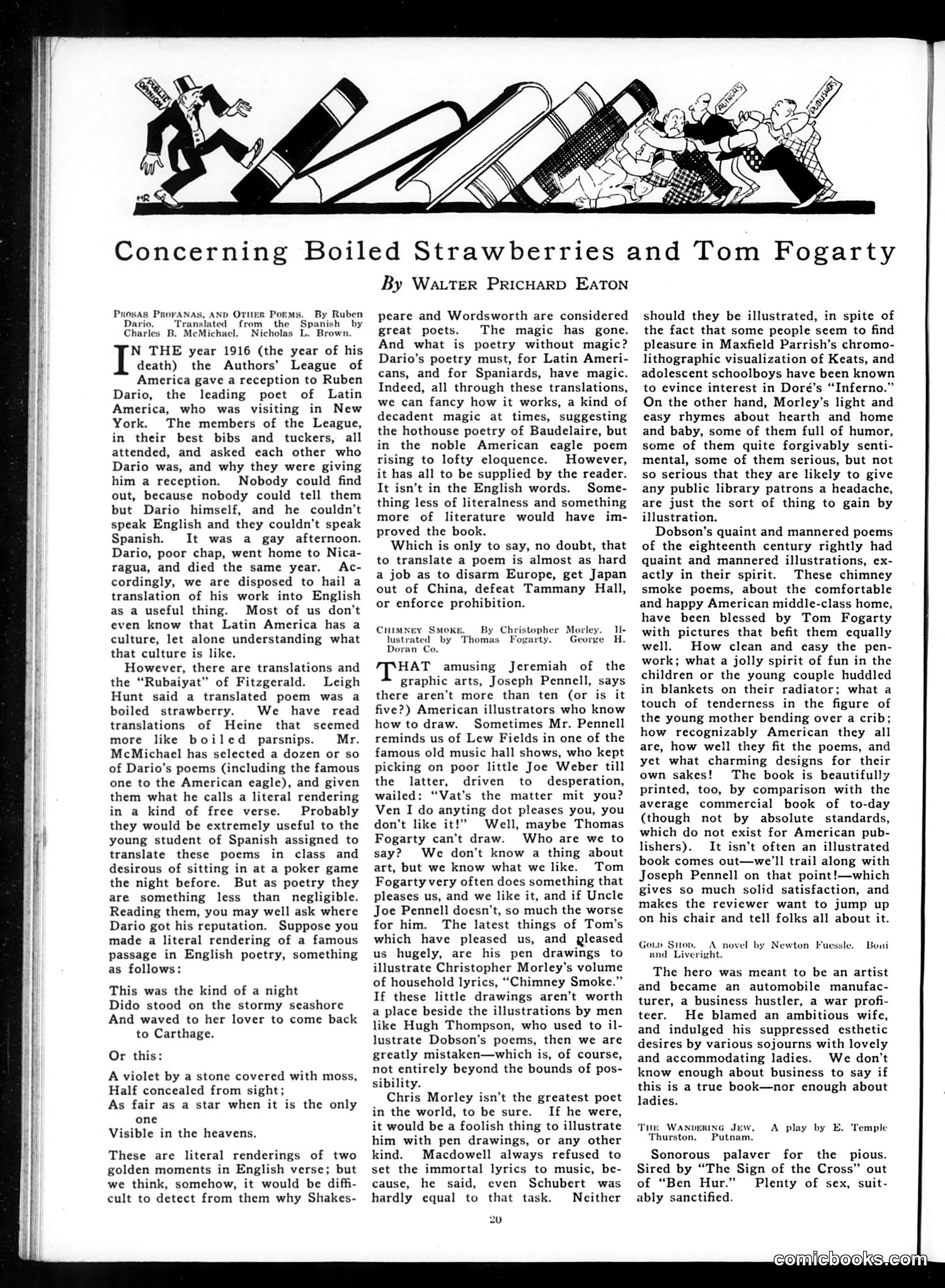
This page contains book reviews rather than political cartoons. The lead article criticizes a new English translation of poems by Rubén Darío, the recently deceased Latin American poet. The author mocks the Authors' League's 1916 reception for Darío—noting that none of the attendees actually knew who he was or why they were honoring him, since he spoke no English and they spoke no Spanish. This satirizes American cultural pretension and ignorance. The review's central metaphor compares literal poetic translation to "boiled strawberries"—something that loses all appeal through poor preparation. The author argues that while Darío's poetry likely contains genuine magic for Spanish speakers, the literal English rendering strips away all poetry. The second review defends illustrator Tom Fogarty against criticism from Joseph Pennell, a famous graphic artist known for harshly judging other illustrators' work. The piece humorously compares Pennell's constant carping to a vaudeville routine.
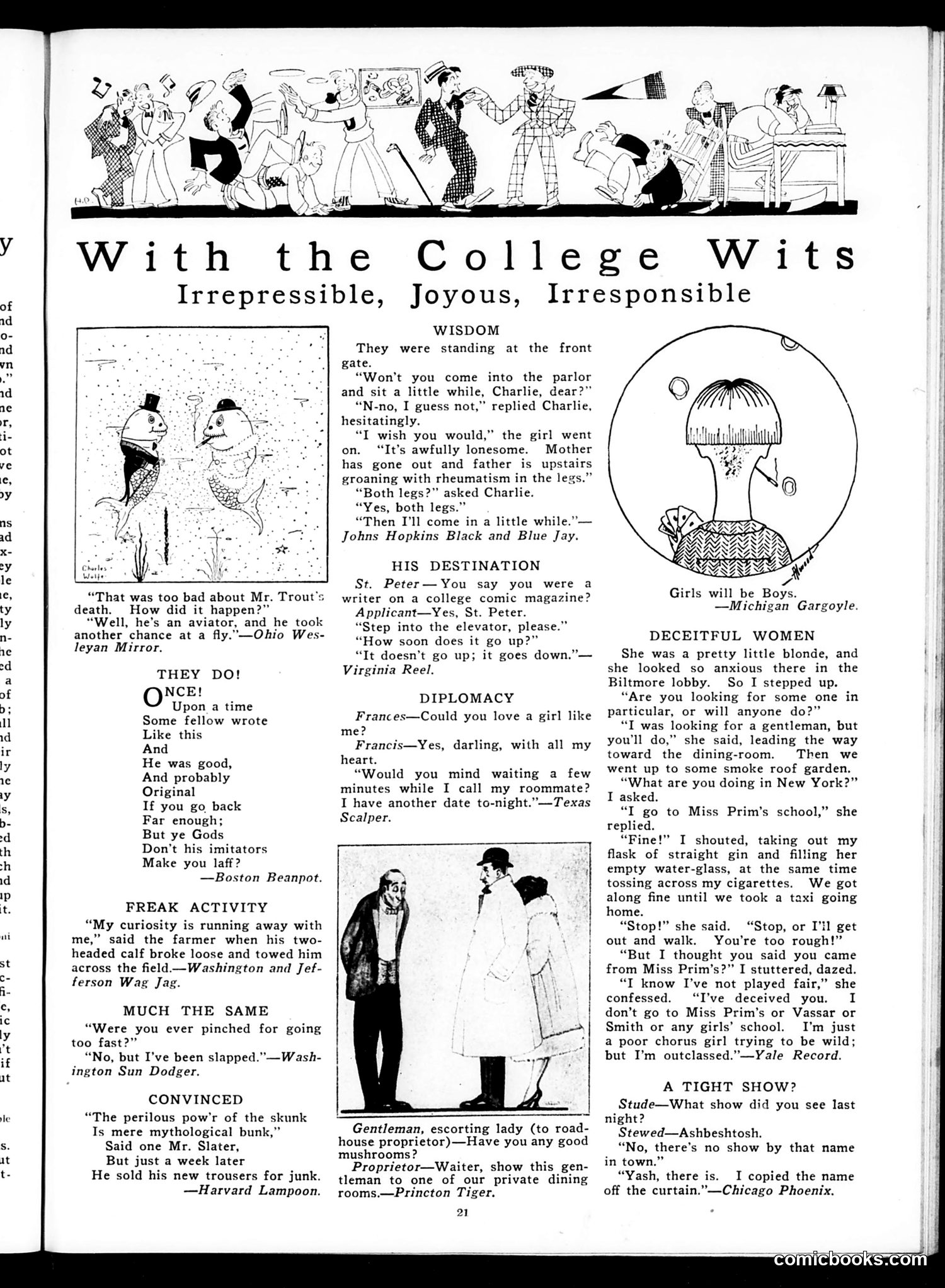
This page collects humorous submissions from various college humor magazines (Johns Hopkins, Ohio Wesleyan, Harvard, Yale, etc.), a common feature in Judge during this era. The jokes target college-life stereotypes and young people's behavior. **Key themes:** - **Dating awkwardness**: A boy hesitates entering a parlor with a girl; a man pretends to love someone while she admits to having another date - **Reckless youth**: Aviation deaths treated as comedic; a drunk student can't identify a theater he attended - **Deception and immorality**: A young woman lies about attending an exclusive girls' school while actually being a "chorus girl" (implying moral looseness) - **Generational critique**: The "deceitful women" section especially mocks young women as dishonest and sexually forward by 1920s standards The satire presents college students as irresponsible, romantically duplicitous, and morally questionable—a common Judge trope mocking youth culture and jazz-age behavior during the Roaring Twenties.
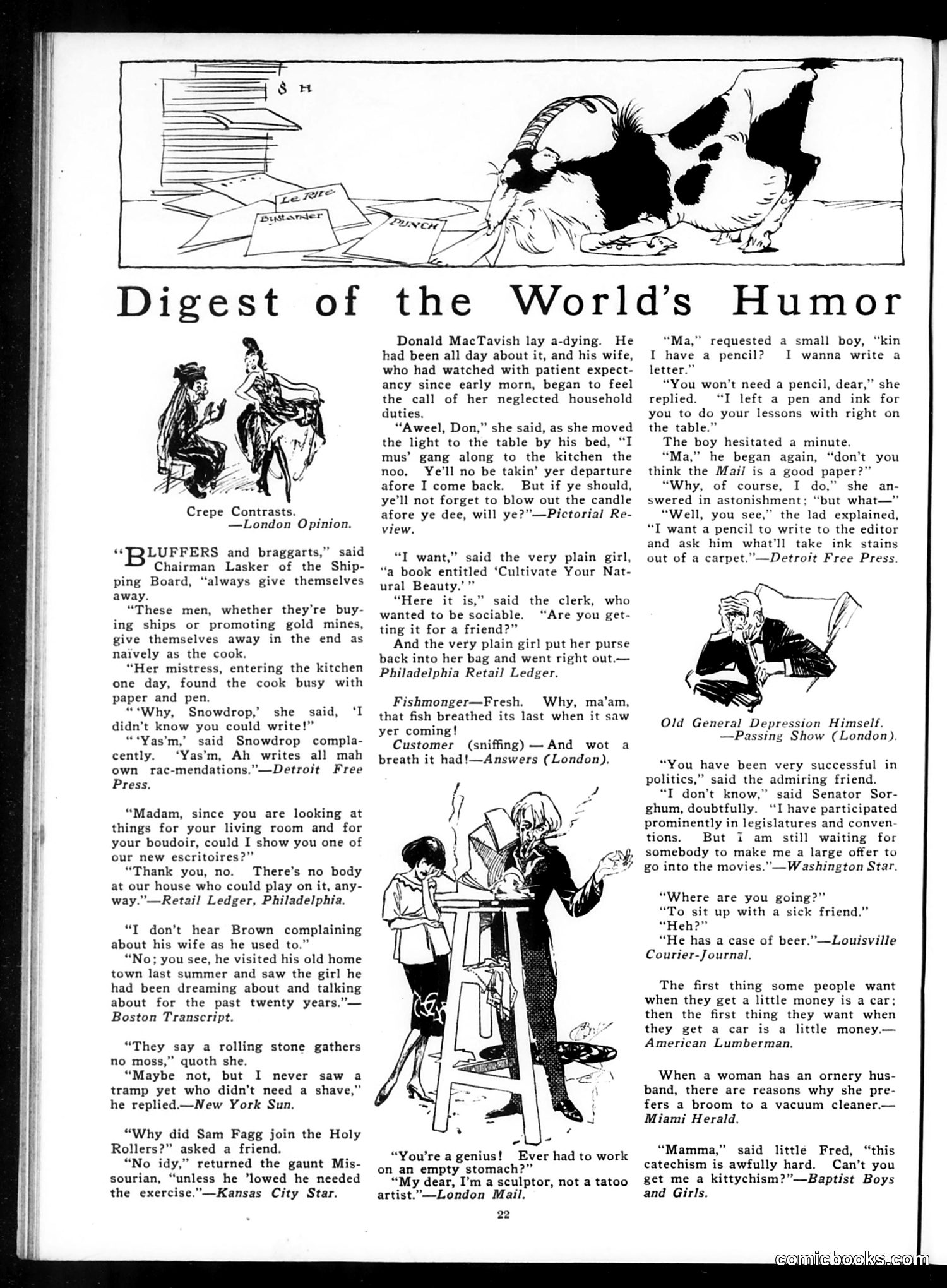
This page collects humorous anecdotes from newspapers worldwide, arranged without overt political messaging. The cartoons and jokes reflect early-20th-century social attitudes: **The cartoons** show domestic and workplace scenes with exaggerated character types—servants, shop clerks, family members—depicted in period dress with comedic body language. **The humor relies on**: - Class and ethnic stereotypes (the cook's dialect, a "very plain girl's" vanity) - Gender roles (wives managing households, women's appearance anxieties) - Marital discord played for laughs - Malapropisms and working-class speech patterns treated as inherently funny **Notable references**: Chairman Lasker of the Shipping Board appears in one anecdote; Senator Sorghum in another—likely contemporary political figures used as punchlines about ambition. The content assumes reader familiarity with servant hierarchies, courtship rituals, and economic aspiration that would resonate with 1920s-era readers. Modern audiences would find much of it dated or problematic in its casual mockery of class and appearance.
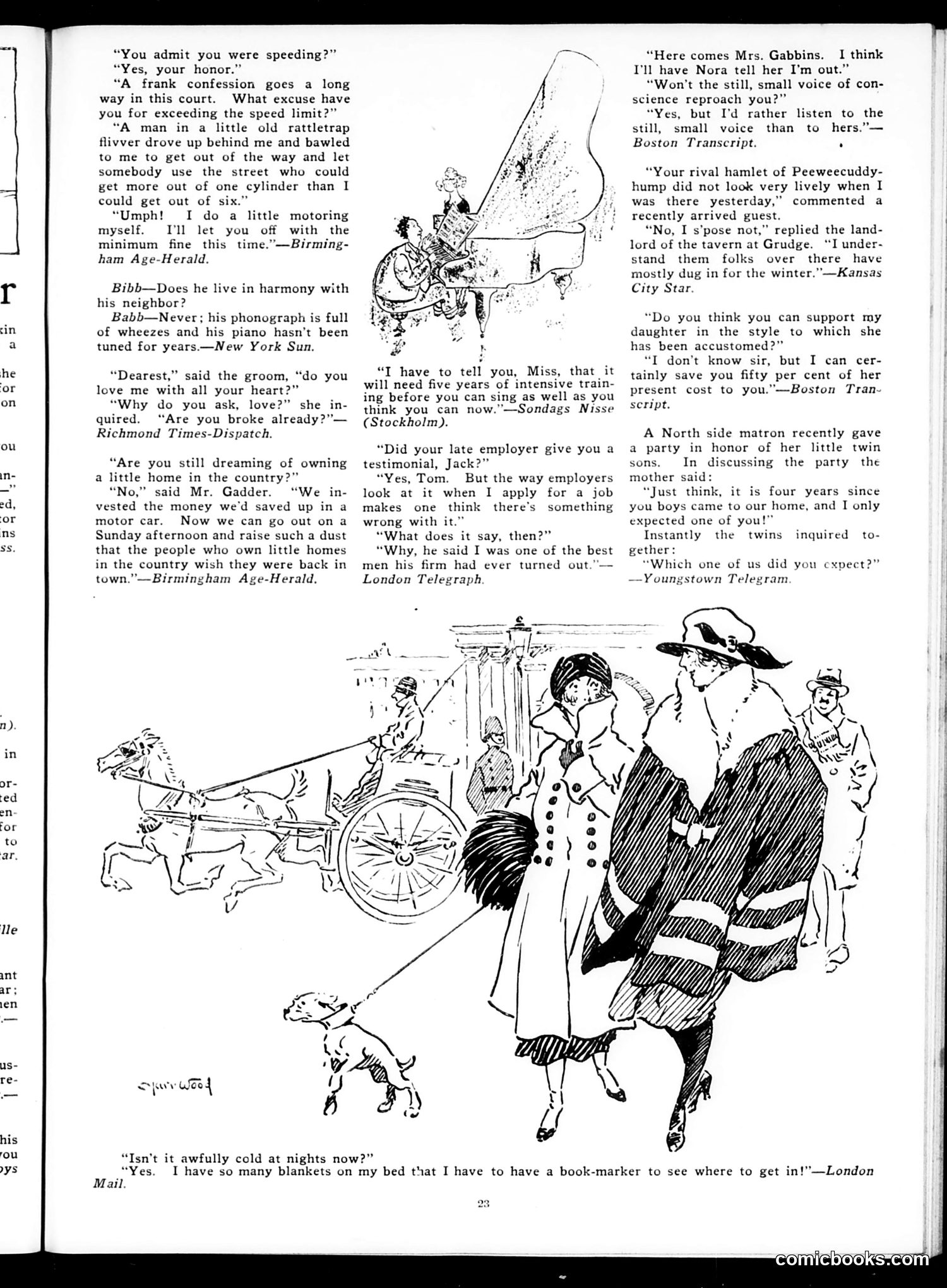
This page from the satirical magazine *Judge* collects brief humorous anecdotes and jokes, plus one illustrated cartoon, all poking fun at early 20th-century American life and social pretensions. **The cartoon** (by Sy Weed) depicts a wealthy couple with servants, a horse-drawn carriage, and small dogs—a visual joke about ostentatious display and social climbing. **The jokes target**: - **Speeding/automobiles**: A driver excuses reckless speeding by claiming a "flivver" (cheap car) forced him off the road; the judge sympathizes because he also enjoys motoring. - **Consumer culture**: A man buys a motor car instead of saving for a country home, then enjoys stirring up dust to annoy actual homeowners—satirizing how new cars create status anxiety. - **Marriage and money**: A bride asks if her groom is "broke already," implying financial anxiety dominates romance. - **Class anxiety**: A job applicant's glowing testimonial actually hurts his prospects, suggesting employer references are unreliable. - **Domestic evasion**: A woman avoids greeting a visitor, choosing to ignore her conscience rather than hear complaints. The humor assumes a middle-class readership anxious about social position and new consumer technologies.
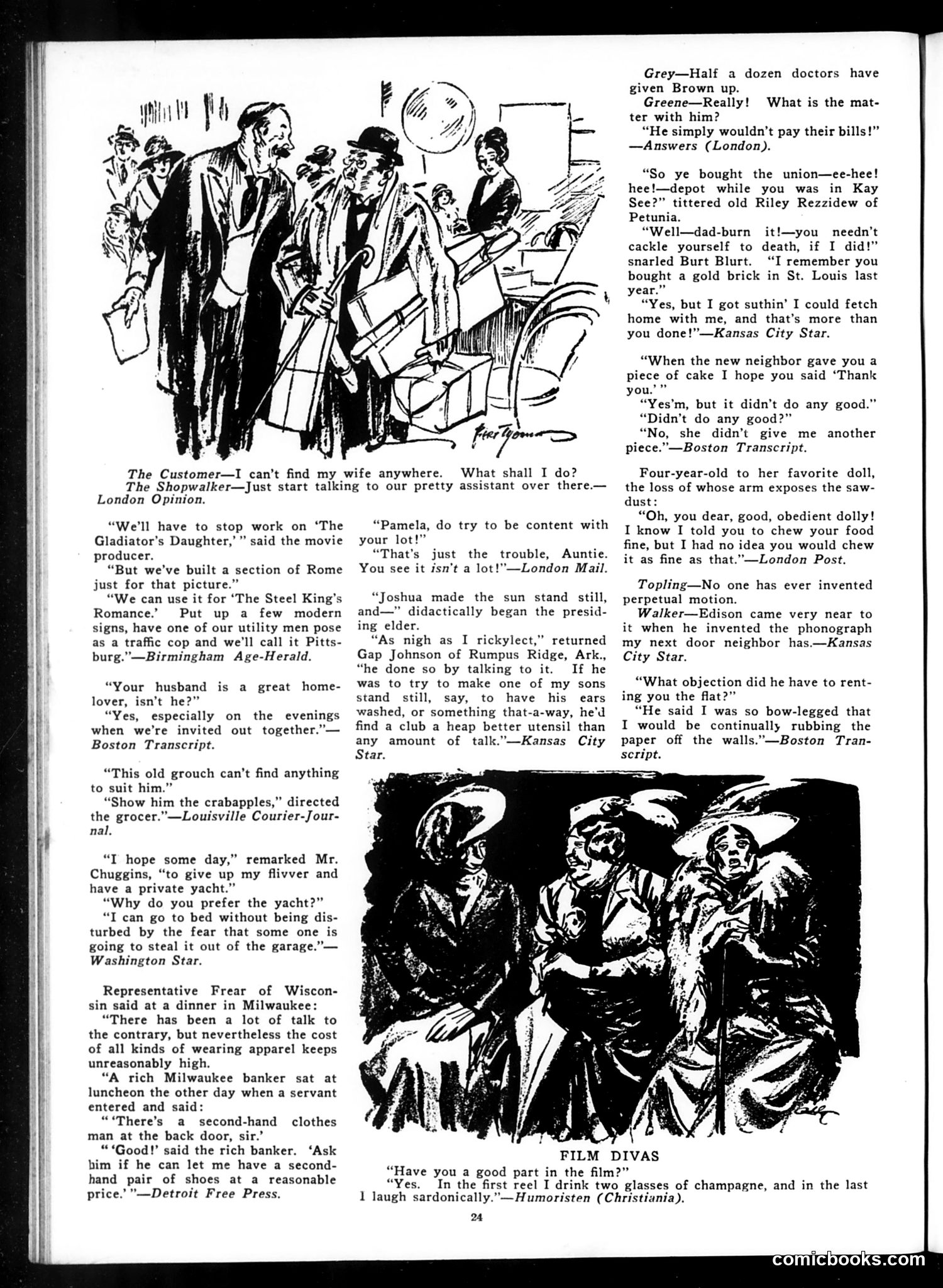
This page from the American satirical magazine **Judge** contains multiple brief humor pieces rather than a single political cartoon. The top illustration shows figures in what appears to be a commercial setting, likely depicting a shopkeeper's flirtation tactic. The jokes satirize early 20th-century American social life: marital dynamics, consumer culture, and emerging technologies (the "flivver"—affordable Model T automobile). One notable piece mocks economic hypocrisy—a wealthy banker so stingy he seeks secondhand shoes despite his wealth. Another jokes about doctors abandoning a patient simply because he won't pay bills, reflecting frustration with medical profession's mercenary reputation. References include movie production (suggesting Hollywood's rapid growth), rural dialect characters, and the phonograph as a recent Edison invention. The final "Film Divas" section satirizes actresses' superficial film roles requiring only drinking champagne and theatrical laughing. Overall, the page reflects genteel, middle-class concerns about spending, marriage, and modern conveniences—typical Judge magazine fare from roughly the 1910s era.
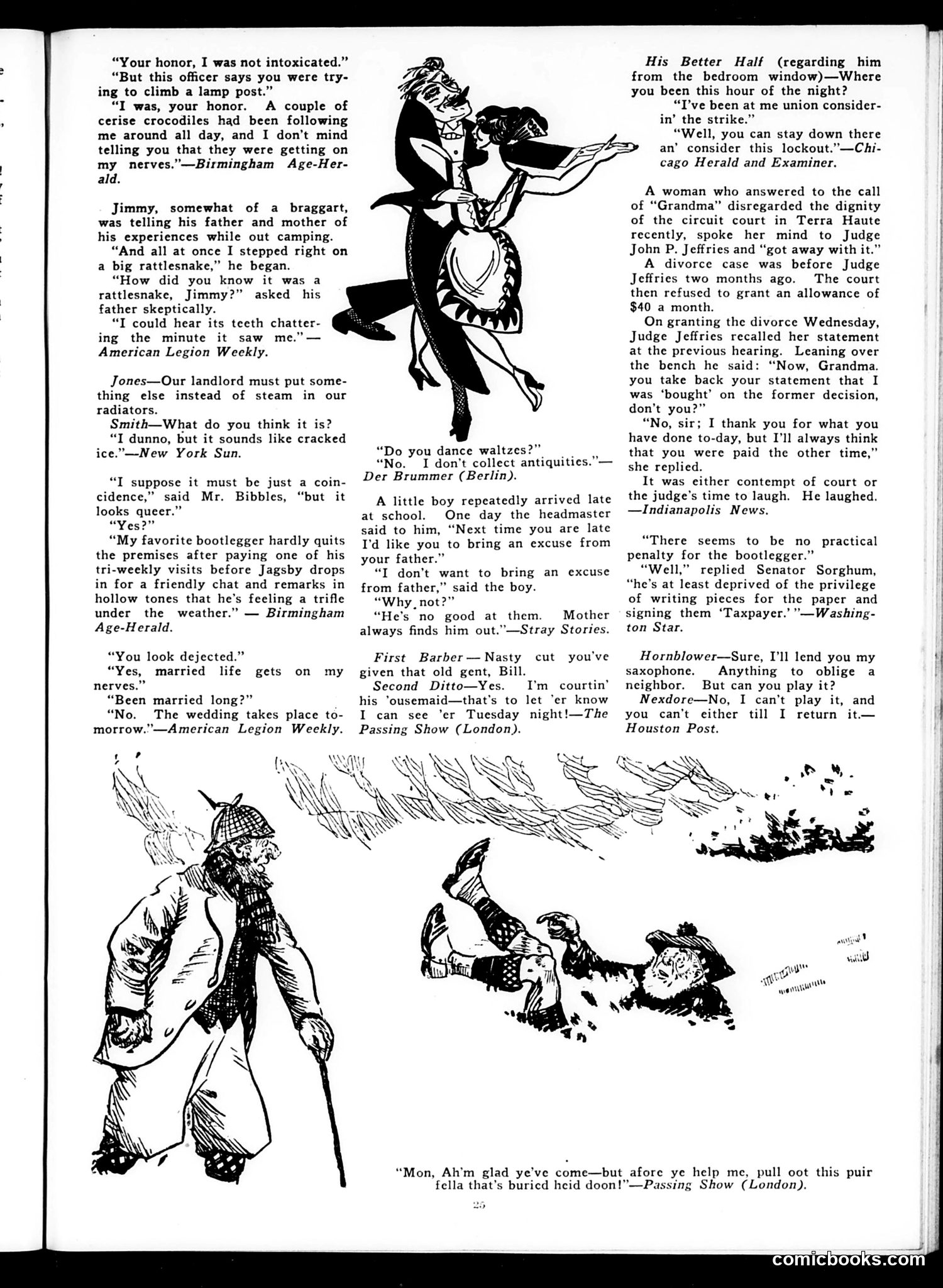
This page from *Judge* (an American satirical magazine) collects humorous anecdotes and jokes from various newspapers, typical of early 20th-century humor publications. **Key content:** The jokes satirize common social anxieties: a drunk man blames "cerise crocodiles" for his behavior; a bootlegger's frequent visits coincide suspiciously with a neighbor's sudden illness; a groom dreads marriage the day before his wedding. **Notable item:** A "Grandma" character appears in court regarding a divorce allowance. She boldly contradicts Judge Jeffries, claiming he was "bought" in his previous decision. The judge laughs rather than holding her in contempt—satirizing either judicial corruption or judicial weakness in enforcing courtroom decorum. **The cartoons** (lower half) depict slapstick scenes: a man slipping in snow, illustrating physical comedy typical of the era. These anecdotes reflect Prohibition-era concerns (bootleggers), marital discord, and irreverent treatment of authority figures—common themes in 1920s-30s American humor.
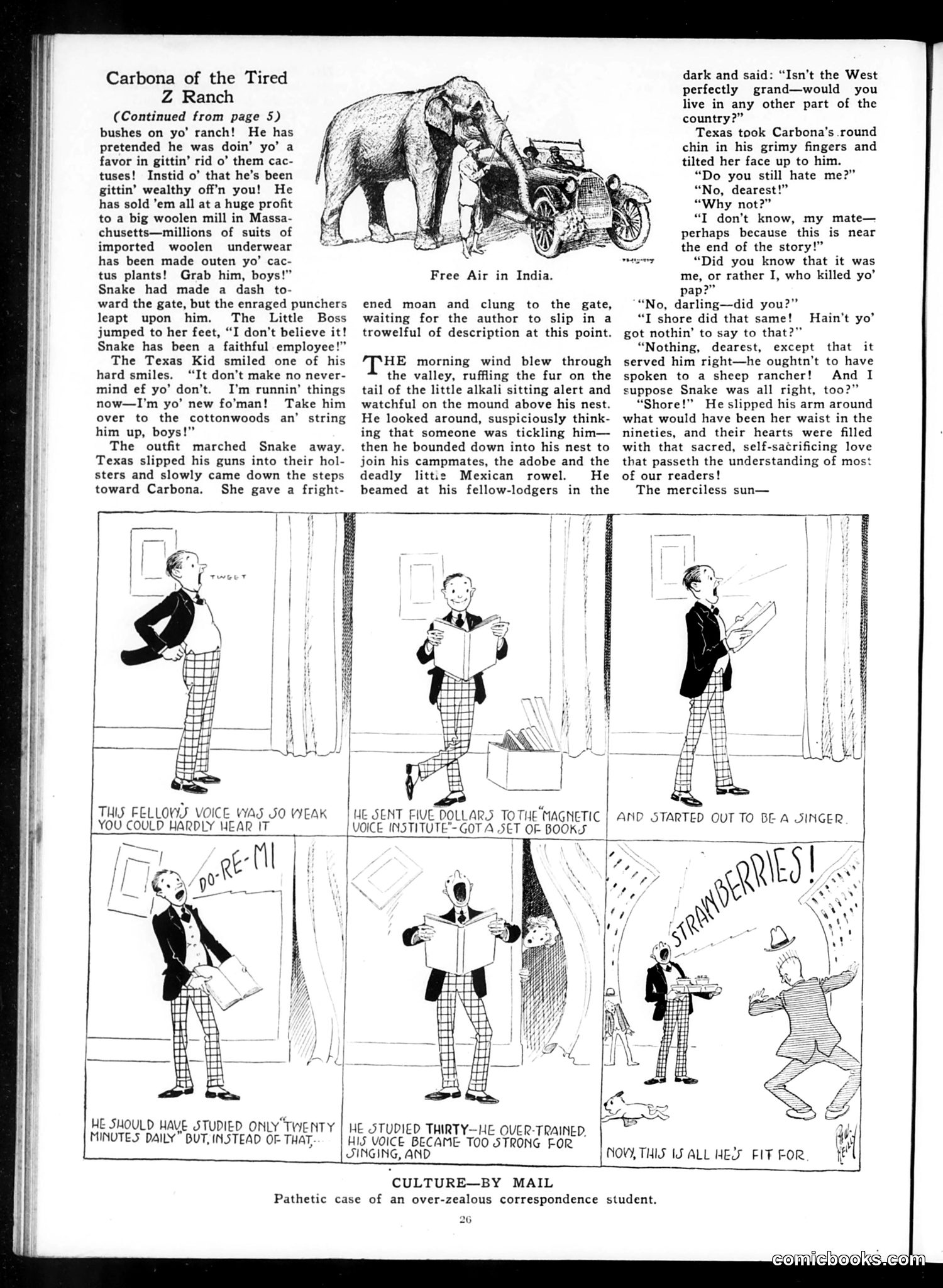
This page contains two distinct pieces of satire: **"Carbona of the Tired Z Ranch"** (top) is a parody of Western pulp fiction, specifically mocking the overwrought romantic and dramatic conventions of the genre. The narrative absurdly combines melodrama (a villain's exposure, a lynching threat) with self-aware commentary—the character Carbona literally references "the end of the story," breaking the fourth wall. The satire targets the formulaic nature of dime-novel Westerns and their purple prose. **"Culture—by Mail"** (bottom comic strip) satirizes correspondence courses, a popular early 20th-century phenomenon. The joke shows a man who enrolled in a magnetic voice institute, over-trained by studying 30 minutes instead of the recommended 20 minutes daily, and developed an overly powerful voice unsuitable for singing. This ridicules both the dubious claims of mail-order self-improvement schemes and the gullibility of students who misuse them. Both pieces target contemporary American commercial culture and popular entertainment forms.
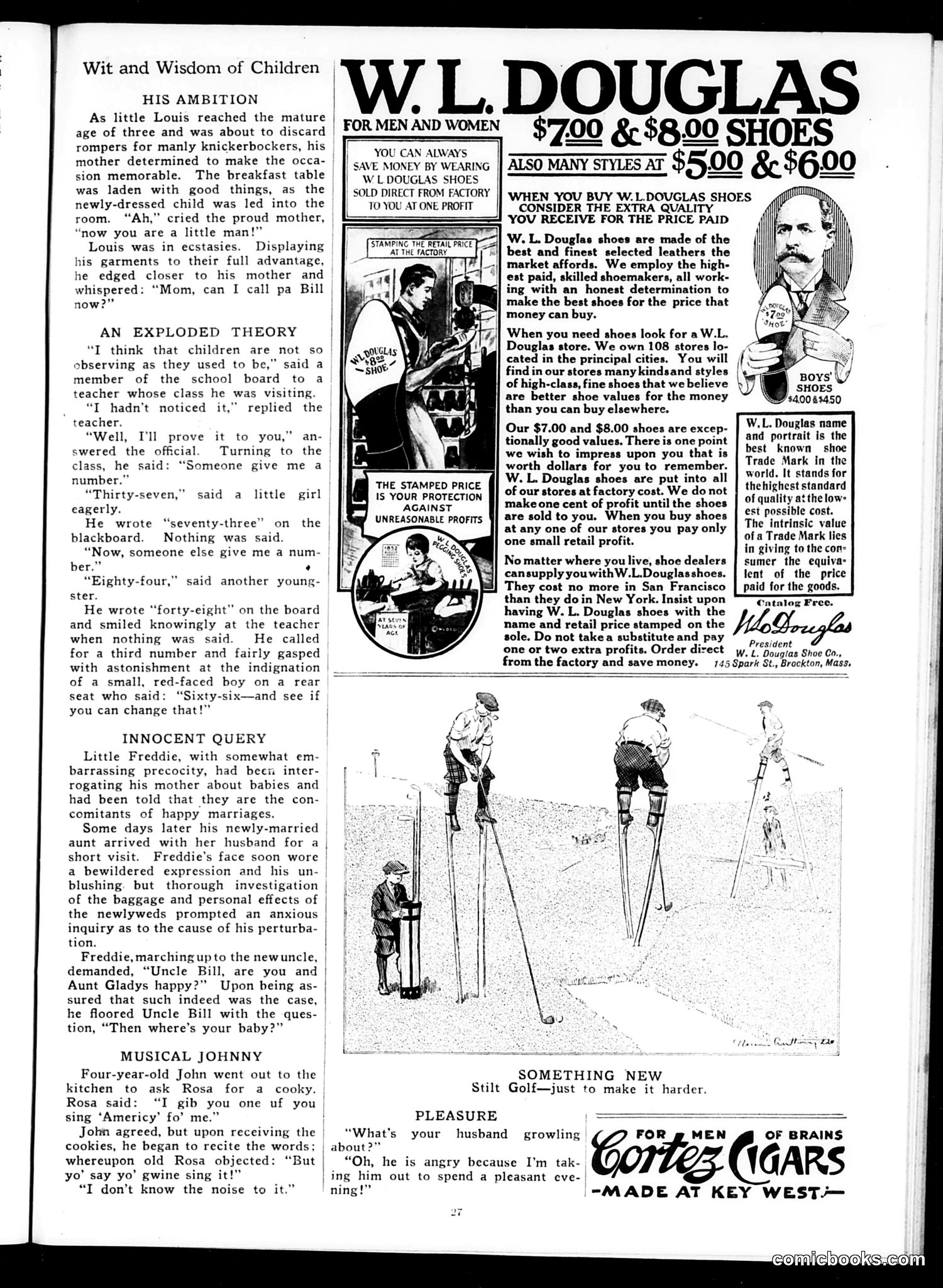
This page is primarily **humorous anecdotes about children's logic and literal thinking**, a popular feature in early 20th-century magazines. The three stories satirize how children expose adult contradictions through innocent observations: 1. **"His Ambition"**: A three-year-old, upon receiving his first "manly" outfit, asks if he can now call his father by his first name—absurdly literalizing what "becoming a man" means. 2. **"An Exploded Theory"**: A school official claims children are less observant than before, then reverses numbers on a blackboard expecting no reaction. A boy indignantly catches the trick, proving children *are* observant. 3. **"Musical Johnny"** and **"Innocent Query"**: Children take adults literally—reciting rather than singing lyrics; asking where newlyweds' baby is, having been told happy marriages produce children. The **advertisement for W.L. Douglas shoes** dominates the right side, emphasizing factory-direct pricing and quality. The implicit humor: **children's logical minds expose the fuzzy, hypocritical language adults use.**
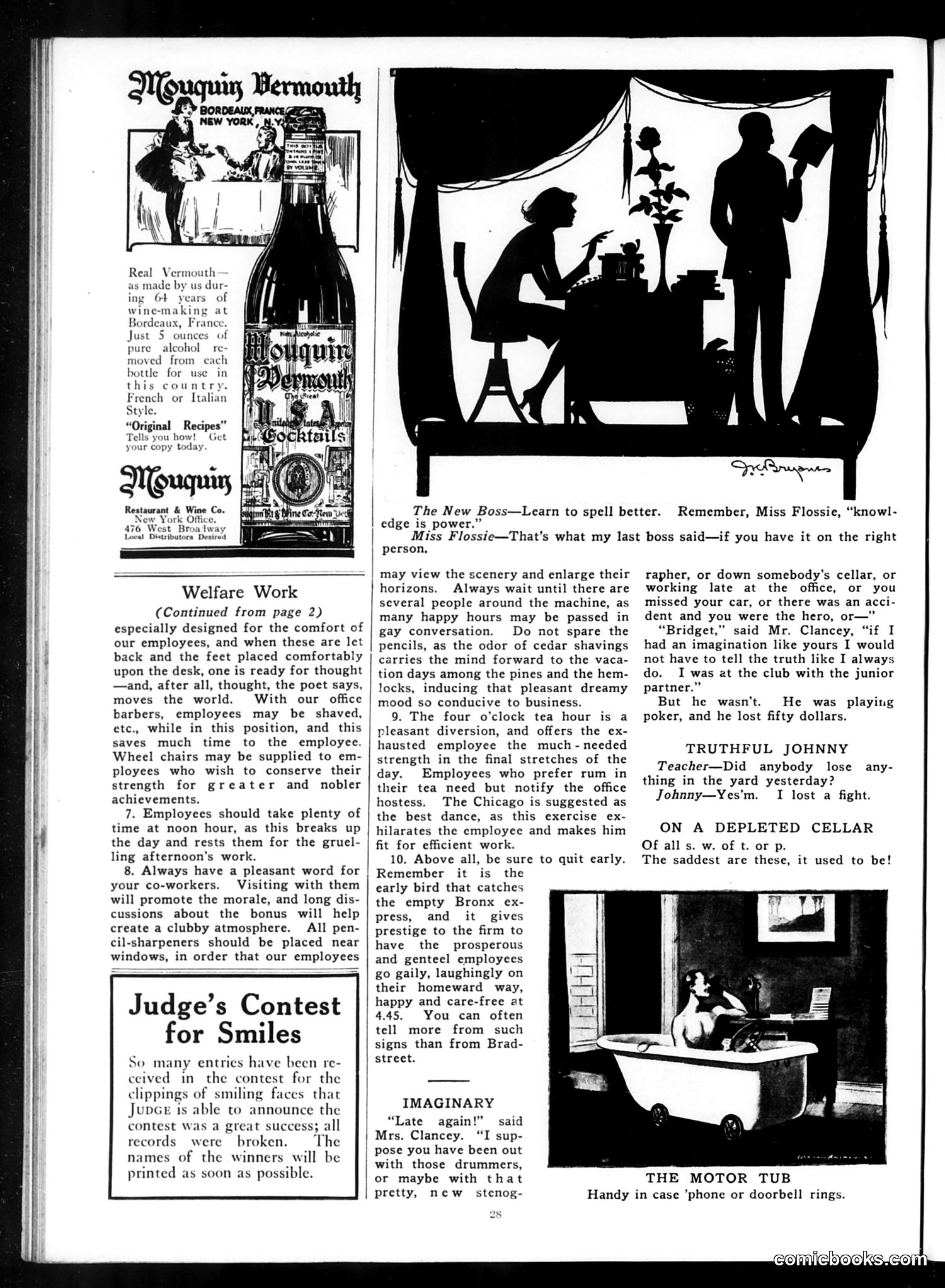
This page contains several satirical pieces mocking early 20th-century workplace and domestic life: **"The New Boss"** cartoon depicts a hierarchical office scene where a new female boss corrects an employee's spelling, illustrating workplace power dynamics and the novelty of women in supervisory roles. **"Welfare Work"** section sarcastically lists employer "benefits"—lengthy lunch breaks, pencil-sharpeners by windows for daydreaming, four o'clock tea, early departures at 4:45—that supposedly benefit workers but actually encourage time-wasting and reduced productivity. The satire critiques corporate "welfare capitalism" programs as performative rather than genuinely helpful. **"Truthful Johnny"** and **"Imaginary"** are brief humor pieces about excuses and fabrication. **"The Motor Tub"** illustrates a bathtub positioned near a window as a convenient location for answering phones or doorbells—absurdist domestic humor. The page also includes a Mouquin Vermouth advertisement noting alcohol was removed for legal sale, referencing Prohibition-era restrictions.
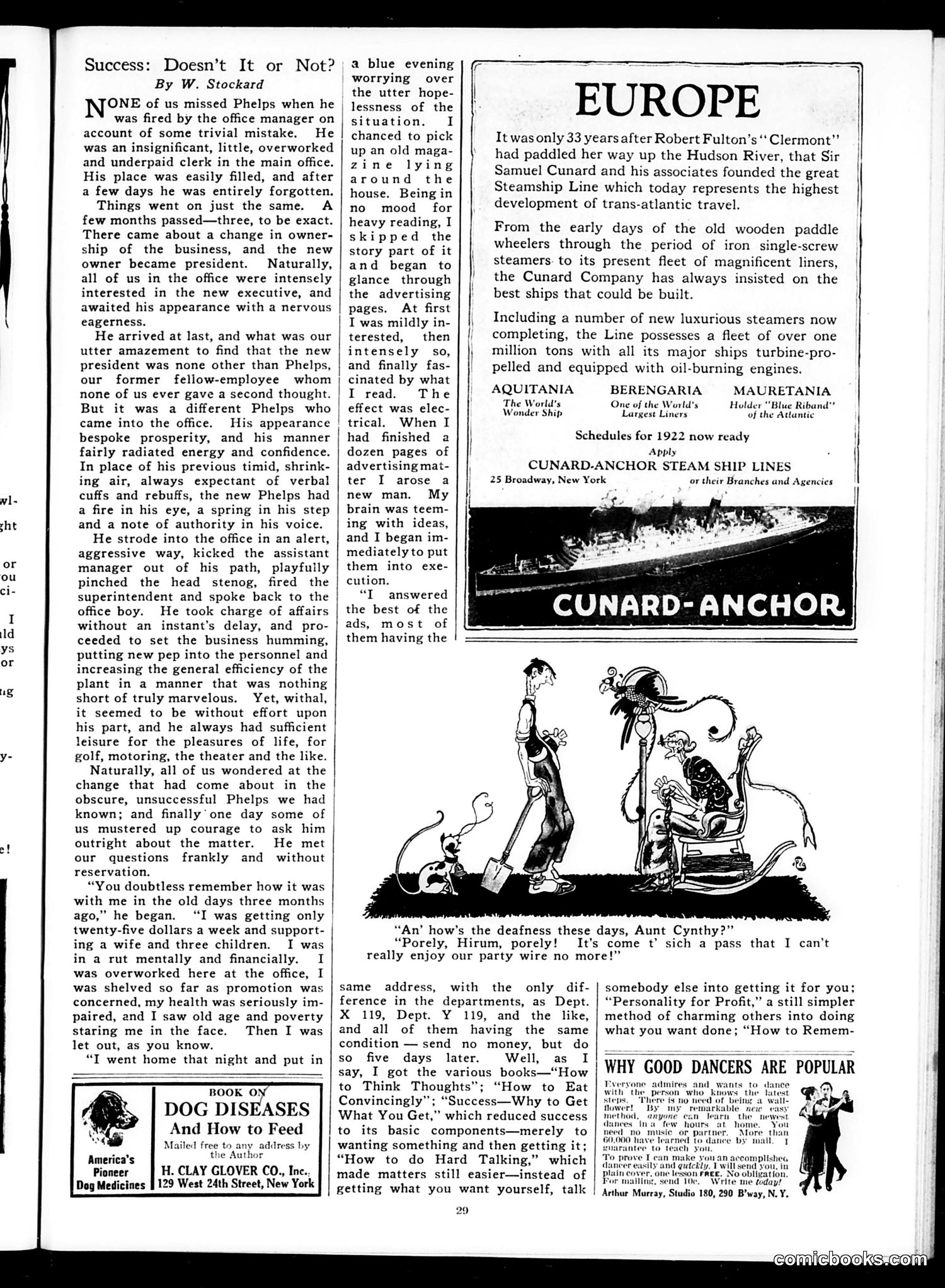
This page presents two distinct elements: **The Main Story ("Success: Doesn't It or Not?")** is a satirical tale about career advancement. A downtrodden, underpaid office clerk named Phelps is fired for a minor mistake and forgotten. Three months later, he returns as the company's new president—transformed into an aggressive, confident leader who immediately reorganizes the office. When asked about his transformation, Phelps reveals he discovered self-help magazine articles while unemployed (titles like "How to Think Thoughts," "How to Eat Convincingly," "Success—Why to Get What You Get"). **The Satire:** The piece mocks the early-20th-century self-help industry's promises that mere mental attitude and confidence-building techniques could transform one's circumstances. It's absurd that Phelps's reading alone made him suddenly competent—yet the story presents this as success. **The Cunard Advertisement** (right side) promotes luxury ocean liner travel, unrelated to the satire. The cartoon below shows a deaf woman at a party, unable to enjoy socializing—a sidebar advertisement for dance lessons.
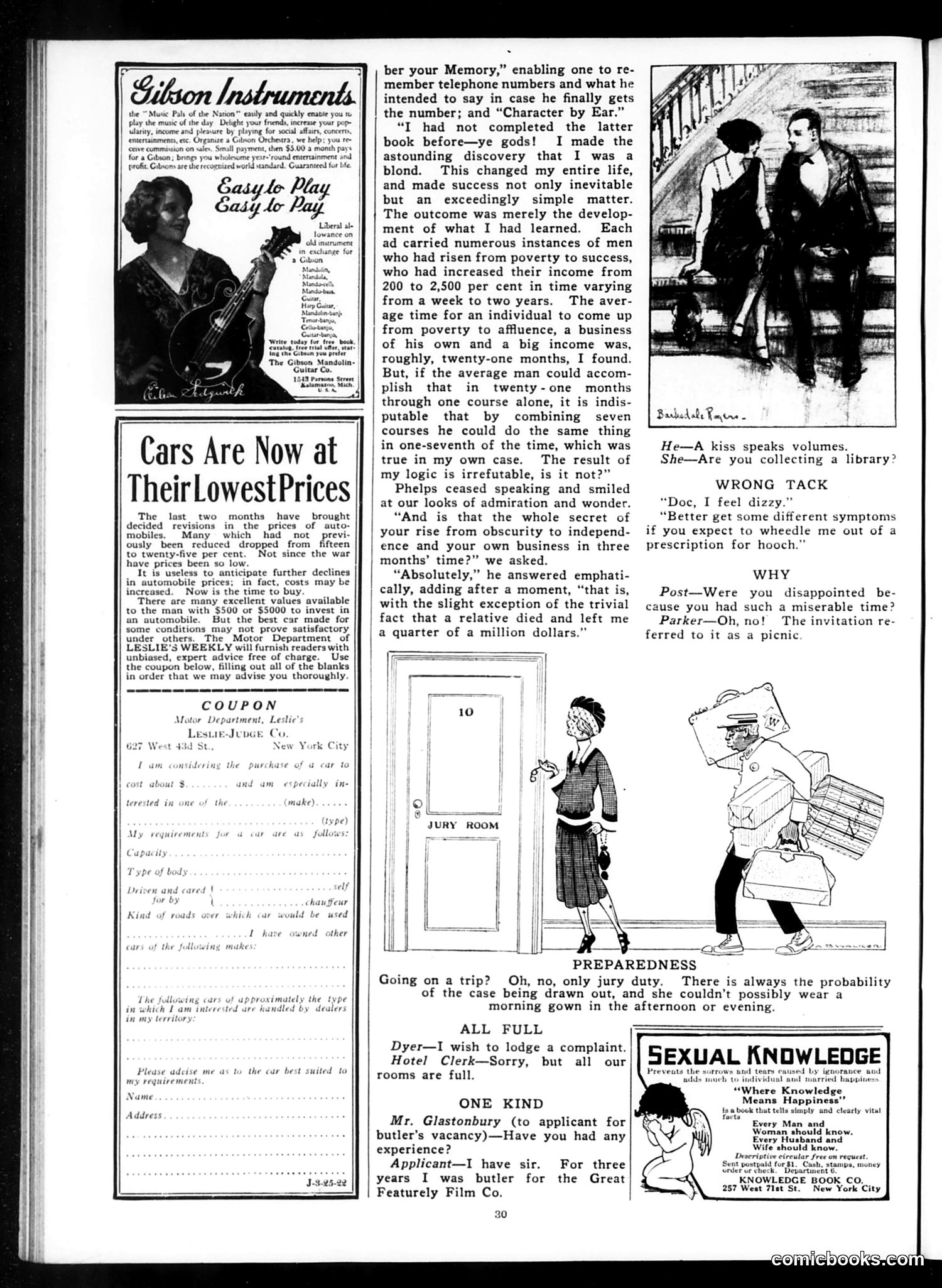
This page contains several brief satirical comics and advertisements from Judge magazine. The main satirical content includes: **"Phelps' Success Secret"** (upper right): A satirical narrative mocking self-help schemes and correspondence courses popular in the early 20th century. A man attributes his rise from poverty to "success" through combining multiple expensive courses, but reveals his actual fortune came from a relative's death. It's mockery of pseudo-scientific self-improvement promises. **"Wrong Tack"** (middle right): A doctor refuses to prescribe alcohol to a patient claiming dizziness, suggesting patients use genuinely different symptoms to manipulate doctors into bootleg prescriptions—likely referencing Prohibition-era attempts to obtain alcohol illegally through medical prescriptions. **"Preparedness"** (lower right): A woman selected for jury duty worries she lacks an appropriate dress for both morning and evening, illustrating female vanity over civic duty. The remaining items ("One Kind," "Why," "All Full") are brief humor pieces about employment and hotel complaints. The page primarily contains advertisements for Gibson instruments, automobile prices, and Leslie's Weekly.
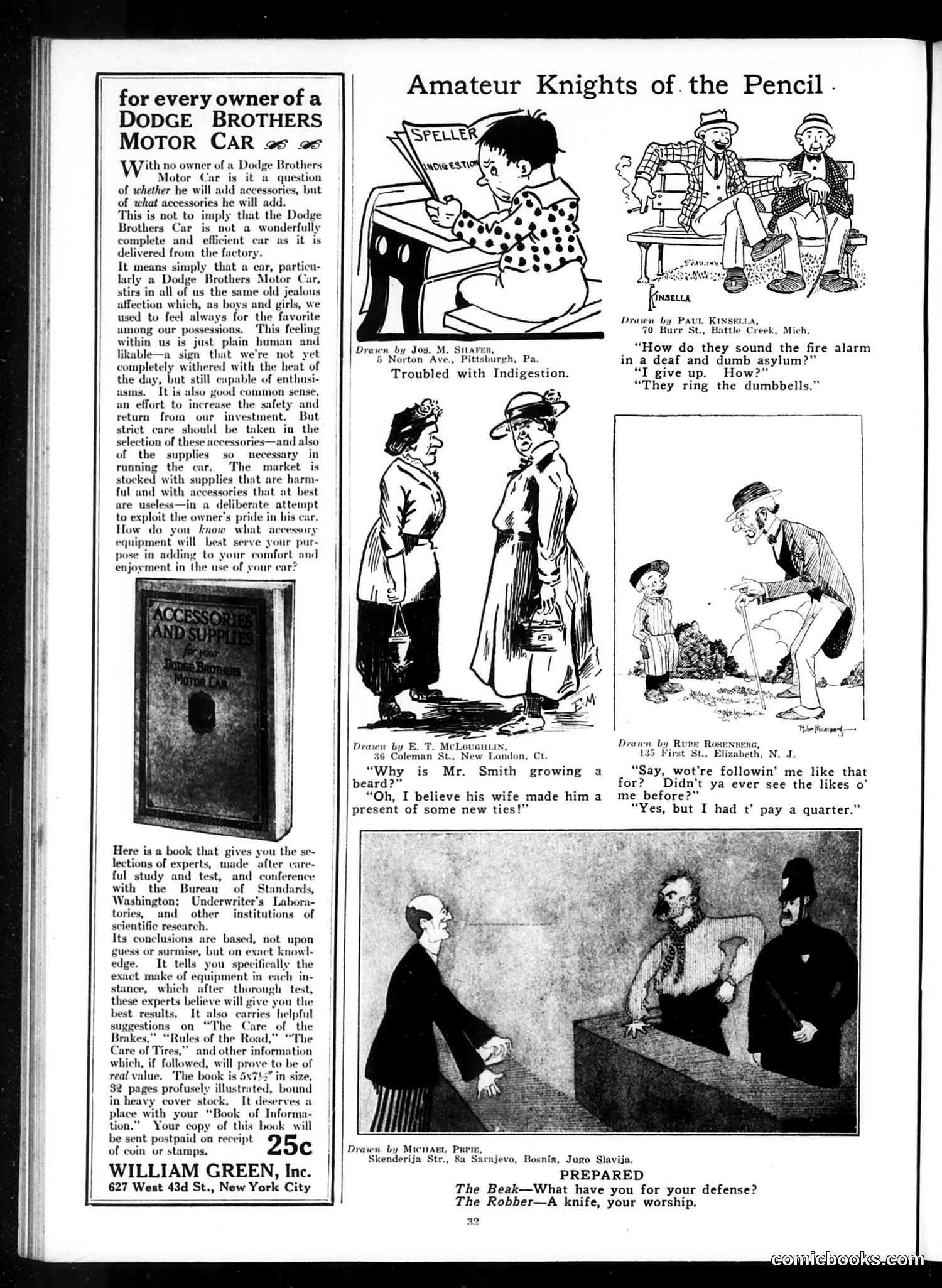
This page contains **amateur cartoons** submitted by readers to Judge magazine, plus a Dodge Brothers car advertisement. The cartoons are simple jokes: 1. **"Fire Alarm"**: A pun playing on "dumbbells" (weights) sounding like "dumb bells" (bells for deaf people). 2. **"Indigestion"**: A man complains his wife gave him ties as a gift, so he's growing a beard to hide them. 3. **"Following"**: A man asks why someone is trailing him; the reply is a class joke—the follower previously had to *pay* (commit a crime?) to see this man, but now follows for free. 4. **"Prepared"**: A courtroom scene where a robber claims his "defense" is a knife—dark humor about an inadequate legal defense. These represent submissions from amateur cartoonists (credited with names and addresses), showcasing the magazine's reader-participation feature. The humor is elementary—puns and simple observational jokes typical of early 20th-century popular comedy. The Dodge advertisement occupies the left side.
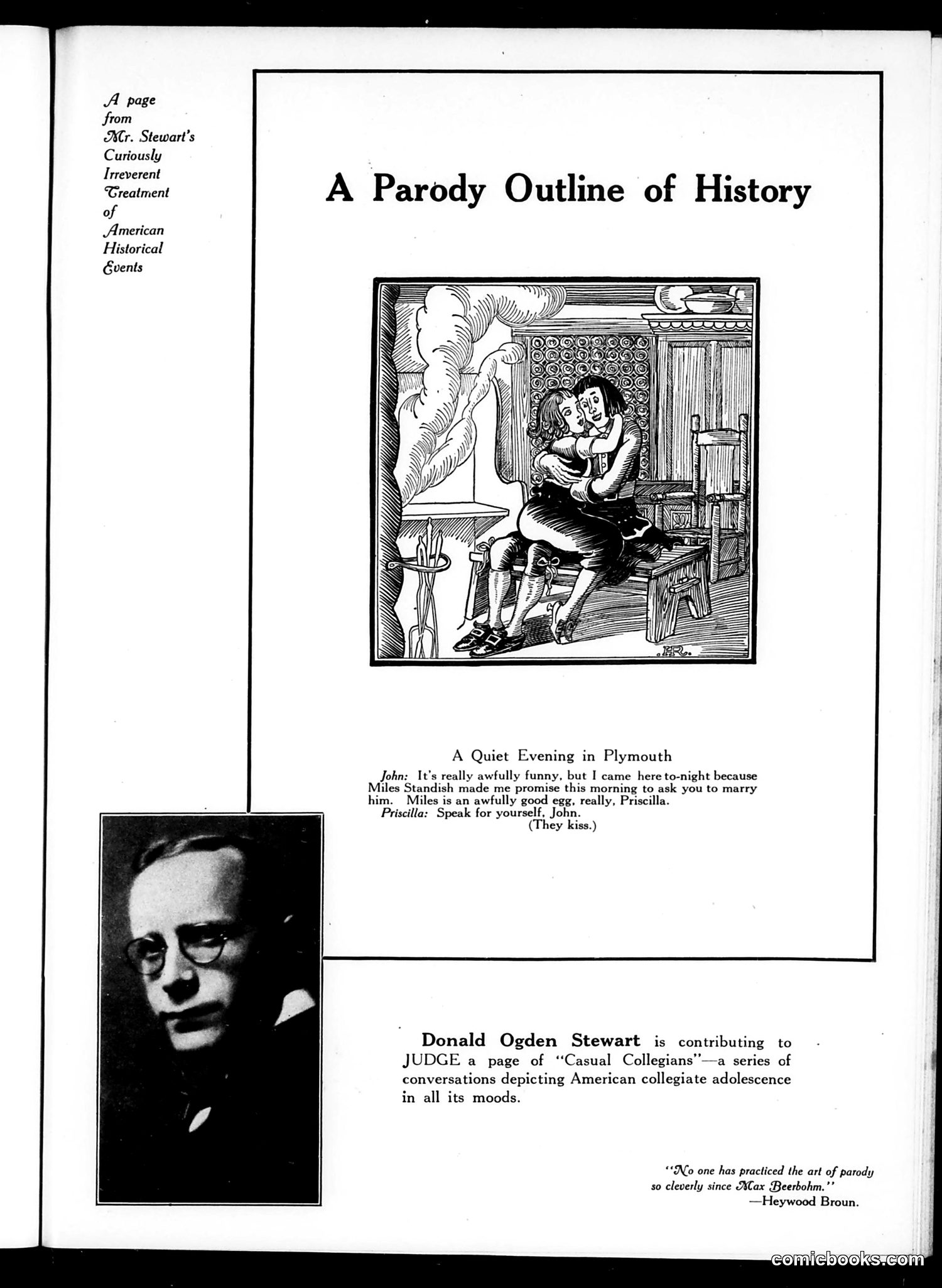
This parody satirizes the famous historical legend of the courtship of Priscilla Mullins and John Alden in colonial Plymouth. The traditional story depicts Miles Standish asking John to propose on his behalf, with Priscilla famously responding "speak for yourself, John." Stewart's parody subverts this romantic narrative by making it absurdly casual and modern—reducing the colonial love story to contemporary collegiate flirtation. The cartoon shows the couple kissing immediately after Priscilla's rejection of Standish, treating a supposedly momentous historical moment as trivial adolescent behavior. The satire mocks how Americans mythologize colonial history while suggesting that beneath the romanticized narrative, the actual behavior was probably just ordinary teenage romance. The page is part of Stewart's "Casual Collegians" series depicting American college life, applying irreverent modern sensibilities to supposedly dignified historical events.