
Judge, 1922-03-25 · page 8 of 36
Judge — March 25, 1922 — page 8: what you’re looking at
What you’re looking at
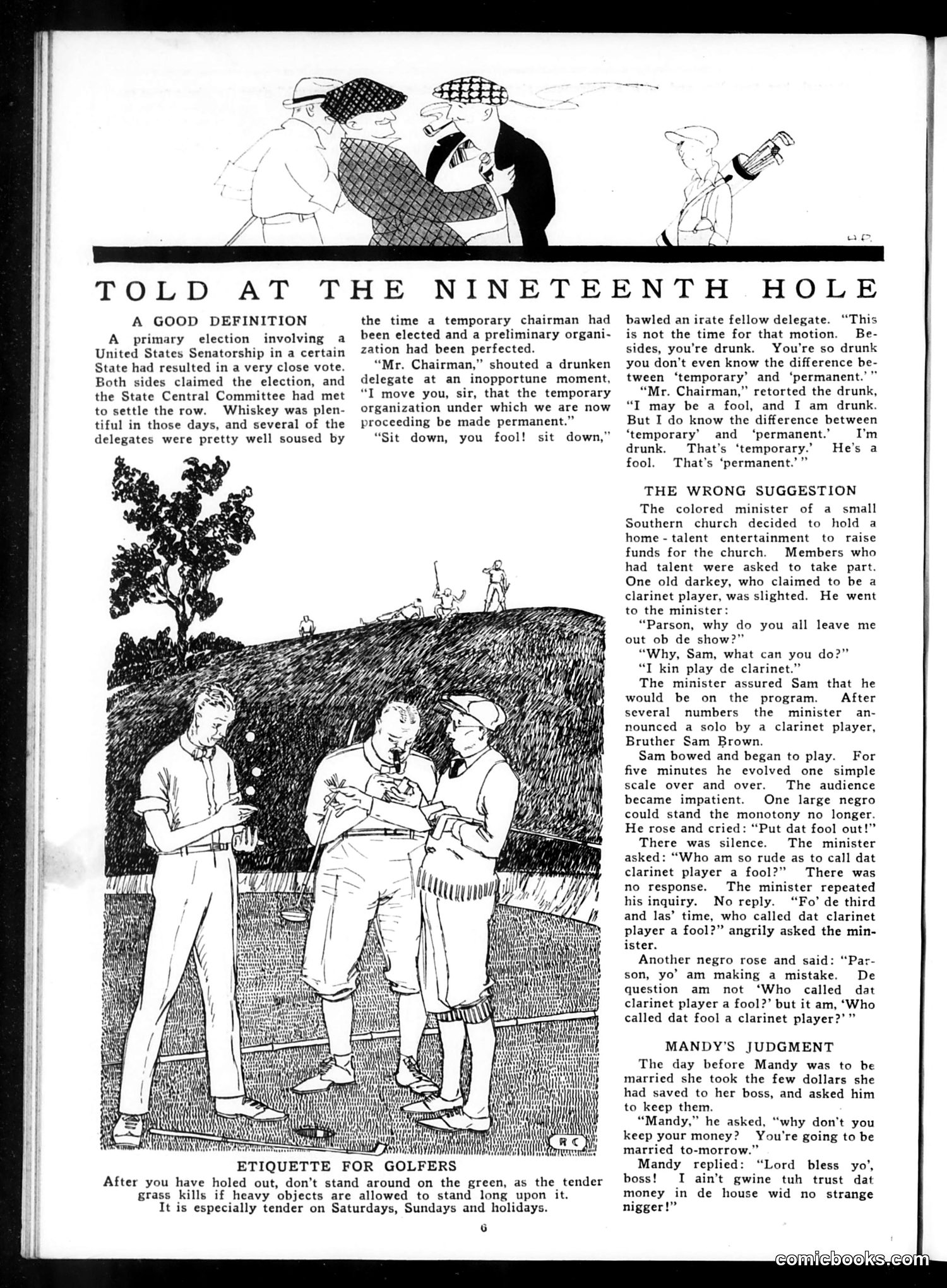
This page from *Judge* magazine contains three separate humorous anecdotes positioned as casual stories told among golfers (hence "nineteenth hole"—the bar at golf clubs). **"A Good Definition"** satirizes political corruption during the primary election era. A drunken delegate at a state party meeting confuses "temporary" and "permanent" organization, prompting his colleague to mock him—only for the drunk to cleverly retort that his intoxication is merely "temporary," while his rival's foolishness is "permanent." The joke mocks both alcohol-fueled politics and the self-deception of political operatives. **"The Wrong Suggestion"** and **"Mandy's Judgment"** employ racist caricatures and dialect stereotyping common to early 20th-century American humor magazines. These feature Black characters in servile or dependent positions, using exaggerated language for comedic effect. The page reflects *Judge's* era: political satire mixed with entertainment humor that relied heavily on ethnic and racial stereotyping accepted (though controversial even then) in mainstream publications.
📄 Transcribed text from this page (OCR, searchable)
Machine-transcribed from the original scan — historical spelling and the odd misread are preserved.
TOLD AT THE NINETEENTH HOLE A GOOD DEFINITION A primary election involving a United States Senatorship in a certain State had resulted in a very close vote. Both sides claimed the election, and the State Central Committee had met to settle the row. Whiskey was plen- tiful in those days, and several of the delegates were pretty well soused by the time a temporary chairman had been elected and a preliminary organi- zation had been perfected. “Mr. Chairman,” shouted a drunken delegate at an inopportune moment, “I move you, sir, that the temporary organization under which we are now proceeding be made permanent.” “Sit down, you fool! sit down,” nN ETIQUETTE FOR GOLFERS After you have holed out, don’t stand around on the green, as the tender grass kills if heavy objects are allowed to stand long upon it. It is especially tender on Saturdays, Sundays and holidays. 6 bawled an irate fellow delegate. “This is not the time for that motion. Be- sides, you're drunk. You're so drunk you don’t even know the difference be- tween ‘temporary’ and ‘permanent.’” “Mr. Chairman,” retorted the drunk, “I may be a fool, and I am drunk. But I do know the difference between ‘temporary’ and ‘permanent.’ I'm drunk. That’s ‘temporary.’ He's a fool. That's ‘permanent.’” THE WRONG SUGGESTION The colored minister of a small Southern church decided to hold a home - talent entertainment to raise funds for the church. Members who had talent were asked to take part. One old darkey, who claimed to be a clarinet player, was slighted. He went to the minister: “Parson, why do you all leave me out ob de show?” “Why, Sam, what can you do?” “I kin play de clarinet.” The minister assured Sam that he would be on the program. After several numbers the minister an- nounced a solo by a clarinet player, Bruther Sam Brown. Sam bowed and began to play. For five minutes he evolved one simple scale over and over. The audience became impatient. One large negro could stand the monotony no longer. He rose and cried: “Put dat fool out!” There was silence. The minister asked: “Who am so rude as to call dat clarinet player a fool?” There was no response. The minister repeated his inquiry. No reply. “Fo’ de third and las’ time, who called dat clarinet player a fool?” angrily asked the min- ister. Another negro rose and said: ‘“Par- son, yo’ am making a mistake. De question am not ‘Who called dat clarinet player a fool?’ but it am, ‘Who called dat fool a clarinet player?’” MANDY’S JUDGMENT The day before Mandy was to be married she took the few dollars she had saved to her boss, and asked him to keep them. “Mandy,” he asked, “why don't you keep your money? You're going to be married to-morrow.” Mandy replied: “Lord bless yo’, boss! I ain’t gwine tuh trust dat money in de house wid no strange nigger!”