
Judge, 1922-03-25 · page 22 of 36
Judge — March 25, 1922 — page 22: what you’re looking at
What you’re looking at
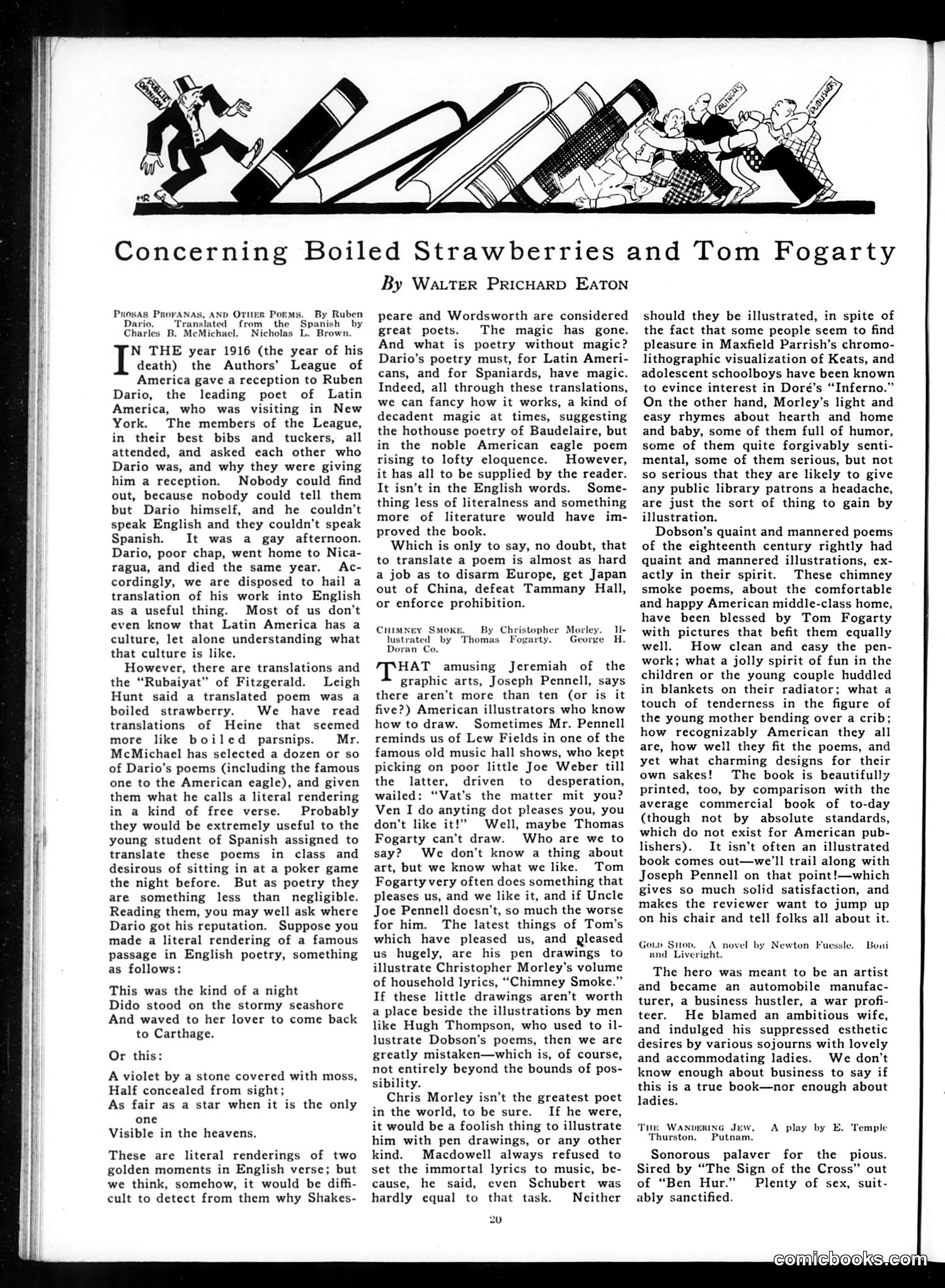
This page contains book reviews rather than political cartoons. The lead article criticizes a new English translation of poems by Rubén Darío, the recently deceased Latin American poet. The author mocks the Authors' League's 1916 reception for Darío—noting that none of the attendees actually knew who he was or why they were honoring him, since he spoke no English and they spoke no Spanish. This satirizes American cultural pretension and ignorance. The review's central metaphor compares literal poetic translation to "boiled strawberries"—something that loses all appeal through poor preparation. The author argues that while Darío's poetry likely contains genuine magic for Spanish speakers, the literal English rendering strips away all poetry. The second review defends illustrator Tom Fogarty against criticism from Joseph Pennell, a famous graphic artist known for harshly judging other illustrators' work. The piece humorously compares Pennell's constant carping to a vaudeville routine.
📄 Transcribed text from this page (OCR, searchable)
Machine-transcribed from the original scan — historical spelling and the odd misread are preserved.
Concerning Boiled Strawberries and Tom Fogarty By Ruben panish by death) the Authors’ League of America gave a reception to Ruben Dario, the leading poet of Latin America, who was visiting in New York. The members of the League, in their best bibs and tuckers, all attended, and asked each other who Dario was, and why they were giving him a reception. Nobody could find out, because nobody could tell them but Dario himself, and he couldn't speak English and they couldn’t speak Spanish. It was a gay afternoon. Dario, poor chap, went home to Nica- ragua, and died the same year. Ac- cordingly, we are disposed to hail a translation of his work into English as a useful thing. Most of us don’t even know that Latin America has a culture, let alone understanding what that culture is like. However, there are translations and the “Rubaiyat” of Fitzgerald. Leigh Hunt said a translated poem was a boiled strawberry. We have read translations of Heine that seemed more like boiled parsnips. Mr. McMichael has selected a dozen or so of Dario’s poems (including the famous one to the American eagle), and given them what he calls a literal rendering in a kind of free verse. Probably they would be extremely useful to the young student of Spanish assigned to translate these poems in class and desirous of sitting in at a poker game the night before. But as poetry they are something less than negligible. Reading them, you may well ask where Dario got his reputation. Suppose you made a literal rendering of a famous passage in English poetry, something as follows: This was the kind of a night Dido stood on the stormy seashore And waved to her lover to come back to Carthage. Or this: A violet by a stone covered with moss, Half concealed from sight; As fair as a star when it is the only one Visible in the heavens. These are literal renderings of two golden moments in English verse; but we think, somehow, it would be diffi- cult to detect from them why Shakes- By Wa ter PricHarD EaTon peare and Wordsworth are considered great poets. The magic has gone. And what is poetry without magic? Dario’s poetry must, for Latin Ameri- cans, and for Spaniards, have magic. Indeed, all through these translations, we can fancy how it works, a kind of decadent magic at times, suggesting the hothouse poetry of Baudelaire, but in the noble American eagle poem rising to lofty eloquence. However, it has all to be supplied by the reader. It isn’t in the English words. Some- thing less of literalness and something more of literature would have im- proved the book. Which is only to say, no doubt, that to translate a poem is almost as hard a job as to disarm Europe, get Japan out of China, defeat Tammany Hall, or enforce prohibition. topher Morley. + Cuimxey Smoke. By Chi rty. George H. lustrated by Thomas F Doran Co. THAT amusing Jeremiah of the graphic arts, Joseph Pennell, says there aren’t more than ten (or is it five?) American illustrators who know how to draw. Sometimes Mr. Pennell reminds us of Lew Fields in one of the famous old music hall shows, who kept picking on poor little Joe Weber till the latter, driven to desperation, wailed: “Vat'’s the matter mit you? Ven I do anyting dot pleases you, you don’t like it!” Well, maybe Thomas Fogarty can’t draw. Who are we to say? We don’t know a thing about art, but we know what we like. Tom Fogarty very often does something that pleases us, and we like it, and if Uncle Joe Pennell doesn’t, so much the worse for him. The latest things of Tom’s which have pleased us, and pleased us hugely, are his pen drawings to illustrate Christopher Morley’s volume of household lyrics, “Chimney Smoke.” If these little drawings aren’t worth a place beside the illustrations by men like Hugh Thompson, who used to il- lustrate Dobson’s poems, then we are greatly mistaken—which is, of course, not entirely beyond the bounds of pos- sibility. Chris Morley isn’t the greatest poet in the world, to be sure. If he were, it would be a foolish thing to illustrate him with pen drawings, or any other kind. Macdowell always refused to set the immortal lyrics to music, be- cause, he said, even Schubert was hardly equal to that task. Neither 20 should they be illustrated, in spite of the fact that some people seem to find pleasure in Maxfield Parrish’s chromo- lithographic visualization of Keats, and adolescent schoolboys have been known to evince interest in Doré’s “Inferno.” On the other hand, Morley’s light and easy rhymes about hearth and home and baby, some of them full of humor, some of them quite forgivably senti- mental, some of them serious, but not so serious that they are likely to give any public library patrons a headache, are just the sort of thing to gain by illustration. Dobson’s quaint and mannered poems of the eighteenth century rightly had quaint and mannered illustrations, ex- actly in their spirit. These chimney smoke poems, about the comfortable and happy American middle-class home, have been blessed by Tom Fogarty with pictures that befit them equally well. How clean and easy the pen- work; what a jolly spirit of fun in the children or the young couple huddled in blankets on their radiator; what a touch of tenderness in the figure of the young mother bending over a crib; how recognizably American they all are, how well they fit the poems, and yet what charming designs for their own sakes! The book is beautifully printed, too, by comparison with the average commercial book of to-day (though not by absolute standards, which do not exist for American pub- lishers). It isn’t often an illustrated book comes out—we'll trail along with Joseph Pennell on that point!—which gives so much solid satisfaction, and makes the reviewer want to jump up on his chair and tell folks all about it. Gow Stop. A novel by Newton Fuessle. Boni and Liveright. The hero was meant to be an artist and became an automobile manufac- turer, a business hustler, a war profi- teer. He blamed an ambitious wife, and indulged his suppressed esthetic desires by various sojourns with lovely and accommodating ladies. We don’t know enough about business to say if this is a true book—nor enough about ladies. Tur A play by E. Temple Thurs‘ the pious. palaver for Sired by “The Sign of the Cross” out Sonorous of “Ben Hur.” ably sanctified. Plenty of sex, suit-