
Judge, 1922-03-25 · page 14 of 36
Judge — March 25, 1922 — page 14: what you’re looking at
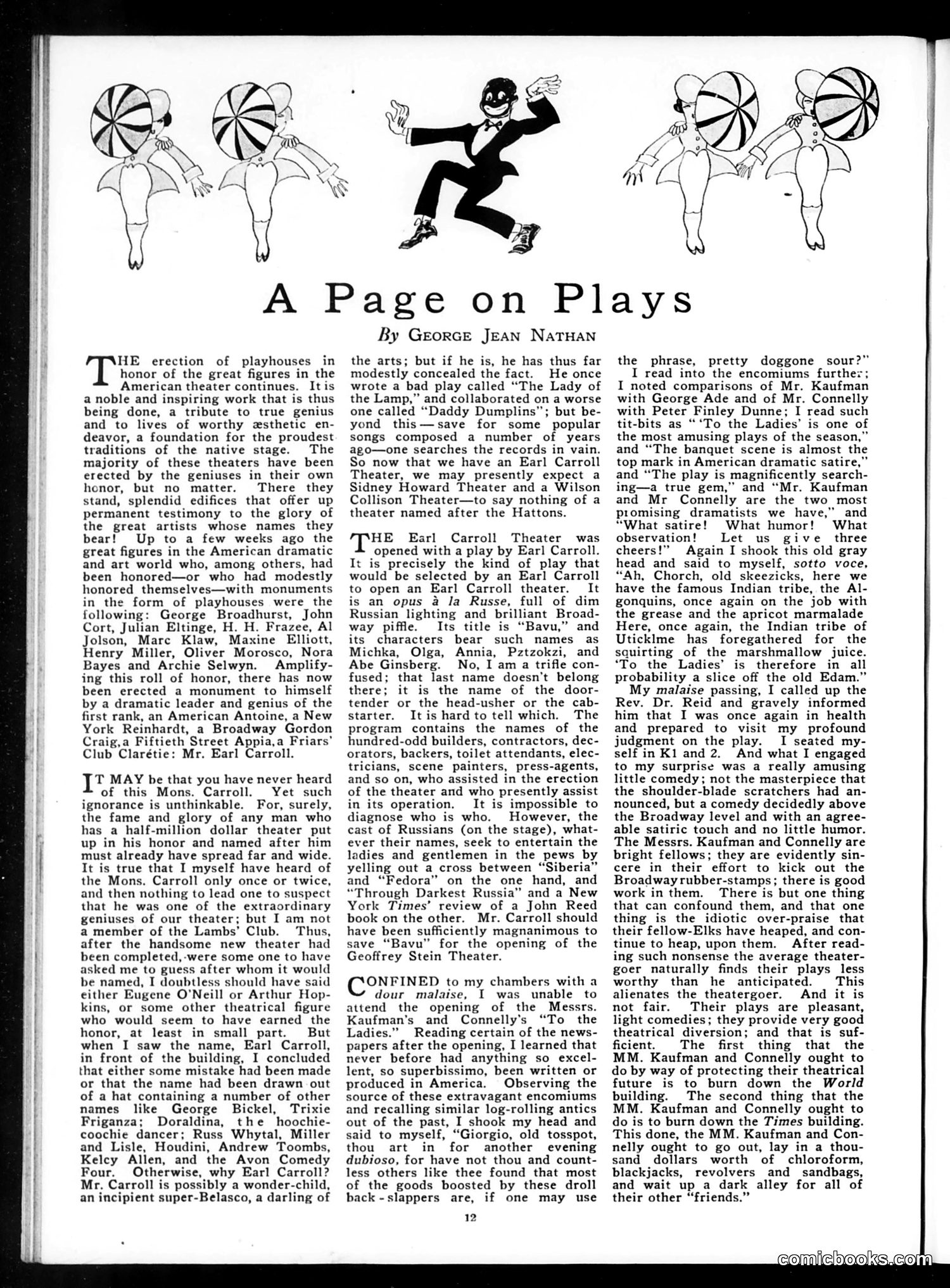
A restored page from Judge, 1922-03-25. Page through the whole issue in the reader above.
📄 Transcribed text from this page (OCR, searchable)
Machine-transcribed from the original scan — historical spelling and the odd misread are preserved.
A Page on Plays HE erection of playhouses in honor of the great figures in the American theater continues. Itis a noble and inspiring work that is thus being done, a tribute to true genius and to lives of worthy esthetic en- deavor, a foundation for the proudest traditions of the native stage. The majority of these theaters have been erected by the geniuses in their own honor, but no matter. There they stand, splendid edifices that offer up permanent testimony to the glory of the great artists whose names they bear! Up to a few weeks ago the great figures in the American dramatic and art world who, among others, had been honored—or who had modestly honored themselves—with monuments in the form of playhouses were the following: George Broadhurst, John Cort, Julian Eltinge, H. H. Frazee, Al Jolson, Mare Klaw, Maxine Elliott, Henry Miller, Oliver Morosco, Nora Bayes and Archie Selwyn. Amplify- ing this roll of honor, there has now been erected a monument to himself by a dramatic leader and genius of the first rank, an American Antoine, a New York Reinhardt, a Broadway Gordon Craig,a Fiftieth Street Appia,a Friars’ Club Clarétie: Mr. Earl Carroll. It MAY be that you have never heard of this Mons. Carroll. Yet such ignorance is unthinkable. For, surely, the fame and glory of any man who has a half-million dollar theater put up in his honor and named after him must already have spread far and wide. It is true that I myself have heard of the Mons. Carroll only once or twice, and then nothing to lead one to suspect that he was one of the extraordinary geniuses of our theater; but I am not a member of the Lambs’ Club. Thus, after the handsome new theater had been completed, -were some one to have asked me to guess after whom it would be named, I doubtless should have said either Eugene O'Neill or Arthur Hop- kins, or some other theatrical figure who would seem to have earned the honor, at least in small part. But when I saw the name, Earl Carroll, in front of the building, I concluded that either some mistake had been made or that the name had been drawn out of a hat containing a number of other names like George Bickel, Trixie Friganza; Doraldina, the hoochie- coochie dancer; Russ Whytal, Miller and Lisle, Houdini, Andrew Toombs, Kelcy Allen, and the Avon Comedy Four. Otherwise, why Earl Carroll? Mr, Carroll is possibly a wonder-child, an incipient super-Belasco, a darling of By Greorce JEAN NaTHAN the arts; but if he is, he has thus far modestly concealed the fact. He once wrote a bad play called “The Lady of the Lamp,” and collaborated on a worse one called “Daddy Dumplins”; but be- yond this—save for some popular songs composed a number of years ago—one searches the records in vain. So now that we have an Earl Carroll Theater, we may presently expect a Sidney Howard Theater and a Wilson Collison Theater—to say nothing of a theater named after the Hattons. HE Earl Carroll Theater was opened with a play by Earl Carroll. t is precisely the kind of play that would be selected by an Earl! Carroll to open an Earl Carroll theater. It is an opus a Ja Russe, full of dim Russian lighting and brilliant Broad- way piffle. Its title is “Bavu,” and its characters bear such names as Michka, Olga, Annia, Pztzokzi, and Abe Ginsberg. No, I am a trifle con- fused; that last name doesn’t belong there; it is the name of the door- tender or the head-usher or the cab- starter. It is hard to tell which. The program contains the names of the hundred-odd builders, contractors, dec- orators, backers, toilet attendants, elec- tricians, scene painters, press-agents, and so on, who assisted in the erection of the theater and who presently assist in its operation. It is impossible to diagnose who is who. However, the cast of Russians (on the stage), what- ever their names, seek to entertain the ladies and gentlemen in the pews by yelling out a cross between “Siberia” and “Fedora” on the one hand, and “Through Darkest Russia” and a New York Times’ review of a John Reed book on the other. Mr. Carroll should have been sufficiently magnanimous to save “Bavu” for the opening of the Geoffrey Stein Theater. CONFINED to my chambers with a dour malaise, I was unable to attend the opening of the Messrs. Kaufman's and Connelly’s “To the Ladies.” Reading certain of the news- papers after the opening, I learned that never before had anything so excel- lent, so superbissimo, been written or produced in America. Observing the source of these extravagant encomiums and recalling similar log-rolling antics out of the past, I shook my head and said to myself, “Giorgio, old tosspot, thou art in for another evening dubioso, for have not thou and count- less others like thee found that most of the goods boosted by these droll back-slappers are, if one may use 12 the phrase, pretty doggone sour?” I read into the encomiums furthez; I noted comparisons of Mr. Kaufman with George Ade and of Mr. Connelly with Peter Finley Dunne; I read such tit-bits as “‘To the Ladies’ is one of the most amusing plays of the season,” and “The banquet scene is almost the top mark in American dramatic satire,” and “The play is magnificently search- ing—a true gem,” and “Mr. Kaufman and Mr Connelly are the two most promising dramatists we have,” and “What satire! What humor! What observation! Let us give three cheers!” Again I shook this old gray head and said to myself, sotto voce, “Ah, Chorch, old skeezicks, here we have the famous Indian tribe, the Al- gonquins, once again on the job with the grease and the apricot marmalade Here, once again, the Indian tribe of Uticklme has foregathered for the squirting of the marshmallow juice. ‘To the Ladies’ is therefore in all probability a slice off the old Edam.” My malaise passing, I called up the Rev. Dr. Reid and gravely informed him that I was once again in health and prepared to visit my profound judgment on the play. I seated my- self in K1 and 2. And what I engaged to my surprise was a really amusing little comedy; not the masterpiece that the shoulder-blade scratchers had an- nounced, but a comedy decidedly above the Broadway level and with an agree- able satiric touch and no little humor. The Messrs. Kaufman and Connelly are bright fellows; they are evidently sin- cere in their effort to kick out the Broadwayrubber-stamps; there is good work in them. There is but one thing that can confound them, and that one thing is the idiotic over-praise that their fellow-Elks have heaped, and con- tinue to heap, upon them. After read- ing such nonsense the average theater- goer naturally finds their plays less worthy than he anticipated. This alienates the theatergoer. And it is not fair. Their plays are pleasant, light comedies; they provide very good theatrical diversion; and that is suf- ficient. The first thing that the MM. Kaufman and Connelly ought to do by way of protecting their theatrical future is to burn down the World building. The second thing that the MM. Kaufman and Connelly ought to do is to burn down the Times building. This done, the MM. Kaufman and Con- nelly ought to go out, lay in a thou- sand dollars worth of chloroform, blackjacks, revolvers and sandbags, and wait up a dark alley for all of their other “friends.”