
Judge, 1922-03-25 · page 21 of 36
Judge — March 25, 1922 — page 21: what you’re looking at
What you’re looking at
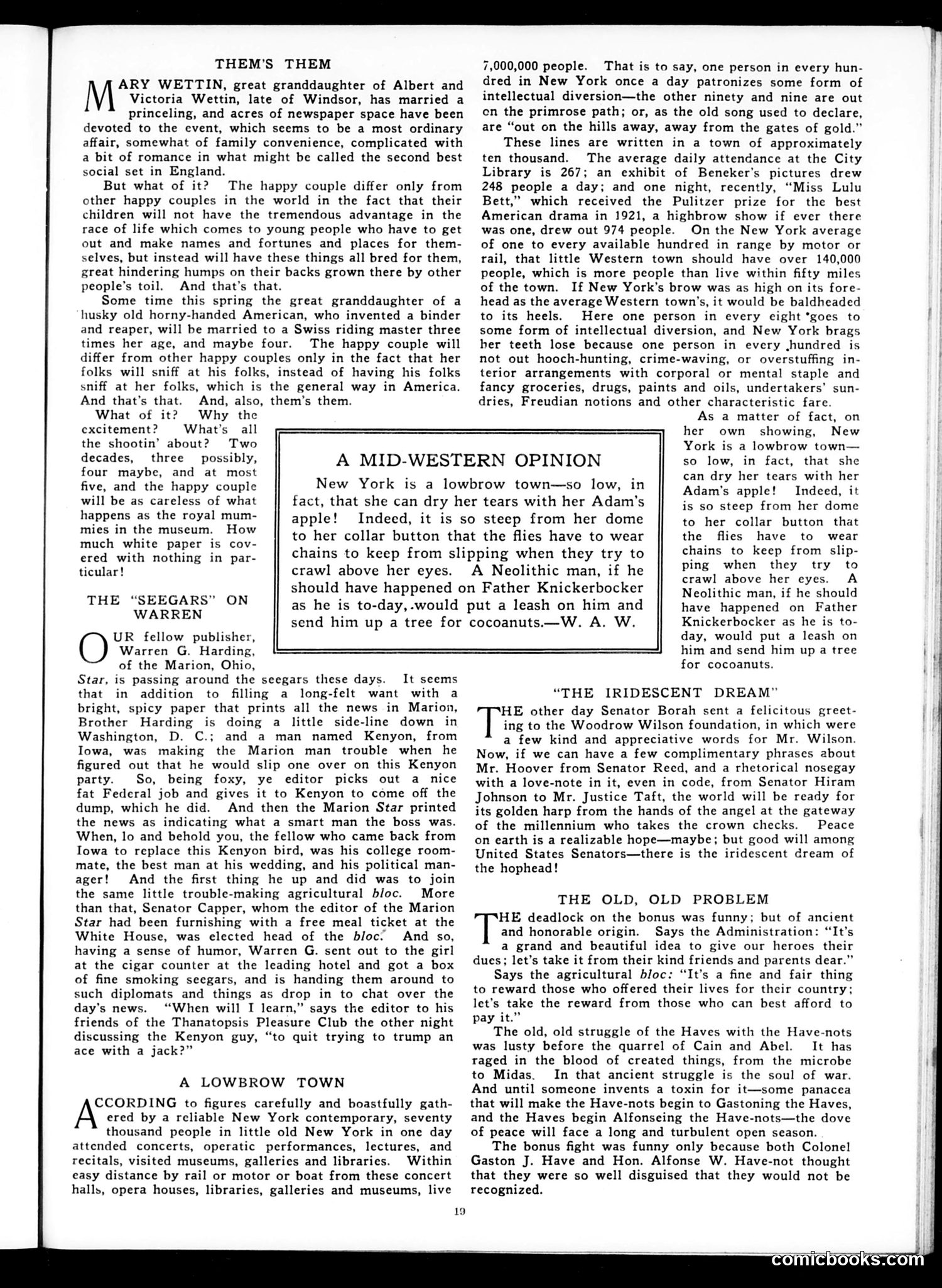
This page contains satirical commentary on three separate topics: **"Them's Them"**: Mocks excessive newspaper coverage of Mary Wettin's (likely a royal or aristocratic figure) marriage. The satire argues that inherited privilege, while celebrated, actually handicaps children compared to self-made Americans. The contrast—a wealthy American heiress marrying a poor Swiss riding master—illustrates that class distinctions are ultimately meaningless. **"The 'Seegars' on Warren"**: Attacks Warren G. Harding (Marion, Ohio newspaper publisher and future U.S. President) for hypocritical self-promotion. He publicized a federal job appointment as evidence of his political savvy, but the appointee was replaced by the original candidate's college roommate—undermining Harding's claimed influence. The "seegars" (cigars) reference Harding's embarrassed attempts to smooth over the political blunder. **"A Lowbrow Town"**: Sarcastically critiques New York's cultural pretensions, claiming despite 70,000 daily attendees at high-culture venues, the city remains fundamentally lowbrow—too preoccupied with material concerns to truly appreciate intellectual pursuits.
📄 Transcribed text from this page (OCR, searchable)
Machine-transcribed from the original scan — historical spelling and the odd misread are preserved.
THEM'S THEM ARY WETTIN, great granddaughter of Albert and M Victoria Wettin, late of Windsor, has married a princeling, and acres of newspaper space have been devoted to the event, which seems to be a most ordinary affair, somewhat of family convenience, complicated with a bit of romance in what might be called the second best social set in England. But what of it? The happy couple differ only from other happy couples in the world in the fact that their children will not have the tremendous advantage in the race of life which comes to young people who have to get out and make names and fortunes and places for them- selves, but instead will have these things all bred for them, great hindering humps on their backs grown there by other people’s toil. And that’s that. Some time this spring the great granddaughter of a husky old horny-handed American, who invented a binder and reaper, will be married to a Swiss riding master three times her age, and maybe four. The happy couple will differ from other happy couples only in the fact that her folks will sniff at his folks, instead of having his folks sniff at her folks, which is the general way in America. And that's that. And, also, them’s them. What of it? Why the excitement? What's all the shootin’ about? Two decades, three possibly, four maybe, and at most five, and the happy couple will be as careless of what happens as the royal mum- mies in the museum. How much white paper is cov- ered with nothing in par- ticular! apple! crawl above her eyes. THE “SEEGARS” ON WARREN UR fellow publisher, Warren G. Harding, of the Marion, Ohio, Star, is passing around the seegars these days. It seems that in addition to filling a long-felt want with a bright, spicy paper that prints all the news in Marion, Brother Harding is doing a little side-line down in Washington, D. C.; and a man named Kenyon, from Iowa, was making the Marion man trouble when he figured out that he would slip one over on this Kenyon party. So, being foxy, ye editor picks out a nice fat Federal job and gives it to Kenyon to come off the dump, which he did. And then the Marion Star printed the news as indicating what a smart man the boss was. When, lo and behold you, the fellow who came back from Iowa to replace this Kenyon bird, was his college room- mate, the best man at his wedding, and his political man- ager! And the first thing he up and did was to join the same little trouble-making agricultural bloc. More than that, Senator Capper, whom the editor of the Marion Star had been furnishing with a free meal ticket at the White House, was elected head of the bloc. And so, having a sense of humor, Warren G. sent out to the girl at the cigar counter at the leading hotel and got a box of fine smoking seegars, and is handing them around to such diplomats and things as drop in to chat over the day’s news. ‘When will I learn,” says the editor to his friends of the Thanatopsis Pleasure Club the other night discussing the Kenyon guy, “to quit trying to trump an ace with a jack?” A LOWBROW TOWN CCORDING to figures carefully and boastfully gath- A ered by a reliable New York contemporary, seventy thousand people in little old New York in one day attended concerts, operatic performances, lectures, and recitals, visited museums, galleries and libraries. Within easy distance by rail or motor or boat from these concert halls, opera houses, libraries, galleries and museums, live New York is a lowbrow town—so low, in fact, that she can dry her tears with her Adam's Indeed, it is so steep from her dome to her collar button that the flies have to wear the flies have to wear chains to keep from slipping when they try to A Neolithic man, if he should have happened on Father Knickerbocker as he is to-day,-would put a leash on him and send him up a tree for cocoanuts.—W. A. W. 7,000,000 people. That is to say, one person in every hun- dred in New York once a day patronizes some form of intellectual diversion—the other ninety and nine are out en the primrose path; or, as the old song used to declare, are “out on the hills away, away from the gates of gold.” These lines are written in a town of approximately ten thousand. The average daily attendance at the City Library is 267; an exhibit of Beneker's pictures drew 248 people a day; and one night, recently, “Miss Lulu Bett,” which received the Pulitzer prize for the hest American drama in 1921, a highbrow show if ever there was one, drew out 974 people. On the New York average of one to every available hundred in range by motor or rail, that little Western town should have over 140,000 people, which is more people than live within fifty miles of the town. If New York’s brow was as high on its fore- head as the average Western town’s, it would be baldheaded to its heels. Here one person in every eight ‘goes to some form of intellectual diversion, and New York brags her teeth lose because one person in every ,hundred is not out hooch-hunting, crime-waving, or overstuffing in- terior arrangements with corporal or mental staple and fancy groceries, drugs, paints and oils, undertakers’ sun- dries, Freudian notions and other characteristic fare. As a matter of fact, on her own showing, New York is a lowbrow town— A MID-WESTERN OPINION so low, in fact, that she can dry her tears with her Adam's apple! Indeed, it is so steep from her dome to her collar button that chains to keep from slip- ping when they try to crawl above her eyes. A Neolithic man, if he should have happened on Father Knickerbocker as he is to- day, would put a leash on him and send him up a tree for cocoanuts. “THE IRIDESCENT DREAM” HE other day Senator Borah sent a felicitous greet- ‘Tie to the Woodrow Wilson foundation, in which were a few kind and appreciative words for Mr. Wilson Now, if we can have a few complimentary phrases about Mr. Hoover from Senator Reed, and a rhetorical nosegay with a love-note in it, even in code, from Senator Hiram Johnson to Mr. Justice Taft, the world will be ready for its golden harp from the hands of the angel at the gateway of the millennium who takes the crown checks. Peace on earth is a realizable hope—maybe; but good will among United States Senators—there is the iridescent dream of the hophead! THE OLD, OLD PROBLEM HE deadlock on the bonus was funny; but of ancient and honorable origin. Says the Administration: “It’s a grand and beautiful idea to give our heroes their dues; let’s take it from their kind friends and parents dear.” Says the agricultural bloc: “It’s a fine and fair thing to reward those who offered their lives for their country; let's take the reward from those who can best afford to pay it.” The old, old struggle of the Haves with the Have-nots was lusty before the quarrel of Cain and Abel. It has raged in the blood of created things, from the microbe to Midas. In that ancient struggle is the soul of war. And until someone invents a toxin for it—some panacea that will make the Have-nots begin to Gastoning the Haves, and the Haves begin Alfonseing the Have-nots—the dove of peace will face a long and turbulent open season. The bonus fight was funny only because both Colonel Gaston J. Have and Hon. Alfonse W. Have-not thought that they were so well disguised that they would not be recognized.