
Judge, 1922-03-25 · page 31 of 36
Judge — March 25, 1922 — page 31: what you’re looking at
What you’re looking at
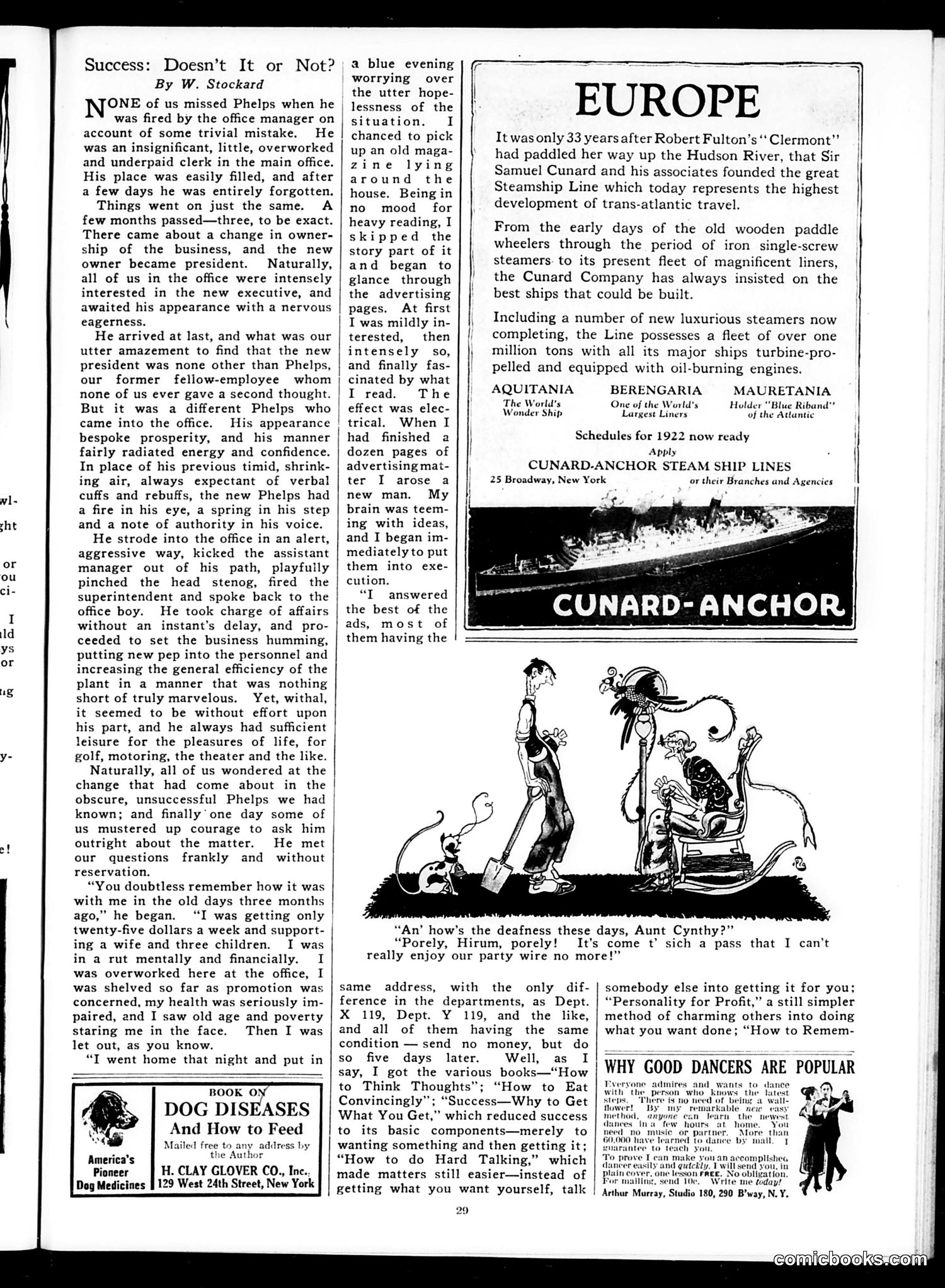
This page presents two distinct elements: **The Main Story ("Success: Doesn't It or Not?")** is a satirical tale about career advancement. A downtrodden, underpaid office clerk named Phelps is fired for a minor mistake and forgotten. Three months later, he returns as the company's new president—transformed into an aggressive, confident leader who immediately reorganizes the office. When asked about his transformation, Phelps reveals he discovered self-help magazine articles while unemployed (titles like "How to Think Thoughts," "How to Eat Convincingly," "Success—Why to Get What You Get"). **The Satire:** The piece mocks the early-20th-century self-help industry's promises that mere mental attitude and confidence-building techniques could transform one's circumstances. It's absurd that Phelps's reading alone made him suddenly competent—yet the story presents this as success. **The Cunard Advertisement** (right side) promotes luxury ocean liner travel, unrelated to the satire. The cartoon below shows a deaf woman at a party, unable to enjoy socializing—a sidebar advertisement for dance lessons.
📄 Transcribed text from this page (OCR, searchable)
Machine-transcribed from the original scan — historical spelling and the odd misread are preserved.
Doesn’t It or Not? By W. Stockard NONE of us missed Phelps when he was fired by the office manager on account of some trivial mistake. He was an insignificant, little, overworked and underpaid clerk in the main office. His place was easily filled, and after a few days he was entirely forgotten. Things went on just the same. A few months passed—three, to be exact. There came about a change in owner- ship of the business, and the new owner became president. Naturally, all of us in the office were intensely interested in the new executive, and awaited his appearance with a nervous eagerness. He arrived at last, and what was our utter amazement to find that the new president was none other than Phelps, our former fellow-employee whom none of us ever gave a second thought. Success: But it was a different Phelps who | came into the office. His appearance bespoke prosperity, and his manner fairly radiated energy and confidence. In place of his previous timid, shrink- ing air, always expectant of verbal cuffs and rebuffs, the new Phelps had a fire in his eye, a spring in his step and a note of authority in his voice. He strode into the office in an alert, aggressive way, kicked the assistant manager out of his path, playfully pinched the head stenog, fired the superintendent and spoke back to the office boy. He took charge of affairs without an instant’s delay, and pro- ceeded to set the business humming, putting new pep into the personnel and increasing the general efficiency of the plant in a manner that was nothing short of truly marvelous. Yet, withal, it seemed to be without effort upon his part, and he always had sufficient leisure for the pleasures of life, for golf, motoring, the theater and the like. Naturally, all of us wondered at the change that had come about in the obscure, unsuccessful Phelps we had known; and finally’one day some of us mustered up courage to ask him outright about the matter. He met our questions frankly and without reservation. “You doubtless remember how it was with me in the old days three months ago,” he began. “I was getting only twenty-five dollars a week and support- ing a wife and three children. I was in a rut mentally and financially. I was overworked here at the office, I was shelved so far as promotion was concerned, my health was seriously im- paired, and I saw old age and poverty staring me in the face. Then I was let out, as you know. “I went home that night and put in DOG DISEASES And How to Feed Mailed free to any address by the Author America’s Pionet H. CLAY GLOVER CO., Inc. 129 West 24th Street, New York a blue evening | worrying over the utter hope- | lessness of the | [| ee) situation. I chanced to pick It was only 33 years after Robert Fulton’s “Clermont” up an old maga- had paddled her way up the Hudson River, that Sir zine lying Samuel Cunard and his associates founded the great around the house. Being in no mood for mints ett From the early days of the old wooden paddle story part of it | | wheelers through the period of iron single-screw and began to | steamers. to its present fleet of magnificent liners, glance through | || the Cunard Company has always insisted on the the advertising | || best ships that could be built. pages. At first I was mildly in- | |) Steamship Line which today represents the highest development of trans-atlantic travel. Including a number of new luxurious steamers now terested, then | // completing, the Line possesses a fleet of over one intensely so,| | million tons with all its major ships turbine-pro- and finally fas- pelled and equipped with oil-burning engines. cinated by what t sad The AQUITANIA BERENGARIA — MAURETANIA The World’ ¢ of the World's older “Blue Riband’* effect was elec- Wonder Shi Sita ee | trical. When I | had finished a | || Schedules for 1922 now ready | dozen pages of | |! Apply advertising mat- | |, CUNARD-ANCHOR STEAM SHIP LINES ter I arose a] |, 25 Broadway, New York _ or their Branches and Agencies new man. My | }! A | brain was teem- 7 ing with ideas, and I began im- mediatelyto put them into exe- cution. “IT answered the best of the ads, most of them having the - “An’ how's the deafness these days, Aunt Cynthy?” “Porely, Hirum, porely! It’s come t’ sich a pass that I can’t really enjoy our party wire no more!” same address, with the only dif- | somebody else into getting it for you; ference in the departments, as Dept. | “Personality for Profit,” a still simpler X 119, Dept. Y 119, and the like, | method of charming others into doing and all of them having the same | what you want done; “How to Remem- condition — send no money, but do so five days later. Well, as I say, I got the various books—‘How to Think Thoughts”; “How to Eat Convincingly”; “Success—Why to Get What You Get,” which reduced success to its basic components—merely to wanting something and then getting it; “How to do Hard Talking,” which made matters still easier—instead of getting what you want yourself, talk ‘complishea nd vou, it n FREE. No obligation, ‘Write me today! Arthur Murray, Studio 180, 290 Bway, N.Y. 29