
Judge, 1922-03-25 · page 11 of 36
Judge — March 25, 1922 — page 11: what you’re looking at
What you’re looking at
This is a morality tale about workplace management and human nature, not political satire. The narrator contrasts two approaches to hiring workers: The narrator praises his employees generously, calling them "birds" and complimenting their work. They arrive "in jaunty style" and work happily. His neighbor Sam, by contrast, constantly criticizes and finds fault with workers, causing them to become angry and defensive—leading to fistfights. Mason's point: **kindness and encouragement motivate better work than criticism and complaints.** He illustrates this with a final anecdote about his annoying rooster. Rather than insulting his neighbor Zeke's livestock and property, the narrator praises Zeke's thoughtfulness, which dissolves tensions and transforms potential conflict into friendship. The message is straightforward labor advice for a modern audience: positive reinforcement works better than negativity. There's no hidden political reference—just practical wisdom about human psychology wrapped in homey, vernacular verse.
📄 Transcribed text from this page (OCR, searchable)
Machine-transcribed from the original scan — historical spelling and the odd misread are preserved.
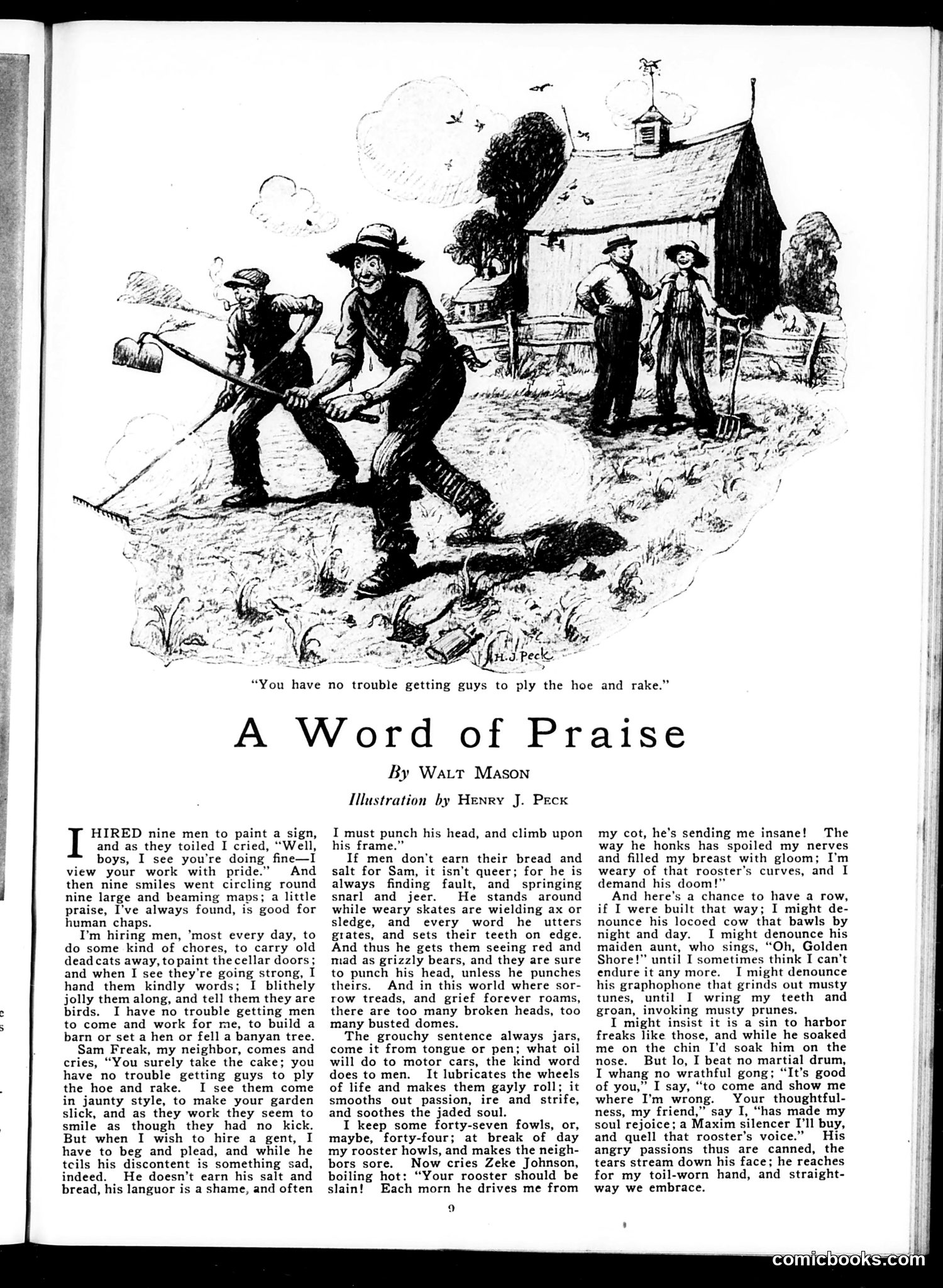
“You have no trouble getting guys to Sa the hoe and rake.” A Word of Praise HIRED nine men to paint a sign, and as they toiled I cried, “Well, boys, I see you're doing fine—I And I view your work with pride.” then nine smiles went circling round nine large and beaming maps; a little praise, I’ve always found, is good for human chaps. I'm hiring men, ’most every day, to do some kind of chores, to carry old dead cats away, topaint the cellar doors; and when I see they're going strong, I hand them kindly words; I blithely jolly them along, and tell them they are birds. I have no trouble getting men to come and work for me, to build a barn or set a hen or fell a banyan tree. Sam Freak, my neighbor, comes and cries, “You surely take the cake; you have no trouble getting guys to ply the hoe and rake. I see them come in jaunty style, to make your garden slick, and as they work they seem to smile as though they had no kick. But when I wish to hire a gent, I have to beg and plead, and while he tceils his discontent is something sad, indeed. He doesn’t earn his salt and bread, his languor is a shame, and often By Watt Mason Illustration by Henry J. Peck I must punch his head, and climb upon his frame.” If men don’t earn their bread and salt for Sam, it isn’t queer; for he is always finding fault, and springing snarl and jeer. He stands around while weary skates are wielding ax or sledge, and every word he utters grates, and sets their teeth on edge. And thus he gets them seeing red and mad as grizzly bears, and they are sure to punch his head, unless he punches theirs. And in this world where sor- row treads, and grief forever roams, there are too many broken heads, too many busted domes. The grouchy sentence always jars, come it from tongue or pen; what oil will do to motor cars, the kind word does to men. It lubricates the wheels of life and makes them gayly roll; it smooths out passion, ire and strife, and soothes the jaded soul. I keep some forty-seven fowls, or, maybe, forty-four; at break of day my rooster howls, and makes the neigh- bors sore. Now cries Zeke Johnson, boiling hot: “Your rooster should be slain!’ Each morn he drives me from 9 my cot, he’s sending me insane! The way he honks has spoiled my nerves and filled my breast with gloom; I’m weary of that rooster’s curves, and I demand his doom!” And here's a chance to have a row, if I were built that way; I might de- nounce his locoed cow that bawls by night and day. I might denounce his maiden aunt, who sings, “Oh, Golden Shore!” until I sometimes think I can’t endure it any more. I might denounce his graphophone that grinds out musty tunes, until I wring my teeth and groan, invoking musty prunes. I might insist it is a sin to harbor freaks like those, and while he soaked me on the chin I'd soak him on the nose. But lo, I beat no martial drum, I whang no wrathful gong; “It’s good of you,” I say, “to come and show me where I’m wrong. Your thoughtful- ness, my friend,” say I, “has made my soul rejoice; a Maxim silencer ri buy, and quell that rooster’s voice.’ His angry passions thus are canned, the tears stream down his face; he reaches for my toil-worn hand, and straight- way we embrace.