
Judge, 1922-03-25 · page 16 of 36
Judge — March 25, 1922 — page 16: what you’re looking at
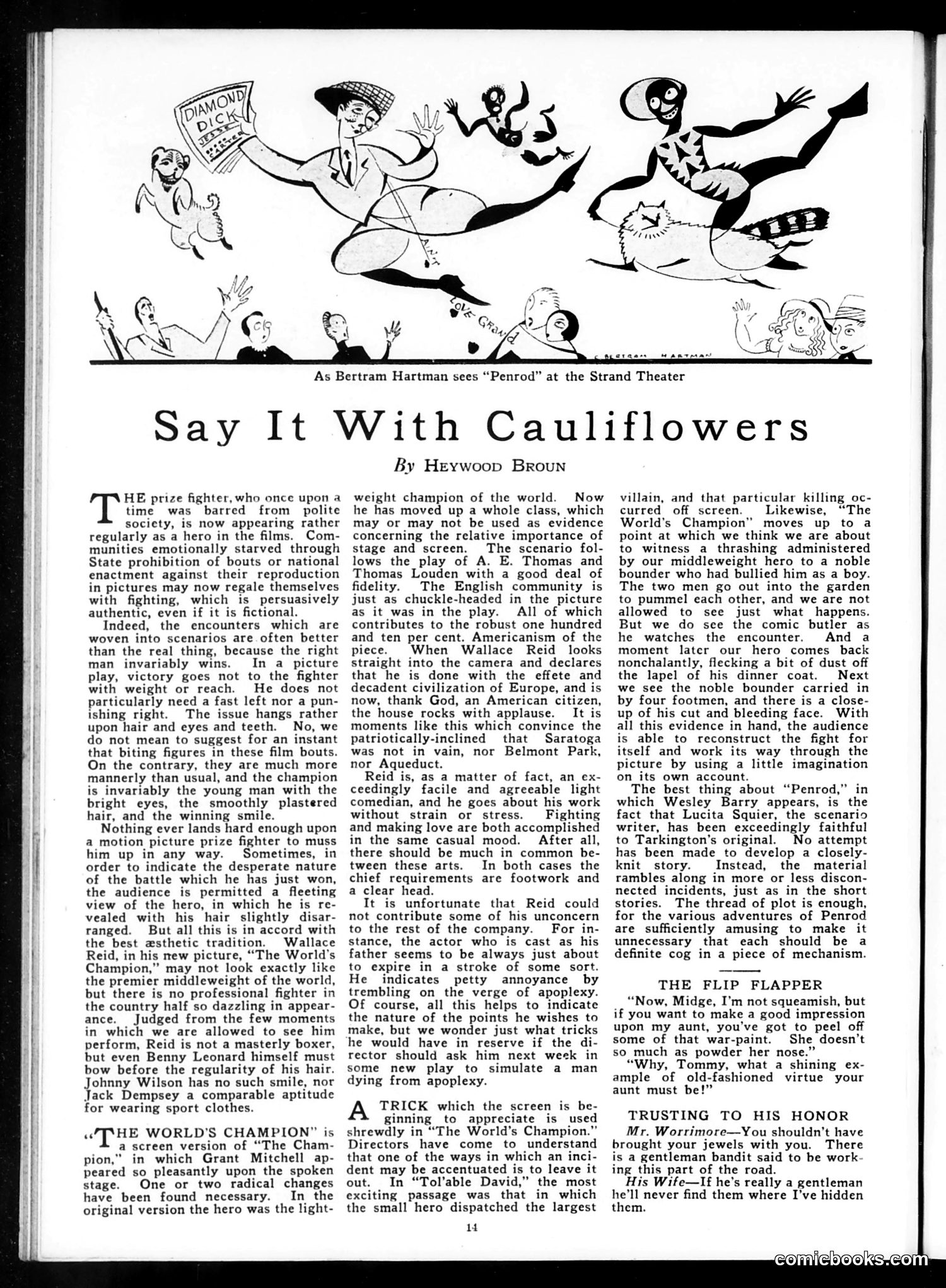
What you’re looking at
The cartoon at top shows "Bertram Hartman" (a Judge cartoonist) reacting wildly to the film "Penrod" at the Strand Theater—the exaggerated response mocking overwrought theatrical reactions to movies. The accompanying article by Heywood Broun critiques boxing films, particularly Wallace Reid's "The World's Champion." Broun satirizes how Hollywood fight scenes prioritize male beauty and glamour over authenticity: fighters never get truly mussed up, victory goes to the handsome hero with the best hair and smile rather than the stronger boxer, and there's no real damage or struggle shown. Broun further mocks the film's patriotic messaging—Reid's character renounces "effete" European civilization for American vigor, triggering audience applause. The piece suggests this appeals to audiences starved for entertainment after Prohibition banned boxing exhibitions, but the sanitized, vain heroes bear no resemblance to real fighters like Benny Leonard or Jack Dempsey. The satire targets both Hollywood's vanity and audiences' appetite for reassuring myths over reality.
📄 Transcribed text from this page (OCR, searchable)
Machine-transcribed from the original scan — historical spelling and the odd misread are preserved.
As Bertram Hartman sees “Penrod” at the Strand Theater Say It With Cauliflowers time was barred from _ polite society, is now appearing rather regularly as a hero in the films. Com- munities emotionally starved through State prohibition of bouts or national enactment against their reproduction in pictures may now regale themselves with fighting, which is persuasively authentic, even if it is fictional. Indeed, the encounters which are woven into scenarios are often better than the real thing, because the right man invariably wins. In a picture play, victory goes not to the fighter with weight or reach. He does not particularly need a fast left nor a pun- ishing right. The issue hangs rather upon hair and eyes and teeth. No, we do not mean to suggest for an instant that biting figures in these film bouts. On the contrary, they are much more mannerly than usual, and the champion is invariably the young man with the bright eyes, the smoothly plastered hair, and the winning smile. Nothing ever lands hard enough upon a motion picture prize fighter to muss him up in any way. Sometimes, in order to indicate the desperate nature of the battle which he has just won, the audience is permitted a fleeting view of the hero, in which he is re- vealed with his hair slightly disar- ranged. But all this is in accord with the best asthetic tradition. Wallace Reid, in his mew picture, “The World's Champion,” may not look exactly like the premier middleweight of the world, but there is no professional fighter in the country half so dazzling in appear- ance. Judged from the few moments in which we are allowed to see him perform, Reid is not a masterly boxer, but even Benny Leonard himself must bow before the regularity of his hair. Johnny Wilson has no such smile, nor Jack Dempsey a comparable aptitude for wearing sport clothes. HE WORLD'S CHAMPION” a screen version of “The Cham- pion,” in which Grant Mitchell ap- peared so pleasantly upon the spoken stage. One or two radical changes have been found necessary. In the original version the hero was the light- T HE prize fighter, who once upon a By Heywoop Broun weight champion of the world. Now he has moved up a whole class, which may or may not be used as evidence concerning the relative importance of stage and screen. The scenario fol- lows the play of A. E. Thomas and Thomas Louden with a good deal of fidelity. The English community is just as chuckle-headed in the picture as it was in the play. All of which contributes to the robust one hundred and ten per cent. Americanism of the piece. When Wallace Reid looks straight into the camera and declares that he is done with the effete and decadent civilization of Europe, and is now, thank God, an American citizen, the house rocks with applause. It is moments like this which convince the patriotically-inclined that Saratoga was not in vain, nor Belmont Park, nor Aqueduct. Reid is, as a matter of fact, an ex- ceedingly facile and agreeable light comedian, and he goes about his work without strain or stress. Fighting and making love are both accomplished in the same casual mood. After all, there should be much in common be- tween these arts. In both cases the chief requirements are footwork and a clear head. It is unfortunate that Reid could not contribute some of his unconcern to the rest of the company. For in- stance, the actor who is cast as his father seems to be always just about to expire in a stroke of some sort. He indicates petty annoyance by trembling on the verge of apoplexy. Of course, all this helps to indicate the nature of the points he wishes to make, but we wonder just what tricks he would have in reserve if the di- rector should ask him next week in some new play to simulate a man dying from apoplexy. TRICK which the screen is be- ginning to appreciate is used shrewdly in “The World’s Champion.” Directors have come to understand that one of the ways in which an inci- dent may be accentuated is to leave it out. In “Tol’able David,” the most exciting passage was that in which the small hero dispatched the largest 14 and that particular killing oc- curred off screen. Likewise, “The World’s Champion” moves up to a point at which we think we are about to witness a thrashing administered by our middleweight hero to a noble bounder who had bullied him as a boy. The two men go out into the garden to pummel each other, and we are not allowed to see just what happens. But we do see the comic butler as he watches the encounter. And a moment later our hero comes back nonchalantly, flecking a bit of dust off the lapel of his dinner coat. Next we see the noble bounder carried in by four footmen, and there is a close- up of his cut and bleeding face. With all this evidence in hand, the audience is able to reconstruct the fight for itself and work its way through the picture by using a little imagination on_its own account. The best thing about “Penrod,” in which Wesley Barry appears, is the fact that Lucita Squier, the scenario writer, has been exceedingly faithful to Tarkington’s original. No attempt has been made to develop a closely- knit story. Instead, the material rambles along in more or less discon- nected incidents, just as in the short stories. The thread of plot is enough, for the various adventures of Penrod are sufficiently amusing to make it unnecessary that each should be a definite cog in a piece of mechanism. villain, THE FLIP FLAPPER “Now, Midge, I’m not squeamish, but if you want to make a good impression upon my aunt, you've got to peel off some of that war-paint. She doesn’t so much as powder her nose.” “Why, Tommy, what a shining ex- ample of old-fashioned virtue your aunt must be!” TRUSTING TO HIS HONOR Mr. Worrimore—You shouldn't have brought your jewels with you. There is a gentleman bandit said to be work ing this part of the road. His Wife—If he’s really a gentleman hell never find them where I've hidden them.