
Judge, 1922-03-25 · page 4 of 36
Judge — March 25, 1922 — page 4: what you’re looking at
What you’re looking at
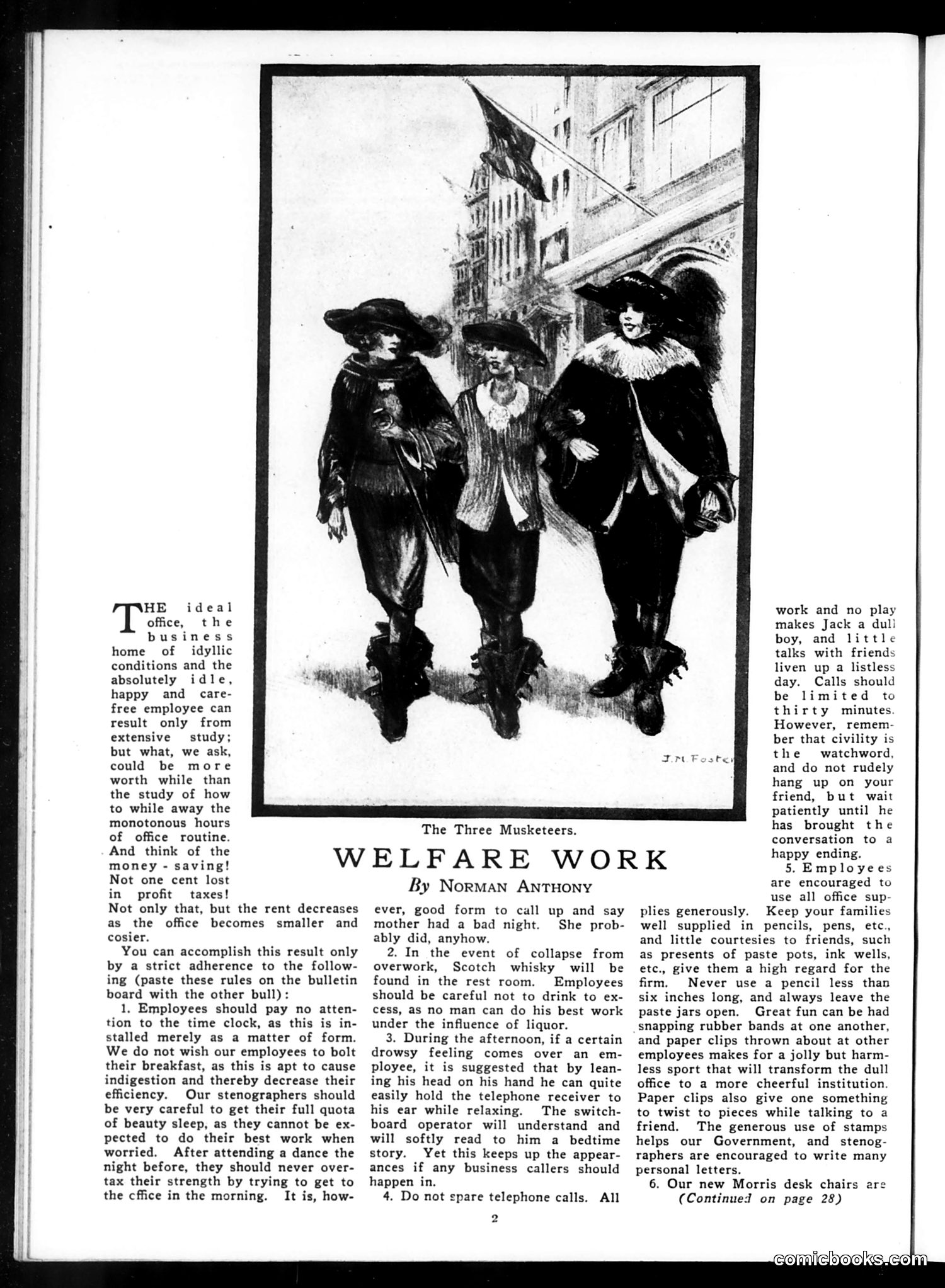
This page contains an illustration titled "The Three Musketeers" by Jim Foster, accompanying an article on "Welfare Work" by Norman Anthony. The cartoon depicts three well-dressed men in period costume walking together on a city street. The accompanying text offers satirical advice on office management and employee welfare, presenting tongue-in-cheek "rules" for treating workers—such as limiting telephone calls to thirty minutes and providing office supplies generously. The satire suggests that while companies promoted "welfare work" as progressive management, the actual implementation often amounted to modest gestures masking continued workplace constraints. The "Three Musketeers" reference appears ironic, contrasting the camaraderie of that literary ideal with the actual employer-employee relationship.
📄 Transcribed text from this page (OCR, searchable)
Machine-transcribed from the original scan — historical spelling and the odd misread are preserved.
HE ideal office, the business home of idyllic conditions and the absolutely idle, happy and care- free employee can result only from extensive study; but what, we ask, could be more worth while than the study of how to while away the monotonous hours of office routine. And think of the money - saving! Not one cent lost in profit taxes! Not only that, but the rent decreases as the office becomes smaller and cosier. You can accomplish this result only by a strict adherence to the follow- ing (paste these rules on the bulletin board with the other bull): 1, Employees should pay no atten- tion to the time clock, as this is in- stalled merely as a matter of form. We do not wish our employees to bolt their breakfast, as this is apt to cause indigestion and thereby decrease their efficiency. Our stenographers should be very careful to get their full quota of beauty sleep, as they cannot be ex- pected to do their best work when worried. After attending a dance the night before, they should never over- tax their strength by trying to get to the cffice in the morning. It is, how- The Three Musketeers. WELFARE WORK By Norman ANTHONY ever, good form to call up and say mother had a bad night. She prob- ably did, anyhow. 2. In the event of collapse from overwork, Scotch whisky will be found in the rest room. Employees should be careful not to drink to ex- cess, as no man can do his best work under the influence of liquor. 3. During the afternoon, if a certain drowsy feeling comes over an em- ployee, it is suggested that by lean- ing his head on his hand he can quite easily hold the telephone receiver to his ear while relaxing. The switch- board operator will understand and will softly read to him a bedtime story. Yet this keeps up the appear- ances if any business callers should happen in. 4. Do not spare telephone calls. All 2 work and no play makes Jack a dull boy, and little talks with friends liven up a listless day. Calls should be limited to thirty minutes However, remem- ber that civility is the watchword, and do not rudely hang up on your friend, but wait patiently until he has brought the conversation to a happy ending. 5. Employees are encouraged to use all office sup- plies generously. Keep your families well supplied in pencils, pens, etc., and little courtesies to friends, such as presents of paste pots, ink wells, etc., give them a high regard for the firm. Never use a pencil less than six inches long, and always leave the paste jars open. Great fun can be had snapping rubber bands at one another, and paper clips thrown about at other employees makes for a jolly but harm- less sport that will transform the dull office to a more cheerful institution. Paper clips also give one something to twist to pieces while talking to a friend. The generous use of stamps helps our Government, and stenog- raphers are encouraged to write many personal letters. 6. Our new Morris desk chairs are (Continued on page 28)