
Judge, 1922-03-25 · page 12 of 36
Judge — March 25, 1922 — page 12: what you’re looking at
What you’re looking at
**"The Skeptic"** satirizes gullible belief in character-reading expertise. A persuasive man claims an innate gift for judging people, using business success as proof. The narrator almost capitulates—until meeting the man's wife, whose existence contradicts his claimed perceptiveness. The joke: someone truly skilled at reading character would surely understand his own spouse, yet apparently doesn't. **"The Six Who Condemned"** mocks pompous, self-righteous judgment. Six men condemn natural beauties (moonbeams, rainbows, butterflies, birdsong, rosebuds, stars) as worthless—revealing not the objects' flaws but their own narrow materialism, pretension, and spiritual poverty. The irony: each feels profound while demonstrating complete obliviousness to his own shallowness. Both pieces target human vanity and the danger of confident self-deception.
📄 Transcribed text from this page (OCR, searchable)
Machine-transcribed from the original scan — historical spelling and the odd misread are preserved.
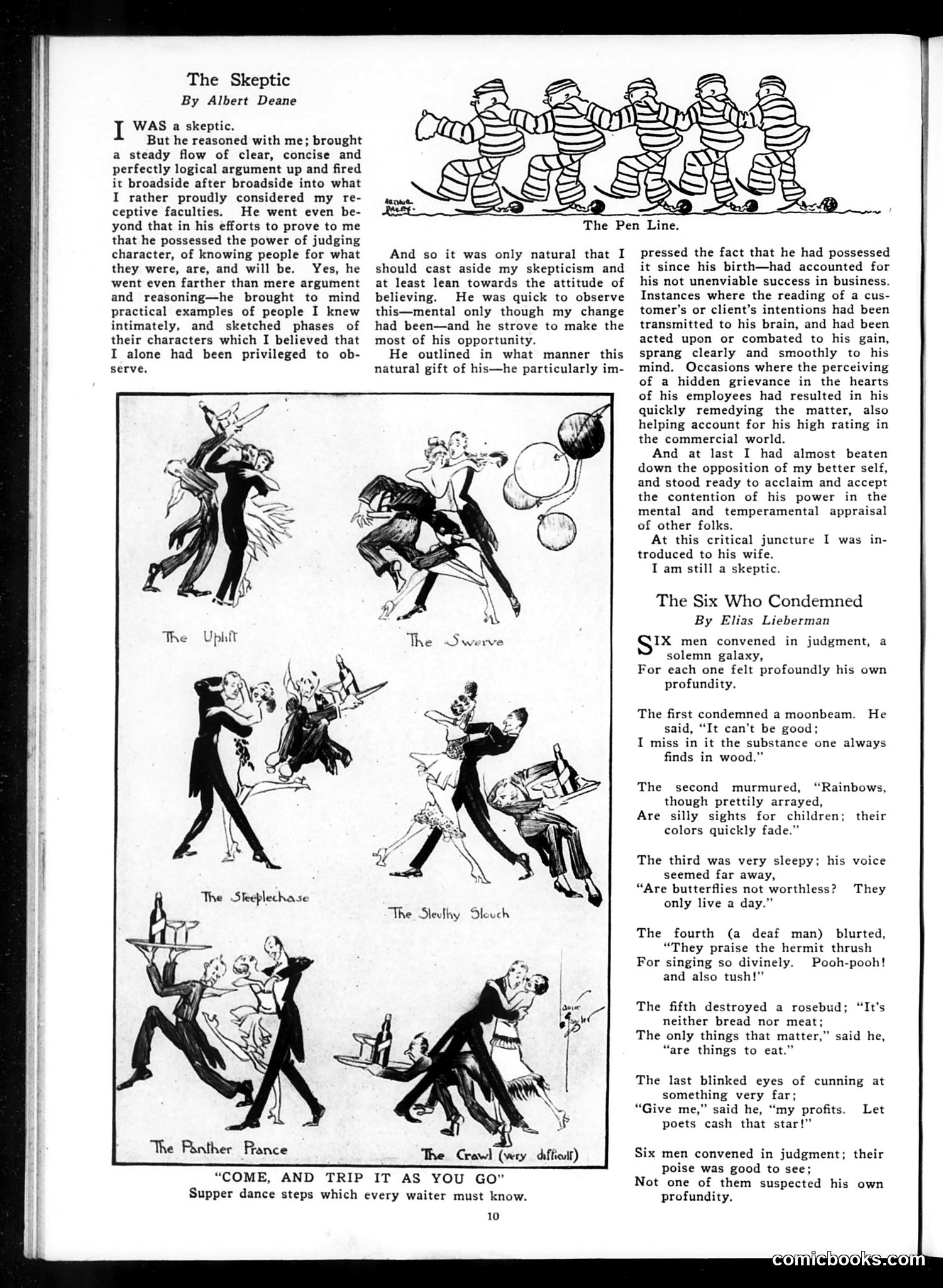
The Skeptic By Albert Deane I WAS a skeptic. But he reasoned with me; brought a steady flow of clear, concise and perfectly logical argument up and fired it broadside after broadside into what I rather proudly considered my re- ceptive faculties. He went even be- yond that in his efforts to prove to me that he possessed the power of judging character, of knowing people for what they were, are, and will be. Yes, he went even farther than mere argument and reasoning—he brought to mind practical examples of people I knew intimately, and sketched phases of their characters which I believed that I alone had been privileged to ob- serve. The The Panther France The Pen Line. And so it was only natural that I should cast aside my skepticism and at least lean towards the attitude of believing. He was quick to observe this—mental only though my change had been—and he strove to make the most of his opportunity. He outlined in what manner this natural gift of his—he particularly im- The Crawl (very difficuit) “COME, AND TRIP IT AS YOU GO” Supper dance steps which every waiter must know. 10 pressed the fact that he had possessed it since his birth—had accounted for his not unenviable success in business. Instances where the reading of a cus- tomer’s or client’s intentions had been transmitted to his brain, and had been acted upon or combated to his gain, sprang clearly and smoothly to his mind. Occasions where the perceiving of a hidden grievance in the hearts of his employees had resulted in his quickly remedying the matter, also helping account for his high rating in the commercial world. And at last I had almost beaten down the opposition of my better self, and stood ready to acclaim and accept the contention of his power in the mental and temperamental appraisal of other folks. At this critical juncture I was in- troduced to his wife. I am still a skeptic. The Six Who Condemned By Elias Lieberman Six men convened in judgment, a solemn galaxy, For each one felt profoundly his own profundity. The first condemned a moonbeam. He said, “It can’t be good; I miss in it the substance one always finds in wood.” The second murmured, “Rainbows, though prettily arrayed, Are silly sights for children; colors quickly fade.” their The third was very sleepy; his voice seemed far away, “Are butterflies not worthless? only live a day.” They The fourth (a deaf man) blurted, “They praise the hermit thrush For singing so divinely. Pooh-pooh! and also tush!” The fifth destroyed a rosebud; “It’s neither bread nor meat; The only things that matter,” said he, “are things to eat.” The last blinked eyes of cunning at something very far; “Give me,” said he, “my profits. poets cash that star!” Let Six men convened in judgment; their poise was good to see; Not one of them suspected his own profundity.