
Judge, 1922-03-25 · page 26 of 36
Judge — March 25, 1922 — page 26: what you’re looking at
What you’re looking at
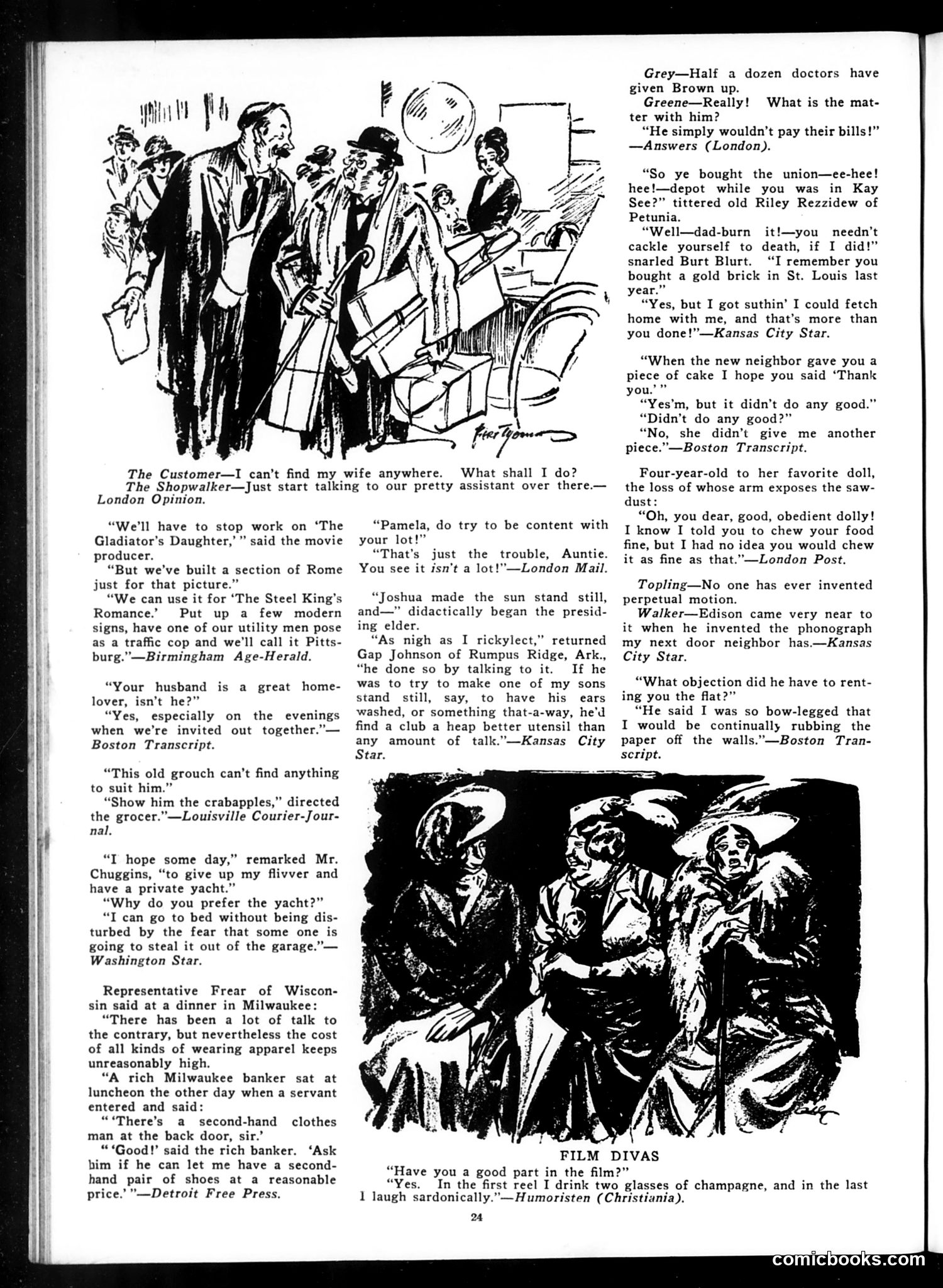
This page from the American satirical magazine **Judge** contains multiple brief humor pieces rather than a single political cartoon. The top illustration shows figures in what appears to be a commercial setting, likely depicting a shopkeeper's flirtation tactic. The jokes satirize early 20th-century American social life: marital dynamics, consumer culture, and emerging technologies (the "flivver"—affordable Model T automobile). One notable piece mocks economic hypocrisy—a wealthy banker so stingy he seeks secondhand shoes despite his wealth. Another jokes about doctors abandoning a patient simply because he won't pay bills, reflecting frustration with medical profession's mercenary reputation. References include movie production (suggesting Hollywood's rapid growth), rural dialect characters, and the phonograph as a recent Edison invention. The final "Film Divas" section satirizes actresses' superficial film roles requiring only drinking champagne and theatrical laughing. Overall, the page reflects genteel, middle-class concerns about spending, marriage, and modern conveniences—typical Judge magazine fare from roughly the 1910s era.
📄 Transcribed text from this page (OCR, searchable)
Machine-transcribed from the original scan — historical spelling and the odd misread are preserved.
The Customer—I can’t find my wife anywhere. What shall I do? The Shopwalker—Just start talking to our pretty assistant over there.— London Opinion. “We'll have to stop work on ‘The Gladiator's Daughter,’ ” said the movie producer. “But we've built a section of Rome just for that picture.” “We can use it for ‘The Steel King’s Romance.” Put up a few modern signs, have one of our utility men pose as a traffic cop and we'll call it Pitts- burg.”—Birmingham Age-Herald. “Your husband is a great home- lover, isn’t he?” “Yes, especially on the evenings when we're invited out together.’”— Boston Transcript. “This old grouch can’t find anything to suit him.” “Show him the crabapples,” directed the grocer.”—Louisville Courier-Jour- nal. “I hope some day,” remarked Mr. Chuggins, “to give up my flivver and have a private yacht.” “Why do you prefer the yacht?” “I can go to bed without being dis- turbed by the fear that some one is going to steal it out of the garage.”— Washington Star. Representative Frear of Wiscon- sin said at a dinner in Milwaukee: “There has been a lot of talk to the contrary, but nevertheless the cost of all kinds of wearing apparel keeps unreasonably high. “A rich Milwaukee banker sat at luncheon the other day when a servant entered and said: “*There’s a second-hand man at the back door, sir.’ “‘Good!’ said the rich banker. ‘Ask him if he can let me have a second- hand pair of shoes at a reasonable price.’ ""—Detroit Free Press. clothes “Pamela, do try to be content with your lot!” “That's just the trouble, Auntie. You see it isn’t a lot!"—London Mail. “Joshua made the sun stand still, and—” didactically began the presid- ing elder. “As nigh as I rickylect,” returned Gap Johnson of Rumpus Ridge, Ark., “he done so by talking to it. If he was to try to make one of my sons stand still, say, to have his ears washed, or something that-a-way, he'd find a club a heap better utensil than any amount of talk.”—Kansas City Star. Grey—Half a dozen doctors have given Brown up. Greene—Really! ter with him? “He simply wouldn’t pay their bills!” —Answers (London). What is the mat- “So ye bought the union—ee-hee! hee!—depot while you was in Kay See?” tittered old Riley Rezzidew of Petunia. “Well—dad-burn it!—you needn't cackle yourself to death, if I did!” snarled Burt Blurt. “I remember you bought a gold brick in St. Louis last year.” “Yes, but I got suthin’ I could fetch home with me, and that’s more than you done!”—Kansas City Star. “When the new neighbor gave you a piece of cake I hope you said ‘Thank you.’ “Yes’m, but it didn’t do any good.” “Didn't do any good?” “No, she didn’t give me another piece.”—Boston Transcript. Four-year-old to her favorite doll, the loss of whose arm exposes the saw- dust: “Oh, you dear, good, obedient dolly! I know I told you to chew your food fine, but I had no idea you would chew it as fine as that.”"—London Post. Topling—No one has ever invented perpetual motion. Walker—Edison came very near to it when he invented the phonograph my next door neighbor has.—Kansas City Star. “What objection did he have to rent- ing you the flat?” “He said I was so bow-legged that I would be continually rubbing the paper off the walls."—Boston Tran- script. FILM DIVAS “Have you a good part in the film?” “Yes. In the first reel I drink two glasses of champagne, and in the last 1 laugh sardonically."—Humoristen (Christiania). 24