
Judge, 1922-03-25 · page 9 of 36
Judge — March 25, 1922 — page 9: what you’re looking at
What you’re looking at
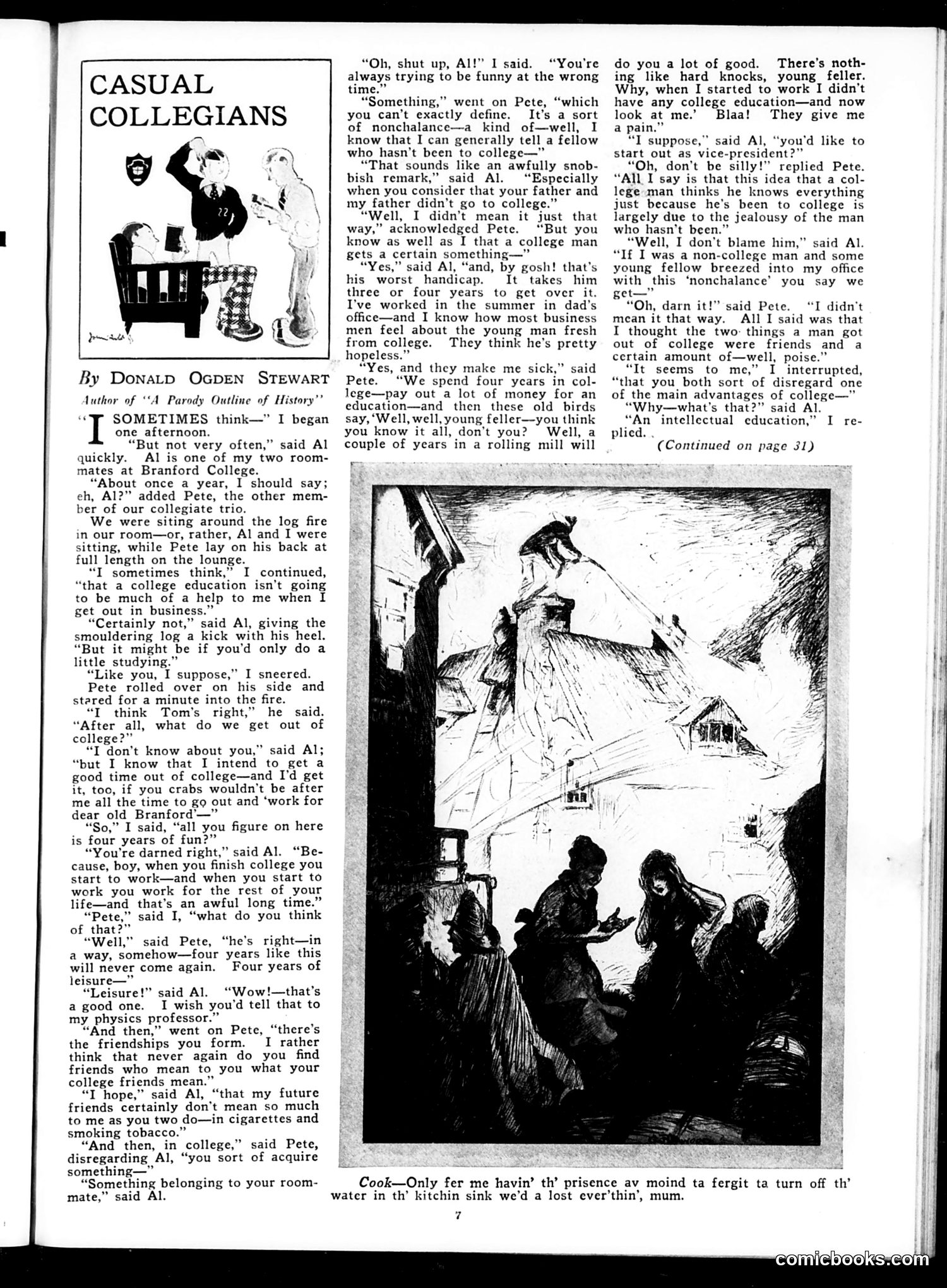
This is a humorous short story satirizing college students and their self-important attitudes. Three roommates at Branford College debate what college actually offers. The story mocks several period attitudes: **The targets of satire:** - College students' pretension about acquiring undefined "nonchalance" and superiority - Business owners who dismiss college graduates as arrogant know-it-alls - The contradiction between college's promise and its actual utility - Students viewing college primarily as leisure rather than education **The joke's premise:** The characters ironically acknowledge that college supposedly grants intangible sophistication, yet employers resent this attitude. Al cynically views college as four years of fun before lifelong work; Pete romanticizes college friendships while also recognizing the snobbery involved. The illustration shows figures in period dress, likely depicting the casual dorm scene described. The satire reflects 1920s anxiety about higher education's actual value and the generational clash between college-educated youth and skeptical business elders.
📄 Transcribed text from this page (OCR, searchable)
Machine-transcribed from the original scan — historical spelling and the odd misread are preserved.
CASUAL COLLEGIANS By DonatpD OGDEN STEWART 1uthor of ‘‘A Parody Outline of History’’ se SOMETIMES think—” I began one afternoon. “But not very often,” said Al quickly. Al is one of my two room- mates at Branford College. “About once a year, I should say; eh, Al?” added Pete, the other mem- ber of our collegiate trio. We were siting around the log fire in our room—or, rather, Al and I were sitting, while Pete lay on his back at full length on the lounge. “I sometimes think,” I continued, “that a college education isn’t going to be much of a help to me when I get out in business.” “Certainly not,” said Al, giving the smouldering log a kick with his heel. “But it might be if you'd only do a little studying.” “Like you, I suppose,” I sneered. Pete rolled over on his side and stared for a minute into the fire. “I think Tom's right,” he said. “After all, what do we get out of college?” “I don't know about you,” said Al; “but I know that I intend to get a good time out of college—and I'd get it, too, if you crabs wouldn't be after me all the time to go out and ‘work for dear old Branford’—” “So,” I said, “all you figure on here is four years of fun?” “You're darned right,” said Al. “Be- cause, boy, when you finish college you start to work—and when you start to work you work for the rest of your life—and that’s an awful long time.” “Pete,” said I, “what do you think of that?” . “Well,” said Pete, “he's right—in a way, somehow—four years like this will never come again. Four years of leisure—” “Leisure!” said Al. “Wow!—that’s a good one. I wish you'd tell that to my physics professor.” “And then,” went on Pete, “there's the friendships you form. I rather think that never again do you find friends who mean to you what your college friends mean.” “T hope,” said Al, “that my future friends certainly don’t mean so much to me as you two do—in cigarettes and smoking tobacco.” “And then, in college,” said Pete, disregarding Al, “you sort of acquire something—” . “Something belonging to your room- mate,” said Al. “Oh, shut up, Al!” I said. “You're always trying to be funny at the wrong time.” “Something,” went on Pete, “which you can’t exactly define. It’s a sort of nonchalance—a kind of—well, I know that I can generally tell a fellow who hasn't been to college—” “That sounds like an awfully snob- bish remark,” said Al. “Especially when you consider that your father and my father didn’t go to college.” “Well, I didn’t mean it just that way,” acknowledged Pete. “But you know as well as I that a college man gets a certain something—” “Yes,” said Al, “and, by gosh! that's his worst handicap. It takes him three or four years to get over it. I've worked in the summer in dad’s office—and I know how most business men feel about the young man fresh from college. They think he’s pretty hopeless.” “Yes, and they make me sick,” said Pete. “We spend four years in col- lege—pay out a lot of money for an education—and then these old birds say, ‘Well, well, young feller—you think you know it all, don’t you? Well, a couple of years in a rolling mill will do you a lot of good. There’s noth- ing like hard knocks, young feller. Why, when I started to work I didn’t have any college education—and now look at me.’ Blaa! They give me a pain.” “I suppose,” said Al, “you'd like to start out as vice-president?” “Oh, don't be silly!” replied Pete. “All I say is that this idea that a col- lege man thinks he knows everything just because he’s been to college is largely due to the jealousy of the man who hasn't been.” “Well, I don’t blame him,” said Al. “If I was a non-college man and some young fellow breezed into my office with this ‘nonchalance’ you say we get—” “Oh, darn it!” said Pete. I didn't mean it that way. All I said was that I thought the two: things a man got out of college were friends and a certain amount of—well, poise.” “It seems to me,” I interrupted, “that you both sort of disregard one of the main advantages of college—” “Why—what's that?” said Al. “An intellectual education,” plied. (Continued on page 31) I re- Cook—Only fer me havin’ th’ prisence av moind ta fergit ta turn off th’ water in th’ kitchin sink we’d a lost ever’thin’, mum. 7