
Judge, 1922-03-25 · page 7 of 36
Judge — March 25, 1922 — page 7: what you’re looking at
What you’re looking at
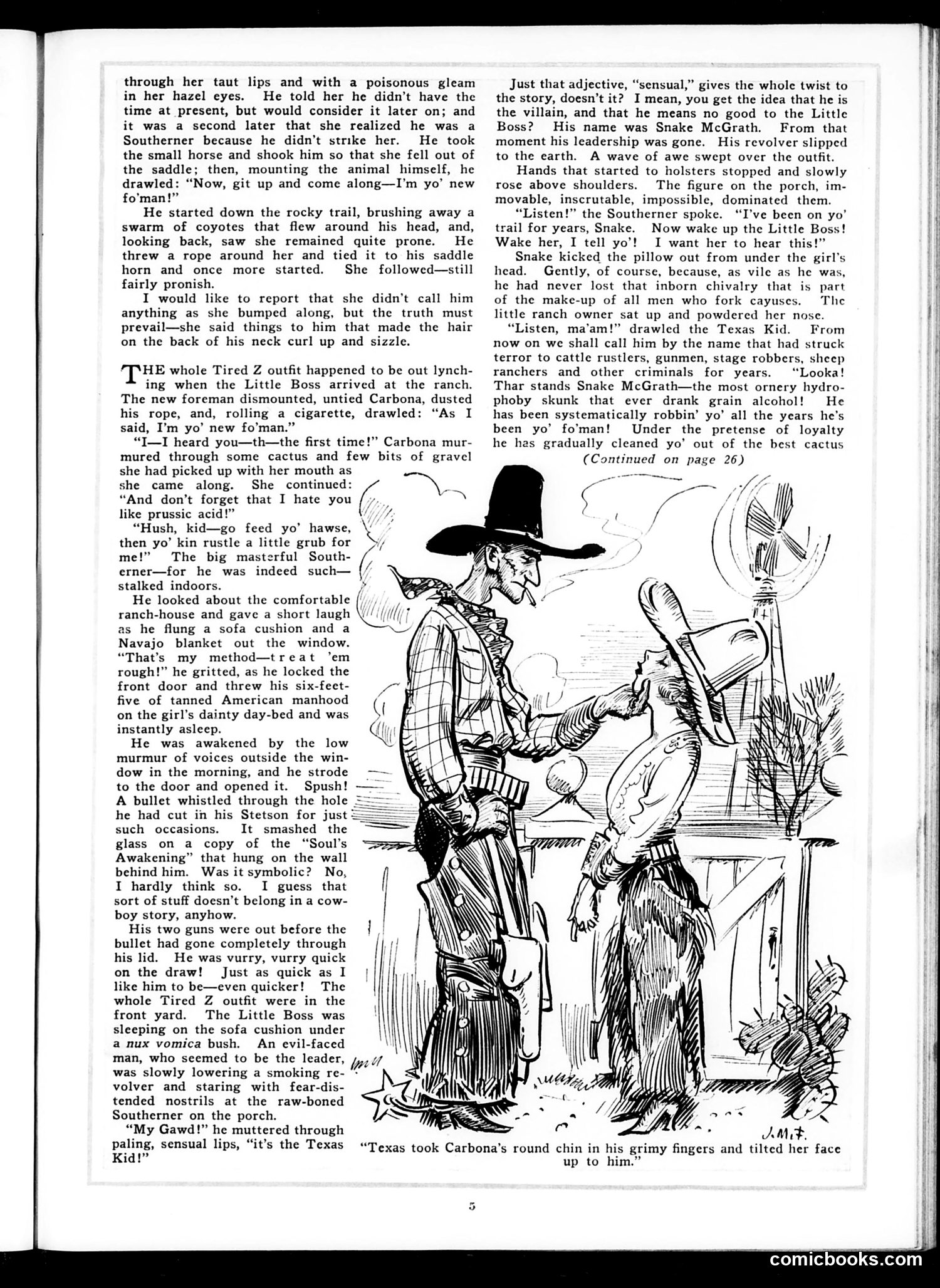
This page satirizes **Western pulp fiction conventions** through exaggerated parody. The story features stereotypical characters: a rough, domineering "Texas Kid" Southerner who rescues the "Little Boss" (a woman) from villainous rustlers led by the evil "Snake McGrath." The satire targets the genre's overwrought melodrama and clichés—the "sensual lips" of villains, the impossibly heroic gunslinger, contrived plot devices (the bullet through his hat), and purple prose ("inscrutable, impossible, dominated them"). The narrator explicitly mocks narrative conventions, as when noting the symbolic bullet hole "doesn't belong in a cowboy story, anyhow." The illustration shows the Southerner confronting the rustlers after the dramatic reveal of his identity terrifies them. Judge's mockery suggests contemporary readers found such Western stories laughably predictable and overwrought.
📄 Transcribed text from this page (OCR, searchable)
Machine-transcribed from the original scan — historical spelling and the odd misread are preserved.
through her taut lips and with a poisonous gleam in her hazel eyes. He told her he didn’t have the time at present, but would consider it later on; and it was a second later that she realized he was a Southerner because he didn’t strike her. He took the small horse and shook him so that she fell out of the saddle; then, mounting the animal himself, he drawled: “Now, git up and come along—I’m yo’ new fo'man!” He started down the rocky trail, brushing away a swarm of coyotes that flew around his head, and, looking back, saw she remained quite prone. He threw a rope around her and tied it to his saddle horn and once more started. She followed—still fairly pronish. I would like to report that she didn’t call him anything as she bumped along, but the truth must prevail—she said things to him that made the hair on the back of his neck curl up and sizzle. THE whole Tired Z outfit happened to be out lynch- ing when the Little Boss arrived at the ranch. The new foreman dismounted, untied Carbona, dusted his rope, and, rolling a cigarette, drawled: “As I said, I’m yo’ new fo’man.” “I—I heard you—th—the first time!” Carbona mur- mured through some cactus and few bits of gravel she had picked up with her mouth as she came along. She continued: ™,_ “And don’t forget that I hate you ( ; - like prussic acid!” “ii/f; “Hush, kid—go feed yo’ hawse, XK then yo’ kin rustle a little grub for i/ me!” The big masterful South- erner—for he was indeed such— (/ stalked indoors. P He looked about the comfortable ranch-house and gave a short laugh as he flung a sofa cushion and a Navajo blanket out the window. “That’s my method—treat ’em rough!” he gritted, as he locked the front door and threw his six-feet- five of tanned American manhood on the girl’s dainty day-bed and was instantly asleep. He was awakened by the low murmur of voices outside the win- dow in the morning, and he strode to the door and opened it. Spush! A bullet whistled through the hole he had cut in his Stetson for just such occasions. It smashed the glass on a copy of the “Soul’s Awakening” that hung on the wall behind him. Was it symbolic? No, I hardly think so. I guess that sort of stuff doesn’t belong in a cow- boy story, anyhow. His two guns were out before the bullet had gone completely through his lid. He was vurry, vurry quick on the draw! Just as quick as I like him to be—even quicker! The whole Tired Z outfit were in the front yard. The Little Boss was sleeping on the sofa cushion under a nux vomica bush. An evil-faced man, who seemed to be the leader, was slowly lowering a smoking re- * volver and staring with fear-dis- tended nostrils at the raw-boned Southerner on the porch. “My Gawd!” he muttered through paling, sensual lips, “it’s the Texas Kid!” Just that adjective, “sensual,” gives the whole twist to the story, doesn’t it? I mean, you get the idea that he is the villain, and that he means no good to the Little Boss? His name was Snake McGrath. From that moment his leadership was gone. His revolver slipped to the earth. A wave of awe swept over the outfit. Hands that started to holsters stopped and slowly rose above shoulders. The figure on the porch, im- movable, inscrutable, impossible, dominated them. “Listen!” the Southerner spoke. “I’ve been on yo’ trail for years, Snake. Now wake up the Little Boss! Wake her, I tell yo’! I want her to hear this!” Snake kicked the pillow out from under the girl's head. Gently, of course, because, as vile as he was, he had never lost that inborn chivalry that is part of the make-up of all men who fork cayuses. The little ranch owner sat up and powdered her nose. “Listen, ma’am!” drawled the Texas Kid. From now on we shall call him by the name that had struck terror to cattle rustlers, gunmen, stage robbers, sheep ranchers and other criminals for years. “Looka! Thar stands Snake McGrath—the most ornery hydro- phoby skunk that ever drank grain alcohol! He has been systematically robbin’ yo’ all the years he's been yo’ fo’man! Under the pretense of loyalty he has gradually cleaned yo’ out of the best cactus (Continued on page 26) AMF. “Texas took Carbona’s round chin in his grimy fingers and tilted her face up to him.” -comicbooks.com