
Judge, 1922-03-25 · page 28 of 36
Judge — March 25, 1922 — page 28: what you’re looking at
What you’re looking at
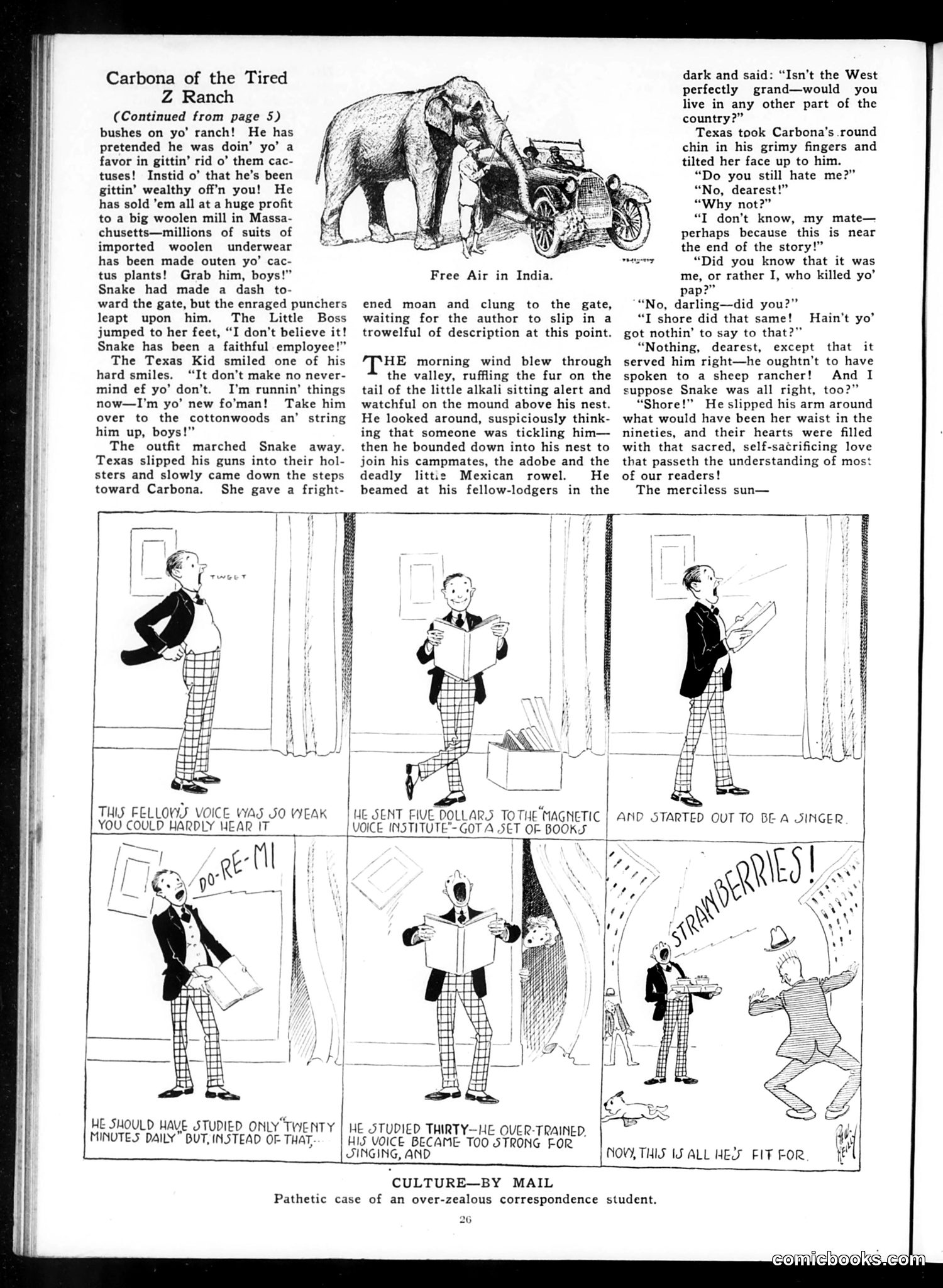
This page contains two distinct pieces of satire: **"Carbona of the Tired Z Ranch"** (top) is a parody of Western pulp fiction, specifically mocking the overwrought romantic and dramatic conventions of the genre. The narrative absurdly combines melodrama (a villain's exposure, a lynching threat) with self-aware commentary—the character Carbona literally references "the end of the story," breaking the fourth wall. The satire targets the formulaic nature of dime-novel Westerns and their purple prose. **"Culture—by Mail"** (bottom comic strip) satirizes correspondence courses, a popular early 20th-century phenomenon. The joke shows a man who enrolled in a magnetic voice institute, over-trained by studying 30 minutes instead of the recommended 20 minutes daily, and developed an overly powerful voice unsuitable for singing. This ridicules both the dubious claims of mail-order self-improvement schemes and the gullibility of students who misuse them. Both pieces target contemporary American commercial culture and popular entertainment forms.
📄 Transcribed text from this page (OCR, searchable)
Machine-transcribed from the original scan — historical spelling and the odd misread are preserved.
Carbona of the Tired Z Ranch (Continued from page 5) bushes on yo’ ranch! He has pretended he was doin’ yo’ a favor in gittin’ rid o’ them cac- tuses! Instid 0’ that he’s been gittin’ wealthy off’n you! He has sold ’em all at a huge profit to a big woolen mill in Massa- chusetts—millions of suits of imported woolen underwear has been made outen yo’ cac- tus plants! Grab him, boys!” Snake had made a dash to- ward the gate, but the enraged punchers leapt upon him. The Little Boss jumped to her feet, “I don’t believe it! Snake has been a faithful employee!” The Texas Kid smiled one of his hard smiles. “It don’t make no never- mind ef yo’ don’t. I’m runnin’ things now—I'm yo’ new fo'man! Take him over to the cottonwoods an’ string him up, boys!” The outfit marched Snake away. Texas slipped his guns into their hol- sters and slowly came down the steps toward Carbona. She gave a fright- Free Air in India. ened moan and clung to the gate, waiting for the author to slip in a trowelful of description at this point. ‘THE morning wind blew through the valley, ruffling the fur on the tail of the little alkali sitting alert and watchful on the mound above his nest. He looked around, suspiciously think- ing that someone was tickling him— then he bounded down into his nest to join his campmates, the adobe and the deadly littie Mexican rowel. He beamed at his fellow-lodgers in the dark and said: “Isn't the West perfectly grand—would you live in any other part of the country?” Texas took Carbona’s round chin in his grimy fingers and tilted her face up to him. “Do you still hate me?” “No, dearest!” “Why not?” “I don’t know, my mate— perhaps because this is near the end of the story!” “Did you know that it was me, or rather I, who killed yo’ pap?” “No, darling—did you?” “I shore did that same! got nothin’ to say to that?” “Nothing, dearest, except that it served him right—he oughtn’t to have spoken to a sheep rancher! And I suppose Snake was all right, too?” “Shore!” He slipped his arm around what would have been her waist in the nineties, and their hearts were filled with that sacred, self-saérificing love that passeth the understanding of most of our readers! The merciless sun— Hain't yo’ —-- [ — \ | THIS FELLOWS VOICE WAS JO WEAK YOU COULD HARDLY HEAR IT | HE SENT FIVE DOLLARS TO THE MAGNETIC HE SHOULD HAVE STUDIED ONLY “TWENTY MINUTES DAILY” BUT, INSTEAD OF THAT,- VOICE INSTITUTE’- GOT A SET OF BOOKS HE STUDIED THIRTY—HE OVER-TRAINED, HIS VOICE BECAME TOO STRONG FOR SINGING, AND CULTURE—BY MAIL Pathetic case of an over-zealous correspondence student. 26