
A complete issue · 36 pages · 1922
Judge — March 11, 1922
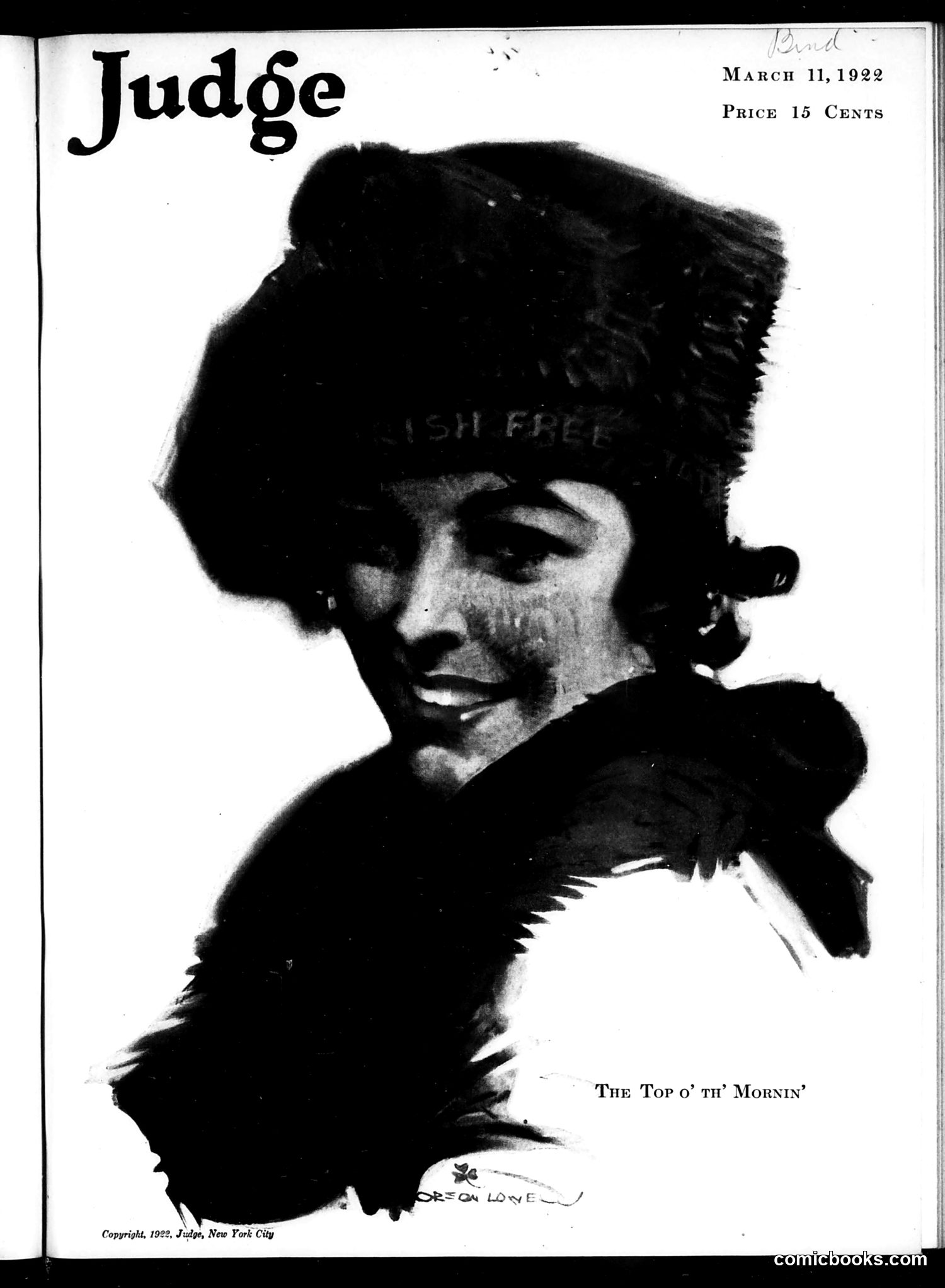
This is a Judge magazine cover from March 11, 1922, priced at 15 cents. The image shows a portrait photograph of a woman wearing a distinctive fur hat and fur-collared garment, smiling at the camera in a three-quarter pose. The caption reads "The Top o' th' Mornin'" — a stereotypical Irish greeting phrase. The styling, hat design, and Irish reference suggest this is likely commentary on Irish-American culture or a specific Irish public figure of 1922. However, without being able to definitively identify the subject from the image alone, I cannot specify which person this caricatures or what particular event or social commentary it references. The cartoon appears to play on Irish stereotypes common to that era's satirical publications.
This page is a **promotional advertisement for Leslie's Weekly magazine**, not a political cartoon. The text explains why Leslie's Weekly's readership is growing, claiming it offers attractive, interesting, and likeable content across home, office, and travel contexts. The advertisement includes testimonial excerpts from readers in Texas, Indiana, Tennessee, Pennsylvania, and California praising specific features: interesting articles, the Investment Department, timely topics, illustrations, and the magazine's improved quality over time. The satire is subtle—the headline "There's No Mystery About It" ironically suggests there's no mystery while the ad functions as a straightforward marketing pitch. The point: Leslie's Weekly succeeds simply because readers genuinely enjoy reading it, not through any hidden gimmick.
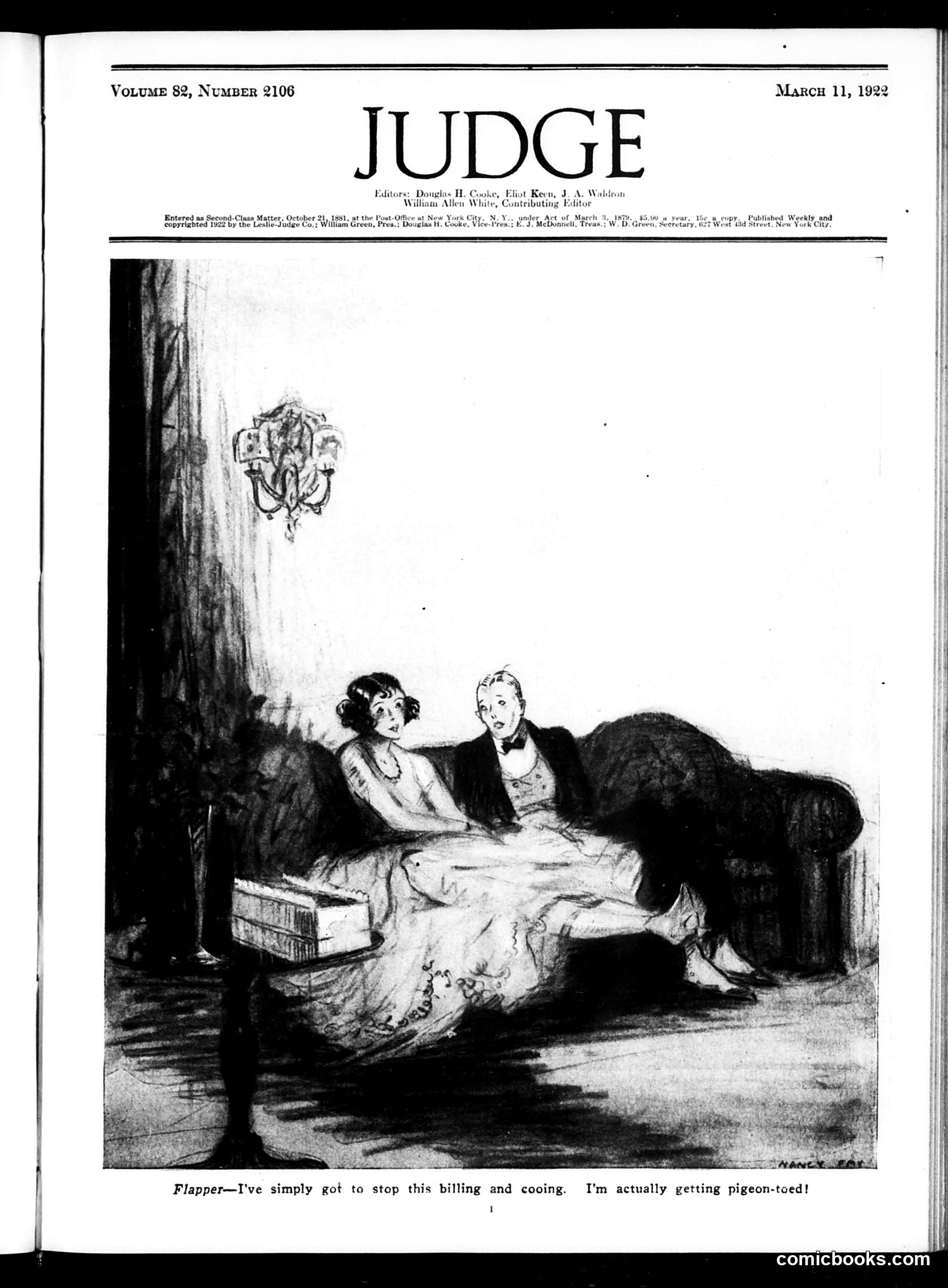
This 1922 Judge magazine cartoon depicts a domestic scene where a man reclines on a sofa while a woman sits nearby. The caption reads: "Flapper—I've simply got to stop this billing and cooing. I'm actually getting pigeon-toed!" The humor targets 1920s "flapper" culture—young women known for rejecting Victorian propriety and embracing modern, liberated lifestyles. The joke plays on the term "billing and cooing" (affectionate behavior between lovers) by literalizing it: the woman claims excessive romantic behavior is physically deforming her feet, making them resemble a pigeon's. The satire gently mocks both flapper dating customs and the physical consequences of their fashionable but restrictive footwear popular in that era.
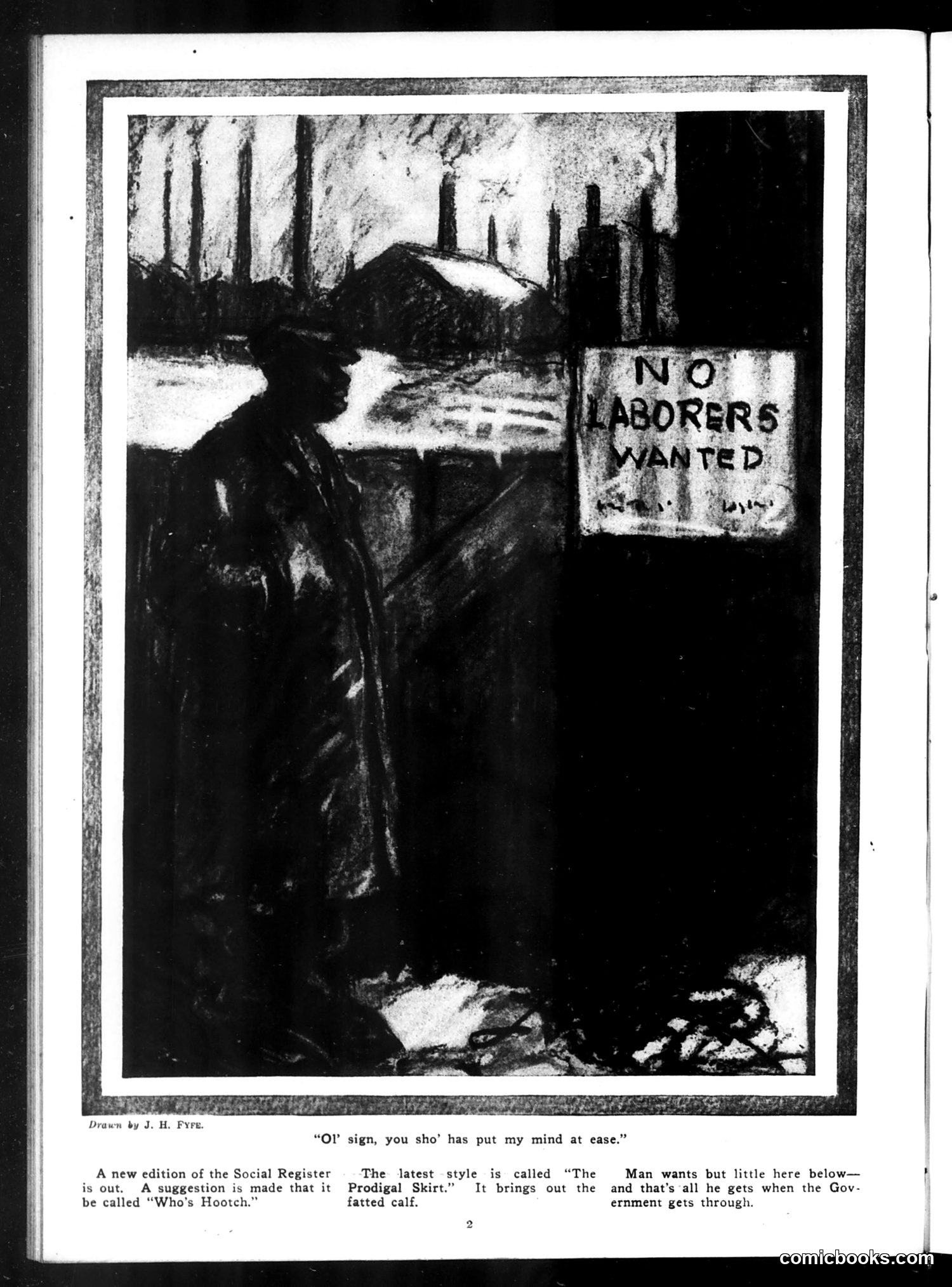
This cartoon by J.H. Fyre satirizes post-World War I labor anxieties. A solitary figure stands before a sign reading "NO LABORERS WANTED" in an industrial landscape. The caption quotes him: "'Ol' sign, you sho' has put my mind at ease." The satire appears ironic—the worker claims relief at being rejected for employment, which seems counterintuitive. This likely mocks either worker desperation during economic hardship or comments on labor unrest and strikes of the post-WWI era, when tensions between workers and employers were high. The figure's apparent contentment despite unemployment suggests commentary on either labor militancy or the grim reality of joblessness. The page also mentions a "Social Register" and "Who's Hooch"—separate satirical content typical of Judge magazine's format.
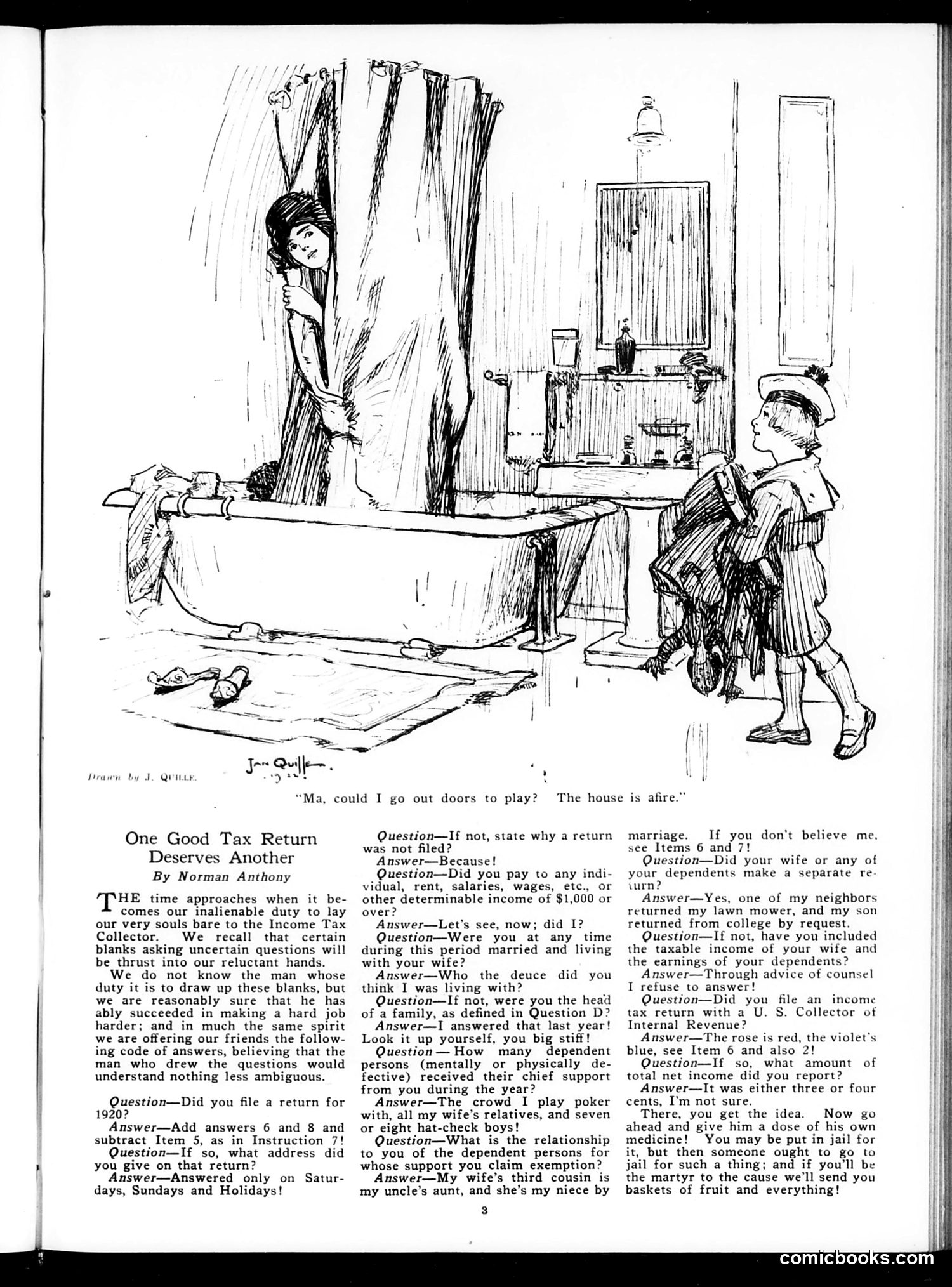
This 1920s satirical cartoon mocks the complexity of U.S. income tax forms. The illustration shows a boy asking his mother if he can play outside, saying "The house is afire"—suggesting the household is in chaos. The accompanying article and Q&A by Norman Anthony uses humor to address genuine tax confusion: citizens asking whether they must file returns, what counts as dependent income, and how to report various earnings. The satire targets both the bewildering tax code itself and taxpayers' creative attempts to minimize their obligations through dubious claims about dependent relatives and household expenses. The title suggests that just as one must file a proper tax return, one deserves to understand what the government actually requires—highlighting the absurdity of overly complicated tax regulations.
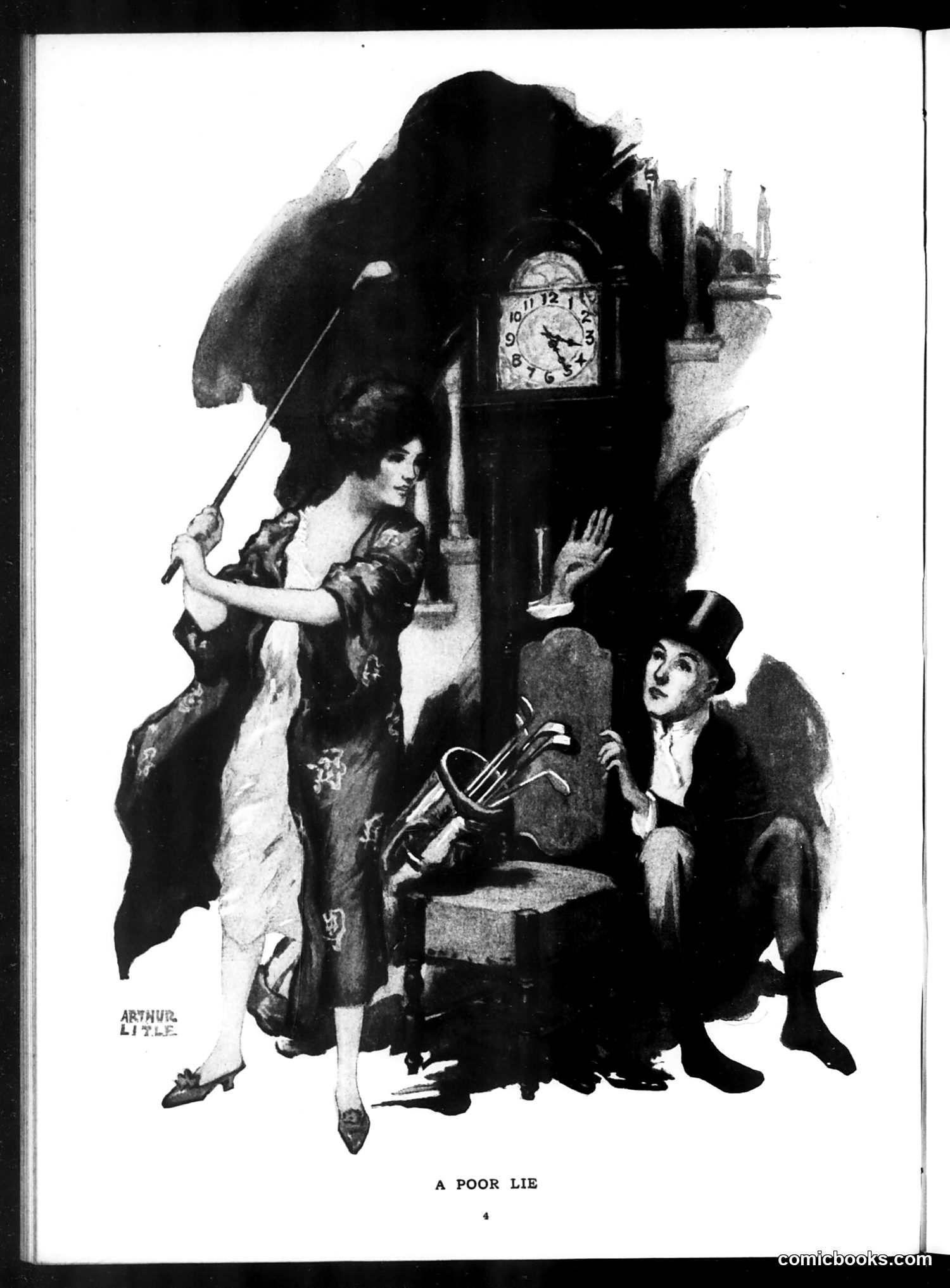
This cartoon by Arthur Lisle depicts a woman with an umbrella confronting two men in formal dress near a grandfather clock showing the time. The title "A Poor Lie" suggests the woman has caught the men in a deception—likely they claimed to be somewhere or doing something, but she's discovered otherwise. The grandfather clock is the key detail: it establishes a specific time, presumably contradicting the men's alibi. The woman's confrontational pose with her umbrella suggests she's confronting them about their false excuse. The formal Victorian-era clothing and setting indicate this satirizes social situations where gentlemen fabricate stories to cover their activities, which their female acquaintances can expose through simple evidence like the time of day.
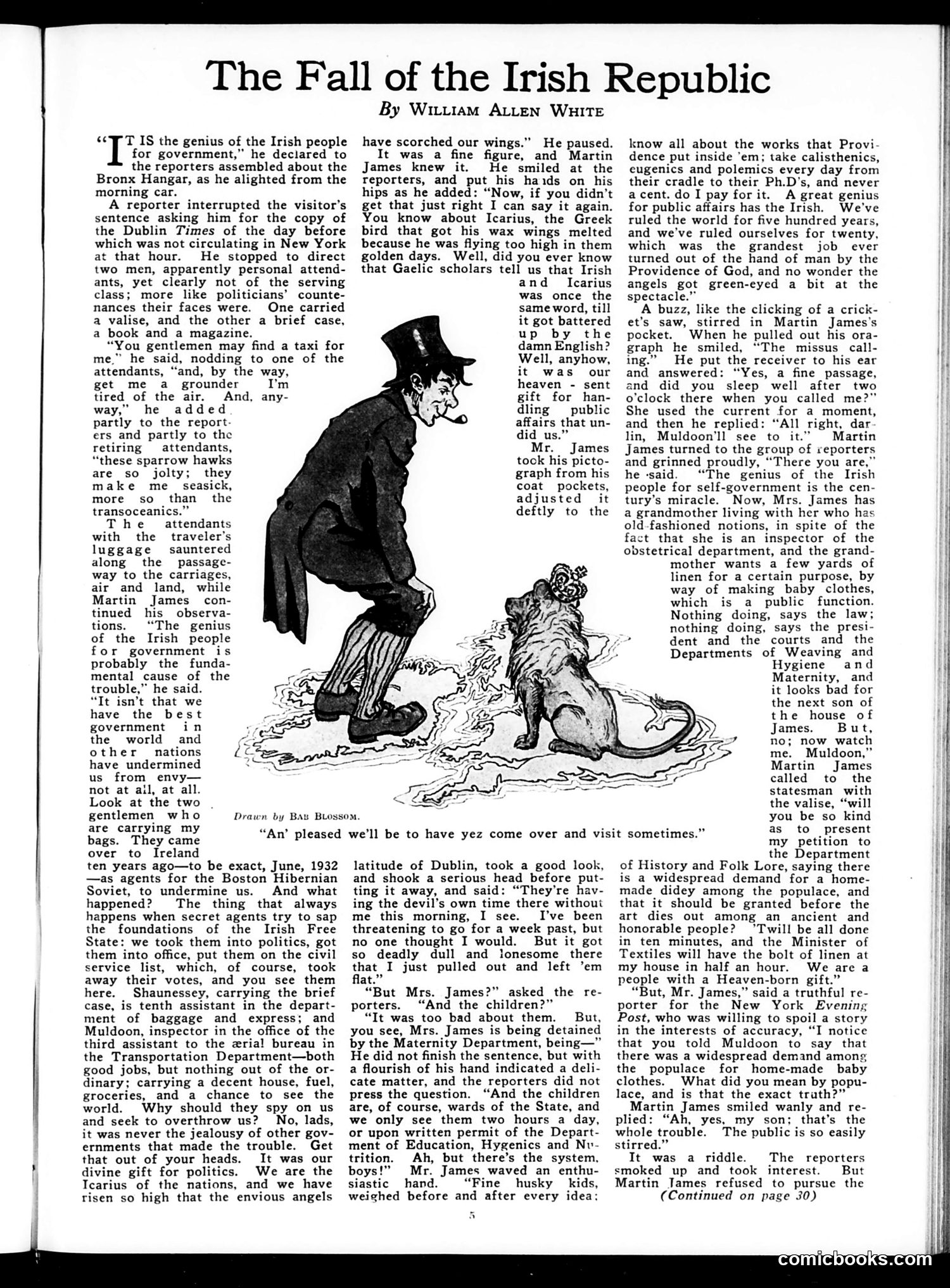
By William Allen White, this satirical article mocks Irish political incompetence through the character Martin James, a self-important Irish politician visiting America who blames Ireland's troubles on the Irish people's supposed natural genius for politics—ironically suggesting this gift has become their fatal flaw. **The Satire's Target:** White suggests Irish governance failed not from external sabotage but from internal mismanagement. James describes two former Boston Hibernian agents sent to undermine Ireland who simply became low-level civil servants—illustrating how even spies became absorbed into the Irish bureaucratic system harmlessly. **The Icarus Reference:** James draws a parallel between Irish political overreach and the mythological Icarus (claiming dubious etymological connection to "Irish"), suggesting Irish politicians flew too high with ambitions and crashed. **The Cartoon:** Bas Hossoms' illustration depicts a caricatured Irish figure amid satirical decay, emphasizing the article's critique of Irish political failure and self-delusion during what appears to be the early Irish Free State period (post-1922).
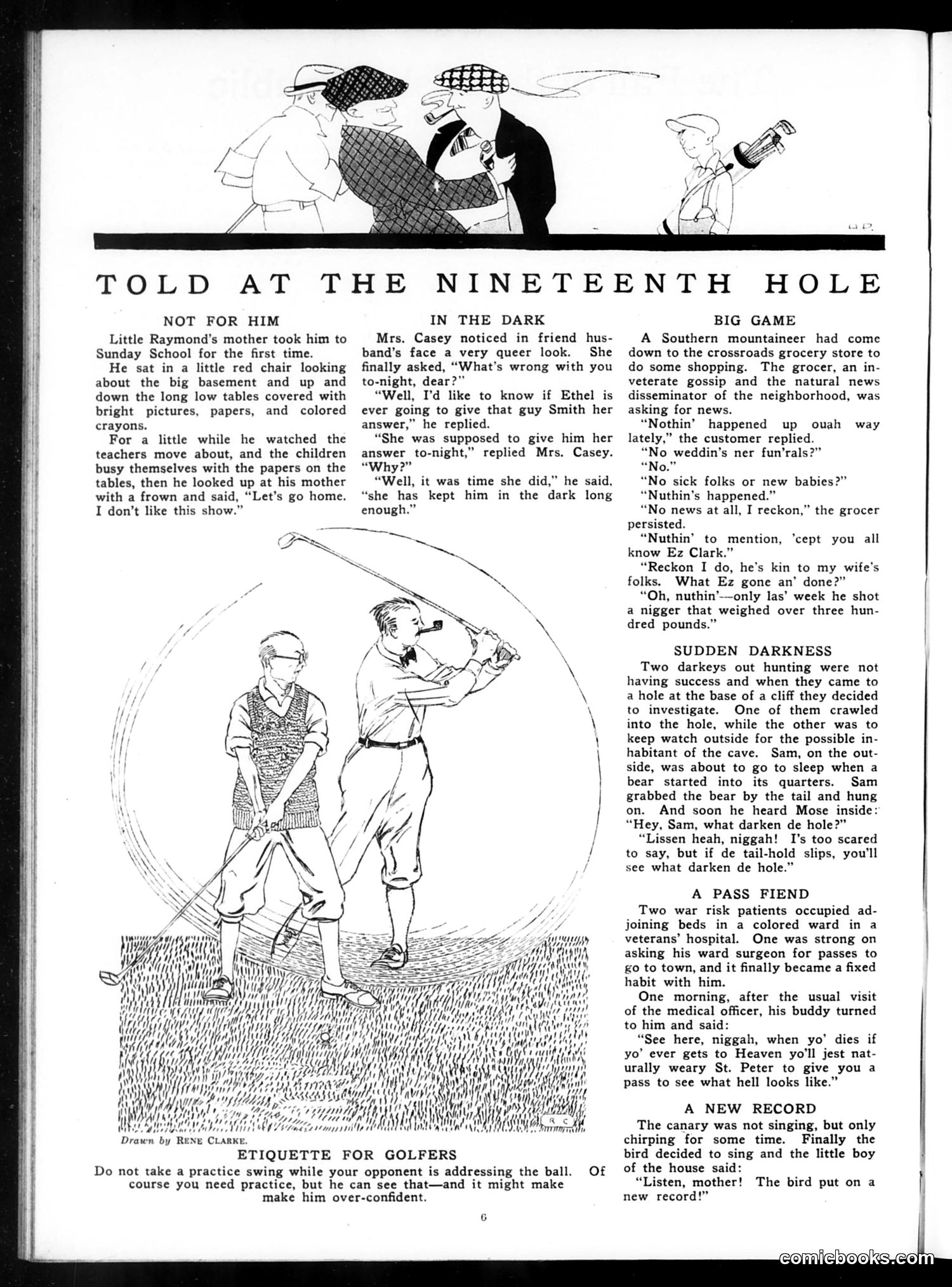
This page from *Judge* magazine contains several humor pieces reflecting early 20th-century attitudes: **"Not for Him"** is a gentle joke about a child finding Sunday School boring—comparing it unfavorably to entertainment. **"Told at the Nineteenth Hole"** (golf club anecdotes) includes three stories with period-specific humor. "In the Dark" plays on a double entendre about romantic delay. "Big Game" and "Sudden Darkness" both use offensive racial dialect and stereotypes common to the era, depicting Black Americans in demeaning ways that reflect the magazine's casual racism. "A Pass Fiend" similarly relies on racial caricature and dialect for its punchline. **"Etiquette for Golfers"** offers practical golf advice wrapped in humor. **"A New Record"** is innocent wordplay about a singing canary. The racial content would be considered offensive today; it represents *Judge*'s historical editorial perspective rather than universal values.
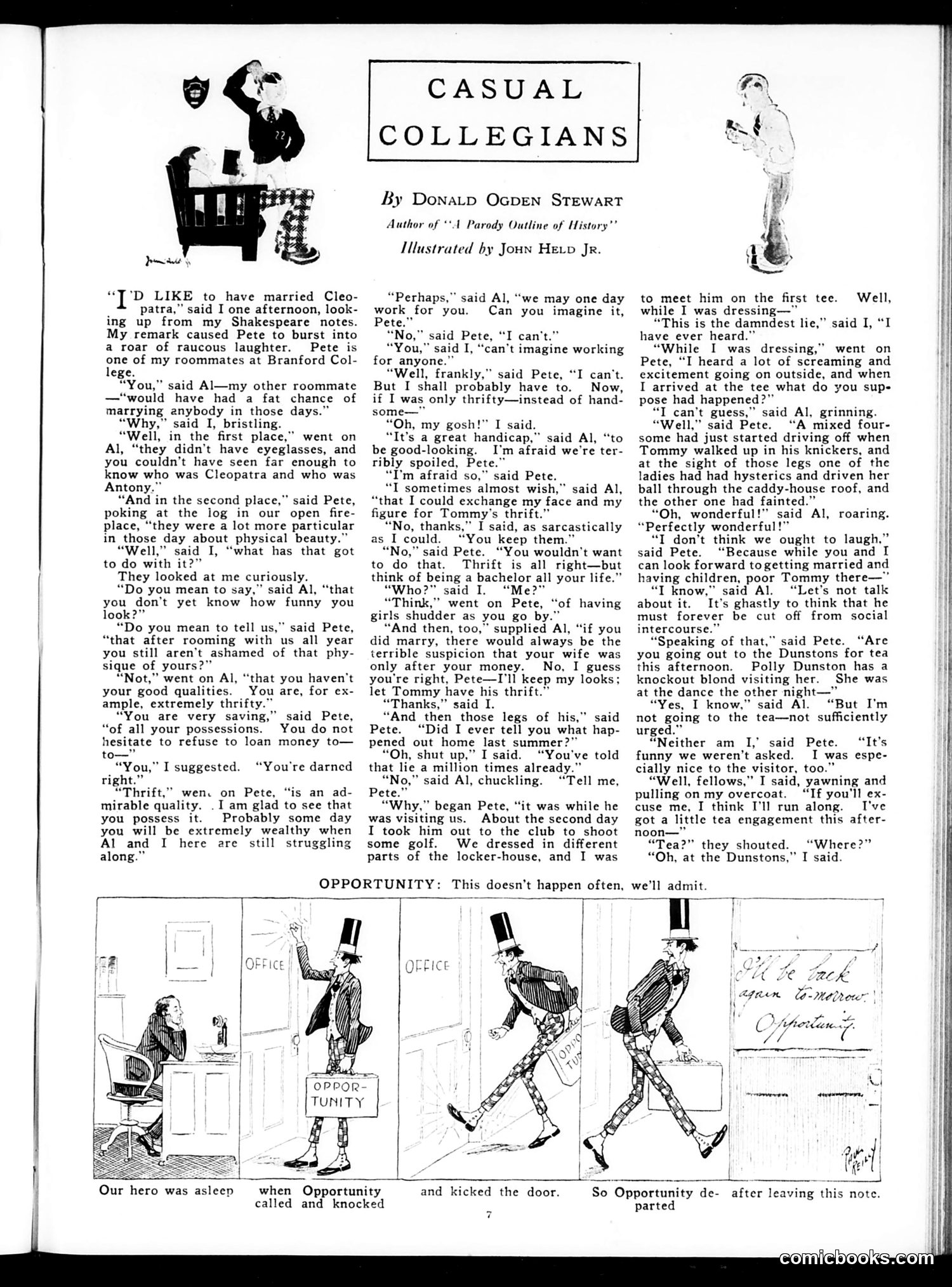
This is a humorous story about three college roommates at Branford College debating their prospects for marriage and success. The narrator lacks self-awareness about his unattractiveness, while his roommates Pete and Al mock him—particularly his poor physical appearance and lack of vanity. The central joke contrasts thrift (financial prudence) with physical attractiveness. Pete and Al suggest the narrator's only marketable quality is being thrifty, implying he'll never marry for love. They humorously fantasize about trading their good looks for their roommate's frugality, recognizing that attractiveness is actually a liability—it invites suspicion of gold-digging wives and creates social complications (illustrated by the anecdote about a woman's hysterical reaction to his legs). The bottom panel shows "Opportunity" literally knocking on a sleeping man's door, then leaving—a visual pun on the phrase "opportunity knocks." The satire gently mocks college-age masculine insecurity and the anxieties about attractiveness, wealth, and marriage prospects common among young men.
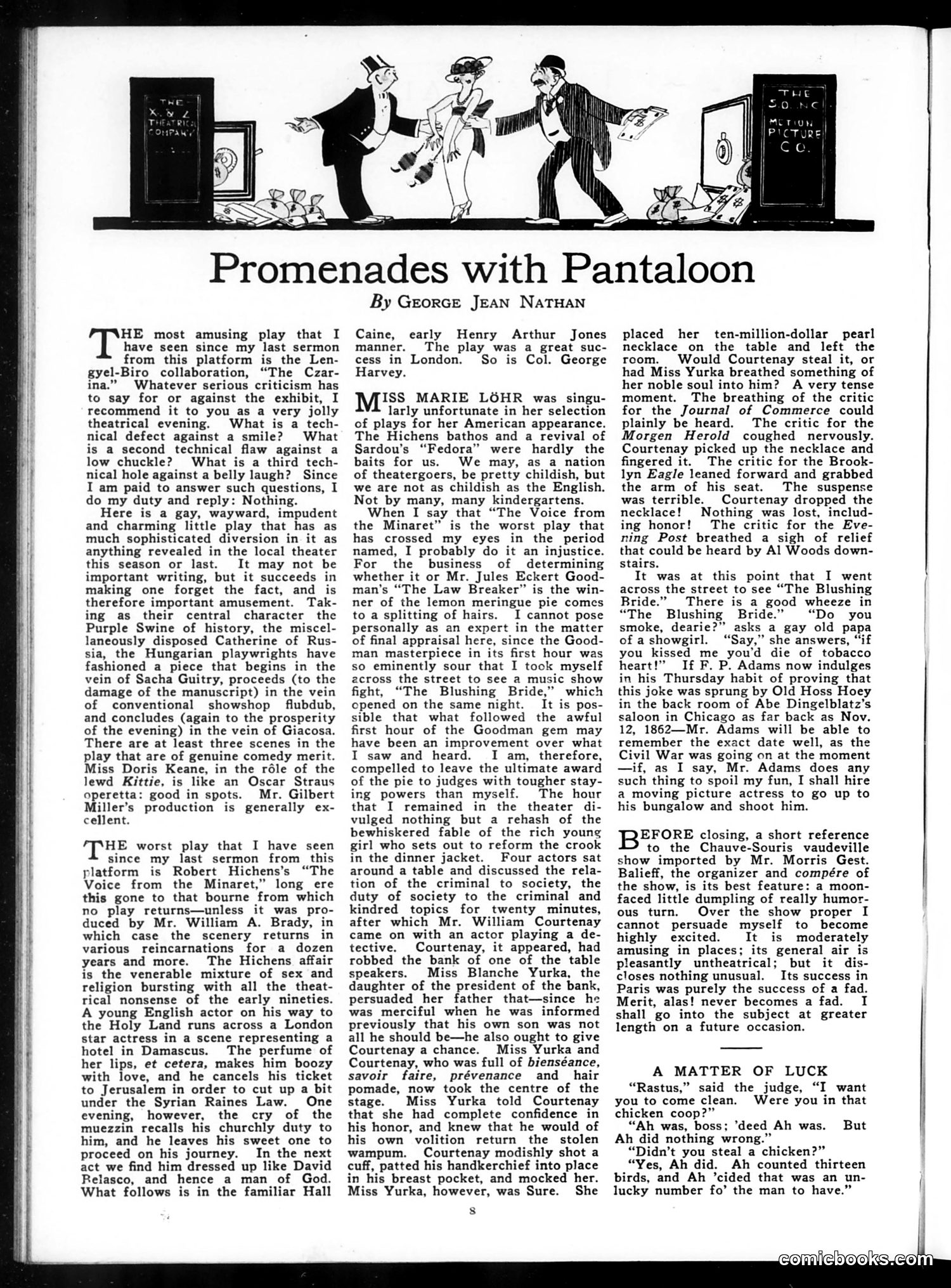
This page from Judge magazine contains theater reviews rather than political cartoons. The header illustration shows a vaudeville-style scene with performers and theater company logos, setting the tone for theatrical criticism. The author, George Jean Nathan, reviews three plays with characteristic acerbic wit. He praises "The Czarina," a Hungarian comedy about Catherine of Russia, calling it amusing despite technical flaws. He savagely dismisses "The Voice from the Minaret" by Robert Hichens as among the worst plays he's seen—criticizing its dated "early nineties" mixture of sex and religion melodrama. He also discusses actress Marie Lohr's unfortunate play selections and compares "The Voice from the Minaret" to Jules Eckert Goodman's "The Law Breaker," finding both equally terrible. The reviews showcase early 20th-century theatrical taste and Nathan's reputation for caustic, entertaining criticism. The "Promenades with Pantaloon" title suggests theater gossip and entertainment reporting typical of Judge's theatrical coverage.
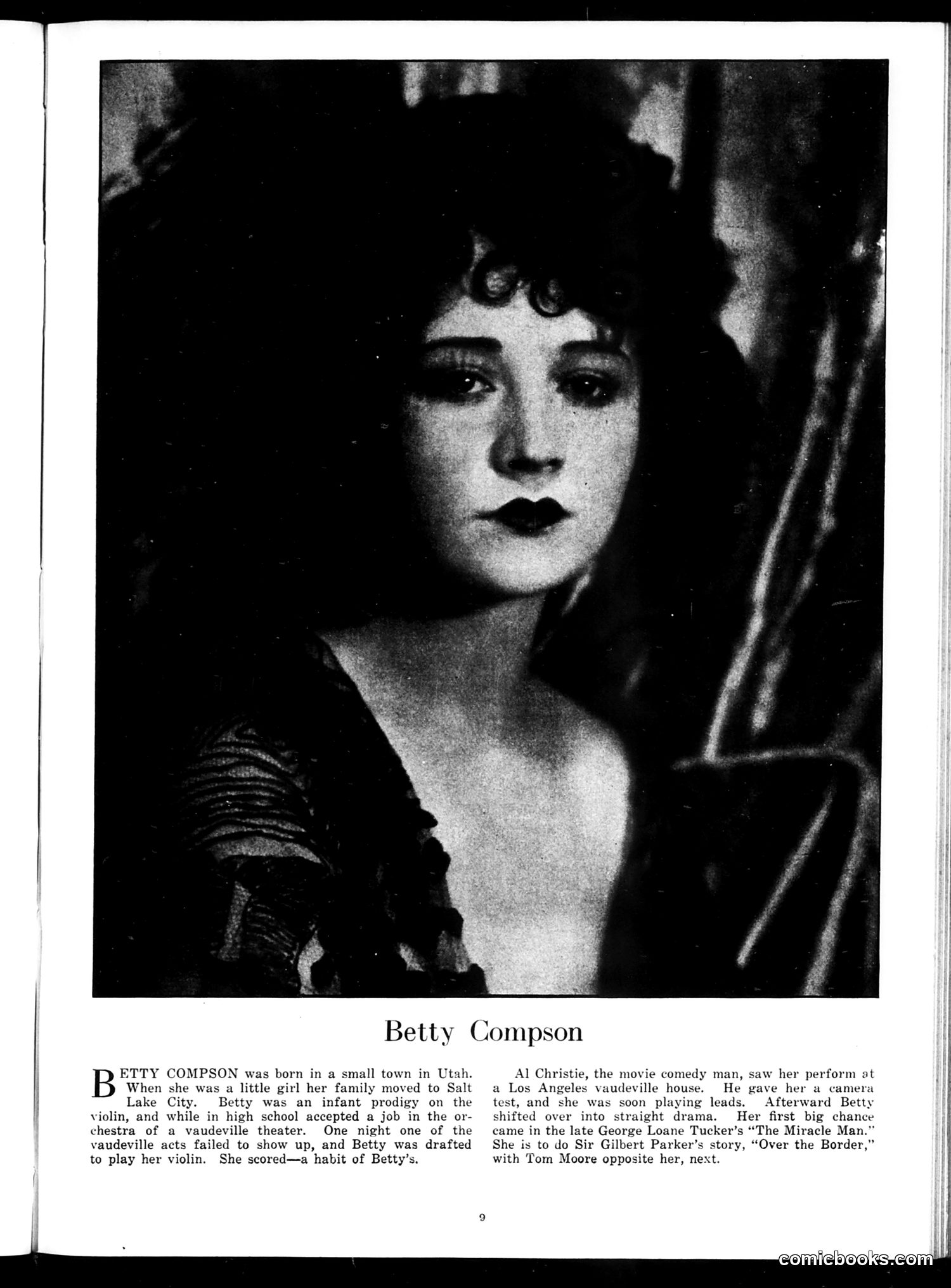
This is a biographical entry from Judge magazine featuring actress Betty Compson. The page combines a formal portrait photograph with a brief career synopsis—not satire or political commentary, but rather entertainment industry promotion. The text traces Compson's rise from child violin prodigy in Utah through vaudeville performance to film stardom. It credits Al Christie, a silent-film comedy producer, with discovering her and transitioning her from comedies to dramatic roles. Her upcoming film "The Miracle Man" is mentioned as a significant opportunity. This appears to be a standard Hollywood profile piece typical of entertainment journalism from the silent film era, meant to inform Judge's readers about rising stars in American cinema rather than to mock or critique.
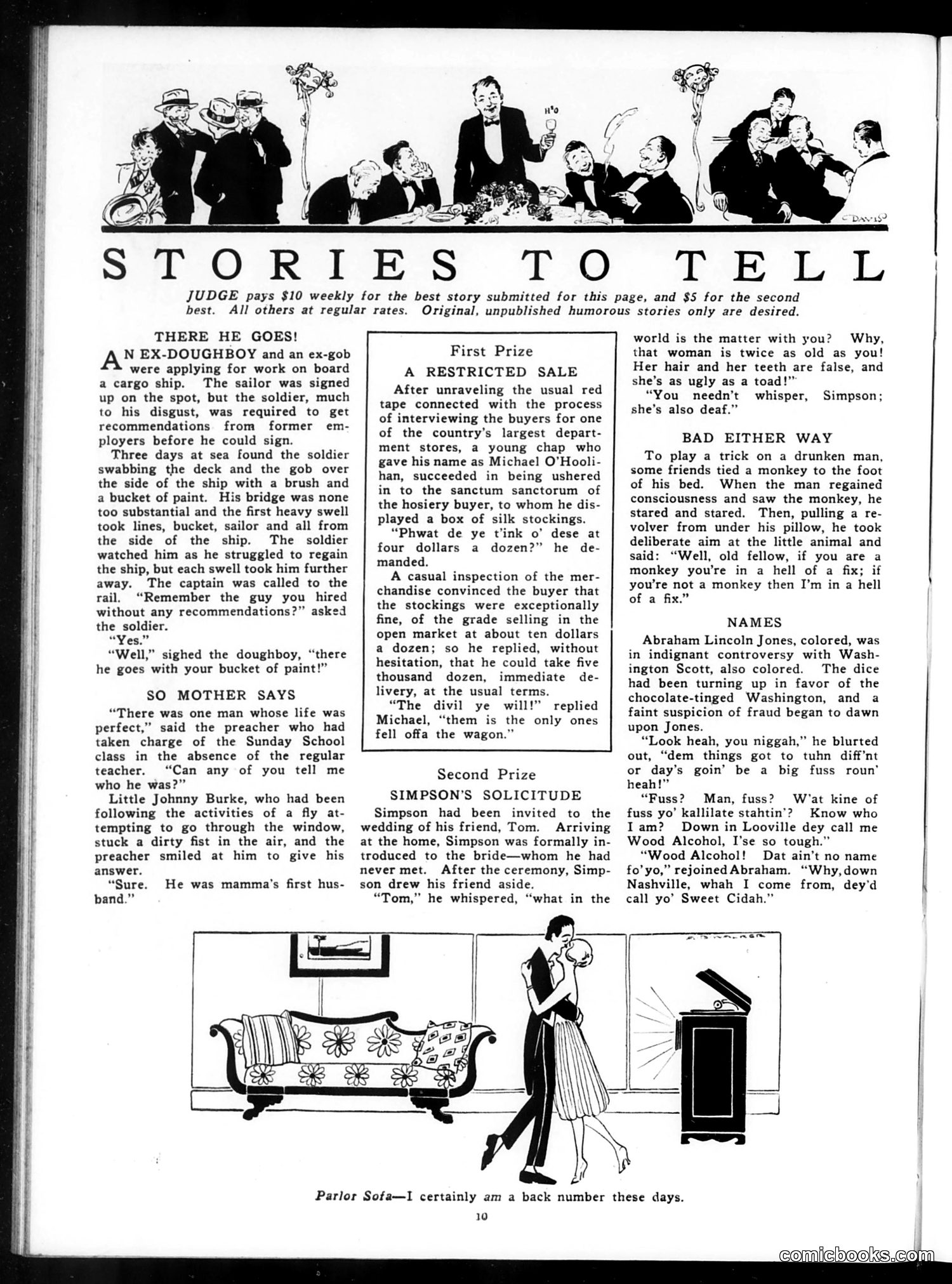
This is a *humor submission page* from Judge magazine—not political satire, but rather a contest where readers submitted jokes for publication. The page showcases three winning stories: 1. **"There He Goes!"** — A wartime joke contrasting an ex-soldier and ex-sailor applying for ship work. The soldier needs former employer recommendations; the sailor doesn't. When the sailor falls overboard with paint supplies, the soldier quips he's "going with your bucket of paint"—dark humor about military bureaucracy versus practical hiring. 2. **"So Mother Says"** — A Sunday School joke: when asked who lived a "perfect life," a boy answers "mamma's first husband"—implying the current husband is inferior. 3. **Additional stories** include an Irish immigrant (Michael O'Hoolihan) selling stolen stockings claiming they "fell offa the wagon," and crude racial humor about "Abraham Lincoln Jones" and "Washington Scott" (colored men playing dice). The page reflects early 20th-century Judge humor: slapstick, wordplay, ethnic stereotyping, and marital comedy. It's primarily entertainment, not social commentary.
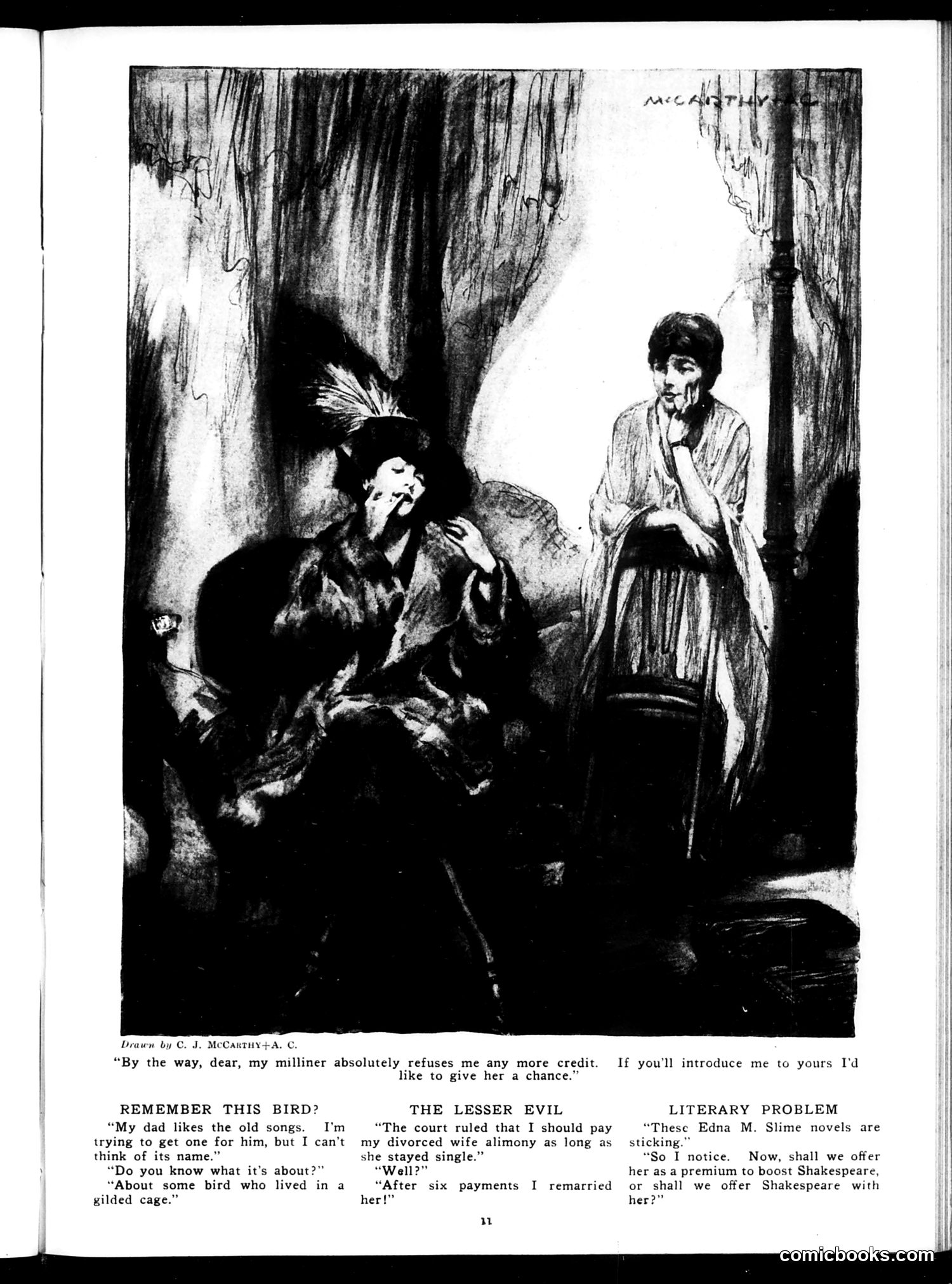
This page contains three separate satirical cartoons mocking domestic and social issues of the era. **Top cartoon**: Shows a woman whose milliner refuses further credit, seeking to introduce a financially struggling friend to a wealthy acquaintance—suggesting women navigated social hierarchies partly through access to others' money and credit. **"Remember This Bird?"**: References the popular song "The Bird in the Gilded Cage," mocking a father's nostalgia for old songs while his son struggles to recall it. **"The Lesser Evil"**: Satirizes divorce law and alimony by showing a man who remarried his ex-wife to escape alimony payments—a darkly comic commentary on flawed legal remedies. **"Literary Problem"**: Mocks the quality of "Edna M. Slime" novels (likely a fictional author), suggesting they're so unpopular publishers might use them as giveaway premiums to boost sales of Shakespeare—jabbing at lowbrow versus highbrow literature tastes. All three mock contemporary manners and social absurdities.
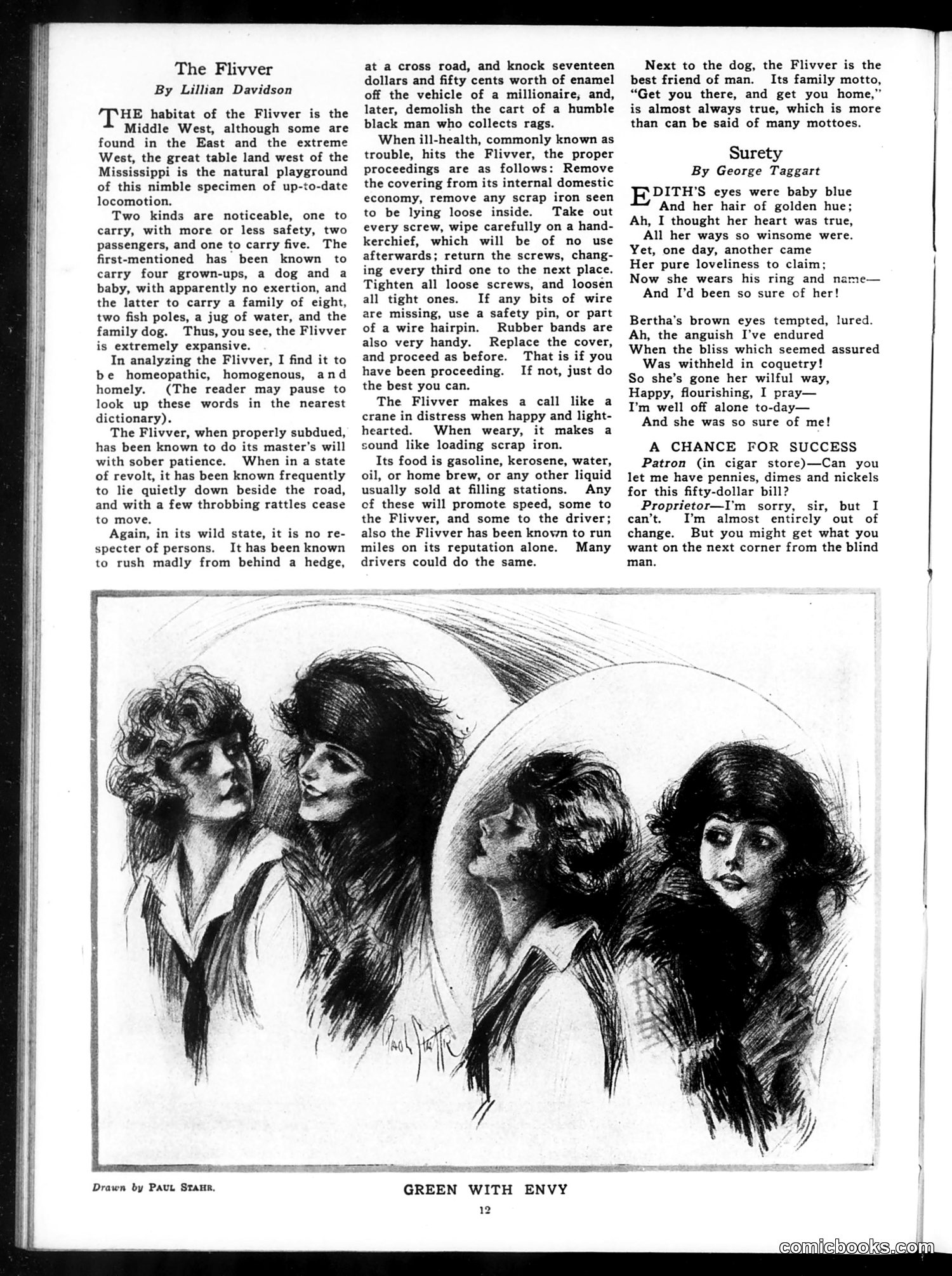
This page contains three distinct pieces. The main illustration, "Green with Envy" by Paul Stahr, depicts four women's faces in sketch form, likely representing jealousy or romantic rivalry—a common theme in early 20th-century humor. The two accompanying texts are unrelated: Lillian Davidson's "The Flivver" is a humorous essay about the Model T Ford, mocking its unreliability, makeshift repairs, and democratic ability to damage both millionaires' and poor people's vehicles equally. George Taggart's poem "Surety" contrasts two men who lost romantic interests to other suitors, with ironic reversals about who ended up satisfied. The small joke at bottom about exchanging a fifty-dollar bill satirizes economic hardship—the proprietor suggesting the customer ask a blind street beggar for change implies widespread financial desperation, where even blind panhandlers might carry small denominations.
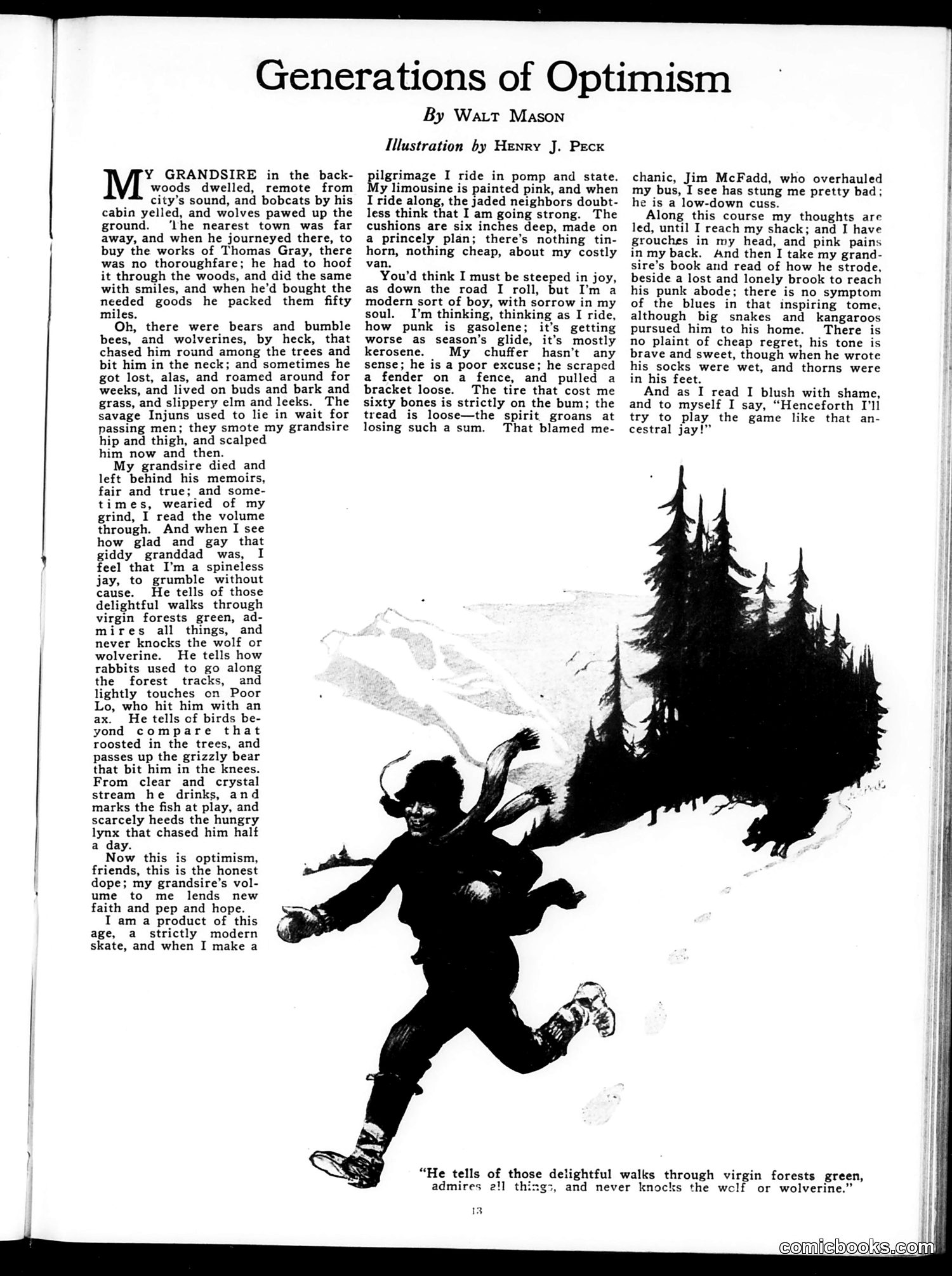
This satirical poem by Walt Mason contrasts two generations' attitudes toward hardship. The narrator's **grandfather** was a frontier settler who endured genuine dangers—bears, Native Americans ("Poor Lo"), injuries, disease—yet remained cheerful and grateful, dwelling on nature's beauty rather than complaints. The **modern narrator** (the grandfather's descendant), by contrast, owns a luxurious pink limousine but constantly grumbles about minor annoyances: expensive gasoline, an incompetent mechanic, a dented fender, a worn tire. Despite material comfort far exceeding his ancestor's, he's perpetually miserable. The satire targets **early 20th-century modernity and consumerism**: progress and conveniences haven't brought happiness; instead, people have become soft, entitled complainers. The illustration shows the narrator skiing, representing modern leisure activities his frontier grandfather never enjoyed. The message is that **optimism comes from resilience during genuine hardship, not from having things**—a criticism of contemporary consumer culture's failure to deliver promised satisfaction.
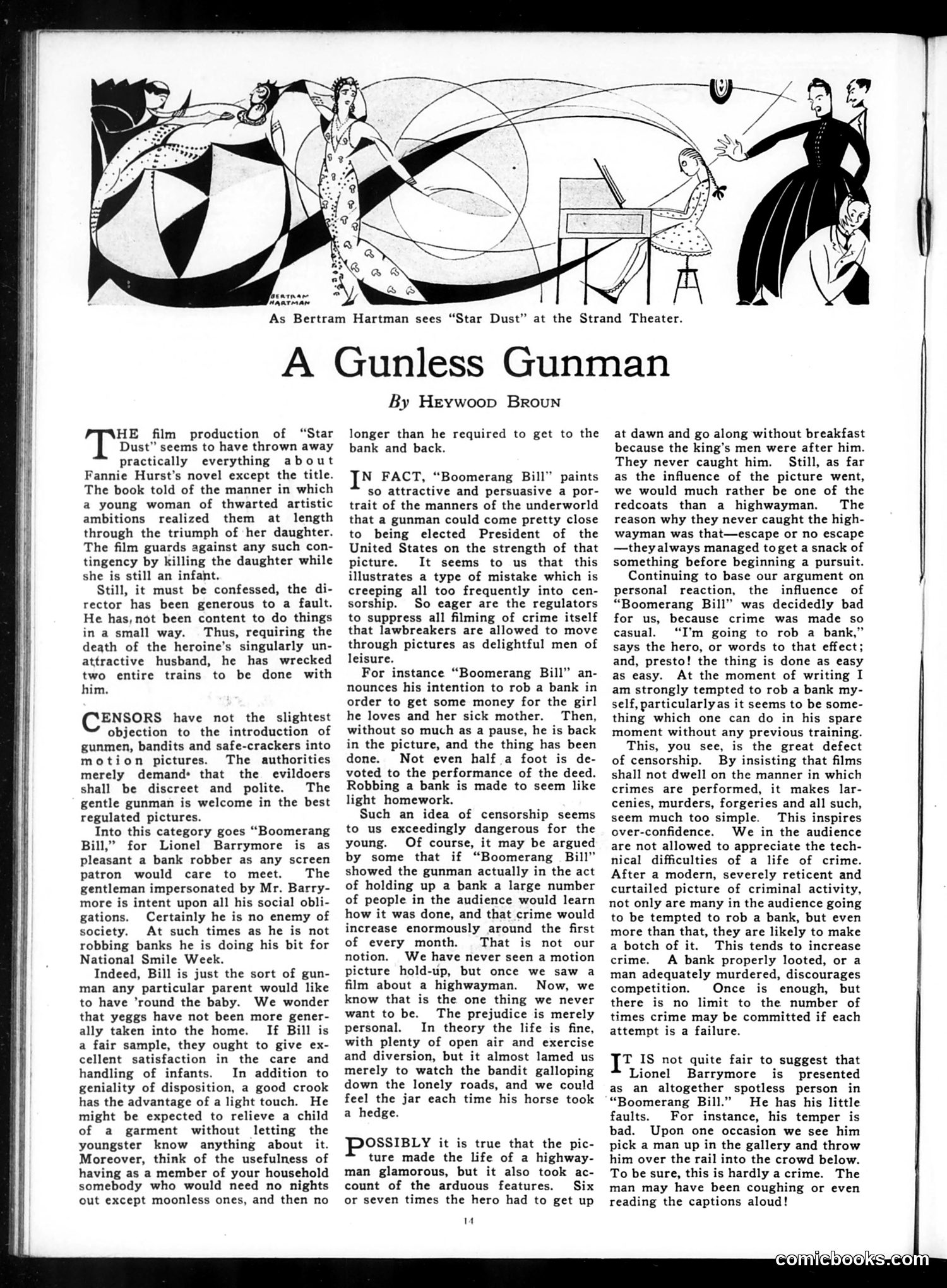
This article by Heywood Broun critiques film censorship's inconsistent logic regarding crime depictions. The accompanying cartoon illustrates the article's argument. **The Target:** Film censors who permit glamorous portrayals of criminals (specifically the "Boomerang Bill" character played by Lionel Barrymore) while suppressing depictions of actual crime. Broun argues this creates a dangerous paradox: audiences see bank robbery as "light homework" because the crime itself is never shown—only its charming aftermath. **The Satire:** Broun sardonically suggests that criminals make ideal babysitters and household employees, since they're portrayed as gentlemen of leisure with good manners. He notes the censor's logic is backwards: showing *how* crimes are committed might actually discourage crime, whereas sanitizing criminals into romantic figures glorifies lawbreaking. **The Point:** Broun argues 1920s film censorship, while banning explicit crime scenes, inadvertently romanticizes criminality by allowing charming criminals to operate without consequences on screen.
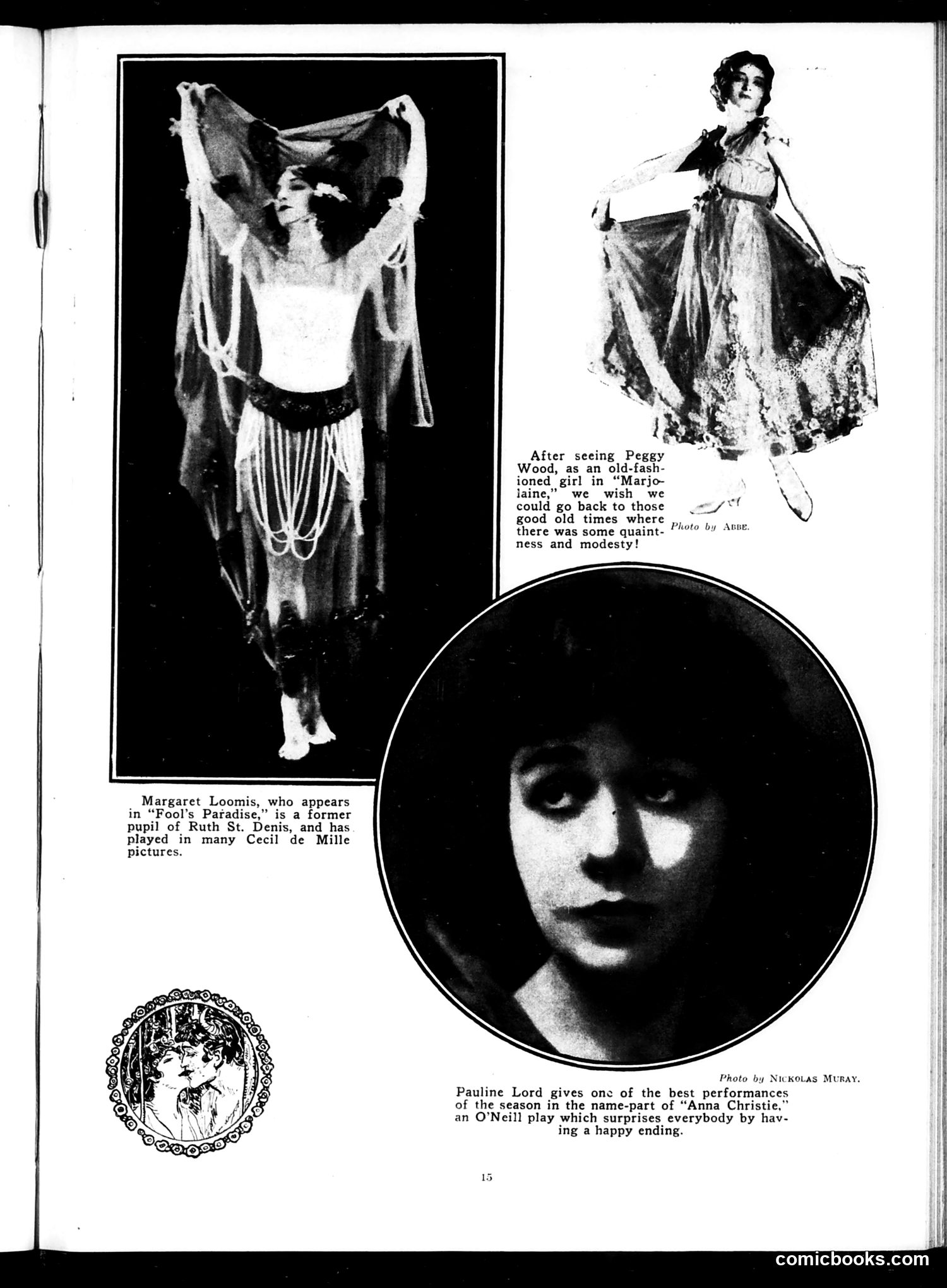
This page features theatrical reviews rather than political satire. It showcases three actresses and their current Broadway roles circa the 1920s: **Margaret Loomis** appears in "Fool's Paradise," noted as a former Ruth St. Denis student and Cecil de Mille film actress. **Peggy Wood** stars in "Mariolaine," playing an old-fashioned girl. The commentary humorously laments that modern audiences wish they could return to times of "quaintness and modesty"—a gentle jab at contemporary (1920s) fashion and behavior becoming more daring. **Pauline Lord** receives praise for her performance in Eugene O'Neill's "Anna Christie," with the reviewer noting surprise that this O'Neill play has a happy ending (unusual for the famously dark playwright). The page is primarily entertainment coverage celebrating current Broadway productions and their stars, reflecting Judge's broader cultural commentary beyond politics.
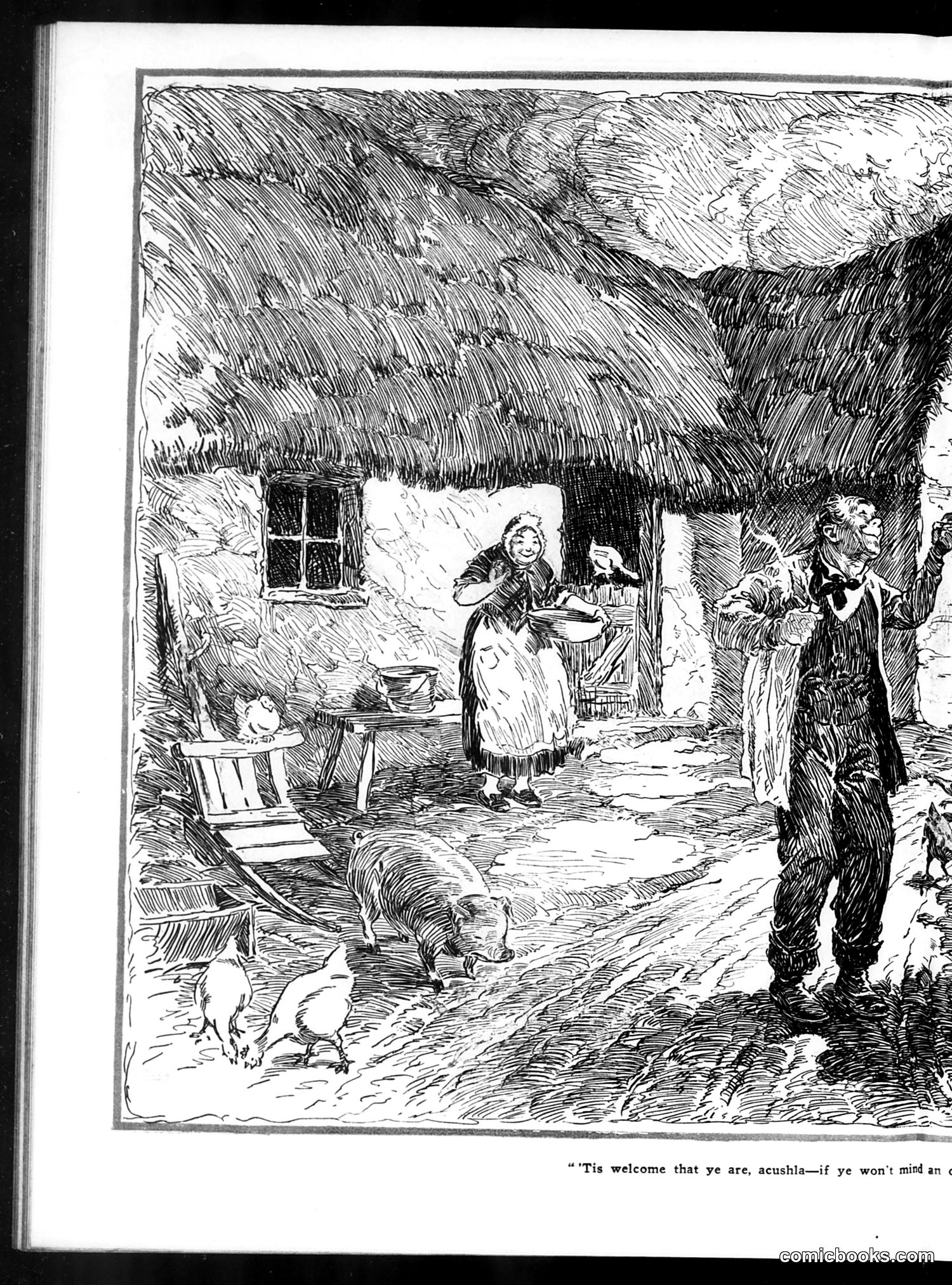
This is a pen-and-ink illustration depicting a rural Irish cottage scene. The visible caption reads: "'Tis welcome that ye are, acushla—if ye won't mind an..." (text cuts off). The scene shows what appears to be Irish figures in traditional dress outside a thatched-roof cottage, with pigs and chickens in the yard. The illustration uses stereotypical visual markers—the thatched dwelling, rural setting, and dialect in the caption ("acushla," an Irish term of endearment). This reflects 19th-century American satirical magazine conventions that frequently caricatured Irish immigrants and Irish culture through exaggerated dialect, poverty imagery, and rural "backwardness." The cartoon likely plays on period American attitudes toward Irish immigration, presenting Irish people as rustic and quaint, or possibly mocking their circumstances. Without the complete caption, the specific satirical point remains partially unclear.
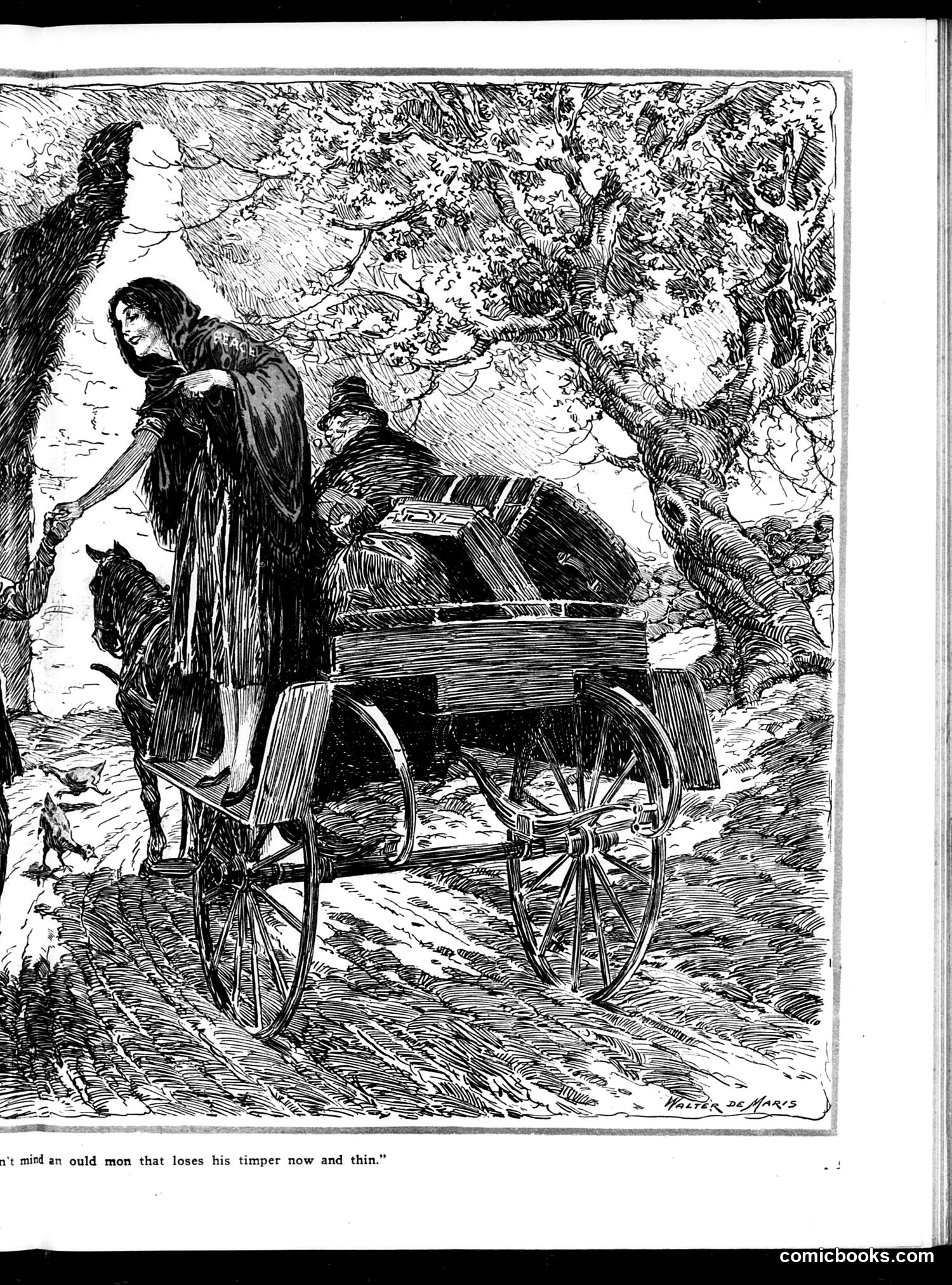
This pen-and-ink illustration by Walter de Maris depicts two figures with a baby carriage in a wooded setting. The visible text fragment—"n't mind an ould mon that loses his temper now and thin"—appears to reference an elderly man's volatile temperament, rendered in dialect spelling ("ould," "thin" for "then"). The cartoon likely satirizes aging and irritability, a common Judge magazine theme. The formal dress and carriage suggest middle or upper-class subjects. Without the complete caption or publication date visible, the specific political or social target remains unclear, though the tone suggests gentle mockery of an older gentleman's declining composure. The naturalistic woodland setting contrasts with the domestic scenario, possibly emphasizing life's inevitable changes with age.
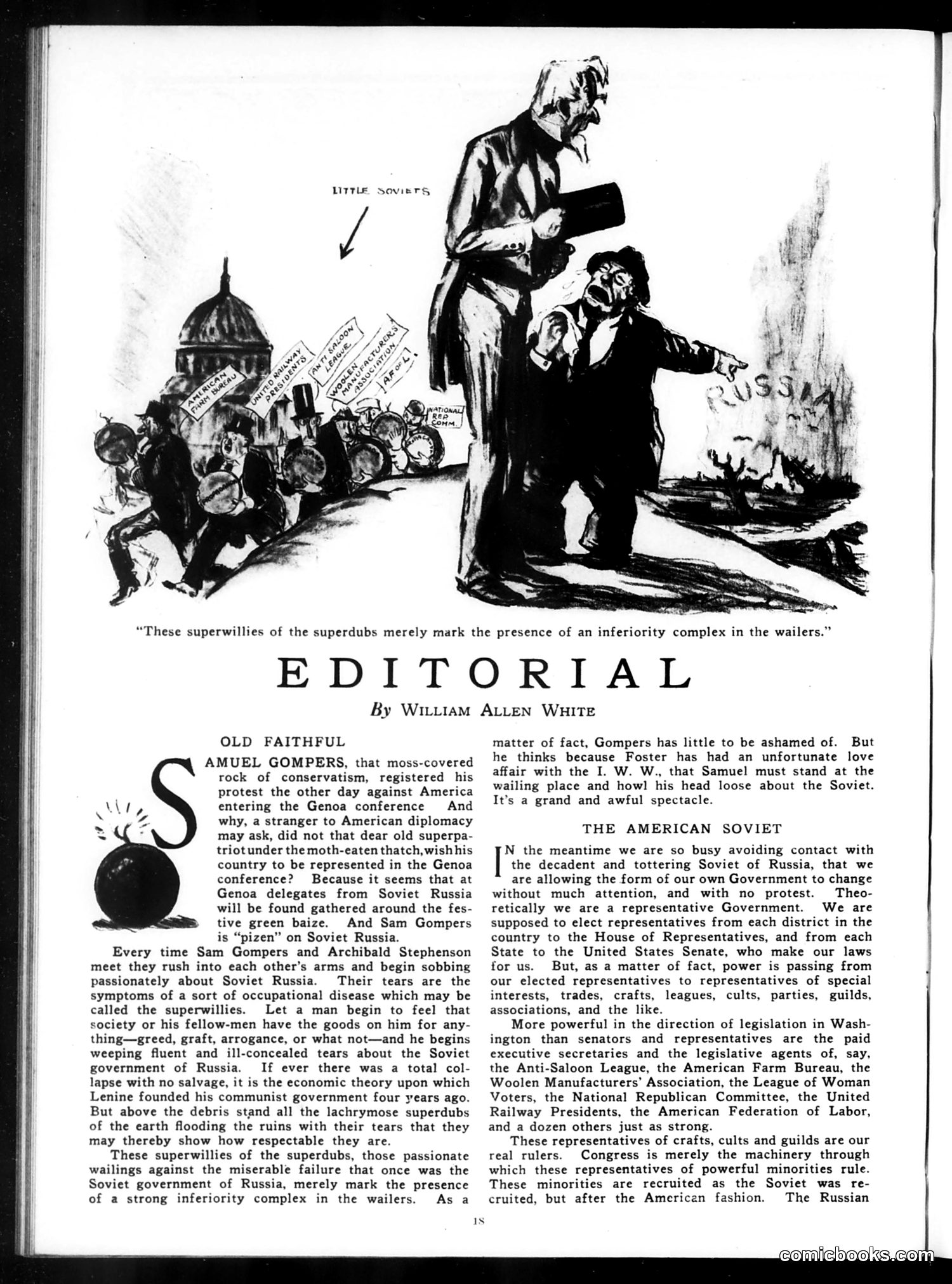
This editorial by William Allen White satirizes American anti-communist hysteria while arguing the U.S. faces its own hidden authoritarianism. **Main Figures:** - Samuel Gompers (labor leader) and Archibald Stephenson represent anti-Soviet crusaders depicted as emotionally overwrought "superdubs" crying about Soviet Russia's failures - "Little Soviets" in the cartoon appear to be special interest groups **The Satire:** White mocks what he calls "superwillies"—obsessive, performative anti-communism masking guilty consciences. He argues Gompers uses Soviet threats to distract from his own compromises. **The Deeper Argument:** White's second section reveals the real target: American democracy is already corrupted. Unelected lobbyists from the Anti-Saloon League, Farm Bureau, and labor federations wield more legislative power than elected representatives. These "minorities" rule through special interests rather than democratic process—making America functionally similar to Soviet authoritarianism, just through different means. The cartoon's burning "Russia" suggests American self-righteousness about Soviet communism while ignoring domestic oligarchy.
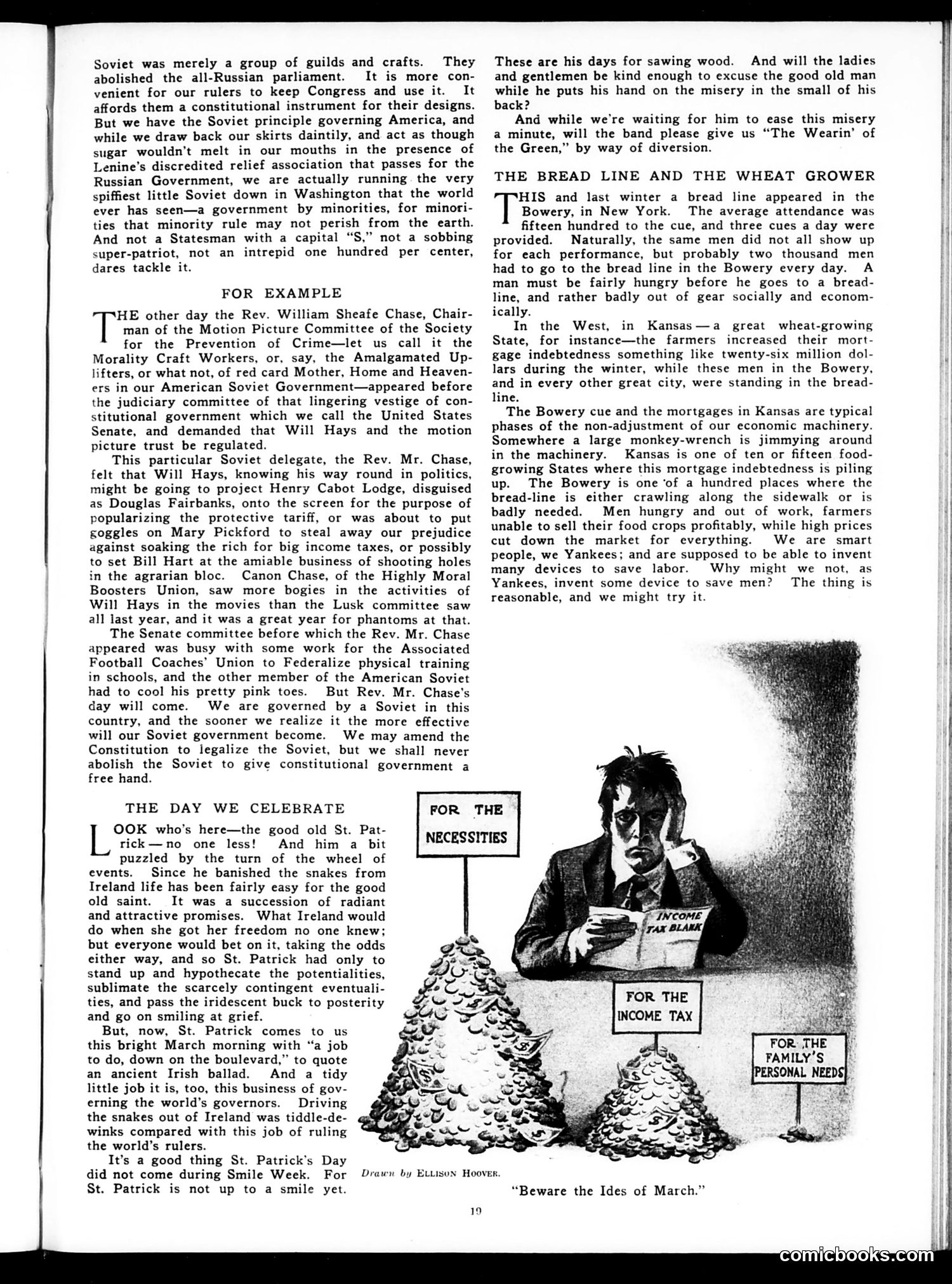
This *Judge* magazine page contains two distinct satirical pieces: **Top Section - "For Example":** Attacks Rev. William Sheafe Chase, a reformer who testified before the Senate about regulating Will Hays and the motion picture industry. The author sarcastically dismisses Chase as a self-righteous busybody leading a "Soviet" of morality crusaders ("Amalgamated Uplifters"). The piece ridicules the idea that Hollywood might promote progressive causes like taxing the wealthy or criticizing tariffs, while mocking how Chase sees dangers everywhere. The underlying point: anti-communist crusaders are themselves tyrannical minorities imposing their will. **Bottom Section - "The Day We Celebrate":** A St. Patrick's Day piece imagining the saint bewildered by his new job: "governing the world's governors"—apparently referencing Ireland's recent independence (1921) and newfound diplomatic responsibilities. The satire suggests Irish leadership now faces far greater challenges than the legendary task of banishing snakes. Both pieces attack self-appointed moral authorities and reformist overreach through sarcasm and ironic comparison to tyrannical systems.
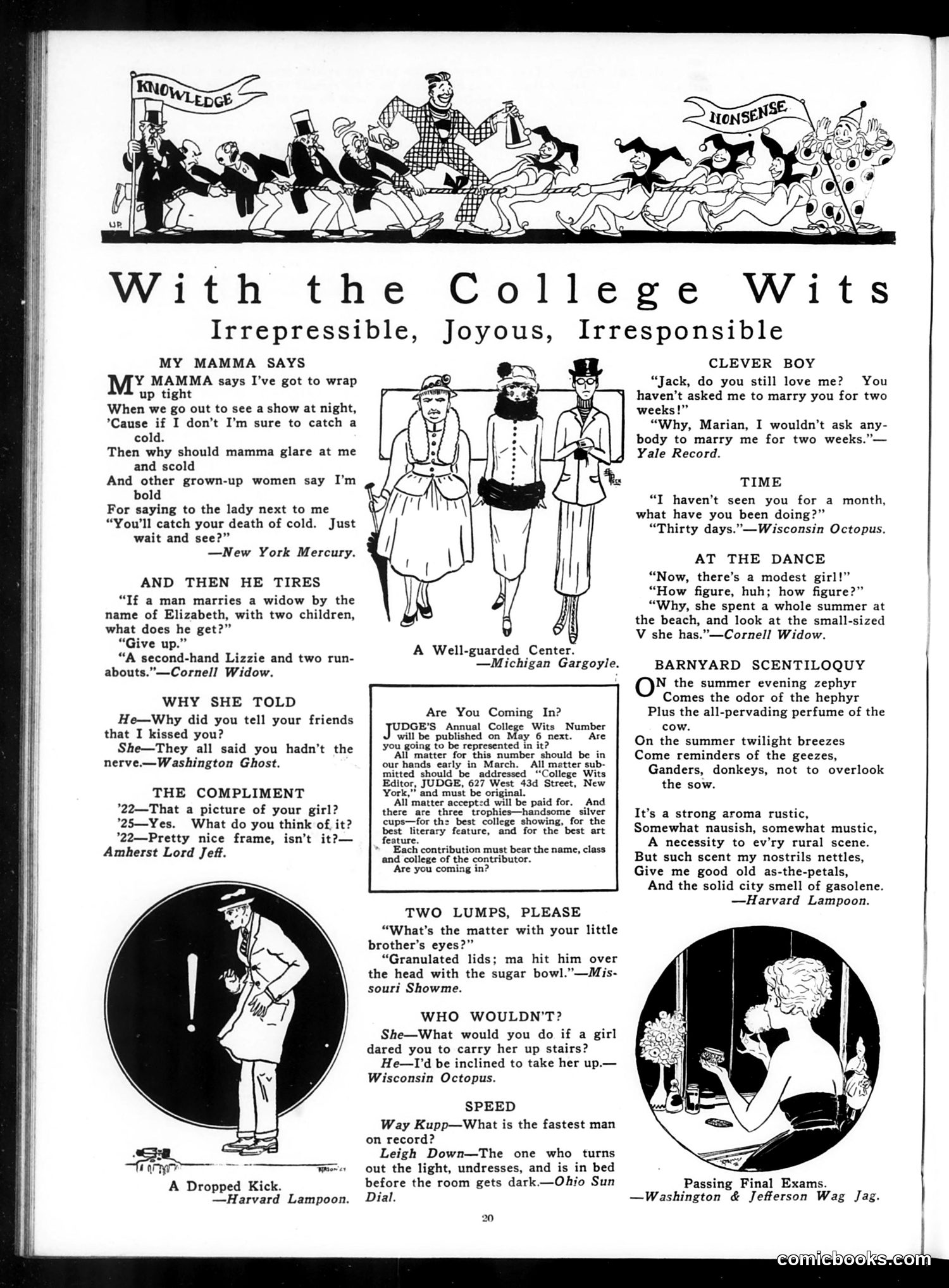
This page collects humorous submissions from college newspapers and literary magazines across America, a common Judge feature. The content reflects 1920s campus life and concerns. **Key themes:** - **Dating/romance anxieties**: jokes about marriage proposals, kissing, carrying girls upstairs—reflecting era-appropriate courtship rituals and male-female dynamics - **Academic life**: references to exams, college rivalries, and campus pranks - **Class/generational humor**: older men (represented in illustrations) commenting on younger behavior; mothers worrying about propriety - **Rural vs. urban contrast**: "Barnyard Scentiloquy" humorously expresses college students' disdain for farm life, preferring city gasoline fumes to barnyard smells The cartoons and jokes are gentle satire of college culture—mocking romantic clumsiness, parental concern over "boldness," and provincial attitudes. The overall tone is playful rather than biting.
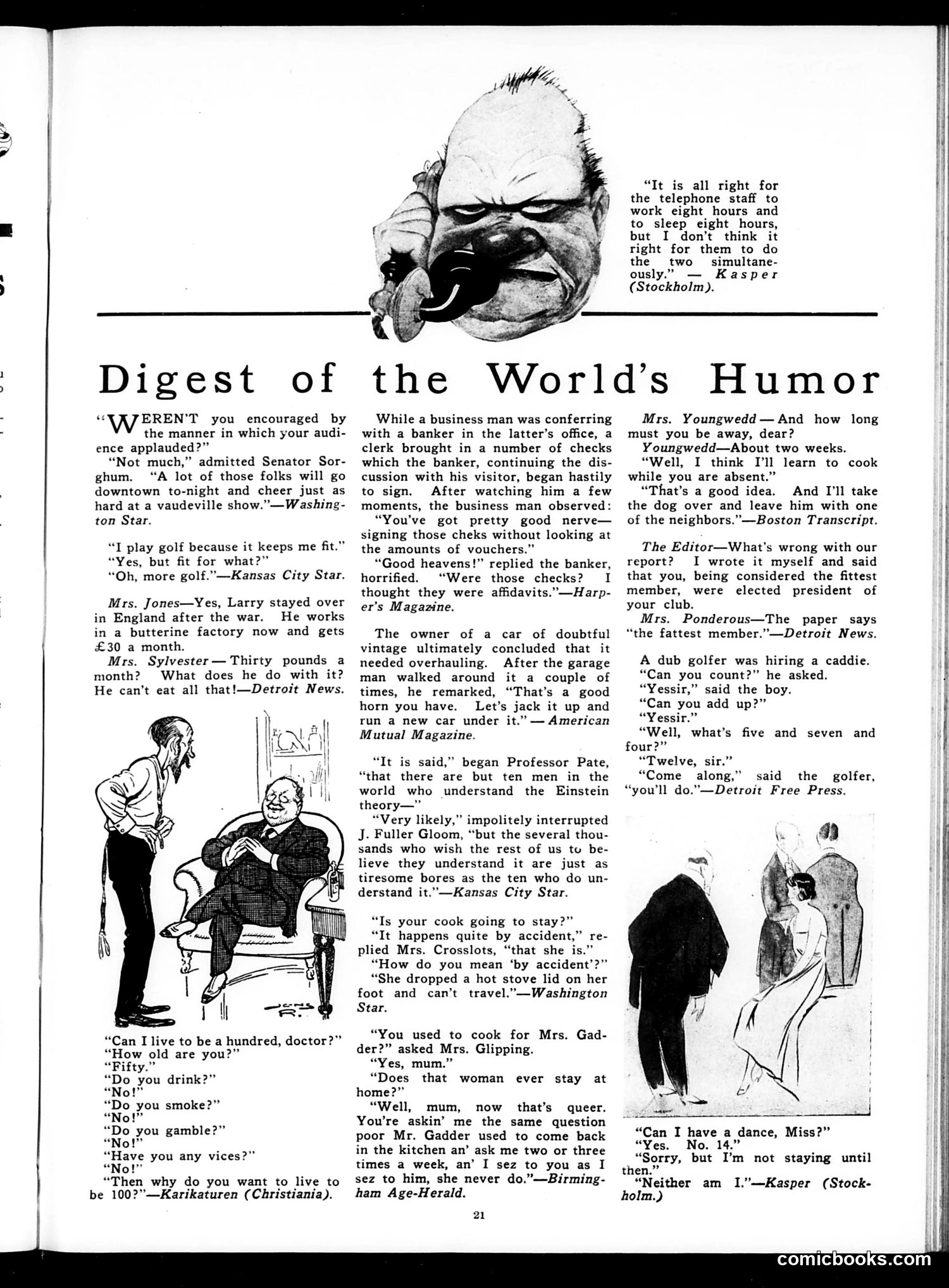
This page collects brief jokes and quips from newspapers and magazines worldwide, arranged around two illustrations. The content reflects early 20th-century concerns and humor. **Key themes:** - **Work and modern life**: Jokes about telephone workers sleeping on the job, golf obsession, and a banker so careless he signs checks without reading them. - **Einstein theory**: A dig at intellectuals—the joke mocks both those claiming to understand Einstein's theory and those pretending to understand it. - **Gender and marriage**: Humor centered on wives who won't cook or stay home, husbands resigned to domestic absurdity, and marrieds avoiding each other. - **Social pretense**: A doctor's patient has no vices but wants to live to 100—the irony being a virtue-free life lacks purpose. The illustrations show a man playing a stringed instrument and a couple at a dance. The overall tone is gently cynical about modern manners, intellectual pretension, and domestic life—typical of Judge's satirical approach.
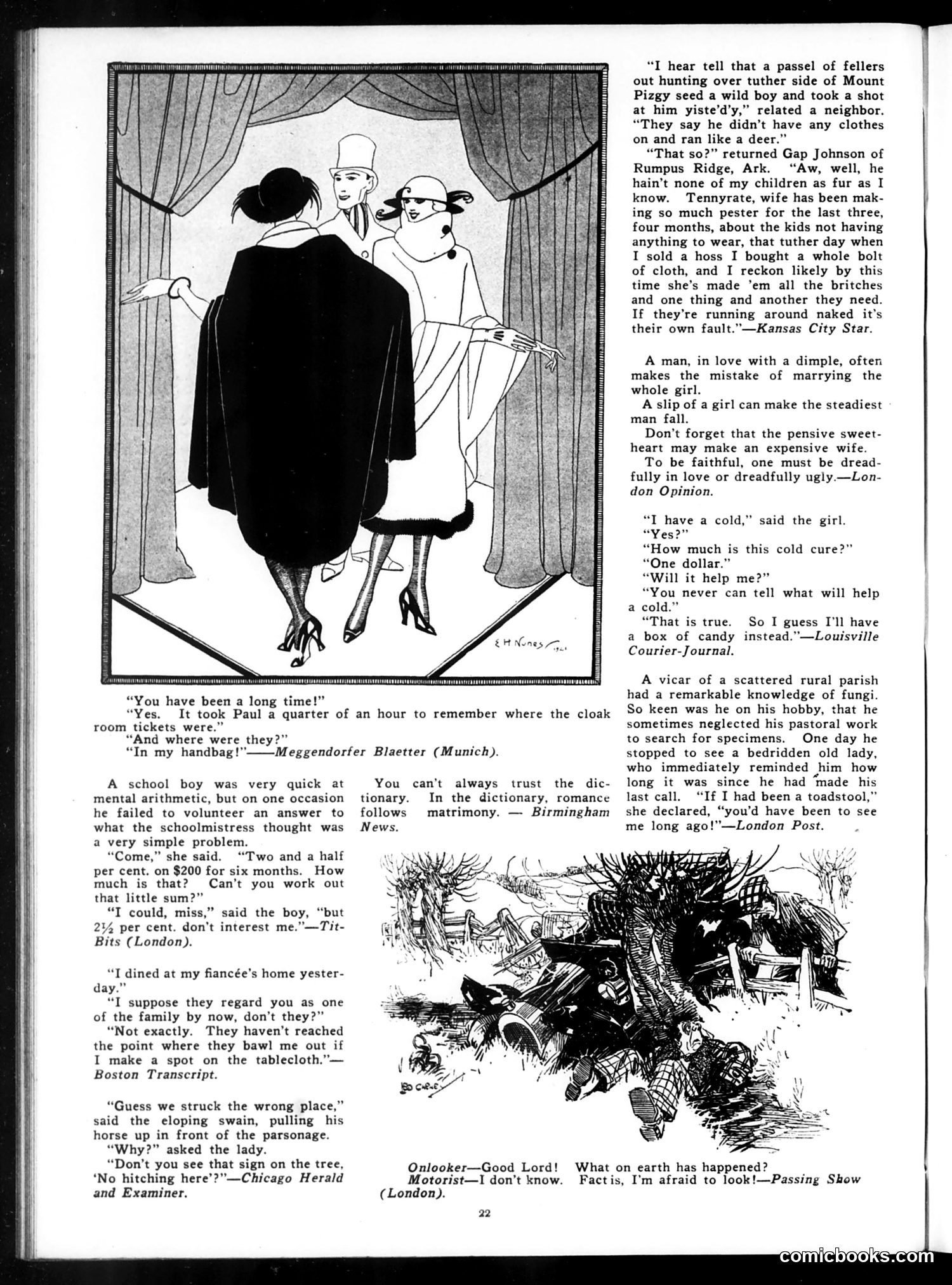
This page compiles humorous anecdotes and jokes typical of early 20th-century American satirical magazines. The content reflects social attitudes of the era: **Main Illustration**: Shows three well-dressed figures (likely depicting social elites) in what appears to be a theater or formal setting, illustrating a joke about forgetfulness—a man cannot remember where his companion left her cloak tickets. **Recurring Themes**: The jokes target familiar targets of period satire: absent-minded husbands, marital discord, courtship mishaps, and rural/urban class distinctions. One anecdote mocks a schoolboy's disinterest in mathematics; another satirizes an elopement gone wrong. **Social Commentary**: Several jokes express skeptical attitudes toward marriage and romantic love, suggesting women are expensive and unpredictable. Rural dialect humor ("yiste'd'y," "hain't") reflects period stereotypes. **The Car Crash Sketch** (bottom): Shows a motorist accident, with figures expressing shock—reflecting early automobile-era anxieties about this new technology. The humor is genteel, moralistic, and assumes a middle-class readership.
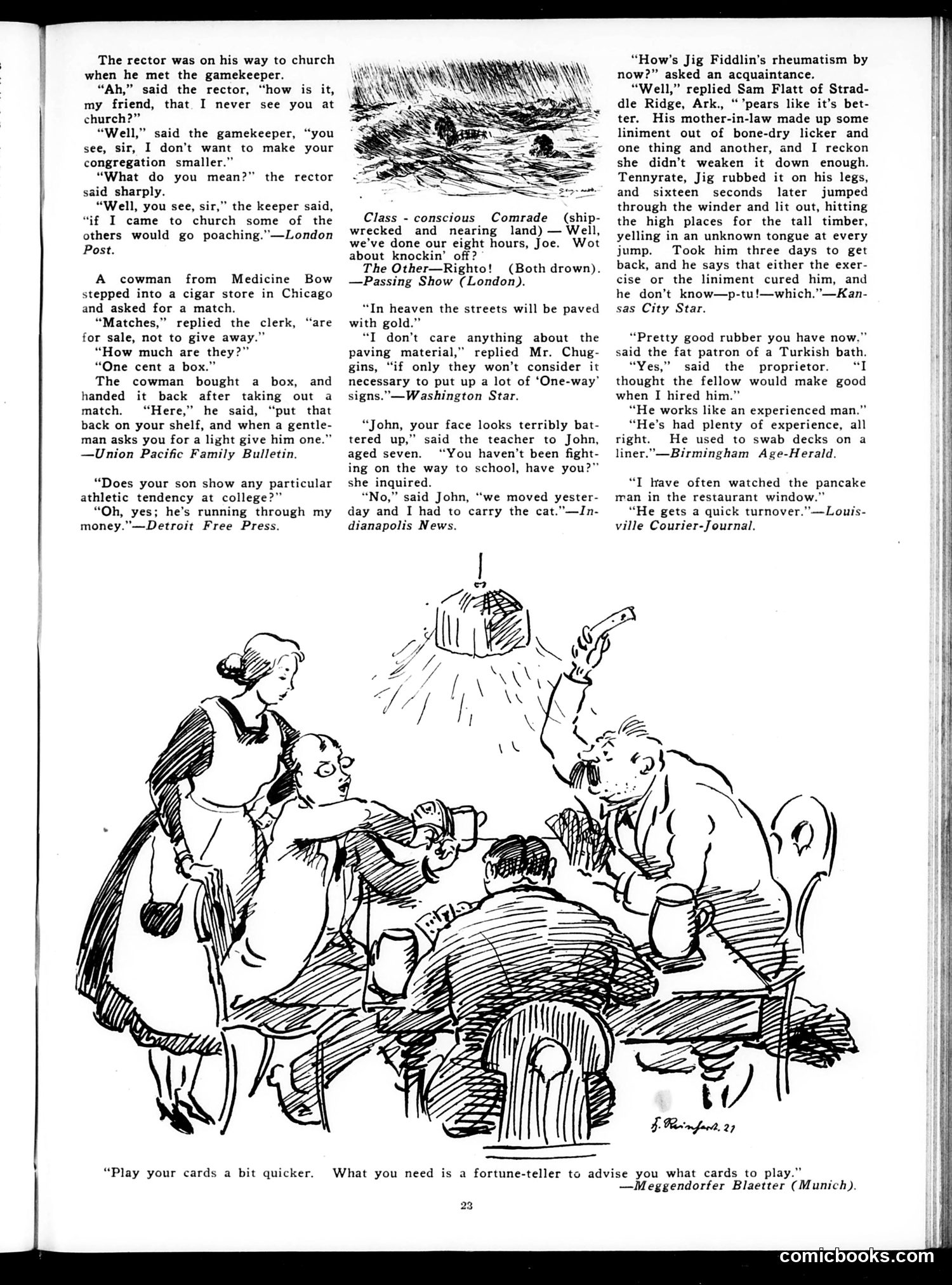
This page contains multiple brief humorous anecdotes typical of early 20th-century American satirical magazines, presented as jokes submitted from various newspapers. The main cartoon depicts a fortune-teller advising card players, illustrating the caption's joke about needing supernatural guidance for card games—a satirical jab at gamblers' desperation. The text anecdotes mock various social types: a gamekeeper's crude logic about church attendance affecting poaching; a stingy Chicago clerk; a spendthrift college student; and working-class characters (a cowboy, a boy who fought while moving, a sick man given questionable liniment). The humor relies on wordplay (the "quick turnover" pancake joke), class-based comedy, and rustic dialect. A notably dark joke depicts two drowning sailors as "class-conscious" for working their eight-hour shift before abandoning ship—satirizing labor activism as absurdly rigid. The overall tone reflects period attitudes: rural simplicity presented as comic, working-class speech as inherently funny, and skepticism toward both religious and political earnestness.
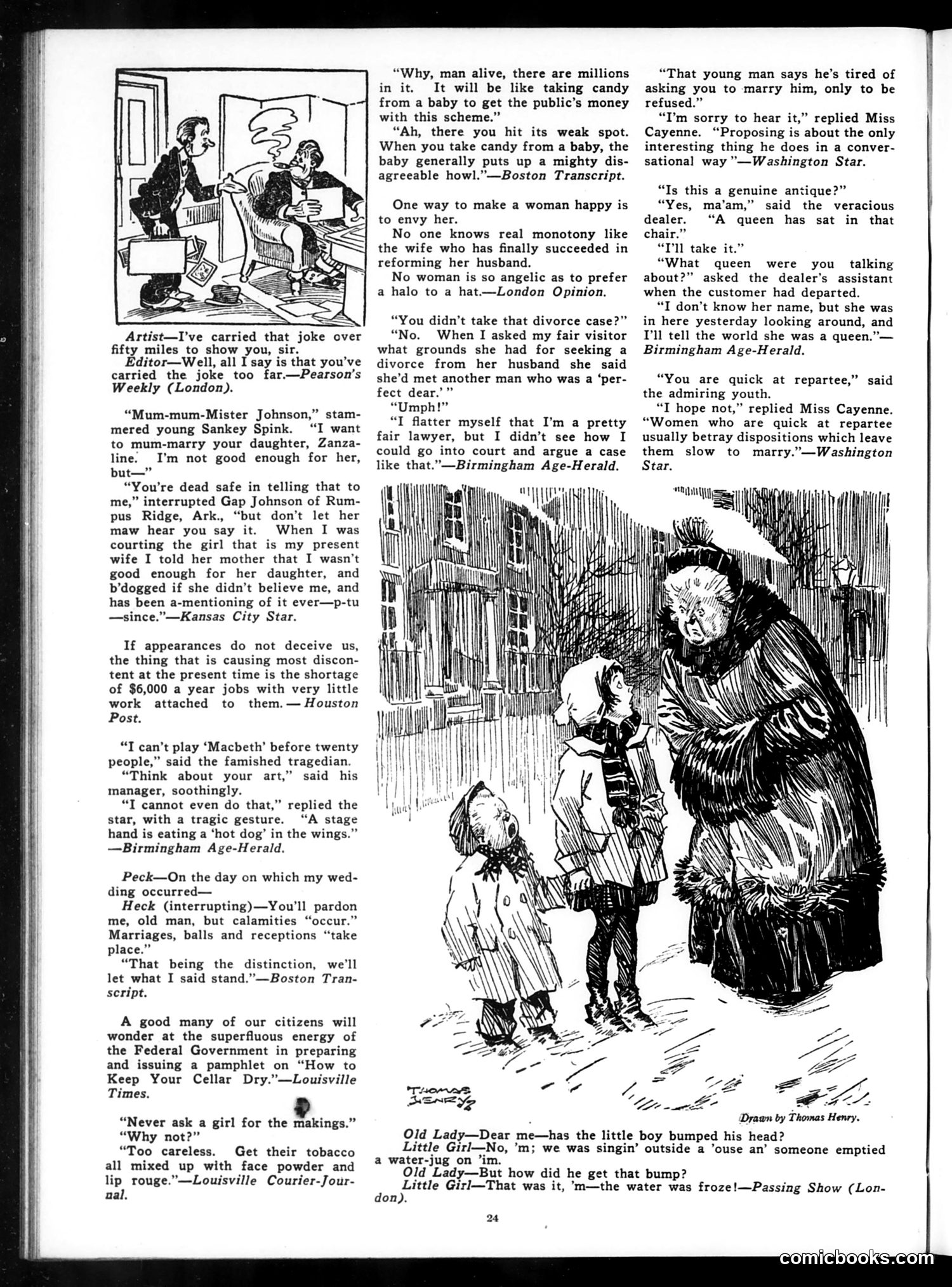
This page from *Judge* (a satirical American magazine) contains primarily **joke columns and brief anecdotes** rather than political cartoons—typical of the publication's humor format. The content satirizes **early 20th-century social conventions**: marriage proposals, divorce, spousal reform efforts, and gender relations. One notable cartoon (by Thomas Henry) depicts a street scene with children and an old woman—a domestic vignette with working-class British dialect humor about children getting soaked outside a house. The jokes target **matrimonial anxieties**: a suitor's self-deprecation, a lawyer refusing a divorce case based on weak grounds ("perfect dear"), and a woman's reluctance to marry quick-witted men. There's also satire of **financial schemes** and government overreach (the cellar-drying pamphlet joke). The overall tone reflects period anxieties about **marriage, women's agency, and courtship rituals**—treated with the magazine's characteristic wry humor. No specific political figures or events appear clearly identifiable on this page.
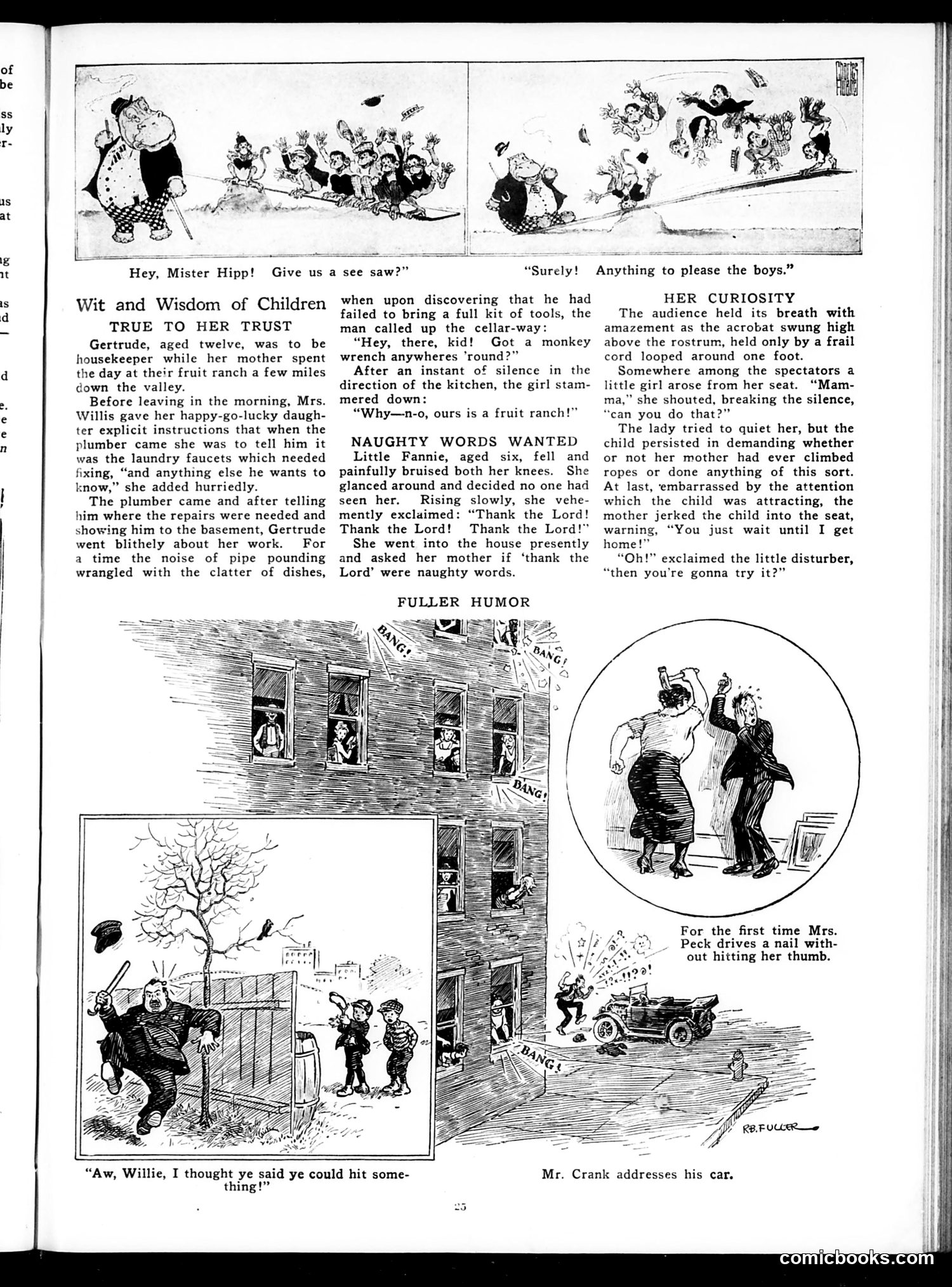
This page from *Judge* magazine presents humorous anecdotes about children's literal-mindedness and innocent misunderstandings—a common satirical target of the era. **"True to Her Trust"**: A twelve-year-old housekeeper, given vague instructions about a plumber's visit, takes her mother's words literally. When the plumber asks for a "monkey wrench," she responds that theirs is a "fruit ranch"—she assumes he's asking about an actual monkey, missing the tool's name entirely. The humor relies on the child's innocent, logical interpretation. **"Naughty Words Wanted"**: A six-year-old, after falling unobserved, thanks the Lord repeatedly—then innocently asks if "thank the Lord" counts as naughty words, having been told not to use profanity. **"Fuller Humor"** consists of brief gag cartoons about domestic mishaps: a woman hitting her thumb while nailing, a man addressing his car (possibly anthropomorphizing it or scolding it), and a circus acrobat drawing a child's curious question about whether her mother can perform the same feat. The satire gently mocks children's logical but socially awkward interpretations of adult communication.
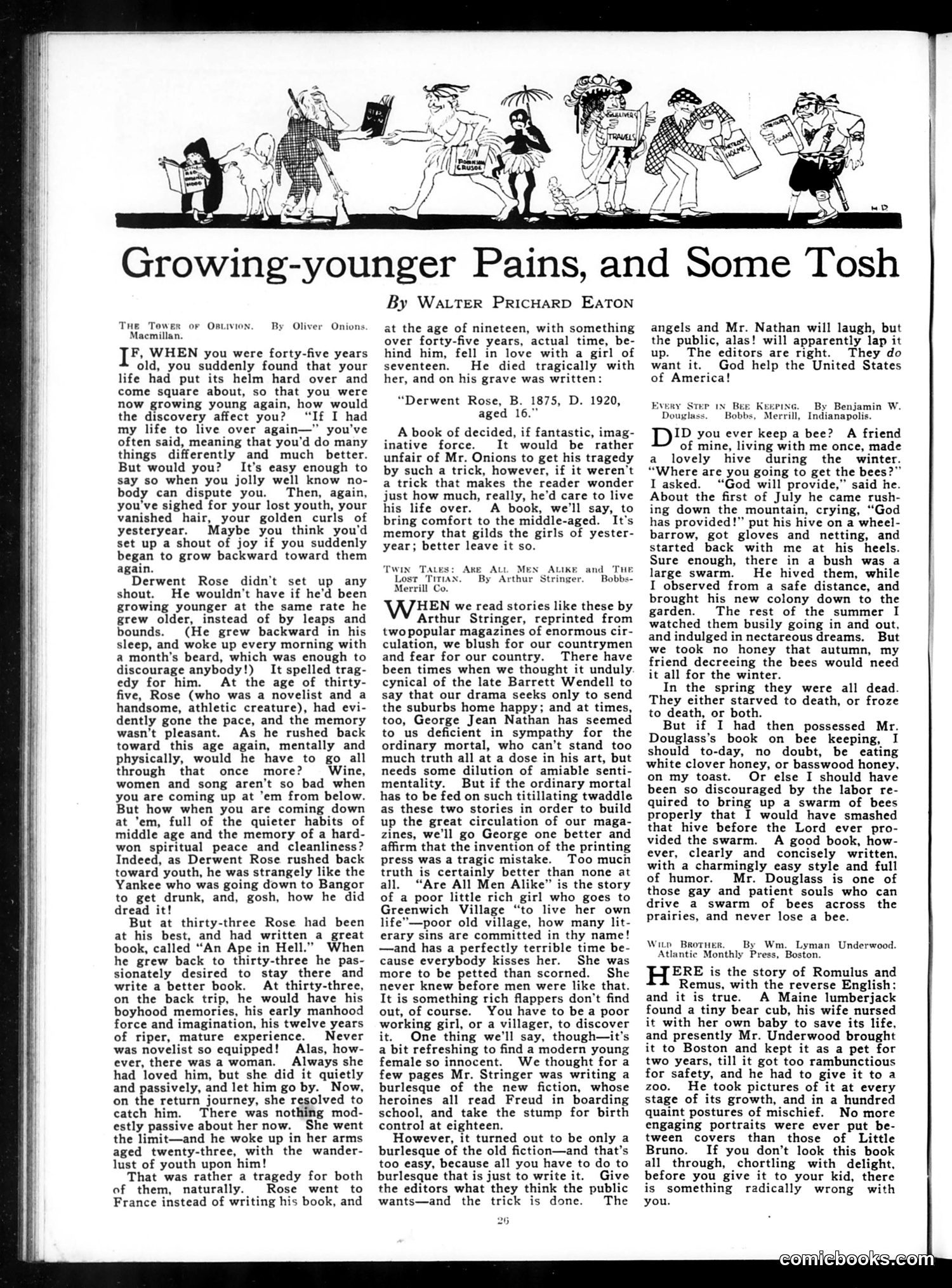
This page from *Judge* magazine reviews three books, with the main feature being Walter Prichard Eaton's critique of Oliver Onions' novel *The Tower of Oblivion*. **The Cartoon**: The header illustration depicts various figures across a timeline, likely representing the protagonist's paradoxical aging and rejuvenation. **The Main Review's Point**: Eaton discusses a fantastical premise—a middle-aged man (Derwent Rose) who begins physically growing younger while retaining his adult memories. The satire explores whether people truly want to relive youth, given its attendant passions and poor choices. Rose, hoping to recapture his creative prime at age thirty-three, instead gets swept up in youthful romance and tragedy, dying at nineteen with a seventeen-year-old lover. **The Social Commentary**: The review uses this dark fantasy to gently mock middle-aged nostalgia—the common refrain "if I could live my life over." Eaton suggests that memory romanticizes youth in ways that reality wouldn't support, making the novel comforting rather than cautionary for aging readers. The reviews of other books express concerns about American literature's quality and morality.
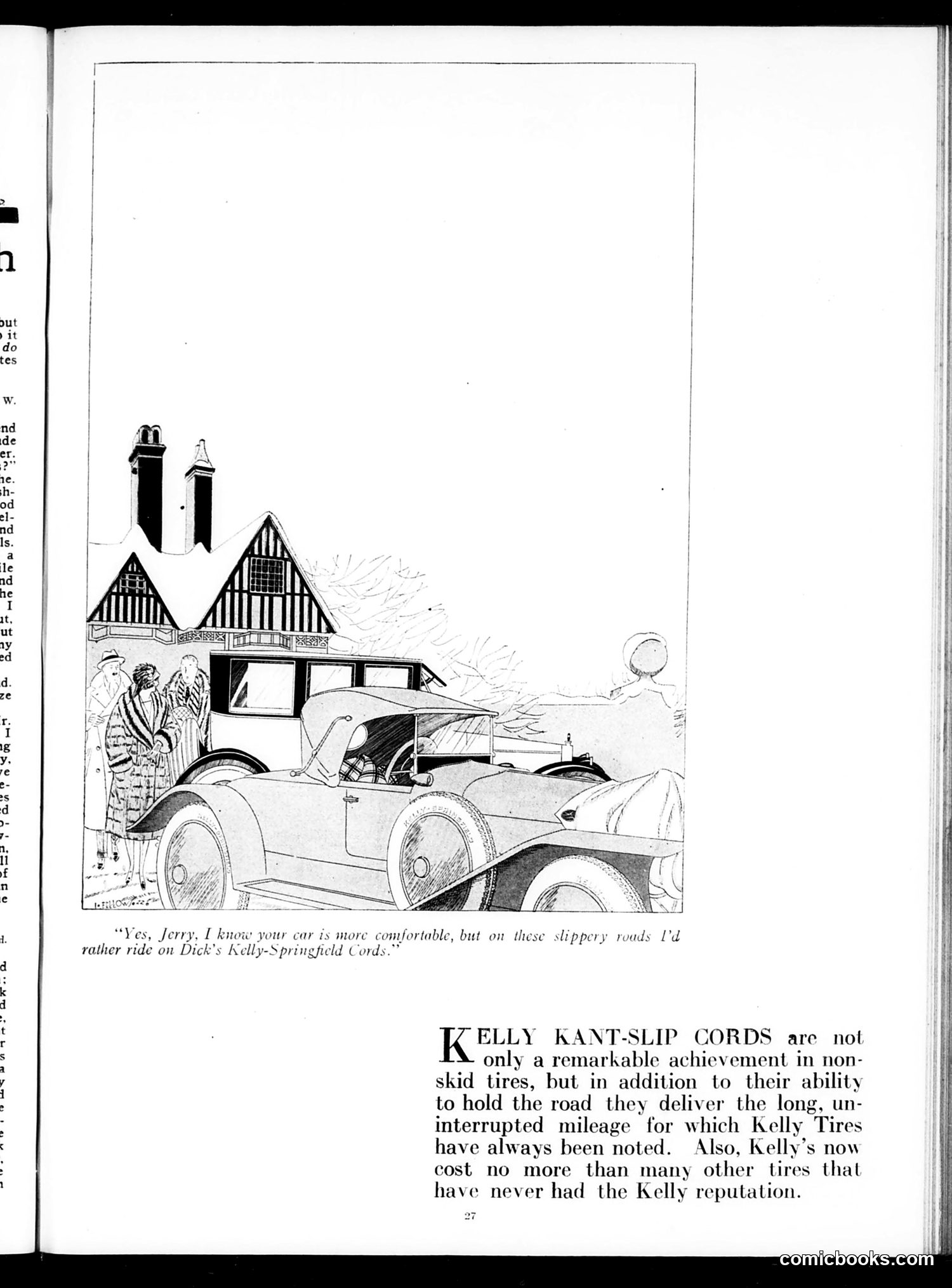
This page is primarily **advertising**, not satire or political commentary. It promotes Kelly-Springfield Kant-Slip Cords automobile tires through a cartoon scenario. The humor is domestic and situational: a woman tells her companion Jerry that while his car may be more comfortable, she'd prefer riding in Dick's vehicle because it has superior Kelly-Springfield tires—particularly important on slippery roads. The joke plays on prioritizing safety (tire grip) over comfort. The ad copy below emphasizes that Kelly Kant-Slip Cords prevent skidding, deliver long mileage, and now cost competitively with lesser-known brands. The visual shows 1920s-era automobiles and fashionably dressed figures outside a half-timbered house, establishing an upscale context for the product pitch. This is representative of Judge magazine's revenue model: blending humorous editorial content with advertisements designed to appeal to its affluent readership.
This page features Homer Croy's humorous essay about "Family Jokes"—inside jokes that only make sense to family members and grow funnier with repetition. The satire contrasts private family life with social propriety. Croy illustrates how the Washington family, entertaining guests formally, erupts into inexplicable laughter over a reference only they understand—a childhood prank involving "little George" and someone named Jones. The bewildered guests interpret this as mockery of their own comments and awkwardly excuse themselves, never learning the actual source of hilarity. The joke's point: families develop private comedic codes incomprehensible to outsiders, creating awkward social moments when these eruptions occur during polite company. It satirizes the gap between domestic intimacy and public decorum—the family's uncontrollable laughter reveals how differently people behave in private versus public settings. The page also includes vintage advertisements (Mouquin's vermouth, watches, canoes) typical of 1920s *Judge* magazine issues.
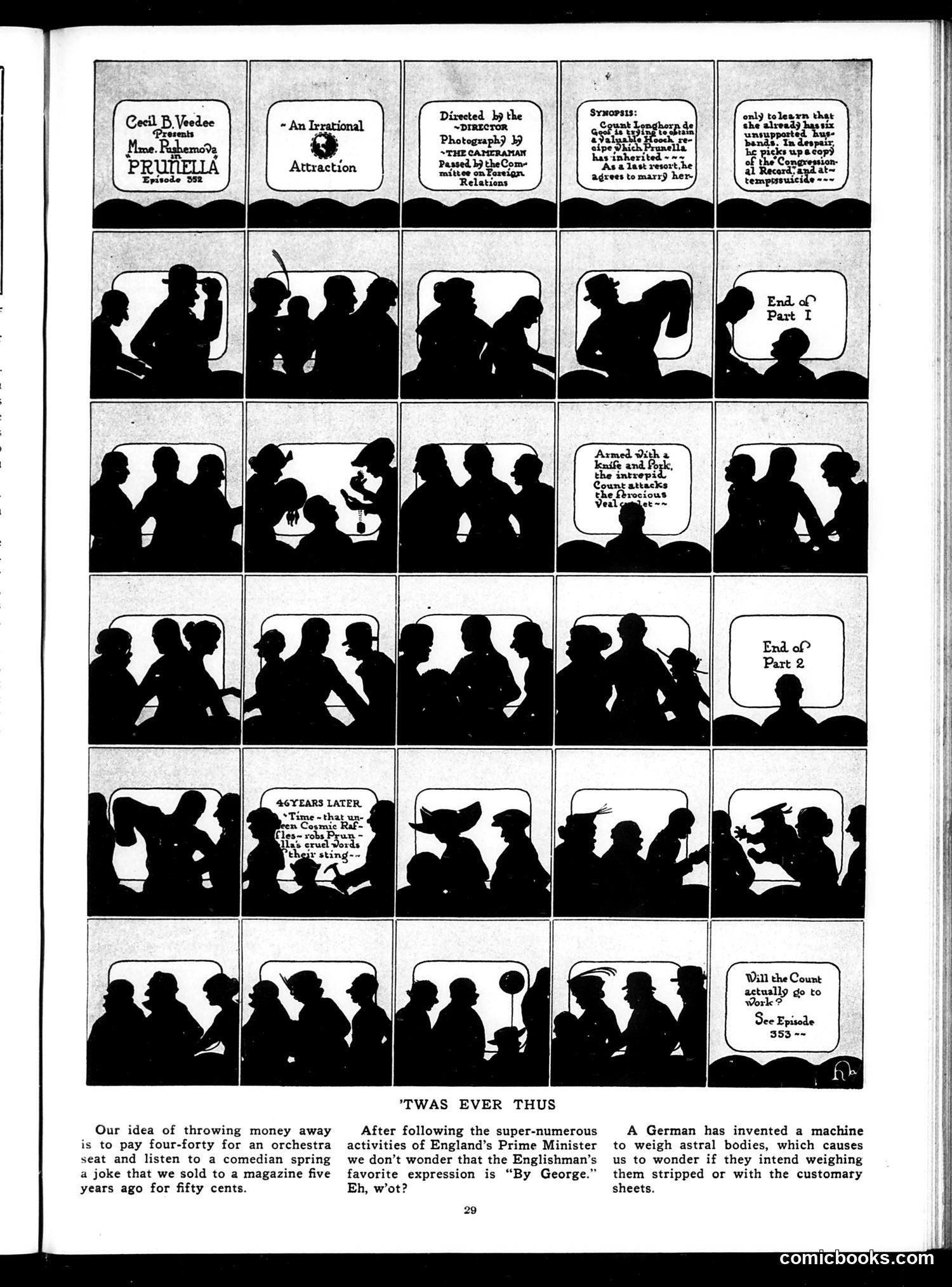
This is a **silent film parody** presented as a multi-panel comic strip titled "An Irrational Attraction," credited to Cecil B. DeMille (satirized as "Cecil E B. Veedee"). The narrative appears to mock melodramatic silent cinema: a couple marries, conflict ensues with armed combat, and years later they're reunited—a typical overwrought plot device. The satire targets **DeMille's elaborate, emotion-driven filmmaking** and silent cinema's reliance on exaggerated physical storytelling. The phrase "Directed by the Committee on Foreign Relations" suggests the strip is also **mocking America's foreign policy approaches**—implying they're as contrived and theatrical as Hollywood productions. Below, three brief items joke about: wasting money on entertainment; England's Prime Minister (likely Lloyd George, given the period); and a supposed German invention for weighing "astral bodies." The page satirizes both **popular entertainment excess and contemporary politics** through visual silhouettes typical of Judge's format.
This article satirizes post-independence Ireland's political dysfunction through a fictional character, Martin James. The satire blames American industrialists **Edison and Ford** for Ireland's troubles: by making power and labor-saving devices freely available, they eliminated the economic necessity for work—and thus eliminated the primary incentive for honest government. The joke's logic is absurdist: Martin argues that poverty and struggle are *necessary* for a functioning republic because they create motives for theft, which in turn necessitates government. Free energy and automation removed this "natural" incentive structure, leaving Irish citizens with no motivation except seeking political office—turning everyone into bureaucrats obsessed with trivial scandals (a postmaster stealing stamps). The satire mocks both **Irish political culture** (portrayed as inherently prone to corruption and office-seeking) and reflects **1920s American skepticism** about technological utopias and their social consequences. It's dark political humor suggesting that prosperity and freedom may paradoxically undermine civic virtue.
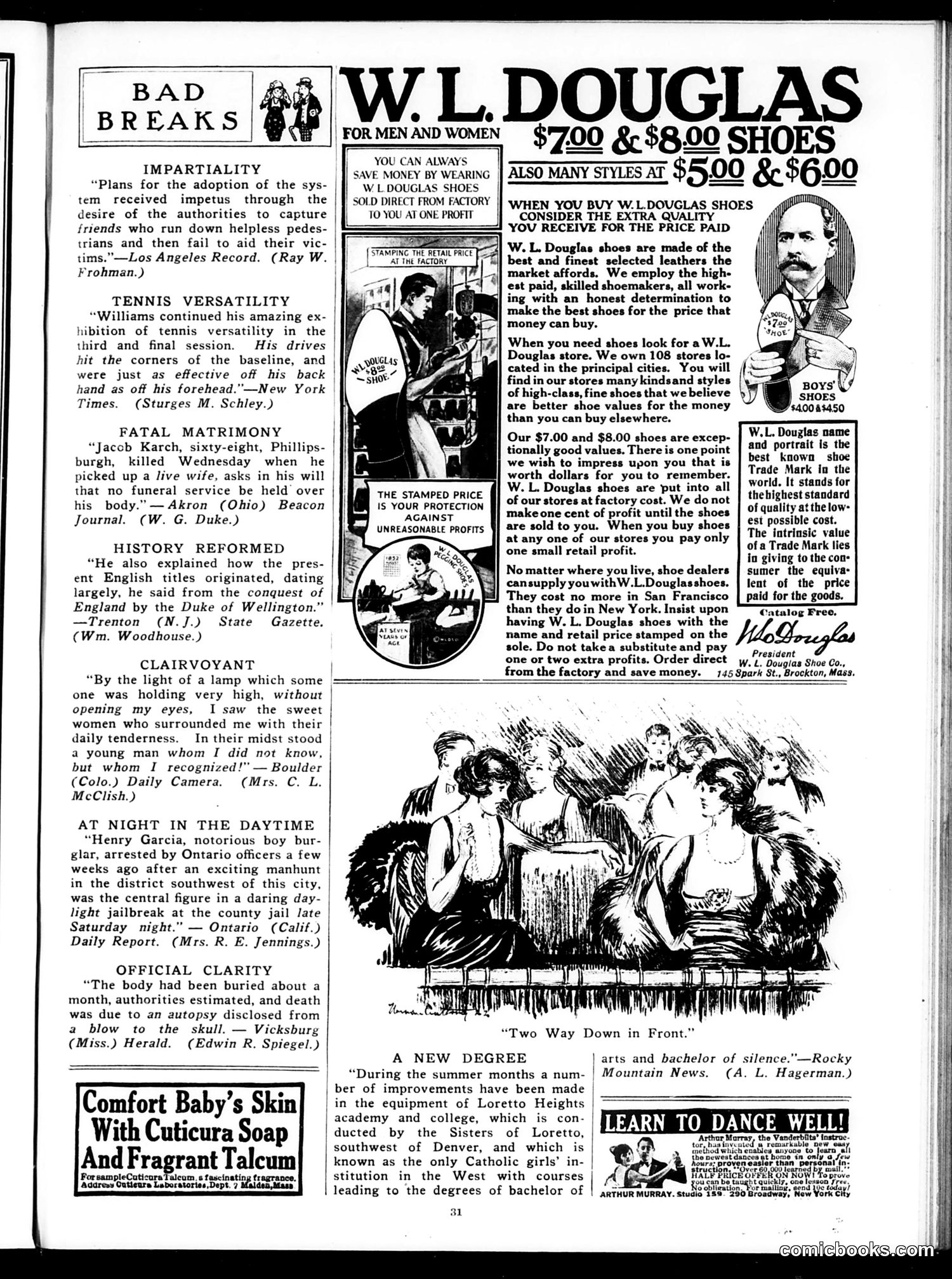
This page is primarily **advertising** for W.L. Douglas shoes, dominating the right side. The left column contains "Bad Breaks"—humorous excerpts from newspapers with absurd or contradictory statements, meant to mock poor journalism. Examples include: a report praising a system to catch hit-and-run drivers while praising their helplessness; crediting tennis skill to both forehand and backhand equally; a man killed by a "jive wife" requesting no funeral; and attributing English titles to the "Duke of Wellington" (historically inaccurate). The shoe advertisement emphasizes direct-from-factory pricing, stamped prices as consumer protection against markup, and W.L. Douglas's 108 stores nationwide. The cartoons illustrate shoe manufacturing and retail. There are also unrelated items: a Cuticura Soap ad, a dance instruction ad, and a brief story excerpt titled "A New Degree" and "Two Way Down in Front." The satire targets journalistic carelessness and logical inconsistencies in published reporting.
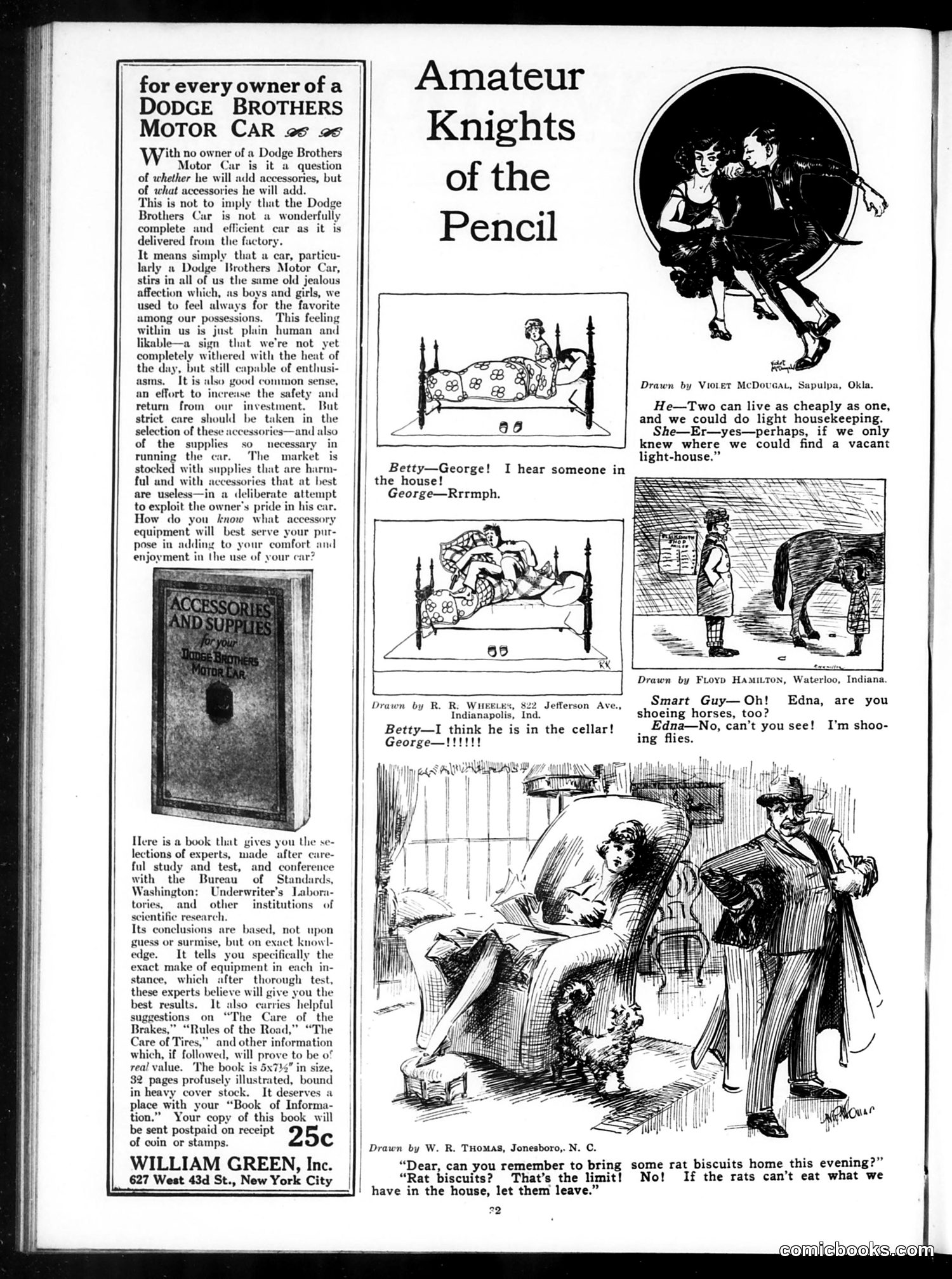
This page showcases humorous cartoon strips by various artists, collectively titled "Amateur Knights of the Pencil"—a playful reference to amateur cartoonists/illustrators. The four illustrated jokes are domestic comedy: 1. A couple hears an intruder; the husband grunts dismissively. 2. A newlywed couple discusses economical living in a lighthouse (joke: extreme frugality). 3. A woman shoes flies while a man asks if she's shoeing horses (pun on "shoeing"). 4. A husband refuses to buy "rat biscuits," declaring if rats won't eat the family's food, they should leave anyway. These represent typical *Judge* magazine fare: gentle, middle-class domestic humor poking fun at marriage, household economics, and miscommunication. The accompanying Dodge Brothers advertisement emphasizes automotive accessories as status symbols—reflecting 1920s consumer culture anxieties about distinguishing quality products from exploitative ones. The contrast illustrates *Judge*'s dual purpose: satirizing modern consumer desires while maintaining advertising revenue.
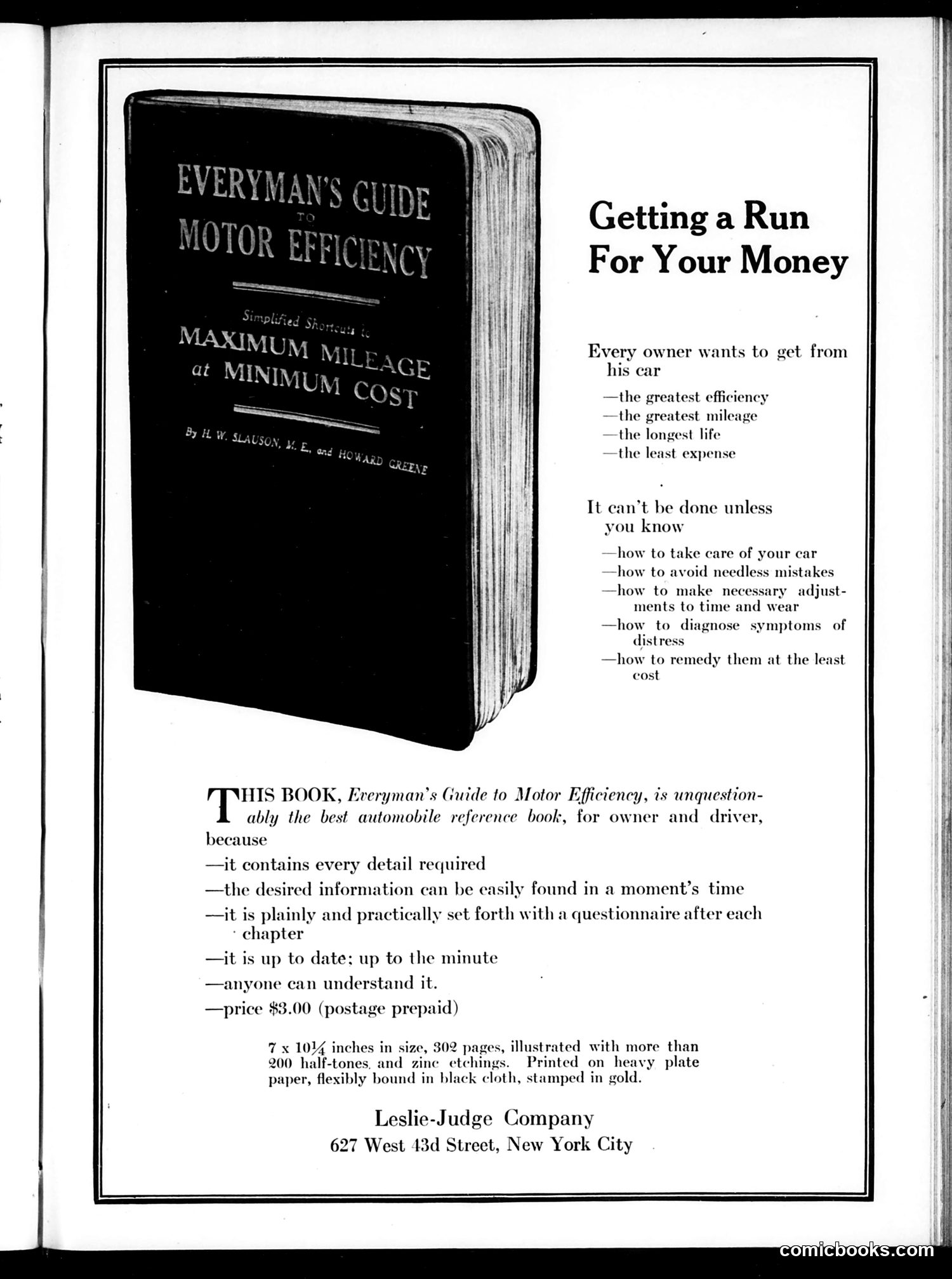
This page is **not a cartoon or satire**—it's a straightforward advertisement for "Everyman's Guide to Motor Efficiency," a practical automobile maintenance manual published by Leslie-Judge Company (1920s era, based on styling). The ad targets car owners concerned with fuel economy and maintenance costs during the early automotive era, when vehicle upkeep was complex and expensive. The book promises to teach readers how to diagnose problems, maintain their cars properly, and avoid costly repairs—practical concerns for ordinary owners. The $3.00 price tag and emphasis on accessibility ("anyone can understand it") reflect marketing to middle-class buyers. The 302-page book with over 200 illustrations signals comprehensiveness for an owner's manual of that period. This represents **educational/practical advertising** rather than political satire—typical of Judge magazine's mixed content of humor and commercial advertising.
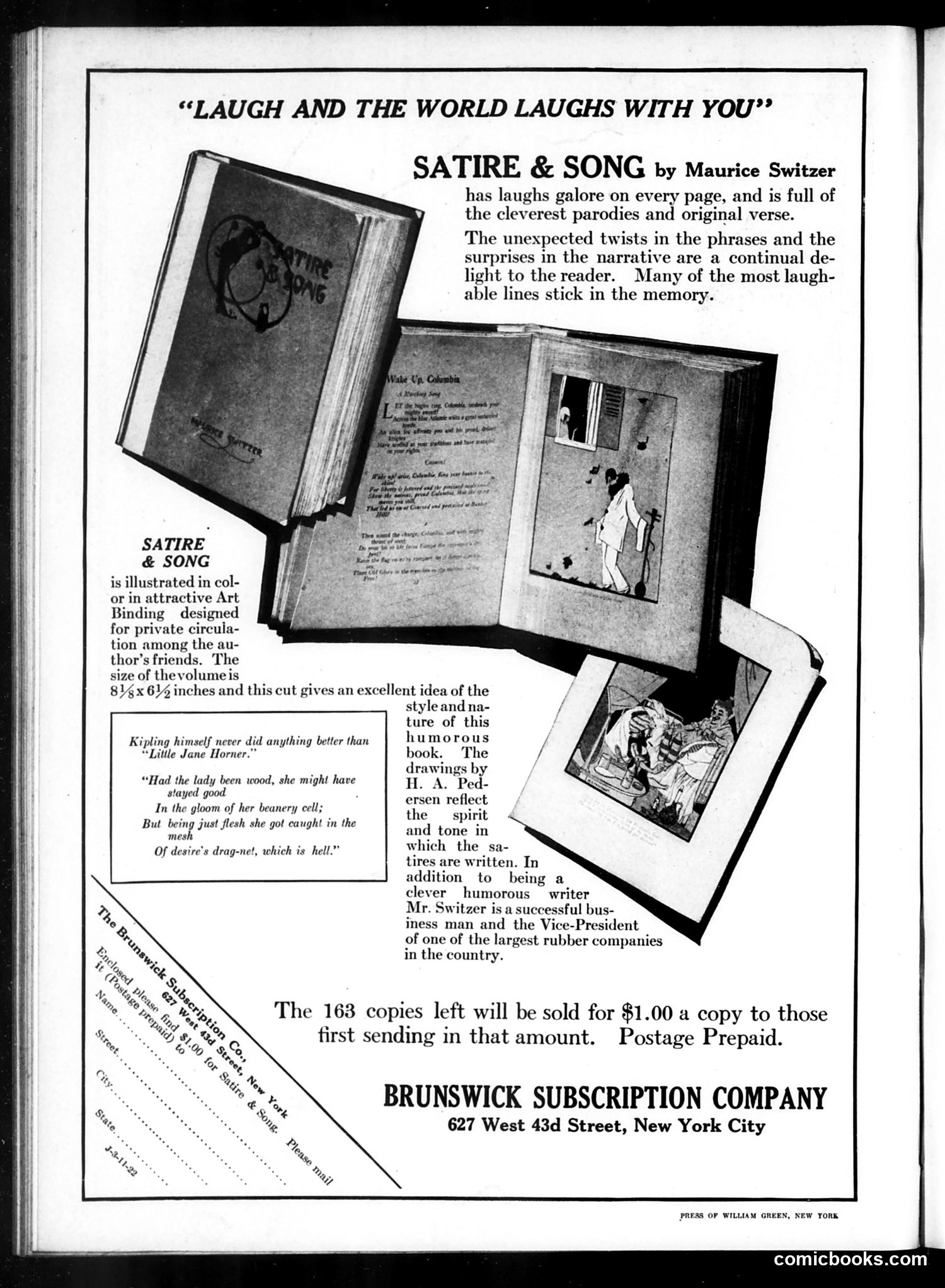
This is primarily a **book advertisement** rather than editorial cartoon content. It promotes a limited-edition satirical poetry collection (163 copies remaining) priced at $1.00, sold through the Brunswick Subscription Company in New York. The page includes a sample verse mocking "Little Jane Horner" — apparently a female character who fell from respectability ("stayed good") into moral ruin through sexual desire, depicted as inescapable ("desire's drag-net, which is hell"). The comparison to Rudyard Kipling suggests the author aspired to serious literary satire. The book features illustrations by H.A. Pedersen in color binding, designed for private circulation among the author's friends. Switzer is identified as a successful businessman and vice-president of a major rubber company, positioning him as a gentleman dabbler in humor rather than a professional writer. The advertisement appears designed to appeal to affluent readers seeking exclusive, sophisticated satirical verse.