
Judge, 1922-03-11 · page 7 of 36
Judge — March 11, 1922 — page 7: what you’re looking at
What you’re looking at
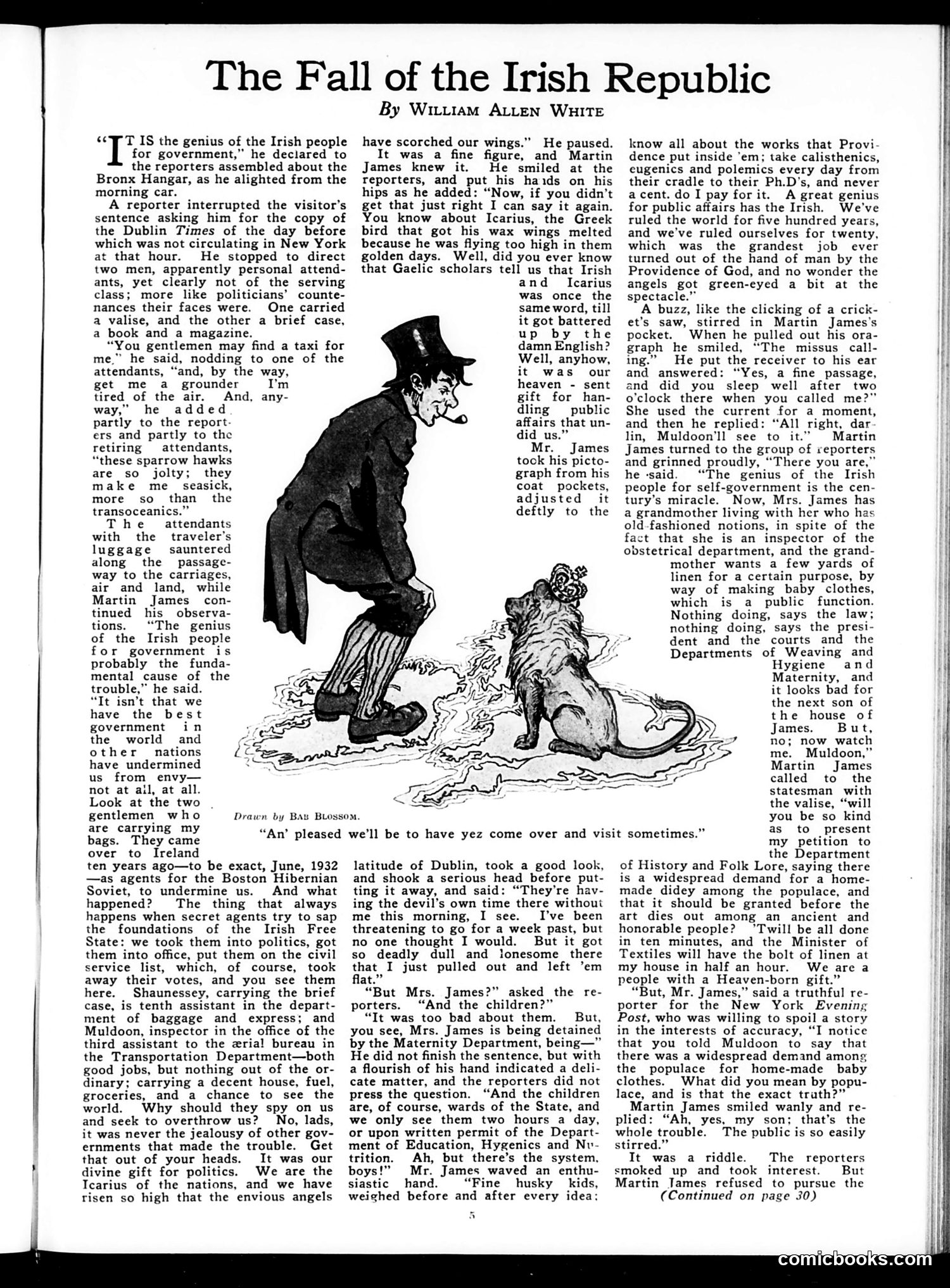
By William Allen White, this satirical article mocks Irish political incompetence through the character Martin James, a self-important Irish politician visiting America who blames Ireland's troubles on the Irish people's supposed natural genius for politics—ironically suggesting this gift has become their fatal flaw. **The Satire's Target:** White suggests Irish governance failed not from external sabotage but from internal mismanagement. James describes two former Boston Hibernian agents sent to undermine Ireland who simply became low-level civil servants—illustrating how even spies became absorbed into the Irish bureaucratic system harmlessly. **The Icarus Reference:** James draws a parallel between Irish political overreach and the mythological Icarus (claiming dubious etymological connection to "Irish"), suggesting Irish politicians flew too high with ambitions and crashed. **The Cartoon:** Bas Hossoms' illustration depicts a caricatured Irish figure amid satirical decay, emphasizing the article's critique of Irish political failure and self-delusion during what appears to be the early Irish Free State period (post-1922).
📄 Transcribed text from this page (OCR, searchable)
Machine-transcribed from the original scan — historical spelling and the odd misread are preserved.
The Fall of the Irish Republic By Wiuram ALLEN WHITE sew T IS the genius of the Irish people for government,” he declared to the reporters assembled about the Bronx Hangar, as he alighted from the morning car. A reporter interrupted the visitor's sentence asking him for the copy of the Dublin Times of the day before which was not circulating in New York at that hour. He stopped to direct two men, apparently personal attend- ants, yet clearly not of the serving class; more like politicians’ counte- nances their faces were. One carried a valise, and the other a brief case, a book and a magazine. “You gentlemen may find a taxi for me.” he said, nodding to one of the attendants, “and, by the way, get me a_ grounder I'm tired of the air. And, any- way,” he added partly to the report- ers and partly to the retiring attendants, “these sparrow hawks are so jolty; they make me_ seasick, more so than the transoceanics.” The attendants with the traveler’s luggage sauntered along the passage- way to the carriages, air and land, while Martin James con- tinued his observa- tions. “The genius of the Irish people for government is probably the funda- mental cause of the trouble,” he said. “It isn’t that we have the best government in the world and other nations have undermined us from envy— not at ail, at all. Look at the two gentlemen who are carrying my bags. They came over to Ireland ten years ago—to be exact, June, 1932 —as agents for the Boston Hibernian Soviet, to undermine us. And what happened? The thing that always happens when secret agents try to sap the foundations of the Irish Free State: we took them into politics, got them into office, put them on the civil service list, which, of course, took away their votes, and you see them here. Shaunessey, carrying the brief case, is tenth assistant in the depart- ment of baggage and express; and Muldoon, inspector in the office of the third assistant to the erial bureau in the Transportation Department—both good jobs, but nothing out of the or- dinary; carrying a decent house, fuel, groceries, and a chance to see the world. Why should they spy on us and seek to overthrow us? No, lads, it was never the jealousy of other gov- ernments that made the trouble. Get that out of your heads. It was our divine gift for politics. We are the Tcarius of the nations, and we have risen so high that the envious angels have scorched our wings.” He paused. It was a fine figure, and Martin James knew it. He smiled at the reporters, and put his haids on his hips as he added: “Now, if you didn’t get that just right I can say it again. You know about Icarius, the Greek bird that got his wax wings melted because he was flying too high in them golden days. Well, did you ever know that Gaelic scholars tell us that Irish and = Icarius was once the same word, till it got battered up by the damn English? Well, anyhow, it was our heaven - sent gift for han- dling public affairs that un- did us.” Mr. James took his picto- graph from his coat pockets, adjusted it deftly to the Drawn by Bas Bossom. “An’ pleased we'll be to have yez come over and visit sometimes.” latitude of Dublin, took a good look, and shook a serious head before put- ting it away, and said: “They're hav- ing the devil’s own time there without me this morning, I see. I’ve been threatening to go for a week past, but no one thought I would. But it got so deadly dull and lonesome there thet I just pulled out and left ’em lat.” “But Mrs. James?” asked the re- porters. “And the children?” “It was too bad about them. But, you see, Mrs. James is being detained by the Maternity Department, being—” He did not finish the sentence, but with a flourish of his hand indicated a deli- cate matter, and the reporters did not press the question. “And the children are, of course, wards of the State, and we only see them two hours a day, or upon written permit of the Depart- ment of Education, Hygenics and Nv- trition. Ah, but there’s the system, boys!” Mr. James waved an enthu- siastic hand. “Fine husky kids, weighed before and after every idea: know all about the works that Provi- dence put inside ‘em; take calisthenics, eugenics and polemics every day from their cradle to their Ph.D’s, and never acent. do I pay forit. A great genius for public affairs has the Irish. We've ruled the world for five hundred years, and we've ruled ourselves for twenty, which was the grandest job ever turned out of the hand of man by the Providence of God, and no wonder the angels got green-eyed a bit at the spectacle.” A buzz, like the clicking of a crick- et’s saw, stirred in Martin James’s pocket. When he pulled out his ora- graph he smiled, “The missus call- ing.” He put the receiver to his ear and answered: “Yes, a fine passage, and did you sleep well after two o'clock there when you called me?” She used the current for a moment, and then he replied: “All right, dar lin, Muldoon'll see to it.” Martin James turned to the group of reporters and grinned proudly, “There you are,” he ‘said. “The genius of the Irish people for self-government is the cen- tury’s miracle. Now, Mrs. James has a grandmother living with her who has old-fashioned notions, in spite of the fact that she is an inspector of the obstetrical department, and the grand- mother wants a few yards of linen for a certain purpose, by way of making baby clothes, which is a public function. Nothing doing, says the law; nothing doing, says the presi- . dent and the courts and the Departments of Weaving and Hygiene and Maternity, and it looks bad for the next son of the house of James. But, 7 no; now watch me. Muldoon,” Martin James called to the statesman with the valise, “will you be so kind as to present my petition to the Department of History and Folk Lore, saying there is a widespread demand for a home- made didey among the populace, and that it should be granted before the art dies out among an ancient and honorable people? ’Twill be all done in ten minutes, and the Minister of Textiles will have the bolt of linen at my house in half an hour. We are a people with a Heaven-born gift.” “But, Mr. James,” said a truthful re- porter for the New York Evening Post, who was willing to spoil a story in the interests of accuracy, “I notice that you told Muldoon to say that there was a widespread demand among the populace for home-made baby clothes. What did you mean by popu- lace, and is that the exact truth?” Martin James smiled wanly and re- plied: “Ah, yes, my son; that’s the whole trouble. The public is so easily stirred.” It was a riddle. The reporters smoked up and took interest. But Martin Tames refused to pursue the (Continued on page 30)