
Judge, 1922-03-11 · page 9 of 36
Judge — March 11, 1922 — page 9: what you’re looking at
What you’re looking at
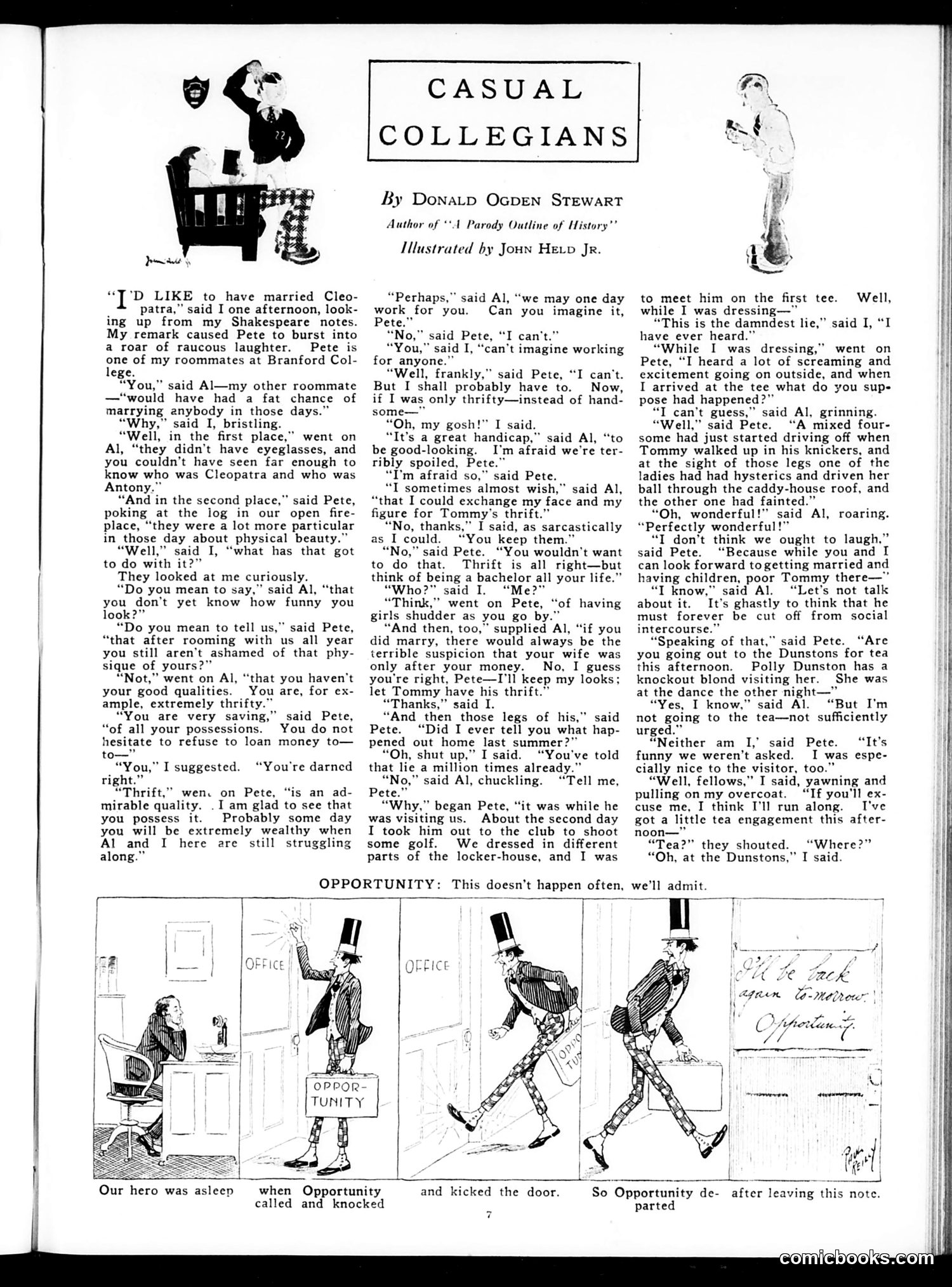
This is a humorous story about three college roommates at Branford College debating their prospects for marriage and success. The narrator lacks self-awareness about his unattractiveness, while his roommates Pete and Al mock him—particularly his poor physical appearance and lack of vanity. The central joke contrasts thrift (financial prudence) with physical attractiveness. Pete and Al suggest the narrator's only marketable quality is being thrifty, implying he'll never marry for love. They humorously fantasize about trading their good looks for their roommate's frugality, recognizing that attractiveness is actually a liability—it invites suspicion of gold-digging wives and creates social complications (illustrated by the anecdote about a woman's hysterical reaction to his legs). The bottom panel shows "Opportunity" literally knocking on a sleeping man's door, then leaving—a visual pun on the phrase "opportunity knocks." The satire gently mocks college-age masculine insecurity and the anxieties about attractiveness, wealth, and marriage prospects common among young men.
📄 Transcribed text from this page (OCR, searchable)
Machine-transcribed from the original scan — historical spelling and the odd misread are preserved.
peasy ‘D LIKE to have married Cleo- . patra,” said I one afternoon, look- ing up from my Shakespeare notes. My remark caused Pete to burst into a roar of raucous laughter. Pete is one of my roommates at Branford Col- lege. “You,” said Al—my other roommate —‘“would have had a fat chance of marrying anybody in those days.” “Why,” said I, bristling. “Well, in the first place,” went on “they didn’t have eyeglasses, and you couldn’t have seen far enough to know who was Cleopatra and who was Antony.” “And in the second place,” said Pete, poking at the log in our open fire- place, “they were a lot more particular in those day about physical beauty.” “Well,” said I, “what has that got to do with it?” They looked at me curiously. “Do you mean to say,” said Al, “that you don't yet know how funny you look?” “Do you mean to tell us,” said Pete, “that after rooming with us all year you still aren't ashamed of that phy- sique of yours?” “Not,” went on Al, “that you haven't your good qualities. You are, for ex- ample, extremely thrifty.” “You are very saving,” said Pete, “of all your possessions. You do not hesitate to refuse to loan money to— to—” “You,” right.” “Thrift,” I suggested. “You're darned wen. on Pete, “is an ad- mirable quality. .I am glad to see that you possess it. Probably some day you will be extremely wealthy when Al and I here are still struggling along.” CASUAL By Donatp OcpEen STEWART Author of “A Parody Outline of History’” Illustrated by Joun Hevv Jr. “Perhaps,” said Al, work for you. Pete.” “No,” said Pete, “I can't.” “You,” said I, “can't imagine working for anyone.” “Well, frankly,” said Pete, “I can't. But I shall probably have to. Now, if I was only thrifty—instead of hand- some— “Oh, my gosh!” I said. “It’s a great handicap,” said Al, be good-looking. I'm afraid we're hee ribly spoiled, Pete.” “I'm afraid so,” said Pete. “I sometimes almost wish,” said Al, “that I could exchange my face and my figure for Tommy’s thrift.” “No, thanks,” I said, as sarcastically as I could. “You keep them.” “No,” said Pete. “You wouldn't want to do that. Thrift is all right—but think of being a bachelor all your life.” “Who?” said I. “Me?” “Think,” went on Pete, “of having girls shudder as you go by.” “And then, too,” supplied Al, “if you did marry, there would always be the terrible suspicion that your wife was only after your money. No, I guess you're right, Pete—I'll keep my looks; let Tommy have his thrift.” “Thanks,” said I. “And then those legs of his,” said Pete. “Did I ever tell you what hap- pened out home last summer?” “Oh, shut up,” I said. “You've told that lie a million times already.” “we may one day Can you imagine it, “No,” said Al, chuckling. “Tell me, Pete. “Why,” began Pete, “it was while he was visiting us. About the second day I took him out to the club to shoot some golf. We dressed in different parts of the locker-house, and I was OPPORTUNITY: This doesn't happen often, COLLEGIANS to meet him on the first tee. Well, while I was dressing—” “This is the damndest lie,” said I, “I have ever heard.” “While I was dressing,” went on Pete, “I heard a lot of screaming and excitement going on outside, and when I arrived at the tee what do you sup- pose had happene “T can’t guess,” said Al, grinning. “Well,” said Pete. “A mixed four- some had just started driving off when Tommy walked up in his knickers, and at the sight of those legs one of the ladies had had hysterics and driven her ball through the caddy-house roof, and the other one had fainted.” “Oh, wonderful!” said Al, roaring. “Perfectly wonderful!” “T don’t think we ought to laugh,” said Pete. “Because while you and I can look forward togetting married and having children, poor Tommy there—” “I know,” said Al. “Let's not talk about it. It’s ghastly to think that he must forever be cut off from social intercourse.” “Speaking of that,” said Pete. “Are you going out to the Dunstons for tea this afternoon. Polly Dunston has a knockout blond visiting her. She was at the dance the other night—” “Yes, I know,” said Al. “But I'm not going to the tea—not sufficiently urged.” “Neither am I,’ said Pete. “It’s funny we weren’t asked. I was espe- cially nice to the visitor, too.” “Well, fellows,” I said, yawning and pulling on my overcoat. “If you'll ex- cuse me, I think I'll run along. I've got a little tea engagement this after- noon—”" “Tea?” they shouted. “Oh, at the Dunstons, “Where?” I said. we'll admit. OPPOR- TUNITY Our hero was asleep when Opportunity and kicked the door. called and knocked So Opportunity de- after leaving this note. parted