
Judge, 1922-03-11 · page 10 of 36
Judge — March 11, 1922 — page 10: what you’re looking at
What you’re looking at
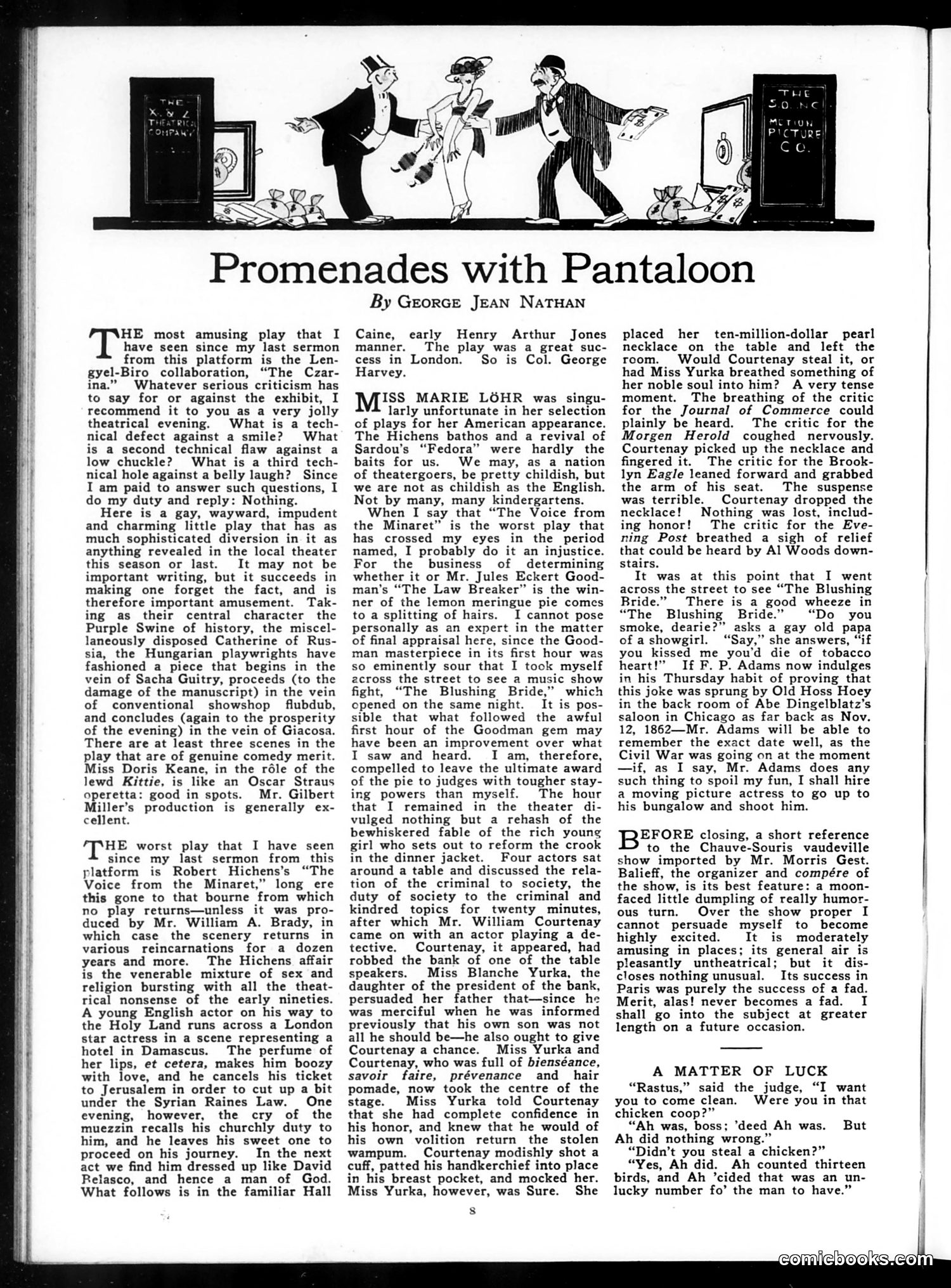
This page from Judge magazine contains theater reviews rather than political cartoons. The header illustration shows a vaudeville-style scene with performers and theater company logos, setting the tone for theatrical criticism. The author, George Jean Nathan, reviews three plays with characteristic acerbic wit. He praises "The Czarina," a Hungarian comedy about Catherine of Russia, calling it amusing despite technical flaws. He savagely dismisses "The Voice from the Minaret" by Robert Hichens as among the worst plays he's seen—criticizing its dated "early nineties" mixture of sex and religion melodrama. He also discusses actress Marie Lohr's unfortunate play selections and compares "The Voice from the Minaret" to Jules Eckert Goodman's "The Law Breaker," finding both equally terrible. The reviews showcase early 20th-century theatrical taste and Nathan's reputation for caustic, entertaining criticism. The "Promenades with Pantaloon" title suggests theater gossip and entertainment reporting typical of Judge's theatrical coverage.
📄 Transcribed text from this page (OCR, searchable)
Machine-transcribed from the original scan — historical spelling and the odd misread are preserved.
HE most amusing play that I have seen since my last sermon from this platform is the Len- gyel-Biro collaboration, “The Czar- ina.” Whatever serious criticism has to say for or against the exhibit, I recommend it to you as a very jolly theatrical evening. What is a tech- nical defect against a smile? What is a second technical flaw against a low chuckle? What is a third tech- nical hole against a belly laugh? Since I am paid to answer such questions, I do my duty and reply: Nothing. Here is a gay, wayward, impudent and charming little play that has as much sophisticated diversion in it as anything revealed in the local theater this season or last. It may not be important writing, but it succeeds in making one forget the fact, and is therefore important amusement. Tak- ing as their central character the Purple Swine of history, the miscel- laneously disposed Catherine of Rus- sia, the Hungarian playwrights have fashioned a piece that begins in the vein of Sacha Guitry, proceeds (to the damage of the manuscript) in the vein of conventional showshop flubdub, and concludes (again to the prosperity of the evening) in the vein of Giacosa. There are at least three scenes in the play that are of genuine comedy merit. Miss Doris Keane, in the réle of the lewd Kittie, is like an Oscar Straus operetta: good in spots. Mr. Gilbert Miller’s production is generally ex- cellent. THE worst play that I have seen since my last sermon from this platform is Robert Hichens’s “The Voice from the Minaret,” long ere this gone to that bourne from which no play returns—unless it was pro- duced by Mr. William A. Brady, in which case the scenery returns in various reincarnations for a dozen years and more. The Hichens affair is the venerable mixture of sex and religion bursting with all the theat- rical nonsense of the early nineties. A young English actor on his way to the Holy Land runs across a London star actress in a scene representing a hotel in Damascus. The perfume of her lips, et cetera, makes him boozy with love, and he cancels his ticket to Jerusalem in order to cut up a bit under the Syrian Raines Law. One evening, however, the cry of the muezzin recalls his churchly duty to him, and he leaves his sweet one to proceed on his journey. In the next act we find him dressed up like David Relasco, and hence a man of God. What follows is in the familiar Hall Promenades with Pantaloon By Georce JEAN NaTHAN early Henry Arthur Jones The play was a great suc- So is Col. George Caine, manner. cess in London. Harvey. Miss MARIE LOHR was singu- larly unfortunate in her selection of plays for her American appearance. The Hichens bathos and a revival of Sardou’s “Fedora” were hardly the baits for us. We may, as a nation of theatergoers, be pretty childish, but we are not as childish as the English. Not by many, many kindergartens. When I say that “The Voice from the Minaret” is the worst play that has crossed my eyes in the period named, I probably do it an injustice. For the business of determining whether it or Mr. Jules Eckert Good- man’s “The Law Breaker” is the win- ner of the lemon meringue pie comes to a splitting of hairs. I cannot pose personally as an expert in the matter of final appraisal here, since the Good- man masterpiece in its first hour was so eminently sour that I took myself across the street to see a music show fight, “The Blushing Bride,” which opened on the same night. It is pos- sible that what followed the awful first hour of the Goodman gem may have been an improvement over what I saw and heard. I am, therefore, compelled to leave the ultimate award of the pie to judges with tougher stay- ing powers than myself. The hour that I remained in the theater di- vulged nothing but a rehash of the bewhiskered fable of the rich young girl who sets out to reform the crook in the dinner jacket. Four actors sat around a table and discussed the rela- tion of the criminal to society, the duty of society to the criminal and kindred topics for twenty minutes, after which Mr. William Courtenay came on with an actor playing a de- tective. Courtenay, it appeared, had robbed the bank of one of the table speakers. Miss Blanche Yurka, the daughter of the president of the bank, persuaded her father that—since he was merciful when he was informed previously that his own son was not all he should be—he also ought to give Courtenay a chance. Miss Yurka and Courtenay, who was full of bienséance, savoir faire, prévenance and_hair pomade, now took the centre of the stage. Miss Yurka told Courtenay that she had complete confidence in his honor, and knew that he would of his own volition return the stolen wampum. Courtenay modishly shot a cuff, patted his handkerchief into place in his breast pocket, and mocked her. Miss Yurka, however, was Sure. She 8 placed her ten-million-dollar pearl necklace on the table and left the room. Would Courtenay steal it, or had Miss Yurka breathed something of her noble soul into him? A very tense moment. The breathing of the critic for the Journal of Commerce could plainly be heard. The critic for the Morgen Herold coughed nervously. Courtenay picked up the necklace and fingered it. The critic for the Brook- lyn Eagle leaned forward and grabbed the arm of his seat. The suspense was terrible. Courtenay dropped the necklace! Nothing was lost, includ- ing honor! The critic for the Eve- ning Post breathed a sigh of relief that could be heard by Al Woods down- stairs. It was at this point that I went across the street to see “The Blushing Bride.” There is a good wheeze in “The Blushing Bride.” “Do you smoke, dearie?” asks a gay old papa of a showgirl. “Say,” she answers, “if you kissed me you'd die of tobacco heart!” If F. P. Adams now indulges in his Thursday habit of proving that this joke was sprung by Old Hoss Hoey in the back room of Abe Dingelblatz’s saloon in Chicago as far back as Nov. 12, 1862—Mr. Adams will be able to remember the exact date well, as the Civil War was going on at the moment —if, as I say, Mr. Adams does any such thing to spoil my fun, I shall hire a moving picture actress to go up to his bungalow and shoot him. BEFORE closing, a short reference to the Chauve-Souris vaudeville show imported by Mr. Morris Gest. Balieff, the organizer and compére of the show, is its best feature: a moon- faced little dumpling of really humor- ous turn. Over the show proper I cannot persuade myself to become highly excited. It is moderately amusing in places; its general air i pleasantly untheatrical; but it di: closes nothing unusual. Its success in Paris was purely the success of a fad. Merit, alas! never becomes a fad. I shall go into the subject at greater length on a future occasion. A MATTER OF LUCK “Rastus,” said the judge, “I want you to come clean. Were you in that chicken coop?” “Ah was, boss; ‘deed Ah was. But Ah did nothing wrong.” “Didn’t you steal a chicken?” “Yes, Ah did. Ah counted thirteen birds, and Ah ’cided that was an un- lucky number fo’ the man to have.”