
Judge, 1922-03-11 · page 14 of 36
Judge — March 11, 1922 — page 14: what you’re looking at
What you’re looking at
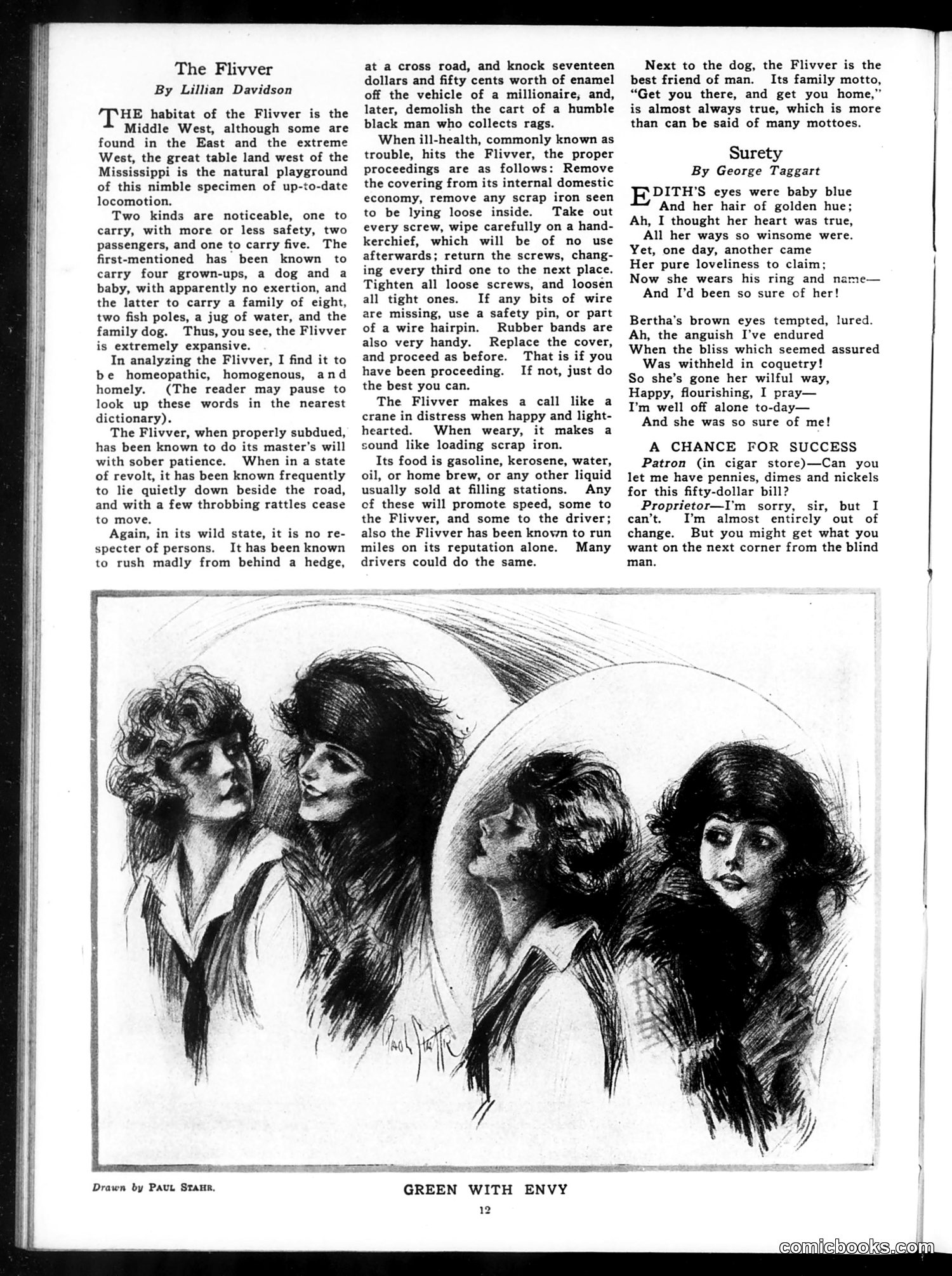
This page contains three distinct pieces. The main illustration, "Green with Envy" by Paul Stahr, depicts four women's faces in sketch form, likely representing jealousy or romantic rivalry—a common theme in early 20th-century humor. The two accompanying texts are unrelated: Lillian Davidson's "The Flivver" is a humorous essay about the Model T Ford, mocking its unreliability, makeshift repairs, and democratic ability to damage both millionaires' and poor people's vehicles equally. George Taggart's poem "Surety" contrasts two men who lost romantic interests to other suitors, with ironic reversals about who ended up satisfied. The small joke at bottom about exchanging a fifty-dollar bill satirizes economic hardship—the proprietor suggesting the customer ask a blind street beggar for change implies widespread financial desperation, where even blind panhandlers might carry small denominations.
📄 Transcribed text from this page (OCR, searchable)
Machine-transcribed from the original scan — historical spelling and the odd misread are preserved.
The Flivver By Lillian Davidson HE habitat of the Flivver is the Middle West, although some are found in the East and the extreme West, the great table land west of the Mississippi is the natural playground of this nimble specimen of up-to-date locomotion. Two kinds are noticeable, one to carry, with more or less safety, two passengers, and one to carry five. The first-mentioned has been known to carry four grown-ups, a dog and a baby, with apparently no exertion, and the latter to carry a family of eight, two fish poles, a jug of water, and the family dog. Thus, you see, the Flivver is extremely expansive. In analyzing the Flivver, I find it to be homeopathic, homogenous, and homely. (The reader may pause to look up these words in the nearest dictionary). The Flivver, when properly subdued, has been known to do its master’s will with sober patience. When in a state of revolt, it has been known frequently to lie quietly down beside the road, and with a few throbbing rattles cease to move. Again, in its wild state, it is no re- specter of persons. It has been known to rush madly from behind a hedge, Drawn by Pau Stan. at a cross road, and knock seventeen dollars and fifty cents worth of enamel off the vehicle of a millionaire, and, later, demolish the cart of a humble black man who collects rags. When ill-health, commonly known as trouble, hits the Flivver, the proper proceedings are as follows: Remove the covering from its internal domestic economy, remove any scrap iron seen to be lying loose inside. Take out every screw, wipe carefully on a hand- kerchief, which will be of no use afterwards; return the screws, chang- ing every third one to the next place. Tighten all loose screws, and loosen all tight ones. If any bits of wire are missing, use a safety pin, or part of a wire hairpin. Rubber bands are also very handy. Replace the cover, and proceed as before. That is if you have been proceeding. If not, just do the best you can. The Flivver makes a call like a crane in distress when happy and light- hearted. When weary, it makes a sound like loading scrap iron. Its food is gasoline, kerosene, water, oil, or home brew, or any other liquid usually sold at filling stations. Any ef these will promote speed, some to the Flivver, and some to the driver; also the Flivver has been known to run miles on its reputation alone. Many drivers could do the same. GREEN WITH ENVY 12 Next to the dog, the Flivver is the best friend of man. Its family motto, “Get you there, and get you home,” is almost always true, which is more than can be said of many mottoes. Surety By George Taggart EDITH'S eyes were baby blue And her hair of golden hue; Ah, I thought her heart was true, All her ways so winsome were. Yet, one day, another came Her pure loveliness to claim; Now she wears his ring and name— And I'd been so sure of her! Bertha’s brown eyes tempted, lured. Ah, the anguish I’ve endured When the bliss which seemed assured Was withheld in coquetry! So she’s gone her wilful way, Happy, flourishing, I pray— I’m well off alone to-day— And she was so sure of me! A CHANCE FOR SUCCESS Patron (in cigar store)—Can you let me have pennies, dimes and nickels for this fifty-dollar bill? Proprietor—I’m sorry, sir, but I can’t. I’m almost entircly out of change. But you might get what you want on the next corner from the blind man.