
Judge, 1922-03-11 · page 13 of 36
Judge — March 11, 1922 — page 13: what you’re looking at
What you’re looking at
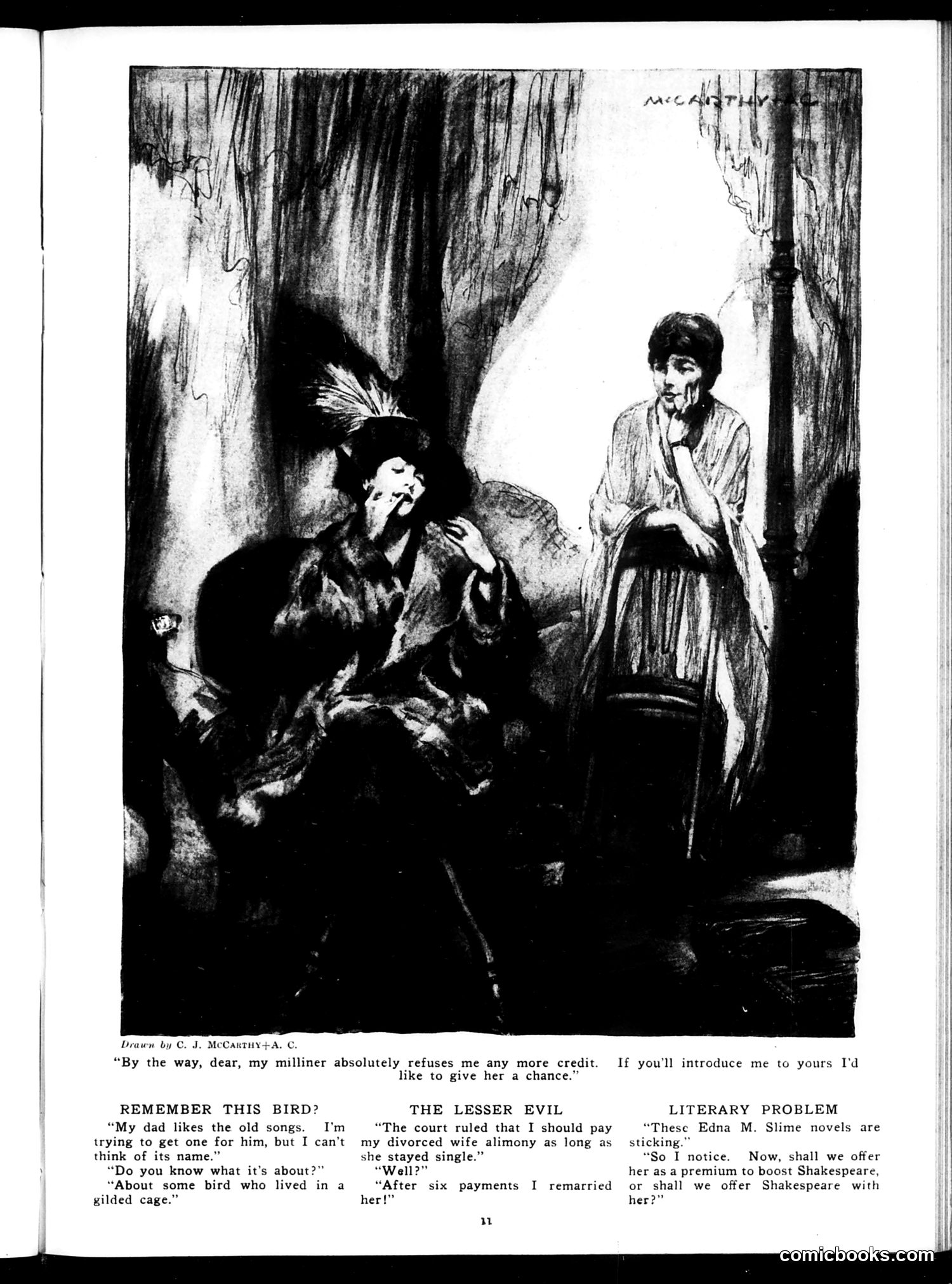
This page contains three separate satirical cartoons mocking domestic and social issues of the era. **Top cartoon**: Shows a woman whose milliner refuses further credit, seeking to introduce a financially struggling friend to a wealthy acquaintance—suggesting women navigated social hierarchies partly through access to others' money and credit. **"Remember This Bird?"**: References the popular song "The Bird in the Gilded Cage," mocking a father's nostalgia for old songs while his son struggles to recall it. **"The Lesser Evil"**: Satirizes divorce law and alimony by showing a man who remarried his ex-wife to escape alimony payments—a darkly comic commentary on flawed legal remedies. **"Literary Problem"**: Mocks the quality of "Edna M. Slime" novels (likely a fictional author), suggesting they're so unpopular publishers might use them as giveaway premiums to boost sales of Shakespeare—jabbing at lowbrow versus highbrow literature tastes. All three mock contemporary manners and social absurdities.
📄 Transcribed text from this page (OCR, searchable)
Machine-transcribed from the original scan — historical spelling and the odd misread are preserved.
Drawn by C. J. McCartHy+A. C. “By the way, dear, my milliner absolutely refuses me any more credit. REMEMBER THIS BIRD? “My dad likes the old songs. I'm trying to get one for him, but I can’t think of its name.” “Do you know what it’s about?” “About some bird who lived in a gilded cage.” like to give her a chance.” THE LESSER EVIL “The court ruled that I should pay my divorced wife alimony as long as she stayed single.” “Well?” “After six payments I remarried her!” Mn If you'll introduce me to yours I'd LITERARY PROBLEM “These Edna M. Slime novels are sticking.” “So I notice. Now, shall we offer her as a premium to boost Shakespeare, or shall we offer Shakespeare with her?” boo