
Judge, 1922-03-11 · page 28 of 36
Judge — March 11, 1922 — page 28: what you’re looking at
What you’re looking at
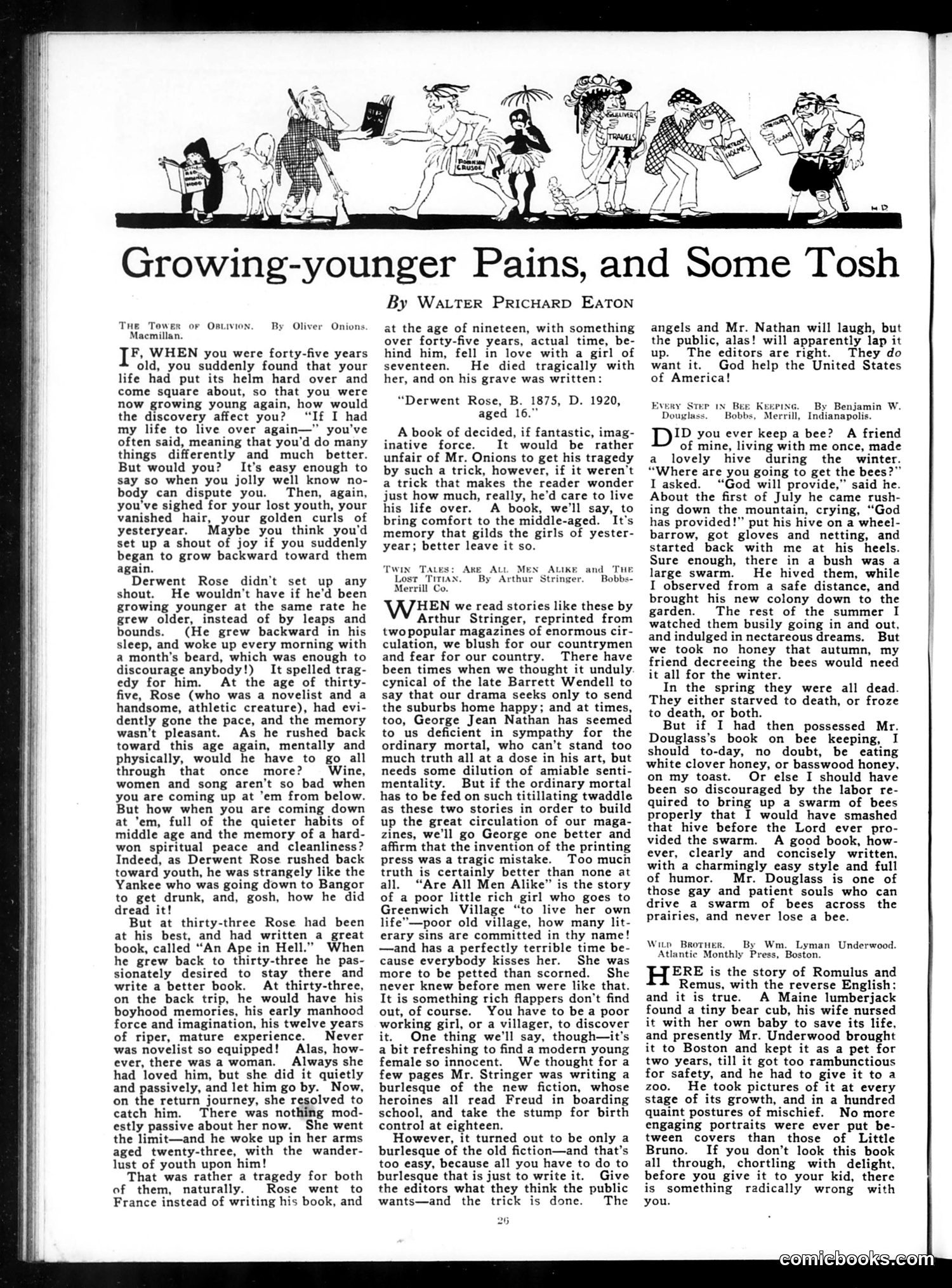
This page from *Judge* magazine reviews three books, with the main feature being Walter Prichard Eaton's critique of Oliver Onions' novel *The Tower of Oblivion*. **The Cartoon**: The header illustration depicts various figures across a timeline, likely representing the protagonist's paradoxical aging and rejuvenation. **The Main Review's Point**: Eaton discusses a fantastical premise—a middle-aged man (Derwent Rose) who begins physically growing younger while retaining his adult memories. The satire explores whether people truly want to relive youth, given its attendant passions and poor choices. Rose, hoping to recapture his creative prime at age thirty-three, instead gets swept up in youthful romance and tragedy, dying at nineteen with a seventeen-year-old lover. **The Social Commentary**: The review uses this dark fantasy to gently mock middle-aged nostalgia—the common refrain "if I could live my life over." Eaton suggests that memory romanticizes youth in ways that reality wouldn't support, making the novel comforting rather than cautionary for aging readers. The reviews of other books express concerns about American literature's quality and morality.
📄 Transcribed text from this page (OCR, searchable)
Machine-transcribed from the original scan — historical spelling and the odd misread are preserved.
Growing-younger Pains, and Some Tosh By Wa ttTerR PRICHARD EATON THe Tower oF Oativion. By Oliver Onions Macmillan. IF: WHEN you were forty-five years old, you suddenly found that your life had put its helm hard over and come square about, so that you were now growing young again, how would the discovery affect you? “If I had my life to live over again—" you've often said, meaning that you'd do many things differently and much better. But would you? It’s easy enough to say so when you jolly well know no- body can dispute you. Then, again, you've sighed for your lost youth, your vanished hair, your golden curls of yesteryear. Maybe you think you'd set up a shout of joy if you suddenly began to grow backward toward them again. Derwent Rose didn’t set up any shout. He wouldn't have if he'd been growing younger at the same rate he grew older, instead of by leaps and bounds. (He grew backward in his sleep, and woke up every morning with a month’s beard, which was enough to discourage anybody!) It spelled trag- edy for him. At the age of thirty- five, Rose (who was a novelist and a handsome, athletic creature), had evi- dently gone the pace, and the memory wasn’t pleasant. As he rushed back toward this age again, mentally and physically, would he have to go all through that once more? Wine, women and song aren’t so bad when you are coming up at ’em from below. But how when you are coming down at ‘em, full of the quieter habits of middle age and the memory of a hard- won spiritual peace and cleanliness? Indeed, as Derwent Rose rushed back toward youth, he was strangely like the Yankee who was going down to Bangor to get drunk, and, gosh, how he did dread it! But at thirty-three Rose had been at his best, and had written a great book, called “An Ape in Hell.” When he grew back to thirty-three he pas- sionately desired to stay there and write a better book. At thirty-three, on the back trip, he would have his boyhood memories, his early manhood force and imagination, his twelve years of riper, mature experience. Never was novelist so equipped! Alas, how- ever, there was a woman. Always she had loved him, but she did it quietly and passively, and let him go by. Now, on the return journey, she resolved to catch him. There was nothing mod- estly passive about her now. She went the limit—and he woke up in her arms aged twenty-three, with the wander- lust of youth upon him! That was rather a tragedy for both of them, naturally. Rose went to France instead of writing his book, and at the age of nineteen, with something over forty-five years, actual time, be- hind him, fell in love with a girl of seventeen. He died tragically with her, and on his grave was written: “Derwent Rose, B. 1875, D. 1920, aged 16." A book of decided, if fantastic, imag- inative force. It would be rather unfair of Mr. Onions to get his tragedy by such a trick, however, if it weren't a trick that makes the reader wonder just how much, really, he'd care to live his life over. A book, we'll say, to bring comfort to the middle-aged. It’s memory that gilds the girls of yester- year; better leave it so. ALIKE and THE Bobbs- Twin 1 ARE ALL MEN Los IAN. By Arthur Stringer. Merrill Co. WHEN we read stories like these by Arthur Stringer, reprinted from two popular magazines of enormous cir- culation, we blush for our countrymen and fear for our country. There have been times when we thought it unduly. cynical of the late Barrett Wendell to say that our drama seeks only to send the suburbs home happy; and at times, too, George Jean Nathan has seemed to us deficient in sympathy for the ordinary mortal, who can’t stand too much truth all at a dose in his art, but needs some dilution of amiable senti- mentality. But if the ordinary mortal has to be fed on such titillating twaddle as these two stories in order to build up the great circulation of our maga- zines, we'll go George one better and affirm that the invention of the printing press was a tragic mistake. Too much truth is certainly better than none at all. “Are All Men Alike” is the story of a poor little rich girl who goes to Greenwich Village “to live her own life’—poor old village, how many lit- erary sins are committed in thy name! —and has a perfectly terrible time be- cause everybody kisses her. She was more to be petted than scorned. She never knew before men were like that. It is something rich flappers don’t find out, of course. You have to be a poor working girl, or a villager, to discover it. One thing we'll say, though—it’s a bit refreshing to find a modern young female so innocent. We thought for a few pages Mr. Stringer was writing a burlesque of the new fiction, whose heroines all read Freud in boarding school, and take the stump for birth control at eighteen. However, it turned out to be only a burlesque of the old fiction—and that’s too easy, because all you have to do to burlesque that is just to write it. Give the editors what they think the public wants—and the trick is done. The angels and Mr. Nathan will laugh, but the public, alas! will apparently lap it up. The editors are right. They do want it. God help the United States of America! Every Ster tn Bee Keer By Benjamin W. Douglass. Bobbs, Merrill, Indianapolis. D» you ever keep a bee? A friend of mine, living with me once, made a lovely hive during the winter. “Where are you going to get the bees?” lasked. “God will provide,” said he. About the first of July he came rush- ing down the mountain, crying, “God has provided!” put his hive on a wheel- barrow, got gloves and netting, and started back with me at his heels. Sure enough, there in a bush was a large swarm. He hived them, while I observed from a safe distance, and brought his new colony down to the garden. The rest of the summer I watched them busily going in and out, and indulged in nectareous dreams. But we took no honey that autumn, my friend decreeing the bees would need it all for the winter. In the spring they were all dead. They either starved to death, or froze to death, or both. But if I had then possessed Mr. Douglass’s book on bee keeping, I should to-day, no doubt, be eating white clover honey, or basswood honey, on my toast. Or else I should have been so discouraged by the labor re- quired to bring up a swarm of bees properly that I would have smashed that hive before the Lord ever pro- vided the swarm. A good book, how- ever, clearly and concisely written, with a charmingly easy style and full of humor. Mr. Douglass is one of those gay and patient souls who can drive a swarm of bees across the prairies, and never lose a bee. Witp Brotuer. By Wm. Lyman Underwood. Atlantic Monthly Press, Boston. HERE is the story of Romulus and Remus, with the reverse English: and it is true. A Maine lumberjack found a tiny bear cub, his wife nursed it with her own baby to save its life, and presently Mr. Underwood brought it to Boston and kept it as a pet for two years, till it got too rambunctious for safety, and he had to give it to a zoo. He took pictures of it at every stage of its growth, and in a hundred quaint postures of mischief. No more engaging portraits were ever put be- tween covers than those of Little Bruno. I£ you don’t look this book all through, chortling with delight, before you give it to your kid, there is something radically wrong with you.