
Judge, 1922-03-11 · page 16 of 36
Judge — March 11, 1922 — page 16: what you’re looking at
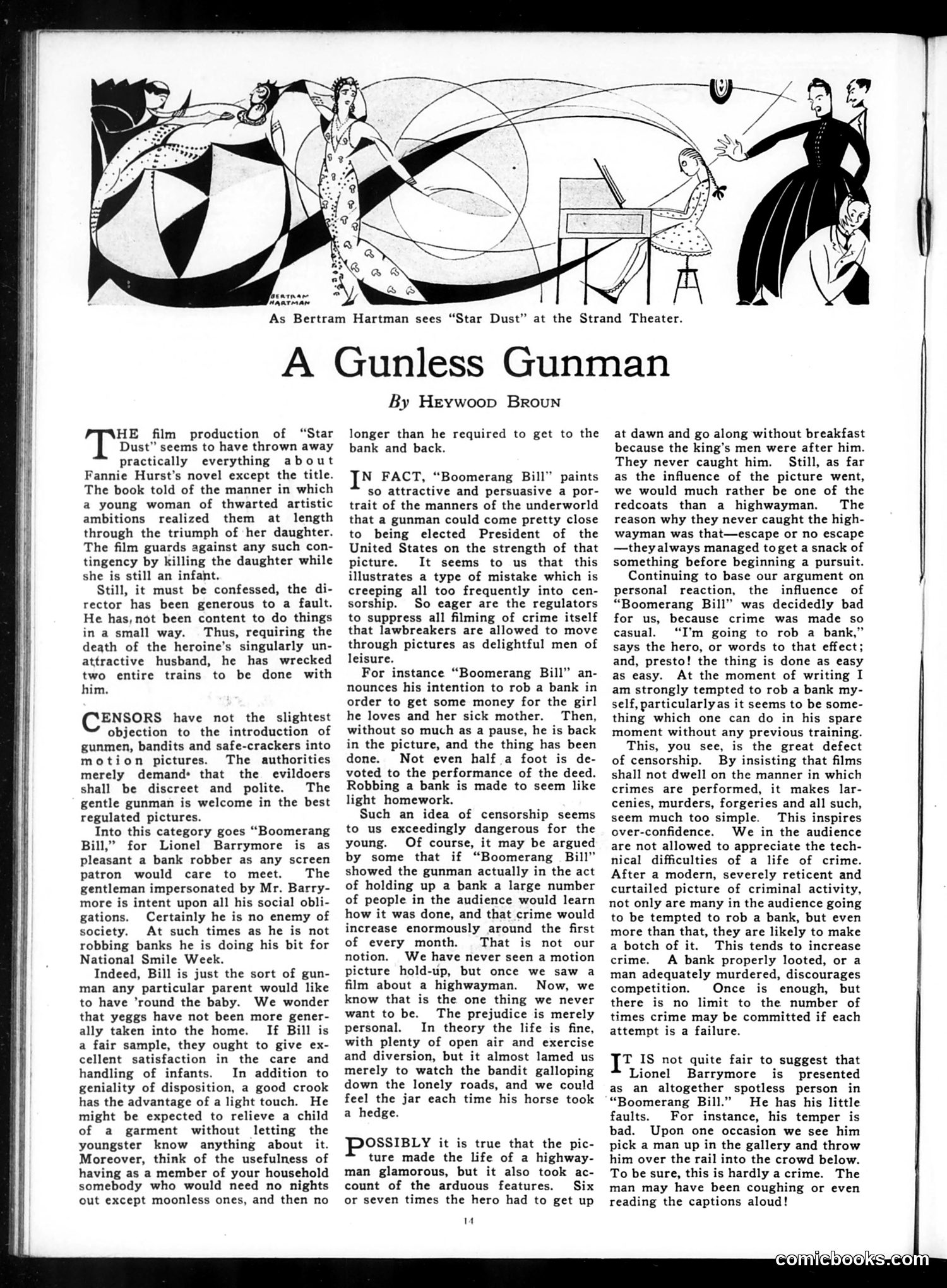
What you’re looking at
This article by Heywood Broun critiques film censorship's inconsistent logic regarding crime depictions. The accompanying cartoon illustrates the article's argument. **The Target:** Film censors who permit glamorous portrayals of criminals (specifically the "Boomerang Bill" character played by Lionel Barrymore) while suppressing depictions of actual crime. Broun argues this creates a dangerous paradox: audiences see bank robbery as "light homework" because the crime itself is never shown—only its charming aftermath. **The Satire:** Broun sardonically suggests that criminals make ideal babysitters and household employees, since they're portrayed as gentlemen of leisure with good manners. He notes the censor's logic is backwards: showing *how* crimes are committed might actually discourage crime, whereas sanitizing criminals into romantic figures glorifies lawbreaking. **The Point:** Broun argues 1920s film censorship, while banning explicit crime scenes, inadvertently romanticizes criminality by allowing charming criminals to operate without consequences on screen.
📄 Transcribed text from this page (OCR, searchable)
Machine-transcribed from the original scan — historical spelling and the odd misread are preserved.
amar mmr As Bertram Hartman sees “Star Dust” at the Strand Theater. A Gunless Gunman By Heywoop Broun HE film production of “Star Dust” seems to have thrown away practically everything about Fannie Hurst’s novel except the title. The book told of the manner in which a young woman of thwarted artistic ambitions realized them at length through the triumph of her daughter. The film guards against any such con- tingency by killing the daughter while she is still an infant. Still, it must be confessed, the di- rector has been generous to a fault. He has, not been content to do things in a small way. Thus, requiring the death of the heroine’s singularly un- attractive husband, he has wrecked two entire trains to be done with him. CENSORS have not the slightest objection to the introduction of gunmen, bandits and safe-crackers into motion pictures. The authorities merely demand* that the evildoers shall be discreet and polite. The gentle gunman is welcome in the best regulated pictures. Into this category goes “Boomerang Bill,’ for Lionel Barrymore is as pleasant a bank robber as any screen patron would care to meet. The gentleman impersonated by Mr. Barry- more is intent upon all his social obli- gations. Certainly he is no enemy of society. At such times as he is not robbing banks he is doing his bit for National Smile Week. Indeed, Bill is just the sort of gun- man any particular parent would like to have ’round the baby. We wonder that yeggs have not been more gener- ally taken into the home. If Bill is a fair sample, they ought to give ex- cellent satisfaction in the care and handling of infants. In addition to geniality of disposition, a good crook has the advantage of a light touch. He might be expected to relieve a child of a garment without letting the youngster know anything about it. Moreover, think of the usefulness of having as a member of your household somebody who would need no nights out except moonless ones, and then no longer than he required to get to the bank and back. N FACT, “Boomerang Bill” paints so attractive and persuasive a por- trait of the manners of the underworld that a gunman could come pretty close to being elected President of the United States on the strength of that picture. It seems to us that this illustrates a type of mistake which is creeping all too frequently into cen- sorship. So eager are the regulators to suppress all filming of crime itself that lawbreakers are allowed to move through pictures as delightful men of leisure. For instance “Boomerang Bill” an- nounces his intention to rob a bank in order to get some money for the girl he loves and her sick mother. Then, without so much as a pause, he is back in the picture, and the thing has been done. Not even half a foot is de- voted to the performance of the deed. Robbing a bank is made to seem like light homework. Such an idea of censorship seems to us exceedingly dangerous for the young. Of course, it may be argued by some that if “Boomerang Bill” showed the gunman actually in the act of holding up a bank a large number of people in the audience would learn how it was done, and that crime would increase enormously around the first of every month. That is not our notion. We have never seen a motion picture hold-up, but once we saw a film about a highwayman. Now, we know that is the one thing we never want to be. The prejudice is merely personal. In theory the life is fine, with plenty of open air and exercise and diversion, but it almost lamed us merely to watch the bandit galloping down the lonely roads, and we could feel the jar each time his horse took a hedge. PoOSsIBLy it is true that the pic- ture made the life of a highway- man glamorous, but it also took ac- count of the arduous features. Six or seven times the hero had to get up 4 at dawn and go along without breakfast because the king’s men were after him. They never caught him. Still, as far as the influence of the picture went, we would much rather be one of the redcoats than a highwayman. The reason why they never caught the high- wayman was that—escape or no escape —theyalways managed toget a snack of something before beginning a pursuit. Continuing to base our argument on personal reaction, the influence of “Boomerang Bill” was decidedly bad for us, because crime was made so | casual. “I’m going to rob a bank,” | says the hero, or words to that effect; and, presto! the thing is done as easy as easy. At the moment of writing I am strongly tempted to rob a bank my- self, particularly as it seems to be some- thing which one can do in his spare moment without any previous training. This, you see, is the great defect of censorship. By insisting that films shall not dwell on the manner in which crimes are performed, it makes lar- cenies, murders, forgeries and all such, seem much too simple. This inspires over-confidence. We in the audience are not allowed to appreciate the tech- nical difficulties of a life of crime. After a modern, severely reticent and curtailed picture of criminal activity, not only are many in the audience going to be tempted to rob a bank, but even more than that, they are likely to make a botch of it. This tends to increase crime. A bank properly looted, or a man adequately murdered, discourages competition. Once is enough, but there is no limit to the number of times crime may be committed if each i attempt is a failure. Iz IS not quite fair to suggest that Lionel Barrymore is presented as an altogether spotless person in “Boomerang Bill.” He has his little faults. For instance, his temper is | bad. Upon one occasion we see him pick a man up in the gallery and throw him over the rail into the crowd below. To be sure, this is hardly acrime. The man may have been coughing or even reading the captions aloud! cComicbooks-com