
Judge, 1922-03-11 · page 21 of 36
Judge — March 11, 1922 — page 21: what you’re looking at
What you’re looking at
This *Judge* magazine page contains two distinct satirical pieces: **Top Section - "For Example":** Attacks Rev. William Sheafe Chase, a reformer who testified before the Senate about regulating Will Hays and the motion picture industry. The author sarcastically dismisses Chase as a self-righteous busybody leading a "Soviet" of morality crusaders ("Amalgamated Uplifters"). The piece ridicules the idea that Hollywood might promote progressive causes like taxing the wealthy or criticizing tariffs, while mocking how Chase sees dangers everywhere. The underlying point: anti-communist crusaders are themselves tyrannical minorities imposing their will. **Bottom Section - "The Day We Celebrate":** A St. Patrick's Day piece imagining the saint bewildered by his new job: "governing the world's governors"—apparently referencing Ireland's recent independence (1921) and newfound diplomatic responsibilities. The satire suggests Irish leadership now faces far greater challenges than the legendary task of banishing snakes. Both pieces attack self-appointed moral authorities and reformist overreach through sarcasm and ironic comparison to tyrannical systems.
📄 Transcribed text from this page (OCR, searchable)
Machine-transcribed from the original scan — historical spelling and the odd misread are preserved.
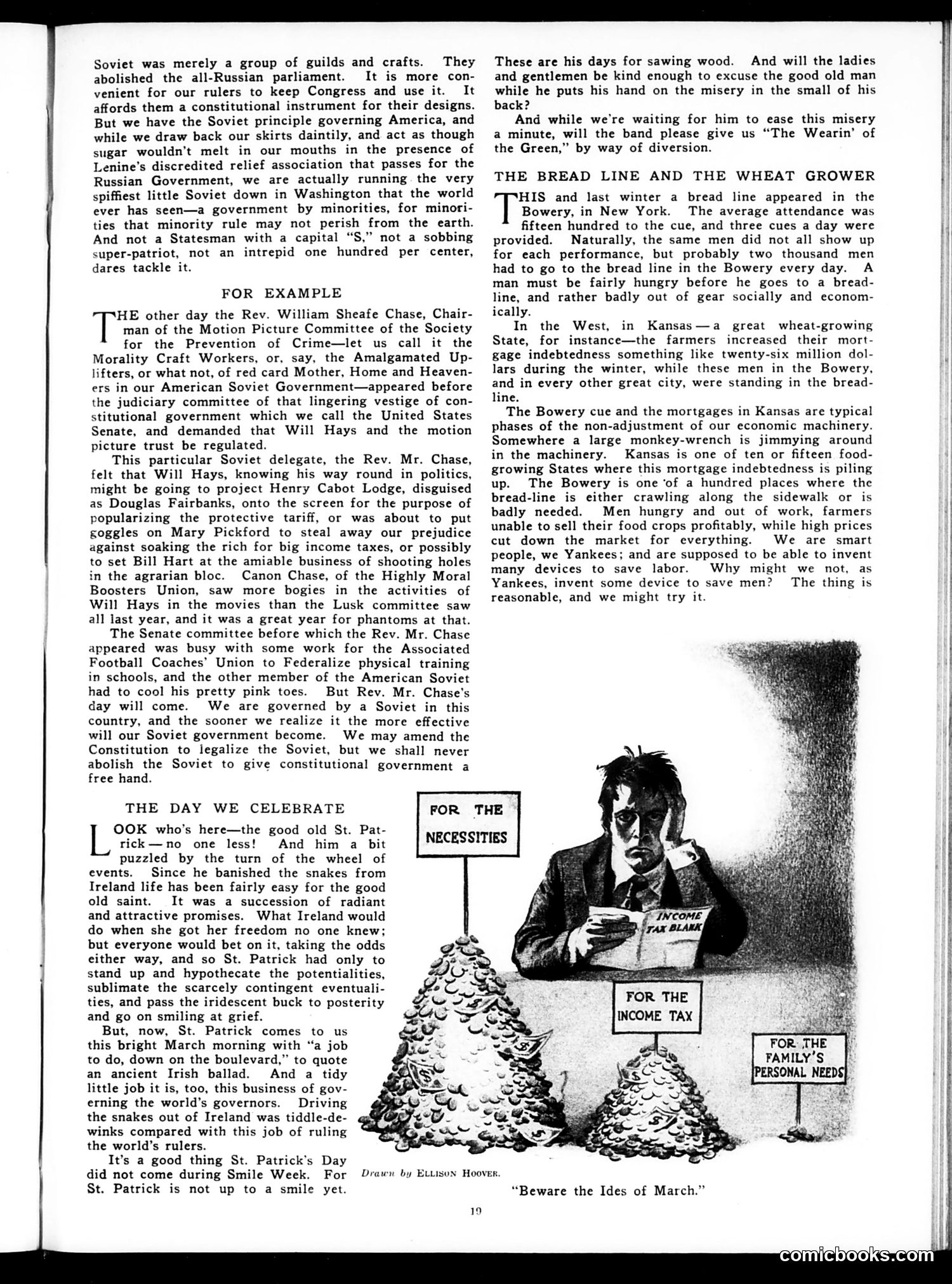
Soviet was merely a group of guilds and crafts. They abolished the all-Russian parliament. It is more con- venient for our rulers to keep Congress and use it. It affords them a constitutional instrument for their designs. But we have the Soviet principle governing America, and while we draw back our skirts daintily, and act as though sugar wouldn’t melt in our mouths in the presence of Lenine’s discredited relief association that passes for the Russian Government, we are actually running the very spiffiest little Soviet down in Washington that the world ever has seen—a government by minorities, for minori- ties that minority rule may not perish from the earth. And not a Statesman with a capital “S,” not a sobbing super-patriot, not an intrepid one hundred per center, dares tackle it. FOR EXAMPLE HE other day the Rev. William Sheafe Chase, Chair- man of the Motion Picture Committee of the Society for the Prevention of Crime—let us call it the Morality Craft Workers, or, say, the Amalgamated Up- lifters, or what not, of red card Mother, Home and Heaven- ers in our American Soviet Government—appeared before the judiciary committee of that lingering vestige of con- stitutional government which we call the United States Senate, and demanded that Will Hays and the motion picture trust be regulated. This particular Soviet delegate, the Rev. Mr. Chase, felt that Will Hays, knowing his way round in politics, might be going to project Henry Cabot Lodge, disguised as Douglas Fairbanks, onto the screen for the purpose of popularizing the protective tariff, or was about to put goggles on Mary Pickford to steal away our prejudice against soaking the rich for big income taxes, or possibly to set Bill Hart at the amiable business of shooting holes in the agrarian bloc. Canon Chase, of the Highly Moral Boosters Union, saw more bogies in the activities of Will Hays in the movies than the Lusk committee saw all last year, and it was a great year for phantoms at that. The Senate committee before which the Rev. Mr. Chase appeared was busy with some work for the Associated Football Coaches’ Union to Federalize physical training in schools, and the other member of the American Soviet had to cool his pretty pink toes. But Rev. Mr. Chase's day will come. We are governed by a Soviet in this country, and the sooner we realize it the more effective will our Soviet government become. We may amend the Constitution to legalize the Soviet, but we shall never abolish the Soviet to give constitutional government a free hand. THE DAY WE CELEBRATE OOK who's here—the good old St. Pat- rick—no one less! And him a bit puzzled by the turn of the wheel of events. Since he banished the snakes from Ireland life has been fairly easy for the good old saint. It was a succession of radiant and attractive promises. What Ireland would do when she got her freedom no one knew; but everyone would bet on it, taking the odds either way, and so St. Patrick had only to stand up and hypothecate the potentialities, sublimate the scarcely contingent eventuali- ties, and pass the iridescent buck to posterity and go on smiling at grief. But, now, St. Patrick comes to us this bright March morning with “a job to do, down on the boulevard,” to quote an ancient Irish ballad. And a tidy little job it is, too, this business of gov- erning the world’s governors. Driving the snakes out of Ireland was tiddle-de- winks compared with this job of ruling the world’s rulers. It’s a good thing St. Patrick’s Day did not come during Smile Week. For St. Patrick is not up to a smile yet. FOR THE NECESSITIES 19 And will the ladies and gentlemen be kind enough to excuse the good old man while he puts his hand on the misery in the small of his back? And while we're waiting for him to ease this misery a minute, will the band please give us “The Wearin’ of the Green,” by way of diversion. These are his days for sawing wood. THE BREAD LINE AND THE WHEAT GROWER HIS and last winter a bread line appeared in the T Bowes, in New York. The average attendance was fifteen hundred to the cue, and three cues a day were provided. Naturally, the same men did not all show up for each performance, but probably two thousand men had to go to the bread line in the Bowery every day. A man must be fairly hungry before he goes to a bread- line, and rather badly out of gear socially and econom- ically. In the West, in Kansas—a great wheat-growing State, for instance—the farmers increased th mort- gage indebtedness something like twenty-six million dol- lars during the winter, while these men in the Bowery, and in every other great city, were standing in the bread- line. The Bowery cue and the mortgages in Kansas are typical phases of the non-adjustment of our economic machinery. Somewhere a large monkey-wrench is jimmying around in the machinery. Kansas is one of ten or fifteen food- growing States where this mortgage indebtedness is piling up. The Bowery is one ‘of a hundred places where the bread-line is either crawling along the sidewalk or is badly needed. Men hungry and out of work, farmers unable to sell their food crops profitably, while high prices cut down the market for everything. We are smart people, we Yankees; and are supposed to be able to invent many devices to save labor. Why might we not, as Yankees, invent some device to save men? The thing is reasonable, and we might try it. FOR. THE FAMILY’S Drawn by EtLLison Hoover. “Beware the Ides of March.”