
A complete issue · 36 pages · 1921
Judge — December 10, 1921
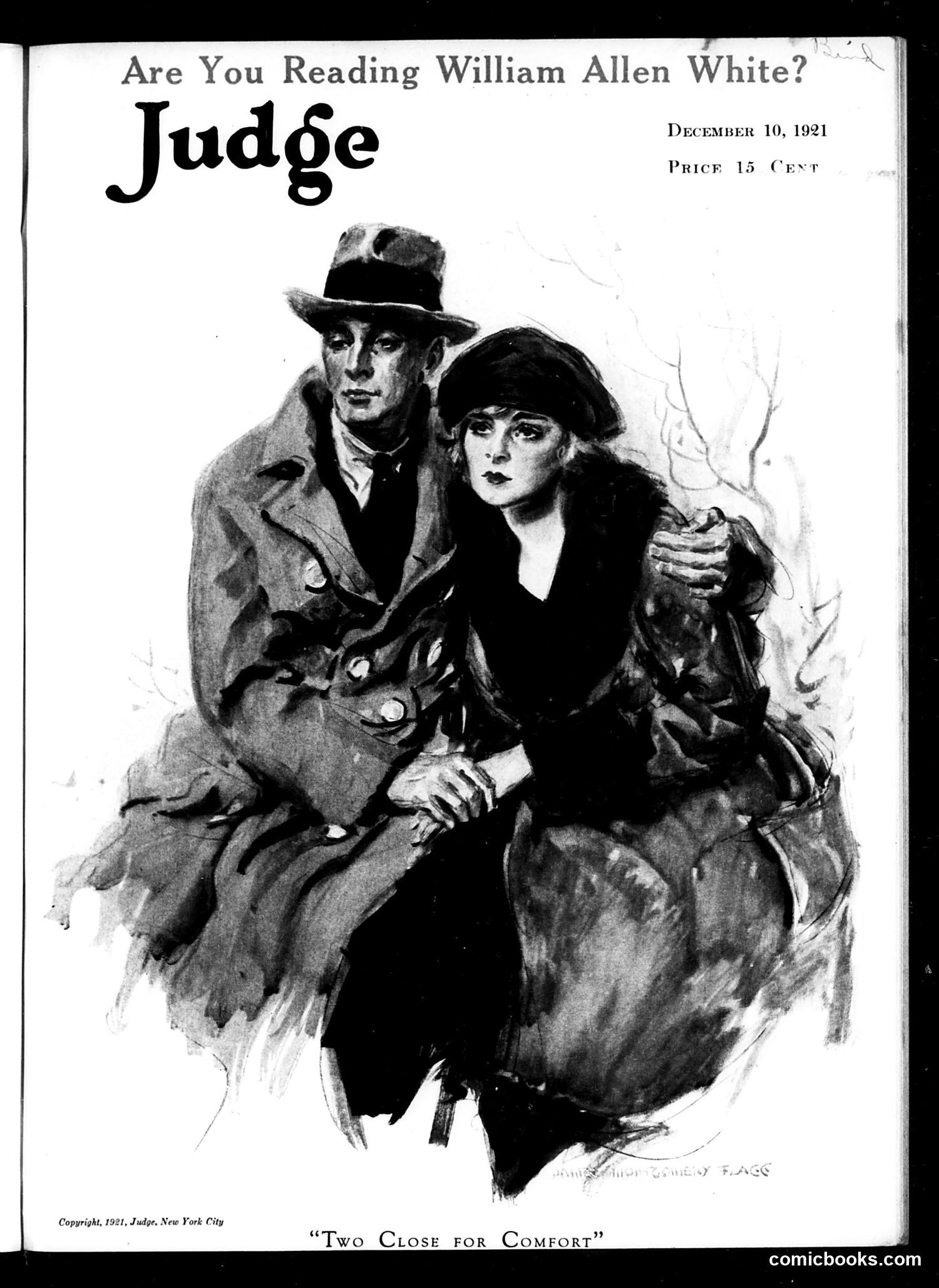
This cover illustrates a romantic scene titled "Two Close for Comfort," showing a couple in winter clothing embracing outdoors. The magazine's header asks "Are You Reading William Allen White?"—referring to the prominent Kansas newspaper editor and social commentator of that era. The illustration appears to be a generic romantic image rather than political satire. It likely serves as the cover art for a humorous story or feature inside the magazine. The pairing with White's name suggests the issue may contain his commentary or a story by him addressing contemporary social issues, possibly including romantic or relationship matters that were topics of public debate in the 1920s.
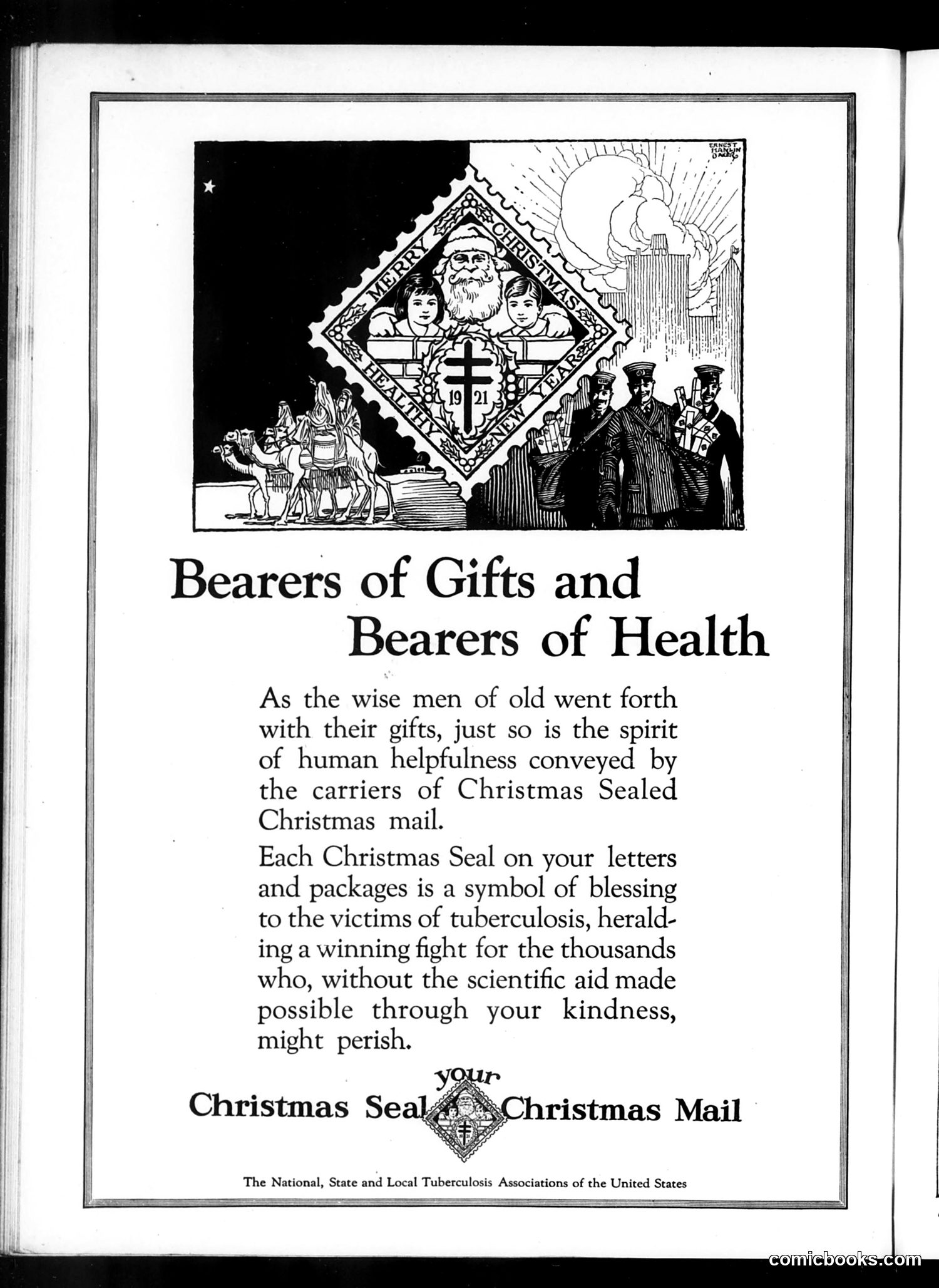
This page is primarily **advertising, not satire**. It's a 1921 Christmas Seal campaign advertisement from tuberculosis associations. The illustration shows the "three wise men" delivering gifts (left), with a diamond-shaped emblem featuring Santa Claus and children centered above a cross. On the right, clergy and military figures represent authority endorsing the cause. The ad compares Christmas Seal purchasers to the biblical Magi bringing gifts of healing rather than gold. It frames tuberculosis—then a major killer—as a solvable problem if people "seal" their Christmas mail with these stamps, funding scientific treatment. The religious imagery (cross, wise men, clergy) legitimizes the public health campaign by connecting charitable giving to Christian tradition and spiritual obligation.
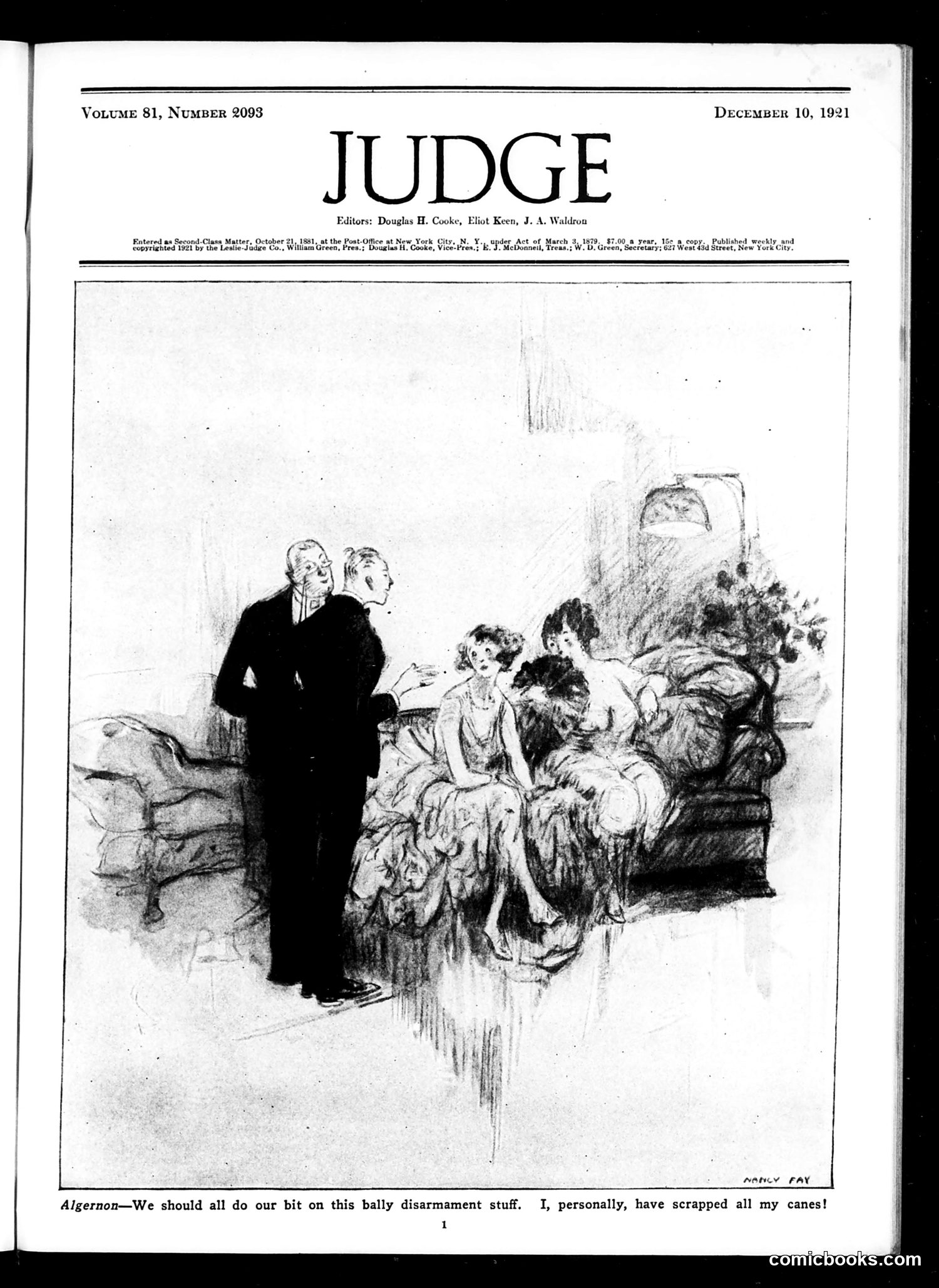
This cartoon satirizes post-World War I disarmament negotiations. A well-dressed diplomat (likely representing a government official) speaks to seated women, saying he's "scrapped all my canels" regarding "bally disarmament stuff." The joke plays on the word "canels" (likely "canals" misspelled by OCR, or possibly referencing naval vessels). The cartoon mocks politicians' public claims of supporting arms reduction while the women appear skeptical or unmoved by his statement. The 1921 date places this amid international disarmament conferences following WWI's devastation. The satire suggests diplomatic promises of peace were hollow rhetoric—politicians boasted about military cuts they hadn't genuinely made, appealing to a war-weary public seeking genuine peace rather than political theater.
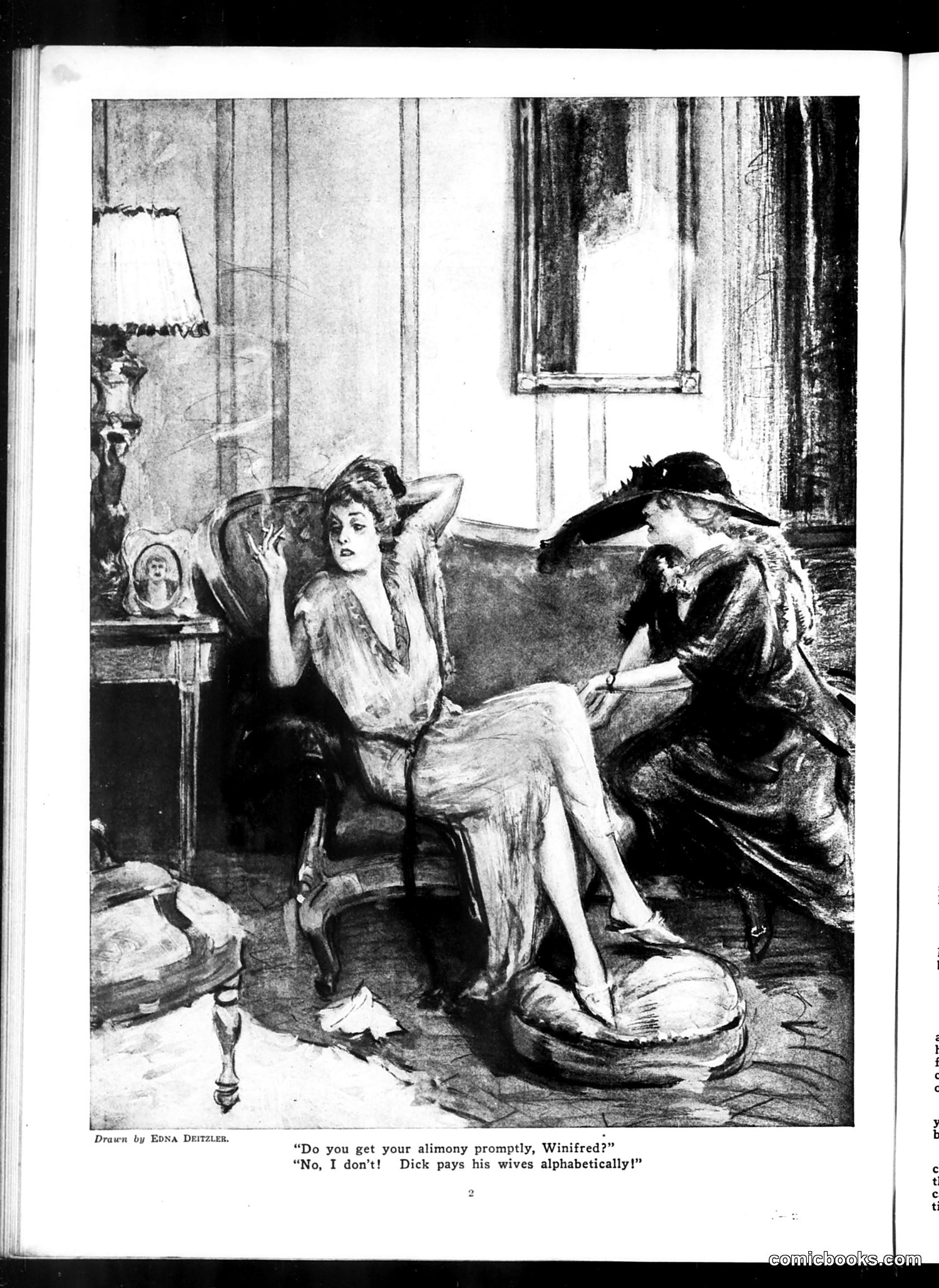
This cartoon by Edna Deitzel satirizes alimony payments through a domestic scene. The dialogue reveals the joke: when asked if she receives her alimony promptly, a woman named Winifred responds that her husband Dick "pays his wives alphabetically." The humor targets men who maintain multiple ex-wives and dodge full alimony obligations by paying them in rotating order—presumably leaving some wives waiting extended periods. This reflects early 20th-century concerns about divorce's financial consequences and men's potential irresponsibility toward former spouses. The fashionable interior setting emphasizes these are women of means, making the joke about incomplete payments more pointed. The satire critiques both the loopholes husbands exploited and the precarious financial position of divorced women despite their social status.
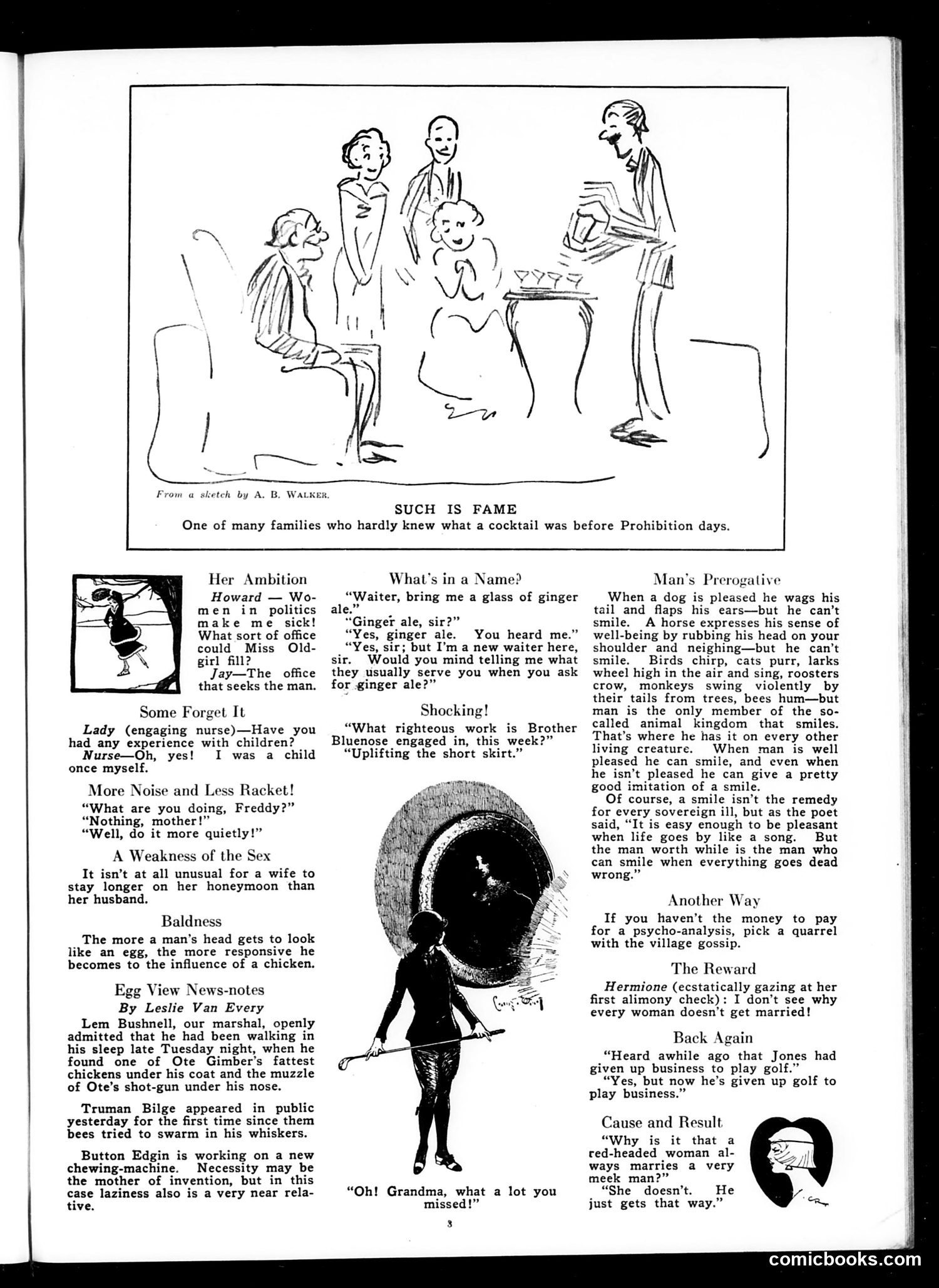
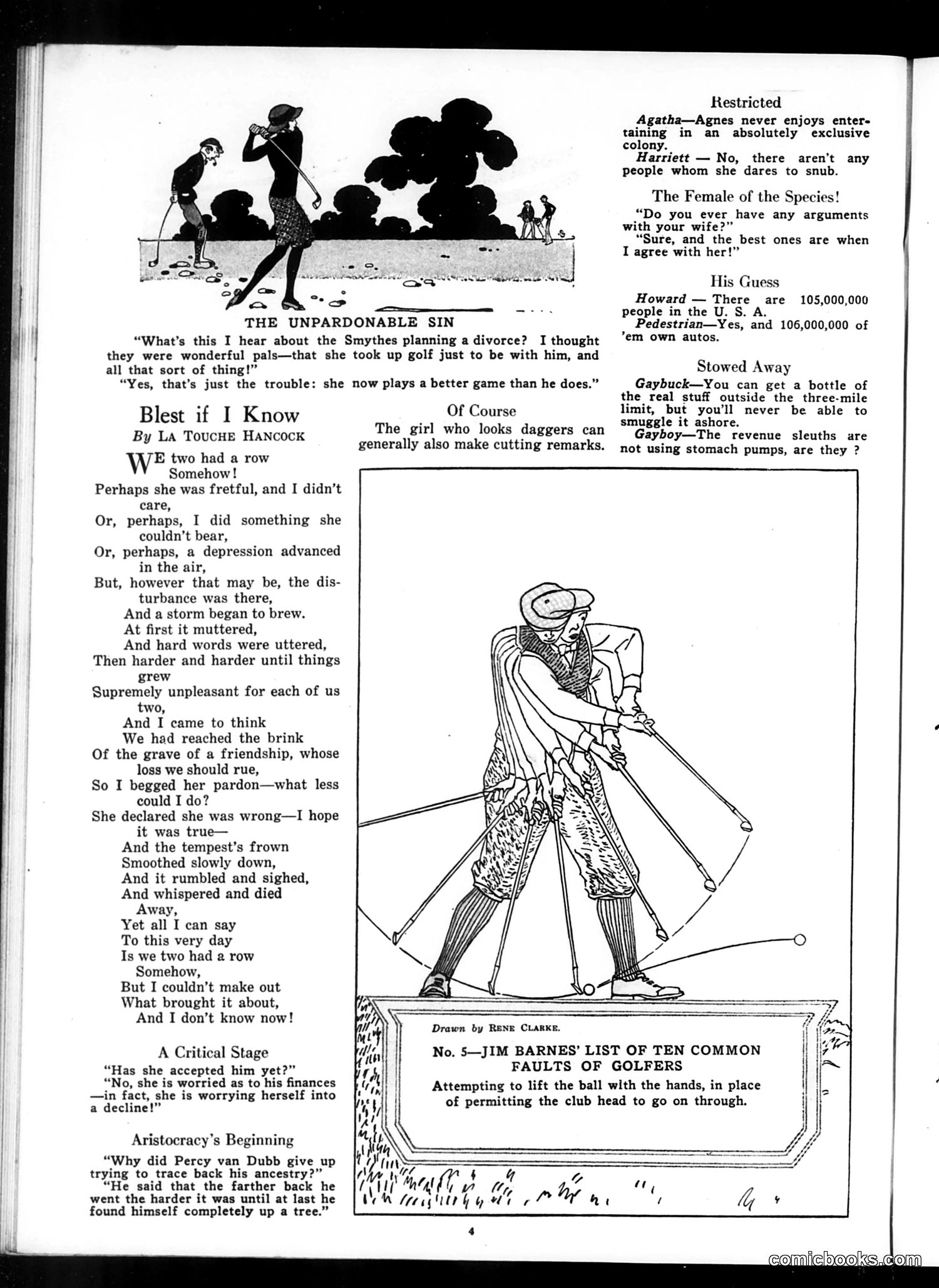
The main cartoon "Such Is Fame" satirizes social change during Prohibition era (pre-1920s). It depicts a family unfamiliar with cocktails—showing how alcohol culture was shifting. The sketch by A.B. Walker illustrates people learning about drinks they previously didn't know existed. The surrounding humor pieces mock various social trends: women's fashion changes ("Uplifting the short skirt"), marital dynamics, and behavioral quirks. References like "Brother Rhipbone's uplifting" suggest jazz-age cultural shifts. The central illustration of a woman with a large parasol captioned "Oh! Grandma, what a lot you missed!" emphasizes generational differences—older generations bewildered by modern social practices. Overall, the page captures Judge's satirical commentary on rapid American social transformation of the early 20th century.
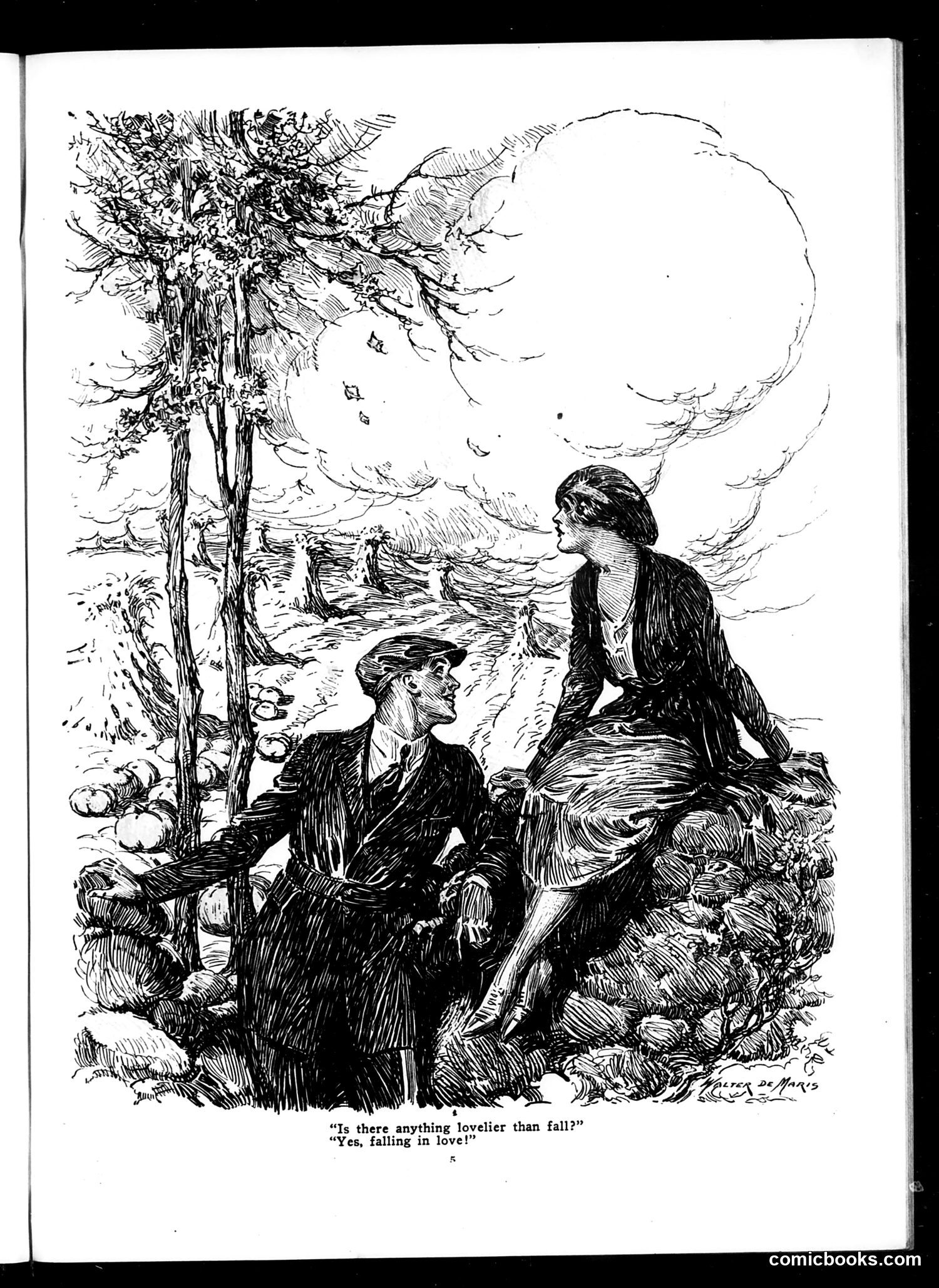
This is a straightforward romantic illustration rather than political satire. Two well-dressed figures sit together in an autumn landscape, admiring falling leaves. The dialogue presents a gentle play on words: when one asks "Is there anything lovelier than fall?" (the season), the other responds "Yes, falling in love!" — turning the noun "fall" into the verb "falling." The image exemplifies the sentimental humor common to Judge magazine's lighter content. It appeals to the publication's middle-class audience through an idealized romantic scenario with classical artistic technique (ink drawing with cross-hatching). The joke relies on wordplay rather than social commentary, reflecting the magazine's entertainment value alongside its better-known satirical pieces. No specific historical figures or political events appear referenced.
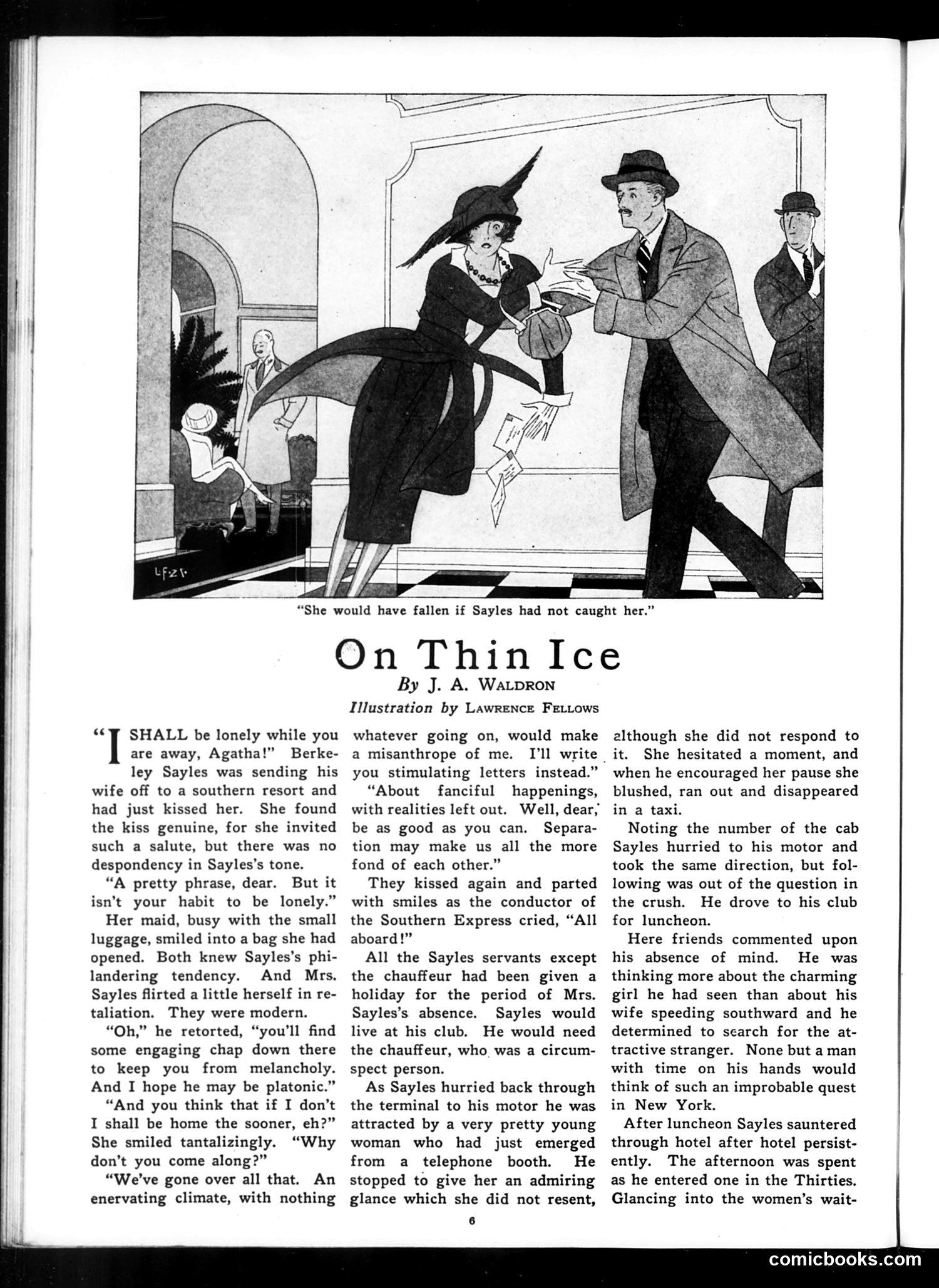
This is a short story illustration satirizing 1920s marital infidelity among the wealthy. Berkeley Sayles sends his wife away to a southern resort while pretending devotion, though both openly acknowledge his philandering tendency. The couple practices modern, cynical tolerance of each other's affairs. The satire targets Sayles specifically: despite his wife's departure, he immediately pursues an attractive stranger at the train station, obsessively tracking her taxi and spending his afternoon hotel-hopping to find her. The irony is sharp—his promise of "stimulating letters" and claims about separation strengthening their bond are instantly betrayed by his compulsive womanizing. The illustration captures the moment where Sayles "catches" the woman, suggesting the predatory nature of his behavior. The story mocks upper-class moral hypocrisy: marriage has become a transactional arrangement where infidelity is accepted as long as it's discreet. The title "On Thin Ice" foreshadows complications ahead.
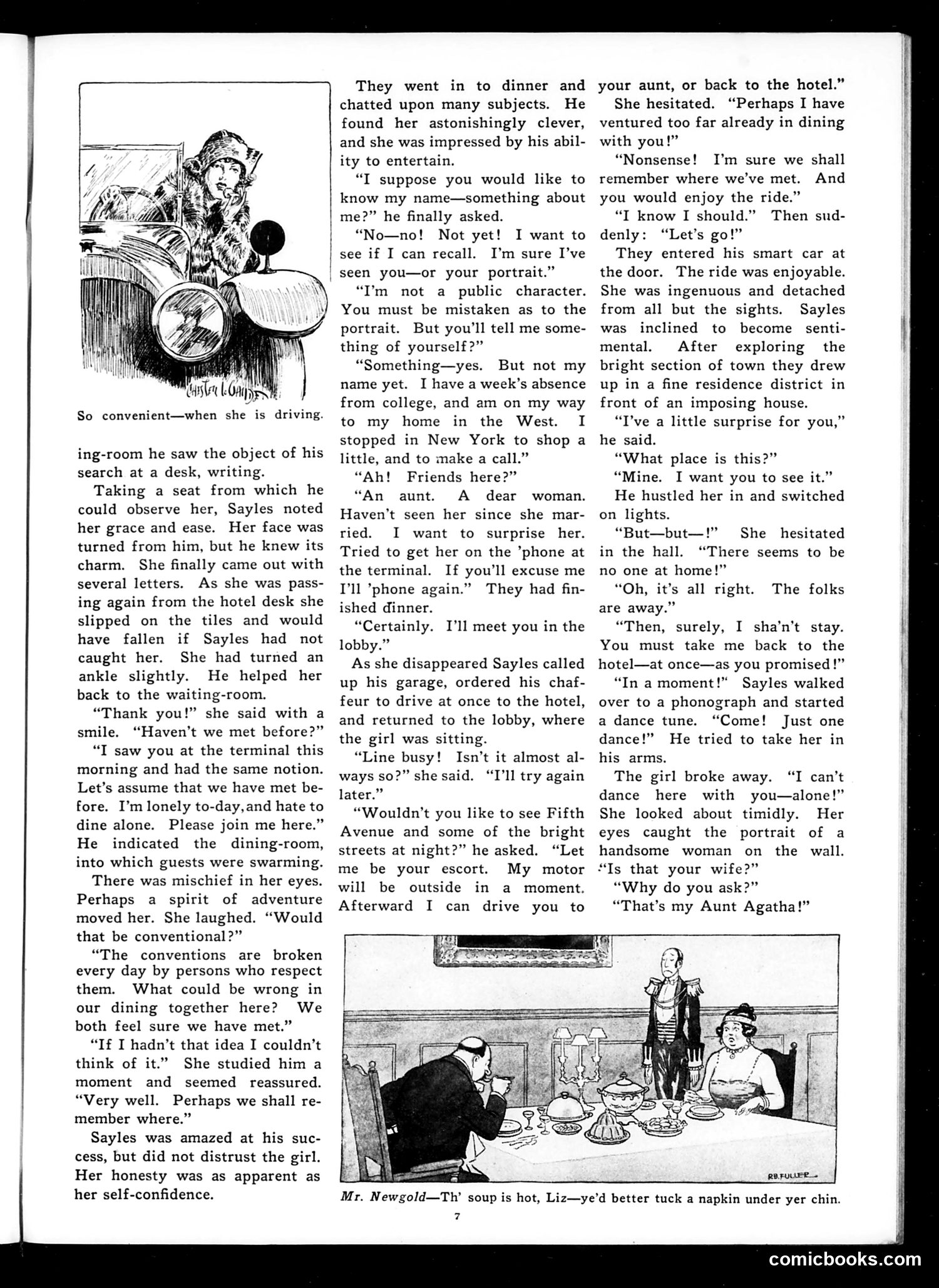
This story from *Judge* magazine satirizes early-20th-century courtship conventions and gender dynamics. The narrative depicts a man (Sayles) who orchestrates an elaborate seduction by feigning chance meetings with a college-aged woman traveling alone in New York City. The satire targets several social hypocrisies: Sayles cynically invokes "broken conventions" to justify dining with a stranger, while the woman accepts his arguments about propriety despite obvious red flags. Her college education and independence ("ingenuous and detached") contrast sharply with her naïveté about his true intentions. The bottom illustration shows a domestic scene—likely representing conventional family life—which ironically frames the main narrative's violation of those very conventions. The joke: respectable society claims to respect social rules while simultaneously flouting them. Sayles succeeds precisely because both parties convince themselves their behavior remains acceptable, even as he deliberately manipulates her into compromising situations—ultimately bringing her to his empty house after dark.
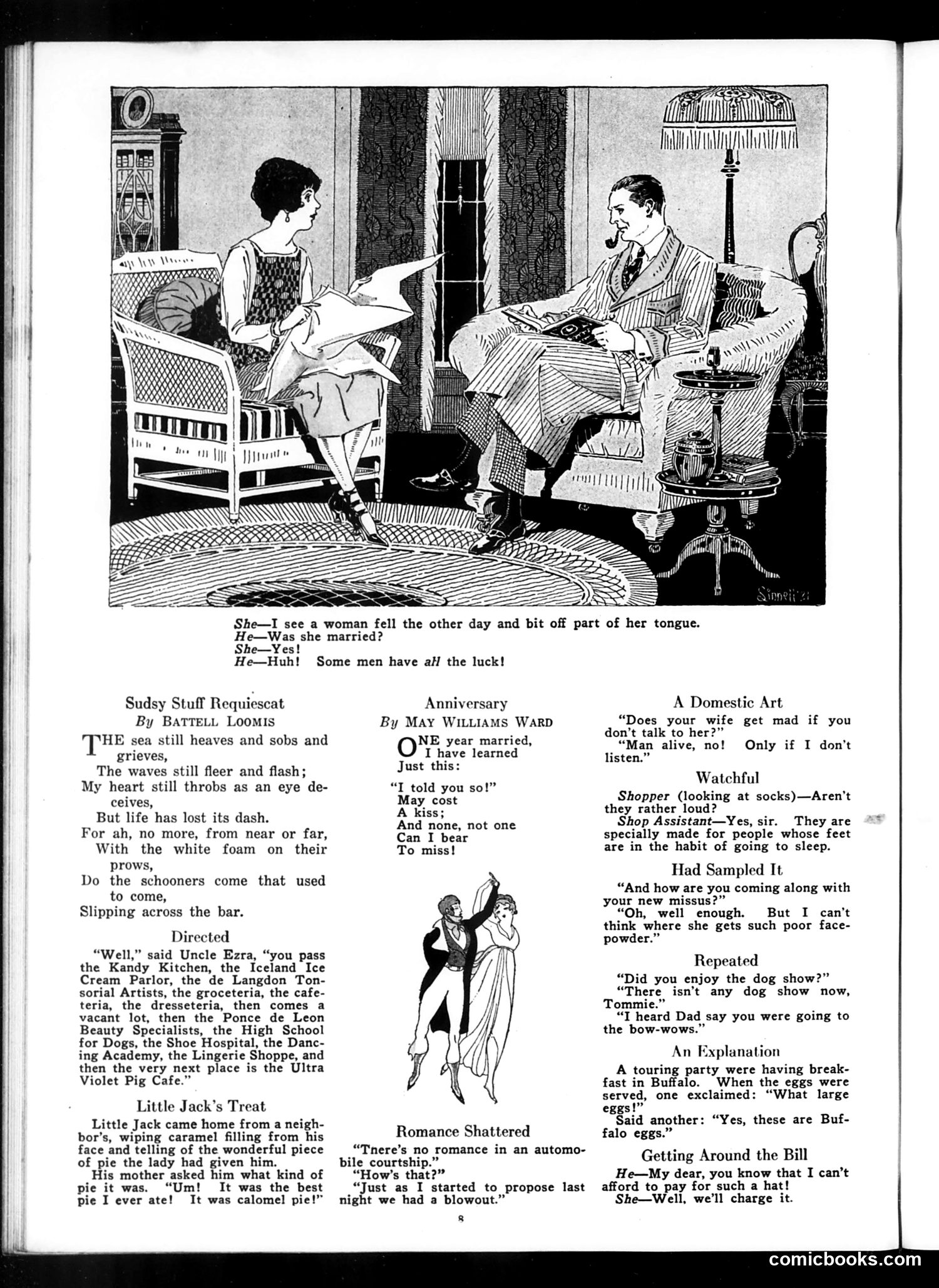
This page from *Judge* contains several short humor pieces typical of early 20th-century American satire. The top cartoon jokes about a married woman biting off part of her tongue in a fall—the humor relies on the stereotype that married women are nagging or quarrelsome, so the man's response ("Huh! Some men have all the luck!") suggests he finds dark amusement in her misfortune. The remaining content comprises brief comic anecdotes and light verse poking fun at domestic life, modern consumer culture, and gender relations. "Directed" satirizes the proliferation of specialized shops (beauty parlors, cafeterias, dance academies) in contemporary America. "Little Jack's Treat" plays on a child's mispronunciation of "calomel" (a laxative) as "calomel pie." Other pieces mock wives' spending habits, marital communication, and urban life. The humor is gentle, sentimental satire aimed at middle-class readers—no overt political content is evident.
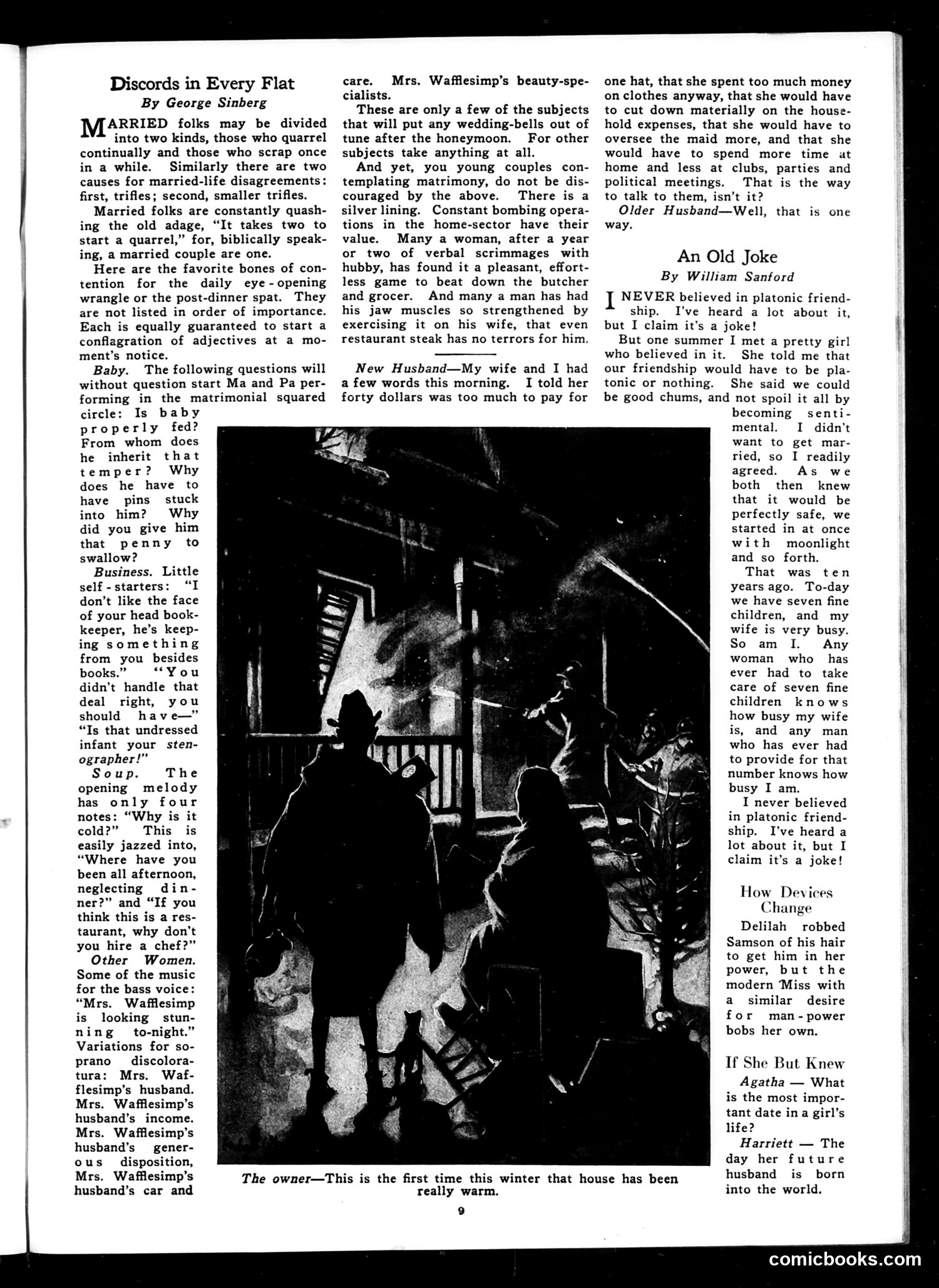
This page from *Judge* magazine presents satirical commentary on married life circa the early 20th century. The main article "Discords in Every Flat" by George Sinberg catalogs common marital arguments—babies, finances, cold soup, jealousy over other women—treating them as inevitable features of marriage rather than serious problems. The accompanying cartoon shows a domestic interior with what appears to be a couple in a heated argument, illustrating these "discords." The caption notes this is "the first time this winter that house has been really warm"—a dark joke suggesting marital quarrels generate heat, both literally and figuratively. Below are two brief anecdotes: "An Old Joke" presents a young man who claims platonic friendship with a woman is impossible, only to end up married with seven children ten years later—the "joke" being that he proved his own cynicism correct. The satire targets both naïve romantic idealism and the inevitability of conventional marriage outcomes.
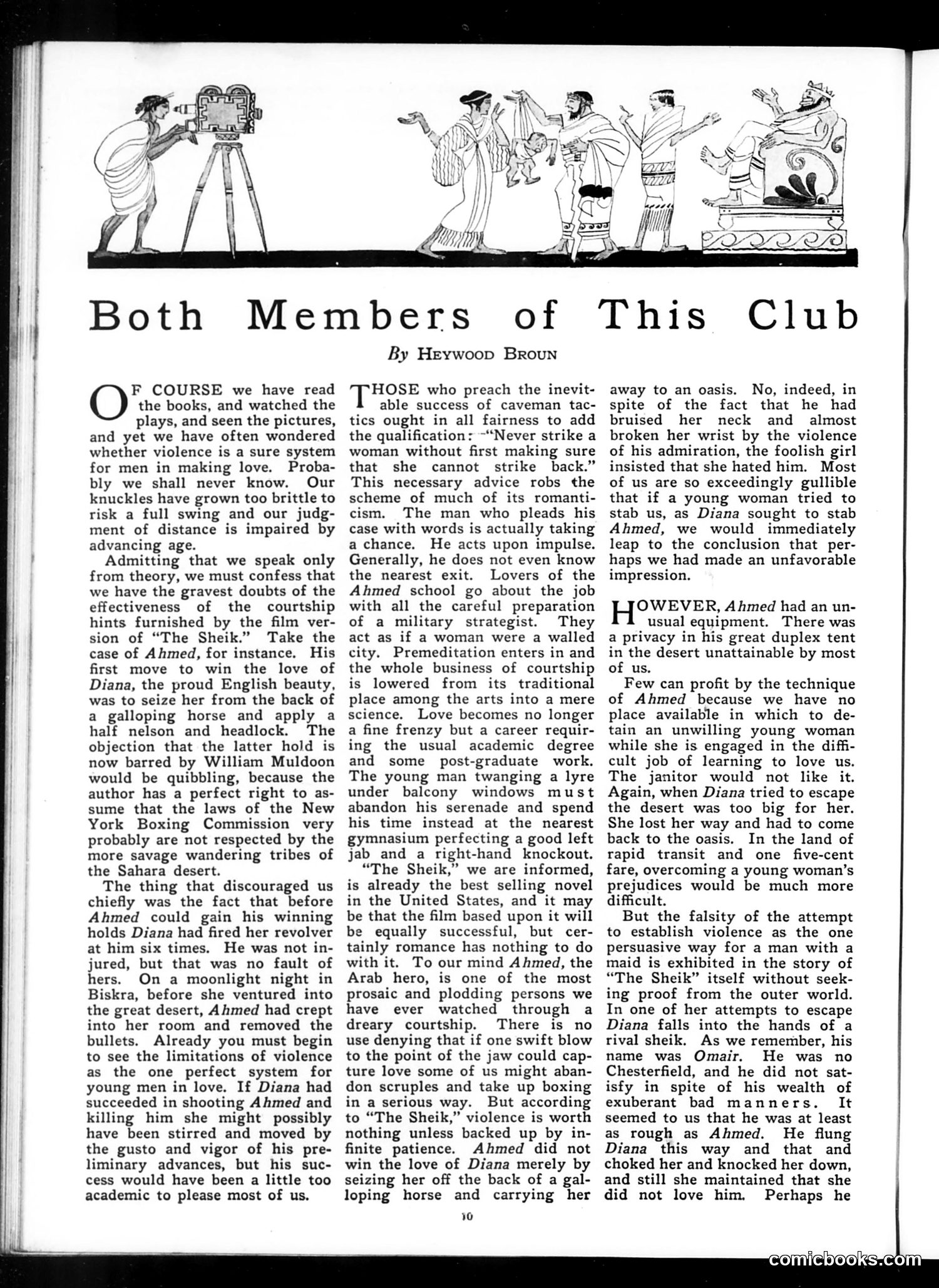
This piece by Heywood Broun satirizes *The Sheik*, a wildly popular 1921 novel (and film adaptation) about an Arab man named Ahmed who forcibly abducts an English woman named Diana into the desert. The cartoon's header depicts a film production scene, establishing the context of cinema's influence on romance narratives. Broun's essay mocks the book's endorsement of violent courtship tactics. He argues that Ahmed's method—kidnapping Diana by seizing her from a horse, applying wrestling holds—is presented as romantic but is actually impractical and counterproductive. He notes that Diana initially shoots at Ahmed six times (foiled only because he'd removed her bullets), highlighting the absurdity of promoting physical force. The satire targets both the novel's logic and society's uncritical consumption of it. Broun points out that successful romance in *The Sheik* requires not spontaneous passion but calculated military strategy—reducing love to a "science" requiring "academic degree and post-graduate work." The critique is fundamentally about how popular media romanticizes male aggression and female submission.
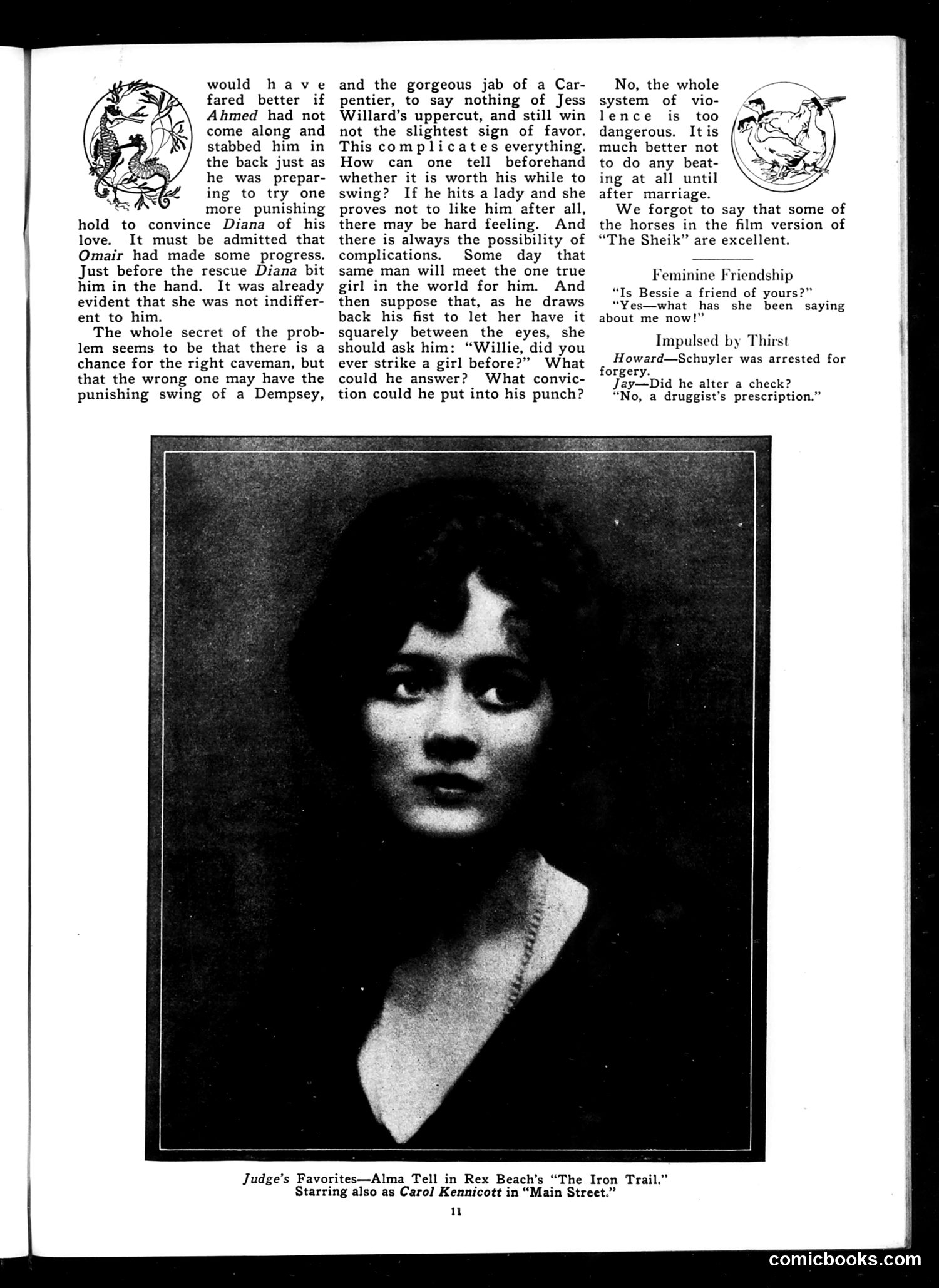
This page satirizes silent film romance tropes, particularly "The Sheik" (a popular 1921 film). The main article mocks the "caveman" seduction method depicted in movies—where male leads forcibly win women through violence and physical domination. The satire's point: such tactics are impractical in real life. If a man strikes a woman and she dislikes him, complications ensue. The piece absurdly concludes that violence should be reserved *for after marriage*—darkly satirizing both film conventions and contemporary attitudes toward marital relations. The page also includes brief humor items: one about female friendship's backhanded compliments, another about a man arrested for altering a druggist's prescription (implying intoxication rather than forgery). The photograph promotes actress Alma Tell in "The Iron Trail" and "Main Street" adaptations. The overall tone critiques how cinema romanticizes aggressive male behavior as desirable courtship.
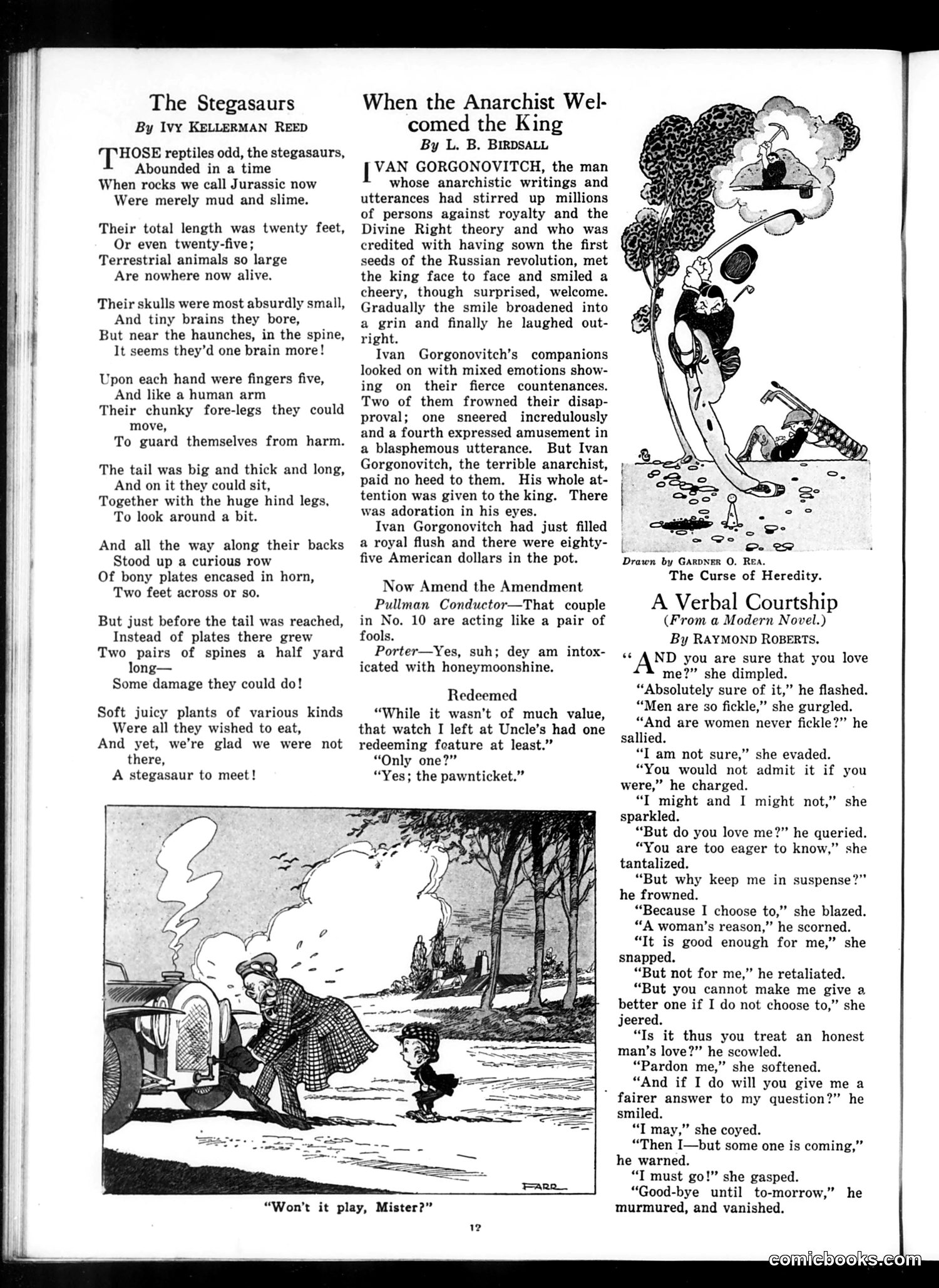
This page contains three satirical pieces reflecting early 20th-century American concerns: **"When the Anarchist Welcomed the King"** mocks anarchist ideology by revealing Ivan Gorgonovitch—a fierce revolutionary credited with fomenting Russian revolution—is actually distracted by a poker game with a royal flush and $85 in the pot. The satire suggests anarchists' grand political rhetoric masks petty self-interest and that ideological fervor crumbles before personal gain. **"Now Amend the Amendment"** jokes about newlyweds acting like fools, with a porter's dialect humor suggesting they're intoxicated on "honeymoonshine"—a pun on prohibition-era concerns. **"The Curse of Heredity"** parodies overwrought romantic dialogue from contemporary novels, where every utterance is tagged with theatrical emotion words ("dimpled," "flashed," "gurgled"). The satire targets the affected sentimentality of popular fiction. "The Stegosaurs" is merely educational poetry about prehistoric creatures, unrelated to satire.
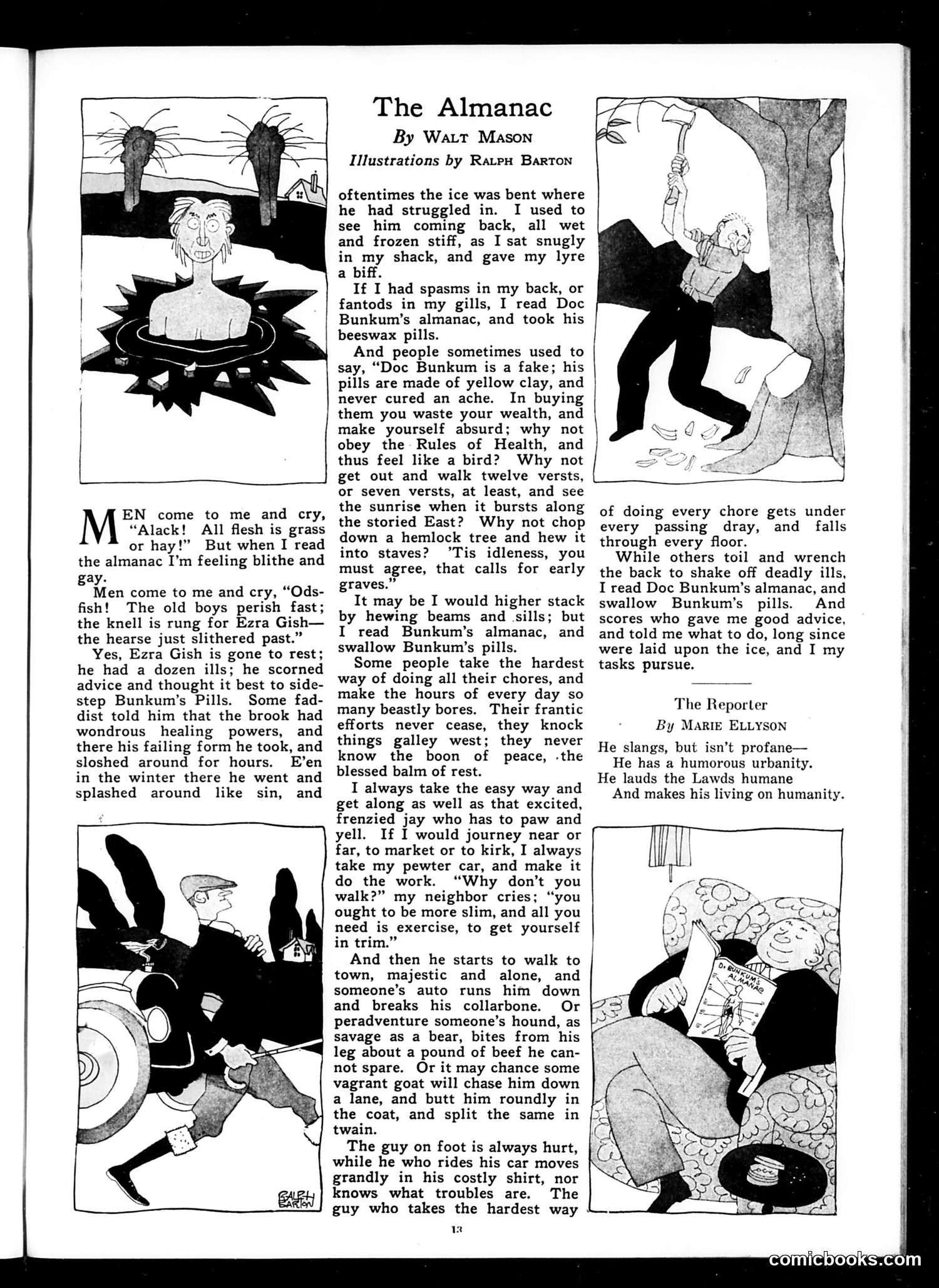
This page satirizes two contrasting philosophies: lazy shortcuts versus rigorous self-improvement. **"The Almanac"** (by Walt Mason, illustrated by Ralph Barton) mocks the popular belief in patent medicine "almanacs" and quack remedies. The narrator represents the lazy everyman who swallows "Bunkum's Pills" (likely referencing real patent medicine scams) and avoids exercise, while his well-meaning neighbor who walks everywhere gets hit by cars, bitten by dogs, or gored by goats. The joke: the lazy man survives through pure luck, while the health-conscious man suffers. The poem ironically validates laziness and quackery as superior to the genuine "Rules of Health." **"The Reporter"** (by Marie Ellyson) appears to be a brief character sketch praising a reporter's wit and humanitarian values beneath his slangy speech. The satire targets the era's widespread faith in patent medicine advertisements and almanacs—genuinely misleading commercial products that promised miraculous cures while mocking legitimate health advice.
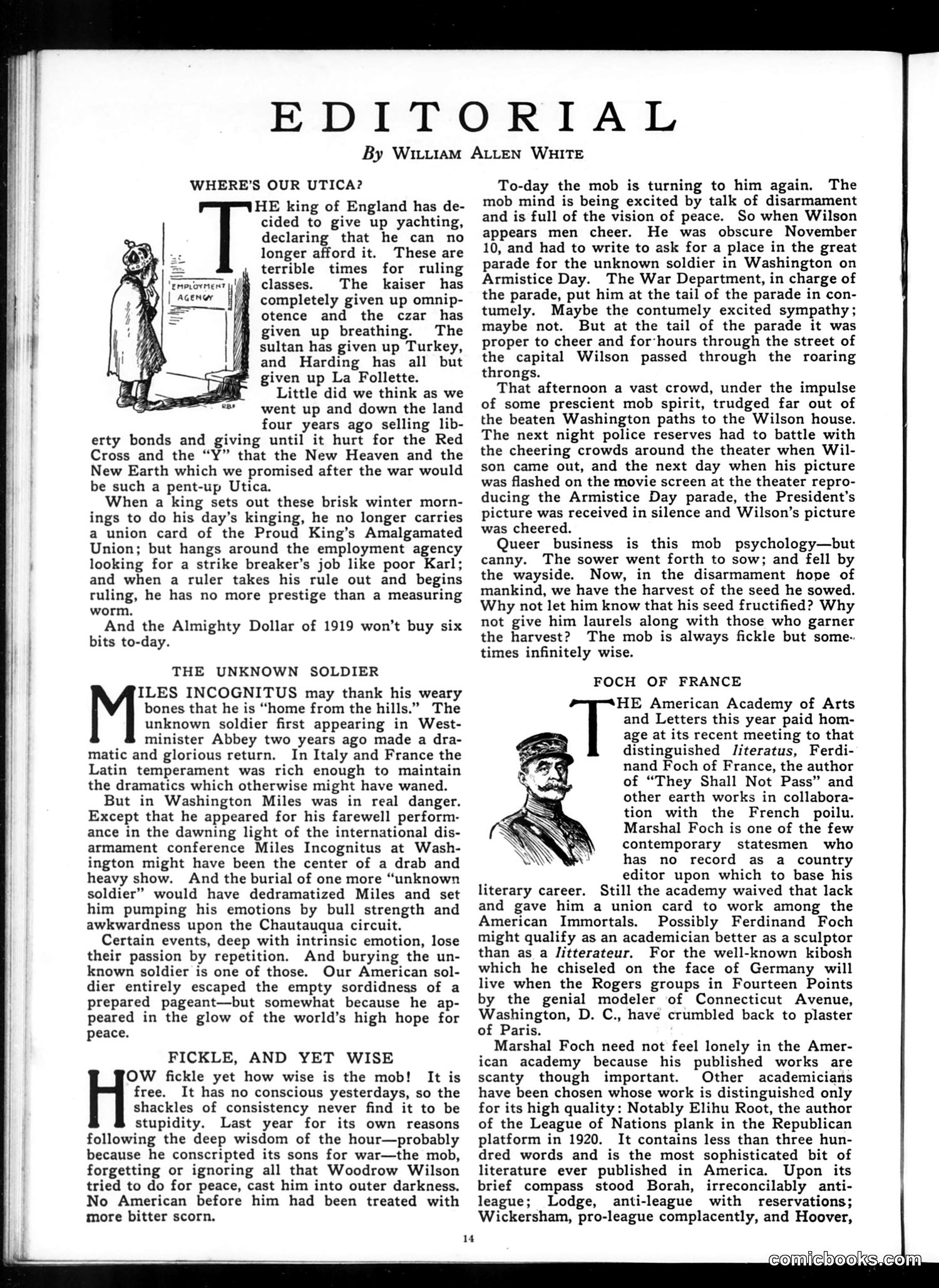
This editorial page by William Allen White satirizes post-WWI disillusionment. The cartoon depicts a figure labeled "EMPLOYMENT AGENCY" showing how monarchs and rulers—including England's king, the kaiser, the czar, and the sultan—have lost their power and prestige after the war, now seeking ordinary jobs like "strike breaker." White's main target is the broken promises of 1919. Americans sacrificed enormously (selling liberty bonds, donating to Red Cross) believing the war would create a utopian "New Heaven and New Earth," but instead got what he sarcastically calls a "pent-up Utica"—a cramped, disappointing reality where even the dollar has lost value. The editorials also address public fickleness regarding Woodrow Wilson: last year the mob scorned him for the war; now they cheer him for peace advocacy. White observes how the emotionally fickle but ultimately "wise" mob operates without historical memory—a pointed critique of democratic inconsistency.
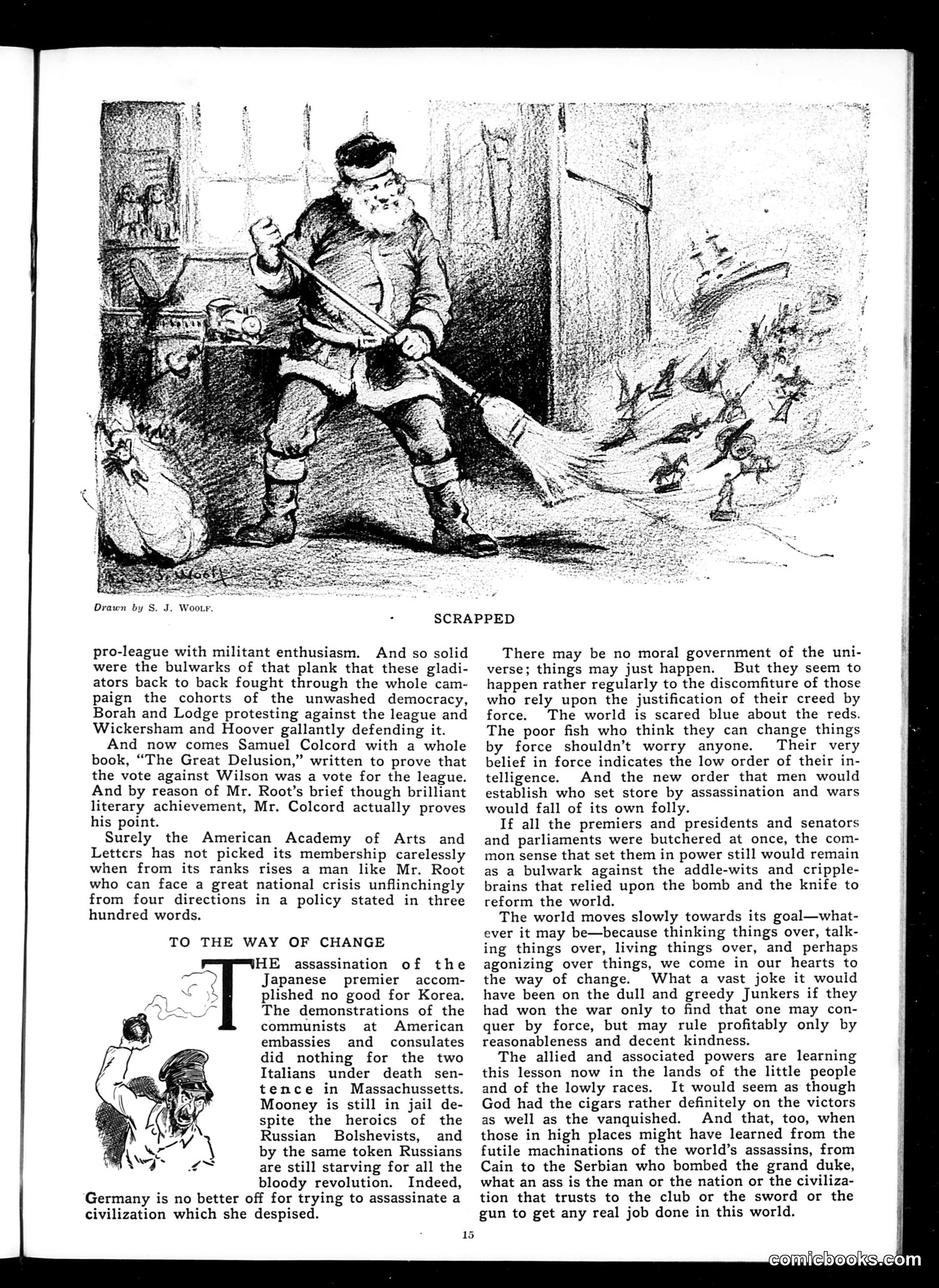
**The Cartoon ("Scrapped"):** Depicts a figure sweeping away tiny armed soldiers and military equipment, symbolizing the futility of military force and violence. **Main Argument:** The editorial attacks those who believe political change can be achieved through assassination and violent revolution. It references recent real events: the Japanese premier's assassination, demonstrations by communists, the imprisonment of Italians (likely Sacco and Vanzetti), labor activist Mooney's jail sentence, and the Russian Revolution—all presented as failures despite their violent methods. **The Point:** The author argues that force—whether assassination, war, or revolution—cannot produce lasting positive change. Only rational deliberation, dialogue, and "reasonableness and decent kindness" create genuine progress. Even military victory (referencing WWI's recent conclusion) proves hollow without moral governance. **Target:** Radical leftists and violent revolutionaries who believe force can remake society. The satire dismisses them as unintelligent and ultimately self-defeating, as history repeatedly demonstrates violence's ineffectiveness.
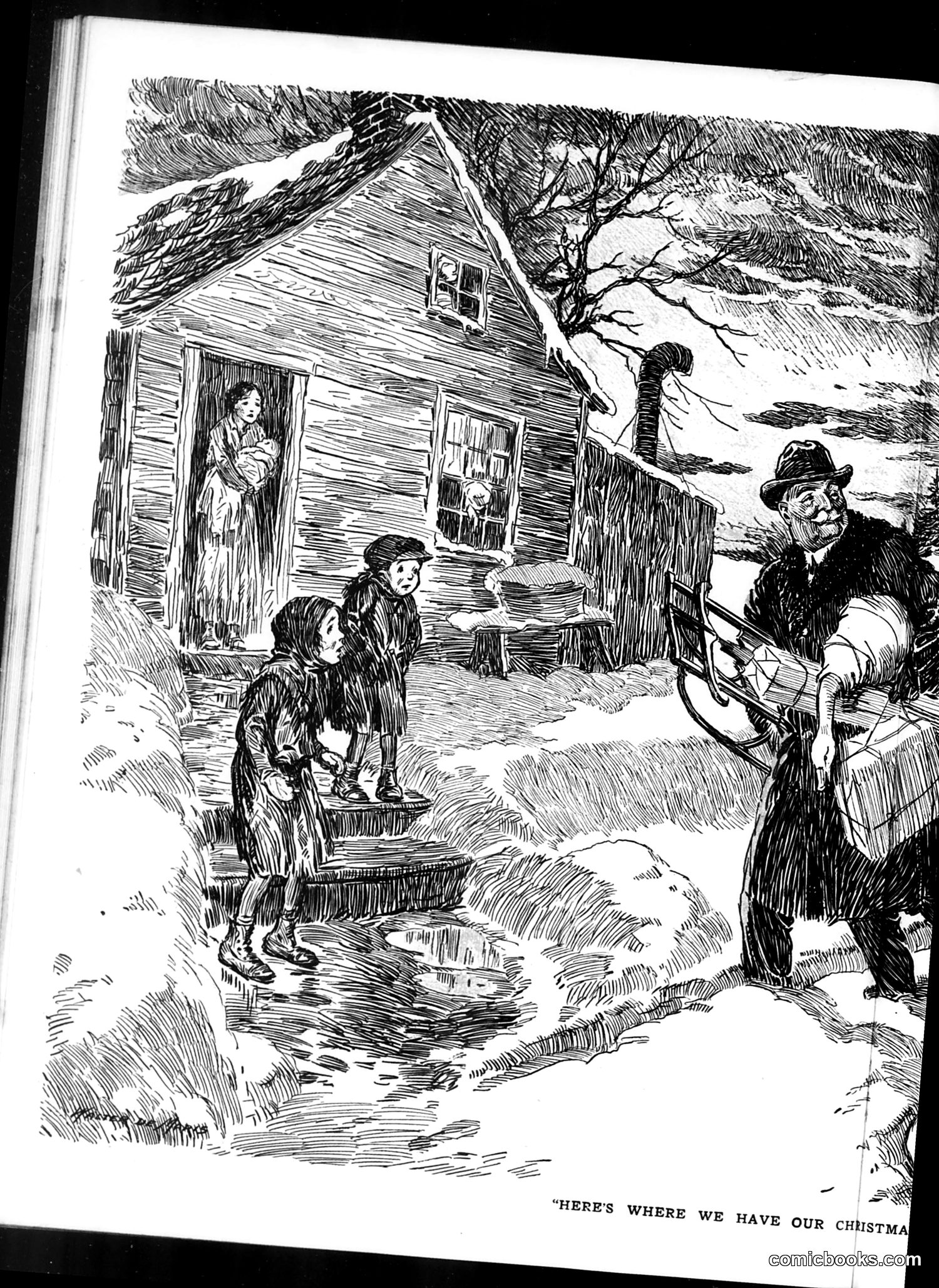
This is a satirical illustration from *Judge* magazine showing a poverty-stricken scene. The caption reads "HERE'S WHERE WE HAVE OUR CHRISTMAS," presenting a stark contrast between the holiday's supposed warmth and the grim reality of poor families. The image depicts two ragged children and an adult (likely parents or guardians) outside a dilapidated cabin in winter, with bare trees and snow. A woman watches from the doorway. The crude dwelling, tattered clothing, and desolate landscape emphasize economic hardship. This appears to be social commentary on Christmas inequality—mocking the sentimentality around the holiday while highlighting that many Americans experienced it in desperate poverty. The satire's target is likely either societal indifference to poverty or perhaps government/wealthy institutions' failure to address it, a common theme in late 19th/early 20th-century *Judge* cartoons.
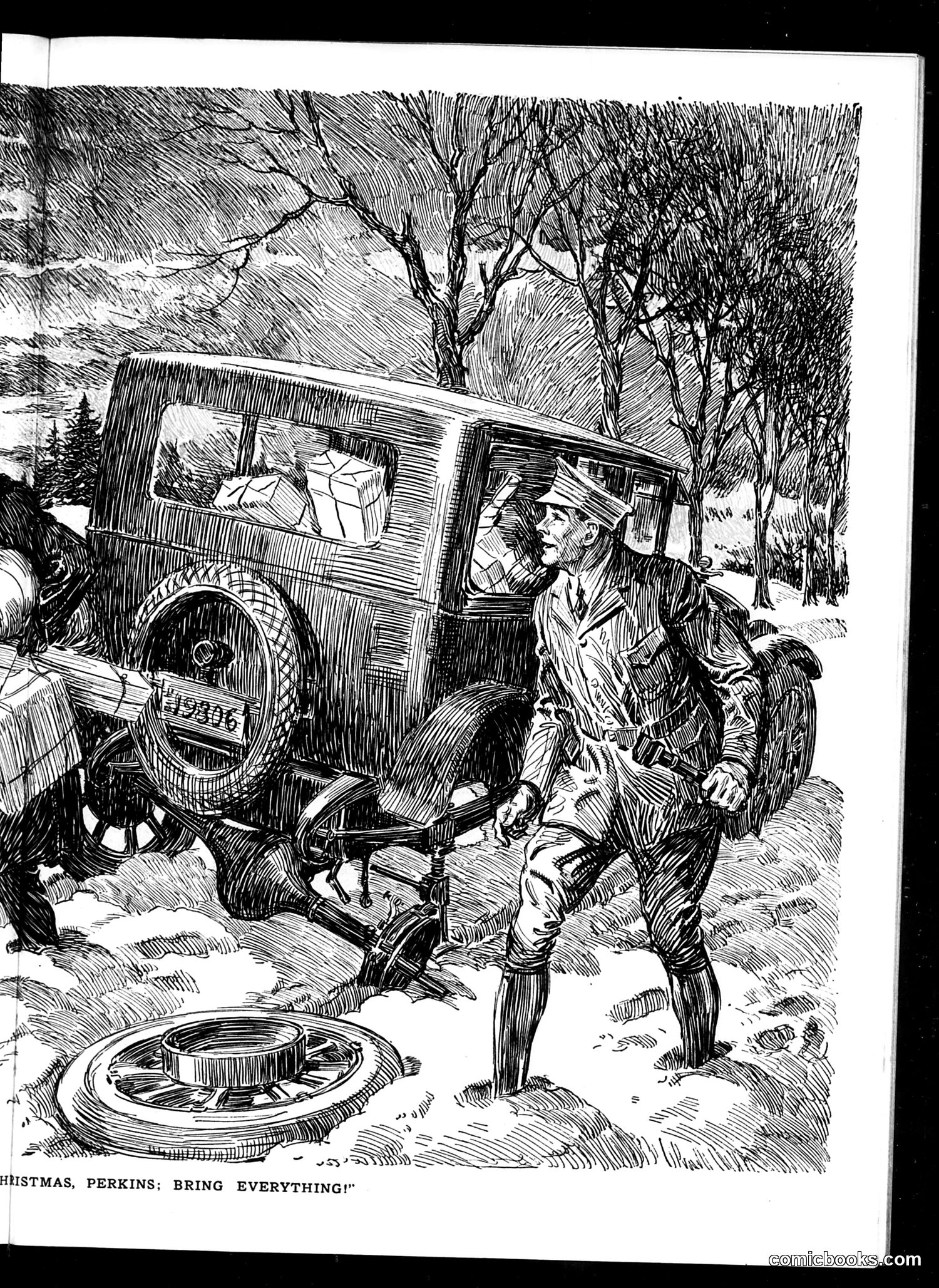
This appears to be a Christmas-themed satirical cartoon from *Judge* magazine. The caption "Christmas, Perkins; Bring Everything!" suggests a scene where someone (likely a wealthy character) is instructing their servant or chauffeur named Perkins to load up an automobile with Christmas purchases. The cartoon satirizes consumerism and materialism during the holiday season, particularly among the wealthy class. The broken wheel visible in the foreground may emphasize the burden or excess of acquiring "everything" for Christmas. The style and setting suggest early-to-mid 20th century, when automobiles were still relatively novel and class distinctions were sharply depicted in satirical publications. The humor lies in mocking extravagant holiday spending habits.
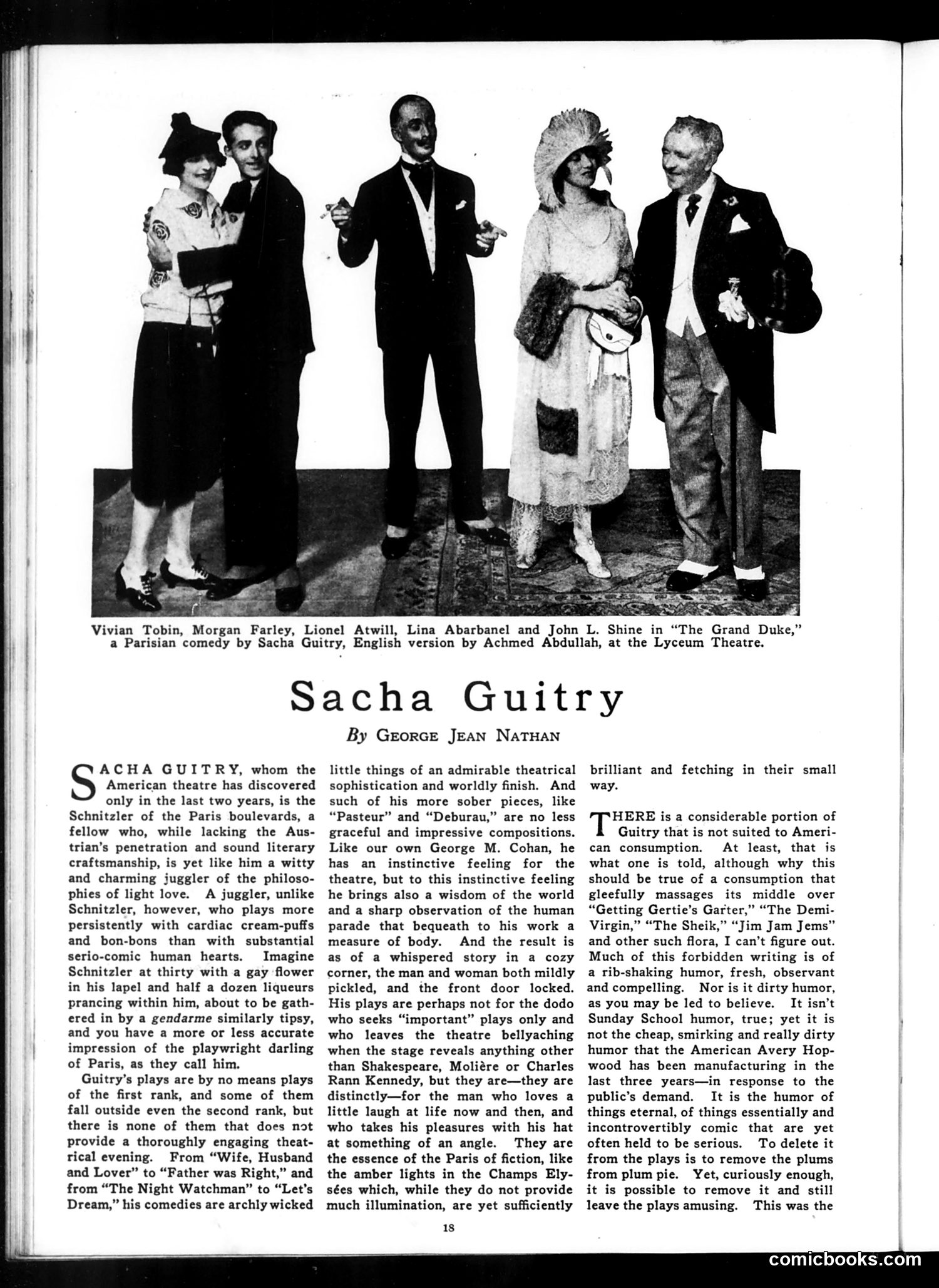
This is not a political cartoon but rather a theatrical feature article and photograph from Judge magazine profiling French playwright Sacha Guitry. The image shows five actors from his play "The Grand Duke" at the Lyceum Theatre. Critic George Jean Nathan argues that Guitry—whom American theatre has recently discovered—is a witty, charming writer of light comedies about romance and human nature, comparable to Austrian playwright Schnitzler. Nathan praises Guitry's theatrical instinct and worldly sophistication, though acknowledges his plays aren't of the "first rank." Nathan notes that some of Guitry's "forbidden" French humor—dealing with adultery and sexual situations—was considered unsuitable for American audiences, though he finds it fresher and less genuinely vulgar than American playwright Avery Hopwood's work. The article suggests that even with risqué content removed, Guitry's plays remain amusing.
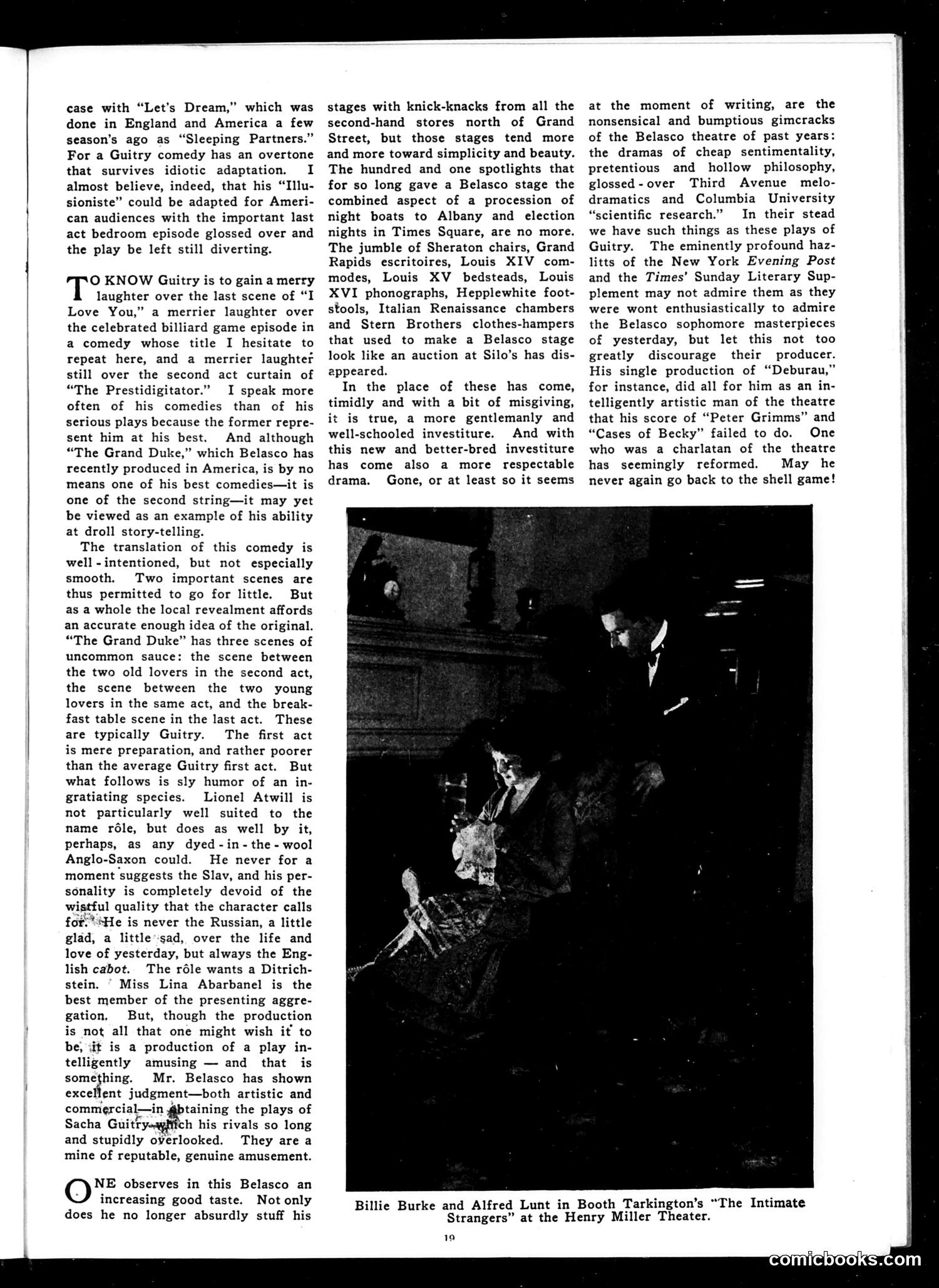
This page is primarily **theater criticism**, not political satire. The author reviews David Belasco's production of Sacha Guitry's French comedy "The Grand Duke" at the Henry Miller Theatre. The accompanying photograph shows **Billie Burke and Alfred Lunt** in a different Guitry play, "The Intimate Strangers," providing performance context. The critic praises Belasco's recent artistic evolution: moving away from cluttered, ostentatious stage design (excessive spotlights, mismatched furniture from junk shops—"Grand Rapids escritoires, Louis XIV commodes") toward elegant simplicity. This represents a shift toward more respectable, refined theatrical taste. The review critiques actor Lionel Atwill as miscast (too Anglo-Saxon, lacking the melancholic Slavic qualities the role requires) and praises Lina Abarbanel's performance. Overall, the critic views the production as "intelligently amusing" despite imperfect translation and casting—a respectable example of Belasco's improved judgment in adapting Guitry's comedies.
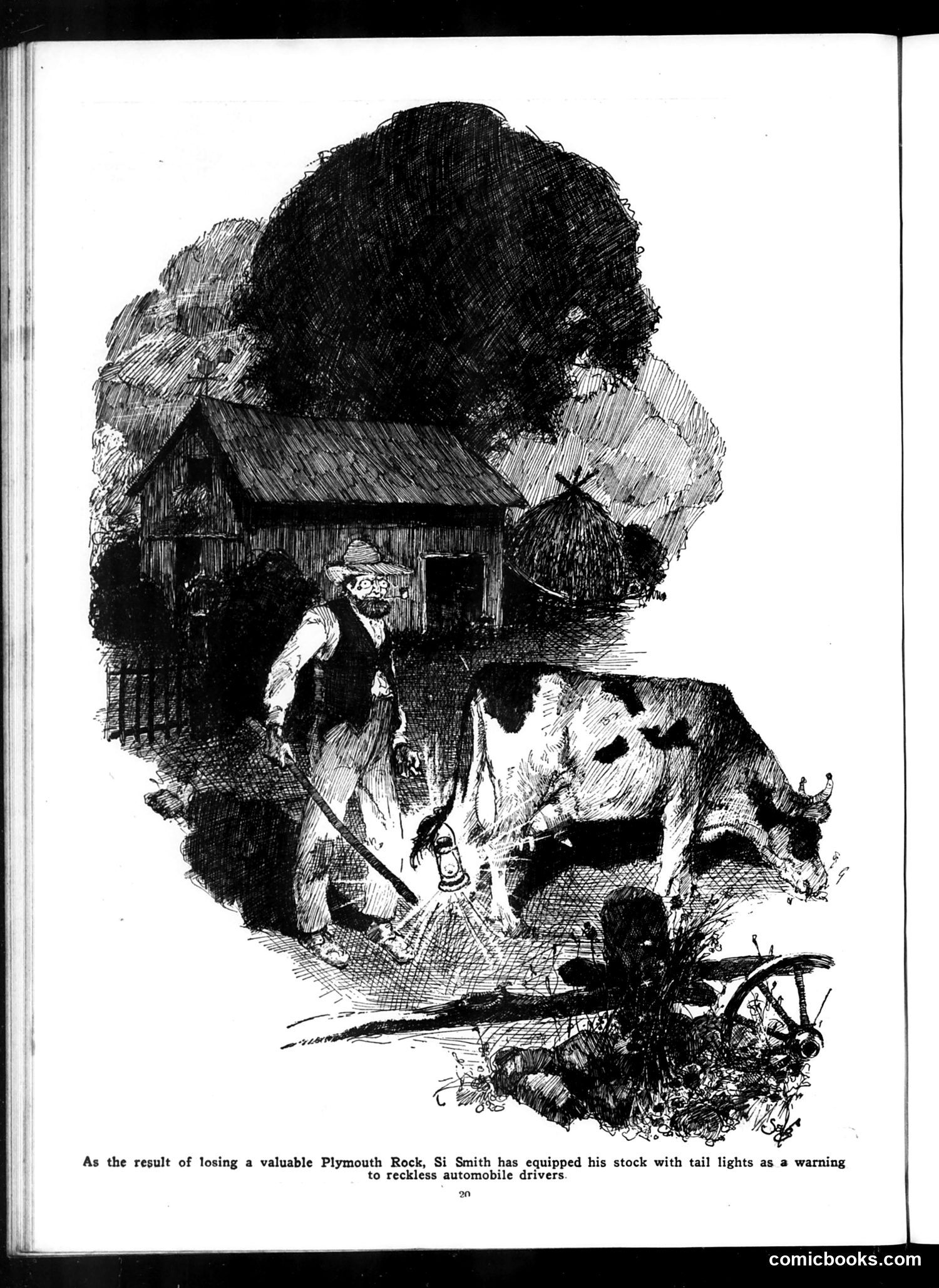
This single-panel cartoon satirizes early automobile safety concerns. A farmer named Si Smith, having lost livestock (apparently to a hit-and-run incident involving a valuable animal), has responded by literally installing tail lights on his remaining cattle as a warning device to drivers. The joke operates on multiple levels: it mocks both reckless drivers who endanger farm animals and the farmer's impractical solution. The image shows a rural homestead with a cow equipped with what appears to be a lantern or light fixture, illustrating the absurd literal interpretation of vehicle safety practices applied to livestock. This reflects a specific moment when automobiles were new and conflicts between motorists and rural life were frequent and contentious.
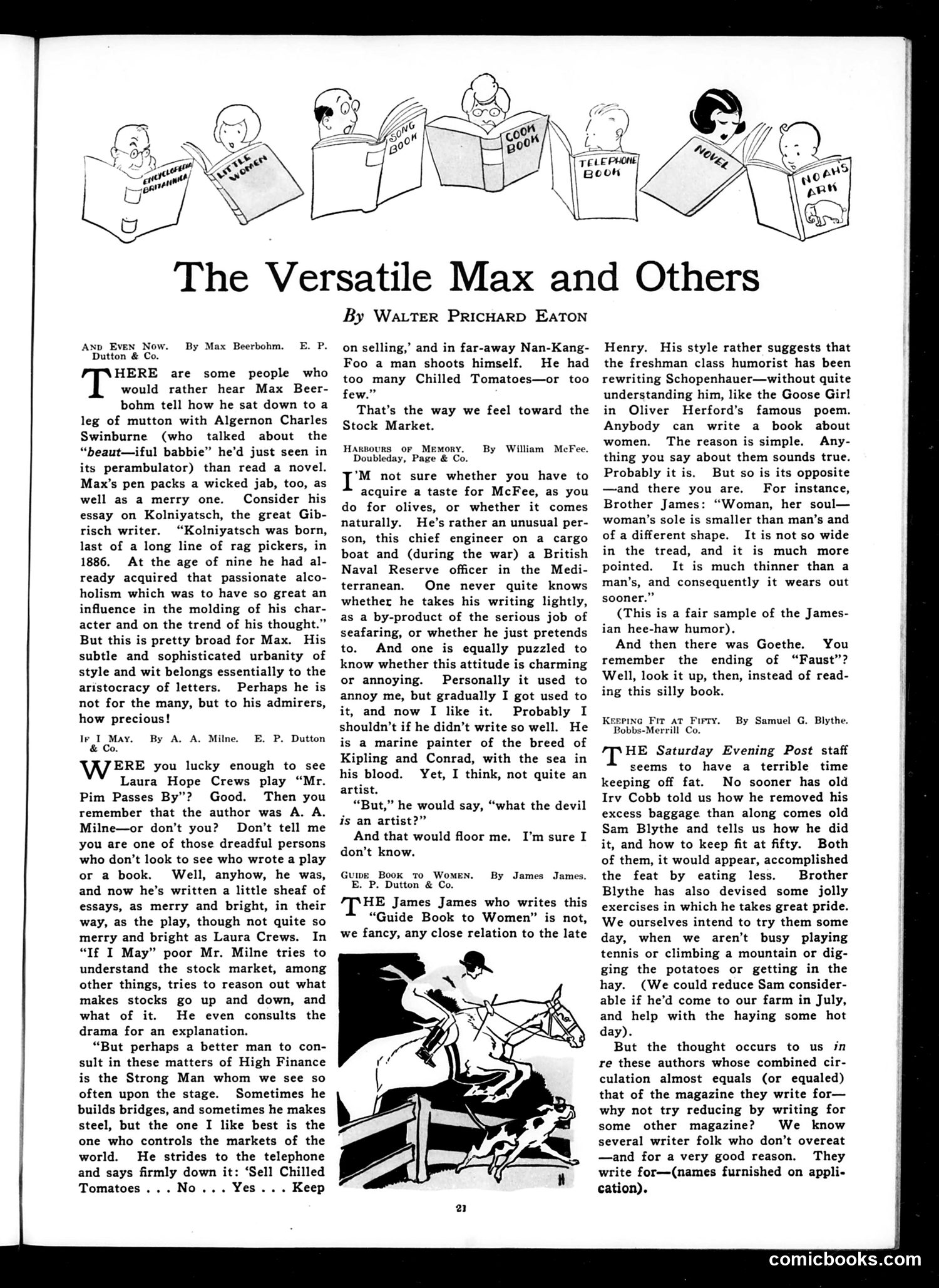
This page contains literary reviews by Walter Prichard Eaton, not political cartoons. The header illustration shows various readers with different books, humorously depicting diverse reading preferences. The reviews discuss four contemporary books: 1. **Max Beerbohm's essays** - praised for witty, sophisticated style appealing to literary elites 2. **A.A. Milne's essays** - humorous attempts to understand stock markets and finance, with the reviewer using Milne's joke about controlling tomato sales to satirize how absurdly stock markets respond to trivial news 3. **William McFee's maritime memoir** - examining whether his casual writing style masks serious artistry 4. **James James's "Guide Book to Women"** - mocked as freshman-level humor suggesting anything said about women sounds true because its opposite is equally true The satire targets both the books' subjects (stock market irrationality, gender stereotypes) and literary pretension. This reflects 1920s urban sophistication about finance, literature, and gender relations.
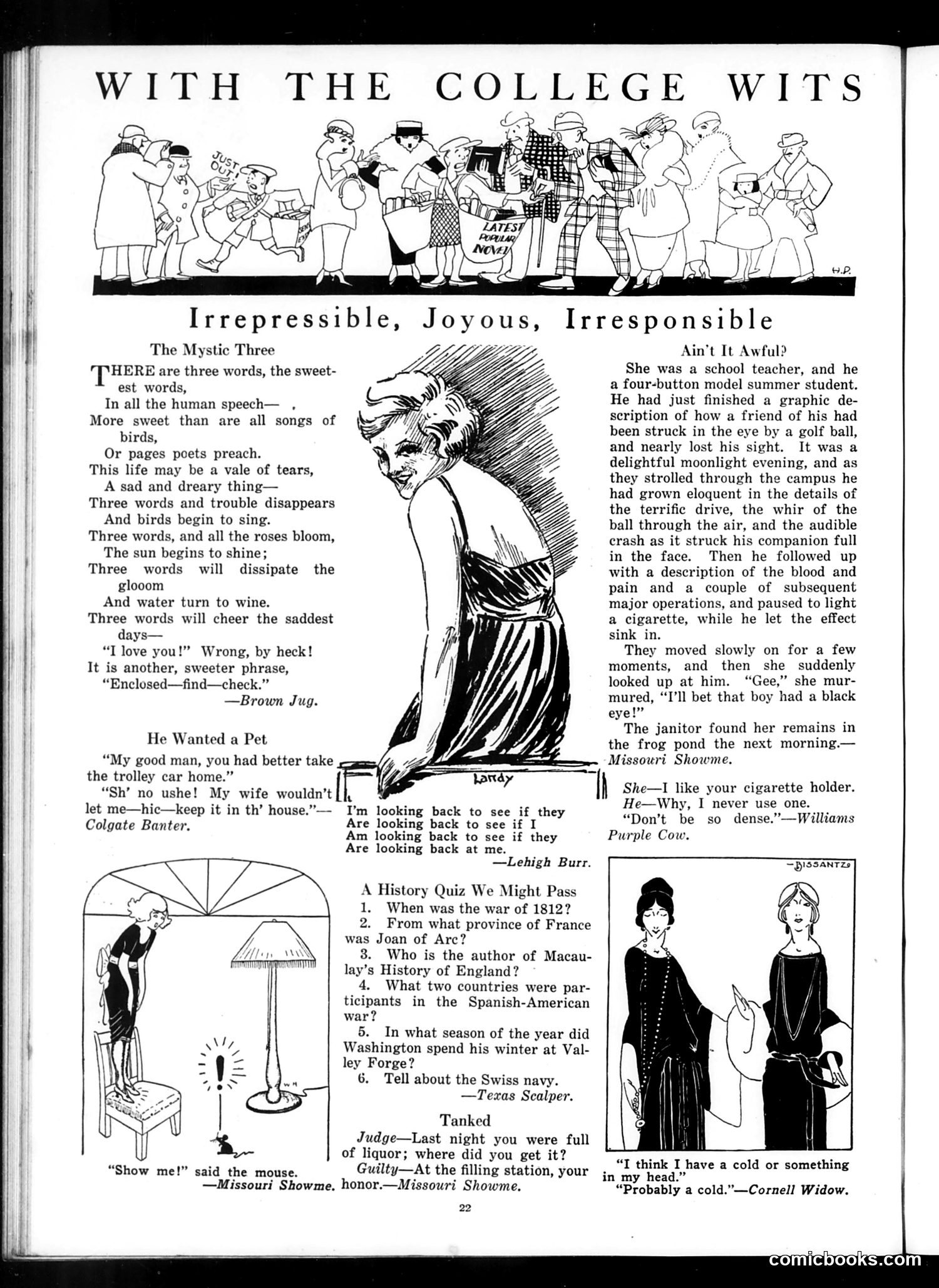
This page collects humorous college-themed content. Key items include: **"The Mystic Three"** (poem): Satirizes sentimentality by claiming the three sweetest words are "Enclosed—find—check" (money) rather than romantic declarations. It's satirizing both romantic clichés and the practical materialism of modern life. **"Ain't It Awful?"** (story): A dark joke about a school teacher and student on campus. He bores her with a graphic story about a golf accident; she responds with apparent sympathy but is actually mocking him ("I'll bet that boy had a black eye!"), implying he *received* the injury, not witnessed it. The punchline—she's found dead in a pond—suggests frustrated homicide. **Other sketches** mock various college behaviors: drunkenness ("Tanked"), courtship posturing ("Looking back to see"), and the absurdity of history trivia quizzes. The overall tone reflects Jazz Age satire targeting college culture, youth behavior, and romantic pretense among the educated classes.
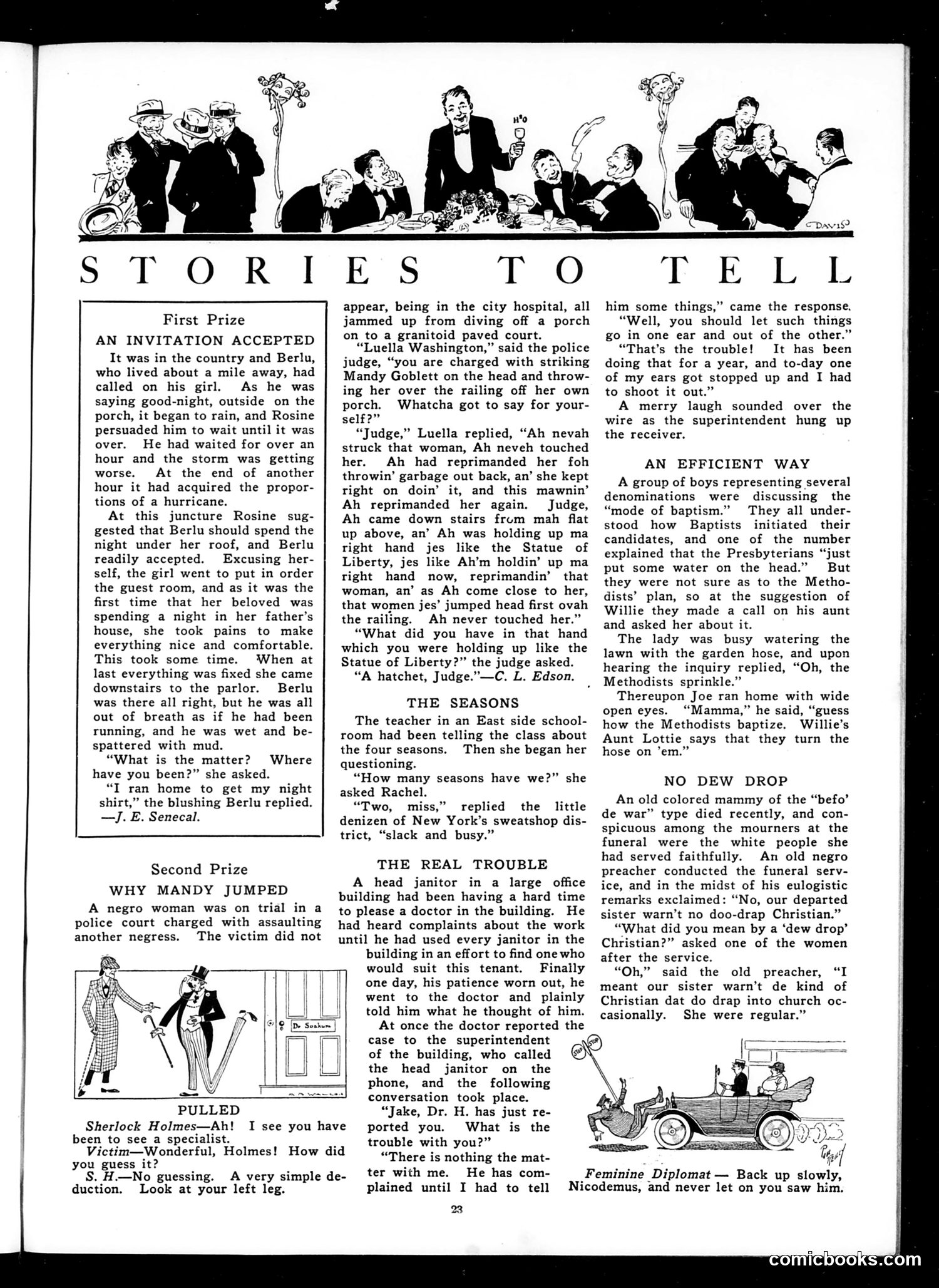
This page contains three humorous short stories typical of Judge magazine's satirical humor: **"An Invitation Accepted"** (First Prize): A simple romantic farce where a young man, caught in a rainstorm at his girlfriend's house, runs home in the rain to retrieve his nightshirt—suggesting improper overnight intentions that scandalize the era's moral sensibilities. **"Why Mandy Jumped"** (Second Prize): A racist caricature depicting Black women in a police court. A defendant claims she merely held up her hand "like the Statue of Liberty" while scolding another woman—but reveals she was holding a hatchet, darkly implying the victim's injuries were self-inflicted. The humor relies on offensive dialect and stereotypes. **Other brief anecdotes**: Include a "Sherlock Holmes" style deduction joke and workplace humor about a janitor and demanding tenant. The cartoons above and throughout use exaggerated drawings typical of the era. The content reflects Judge's focus on class-based, ethnic, and gender humor now considered offensive, alongside more innocent domestic comedy.
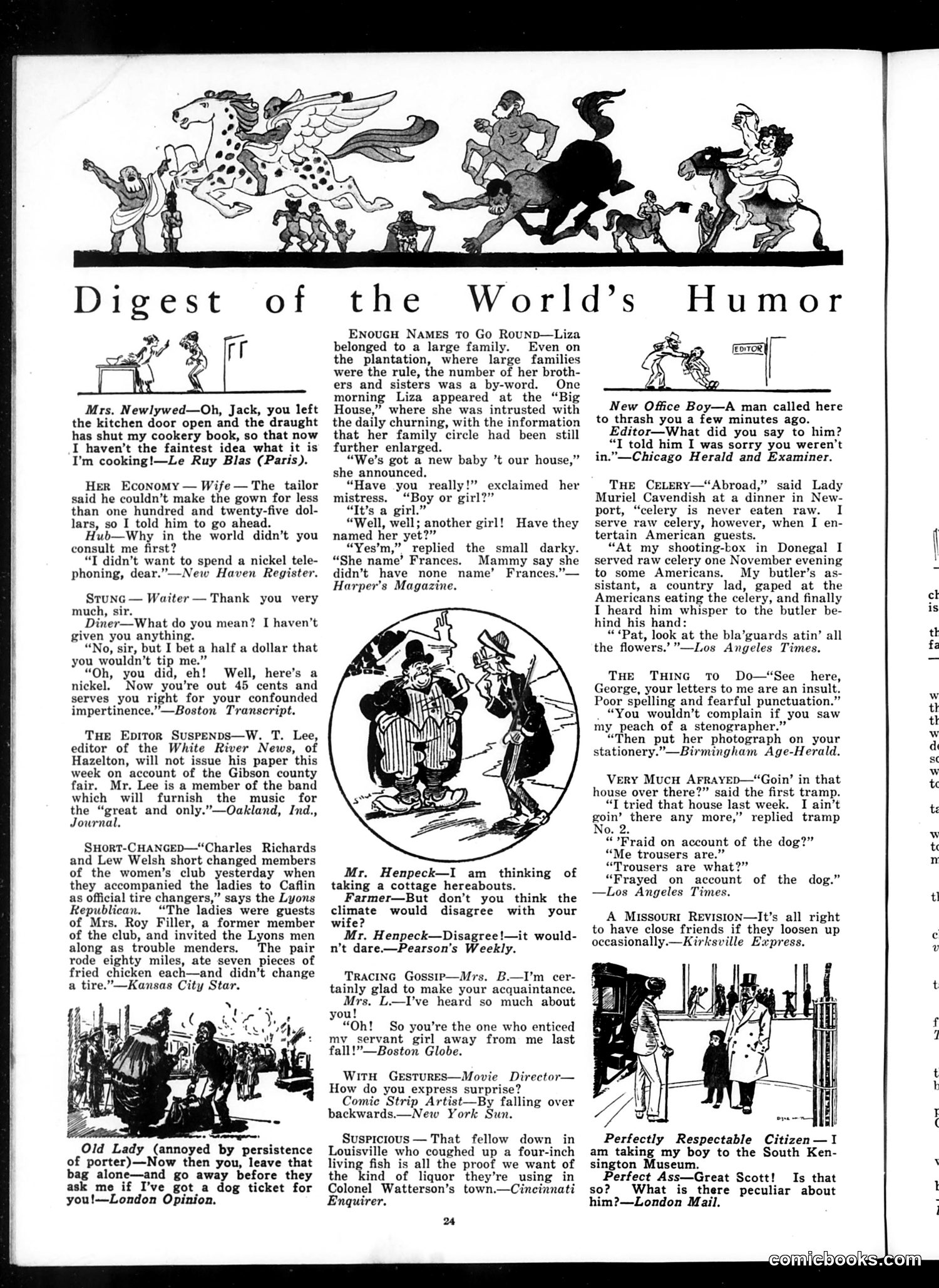
This page collects short humorous anecdotes from newspapers and magazines, organized around domestic and social mishaps typical of early-20th-century life. **Key jokes include:** - **Newlywed incompetence**: A wife can't cook without her cookbook - **Gender/class dynamics**: Women's extravagance vs. marital consultation; servants and tips - **Racial caricature**: "Liza," a Black domestic worker, arrives with news of a new baby named Frances—humor derives from stereotyped speech ("She name' Frances") and the joke that her large family can't remember previous children's names - **Social pretension**: A British lady serves raw celery to American guests, treating it as exotic/uncivilized - **Marriage stereotypes**: "Mr. Henpeck" is hen-pecked by his domineering wife The page reflects period attitudes toward class, gender roles, and racial stereotypes presented as entertainment. The header illustration shows fantastical adventure scenes, contrasting with mundane domestic comedy below.
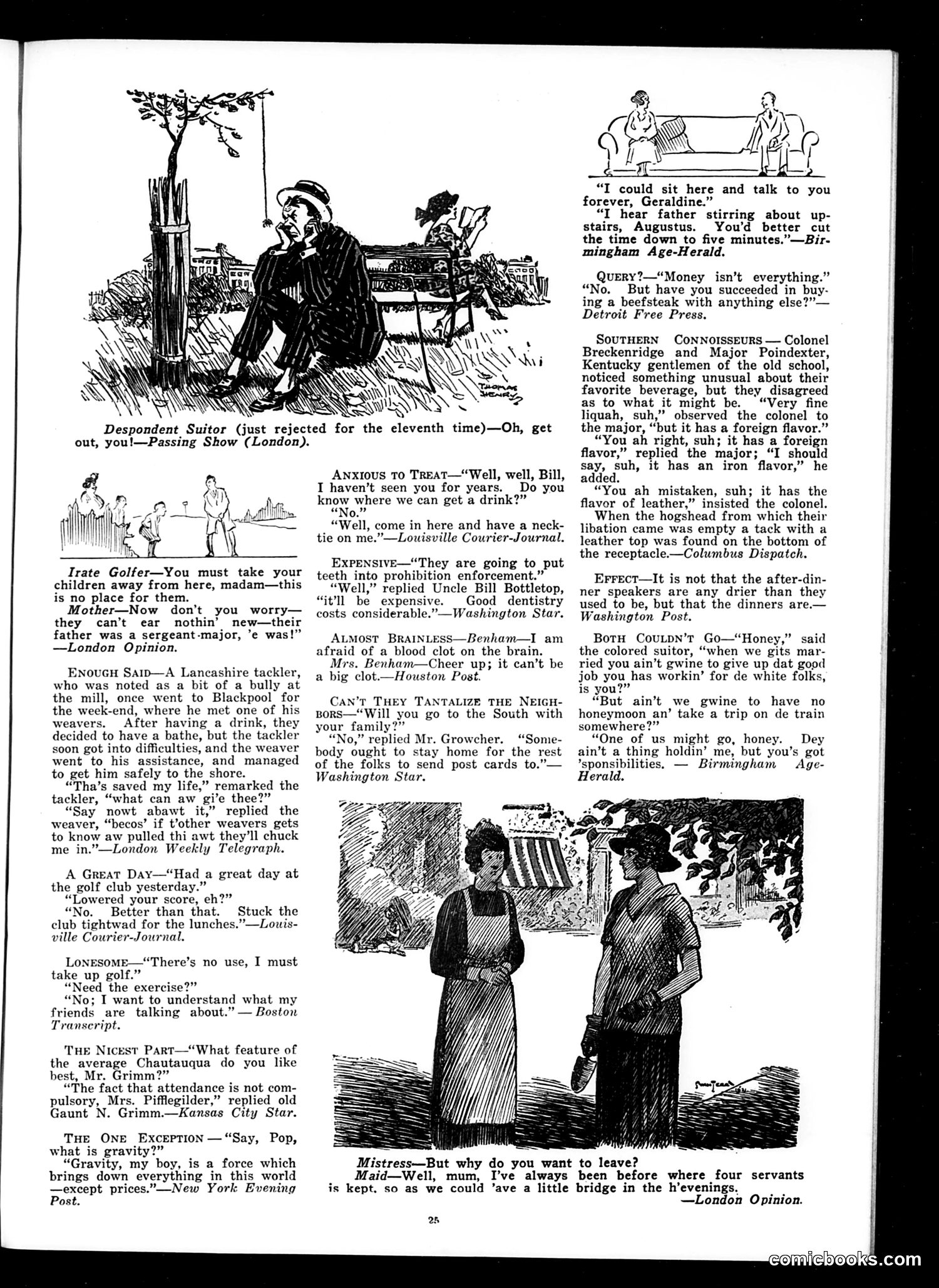
This page from *Judge* magazine contains multiple brief humorous anecdotes mocking various social situations and contemporary issues. **Key satirical themes:** 1. **Class and labor dynamics**: The Lancashire mill story mocks working-class pride—a weaver who saves his boss refuses credit to avoid ridicule from peers. 2. **Prohibition enforcement**: A joke about putting "teeth into prohibition enforcement" plays on dental costs, mocking the difficulty of enforcing Prohibition laws (likely early 1920s context). 3. **Regional stereotypes**: The "Southern Connoisseurs" section uses exaggerated Kentucky dialect to ridicule wealthy Southern gentlemen debating their liquor's "flavor" while unknowingly drinking from a tack-contaminated barrel—satire of both Southern pretension and Prohibition-era bootlegging. 4. **Marital dynamics**: Multiple items mock romance cooling after marriage and romantic inconvenience. 5. **General human folly**: Various jokes target golf obsession, social climbing, and self-deception. The cartoons illustrate social awkwardness and class tensions typical of early 20th-century American humor.
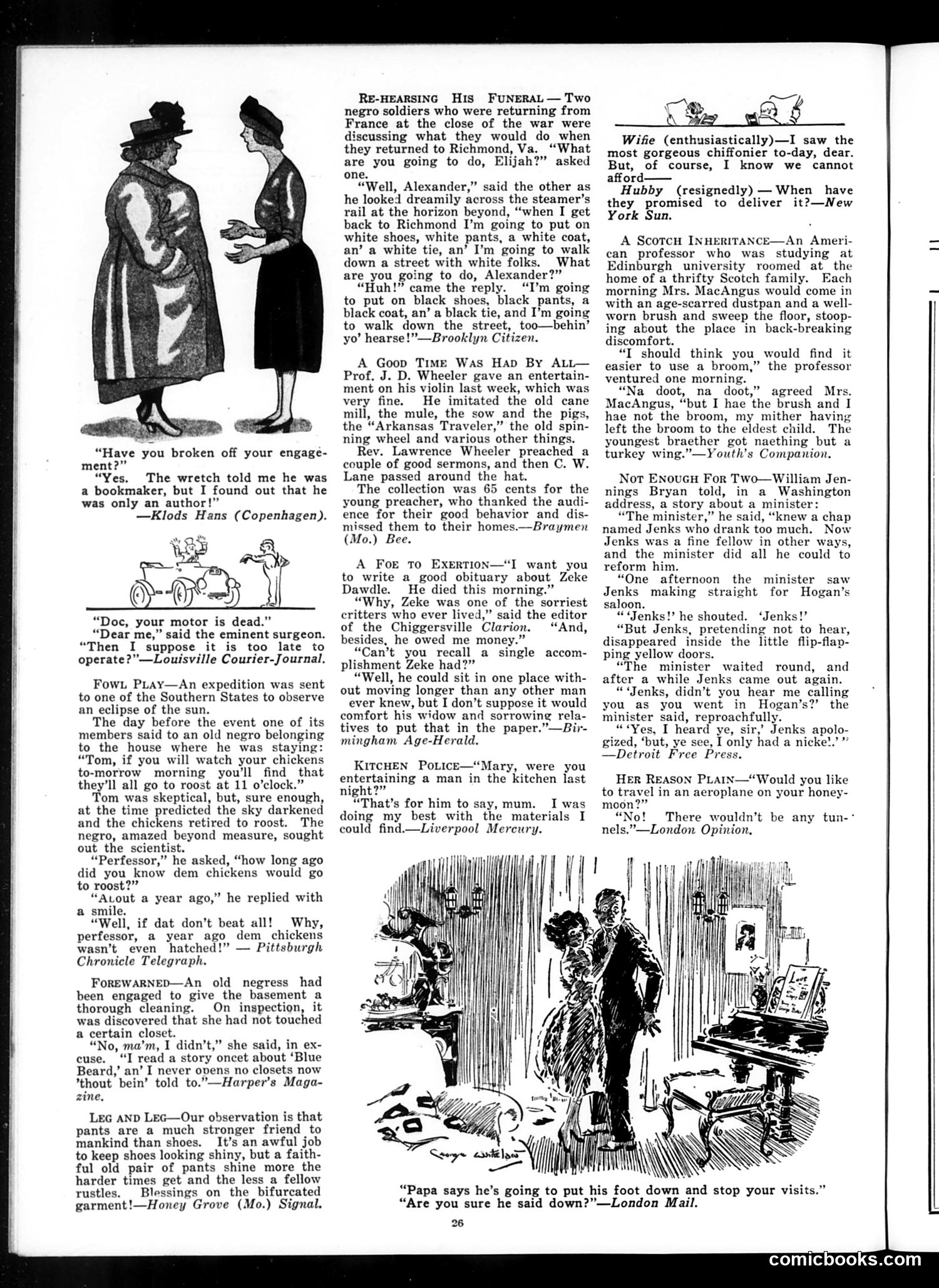
This page from *Judge* contains several brief humorous anecdotes typical of early 20th-century American satirical magazines: **Key Content:** The most historically significant piece is "Re-hearsing His Funeral," a racist joke about two Black soldiers returning from WWI France. One describes dressing in all white clothing to walk with white people in Richmond, Virginia; the other responds he'll dress in black and follow behind as the first man's "hearse"—implying the first man will be killed for such behavior. This darkly satirizes Jim Crow segregation and the violence Black Americans faced, particularly veterans returning from fighting for their country. Other anecdotes mock rural life, small-town newspapers, and include wordplay (a surgeon operating on a dead "motor"/car). One features a "negress" character referencing the Bluebeard folklore. **Context:** These pieces reflect *Judge's* reliance on ethnic/racial humor and small-town Americana stereotypes common in early 20th-century American publications—content that would be considered deeply offensive today.
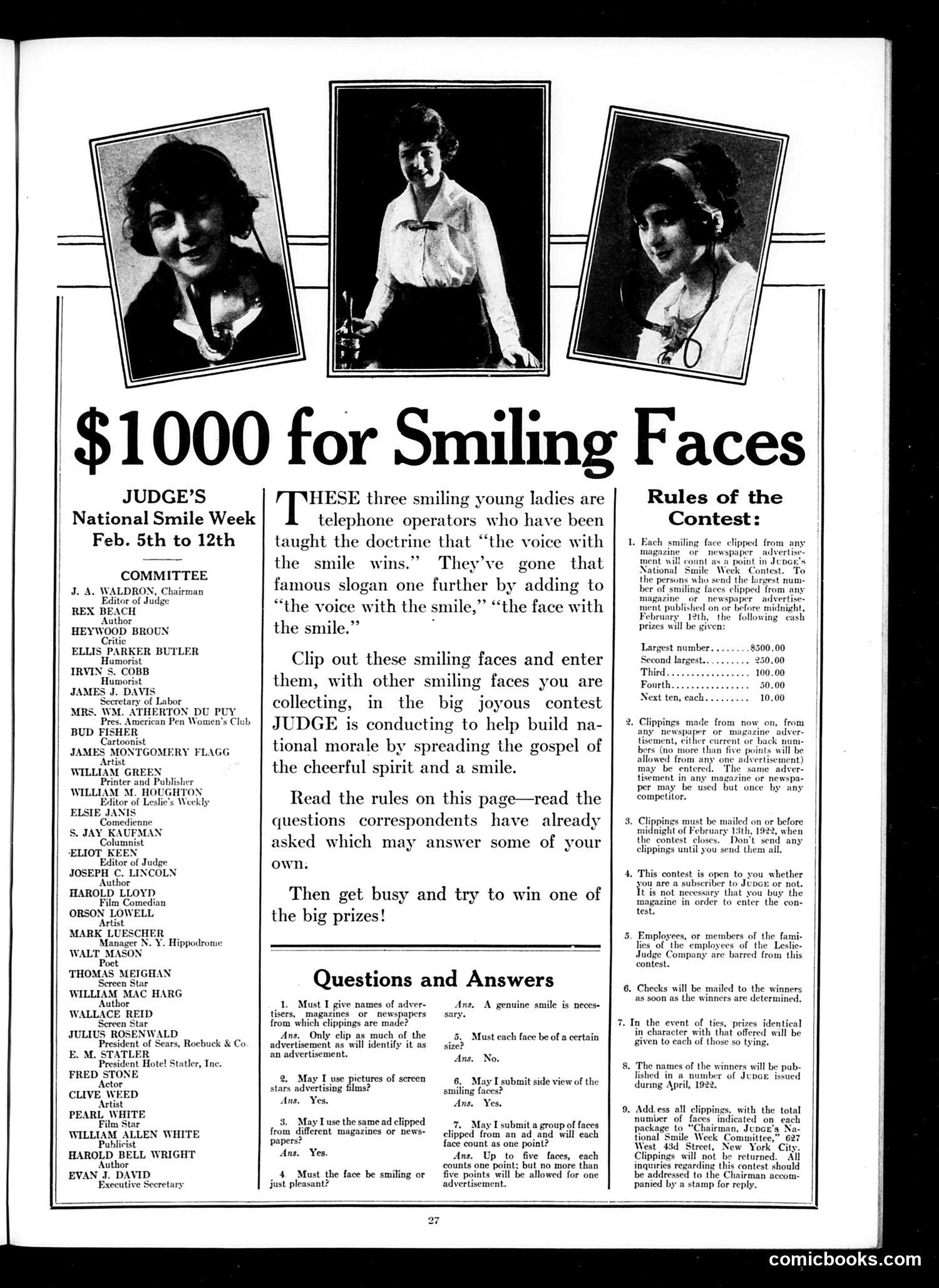
This page promotes **Judge's National Smile Week** (February 5-12), a morale-building initiative featuring a contest where readers clip smiling faces from advertisements and compete for cash prizes ($300 down to $10). The three photographs show telephone operators—women chosen to exemplify the contemporary business slogan "the voice with the smile wins." The contest extends this idea to faces, positioning smiling as both patriotic duty and competitive sport. The committee lists prominent early 20th-century figures (authors, film stars, cartoonists), lending prestige to what appears as earnest civic promotion. However, for modern readers, this reads as quaint: the notion that mass-clipping smiling faces from ads and submitting them would meaningfully boost "national morale" reflects pre-Depression optimism and reveals period attitudes about manufactured cheerfulness as social medicine. The detailed rules suggest this was a serious editorial undertaking, though its underlying premise—that collecting and rewarding images of smiles improves society—seems satirically naive in retrospect.
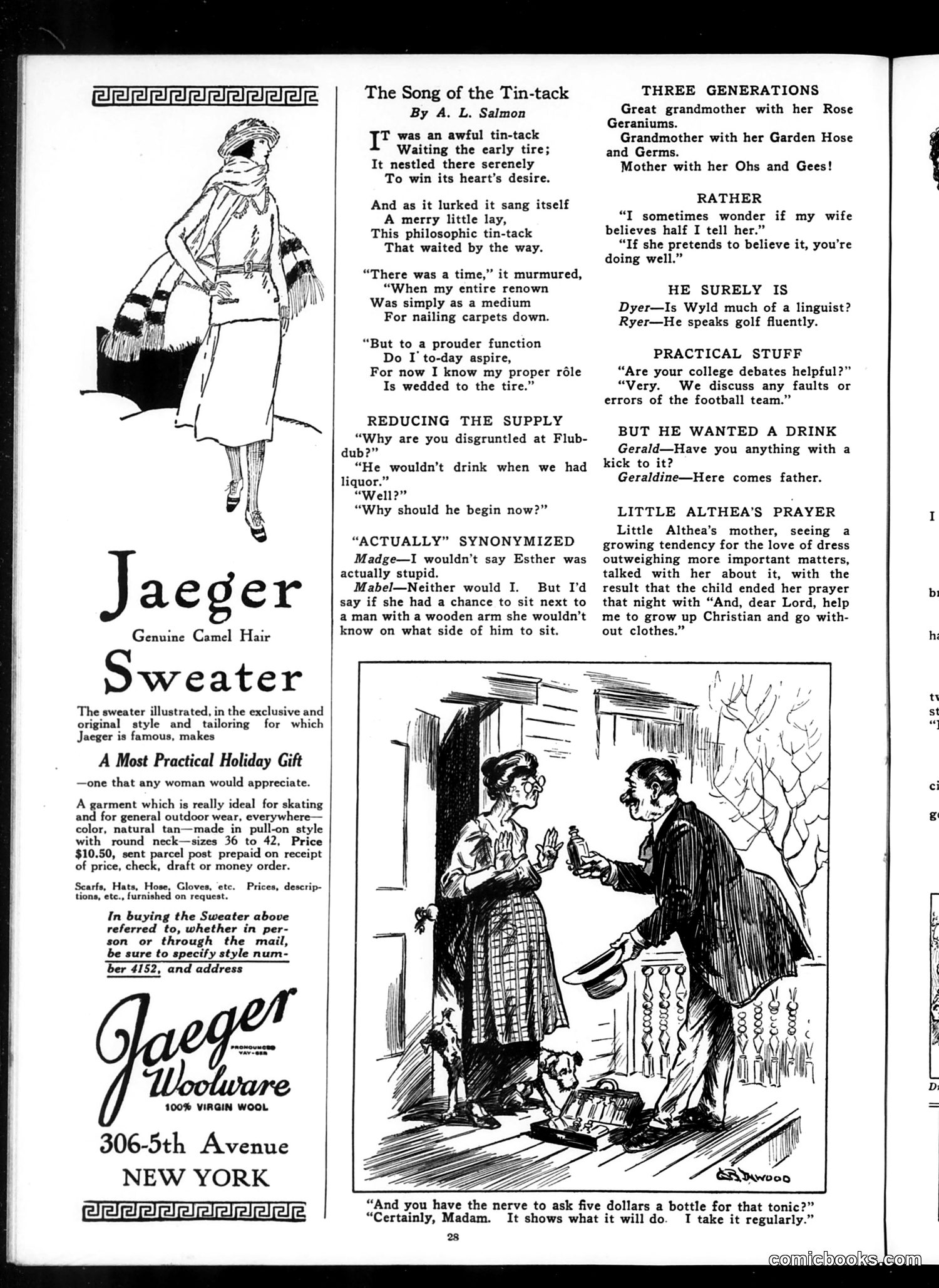
This page contains primarily **short humor pieces and advertisements** rather than political cartoons. The content reflects early 20th-century American social satire: **The cartoon** (bottom right) depicts a domestic scene where a woman confronts a man about charging five dollars for a tonic bottle, claiming it "shows what it will do." The joke suggests the tonic's effectiveness is demonstrated by the man's own appearance—implying he looks terrible despite using it regularly. **The humor pieces** mock various social behaviors: a tin-tack's philosophical musings about its purpose, marital skepticism, linguistic pretensions (speaking "golf fluently"), and a child's prayer about growing up Christian "without clothes" (satirizing parental vanity about children's dress). **The Jaeger advertisement** promotes camel-hair sweaters as practical holiday gifts for women, emphasizing outdoor wear and skating. The page represents **general domestic satire** common to Judge magazine—poking fun at middle-class pretensions, gender relations, and consumer culture—rather than addressing specific political events or figures.
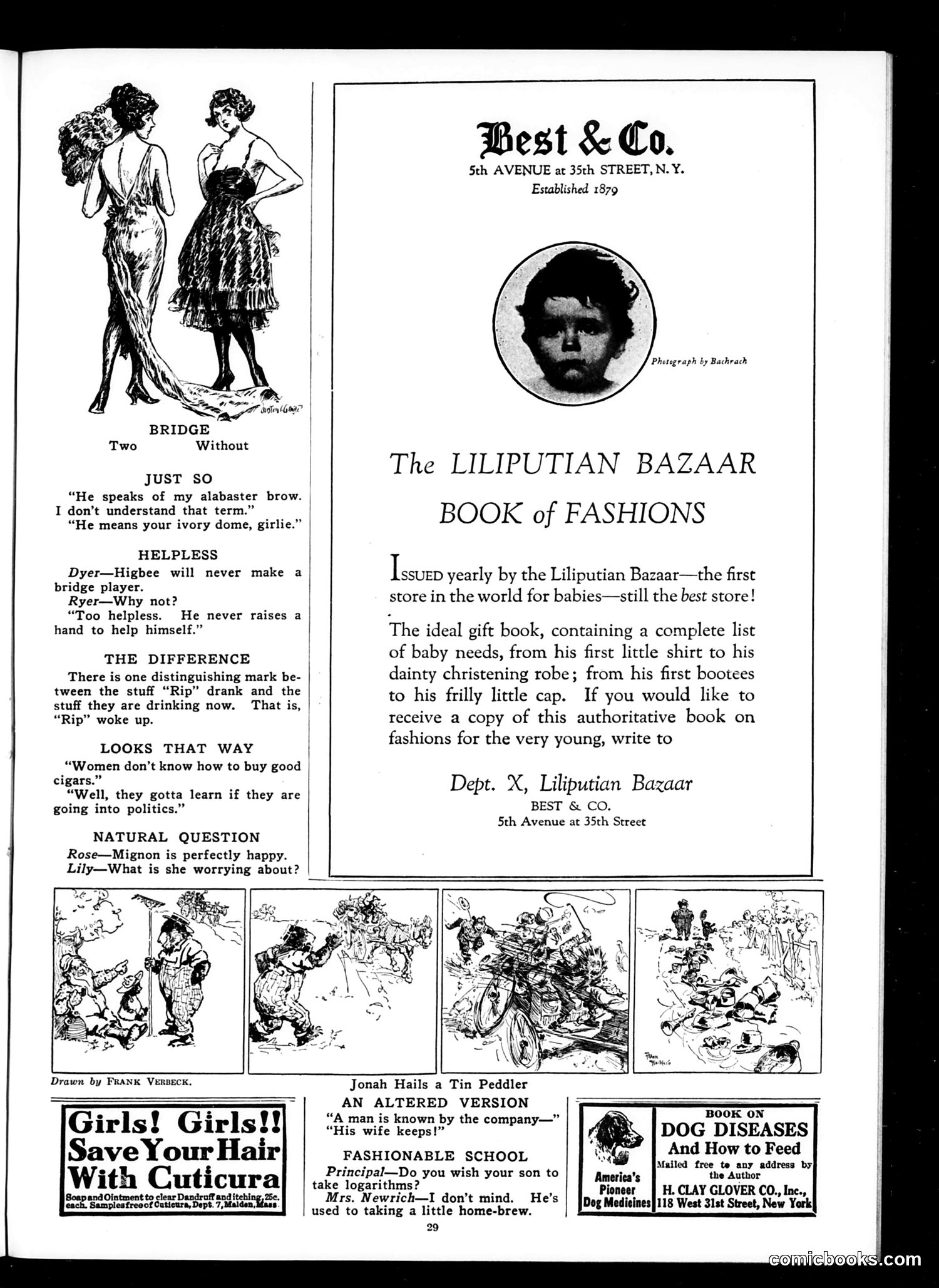
This page is primarily **advertising and promotional content** rather than political satire. It includes: **Main Advertisement:** Best & Co.'s "Liliputian Bazaar Book of Fashions"—a catalog for baby clothing, positioned as a gift book for new parents. **Humor Sections:** Several brief joke exchanges on the left side dealing with everyday life: bridge playing incompetence, the difference between old and new drinking habits (possibly referencing Prohibition-era "home-brew"), and women entering politics. These are generic social humor rather than specific political commentary. **Minor Jokes:** A Frank Verbeck comic strip titled "Jonah Hails a Tin Peddler" (illustrative, meaning unclear from image alone), and a "Fashionable School" joke about teaching logarithms to a woman uninterested in academics. **Other Ads:** Hair care product, dog disease book. The page reflects early 20th-century consumer culture and gentle domestic humor, with no identifiable political figures or sharp satirical targets visible.
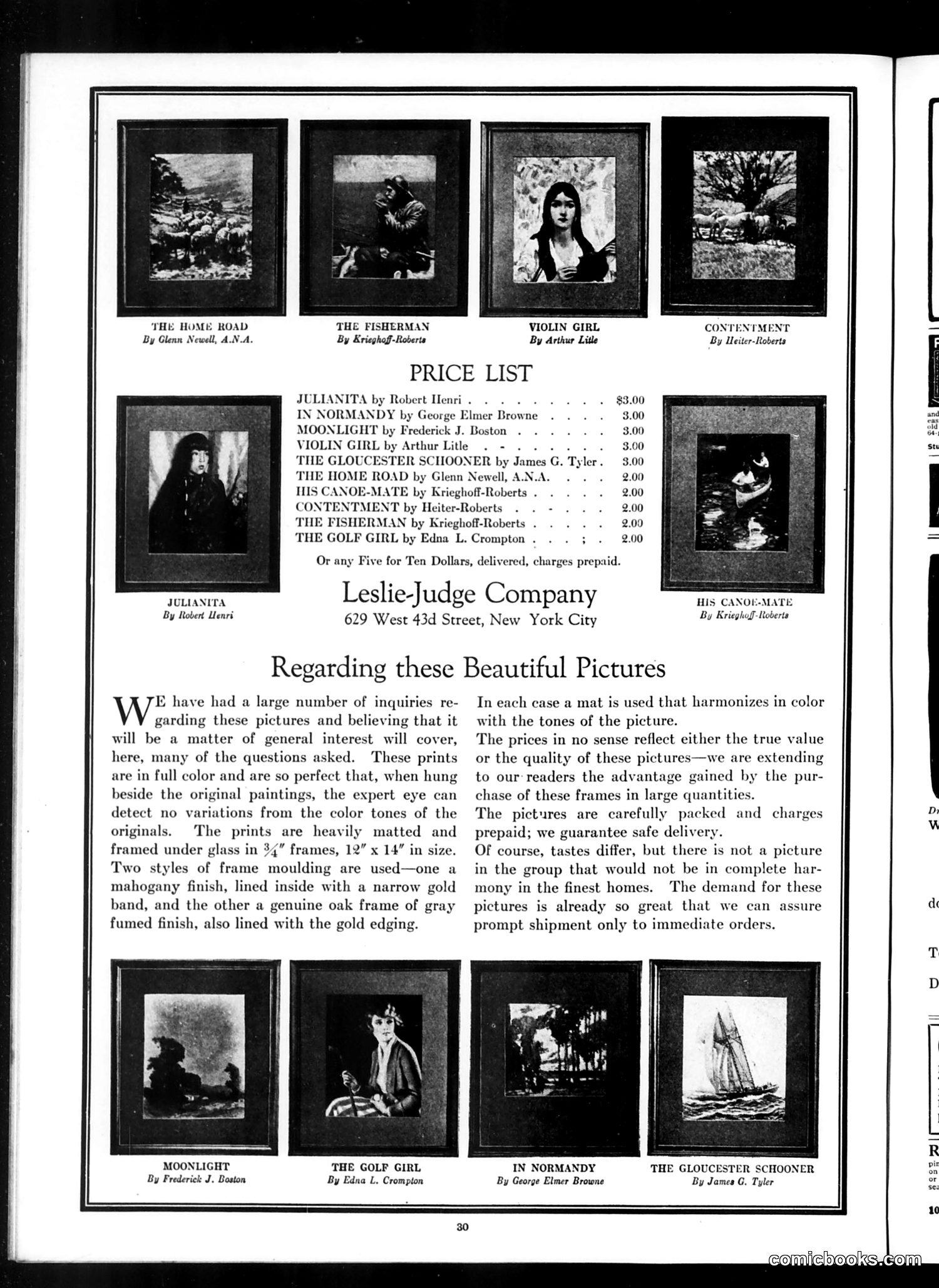
This is **not a political cartoon page**—it's a commercial advertisement for the Leslie-Judge Company, a New York picture frame and print seller (located at 629 West 43d Street). The page showcases eight framed artworks available for purchase, ranging from $2.00 to $3.00 each. The images depicted are romantic or picturesque scenes: landscapes, portraits of young women ("Violin Girl," "Golf Girl"), maritime scenes ("The Gloucester Schooner"), and rural subjects ("The Home Road," "In Normandy"). The accompanying text emphasizes quality—claiming the color prints are so perfect they're indistinguishable from original paintings—and describes the framing options (mahogany or oak frames with gold edging). A bulk discount is offered: five prints for ten dollars. The appeal is to middle-class home decorators seeking affordable, aesthetically refined art reproductions. This represents early 20th-century mass-market commercialism targeting domestic interior decoration.
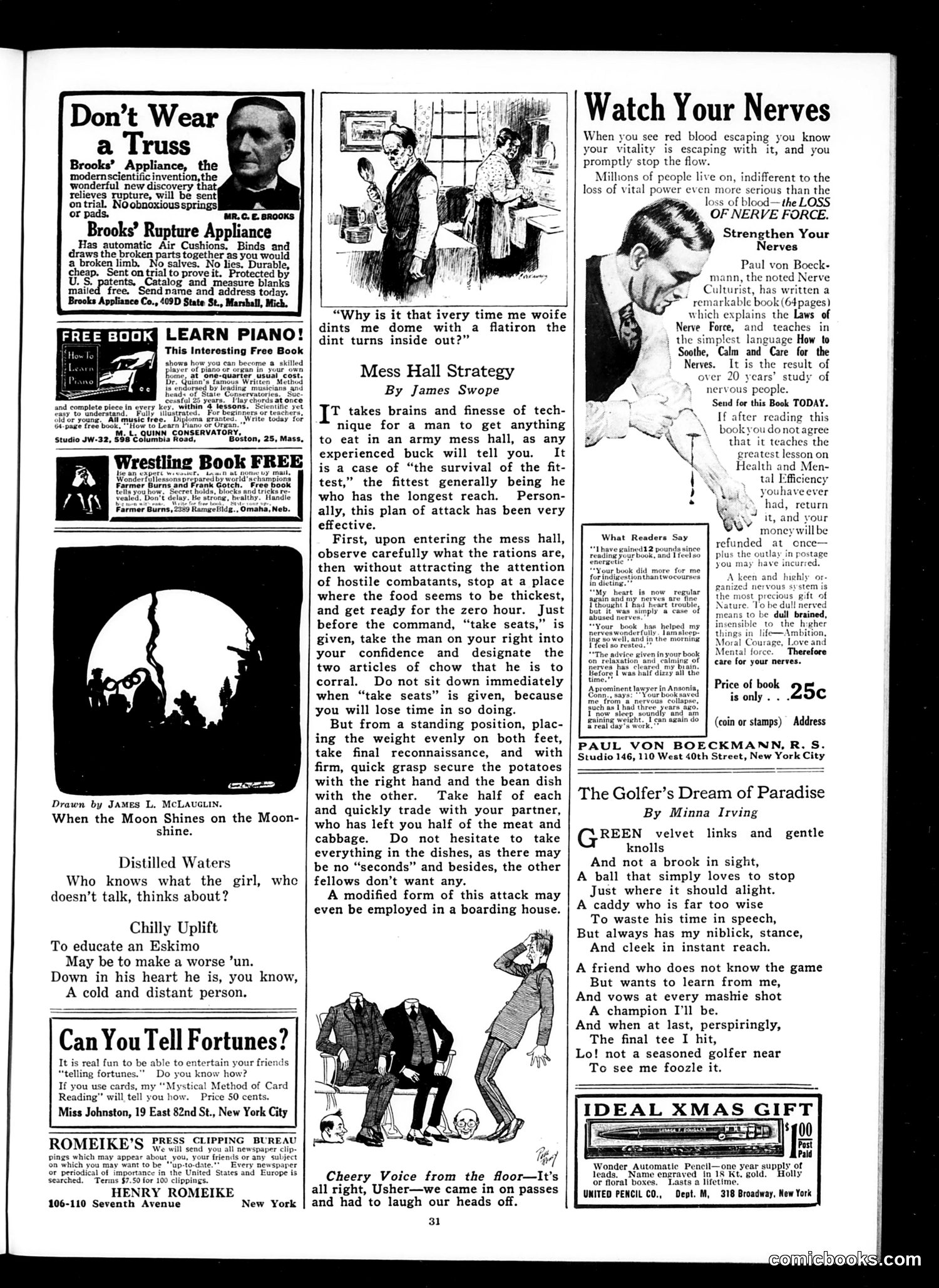
This is primarily an **advertising page** from *Judge* magazine, not a satirical cartoon page. The content consists mainly of mail-order ads typical of early 20th-century publications. Notable ads include: - **Brooks' Rupture Appliance**: Promotes a medical device (truss) for hernia treatment, claiming to be modern and superior to spring-based designs - **"Mess Hall Strategy"**: A humorous article with military illustration about competitive eating tactics in army dining halls—a relatable joke about scarce food and soldier behavior - **Self-improvement courses**: Piano lessons, fortune-telling instruction, and Paul von Boeckmann's nerve-strengthening book The few jokes scattered throughout ("Why is it that every time me wife dints me dome with a flatiron...") are unrelated ethnic humor and puns typical of the era's entertainment style. The page reflects early 1900s American consumer culture targeting readers seeking personal improvement, medical solutions, and entertainment instruction.
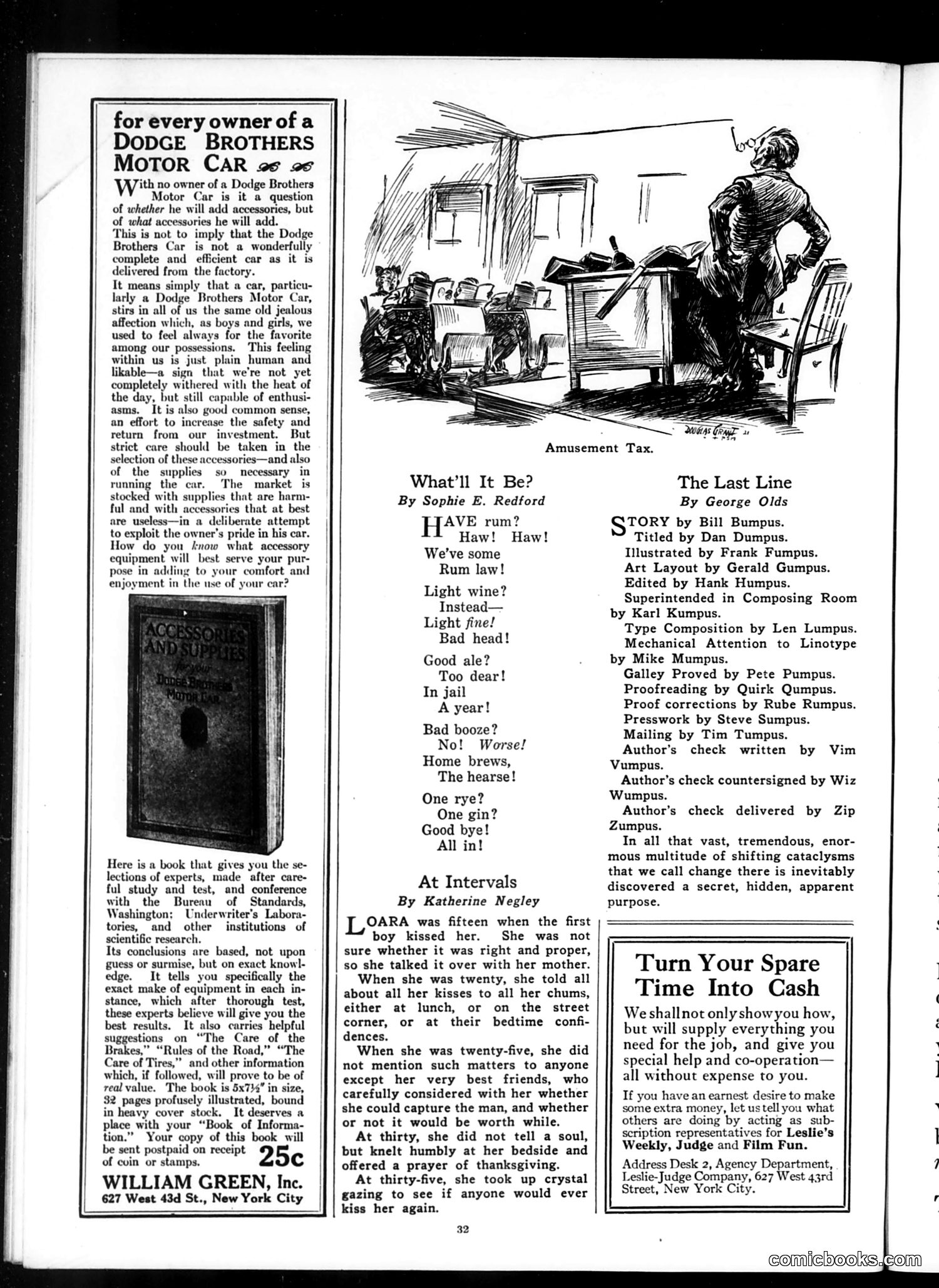
This page primarily contains **advertising and light humor** rather than political satire. The dominant content is a **Dodge Brothers automobile advertisement** promoting accessories—the ad argues that while Dodge cars are complete vehicles, owners naturally want to customize them, and recommends a 25-cent illustrated guide to proper accessories selection. The cartoon titled "Amusement Tax" (upper right) appears to satirize **Prohibition-era alcohol taxes**. The sketch shows a woman confronting a man about drink options—the poem "What'll It Be?" by Sophie E. Redford lists increasingly absurd alcohol choices (rum, wine, ale, gin) with comedic consequences (jail, the hearse), mocking how Prohibition made obtaining alcohol difficult or drove people to dangerous homemade brews. "At Intervals" by Katherine Negley is a humorous piece about how women's attitudes toward romantic kissing change across decades—serious at 15, casual at 20, secretive at 25, prayerful at 30, desperate at 35. "The Last Line" credits appear to be an in-joke listing absurdly rhyming names. Overall: **advertising-heavy with light social humor**, no significant political commentary.
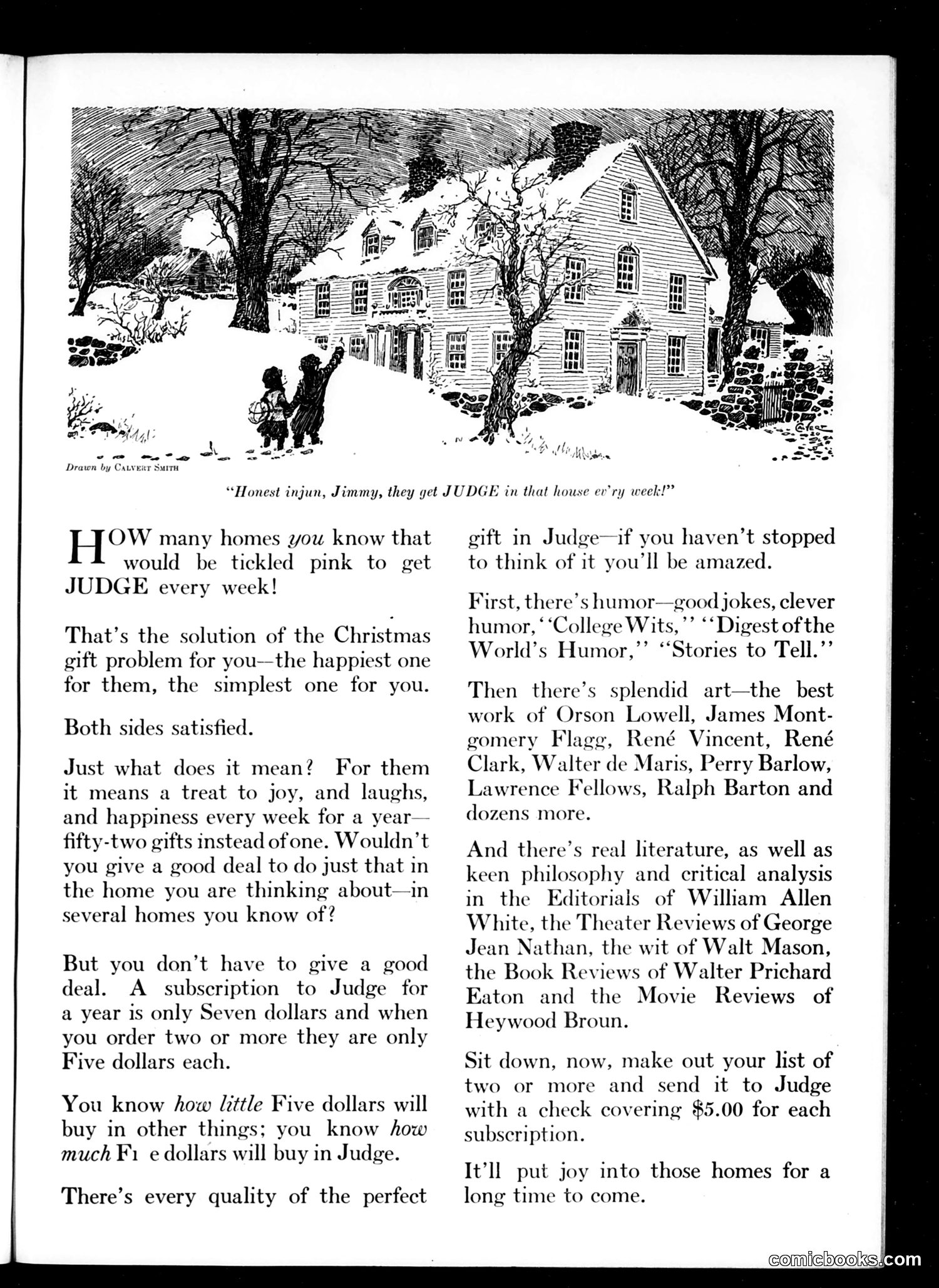
This is a Christmas gift advertisement for **Judge**, a satirical weekly magazine. The cartoon shows two children discussing a neighbor's weekly delivery of Judge, establishing the premise that receiving the magazine regularly constitutes an ideal gift. The ad promotes Judge subscriptions as superior to single gifts because they provide "fifty-two gifts instead of one"—weekly issues throughout the year at $5-7 per subscription. It emphasizes the magazine's quality content: humor columns, artwork by prominent illustrators (James Montgomery Flagg, Ralph Barton, René Vincent, et al.), and serious literary/critical contributions from respected writers like William Allen White and George Jean Nathan. The pitch appeals to gift-givers' desire to give meaningful presents affordably. For a modern reader, this reveals Judge's mid-market positioning—prestigious enough to feature major artists and intellectuals, yet marketed as economical gift-giving. The "honest injun" phrase in the cartoon reflects period vernacular now considered offensive.
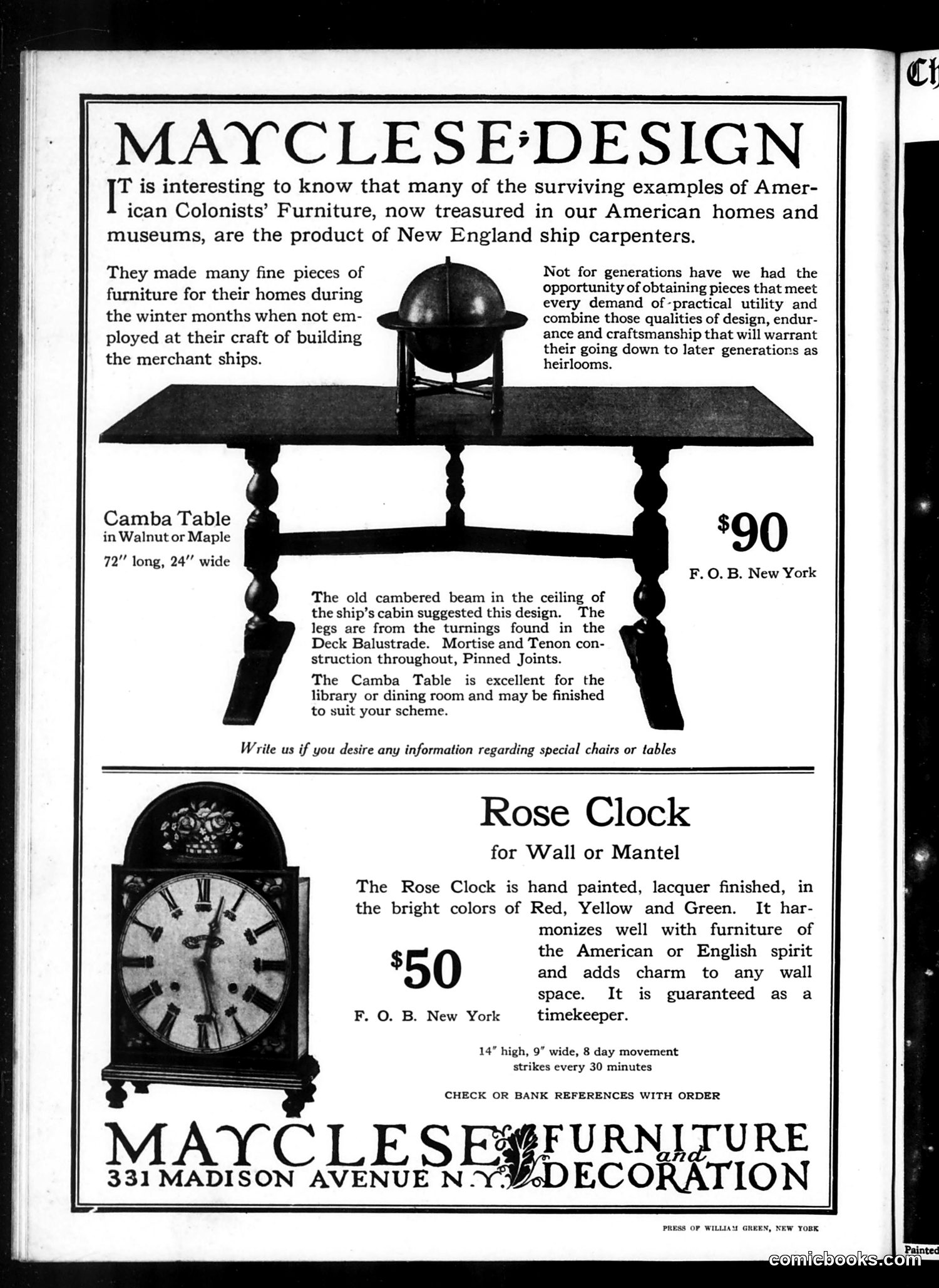
This is **not a political cartoon or satire**—it's a furniture advertisement page from Judge magazine. The page promotes two items from Mayclese Furniture and Decoration (331 Madison Avenue, NYC): 1. **Camba Table** ($90): A dining/library table inspired by New England colonial shipbuilding. The design references ship carpentry details—the legs derive from deck balustrade turnings, and the cambered beam echoes ship cabin ceilings. The ad appeals to American nostalgia and craftsmanship heritage. 2. **Rose Clock** ($50): A hand-painted wall or mantel clock in "bright colors of Red, Yellow and Green," marketed as complementing American or English colonial décor. The advertisement's framing—emphasizing that colonial American furniture was crafted by ship carpenters during off-seasons—taps into period enthusiasm for Colonial Revival aesthetics and American-made heritage goods. This reflects early 20th-century consumer preference for "authentic" colonial design as status markers and heirlooms.