
Judge, 1921-12-10 · page 9 of 36
Judge — December 10, 1921 — page 9: what you’re looking at
What you’re looking at
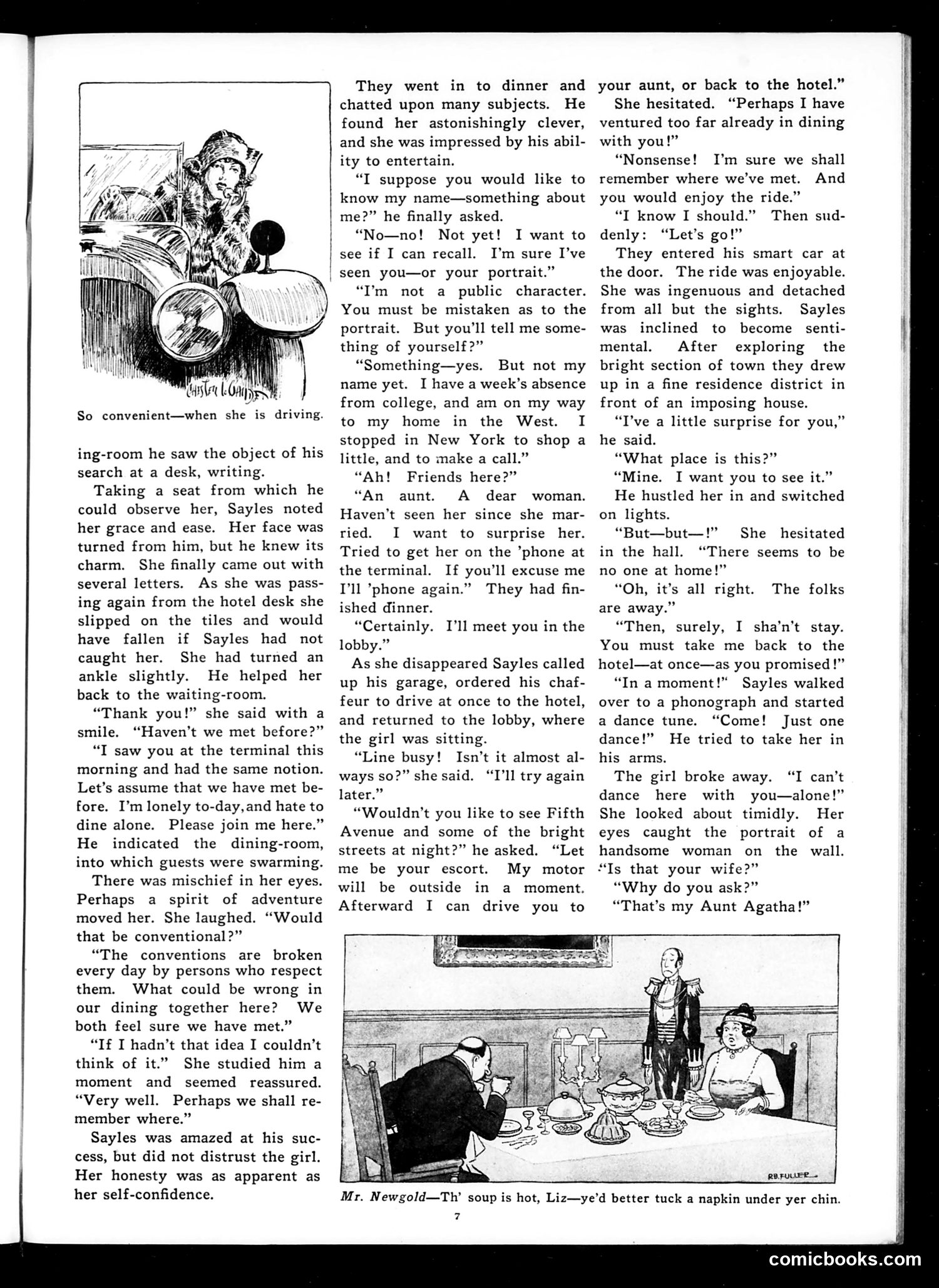
This story from *Judge* magazine satirizes early-20th-century courtship conventions and gender dynamics. The narrative depicts a man (Sayles) who orchestrates an elaborate seduction by feigning chance meetings with a college-aged woman traveling alone in New York City. The satire targets several social hypocrisies: Sayles cynically invokes "broken conventions" to justify dining with a stranger, while the woman accepts his arguments about propriety despite obvious red flags. Her college education and independence ("ingenuous and detached") contrast sharply with her naïveté about his true intentions. The bottom illustration shows a domestic scene—likely representing conventional family life—which ironically frames the main narrative's violation of those very conventions. The joke: respectable society claims to respect social rules while simultaneously flouting them. Sayles succeeds precisely because both parties convince themselves their behavior remains acceptable, even as he deliberately manipulates her into compromising situations—ultimately bringing her to his empty house after dark.
📄 Transcribed text from this page (OCR, searchable)
Machine-transcribed from the original scan — historical spelling and the odd misread are preserved.
So convenient—when she is driving. ing-room he saw the object of his search at a desk, writing. Taking a seat from which he could observe her, Sayles noted her grace and ease. Her face was turned from him, but he knew its charm. She finally came out with several letters. As she was pass- ing again from the hotel desk she slipped on the tiles and would have fallen if Sayles had not caught her. She had turned an ankle slightly. He helped her back to the waiting-room. “Thank you!” she said with a smile. “Haven’t we met before?” “T saw you at the terminal this morning and had the same notion. Let’s assume that we have met be- fore. I’m lonely to-day,and hate to dine alone. Please join me here.” He indicated the dining-room, into which guests were swarming. There was mischief in her eyes. Perhaps a spirit of adventure moved her. She laughed. “Would that be conventional?” “The conventions are broken every day by persons who respect them. What could be wrong in our dining together here? We both feel sure we have met.” “If I hadn’t that idea I couldn’t think of it.” She studied him a moment and seemed reassured. “Very well. Perhaps we shall re- member where.” Sayles was amazed at his suc- cess, but did not distrust the girl. Her honesty was as apparent as her self-confidence. | They went in to dinner and chatted upon many subjects. He found her astonishingly clever, and she was impressed by his abil- ity to entertain. “T suppose you would like to know my name—something about me?” he finally asked. “No—no! Not yet! I want to see if I can recall. I’m sure I’ve | seen you—or your portrait.” “I’m not a public character. You must be mistaken as to the portrait. But you'll tell me some- thing of yourself?” “Something—yes. But not my name yet. I have a week’s absence from college, and am on my way to my home in the West. I stopped in New York to shop a little, and to make a call.” “Ah! Friends here?” “An aunt. A dear woman. Haven't seen her since she mar- ried. I want to surprise her. Tried to get her on the ’phone at the terminal. If you'll excuse me I'll phone again.” They had fin- ished dinner. “Certainly. I'll meet you in the lobby.” As she disappeared Sayles called up his garage, ordered his chaf- feur to drive at once to the hotel, and returned to the lobby, where the girl was sitting. “Line busy! Isn’t it almost al- ways so?” she said. “I'll try again later.” “Wouldn’t you like to see Fifth Avenue and some of the bright streets at night?” he asked. “Let me be your escort. My motor will be outside in a moment. Afterward I can drive you to your aunt, or back to the hotel.” She hesitated. “Perhaps I have ventured too far already in dining with you!” “Nonsense! remember where we’ve met. you would enjoy the ride.” “T know I should.” Then sud- denly: “Let’s go!” They entered his smart car at the door. The ride was enjoyable. She was ingenuous and detached from all but the sights. Sayles was inclined to become senti- mental. After exploring the bright section of town they drew up in a fine residence district in front of an imposing house. “T’ve a little surprise for you,” he said. “What place is this?” “Mine. I want you to see it.” He hustled her in and switched on lights. “But—but—!” She hesitated in the hall. “There seems to be no one at home!” “Oh, it’s all right. are away.” “Then, surely, I sha’n't stay. You must take me back to the hotel—at once—as you promised!” “In a moment!" Sayles walked over to a phonograph and started I’m sure we shall And The folks a dance tune. “Come! Just one dance!” He tried to take her in his arms. The girl broke away. “I can’t dance here with you—alone!” She looked about timidly. Her eyes caught the portrait of a handsome woman on the wall. “Is that your wife?” “Why do you ask?” “That’s my Aunt Agatha!” Mr. Newgold—Th’ soup is hot, Liz—ye’d better tuck a napkin under yer chin. 7 comicbooks.com