
Judge, 1921-12-10 · page 17 of 36
Judge — December 10, 1921 — page 17: what you’re looking at
What you’re looking at
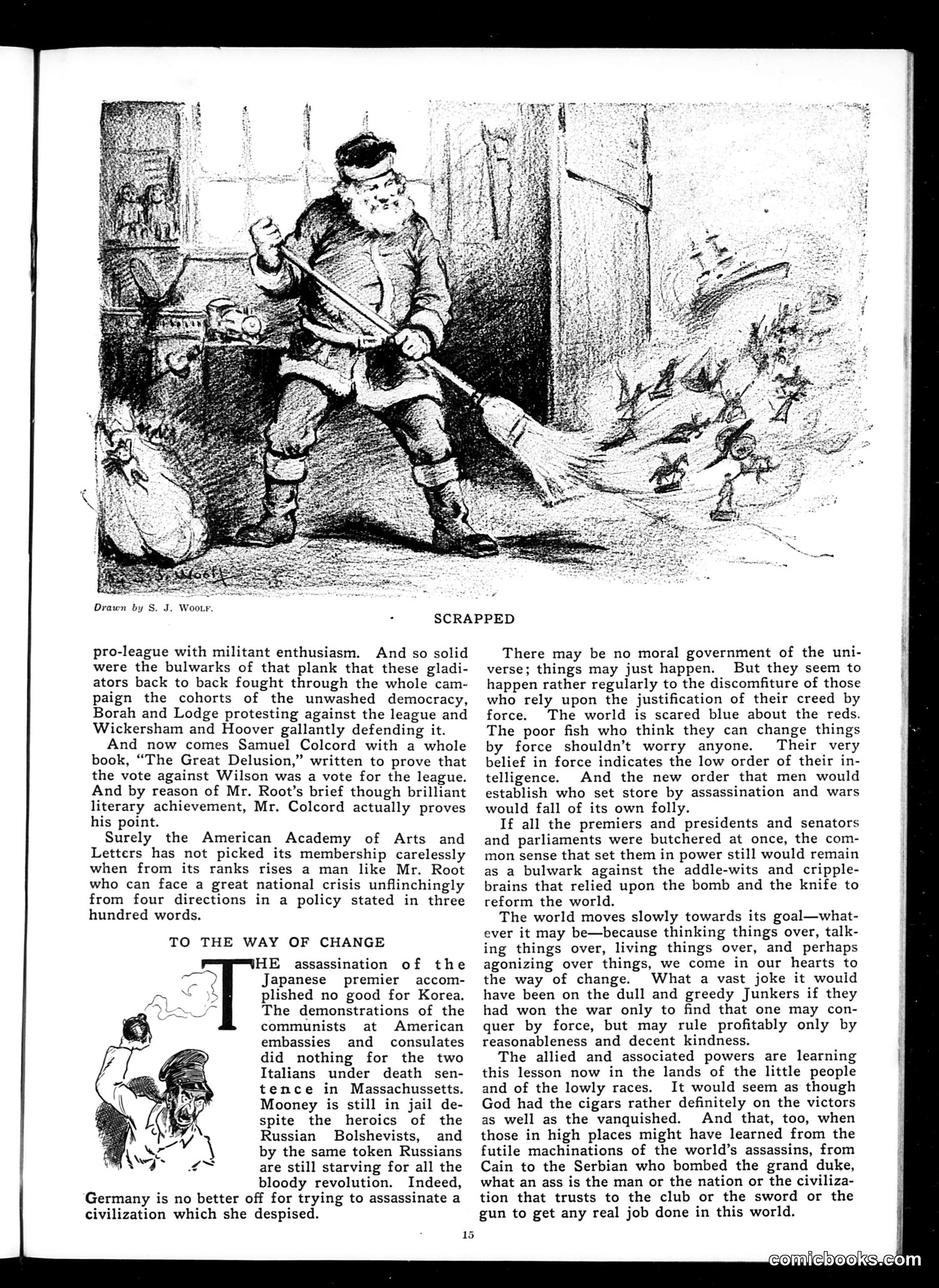
**The Cartoon ("Scrapped"):** Depicts a figure sweeping away tiny armed soldiers and military equipment, symbolizing the futility of military force and violence. **Main Argument:** The editorial attacks those who believe political change can be achieved through assassination and violent revolution. It references recent real events: the Japanese premier's assassination, demonstrations by communists, the imprisonment of Italians (likely Sacco and Vanzetti), labor activist Mooney's jail sentence, and the Russian Revolution—all presented as failures despite their violent methods. **The Point:** The author argues that force—whether assassination, war, or revolution—cannot produce lasting positive change. Only rational deliberation, dialogue, and "reasonableness and decent kindness" create genuine progress. Even military victory (referencing WWI's recent conclusion) proves hollow without moral governance. **Target:** Radical leftists and violent revolutionaries who believe force can remake society. The satire dismisses them as unintelligent and ultimately self-defeating, as history repeatedly demonstrates violence's ineffectiveness.
📄 Transcribed text from this page (OCR, searchable)
Machine-transcribed from the original scan — historical spelling and the odd misread are preserved.
Drawn by S. J. Woowr. pro-league with militant enthusiasm. And so solid were the bulwarks of that plank that these gladi- ators back to back fought through the whole cam- paign the cohorts of the unwashed democracy, Borah and Lodge protesting against the league and Wickersham and Hoover gallantly defending it. And now comes Samuel Colcord with a whole book, “The Great Delusion,” written to prove that the vote against Wilson was a vote for the league. And by reason of Mr. Root’s brief though brilliant literary achievement, Mr. Colcord actually proves his point. Surely the American Academy of Arts and Letters has not picked its membership carelessly when from its ranks rises a man like Mr. Root who can face a great national crisis unflinchingly from four directions in a policy stated in three hundred words. TO THE WAY OF CHANGE HE assassination of the Japanese premier accom- plished no good for Korea. The demonstrations of the communists at American embassies and _ consulates did nothing for the two Italians under death sen- tence in Massachussetts. Mooney is still in jail de- spite the heroics of the Russian Bolshevists, and by the same token Russians are still starving for all the bloody revolution. Indeed, Germany is no better off for trying to assassinate a civilization which she despised. SCRAPPED There may be no moral government of the uni- verse; things may just happen. But they seem to happen rather regularly to the discomfiture of those who rely upon the justification of their creed by force. The world is scared blue about the reds. The poor fish who think they can change things by force shouldn’t worry anyone. Their very belief in force indicates the low order of their in- telligence. And the new order that men would establish who set store by assassination and wars would fall of its own folly. If all the premiers and presidents and senators and parliaments were butchered at once, the com- mon sense that set them in power still would remain as a bulwark against the addle-wits and cripple- brains that relied upon the bomb and the knife to reform the world. The world moves slowly towards its goal—what- ever it may be—because thinking things over, talk- ing things over, living things over, and perhaps agonizing over things, we come in our hearts to the way of change. What a vast joke it would have been on the dull and greedy Junkers if they had won the war only to find that one may con- quer by force, but may rule profitably only by reasonableness and decent kindness. The allied and associated powers are learning this lesson now in the lands of the little people and of the lowly races. It would seem as though God had the cigars rather definitely on the victors as well as the vanquished. And that, too, when those in high places might have learned from the futile machinations of the world’s assassins, from Cain to the Serbian who bombed the grand duke, what an ass is the man or the nation or the civiliza- tion that trusts to the club or the sword or the gun to get any real job done in this world.