
Judge, 1921-12-10 · page 23 of 36
Judge — December 10, 1921 — page 23: what you’re looking at
What you’re looking at
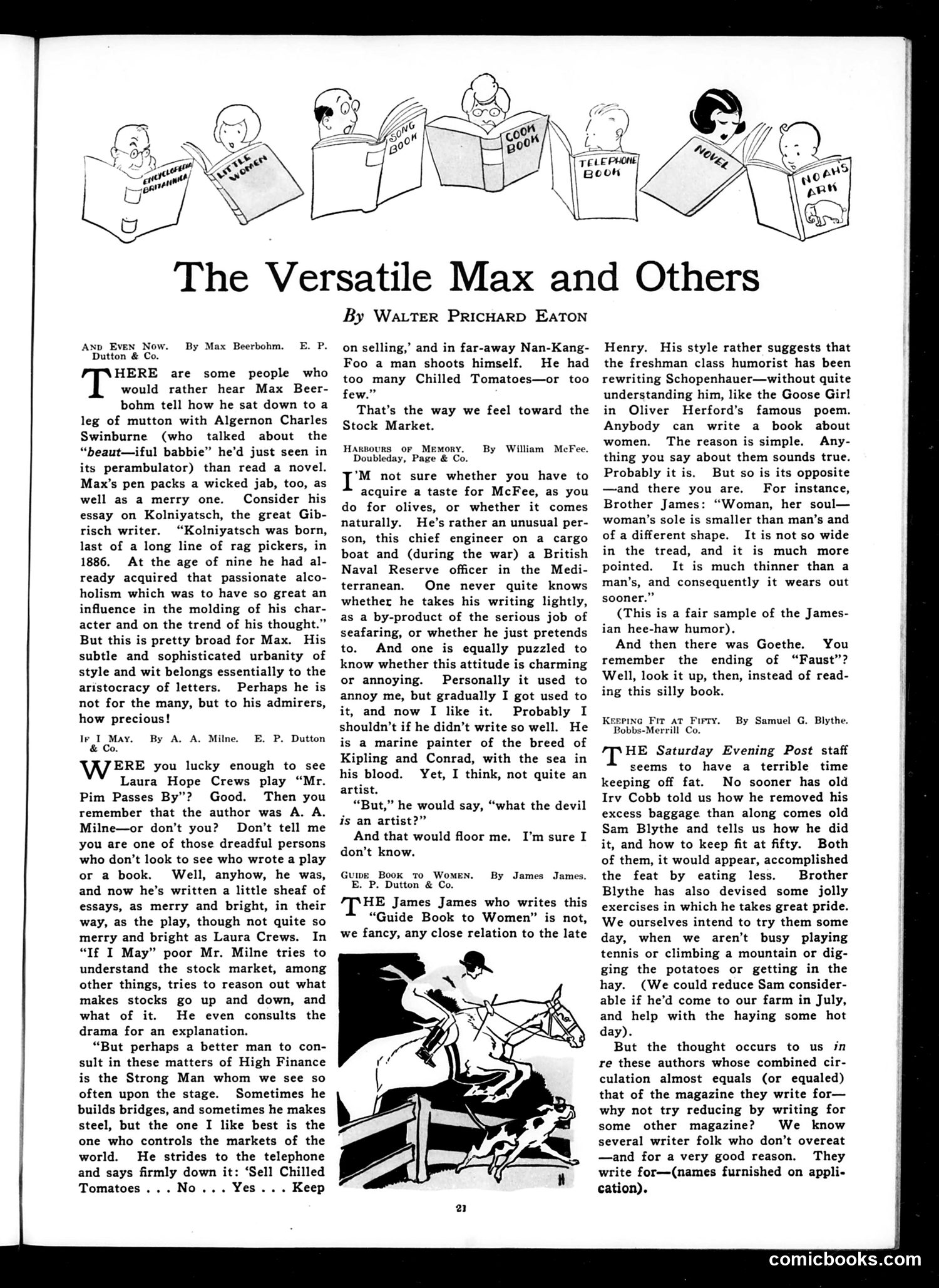
This page contains literary reviews by Walter Prichard Eaton, not political cartoons. The header illustration shows various readers with different books, humorously depicting diverse reading preferences. The reviews discuss four contemporary books: 1. **Max Beerbohm's essays** - praised for witty, sophisticated style appealing to literary elites 2. **A.A. Milne's essays** - humorous attempts to understand stock markets and finance, with the reviewer using Milne's joke about controlling tomato sales to satirize how absurdly stock markets respond to trivial news 3. **William McFee's maritime memoir** - examining whether his casual writing style masks serious artistry 4. **James James's "Guide Book to Women"** - mocked as freshman-level humor suggesting anything said about women sounds true because its opposite is equally true The satire targets both the books' subjects (stock market irrationality, gender stereotypes) and literary pretension. This reflects 1920s urban sophistication about finance, literature, and gender relations.
📄 Transcribed text from this page (OCR, searchable)
Machine-transcribed from the original scan — historical spelling and the odd misread are preserved.
AND EveN Now. By Max Beerbohm. E. P. Dutton & Co. HERE are some people who would rather hear Max Beer- bohm tell how he sat down to a leg of mutton with Algernon Charles Swinburne (who talked about the “beaut—iful babbie” he’d just seen in its perambulator) than read a novel. Max’s pen packs a wicked jab, too, as well as a merry one. Consider his essay on Kolniyatsch, the great Gib- risch writer. “Kolniyatsch was born, last of a long line of rag pickers, in 1886. At the age of nine he had al- ready acquired that passionate alco- holism which was to have so great an influence in the molding of his char- acter and on the trend of his thought.” But this is pretty broad for Max. His subtle and sophisticated urbanity of style and wit belongs essentially to the aristocracy of letters. Perhaps he is not for the many, but to his admirers, how precious! Ir I May. By A. A. Milne. E, P. Dutton ‘o. WERE you lucky enough to see Laura Hope Crews play “Mr. Pim Passes By”? Good. Then you remember that the author was A. A. Milne—or don’t you? Don’t tell me you are one of those dreadful persons who don’t look to see who wrote a play or a book. Well, anyhow, he was, and now he’s written a little sheaf of essays, as merry and bright, in their way, as the play, though not quite so merry and bright as Laura Crews. In “If I May” poor Mr. Milne tries to understand the stock market, among other things, tries to reason out what makes stocks go up and down, and what of it. He even consults the drama for an explanation. “But perhaps a better man to con- sult in these matters of High Finance is the Strong Man whom we see so often upon the stage. Sometimes he builds bridges, and sometimes he makes steel, but the one I like best is the one who controls the markets of the world. He strides to the telephone and says firmly down it: ‘Sell Chilled Tomatoes . ..No... Yes... Keep The Versatile Max and Others By Wa ter PRICHARD EATON on selling,’ and in far-away Nan-Kang- Foo a man shoots himself. He had too many Chilled Tomatoes—or too few.” That’s the way we feel toward the Stock Market. Harpours oF Memory. William McFee. Doubleday, Page & Co. [™ not sure whether you have to acquire a taste for McFee, as you do for olives, or whether it comes naturally. He’s rather an unusual per- son, this chief engineer on a cargo boat and (during the war) a British Naval Reserve officer in the Medi- terranean. One never quite knows whether he takes his writing lightly, as a by-product of the serious job of seafaring, or whether he just pretends to. And one is equally puzzled to know whether this attitude is charming or annoying. Personally it used to annoy me, but gradually I got used to it, and now I like it. Probably I shouldn’t if he didn’t write so well. He is a marine painter of the breed of Kipling and Conrad, with the sea in his blood. Yet, I think, not quite an artist. “But,” he would say, “what the devil is an artist?” And that would floor me. don’t know. By I'm sure I Guwe_ Book to Women. E. P. Dutton & Co. r[THE James James who writes this “Guide Book to Women” is not, we fancy, any close relation to the late By James James. Henry. His style rather suggests that the freshman class humorist has been rewriting Schopenhauer—without quite understanding him, like the Goose Girl in Oliver Herford’s famous poem. Anybody can write a book about women. The reason is simple. Any- thing you say about them sounds true. Probably it is. But so is its opposite —and there you are. For instance, Brother James: “Woman, her soul— woman’s sole is smaller than man’s and of a different shape. It is not so wide in the tread, and it is much more pointed. It is much thinner than a man’s, and consequently it wears out sooner.” (This is a fair sample of the James- ian hee-haw humor). And then there was Goethe. You remember the ending of “Faust”? Well, look it up, then, instead of read- ing this silly book. Keepine Fit at Firty, By Samuel G. Blythe. Bobbs-Merrill Co. (PHE Saturday Evening Post staff seems to have a terrible time keeping off fat. No sooner has old Irv Cobb told us how he removed his excess baggage than along comes old Sam Blythe and tells us how he did it, and how to keep fit at fifty. Both of them, it would appear, accomplished the feat by eating less. Brother Blythe has also devised some jolly exercises in which he takes great pride. We ourselves intend to try them some day, when we aren’t busy playing tennis or climbing a mountain or dig- ging the potatoes or getting in the hay. (We could reduce Sam consider- able if he’d come to our farm in July, and help with the haying some hot day). But the thought occurs to us in re these authors whose combined cir- culation almost equals (or equaled) that of the magazine they write for— why not try reducing by writing for some other magazine? We know several writer folk who don’t overeat —and for a very good reason. They write for—(names furnished on appli- cation). comicbooks.com